OUR LAST DAY IN NDUTU, BLOG 14, APRIL 15TH 2020
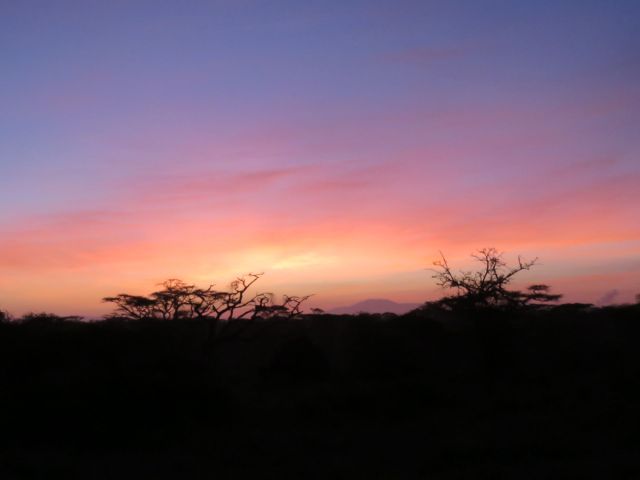
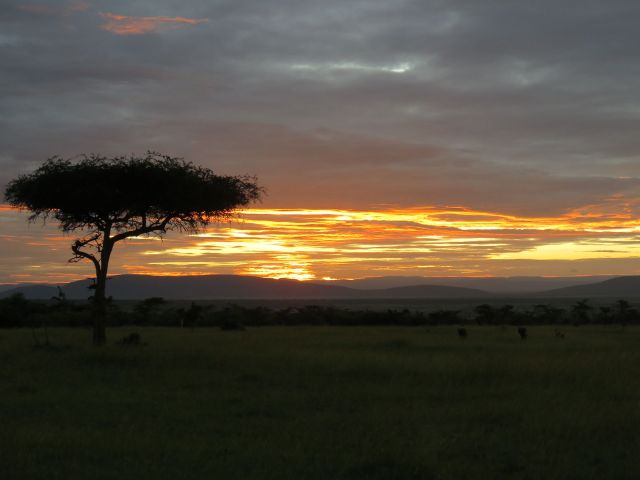
Paul and I are up early as usual and having breakfast at six. There is a place set for Alex but he doesn’t show up while we are eating. We thank the staff for the tasty breakfast before we leave with George for our morning game drive. Not to be redundant but we have another stunning sunrise to start the morning.

Another wonderful sunrise
George tells us as we are leaving camp that a leopard has been found in a tree near Lake Ndutu and he asks if we want to go see the big cat. He adds that every vehicle in the area will be there. Paul hesitates and then replies that since we were so fortunate to see a leopard in the Serengeti that we will pass. I totally agree, being part of a traffic jam to start the day has no appeal for me.
I’m certain that George is very happy with our decision. George then maps out his plan for our morning which is to drive to the Hidden Valley via the Big Marsh. The Hidden Valley is the beautiful vista that was spread out below us when we climbed Naabi Hill. Great, let’s go!
When we arrive at the Big Marsh, George scouts the area hoping to find the lion pride that claims the marsh as their territory but there are no big cats to be found. In fact, there is nothing here in the way of four-legged wildlife at all which is very surprising. We do see some flamingos wading in some shallow water.

A greater and lesser flamingo in the early morning light
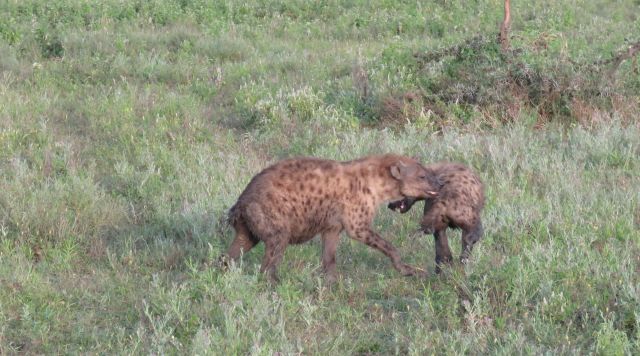
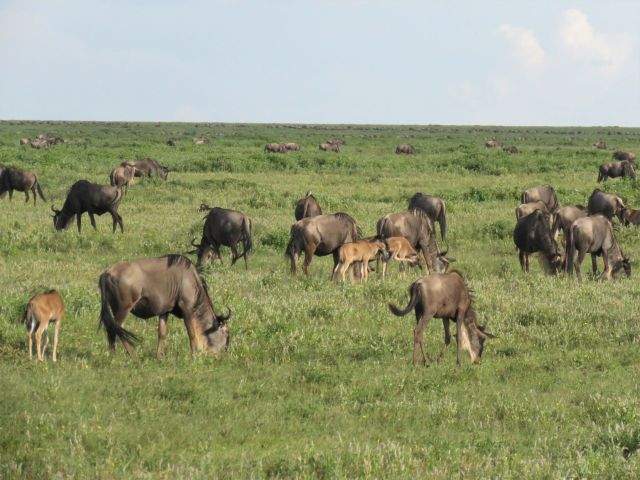
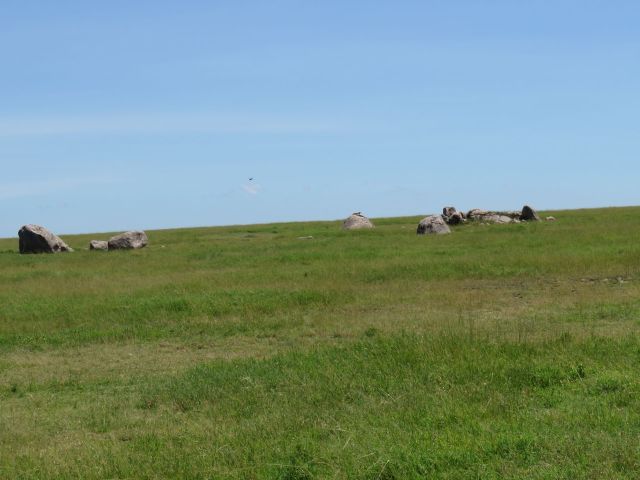
Once we are up on the plateau it is a relief to find that we aren’t facing the high winds of yesterday, at least not yet. That means George won’t have to rescue Paul’s hat today like he did yesterday when the wind blew Paul’s hat off his head and deposited it on the ground. We are heading in the opposite direction of the colossal wildebeest herd and the road we are driving weaves in and out of the stone markers that establish Ndutu’s and Serengeti’s border. We catch a glimpse of a hyena, a smattering of wildebeest, and a pair of jackals on our journey. Right before we start our descent into the valley, we encounter a few zebras.

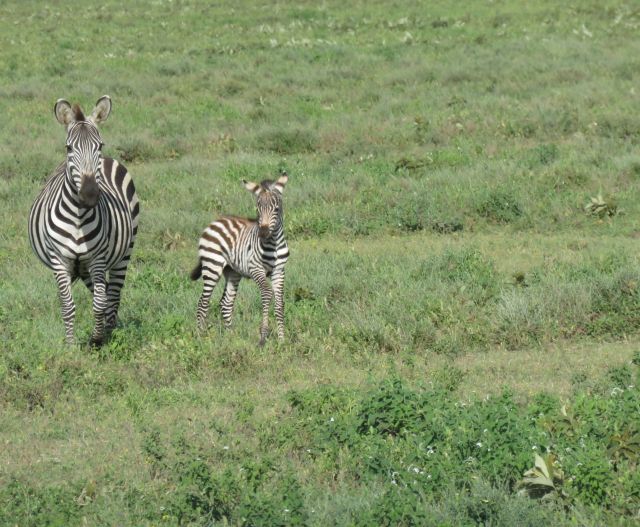
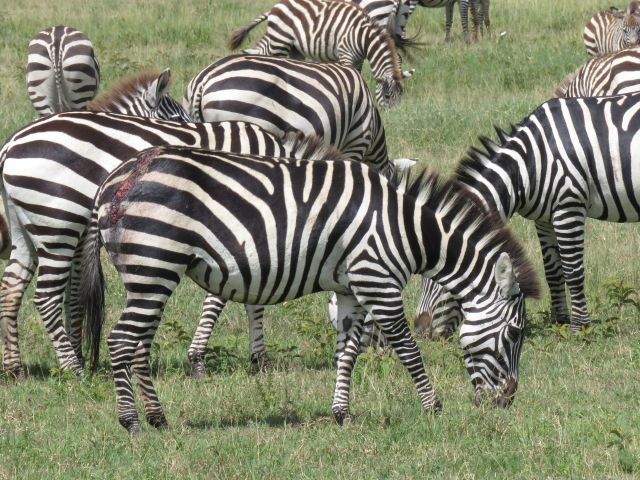
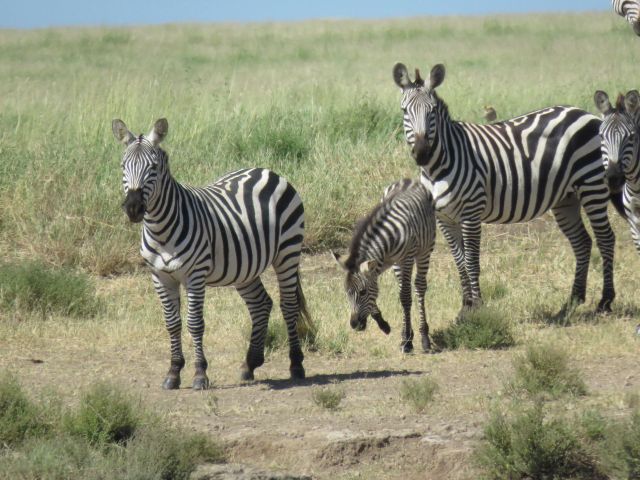
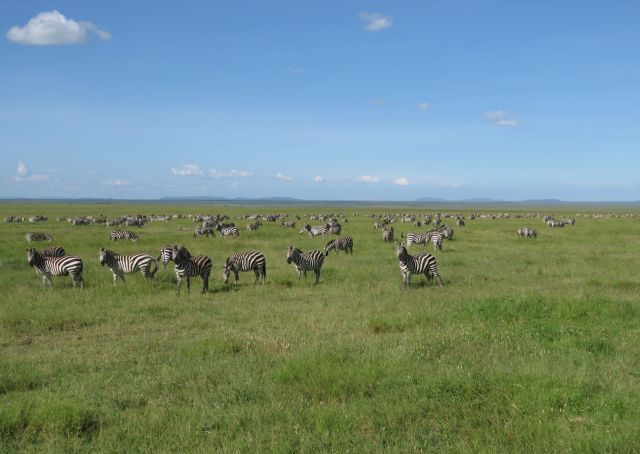
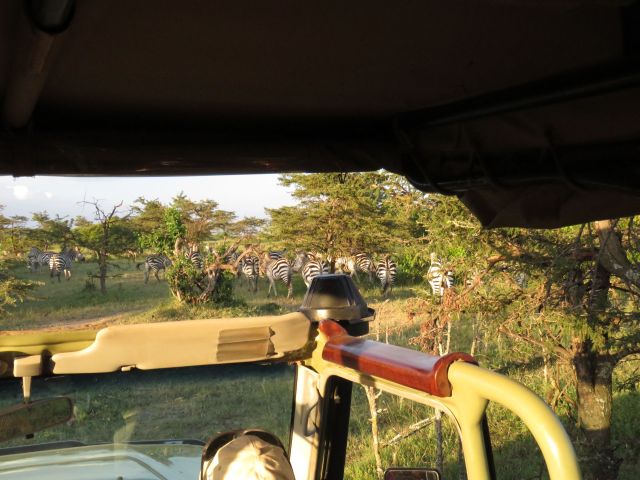
This is a zebra photo from the day before. Never took any photos of the ones we saw today. Enjoy another baby zebra
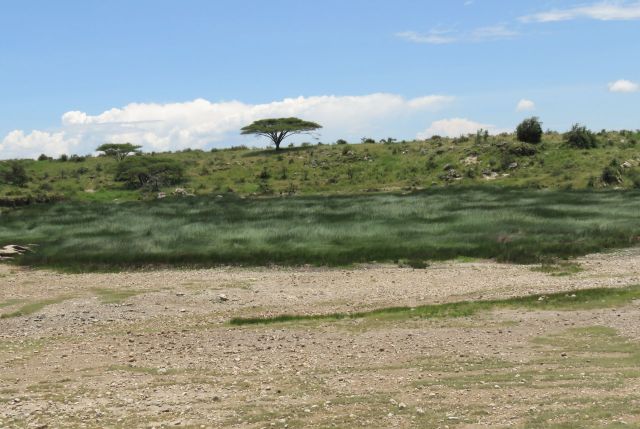
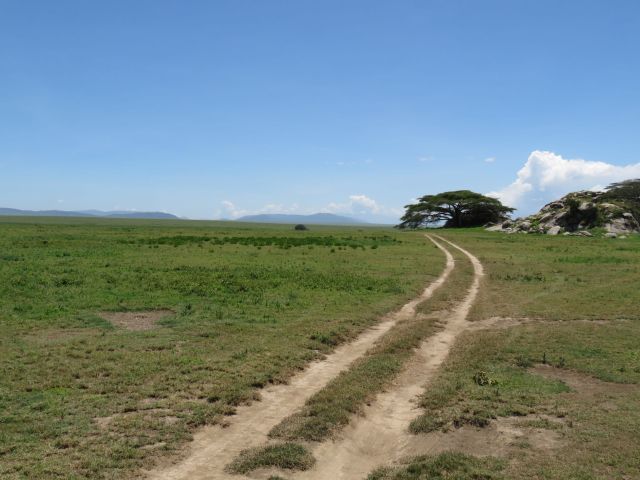
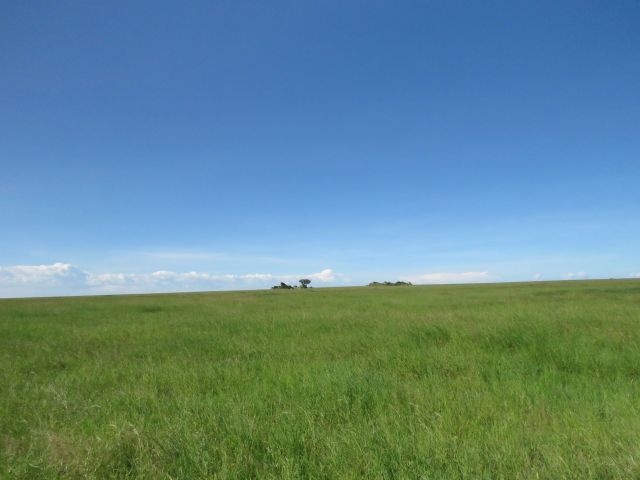
As we drop down into the valley, we find ourselves in a sea of rippling grass as high as what we encountered in the Mara Reserve. George looks over the expanse of land before us and remarks that the valley is empty. Yes it is, there is not an animal in sight for as far as we can see. Even so the lush valley is beautiful to look at. George points out the distant Naabi Hill on the horizon.
George cruises by a small lake where we can hear hippo’s grunting, sounding very much like hogs. There is raptor perched on a dirt clump ahead of us and George stops the truck. He doesn’t recognize the bird, so George consults one of his bird books where he and I go over the obvious markings. Leg color, beak color, eye color, pattern on chest, tail, etc. We are fairly sure it is a harrier but can’t make a positive id as nothing completely fits the patient bird. George grabs another bird book and I look through the first one again. We both shake our head in frustration and agree that it must be an immature harrier but we are unable to get beyond that. I take a few photos of the young raptor and when I get home, I will examine my East African bird book, which is different than the guides George owns.
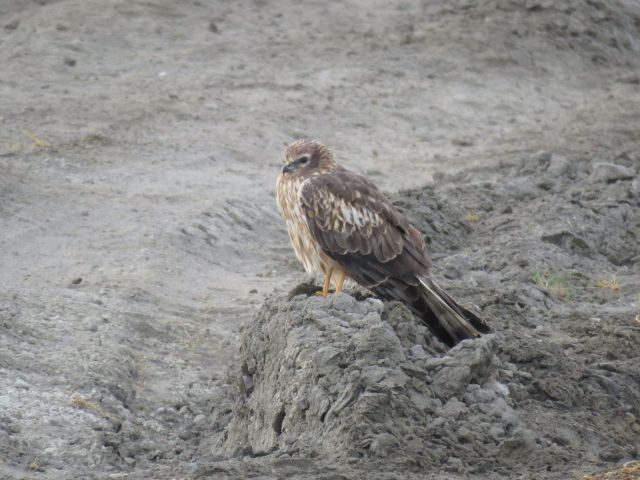
Our mystery raptor. I think it is an immature African Harrier Hawk
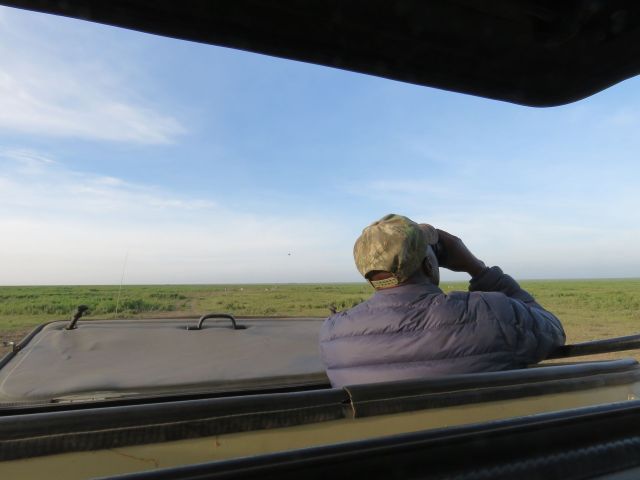
As we are leaving the valley, we notice a lone safari vehicle across a ravine from us. Using our binoculars, we can see that the occupants of the vehicle are watching a male lion resting in the grass. George begins to pick his way across the big ditch as another vehicle farther down from us is attempting to do the same. I’m sure the people who found the lion are mumbling about the interlopers coming to join them😊.
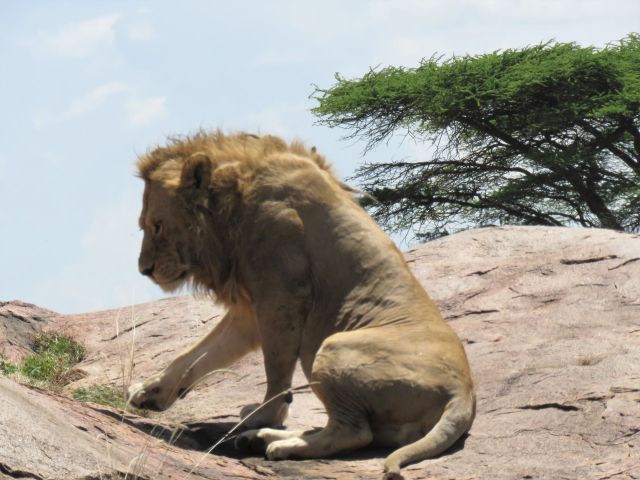
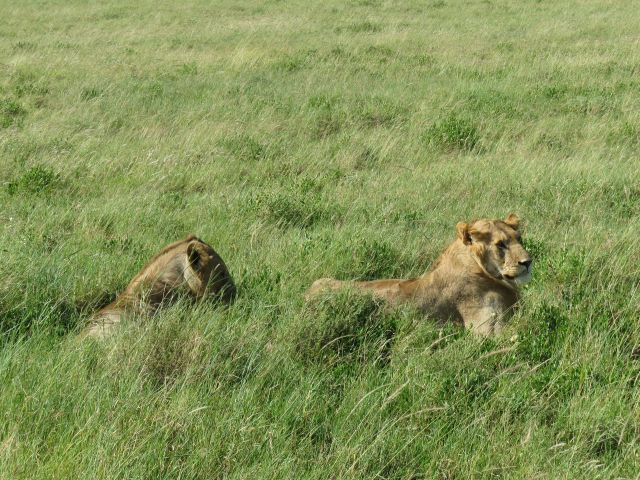
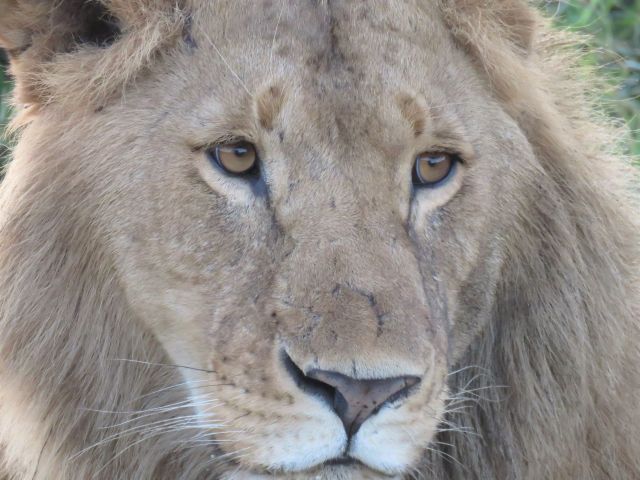
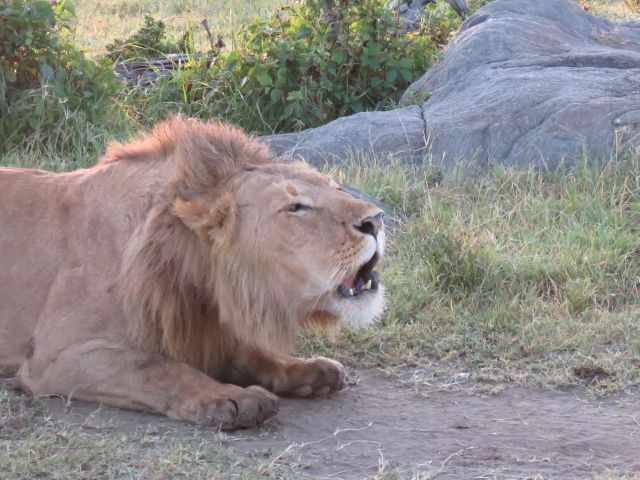
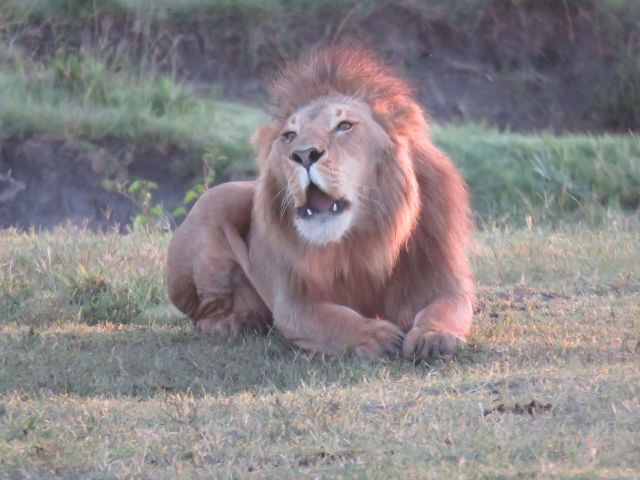
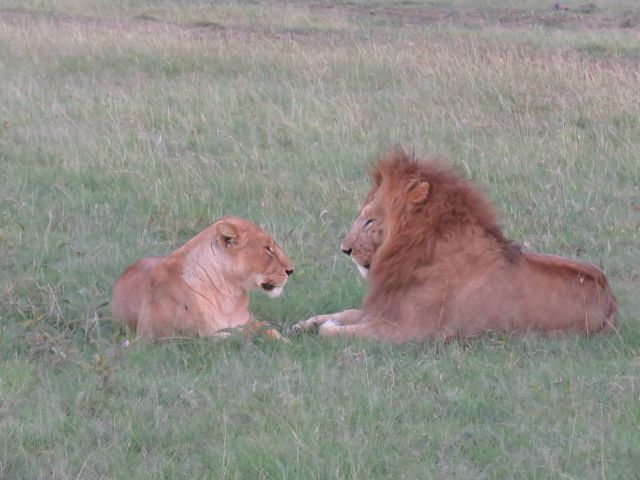
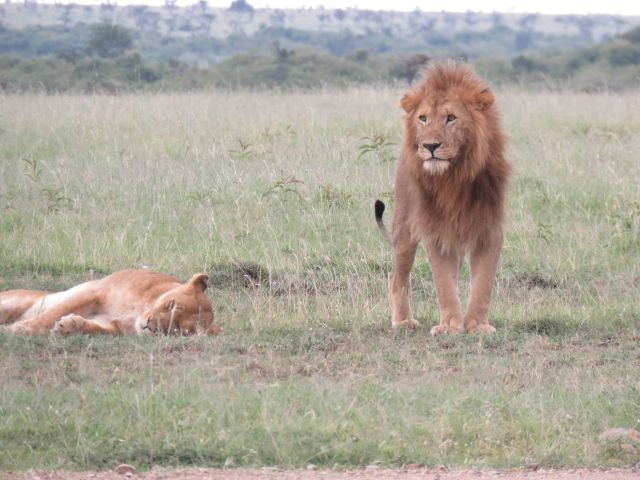
When we arrive, we see that there are two male lions and a female lion. Hmm. The handsome dark-maned male is lying near the lioness who is curled up like a housecat, while the old (his nose is completely black), scruffy fellow is a few paces away from the pair. Occasionally the old lion lifts his head and sniffs the air, probably smelling the scent of the female. The timeworn cat occasionally coughs which makes us wonder if he is sick although he does groom himself which is a good sign. David and Useph had told us that there have been three male lions succumb to a disease recently and themselves and other researchers plus veterinarians haven’t identified the sickness. I don’t think all the lions that died due to the unidentified disease were in Ndutu.

Lion and lioness that must be mating partners

Old lion sniffing the air
The dark-maned male collapses onto his side and soon he is sound asleep. Gramps scrutinizes his fellow lion and then rises to his feet. The old lion takes one step closer, peering again at the sleeping male, than takes another quiet step. I am taking photos and whisper to Paul and George that I think we may see a fight. We watch the older cat literally creep in slow motion towards the female. The stealthy lion has to walk behind the zonked-out lion but the youngster doesn’t wake up.
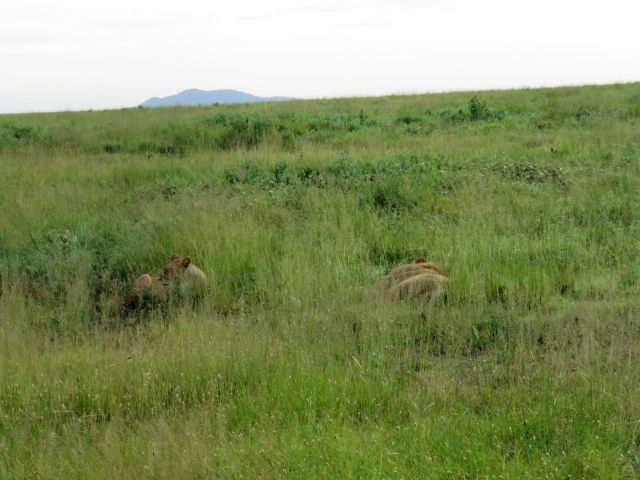
The chosen male sound asleep. The mound on the horizon is Naaibi Hill

The old fellow tiptoeing towards the female
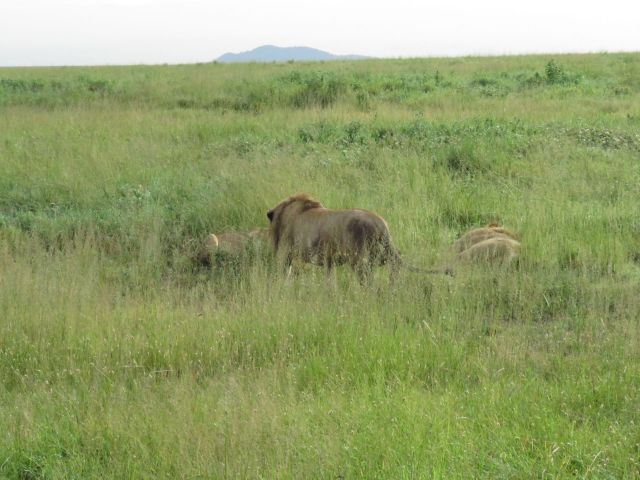
He bypasses the young male without awakening him
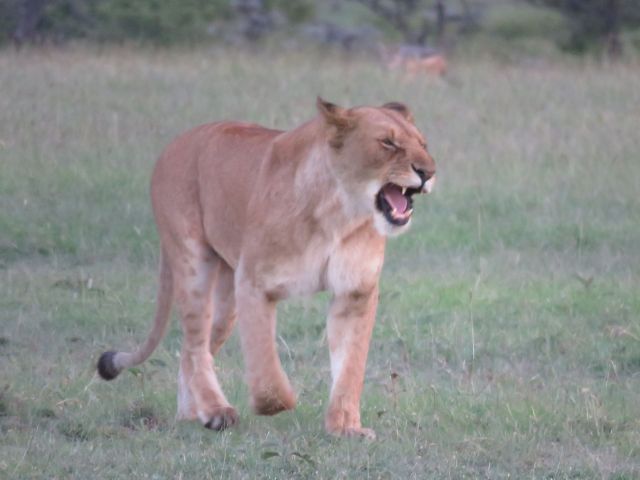
Just as the cheeky lion reaches the sleeping lioness she wakes up, snarls loudly and strikes out at the unwelcome visitor. This brings her slumbering male immediately to his feet. One look from the dominant lion is all it takes for the thwarted male to back away. The alpha male walks between the female, who is still crouched down and snarling, and the elderly lion. The old cat immediately flops on his side in submission. The dominant male looks the situation over and then proceeds to lay back down keeping himself between the two cats. Although the lioness didn’t find this funny at all, we couldn’t help laughing at the image of the elderly lion silently tiptoeing through the turf towards the lioness.
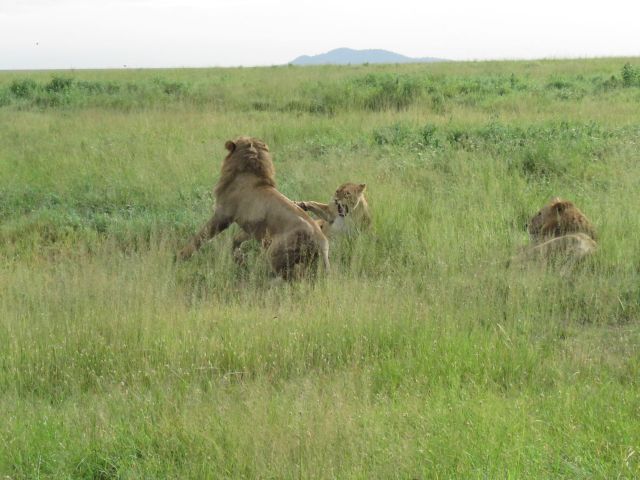
The lioness striking out at the rascal

The young male giving his buddy a stern look
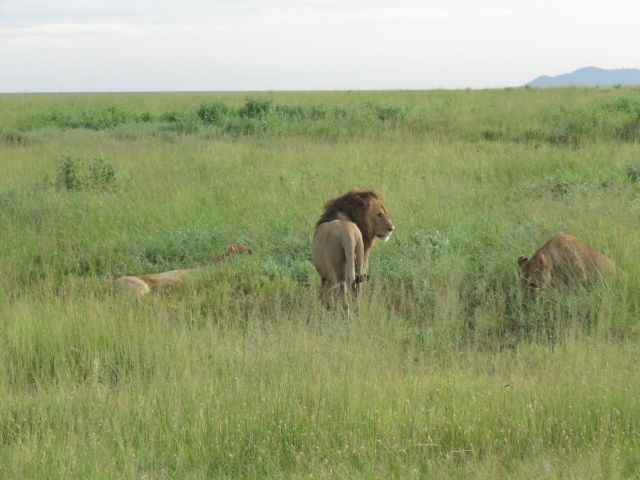
I think the lioness is giving her mate a chewing out

Is that a smile on the dominate males face?

Both males go to sleep as the female still keeps an eye on them
Since the lions have now settled down and are sleeping, we proceed to leave the valley. George returns to the migrating wildebeests taking us to the far side of the bog. Our guide wanders here and there stopping to scope for the cheetah that was supposed to be here yesterday. There are a few vehicles ahead of us and George studies them and quietly says “I guess we will be scavengers and see what they have found” which we find quite a telling statement! When a vehicle is sitting still, other vehicles swarm towards them like hyenas or vultures. I love it!
Just as we are moving towards the cluster of trucks, another guide pulls up next to us and George stops to chat with him. When the man pulls away, George begins to laugh as he tells us the vehicles ahead were checking out why one truck was sitting in that area. Come to find out the safarists were just taking a break. The man that drove over to us had noticed George using his binoculars and though we were watching an animal. Scavengers indeed. Hilarious!
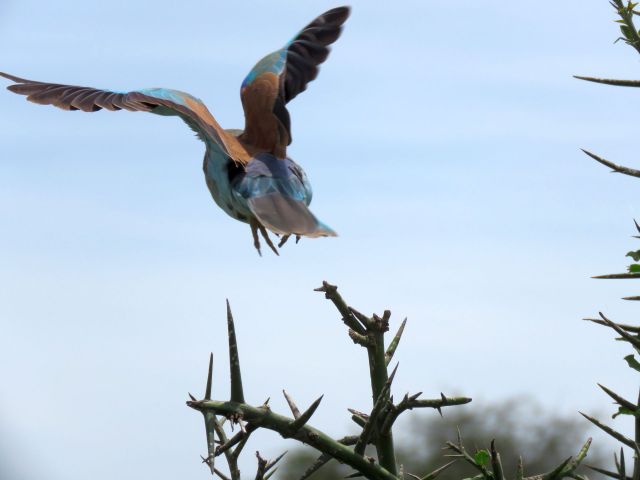
European roller taking off.
George drives on and stops to talk to another guide who delivers the news that there are cheetahs in the Twin Peaks area. We can see the aptly named hill on the horizon where Ngorongoro crater provides a backdrop to it. Driving the road that leads to the Twin peaks region we come upon places where zebra and wildebeest are lying on the road. The comfortable animals reluctantly stand up and move off the road to let us pass. George tells us that the dung beetles will soon be busy making dung balls with all the material these animals are leaving for them when they get on their feet!

All the wildlife that is standing or lying in the road. Forgive all the glare from the windsheild.
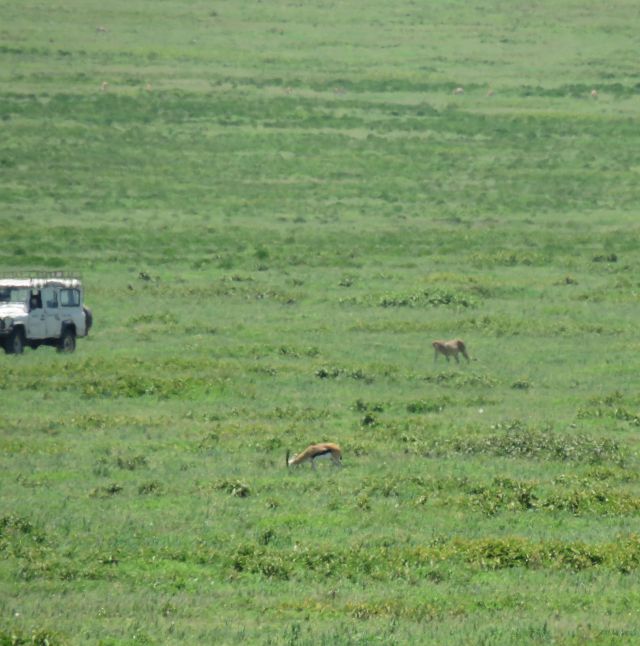
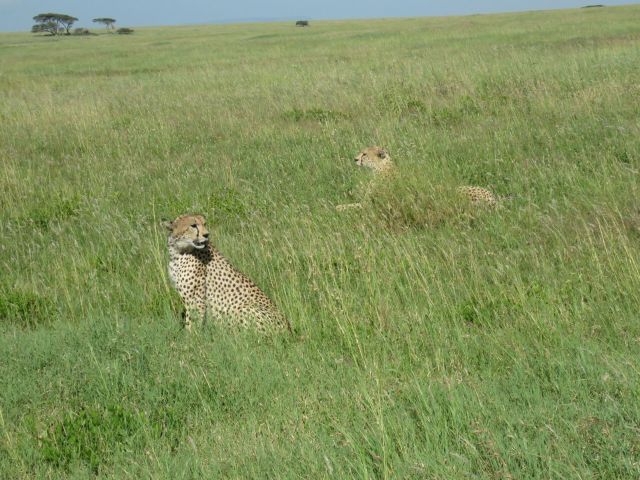
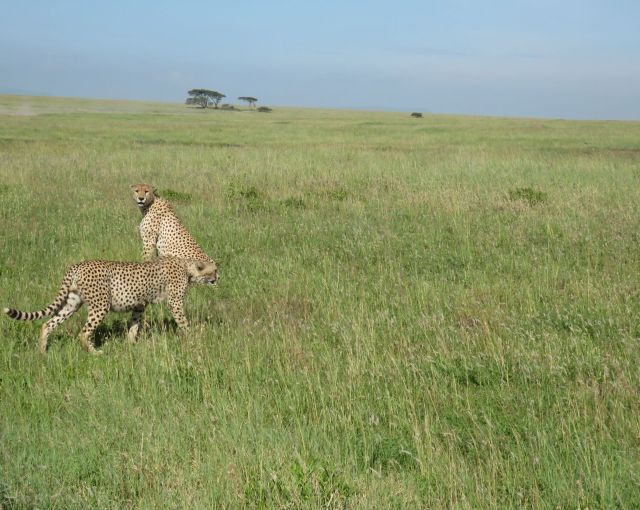
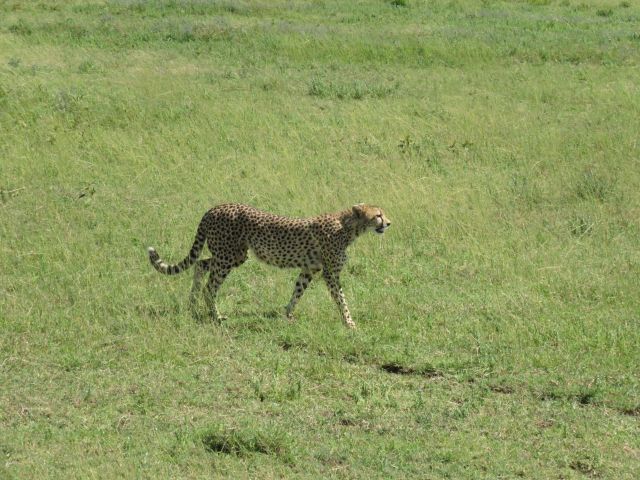
On our arrival at Twin Peaks we see two separate groups of vehicles. The band of trucks closest to us are cruising along the edge of a small ravine. George crosses the gulley and we catch a glimpse of a cheetah on the move. We then see another cheetah but Paul insists that there are three felines. George states it must be the three brothers that are seen here on occasion. It takes some creative driving by George before I finally see that indeed there are three cheetahs although we never get a very clear look at them. Because there are so many trucks jockeying for position trying to get a look at the trio of cheetahs, we vacate the premises and decide to go see what the smaller group of vehicles have found. Surely it can’t be more cheetah as the other trucks are no more than an eighth of a mile away. Hey, twenty-one different cheetahs since we have been with George!
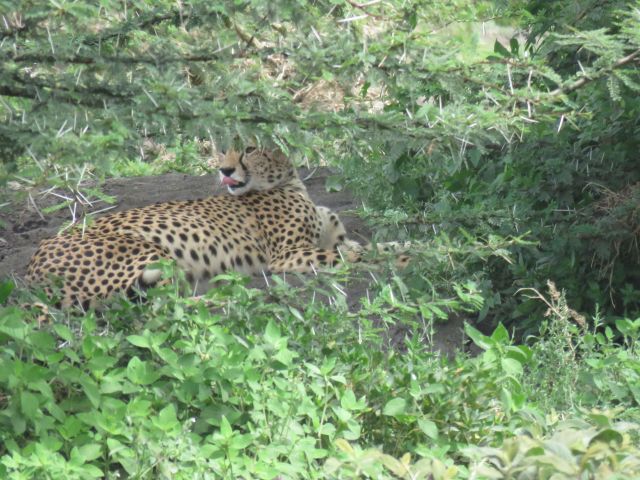
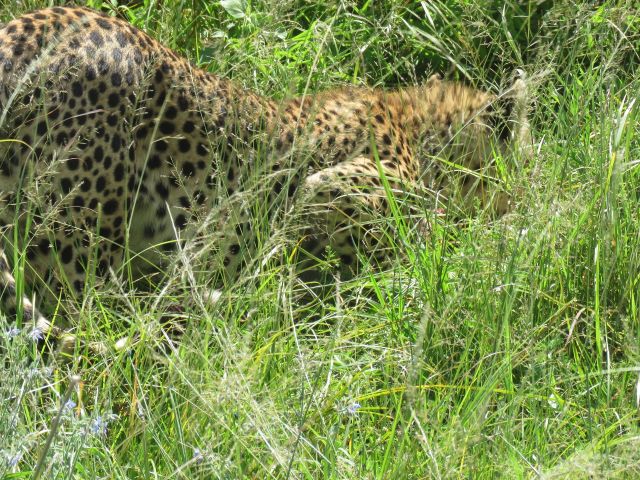
One of the three cheetahs that keep to the cover of the bushes
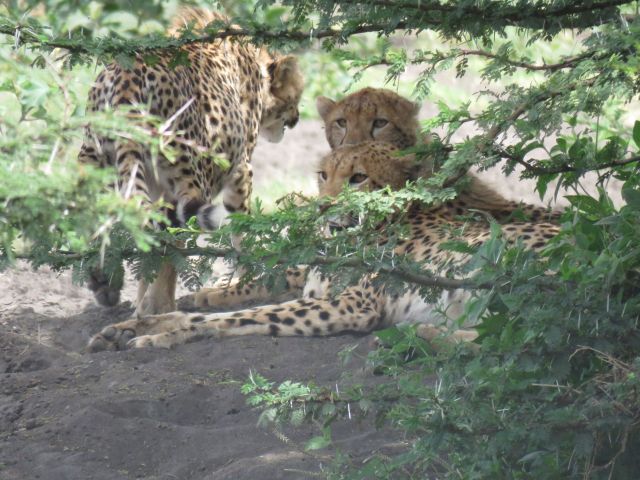
That is the clearest look we get of the three “brothers”
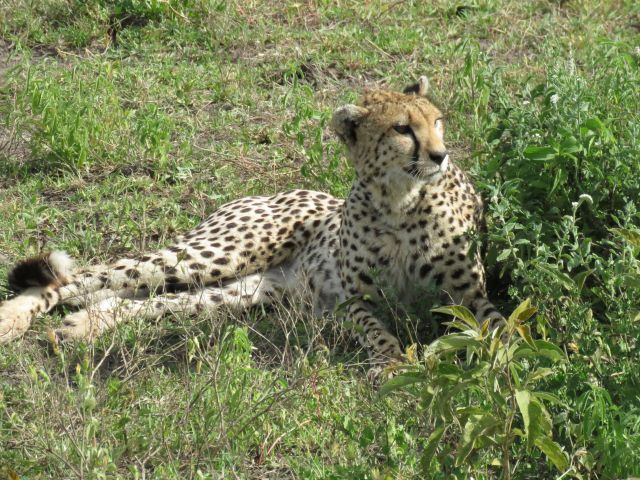
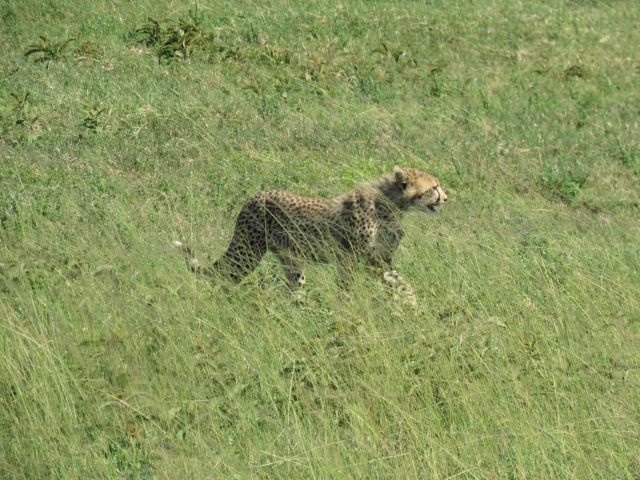
There are only four vehicles at our next stop and George and Paul spot the mother and cub cheetahs as they are sauntering along near the trucks. We are two cheetahs away from the goal George and Paul have set. Unbelievable. Mom and cub approach a whistling thorn shrub and stop in the thin line of shade the scrawny bush is producing. George tells us that the mother is hungry and is looking to hunt but there are no impalas nearby, the closest impalas can hardly be seen with the naked eye. The mother sits down next to the cub who has already laid down. We continue to watch the pair but then mama cheetah lays down plus there is a stream of trucks coming our way so we decide to head back to Njozi camp.

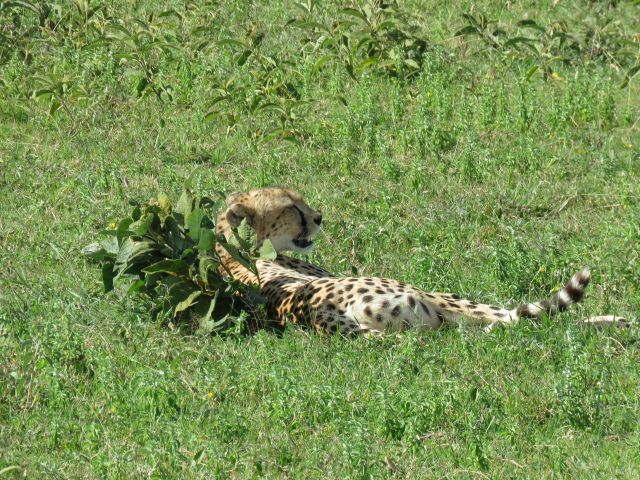
A gorgeous cheetah and her young cub
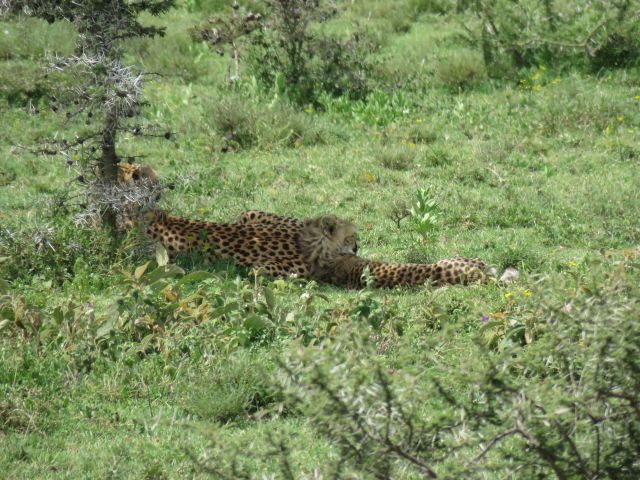
Mom and cub laying in the thin slice of shade
As we drive back through the section where the three brothers were, we see that they are on the move. One of the three is very skittish and runs for cover when a vehicle comes to close. George appraises the situation and decides to move over to the other side of the line of trees the cheetahs have disappeared into. There are zebras and impalas over here so we sit and wait since George thinks the cheetahs will come to us.

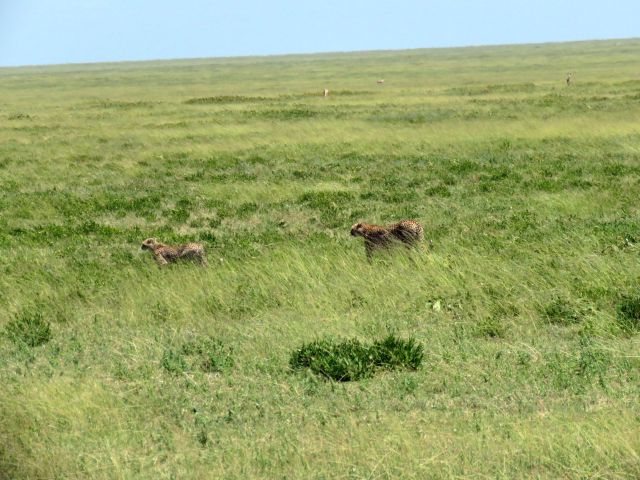
The trio of cheetahs on the move. Well to of them are on the move, the other can barely be seen laying under the two trees to the left
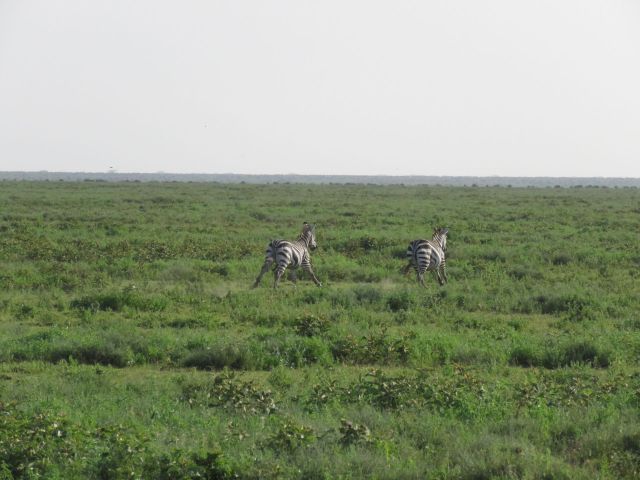
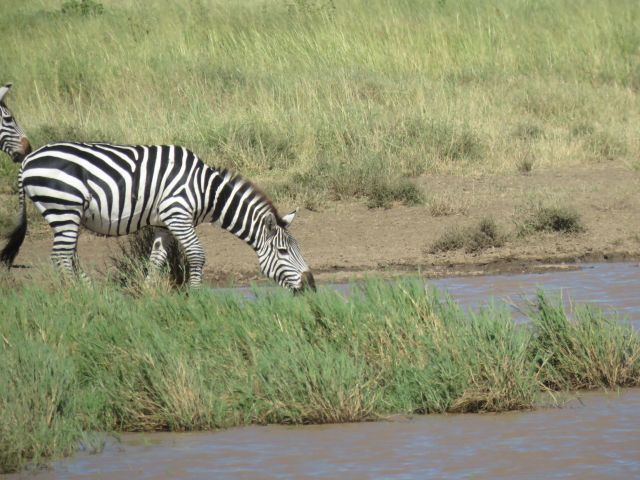
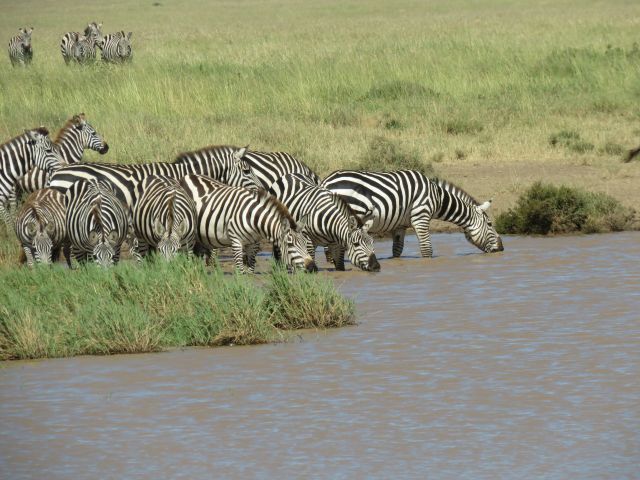
In time there are several zebras that start walking toward the tree lined ravine and it appears they want to go to water. Suddenly the lead zebra becomes very alert and is staring into the heavy foliage and soon other zebras adapt the same alert posture. The striped denizens all stop their forward motion and retreat back to the open field. We continue to wait in anticipation but if what spooked the zebra were the cheetahs, they don’t show themselves to us.

I’m cheating again, for some reason I took no photos of the zebras on alert. This is a filler photo
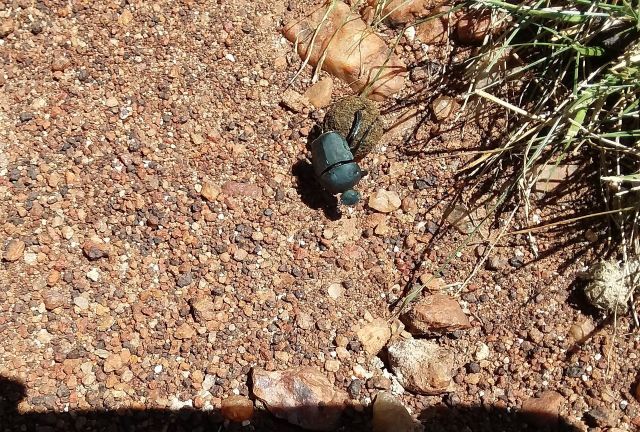
Driving back through the area where all the wildebeest and zebra were lying on the road, we again have to wait for the animals to rise to their feet and move out of the way. George draws our attention to the movement of balls of dung everywhere! George tries to dodge the busy dung beetles as best as he can but it is next to impossible. I don’t see how the beetles don’t get crushed by all the animal hooves that tramp up and down the road as well. Well, I’m sure many beetles do die but since there are numerous beetles to be seen obviously some of the bugs are successful at bringing the next generation into the world.
We are late getting back to Njozi for lunch but boy did we have a good excuse. Five new cheetahs and twenty-three cheetahs total. The staff has a tasty lunch waiting for us consisting of meatballs and Chinese rice with carrots and green beans. When we return to our tent, we see a Marabou Stork land in a dead tree that stands next to one of our neighboring tents. The large bird appears very awkward as he perches on the lifeless limb.

Marabou Stork perched in dead tree in camp
George sets our departure for our afternoon game drive at four o’clock instead of four-thirty since he wants to return to Twin Peaks which is over an hour’s drive away. We end up leaving at ten to four since George, Paul and I end up going to the dining tent early. George drives at a fast clip in order to reach the Twin Peaks area as quickly as possible. We do stop to admire a pair of Secretary Birds that are atop a tree and cooperate for a photo op by not flying away.
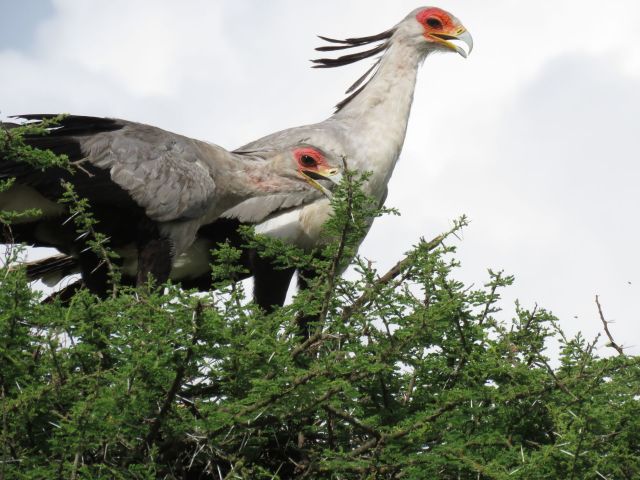
Secretary birds, normally you see them striding along on the ground.
When we reach Twin Peaks it is déjà vu all over again only with less vehicles. There are a trio of vehicles close to where we first saw the three brothers this morning. There is one lone vehicle in the region where we enjoyed watching the mother and cub. George asks what we want to do and since we are closest to the three vehicles we decide to go there first. George was told that people had seen a mother and two cubs at Twin Peaks today and since we had witnessed the three brothers moving on this morning, we are hoping this is the mother and cubs.
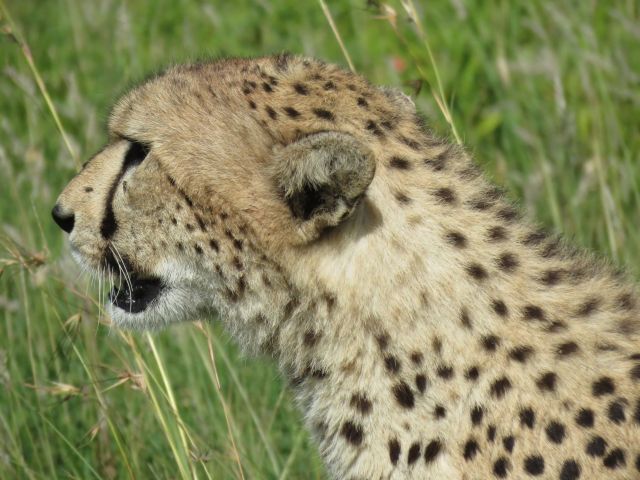
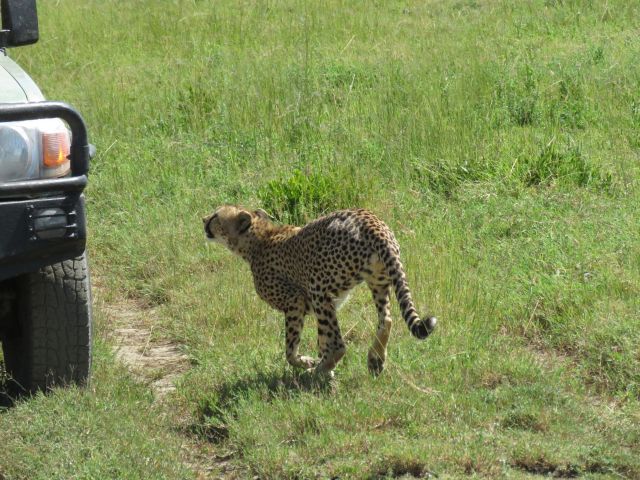
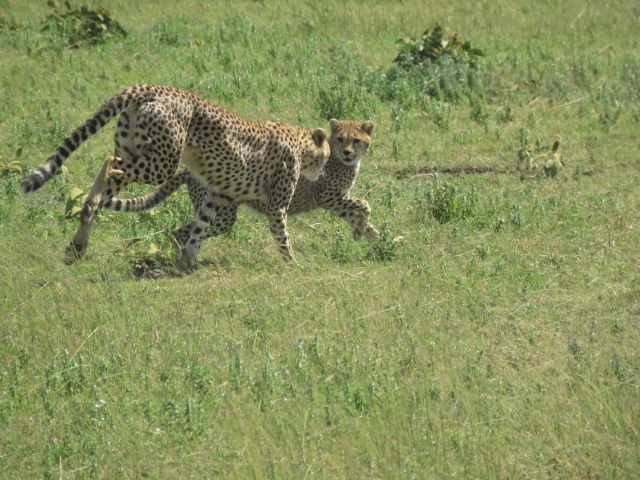
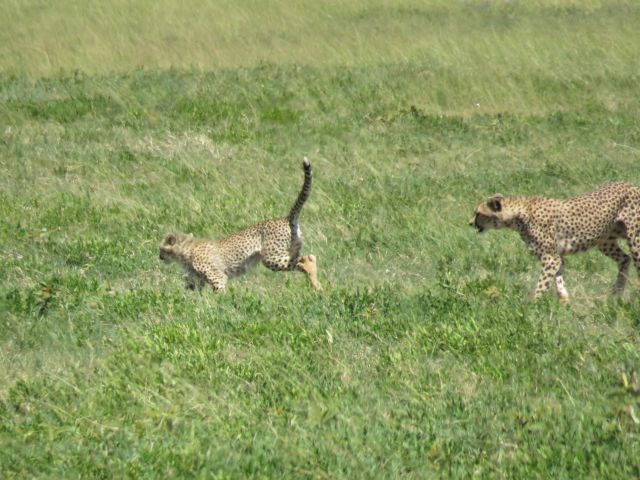
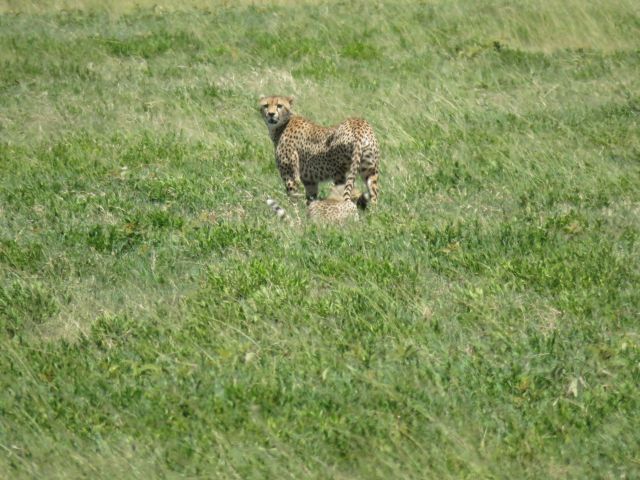
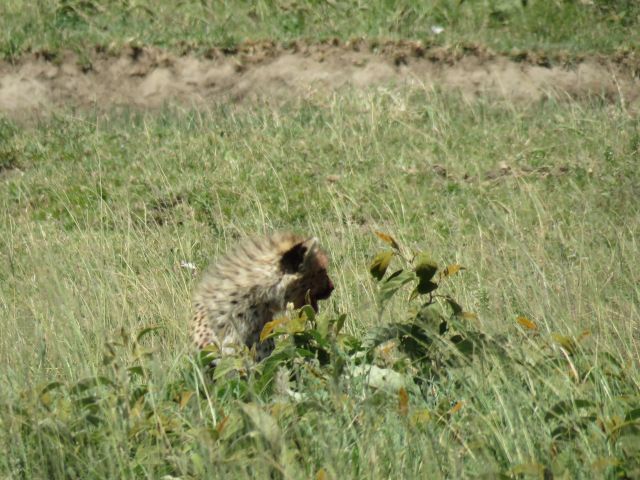
When we arrive at the sighting spot, two vehicles move away leaving us with a good view of the cheetahs. It is a mother and two nearly full-grown cubs. We are elated, this makes twenty-six cheetahs! Our elation is short lived when George says, no, these are the same cheetahs that we saw this morning. He adds that he mistook them for the three brothers that are known to frequent this territory. I am not completely convinced they are the same cheetahs. I will grant that we did not get a close up view of the cheetahs except when they were on the move and then they were a long way away from us. Later, when comparing my photos from this morning and this evening it is obvious that these are the same cheetahs. How could I have had a smidgeon of doubt with George’s statement, a man who definitely knows cheetahs! Well darn, we are back to twenty-three cheetah.
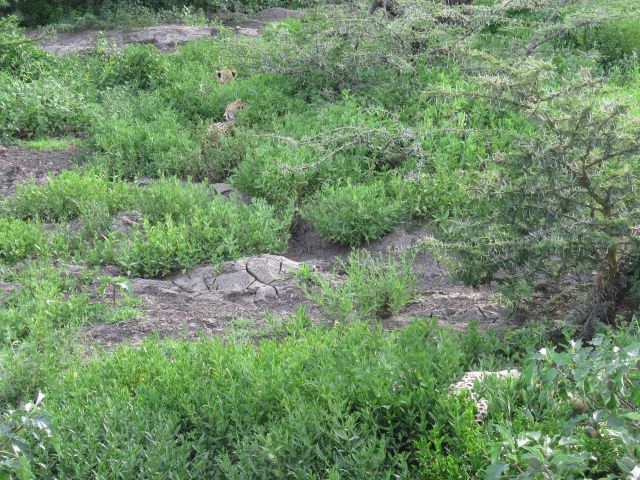
Mother and two cubs. They are the same cheetahs we saw this morning that we thought were three brothers
We don’t spend much time with the trio of cats as the other vehicle has some annoying people in it who are loudly grousing at their guide that they can’t see the cheetahs well enough. Good grief, the cats are hiding in the tall grass so what is the poor man supposed to do, drive the truck at them to make them get up. Sigh…

Mom and one of the two cubs
George begins driving towards the lone truck a quarter mile away. We are about halfway there when the truck starts moving and makes a sudden U-turn and speeds up. I call out that the cheetah must be making a kill but George has already hit the gas. We arrive at the scene to see the last feeble kicks of the full-grown impala as the mother cheetah clamps down on the poor beast’s throat. We missed the actual chase by a couple of minutes!
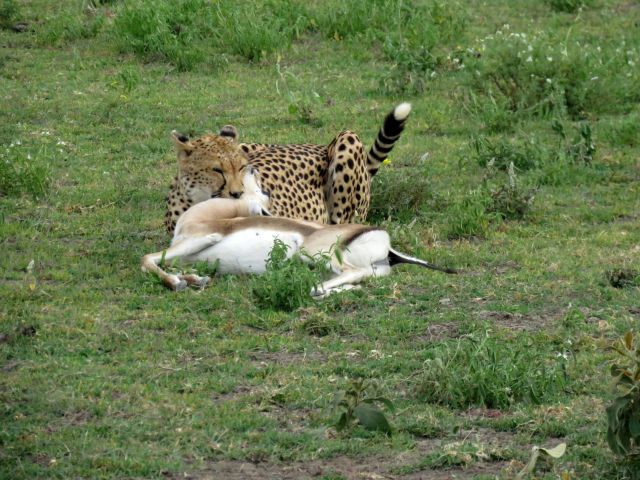
Cheetah finishing the job of killing the impala
Paul is very disappointed but I have mixed feelings about failing to see the whole show. I am getting a bit more soft-hearted in my old age, I guess. The mother cheetah waits until there is no light of life left in the impalas’ eyes then she begins the arduous task of pulling the carcass towards a thorn bush in hopes of hiding her kill from other predators. The cub who was waiting in the wings begins walking towards his mother and dinner.

Dragging the carcass behind the thorn bush
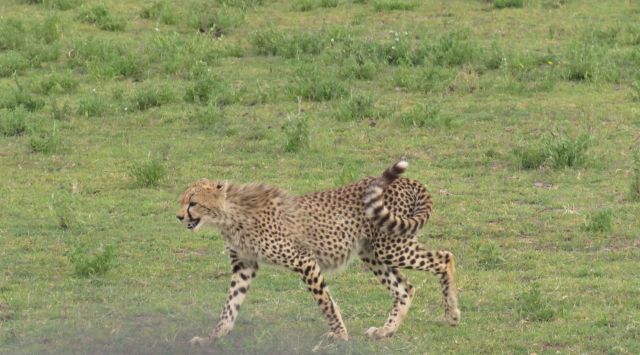
Junior coming for dinner
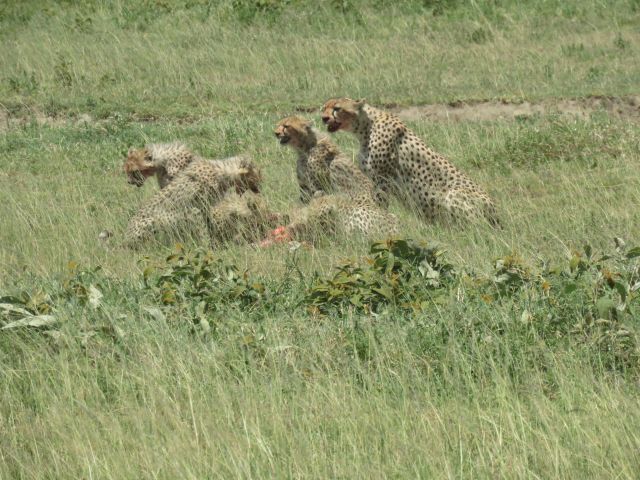
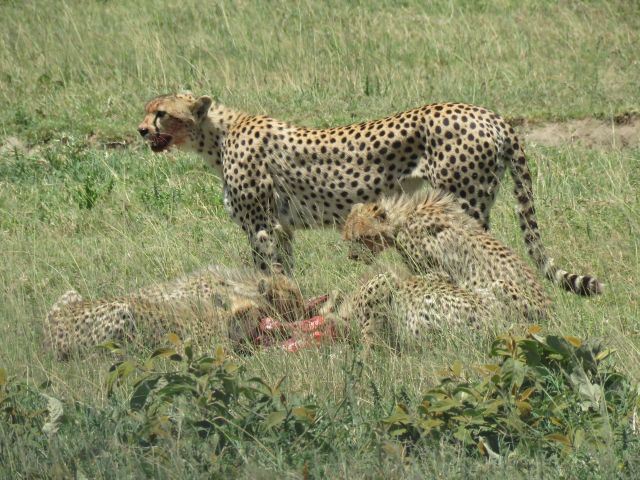
The successful hunter finally reaches the bush and drops the dead impala to the ground. The youngster waltz’s in and pretends to kill the impala all over again, that is how they learn I suppose. The exhausted mother lays down while the cub moves to the rear end of the impala and before long is heartily eating. We stay with the cheetahs for thirty minutes in which time the adult never takes a bite out of the impala. The cub eats for ten minutes or so and then he disappears behind the spikey bush and lays down. There are more vehicles arriving all the time and we have a long drive back to camp so we leave the huntress and cub and start back to Njozi.
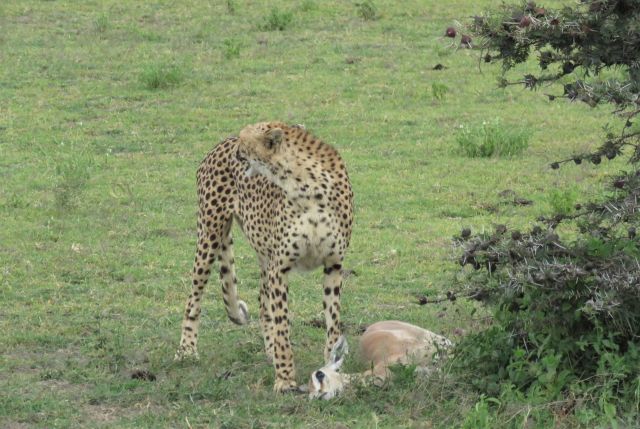
Mission accomplished
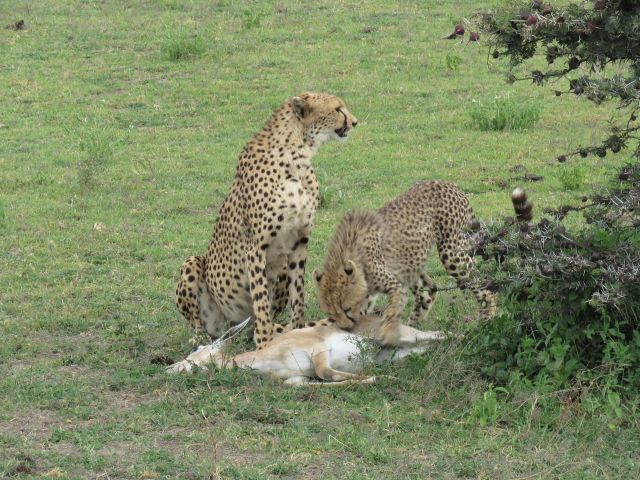
Cub playing with carcass

Huntress taking a well deserved rest while the cub dines on the impala
George begins berating himself for not going directly to the mother with the single cub because then we would have seen the whole hunting scenario. Paul tells him not to blame himself as it was our decision to check out the trio of cheetahs first. George still voices his regrets and I point out to him that if we hadn’t left camp ten minutes early, we would have missed everything. I think Paul and I finally convince him that there is no sense lamenting what can’t be changed. We enjoy the late evening drive home where the vultures are already roosting in the treetops. George stops the truck to look at a Lilac-breasted Roller who is holding a small pebble in his beak. How in the world did this amazing man see a bird with a rock in its bill while driving down the road? Paul informs George that he has decided to include the two cheetah we saw in Kenya to the twenty-three cheetah we saw in Tanzania which equals a total of twenty-five of the gorgeous felines. I’m not sure George approves of this change in the rules but he nods his head in agreement. Nancy

Vultures settling in for the night.
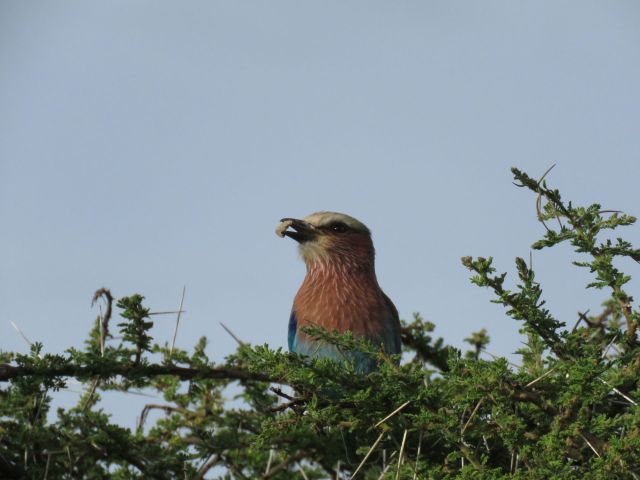
Lilac-breasted roller with pebble in its beak.













































































 realityranching