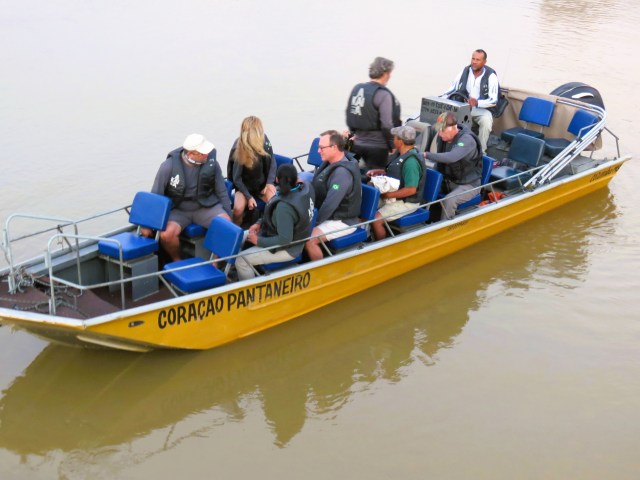
A cold front came through last night with strong winds and the riverboat was sailing into the wind and waves. I woke up several times and could feel our ship hitting waves and rolling a bit. Paul slept through the night and never noticed the waves at all. Consequently, we are behind schedule as far as where the captain had hoped to be this morning.
Paul and I went outside at five a.m. to look at the sunrise and came right back in. It is chilly and with the stiff wind, it is not comfortable. What a change from yesterday. After breakfast we load up in the speedboat.
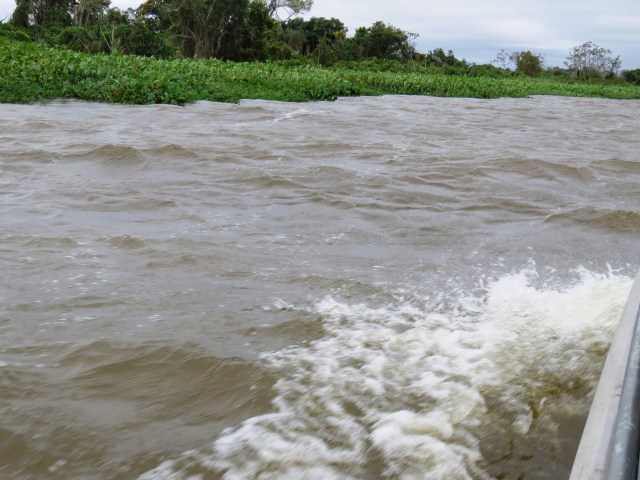
Although our boat driver stays as close to the edge of the river as he can, we are traveling into the wind. This means the wind-created waves are coming straight at us. The river is rough and at times there will be a wave that is three feet tall, (I asked Paul about the height, and this was his estimation). Our driver must speed into these large swells to make it over them. This maneuver sends a spray of water into the boat. This is one time it is good to be sitting in the middle seats! We hardly see any birds, I assume they do not like the wind or the temperature. Fred must see the discomfort of his charges and asks us if we want to go back to the riverboat. Every one of us agrees we want to return. Some explorers we are!
Heading back to the riverboat with the wind behind us.
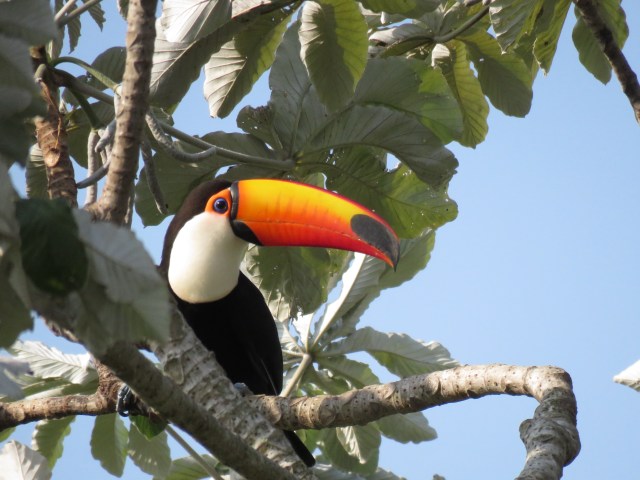
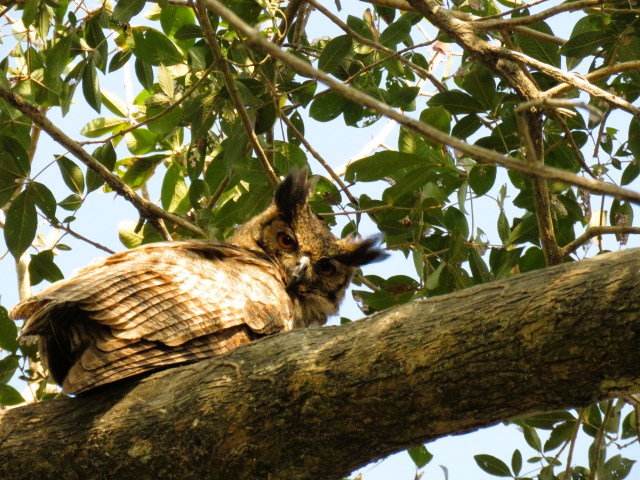
We decide to go back out on the speedboat this afternoon, this is our last chance to explore by speed boat after all. At least the sun is out although it is still windy. We must cross some rough water but then our driver turns into a side channel which is protected from the wind, (and much smaller than the Paraguay river). We see a Toucan, a Trogan, and a Great Horned owl with two chicks in a nest so this alone was worth the trip. We arrive at a crystal-clear pool of water where a lot of the group had hoped to swim and snorkel, but it is just too cold.
No need to mow the lawn when cattle can do the job.
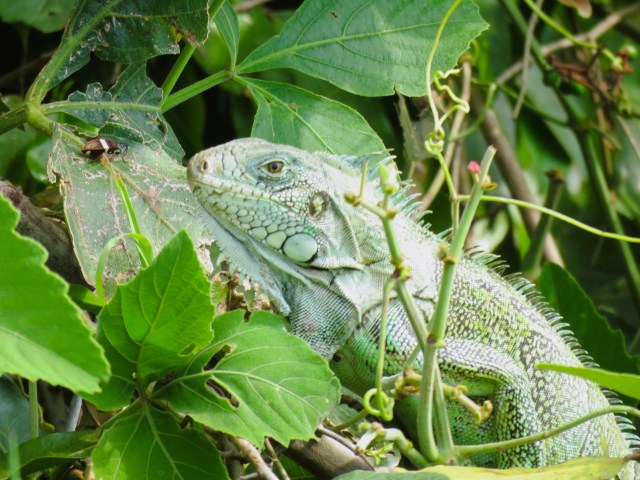
Green Iguana
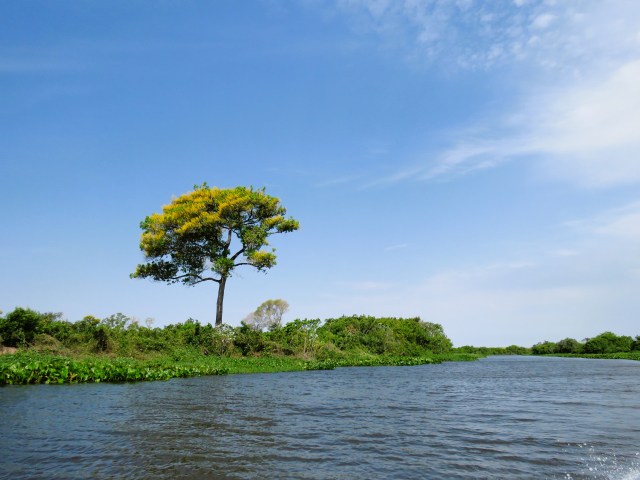
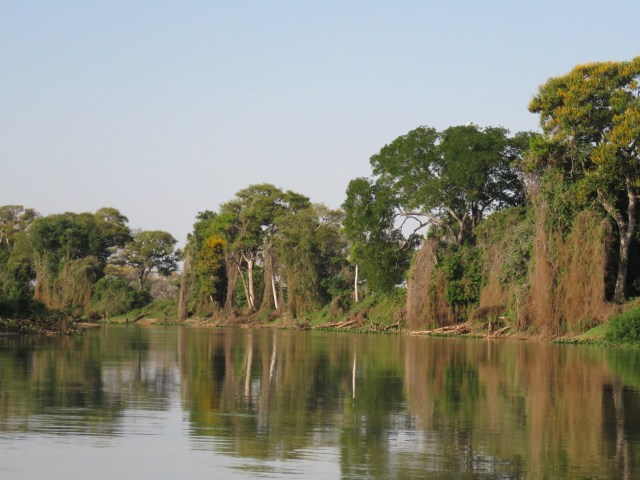
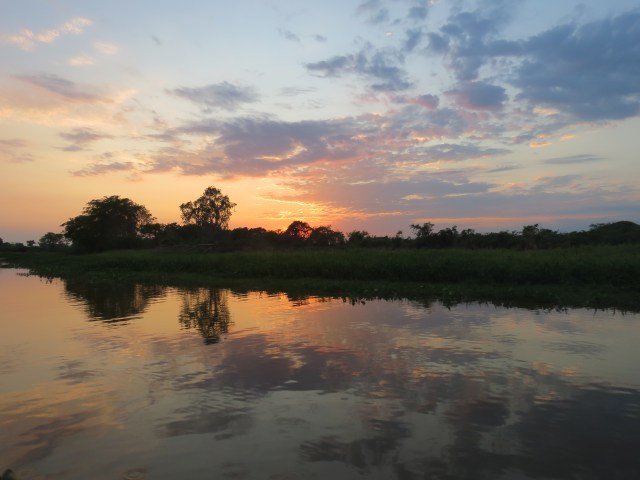
Scenic view while on the river
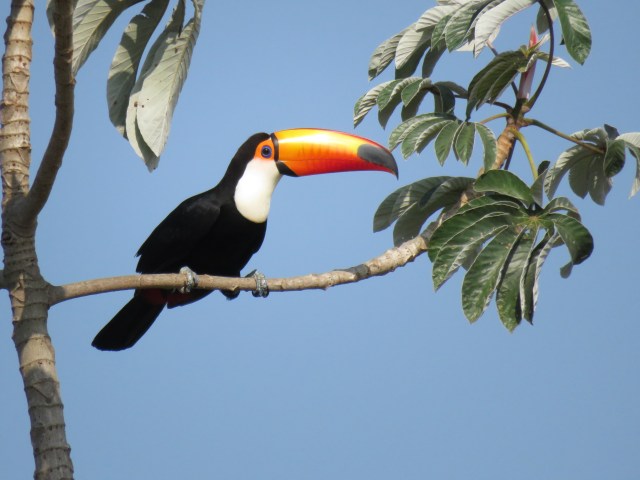
Toco Toucan
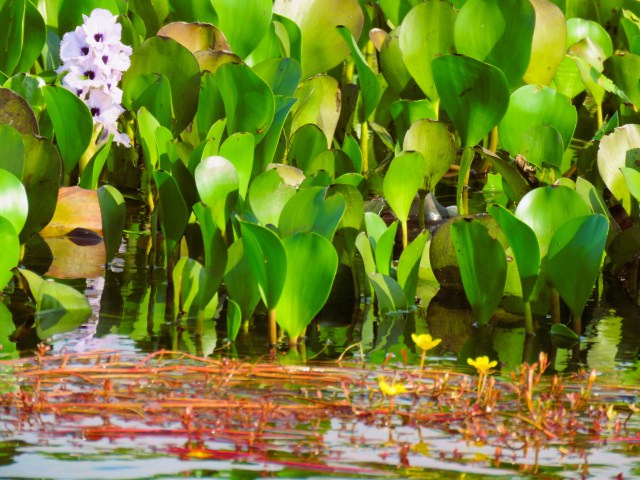
Some of the river flora
Toco Toucan
Great Horned Owl chicks
Great Horned Owl near the nest
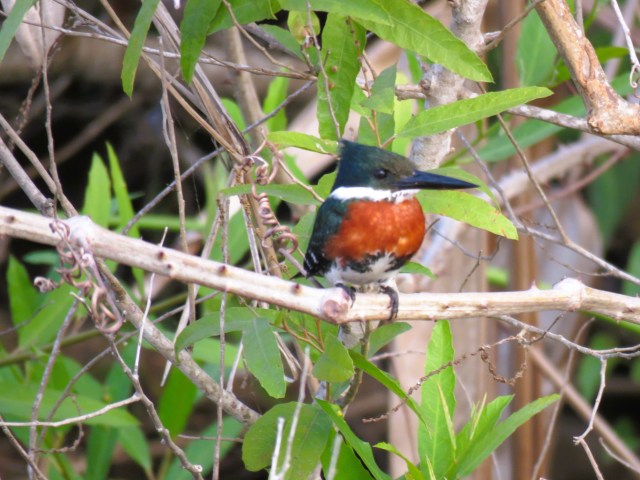
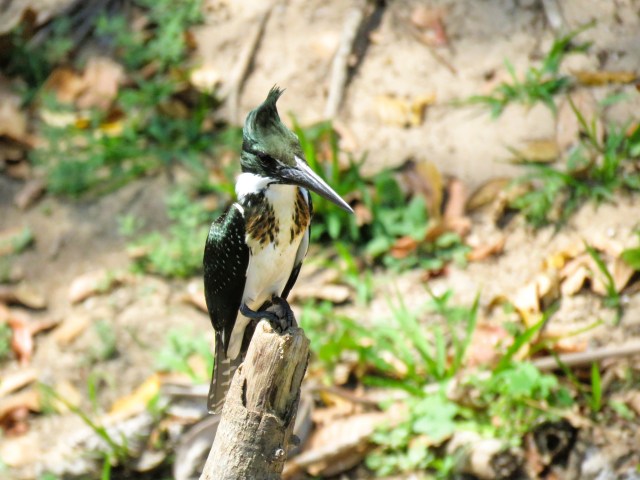
Green Kingfisher.
Fred sings for us one last time and gives an educational talk on Macaws. He also brings the cowboy-hat wearing chefs out and introduces them to us. We give the incredible cooks a much-deserved round of applause for all the delicious meals they have prepared for us.
Our talented chefs
Tonight, the KC Chiefs are playing in Sao Paulo. As crazy as it seems, Paul and the man from Colorado can watch the game on the tv in the dining room. Not exactly roughing it are we?
Today the riverboat delivers us to the town of Carumba. Upon seeing the slot where the captain must maneuver the boat into, I cannot see how in the world he will manage it. However, with seemingly little effort he pulls into the space next to another riverboat. Before we disembark the crew lines up in the prow of the boat. We shake hands, thank them for taking such good care of us and give them a well-deserved tip.
Our last morning on the river. Carumba on the horizen.
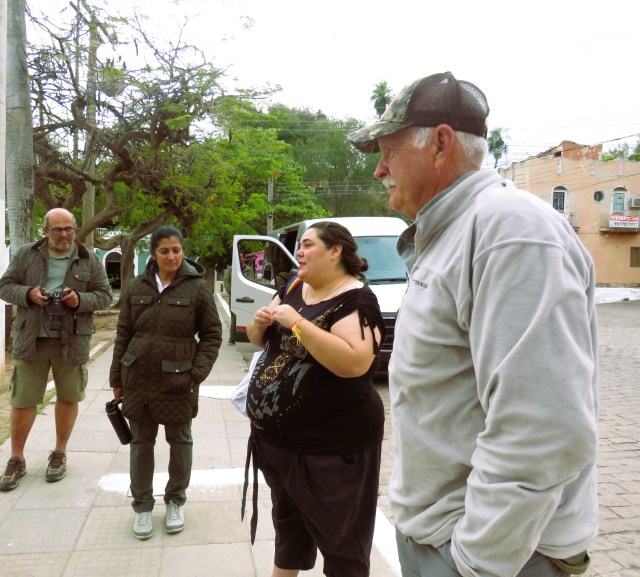
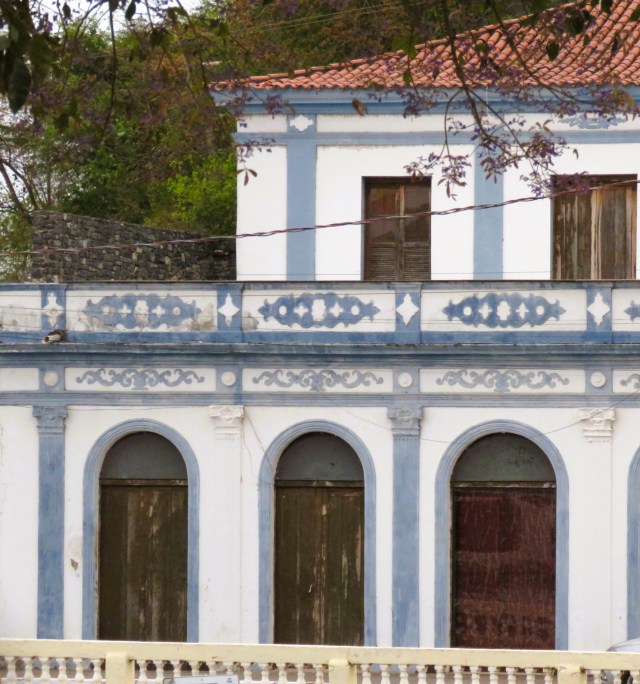
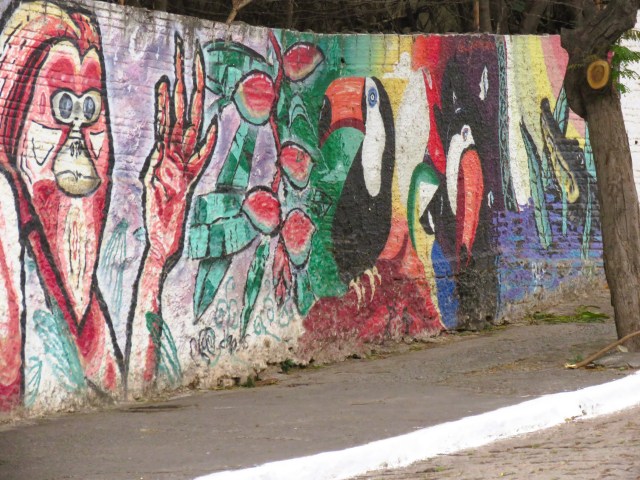
There is a van waiting for us at the boat dock. Some of the crew loads up our luggage and we climb into the van. We are driven into the historic part of Carumba where a young woman is waiting for us. We climb back out of the van and take a walking tour in the old town of Carumba. As we walk, the young woman fills us in on the history of her town as we admire the colorful buildings.
Paul and our guide for the morning.
One example of the historic buildings.
A colorful mural.
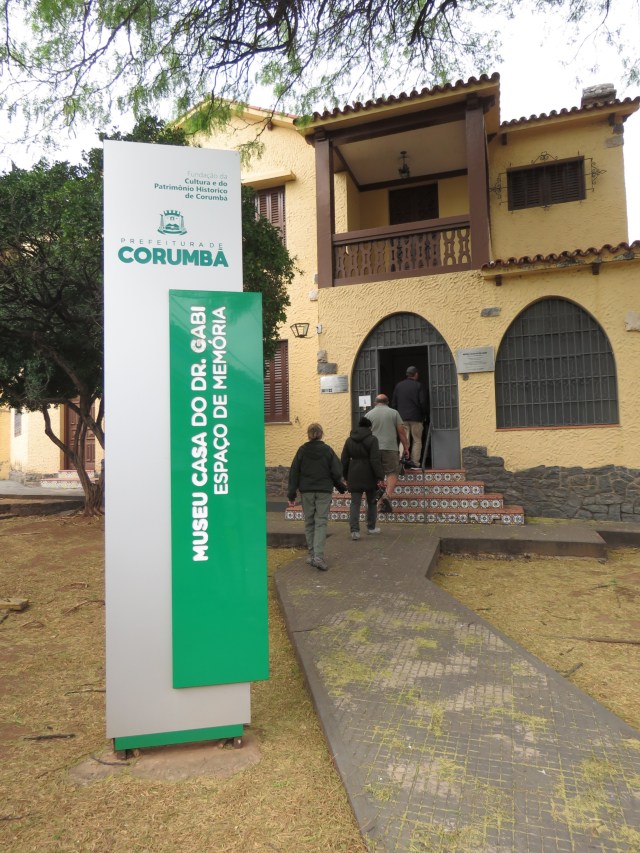
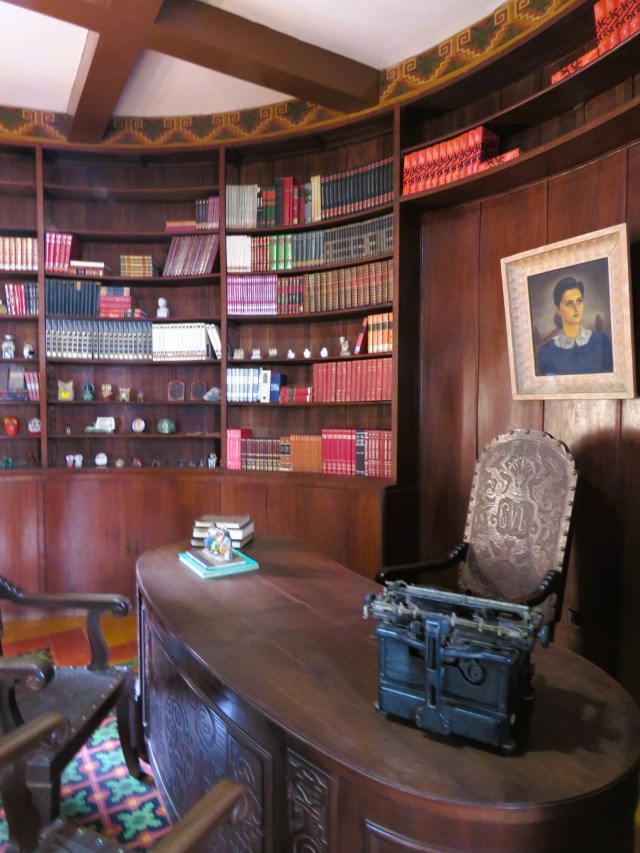
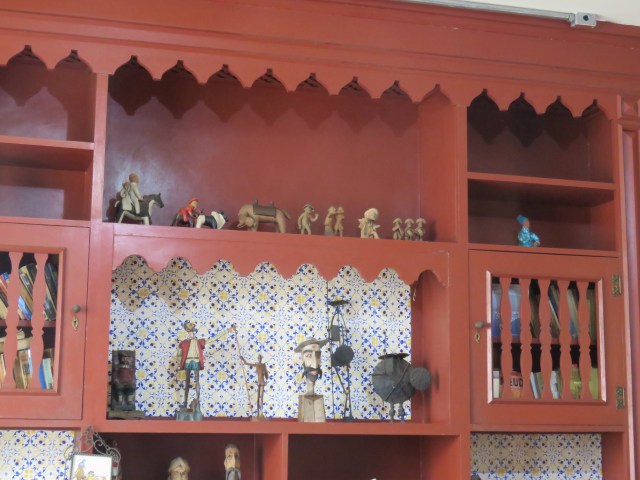
When our tour is over, we crawl back into the van and are driven to a house that is now a museum. The museum was the home of a wealthy couple who left the house and their belongings to the city with the intent for it to become a museum. It is filled with beautiful furniture, has a big library, and a large room dedicated to Don Quixote. The man was obsessed with Quixote. There are Quixote paintings, statues, toys, and books he collected in many languages.
Entering the museum.
A portion of the large library
A small sample of the Don Quixote room
Beautiful courtyard
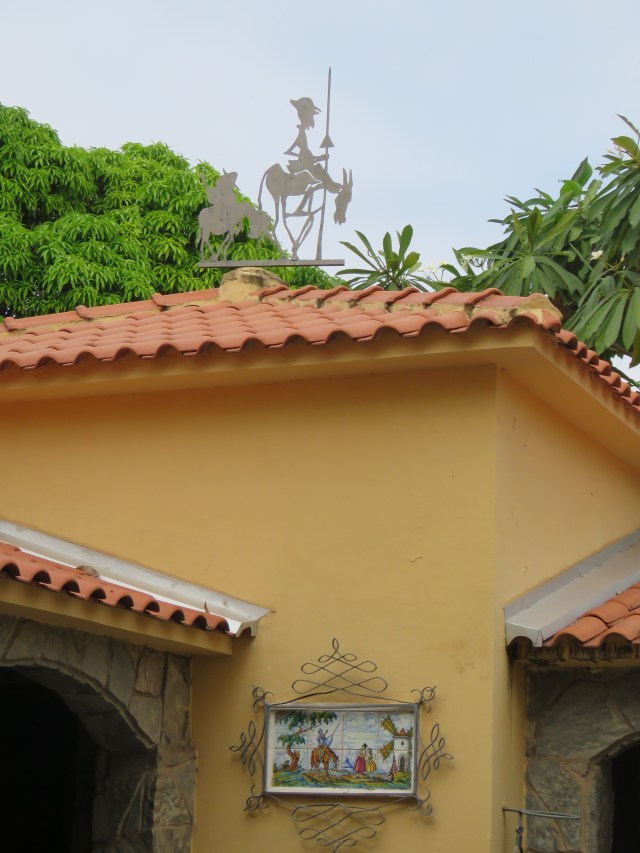
A Don Quixote weathervane atop the museum
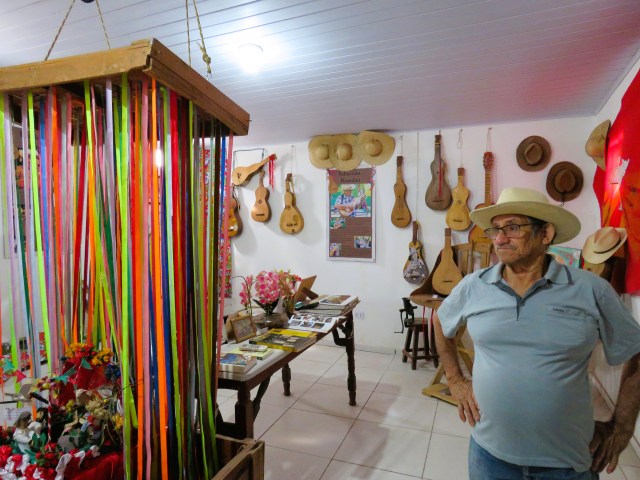
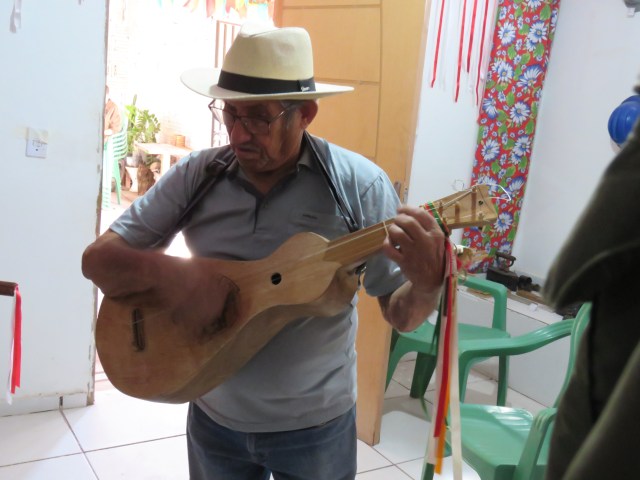
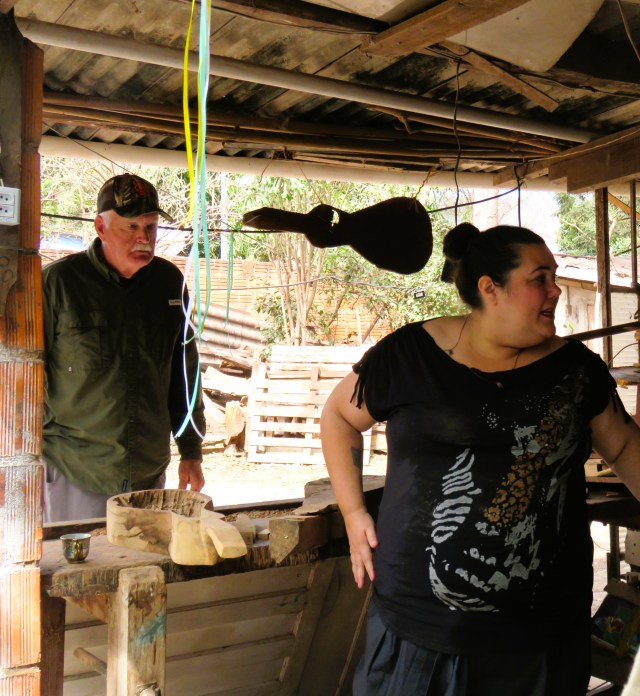
Our next stop is visiting a man who is famous for constructing guitars from native wood. We are given a tour of a room filled with memorabilia and guitars. He also strums on one of his creations while he sings to us. We end the tour in his simple workshop which is behind his house.
The guitar maker in a room showing his products
Playing one of his instruments and singing for us.
Touring his simple workshop.
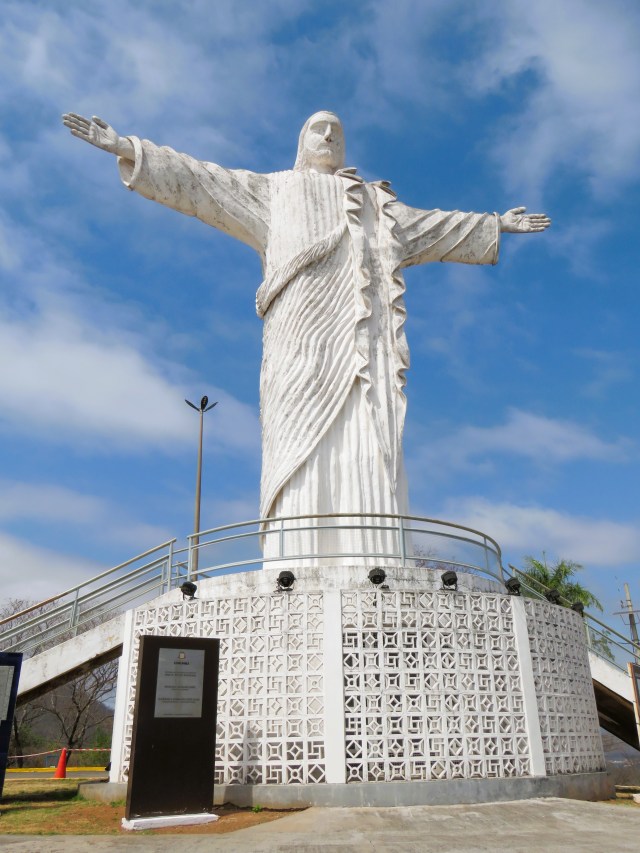
Our last stop before lunch is at the top of a steep hill. There is a statue of Jesus that looks like a replica of the famous statue in Rio de Janeiro. There is also a nice bird’s eye view of Carumba.
Statue of Jesus on top of the hill.
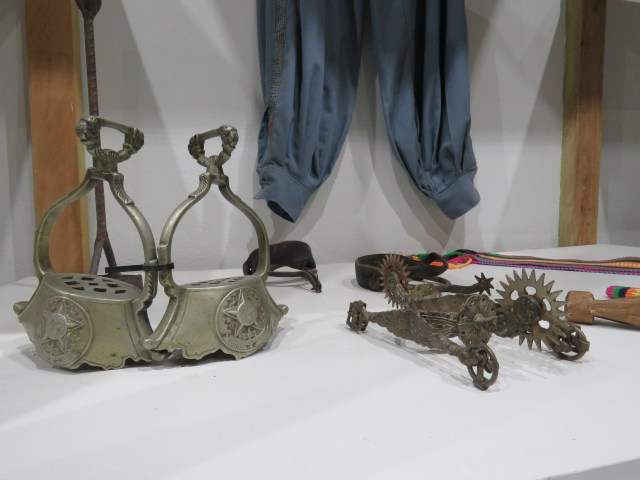
Time for lunch, which is in a museum dedicated to cowboy life in the Pantanal. Fred has outdone himself here. Our table is set up in the middle of the displays, and a trio of men are serenading us as we eat. We are served ten different dishes, one at a time. Though the food was delicious, and the portions small I do not think anyone was able to eat everything. The guitar player and accordion player are excellent. They both have great voices too but when the guitarist sang on his own, I literally got goose bumps. What a haunting voice this young man has. The song I remember clearly was “Easy like Sunday Morning.” Yes, they mostly sang American songs.
A weird-angled photo of the Pantanal Museum
A museum worker blowing a horn made from a cattle horn.
Paul looking over an exhibit
Our fancy dinner table in the middle of the exhibit hall.
One of many exhibits.
Spurs and Stirrups
The excellent trio of musicians.
It is time to journey to the San Francisco ranch, so we say goodbye to and thank our knowledgeable guide. I tell her that her English is superb, and she thanks me for the compliment.
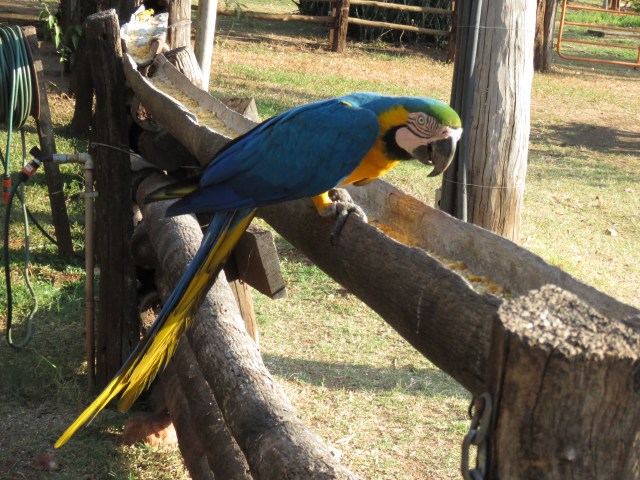
After three hours on a very rough highway and some dirt roads we arrive at our destination. The first thing we see when exiting the van is a pair of Macaws eating from the unique bird feeder. The feeder is the top rail of the wooden fence that has been hollowed out. When everyone is finished snapping photos of the Macaws, Fred leads us to one of the owners who is waiting for us. The young woman points out the restaurant, the office, informs us where to drop off our laundry, etc. We are shown to our rooms which are spacious, simple, and very clean. There are three beds, a half dozen wood platforms attached to the wall to set your luggage on, a small bathroom, and air conditioning. It is all we need.
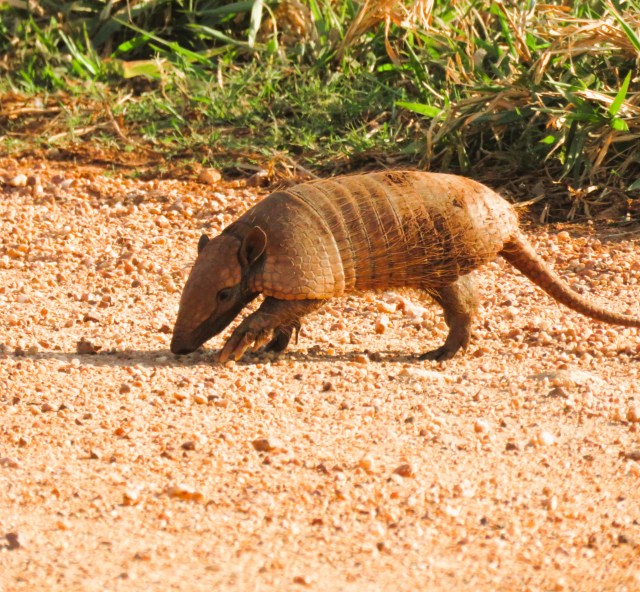
Six-banded armadillo, I think
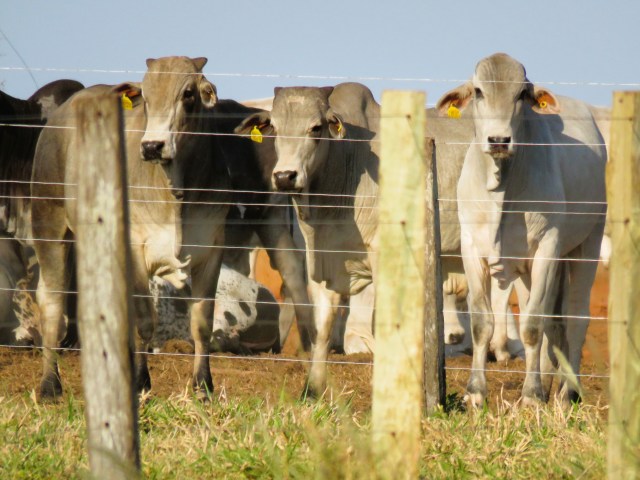
Zebu cattle watching us drive by.
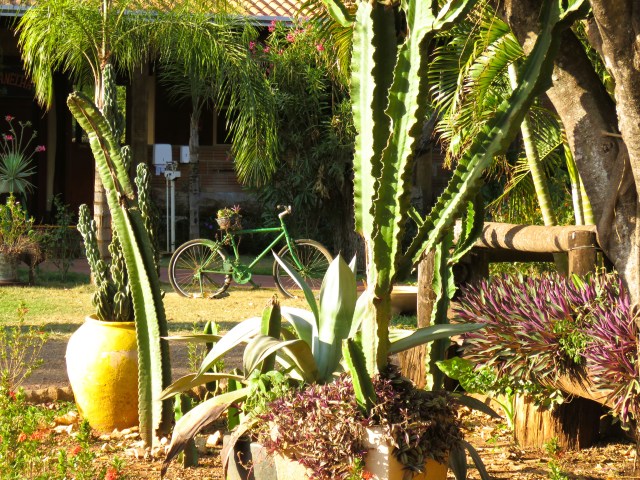
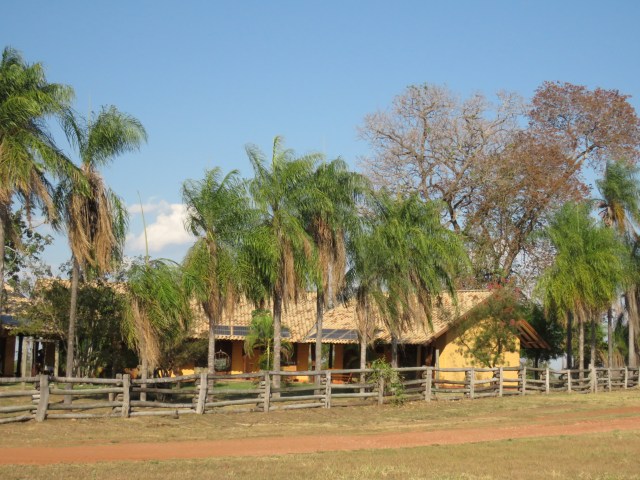
Landscaping on the San Francisco grounds.
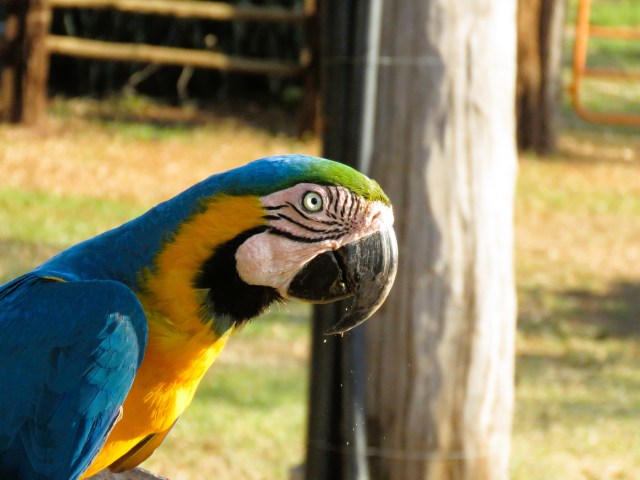
Blue-and-Yellow Macaw
A close up of the Macaw.
Two Blue-and-Yellow Macaw eating out of the bird feeder.
Colorful building used for meetings
The swimming pools
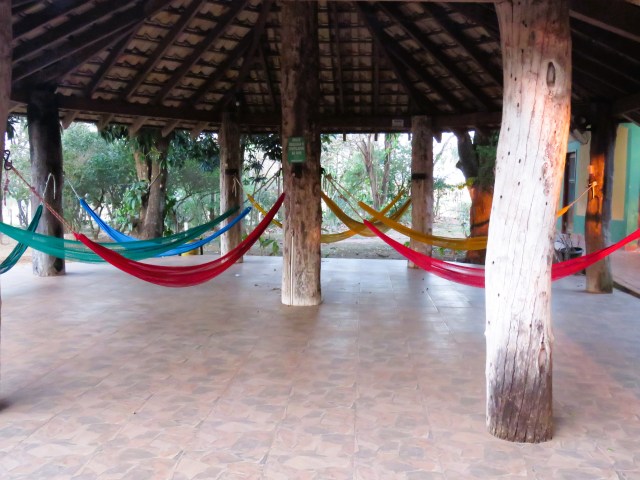
These hammocks were often fully occupied.
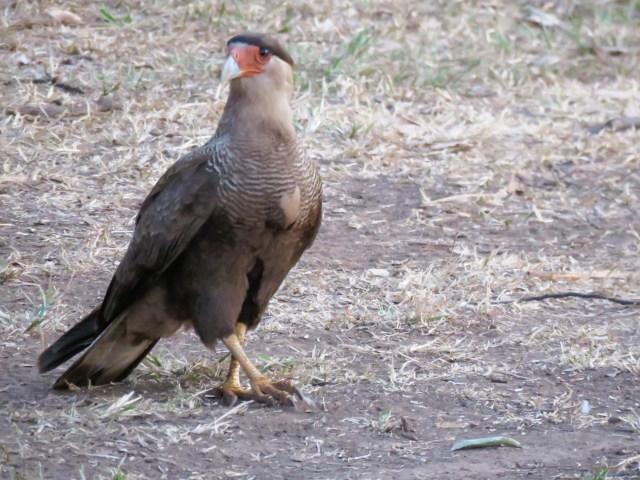
Southern Crested Caracara.
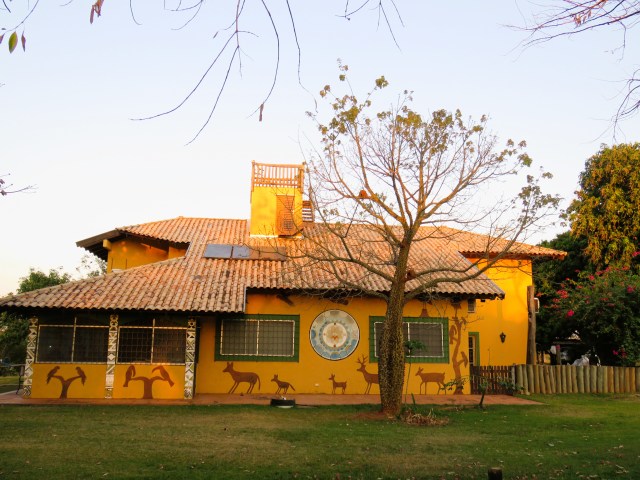
This was the building where our bedroom was located.
We eat supper at 6:30 but it is not just our group. The ranch has many guests here. Most are Brazilians who come for one night to enjoy the country life. They are taken on drives in trucks that carry sixty people. No thanks! The guests also enjoy the pools, hammocks, liquor, and the buffet. Our supper is good but a step or two down from our meals on the riverboat.
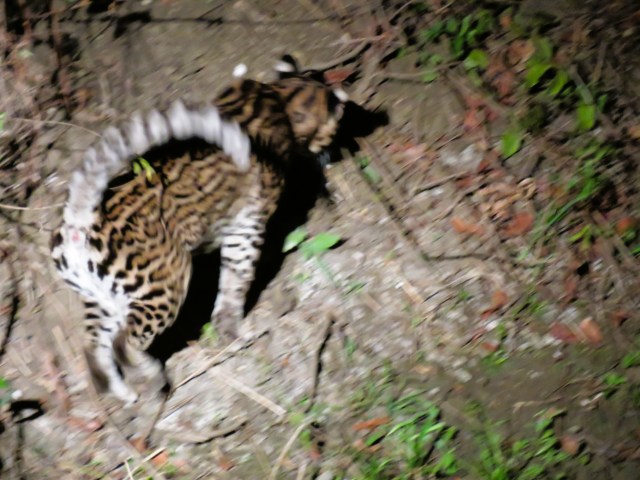
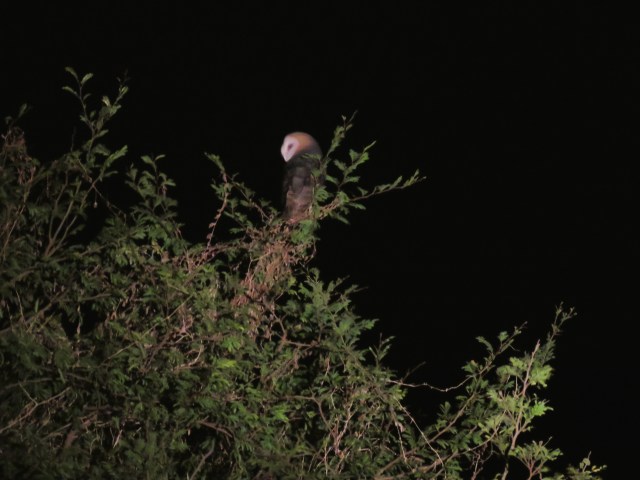
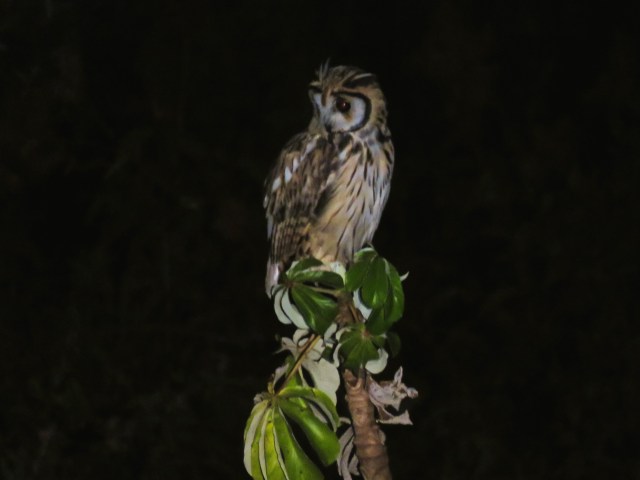
After supper we go on a night drive. I am a little uncomfortable with the spotlighting but that is the only way you will see anything. We get lucky and our spotter finds an ocelot hunting by the edge of the road. The small cat catches what our spotter thinks is a guinea pig. We watch from a distance as she gobbles it down. We sit and wait and sure enough the ocelot comes towards us with no fear at all. She goes into a field and this time we clearly see her pounce on something. Since it does not take her long to consume it the guides figure it is a mouse. Cool, we had hoped to see an ocelot and that can be checked off the list. We also see crab-eating foxes and some owls. I also am surprised at how the animals and birds don’t seem to be affected by the spotlight. We get back to our rooms around ten o’clock, tired but happy.
The ocelot hunting.
The ocelot marking her territory.
Barn owl. My camera isn’t exactly made for night photos even when spotlit.
I think this is a Short-eared Owl
A Crab-eating Fox. The guides couldn’t figure out what happened to him. Notice that it is collared.
This morning, I wake up with an unhappy stomach so make the decision I had better stay on the boat. We cannot exactly pull up anywhere on the riverbank for an emergency stop! Pit stops are only allowed on open sandy beaches and those can be few and far between.
Group leaving without me.
Paul waves at me as the speedboat backs away. Naturally, I feel some remorse as I watch the group leaving without me. The good part of my staying on the riverboat is that today we will be on the move and heading up the river. Another good thing is I can stand up and walk around plus there is an awning to stand under and escape the hot sun! Paul and I are both sick of sitting all the time! We do walk laps around the upper deck when we are on the riverboat to get some exercise.
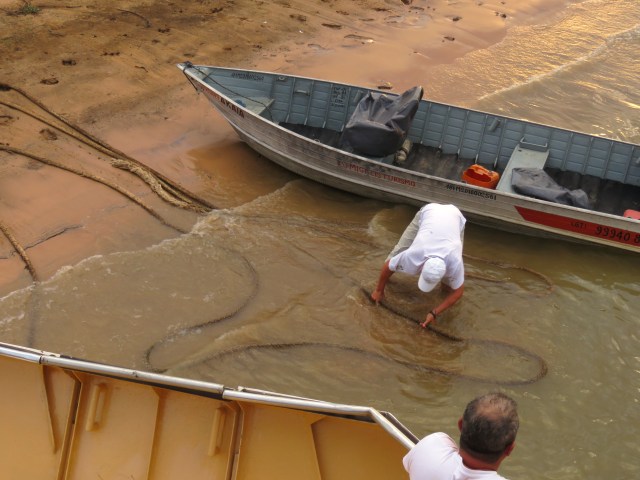
I observe the crew prepare to leave. The youngest member goes ashore to untie the huge rope that has kept the riverboat moored to a tree during the night. It takes three men to get the lengthy rope pulled back onto the ship. One of them is in the water pulling the rope to the boat, another man pulls it through a hole in the ships side, and the third man wraps the rope around a bar on the other side of the ship. This is all taking place below me, so I have a bird’s eye view of the process. It takes a lot of strength to get that rope back on the ship and secured.
Crew member cleaning the mooring rope.
Crew pulling in the rope and securing it.
Once we are moving up the river, I stand in the prow and observe the river and the shoreline. I see birds everywhere, spy an iguana sitting on the edge of the river, and watch a pair of Hyacinth Macaws fly in front of the ship. I did not have my camera in hand so there is no photo of the Macaws.
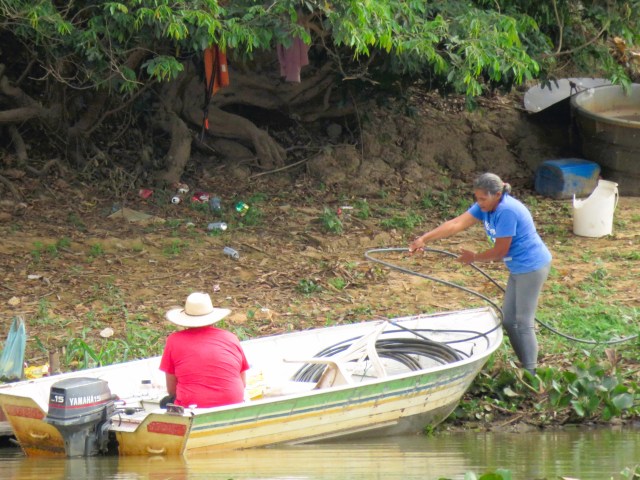
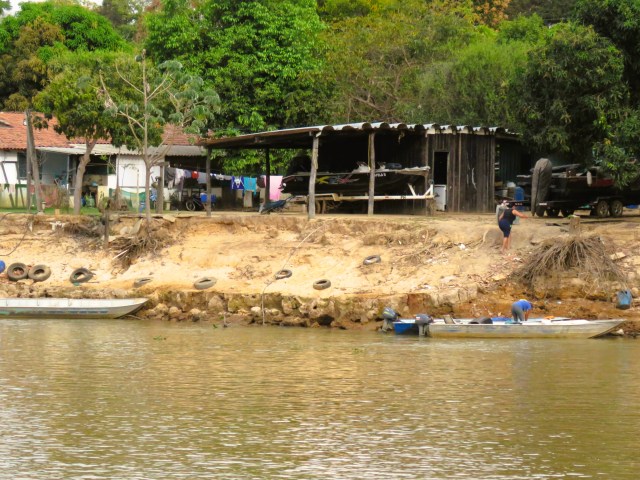
I also watch the Brazilians going about their lives as we drift by their homesteads. One homestead has laundry hanging on the line. There is a man and woman preparing to leave in a small boat. Maybe they are going fishing? A couple of cowboys are driving a small herd of cattle down a road. We wave to each other and by the time I think to take a photo, they have disappeared behind a grove of trees. The riverboat is amazingly quiet which is a nice change from the speed boats. I really am enjoying this!
Going fishing?
Laundry on the line
I watch the crew clean the ship, swabbing the decks and washing windows. This ship is always very clean and well kept. After they finish, I do some laps around the top deck and see several of the crew taking a break on the deck below. I go to our room and get the photo book I brought with photos taken at our ranch. The men do not speak English, and I sure do not speak Portugues but photos they understand. The crew crowd around the man holding the book and one of them points to a photo of cows and says “bison”? No, I reply, they are Angus cattle. Several of them say Angus as though they recognize that word. The photo that gets the most reaction is one of our cows lined up eating hay with snow on the ground and snow on the cattle’s back. All of them react with an ooh or even brr. They hand my book back and thank me for letting them see it, (I think).
Beautiful sky and blooming trees
Fred and the group return to check on me late morning, and I am feeling good enough to go with them on a short jaunt before coming back for lunch. Paul tells me they saw Marcela and Ousado but the best sighting was a Tapir! Boy am I sorry I missed seeing that odd animal. I tell myself that we saw two tapirs on our first trip to Brazil so that makes me feel better. Paul has a photo which looks good on his phone, but it is too pixelated when it is blown up to post on the blog.
Reflections in the water
Our adventure this afternoon is going up a side channel that is very shallow with lots of water hyacinths. Fred must use a pole to check the depth of the water to make sure our boat does not bottom out. There are caiman everywhere and more beautiful birds including Roseate Spoonbills. Unfortunately, it is so blasted hot that everybody agrees we should return to the riverboat early.
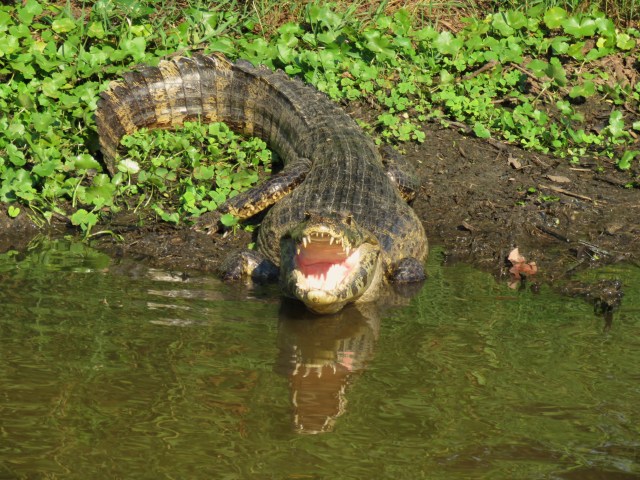
Gaping Caiman
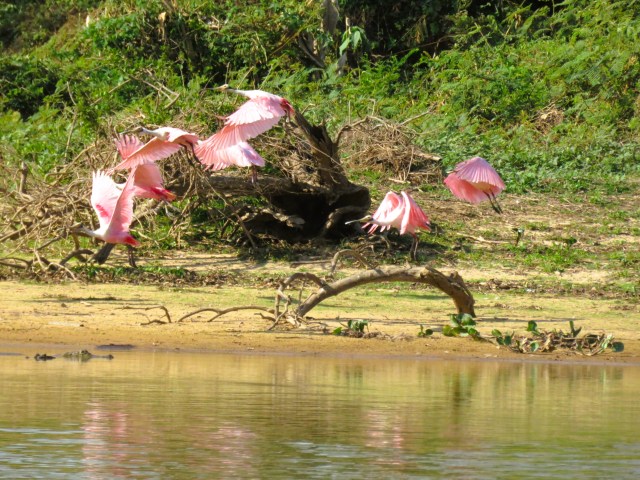
Roseate spoonbills
Fred sang for us and gave a great talk on caymans and howler monkeys tonight. The best thing on the buffet in my opinion was the French fries! They were cooked perfectly. We have not had many potato dishes so I ate my fill of them! I love potatoes and am not fond of rice and beans which is a staple in Brazil. Okay, the stroganoff was excellent too.
Fred singing for us.
This morning Paul and I go out to watch the sunrise but are soon chased back in due to clouds of mosquitos. We have had very little trouble with these pests so far which is kind of surprising.
We do not leave until 6:30 this morning as Fred is taking us to a place where we can take a walk. Yeah!! The Indian couple decide to forgo this as Fred warns us that there will be mosquitos and the man seems to be a mosquito magnet. It was not a tough hike although in one place there were a lot of loose rocks which made you watch your step. We saw a Pale-crested woodpecker which was new for us and a tiny woodpecker about the size of a wren. When we got out of the timber and onto a dirt road, Paul spotted a jaguar track in the dust. We are just glad we did not run into the big cat on the brushy trail. We walked a couple of miles and boy did that feel good.
Hiking the trail.
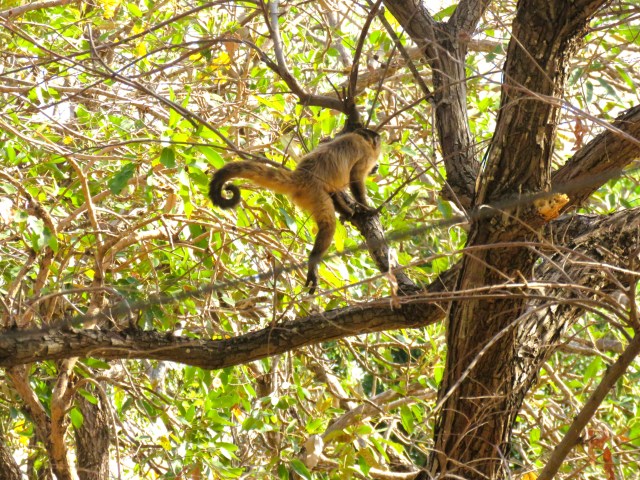
A Capuchin monkey we saw on the hike
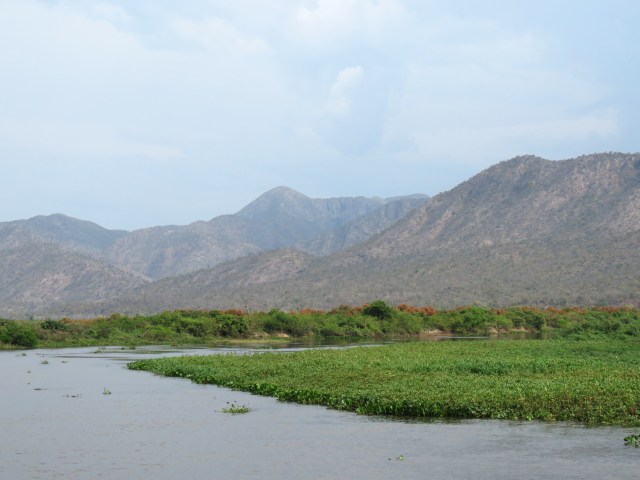
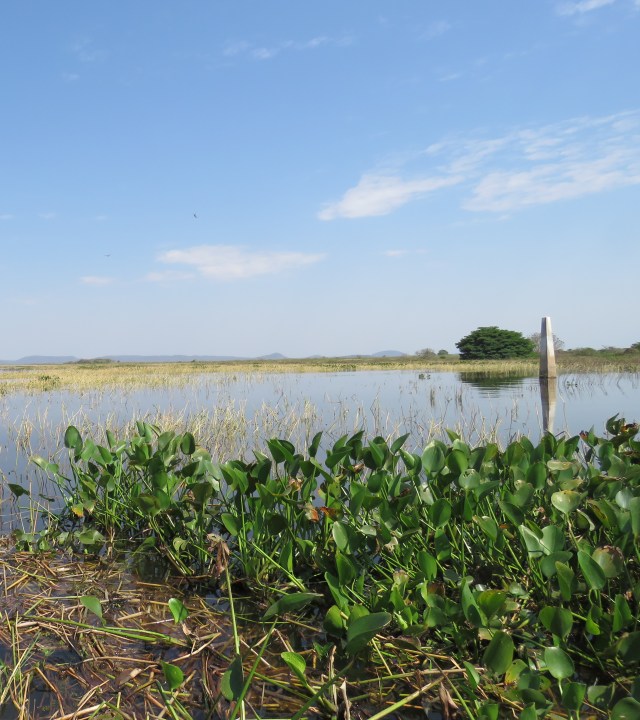
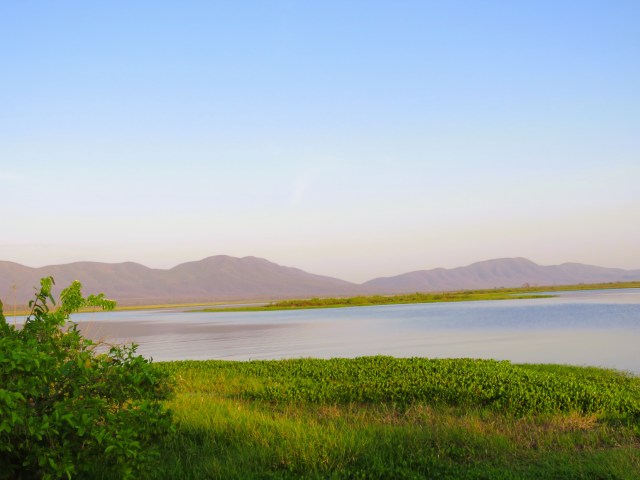
The Indian couple are waiting in the speedboat when we get back. Our boat driver takes us down a river canal which leads to a huge lake. There is a mountain range in the background so the scenery is stunning. As we motor on, there are lakes and water canals as far as you can see. This means we see huge flocks of water birds, flying, perching, and swimming. It is just surreal. We end up in Bolivia for a few minutes; the border is marked by a white post sticking up out of the water. No, we are not supposed to go into Bolivia, but we have not seen a soul since we entered this beautiful area so figure we are safe. Oh yes, the riverboat is now traveling up the Paraguay river.
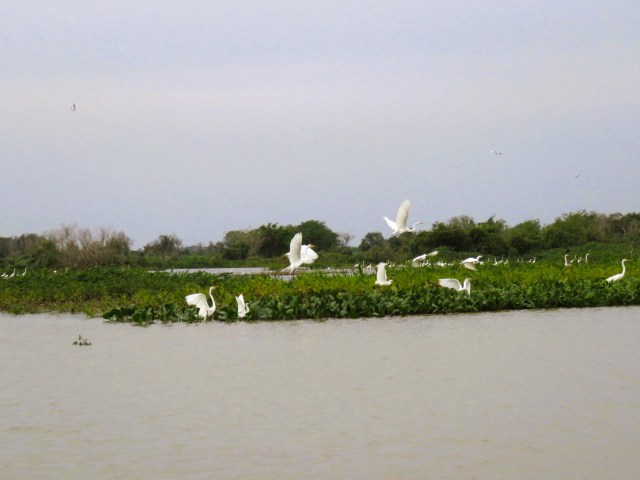
A flock of water birds
Mountain range adding to the stunning scenery
Huge water lilies, sadly they are not native plants
White post marking Bolivia boundary.
Paul enjoying the tour.
Water as far as you can see
Gorgeous views everywhere you look.
This afternoon we are going to visit what Fred calls the shopping mall. A group of women decided to start weaving crafts from the water hyacinth stems. Fred always brings his groups here because he so admires the innovation of the women. Also, very few tourists come here so they need all the help they can get. Everyone finds something to purchase. Paul and I buy a piece that resembles a capybara. I have no idea what we will do with it when we get it home but the ability it took to weave this piece is admirable.
The colorful “shopping mall”
One of the shop owners with the crafts they offer.
We leave the shopping mall behind and motor to the Pantanal National Park headquarters. I cannot remember how many acres the park is but do know it is huge. To patrol the waters and land of this enormous national park there are only two rangers! The head ranger is a personable woman who warmly greets us upon our arrival. We follow her to the office building and sign the visitors’ book. After visiting for a bit, with Fred translating, we head back to the riverboat. One thing Fred shares with us is how isolated the people who work and live here are, twelve hours by boat to a town!
Fred talking about the Pantanal National Park.
A wonderful day and I loved this scenic area. Not a bad way to spend your 49th wedding anniversary!
I have included slideshows in this blog. Below are various birds we saw. Another slide show shows photos when we were touring the expansive waters. Just click on the arrows to see all the photos.
Buff-necked Ibis
Monk Parakeets
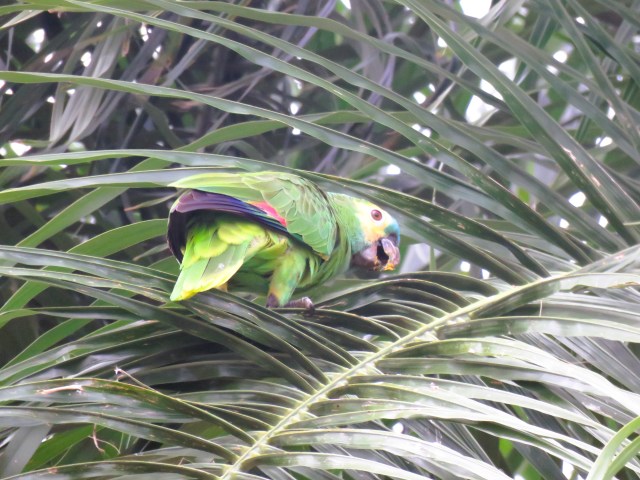
Hmm. not sure of this one. Turquoise -fronted parrot?
I always make notes in a journal at the end of the day, and this is what my first sentence was for today. Jaguar heaven this morning! Can it really be better than yesterday?
Our boat driver to the left and our terrific guide Fred.
We have not gone far on the main river when we experience a phenomenon that I will never forget. Fish begin jumping out of the river and one of them lands in the lap of the Indian woman. She jumps up screaming and runs over to my side of the boat. I get down and while trying to capture the flopping fish I keep reassuring her, (okay I am laughing too), that it is just a fish. She finally settles down, and I manage to grab our uninvited guest and toss it overboard. In the meantime, several other fish have landed in our boat. A crewman that is with us this morning is busy grabbing them and tossing them back. I know I should not have laughed as the poor woman really was freaked out. I am fairly certain I was not the only one laughing at her expense.
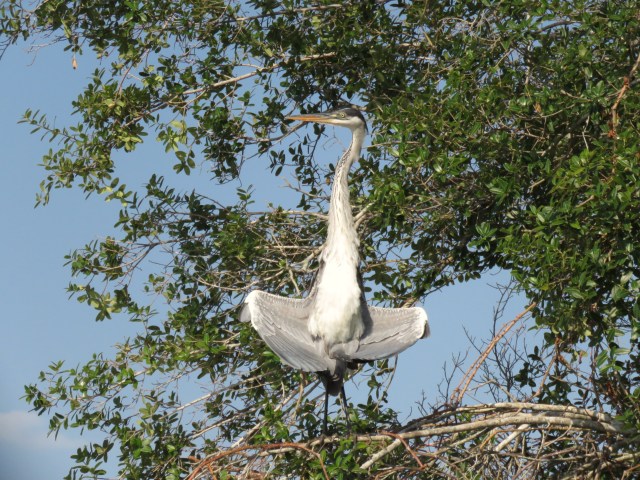
Cocoi heron posing
We have some good bird sightings this morning before we join a few boats watching Marcela as she is getting ready to cross the narrow tributary we are in. Holy smokes! No wonder Marcela slept all day, yesterday. Her belly is huge! This beauty is either very pregnant, or she stuffed herself to the point of bursting. It does not take Marcela long to reach the other side and then she disappears into the woods.
Marcela looking very pregnant or very full.
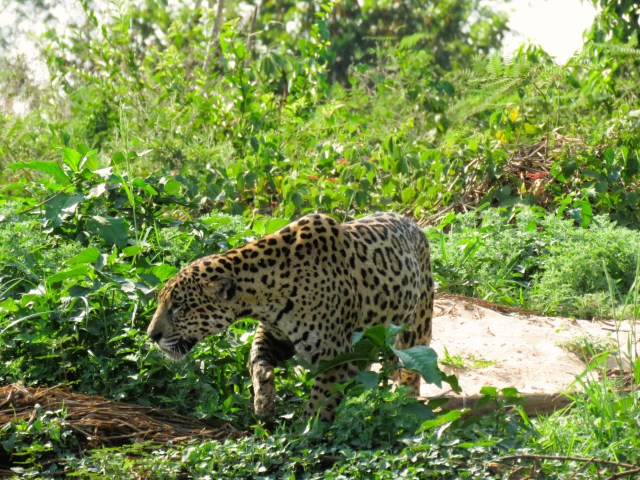
We continue exploring and twenty minutes after leaving Marcela we cross paths with Patricia and Makala walking near the water. Patricia soon vanishes into the brushy cover, but Makala decides to sit down and stare right back at us. He soon becomes bored and heads in the same direction Mom did. Well, that was cool.
Makala staring back at his audience.
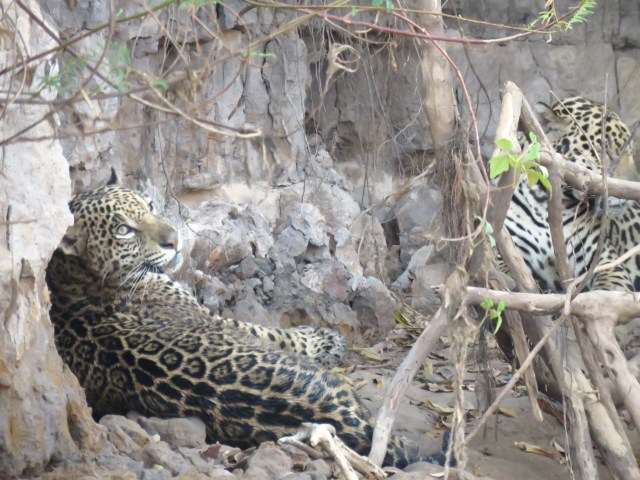
Our driver turns down another channel on orders from Fred and in a few minutes, we find Marcela sleeping in a tree! I guess that swim and short overland hike wore her out. Fred tells us this is one of her favorite trees. The guides obviously know the habits of the individual jaguars very well.
Marcela sleeping again!
This place is a labyrinth of channels off the main river, and I have no idea where we are or where we have been. I do know that we find two river otters in the offshoot of the main river we are exploring now. These otters are not cute in my opinion. To me they look flat out mean. This couple do entertain us with their playful antics. They crawl up the muddy bank and slide around in the mud, then go down into the river and splash around. Suddenly the otters go on alert. Fred sees what they are upset about as he spots Ousado emerging from some trees on the other side of the river. Ousado approaches the water and is preparing to cross when he espies the otters. He stops and intently watches the otters.
River otter. For some reason I never got a photo of the pair together
River otter having fun.
I think all of us are holding our breath as Fred quietly relates to us that jaguar fear river otters. A group of otters will not hesitate to attack a jaguar and if you could see their teeth, you would understand why. After what seems like an eternity, Ousado backs up and takes refuge on the riverbank. The otters seem to accept his retreat and start playing again. Eventually the otters swim down the river and we follow them for a while. They can stay under the water a long time and boy can they swim fast! What an interesting encounter.
Ousado staring across the water at the river otters.
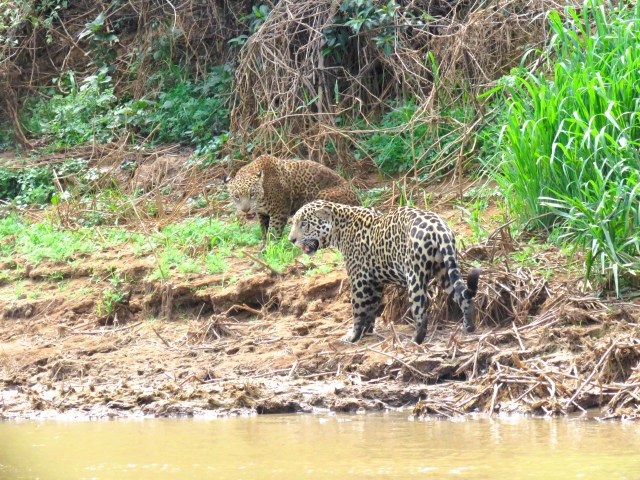
Our boat is speeding off again and this time we are taken to a pair of jaguars in mating mode. Typical cat romance, snarling, lashing out with their paws, nothing that would suggest they wanted anything to do with each other. We sit here with several other tourists watching the jaguars’ antics but the two do not mate. Regardless, a great way to cap off the morning!
Apeiara the female snarling at Bueu
Negative vibes from Apeiara!
It is a relief to be back on the airconditioned riverboat as it is sunny and very hot today. We are served another great meal. These chefs are something else. Fred regals us with stories of things that have happened with other clients of his which is very entertaining. I wonder if the fish encounter will be told to future clients.
We are off at three o’clock, but the Indian couple decide to stay on the boat. Maybe it is too hot for them, and it is stifling hot. I am wearing a neck cooler, and I am so glad I decided to buy one and give it a try. I have no idea how it works but after soaking it in ice water, it stays cool for about three hours. I do not deal with heat very well and this device has allowed me to stay comfortable.
These birds have glaring down pat!
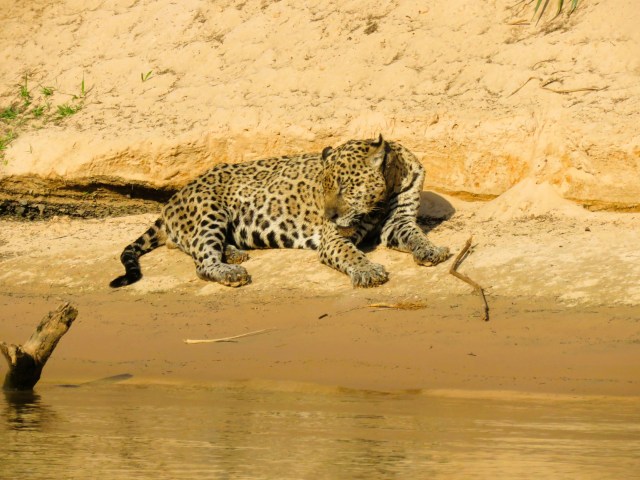
We find a jaguar grooming himself on a sandy beach. It turns out to be Ousado. Fred says Ousado is about two miles from where we saw him this morning. Fred tells us that this makes him feel more positive about Ousado’s health since he has traveled that far in a fairly short time. My question is how the old jaguar can stand being out in the direct sunlight?
Ousado grooming in the hot sun.
We meander down different channels, some quite shallow. When we are in the shallow tributaries, Fred asks us to all to move to front seats so the motor will sit higher in the water. This will keep the motor from getting clogged with the water plants. We go back to check on the mating couple which have stayed in the same area we saw them at this morning. There is no shade for the boat, so we are at the mercy of the late afternoon sun. Yikes, have I mentioned it is really hot? The two jaguars move around some, still making threatening noises and gestures towards one another. We move on after twenty minutes giving up hope that the couple will actually mate. When the speedboat is moving the breeze helps tremendously in cooling us down, so we are all happy to leave.
Apeiara and Bueu
Fred wants to check on Marcella again. I think Marcela must be one of Fred’s favorite jaguars. After we have been there a few minutes, Marcela sits up on the big limb she was sleeping on. Everyone, (a few other boats are here), watch intently in the hope we will see her ambush the caiman that poked his head up not far from Marcela’s perch. Marcela looks at the reptile and then lays back down. What a tease she is!
Marcela in her favorite tree. Beautiful blooms.
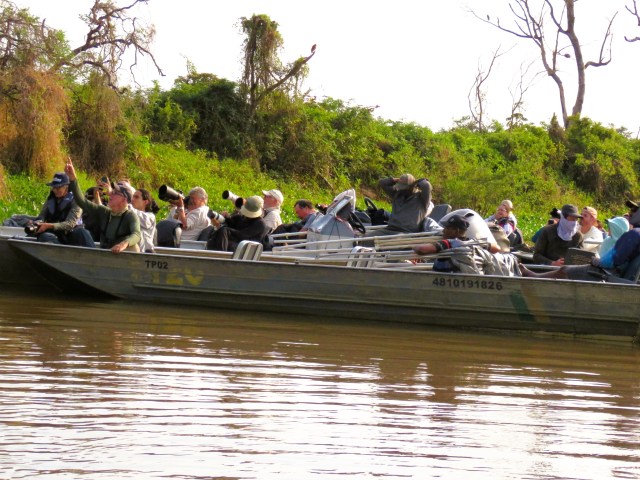
Boatloads of tourists watching Marcela.
Another beautiful sunset, great meal, and entertainment from our versatile guide.
We are up early, 4:30, and eating breakfast at 5:30. This will be our routine for the days we are on the boat. By the way, our boat travels at night so we are at a different place this morning from where it was moored last night. We load up on the speed boat at six a.m. and motor down the Rio Cuiaba river.
Our speed boat
A myriad of birds, caiman, and trees blooming in vibrant reds, pinks, and purples nearly overwhelm me. Fred is amazing on his ability to spot and identify every bird we see, also the trees and flowers. We have not been on the boat very long when it suddenly speeds up and we roar down the river. Since the other people in our group experienced the sudden acceleration yesterday morning, they know what is up and Paul and I have a pretty good idea too.
Beady-eyed Caiman.
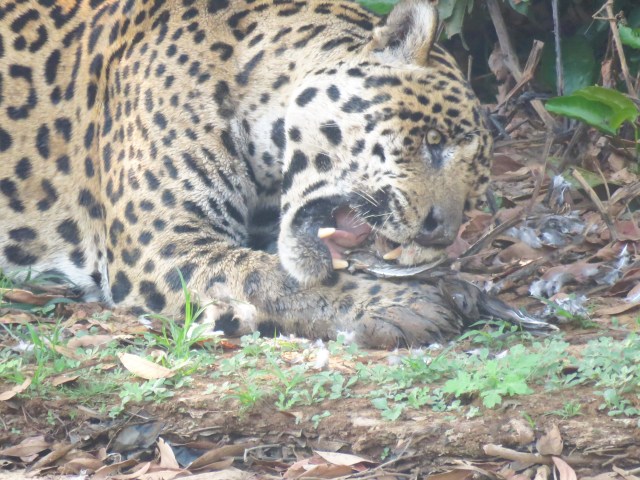
We come upon a boat sitting still in the middle of the river and when we pull up beside it, there on the shore is a beautiful jaguar. Our first jaguar! I am pretty sure my mouth drops open and my heart definitely speeds up. The big male, who Fred identifies as Tomas, is busy eating a bird. A paltry snack for this big cat but Fred says even though the jaguar’s main prey are caimans they never pass up an opportunity for a meal. We sit and watch Tomas devour his big kill. He spends more time plucking feathers and spitting them out than finding a piece of meat to eat. When Tomas finishes his snack, he stands up and strolls into the brush and trees, disappearing from our sight. Tomas never even looked towards the boats that arrived to watch him dine, which tells you how acclimated they are to humans.
Tomas eating a bird
Chowing down
We have learned from this experience that the guides share a jaguar sighting with other guides, which is good. There are so many side channels that the odds would go way down in seeing a jaguar if no one shared their good luck at spotting the beautiful cat.
We head on down or maybe up the river, and I swear we have not left Thomas fifteen minutes ago and our boat is roaring down the river again. Here is the bad part of everyone knowing about a jaguar siting. When we arrive, there are probably twenty boats watching a female jaguar as she is hunting a caiman. We never see the caiman she is after but the big cat will splash into the water, then go up on the shore, walk along the shore a little way before going back into the water. More boats have arrived and are jostling for a better spot which becomes very irritating. The jaguar seems to have given up on her quest for the caiman, as she walks into some dense bushes that engulf her. Our boat and the others proceed in the direction she headed and sure enough the big cat comes back into the open. The jaguar shows no inclination of continuing her hunt. Fred asks us if we have had enough. We all agree we are ready to leave the chaos behind. There were probably thirty boats by the time we left.
Female jaguar hunting in the river.
Giving up the hunt
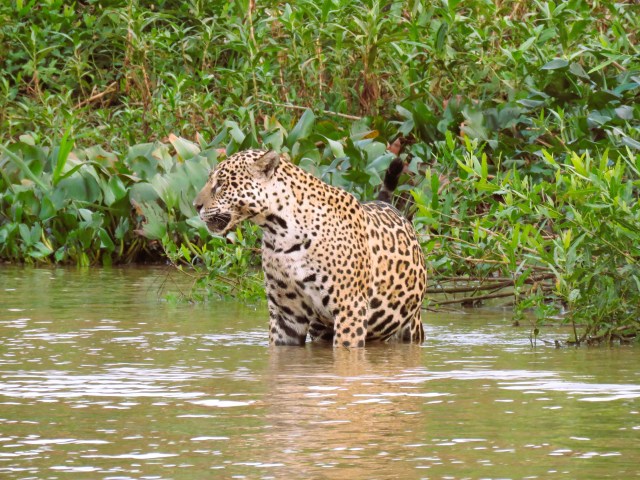
As we cruise down the river, Fred, and our boat driver, simultaneously call out “Jaguar.” Are you kidding me. I must be dreaming, how in the world have we seen three jaguars within an hour or so? Fred immediately knows this male jaguar because he is wearing a radio collar and he has quite a story behind him. Ousado was rescued after a devastating wildfire in this area in 2022. Ousado had been burned badly particularly his feet. I think Fred told us he was under human care for a year and then returned to the wild. He is the only jaguar with a radio collar. Ousado is ten years old which is old for a jaguar particularly one that went through the trauma that he did. Fred notices that he is missing a back toe which is still raw. When Ousado stands up we see how bony he is and that he is walking slowly. Fred shakes his head and wonders out loud how much longer the old cat will survive. I would have to agree with our guides assessment. We are joined by two other boats which after the last jaguar encounter is a marked improvement. As we are leaving Ousado, other boats are speeding our way so we timed our departure just right.
Ousado with injured toe
Ousado showing his age.
Our boat driver takes off and soon we have joined several boats that are clustered near a tree growing next to the shoreline. This is crazy. There is a jaguar sleeping in the tree though she is so hidden that all you can see is her head and front paws. All the staring human eyes and boat noise does not even wake her up. Fred identifies her as Marcela. The jaguars in the identification project are named and identified by the markings on their heads or unique spots on their sides. We stay for a bit to see if the snoozing lady will wake up and do something to entertain us but all we get for the time we are there is seeing her open her eyes once.
Marcela in the tree proving she is alive by opening her eyes.
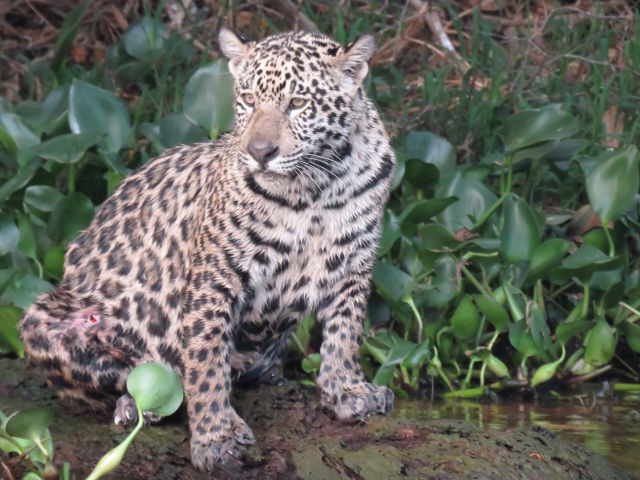
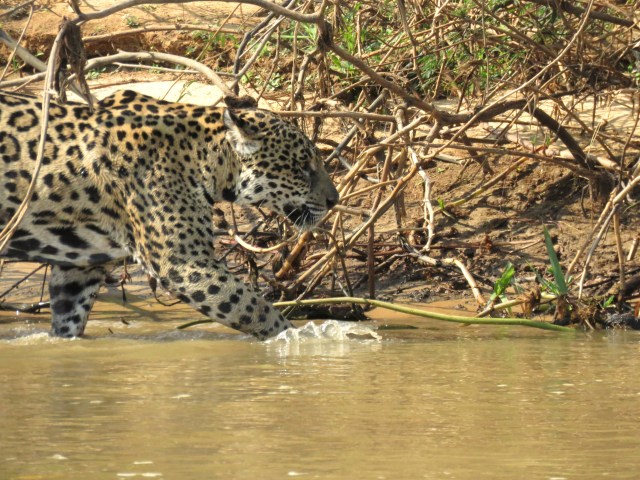
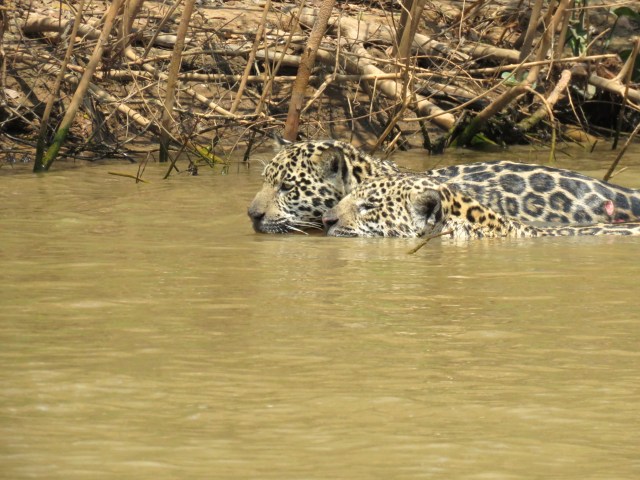
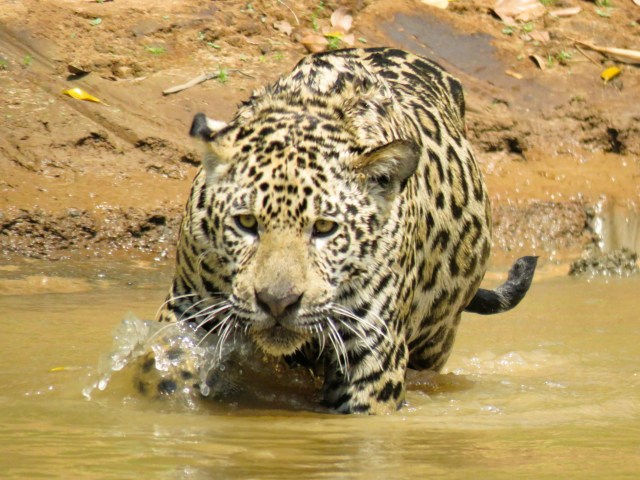
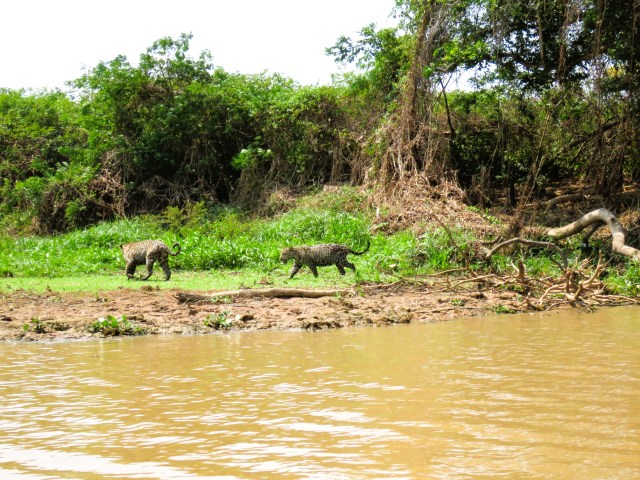
Are you ready? We are speeding away again and soon join a few other tourists in watching a mother and her big cub swimming in the river. How amazing to see cats leisurely swimming. Jaguars often choose to swim in the river to travel to another place rather than go overland. The pair swim near the edge of the river for quite some distance and their entourage of speed boats filled with humans follow slowly on the other side of the river. When the pair emerge from the water, we get a good look at them and see that the male cub is nearly as big as his mama. The cub named Makala has what looks like teeth puncture wounds on his hips. Who knows what put them there but maybe a male jaguar? Patricia, his mother, slowly ambles into the cover of trees and brush with Makala not far behind although he is more curious about we humans and stops to look at us occasionally.
Patricia and her cub Makala swimming in the river.
Makala looking at us straight on. It is hard to believe he still relies on his mother.
Patricia and Makala heading inland.
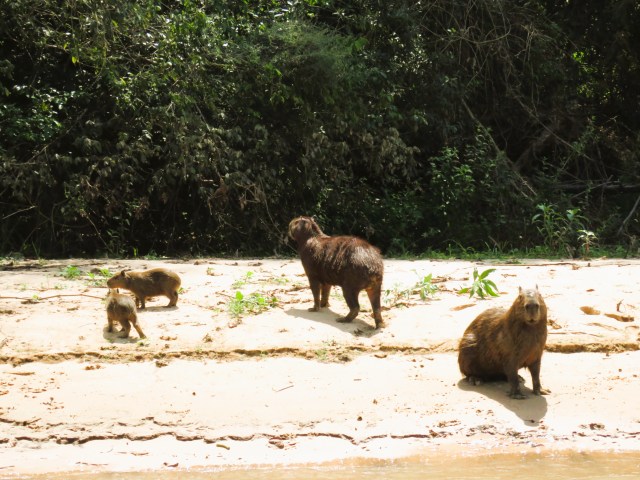
It is time to head back to the boat for lunch and as we arrive there is a family of capybara standing on the beach not far from where our riverboat is moored. Our boat driver takes us near the rodent family so we can snap some photos of the huge, odd-looking creatures. We have seen many of these giant rodents already, but the lighting and the little ones make for a good photo op.
Capybara family near our river boat
Once on the boat we enjoy a wonderful lunch served buffet style. We have a couple hours after lunch to rest up. If anyone would have told us that we would see six individual jaguars within a few hours on the river I think all of us would have laughed out loud! I still have trouble believing our good fortune.
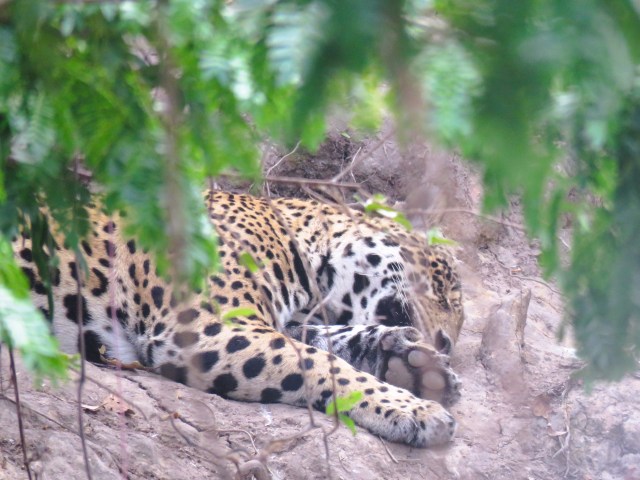
We leave for our afternoon exploration at three o’clock. It is hot, in the 90’s, but it is cloudy which certainly helps. Fred wants to go back and check on Marcela to see if she is still sleeping in the tree. Marcela has left the tree and is now napping on an embankment a few yards from the tree she had been in. Again, Marcela does not move or even open her eyes. I wish I could sleep that well. We do not stay long as there is way too many boats filled with patient people hoping the lazy jaguar will wake up and entertain them.
Marcela sleeping on the ground.
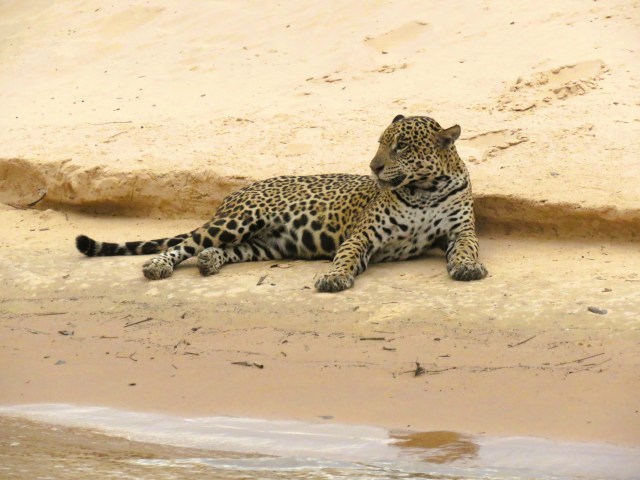
Our boat driver takes us down a small channel and we have not gone far when we join a few boats watching a female jaguar walking on the sandy beach. The lovely lady lays down but after a few minutes she decides that she is thirsty and walks down to the river to drink. Watching any cat lap water is fascinating to me as I do not see how they ever manage to get enough water to satisfy them. There are more boats arriving all the time, so we say farewell to the seventh jaguar we have seen today. Paul and I just shake our heads at this unbelievable day in Brazil. I guess the misery of getting here was worth it. Thanks for sticking with getting us here Paul!
Female Jaguar resting on a beach.
Jaguar quenching her thirst
Fred decides we need to check on Marcela one last time and we find her in the same area, and she is still zonked out. Because there are a lot less boats we are able to see all of this slumbering cat. Marcela will probably start prowling once the sun sets and all these bothersome tourists are gone. We enjoy another gorgeous sunset before going back to the riverboat.
Marcela hasn’t moved but we get a better look at her.
Once we are on the boat, we all head to our rooms to clean up before supper. Our cabin is much like the room we had at the airport. A bed with room for luggage underneath it, a small wardrobe to hang clothes, and a bathroom. It is small but we will not be spending much time in here anyway.
We head upstairs to the dining area and Fred is already playing the guitar and singing. Yes, our guide is multi-talented. He often sings popular American songs in English of course, but occasionally sings a Brazilian song in Portuguese. Fred then presents his “Fred talks” where he has photos he has taken on a computer about the animals he is educating us about for that night. I think tonight it was on capybaras. Fred also has a camera with those long lenses and his photos are stunning. A wonderful meal is just the icing on the cake of this incredible, unbelievable day!
Almost two years ago Paul and I shook hands to seal our agreement that we were finished with international travel as we headed back home from Egypt. Now we are heading for the Manhattan airport to catch our first flight on our way to Brazil. Why did we break our no travel pact? Because Paul found a tour that basically guaranteed that we would see Jaguars. Well heck, the one big cat beside snow leopards that we have not seen. After a few hems and haws from me, the decision was made to go.
Ah yes, the wonderful part of any trip is the journey to get there. Pure sarcasm on my part. Our flight from Manhattan is delayed by an hour. No problem since we have an eight-hour layover in Dallas. We make it to Dallas and after a few hours, passengers begin to line up to board the plane that will take us to Sao Paulo. Ten minutes before actual boarding time an announcement is made telling us our flight has been cancelled. I guess since the crew had not gotten on the plane yet should have been a clue something was wrong. The weather is fine so it must be a problem with the plane, no explanation is given for the cancellation.
While we are standing in line for hotel vouchers, Paul is already reaching out to Exito, the people that booked our flights. A young man from Brazil happens to be standing next to us and he asks us about the hotel choices that have come up on his phone app. Paul checks his phone and he too has the hotel voucher on his app. We tell the young man that none of the choices are great, but we will go with La Quinta over Motel 6 and Super 8. Ed goes with our decision for his hotel choice too. We also get meal vouchers you can use at the airport worth twelve dollars which makes our new acquaintance laugh saying you might be able to buy a cup of coffee for that amount. Ed gets on his phone and connects with the hotel who has a shuttle in route to pick us and other passengers up. Paul continues to work with Exito and now has a representative from the tour company making suggestions too. We have more confusion as we cannot find the shuttle once it announces it has arrived but Ed who is conversing with the driver realizes we need to go down one level.
On the way to the hotel, Paul continues to correspond via What’s App, with Abigal our tour operator and Exito. We make it to the hotel, and before going to our room we make plans with Ed to catch the same shuttle in the morning back to the airport.
I take my glasses off when we get to the room and hear something hit the floor. For crying out loud, one of my lenses fell out. Well, this is why you bring an extra pair. By the time I am ready for bed Paul and the people helping him have booked us on a later flight to Cuiaba that will still allow us to catch our private flight to Port Jofre with the rest of our group. I forgot that if our flight had not been cancelled, we would have been spending the night in Cuiaba before taking the final flight to Porte Jofre.
I wake up early to find Paul on the phone again chatting with our tour and flight coordinators. Guess what? Our departure time was moved back in the middle of the night so a new set of plans must be made! Upon hearing what it entails I tell Paul maybe we should just go home. Paul considers this but decides we should try to follow through. I reluctantly agree. The new plan is that we will get to Sao Paulo in the wee hours of the morning, spend about three hours in an airport hotel, catch our Cuiaba flight, then be transported by a private driver and a guide to Porte Jofre. We darn well better see a jaguar!
After eating a typical hotel breakfast, we join Ed and other passengers on the shuttle that takes us back to the Dallas airport. Our flight is delayed this morning due to heavy rain, but we do get off the ground around noon. Ed has joined us while we wait to board the plane. At one point he needs to go see if he can get his connecting flight to Cuiaba straightened out and asks if we will watch his carry-on luggage. Of course we will. When Ed comes back, he gives us a big box of Lindt mini-candy bars. We protest that we should be treating him for all his help. How kind is that?
Paul and I opted for Premium Economy and boy is it worth it. We have two seats on the right side of the plane and our friend Ed is on the left side. Glad we were not in the middle where there are three seats. We arrive in Sao Paulo at 1:30 in the morning but our checked bag which is packed with trail cameras for the people that run the Jaguar Identification Project does not show up. There are several passengers who have luggage that does not come on the carousel. A young woman comes up to me and asks if our bag is a duffle. Yes, it is. She tells us that they found their duffle bag in the lost luggage area. Someone told them that the baggage handlers do not put them on the conveyer belt since they tend to fall off. I walk over to lost luggage and sure enough our duffle bag is sitting there. Thank goodness for that thoughtful person to let us know or we might have never found it.
Guess who has been waiting for us all this time while we were looking for our luggage? Our guardian angel Ed. He and another Brazilian who works for American Airlines, walk us to our hotel which is in another terminal. Along the way Ed tells us where we will have to check our luggage in and points out the gate where our flight leaves from in the morning. A good thing they escorted us as we would never have found this hotel that is tucked away in a corner of the airport and at this time of morning there is hardly anyone around to help you. After our personal escorts make sure we have a room they leave to go to the other airport hotel. We enter our room at three in the morning. The first thing I do is hit the shower before laying down in hopes of a little sleep.
We are up at 5:30 and out of the small room by six o’clock. It is a good thing as we walk into a mad house. People are everywhere. We go to the area where we think we need to check in our duffle bag, but Paul cannot get the woman who is standing at the entrance of the aisle to pay any attention to him. People keep pushing in front of him but eventually he gets confirmation on where to go. After getting the bag checked in, we proceed to our gate. Paul has the tickets on his phone, and he gets through just fine. He gives me the phone and for some reason my ticket is refused. The women running the gate will not let Paul back out and she points and tells me to go over there. Over where? I am freaking out that I may have to go back to the check-in area but Paul sees the line she is talking about and walks down to show me where it is. I join lots of other passengers whose ticket codes were also rejected. I get through this check point with no trouble. Obviously, a rejected code is not unusual.
Once inside we find the gate where we will be boarding and Paul goes off to buy himself a sprite. After sitting there awhile I am astonished to look up and see Ed. He tells me he wanted to make sure we found our gate. Paul shows up and we visit with Ed until it is time to line up to for boarding. I still find the kindness of this young man unbelievable. I will add that on our last trip to Brazil almost 20 years ago, our connecting flight out of Sao Paulo was cancelled. As we were talking about what we should do (no cell phones then) a young man came up to us and asked if we were the Miller’s. It turns out he was our guide, so he took over and solved our problem! What are the odds?
We boarded our flight on time, but we are not sitting together, guess we were lucky they had 2 seats left on this flight. Once we reach Cuiaba, our duffle bag shows up, our guide, Zainia, is waiting for us and she takes us to the vehicle where Reece, the driver, packs up our luggage. Reece drives us to a barbeque restaurant where the waiters bring all kinds of meat to your table and slice off what you want at your table. You go through a buffet for the side dishes. I do not eat much but what I have is excellent. Paul tries small pieces of just about all the meat except the fish.
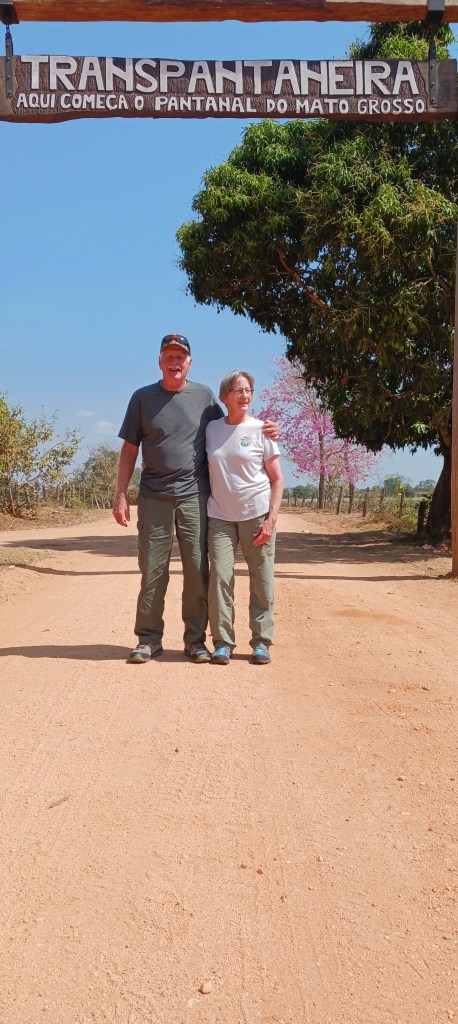
We take off on our four-hour drive with most of the road trip on the Transpantaneira highway which is a very rough dirt road with around a hundred or so bridges. The last time we were here they were all wooden, but many have been replaced with modern bridges. These are small bridges. We see cayman, lots of birds, horses, cattle, and a few deer on our drive while we listen to Zainia tell us about what we are seeing along the way and some of her experiences as a guide.
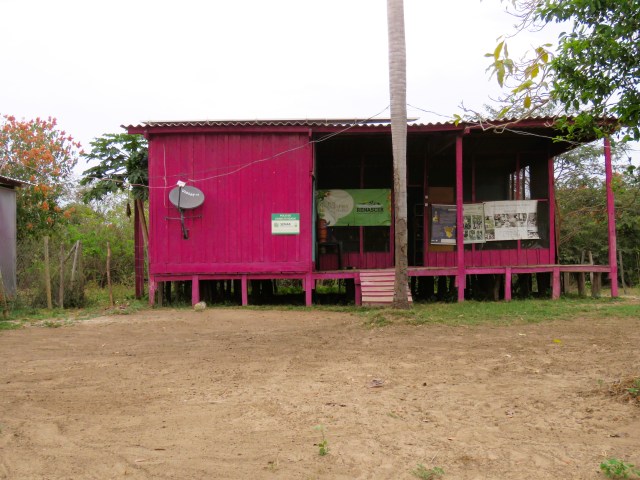
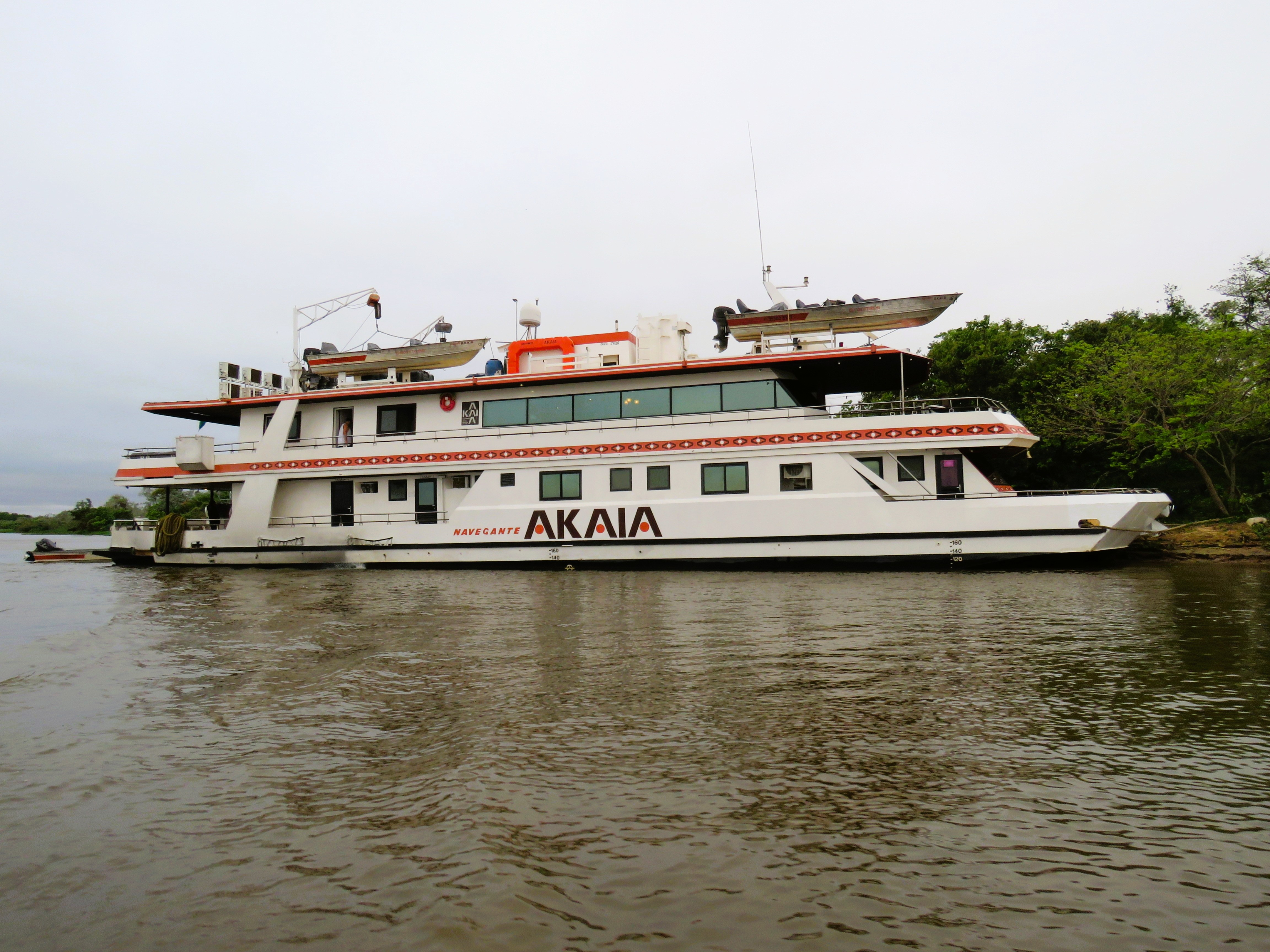
Our home for the next six nights.
Once we reach Port Jofre, we wait 20 minutes for our guide Fred to come pick us up in the speed boat. We see a hyacinth macaw plus other birds while we are waiting. The other six members of the group are also in the boat. We say thank you to Zainia and Reece then get on the speed boat. The boat driver takes us to the river boat where we will spend the next six nights. I assume that Paul and I will get off with our luggage but Fred says no, we are going with them to explore a river channel. We meet the group, a couple from Colorado, two more couples from South Africa but one of those couples are from India who moved to South Africa. The three men and the woman from Colorado have cameras with unbelievably long lenses on them!
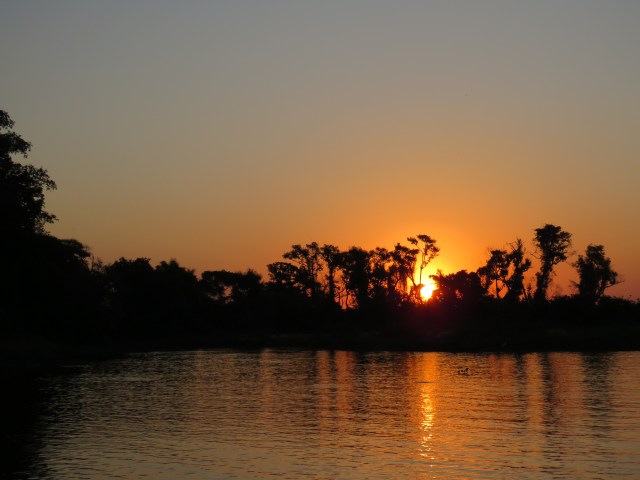
We see birds everywhere and Fred knows every one of them. No jaguars but we do have a gorgeous sunset. Paul and I are exhausted but we enjoy the excellent evening meal and find Fred very personable and knowledgeable. We visit with the other people in the group a bit but excuse ourselves early to go to bed as we are exhausted!
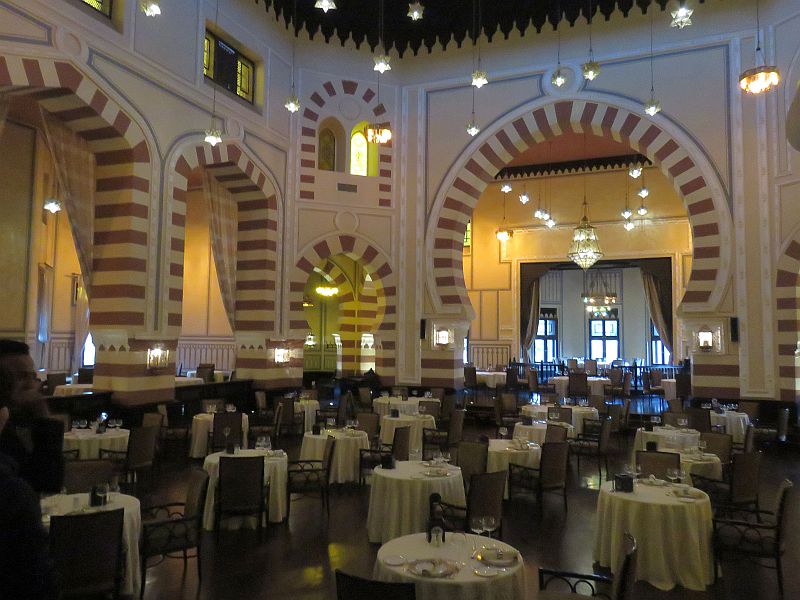
Breakfast is in the Palace Wing in what is called the 1902 Restaurant. There is a huge buffet laid out and you can have eggs made to your order. Hussein told us yesterday when he showed us this restaurant that if you eat here for lunch or dinner you must dress in “appropriate” attire. That leaves Paul and I out since all we have in our suitcases are hiking type clothes and a pair of blue jeans.
1902 Restaurant
Speaking of clothes, I forgot to write in my last blog that Hussein had a call from the Captain of the Aida a day or two after we left that wonderful ship. The captain reported to Hussein that his new clients from OAT were shivering in their cabins because it was so cold. Man were we lucky on having warm weather, and to think we questioned why OAT had advised us to bring warm clothing.
We leave the hotel at nine o’clock and our bus driver drops us off at the entrance of the pier where our boat is waiting to transport us to the temple. Hussein must purchase the tickets for Philae before we board the motorboat so while waiting for our guide, several men vendors try to sell us items, particularly Egyptian style clothing. The salesmen have no luck with anyone in our group purchasing anything. When Hussein returns, he calls out his familiar “follow me” and we trail him down a long wooden dock. We must walk in the middle of the pier as both sides of the dock are packed with vendors displaying their wares. We reach our boat, climb on board, and find a seat on the padded benches.
Before we can begin our journey to the island, we must escape the crowded mooring area. As soon as our boat begins to back away from the dock, other boats begin vying for the place our boat is leaving. It is complete pandemonium. The small boats all have tires attached on the sides of their vessels and it is soon apparent why, because they bump into other boats. As one aggressive “captain” begins to push his way toward the spot we are trying to leave, Hussein tells everyone to lean forward. He gives this advice so you will not get hit by the protruding tires. Paul does not react quick enough and gets thumped in the back by the tire of the encroaching boat. Paul says the tire did not hit him very hard and he is fine. Jeez, this is crazy. The stench of diesel fumes is the icing on the cake.
Boat dock pandemonium. One member of our group trying to block the diesel fumes.
We finally break free of the Nile version of bumper cars, (boats), and make our way to Agilkia Island where Philae Temple is located. Hussein has invited a jewelry salesman to make the trip with us, musing that he felt dealing with one man instead of being waylaid by dozens would be less stressful. Our personal jewelry salesman has success on our trip as various members of our group purchase necklaces and/or bracelets. I do not wear jewelry, (nor does Paul), so as it was in the spice market, we are not one of the fellows’ customers. We are a souvenir sellers’ worst nightmare!
Our personal salesman.
When we arrive at the temple, Hussein schools us in the history of Philae. The temple is dedicated to the goddess Isis and Egyptians worshipped her here along with Osiris and her son Horus. Like the Ramses II temple, this complex of temples and buildings were going to be end up under water by the building of the Aswan dam. Again, UNESCO came to the rescue and moved the stone blocks from Philae Island to Agilkia Island where the Philae complex would be safe. This project took ten years to move the temples and buildings and reconstruct them.
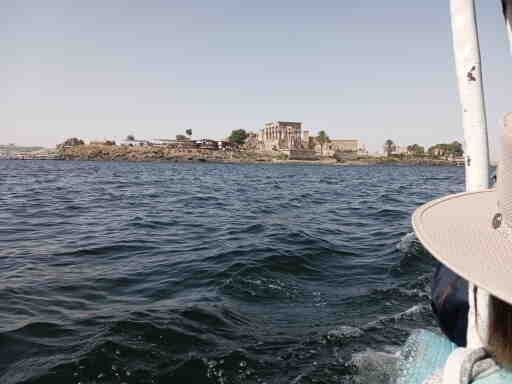
Approaching Philae Island. Paul’s photo.
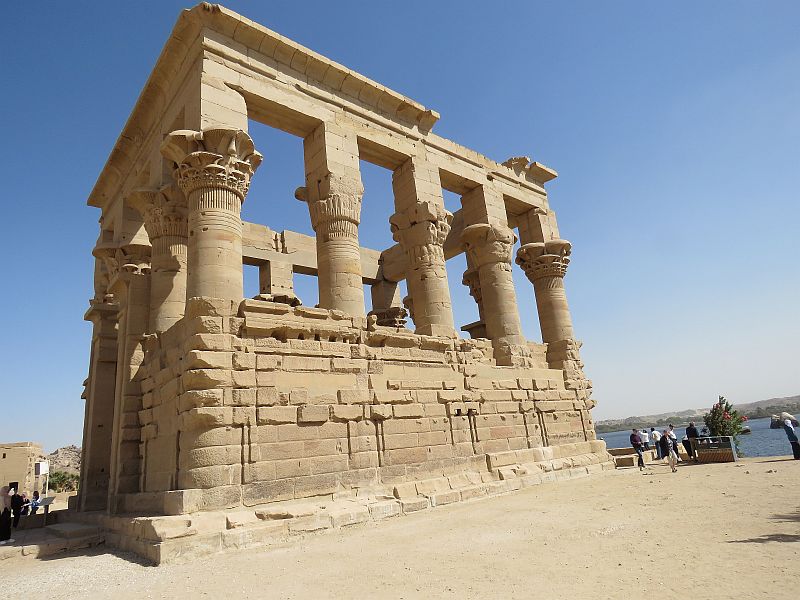
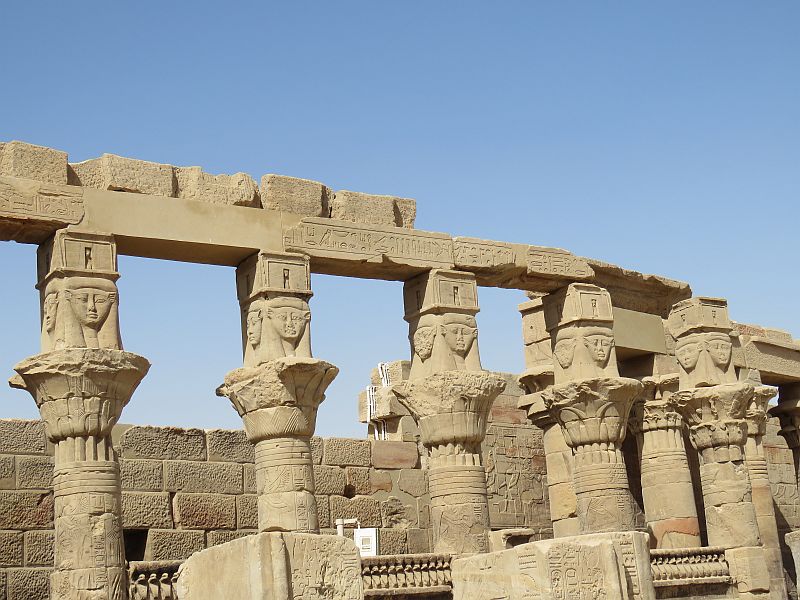
We wander through the Temple of Isis, which is crowded with other tourists and look at the carvings dedicated to this goddess who had many titles including “The Queen of all Gods.” Hussein shows us around the rest of the grounds on this small island. One of the stone buildings is an eye-catching rectangular structure that has the nickname “Pharaoh’s Bed.” With my imagination I can turn the stone structure into a gigantic four poster bed but doubt that is why it was given the nickname. There is a hypostyle hall where the impressive line of stone columns has lotus petals carved at the top of the pillars. A smaller structure has six stone pillars with the face of Hathor carved upon them. Once Hussein has finished showing us around, he allows us to explore things on our own for thirty minutes or so. This is a beautiful place, and it is accentuated with the stunning views surrounding the island.
Slide show of sites on Philae Island.
We board the same boat that we arrived on and the person who had left their backpack on the boat by mistake is relieved to find that it is still there. The group member informed Hussein about forgetting the backpack as soon as they realized they had left it on the boat. Our guide immediately called the boat owner to alert him about the pack so he would keep it safe. This was easier than recovering the cell phone that was lost by one of our companions, on our second day in Cairo. That entailed a trip to the police station for Hussein and the phone’s owner. At the station Hussein was somehow able to track the phone and could see that that the lost phone was on the move. At first, they assumed it was stolen but on further investigation determined it was on our bus. Hussein called the driver and after searching the bus he found the phone laying under a seat. Amazing. According to the phone owner, Hussein solved the location of the phone himself. Is there nothing this amazing man cannot accomplish? I can imagine our traveling companion regaling friends by beginning the story with “I was taken to the police headquarters in Cairo!” I am not guaranteeing that this is a completely accurate rendition of the story.
Ancient ruin at water’s edge.Hieroglyphics we saw on our boat ride.
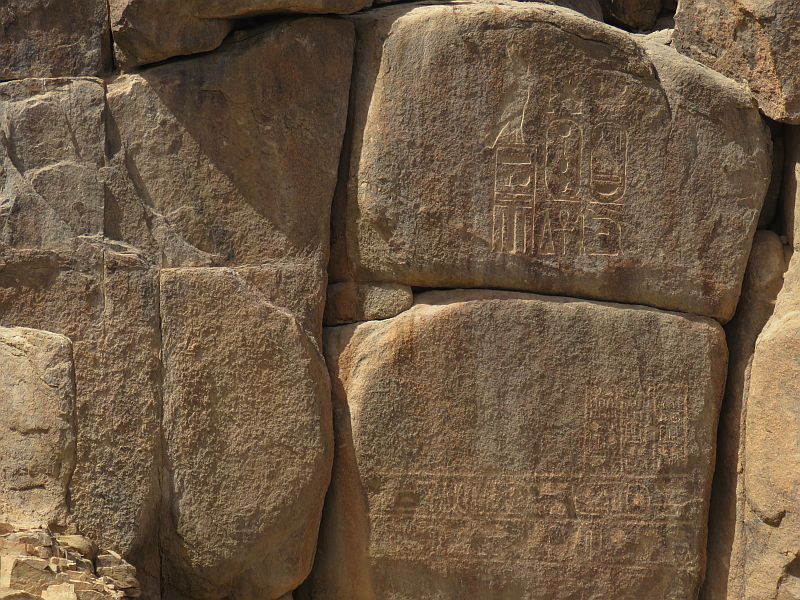
When we leave Agilkia Island, Hussein has our boat captain chug alongside the shoreline where he points out remnants of ancient stone structures and even some hieroglyphs. We reach our destination for lunch which is a waterfront Nubian restaurant and guesthouse atop a cliff. What a colorful place. We climb up a fleet of stairs to reach the restaurant and find tables prepared for our group. The specialty is a fish dish, (Paul who is allergic to fish cannot have this), but most of us order it. I must say it is delicious. After our lunch we board a different boat which hauls us back to our starting point.
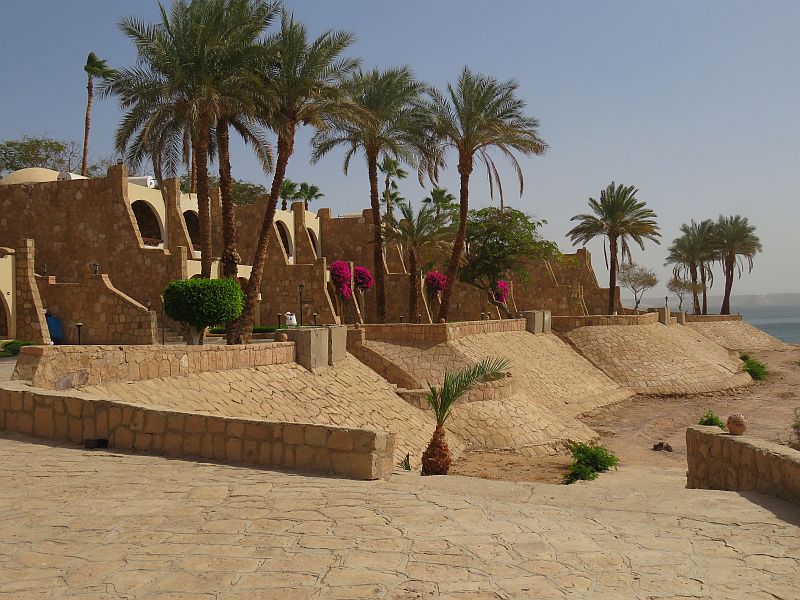
This is where we ate lunch.The colorful interior.
I decide I want to buy a small stone cat for the woman who is taking care of our two cats while we are traveling. Hussein tells us to only pay five or six dollars for this item. I spot some cat statues among the myriad of things one man has on display. I pick one out and Paul asks the man the price who states that the statue is 25 dollars, knowing we will negotiate. It is then that I realize our group has left and is exiting the pier. I tell Paul that they are leaving us and hurriedly begin to walk after them. The salesman follows us and now is offering the cat for twenty dollars which Paul counters with our original offer of five bucks. One of the women in the group sees that we are trying to catch up and turns around telling us they are going out to where they are selling the apparel as they hope to buy a scarf so we should take our time in buying our gift. Oh. It just so happens that we are standing by another man’s display, and he has many cat figurines for sale. I find one that is much nicer than the initial cat I was going to buy. When Paul asks him how much for this very detailed cat, he immediately says five dollars. Suddenly the man that has been trailing us decides his cat is only worth five bucks too. Guess which one we bought?
Hussein gives us two choices once we are back on the bus, we can visit a papyrus and jewelry market, or stay on the bus and continue back to The Old Cataract Hotel. Seven of us stay on the bus, while the rest of the group, including Jennifer, go with Hussein to tour the market. Jennifer told us later that the Papyrus and jewelry market was mostly a place to purchase jewelry or papyrus items. A woman did give a short demonstration that showed the process of making papyrus paper which Jennifer said was interesting.
Once in our room, Paul and I rest for a while and then do some packing as we will be leaving early in the morning for Cairo, (cannot wait to get back there, I am being sarcastic). We then go out and walk around the beautiful grounds of this historic hotel. We walk down to the edge of the Nile and watch the sailboats and ferry boats that tourists can hire for a short ride on the Nile. We are following a group of people back up the stairs who are being flanked by a big, burly guy that is obviously their security guard. Every time the guard steps up with his right leg, we catch a glimpse of what we assume is his gun. However, it appears to have three bore holes on the end of it which makes no sense. We are both leaning forward trying to get a better look at this odd piece of hardware, when a voice behind us says “We are a Jewish group, and we have to have security guards.” Paul relates to the man that we too have had security guards in the cities while on tour. We do not tell him that we were trying to ascertain what the heck that guy was carrying at his waist hidden under his suit coat. A mystery never to be solved.
One more look from our balcony.
At our farewell supper, Hussein asks all of us to relate to the rest of the group what our favorite part of the tour was. Although many people listed things like the hot air balloon ride, or the Valley of the Kings tombs, everyone acknowledged that the time on the Nile was at the top of their list. Paul and I also comment that our farm visit with Sayed was something we will never forget. One thoughtful person proceeds to tell Hussein how he was a big part of making our adventure in Egypt extra special. Everyone agrees with this, and we give our guide a round of applause.
We are up at five a.m., finish packing, and place our two check-through bags in the hallway. We go to eat breakfast at 5:45 taking our hand luggage with us. Hussein has us loading up on the bus by 6:30 and we are at the airport after a short drive. Once I am through the screening line, I look around to see where Paul is. I spot Paul and see him taking things out of his backpack and handing it to the man who is screening the luggage. Finally, the fellow finds what he has been looking for. Paul hands him a flat piece of plastic the size of a credit card and not much thicker. The plastic box contains a miniature knife and scissors. This was an item that was a give-away from some company, but Paul did not know it was in his pack. The kicker is that this escaped the attention of every screener on the journey to Egypt, but this eagle-eyed man spotted it at this small airport.
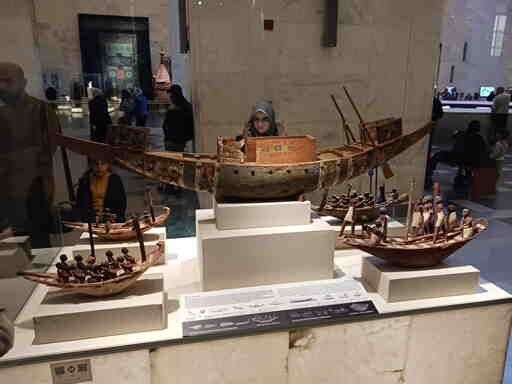
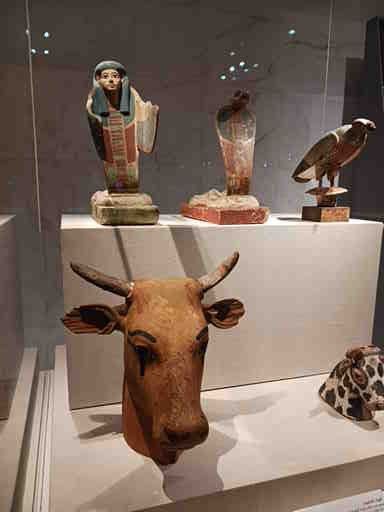
Everything else goes smoothly and we arrive in Cairo an hour and a half later. We gather our luggage and climb into our waiting bus. We stop at The National Museum of Egyptian Civilization where the exhibits portray the different historical periods of Egypt. The museum exhibits are very well showcased and most of the displays have placards written in both Egyptian and English that explain what one is looking at. Jennifer, Paul, and I take our time perusing the displays and then go down to the bottom floor where there are royal mummies on display.
Some of the items on display at the museum. Paul’s photos.
The lighting is dim in this portion of the museum and there is a no photos rule. The first mummy we see has its mouth open and it looks like the shriveled, brown corpse is screaming. To make things worse one of the arms appear to be broken. Oh man, that is all I can take. As the three of us wind our way through the maze of rooms I literally put my hands up alongside my face, using them like blinders on a horse, whenever we walk by a mummy’s glass encased dwelling. I also look at the coffins or statues that are on display in the rooms. I must confess it seems to me that the display of the mummies is morbid and demeaning to that ancient person everyone is staring down at.
All of us appear at the meeting place Hussein gave us at the appropriated time except for one couple. Hussein directs the rest of us to where the bus is and we climb aboard while he goes to find the missing pair. A few minutes later we spy Hussein walking towards us with the wayward couple. I never heard what the problem was but assume they had not heard the correct meeting time or had not understood where we were to meet.
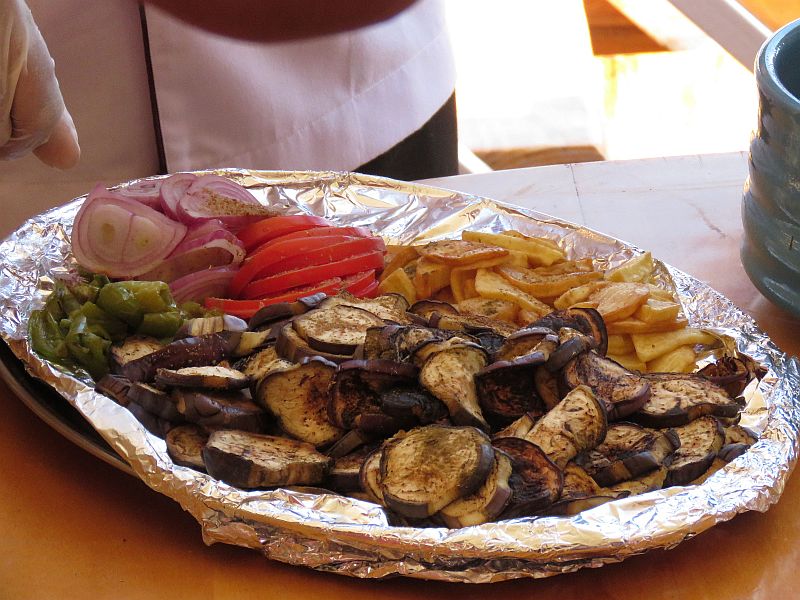
We eat lunch on one of the riverboats and the waitstaff bring out small plates of various foods such as small sausages, eggplant, breads, for us to pass around the table. I am still being very careful with how much I eat and what I eat so I don’t have more than a bite or two of the various foods served to us. I see a waiter with a plate of French fries and assume he is serving them to the couple at the table next to us. Without thinking I exclaim in an envious tone that “those people are having French fries!” When the waiter ends up placing the fries on our table along with a few more plates of fries, I express my delight that we are being served the fries. I love French fries. Luckily for me, most of our group has filled up on the other dishes we were served, and I demolish the big end of one plate of fries. They were delicious.
Upon leaving the parking lot our bus driver must back our bus up because a car is driving toward us and due to cars parked on either side of the narrow street there is no place for the bus and car to get past each other. The driver has only inches to spare on either side of the bus as he continues in reverse until the advancing car finds a place to park. Hussein is shaking his head and tells us that the professional driving is one of the things he so admires about the bus drivers. Everyone agrees with him as our drivers have all been superb.
We get checked into our rooms at the Marriot but unpack only what we will be wearing tomorrow and our toiletries. We have a very early wakeup call tomorrow to catch our morning flight home. At least we will have a few hours to sleep, some of our traveling companions leave for the airport around midnight if I remember correctly.
We still have one meal together this evening, and even though our lunch was at two this afternoon somehow, we all seem to be hungry. Tonight, all of us individually present Hussein with our gifts of money that he has definitely earned. Jennifer, Paul, and I combine our tip for Hussein in a card that features a photo of the Flint Hills on the front. We each have written a message for our wonderful guide, thanking him for a great trip. At one point during the meal, I ask Hussein if he has a photographic memory. He smiles at me and says that he looks at his clients’ photos and names once and knows the names and faces from that moment. I kind of figured the man had this gift. After the meal is finished, all of us hug or shake hands, and say goodbye to those we will not see again. This was a fun group of people to travel with.
It was a short night, but Paul and I did get a few hours of sleep. Setting the luggage by the door we go to the lobby to meet with the others that have the same flight as we do to Munich. Hussein is here which is a surprise since he intended to take the train home. Hussein does not like to fly. Unfortunately, he was not able to book a seat on the train. Each of us are handed a paper sack containing a ridiculous amount of food for our breakfast. Hussein tells us we can leave what we do not want to take into the airport on the bus as the driver will find a use for it. As we leave the hotel, Jennifer and I quietly laugh at the two seated security guards that are sleeping. There is a third man who is awake and upon seeing our reaction to his snoozing buddies, he says something that wakes them up and they all start laughing too. On our trip to the airport, Hussein is asked what he is going to do now that he has some time to himself. Our guide tells us with a smile that he is going to turn off his phone and sleep for twenty-four hours!
We get through the check-in and security without a problem except I tell Jennifer that I hope my pants do not fall down when we have to take our belts off. I am only half kidding as I have had to cinch my belt a notch tighter than when we came to Egypt. (When we get home, I find that I have lost eight pounds!) We part ways with Hussein and find our departure gate. We have arrived at the airport in plenty of time and must wait two hours before we begin boarding.
Paul and I are sitting next to an Egyptian woman who was seated before the rest of us passengers boarded since she had wheelchair assistance. As the plane is preparing to land a stewardess tells the woman that she will need to stay seated until everyone else has left the plane. I ask her what about us and she says that we will have to wait until they come to get the elderly woman. What! The fact that we have a connecting flight does not seem to matter to her. A young man across the aisle that has been conversing with the older woman in Egyptian on and off during the flight, speaks to our seat mate after the stewardess leaves. The fellow than tells Paul and I that he has instructed the woman to stand up when he tells her to and to let us out into the aisle. When I thank him, he says that he understands our predicament and so does the woman and she is happy to accommodate us. How kind is that.
The only other problem I have is when we reach D.C. and I do not follow the instructions correctly on the machine for our global entry pass, so I do not get my paper receipt. After thinking I will have to join the hundreds of passengers in the regular line Paul tells me to go to the booth that is off to the side of the global entry computers. The fellow manning the booth, asks me if I have global entry and when I answer yes, he takes my photo, looks at my passport and sends me on my way. Our flight to Kansas City is fine, we catch the shuttle to where Jennifer’s car awaits and are home by 10:30 p.m. after a 27-hour commute entailing three flights and layover time! Paul and I fall into bed where Paul states “I am so glad to be sleeping in my own bed, I love this bed”! And I swear he is asleep as soon as he finished his pronouncement.
This morning I walk to the window and gaze over the scene of the cows and calves on the brome field and the hills beyond them. I think to myself, “I love this place” and yes, I am going to write it, there really is no place like home. Nancy
Sorry about the lack of photos. I had packed my camera the night before we flew to Cairo and didn’t want to dig it out. Nancy
We set our luggage by the door when we go up for breakfast as we will not be returning to this lovely hotel after our temple visit. After breakfast, Paul and I return to the room, do a walk through, then gather our backpacks and return to the hotel headquarters. When everyone in our group is present and has accounted for their luggage, we climb into the bus and are off to the temples. We have only driven a few yards, when the bus stops and Hussein gets off the coach. In a couple of minutes, he reappears and sheepishly laughs, telling us that he forgot to pay the man that collected and loaded our luggage onto the bus.
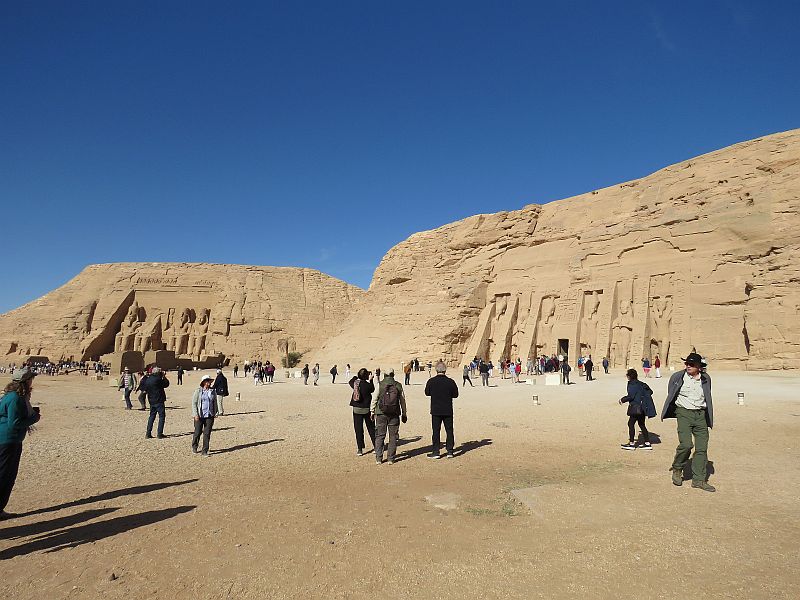
Ramses II temple to the left and Queen Nefertari’s to the right.
We join many tourists at the two temples this morning and I assume everyone is looking at these fantastic works of art with as much awe as all of us are. Hussein talks about the temples, telling us that they were carved out of a sandstone cliff. The four seated statues of Ramses II in front of his temple are sixty plus feet high. That is incredible and to me, suggests someone with a very big ego. Nefertari’s temple, dedicated to the Goddess Hathor, has four figures of Ramses II and two figures of Nefertari gracing the front of her temple. These statues are around half the height of the Ramses II statues at his temple. Hussein does point out that it was unusual for a King to build a temple for his Queen and that it shows what true affection and respect he had for Nefertari. The fact that her figures are the same height as Ramses II figures is very unusual as normally a Pharaoh’s wife never stood taller than the knees of the pharaoh.
With the people next to the Ramses II temple it shows how huge these statues are. The damaged Ramses II statue was already done before UNESCO moved the temples.
The astounding aspect of these two temples is that they were doomed to be submerged by the water of Lake Nasser. An appeal went out to save the two unique temples and UNESCO answered the challenge. I believe fifty some countries worked together to move the temples away from the rising water. How they accomplished this is astounding. The workers removed the top of the cliff off and then cut the temples into blocks that weighed several tons each. The volunteers moved all these blocks two hundred feet from the original temple site removing the temples out of harm’s way. The UNESCO people reassembled the blocks by cementing the blocks back together but what a wonderful job these people did. Yes, you can see the seams but it was so well done that you might not notice this if you did not know the back story. I think this was all accomplished in three years although that is hard to believe, so maybe I have that time frame wrong. We did watch a film on the Aida about this stunning feat of saving the temples, so we were able to see how some of the work was accomplished.
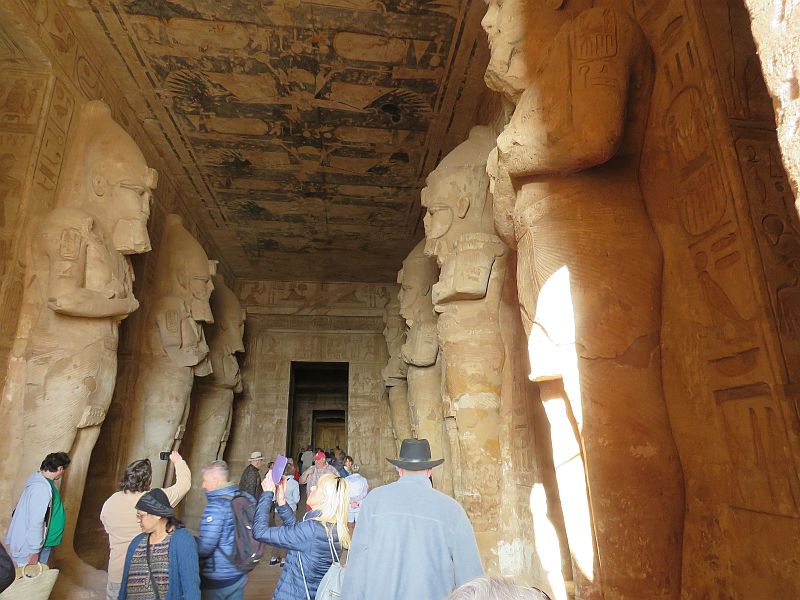
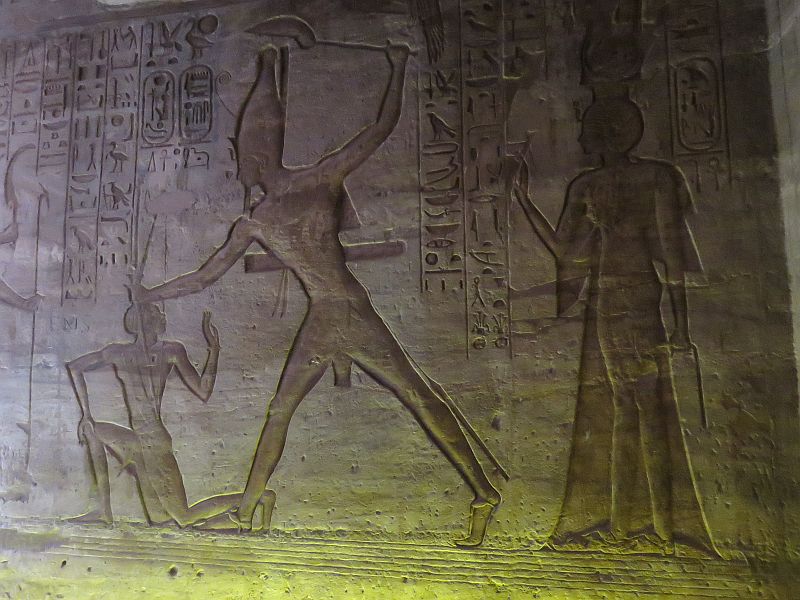
We wander through the temples which are crowded with tourists. A painting on the wall that Hussein points out to us is Ramses II slaying an enemy in the war against the Nubians with Nefertari standing behind her husband in a gesture of support. Hussein tells us that this is another example of Ramses II holding his wife in high regards. At the end of the main hall of the Ramses II temple there are four seated deities, (one of them is a deified Ramses II), that the temple was dedicated to, (the main god being Ra). Two days of the year the sun’s rays penetrate these innermost statues, lighting the seated figures up. Can you imagine how precise the ancient builders had to be to make this happen? There is a spotlight shining on these deities to give an example of what it looks like on the two days that the sun reaches the end of this long corridor to illuminate the Gods. This manmade lighting of the stone figures does not make for good photos though. These temples are an UNESCO World Heritage site and rightly so.
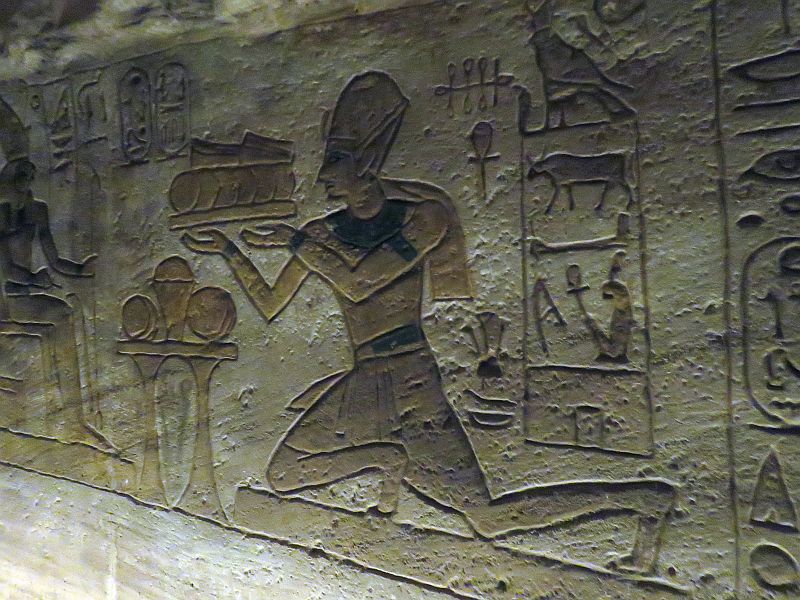
A slide show of the interior of Ramses II temple. The corridor leading to the deities that are sunlit twice a year. Painted scenes found in the small side rooms. Many of the scenes depict Ramses II slaying his enemies. Victory over one’s enemies proved how great you were.
I suppose we spend a couple of hours at the temples before we return to the bus. We spend the next four hours driving back to Aswan with no new sites to be seen. Hussein has told us that most tourists do this trip to Abu Simbel in one day. I am so glad that OAT breaks the journey up into two days. Besides, those folks that just make this a day trip do not get to experience the wonderful sound and light show which I will never forget. Although we have seen many incredible temples, I think this is my favorite, partly because of the heroic effort that saved it from being submerged by Lake Nasser.
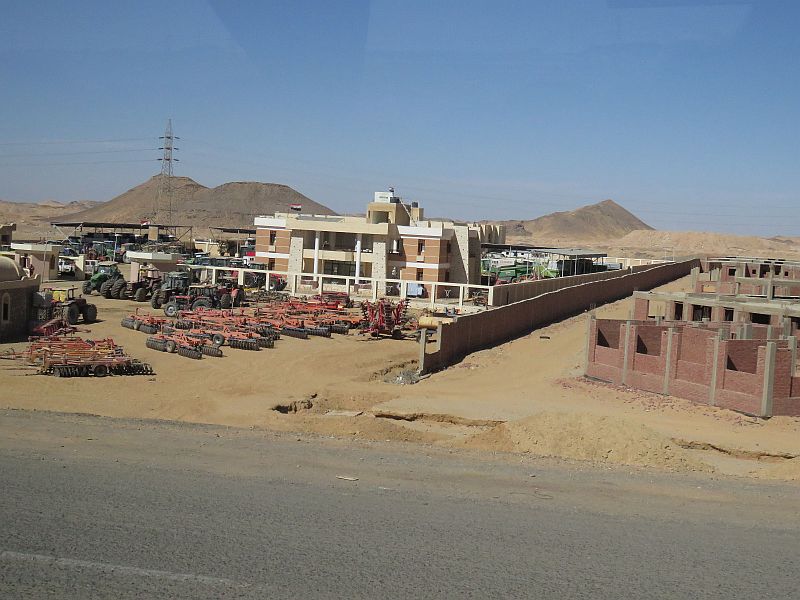
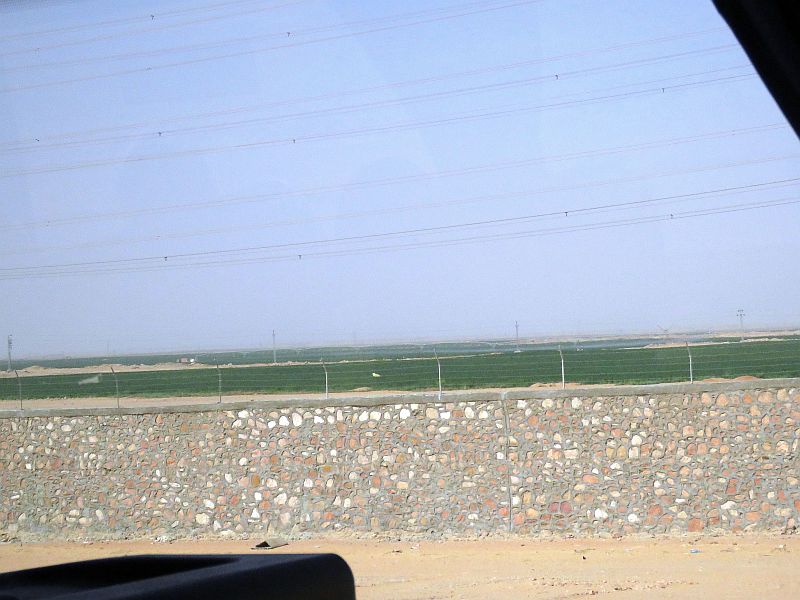
Corn ready for harvest in the middle of the Sahara.Farm machinery.
On the Aida and on this journey to Abu Simbel, Hussein has talked about the problem that Egypt is having with Ethiopia concerning the Nile. Ethiopia is building a dam on the Nile, just like Egypt did, and the Egyptian government understands this. The problem is that Ethiopia wants to fill the reservoir in three years which would deplete the flow of water from the Nile into Egypt. Egypt is trying to negotiate with them to prolong the filling of the reservoir over a span of thirteen years which so far, the Ethiopians are refusing to do. The Nile is the life blood of Egypt, and they could not survive without it. It is the only major river in the country and since Egypt, at least where we were, only averages one inch of rain a year this would ruin them! Ethiopia has several major rivers, so it is not like they do not have other options. You could tell that this was a very worrying subject for Hussein, and I am sure for all Egyptians. It does not take much imagination to see what could happen between the two countries if they can’t work this problem out.
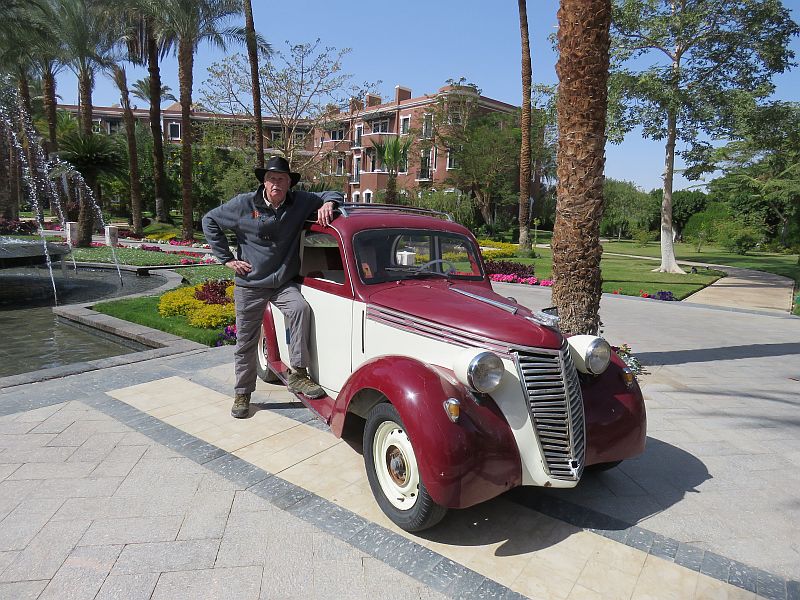
Paul posing with this cool old car in front of the Old Cataract Hotel.
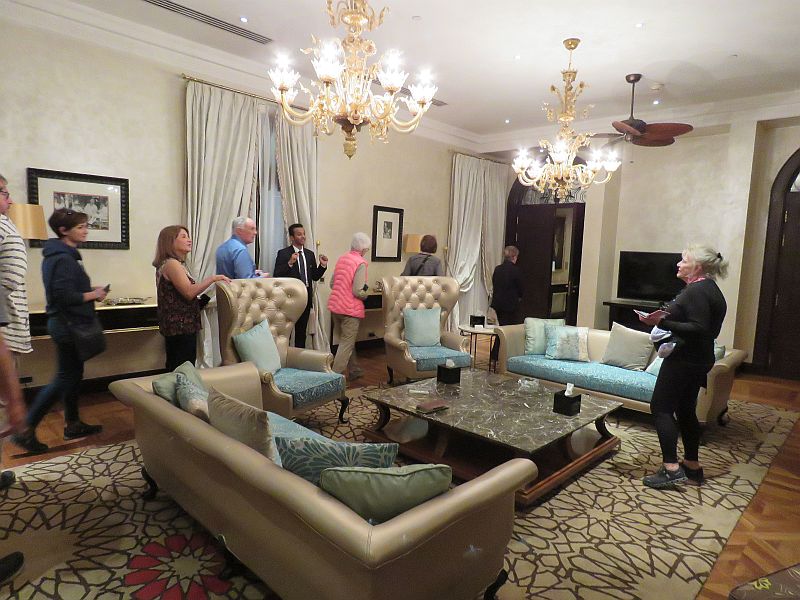
We reach Aswan, at two p.m. and eat lunch before going to our hotel. Once we have finished lunch our driver delivers us to the hotel where we will be staying for two nights. When we disembark at the entrance of the Sofitel Old Cataract Hotel, everyone exclaims at the beauty of the grounds and the building. It was built at the end of the 19th century and was fashioned after a Victorian palace. This luxurious hotel quickly became a favorite of wealthy European travelers in the early 1900’s. The rich and famous guests included Winston Churchill, Howard Carter, (the man who found King Tut’s tomb), and Agatha Christie.
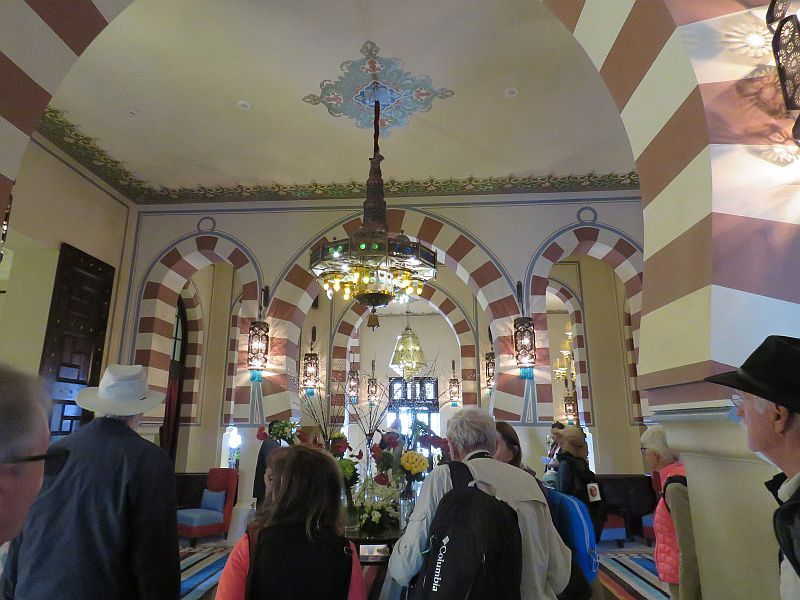
This historic hotel is where Agatha Christie wrote her book “Death on the Nile” in the 1930’s. Hussein had informed us before we arrived at the hotel that we could take a tour of the Agatha Christie suite this afternoon. When we were standing in the lavish lobby of the hotel checking in, a staff member informed Hussein that we would not be able to tour Christie’s suite after all. Well rats, many of us had been looking forward to seeing the famous author’s abode. Shortly after the bad news a man walks up and talks with Hussein who gives us one of his famous smiles and tells us the tour is on after all. We are to meet in the lobby at 3:30 if we want to go on the Christie tour.
The ornate lobby of the hotel. Our group waiting to check in.
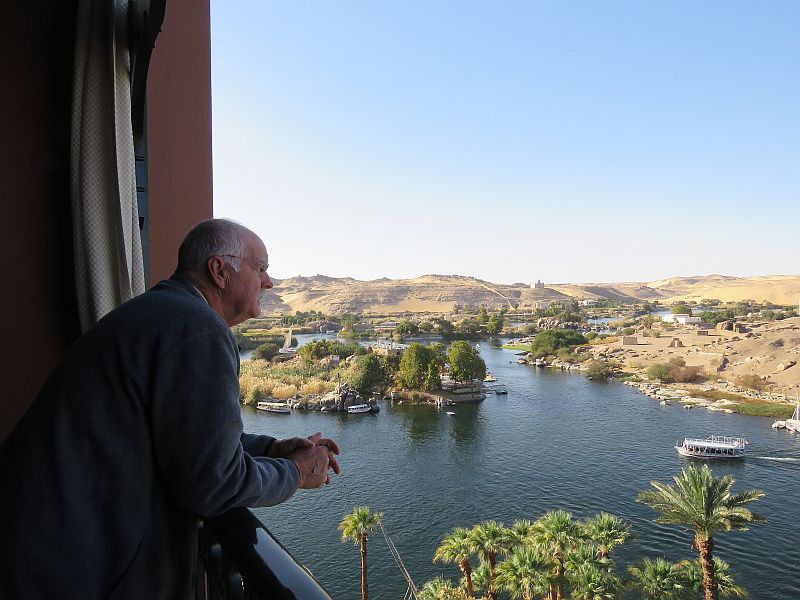
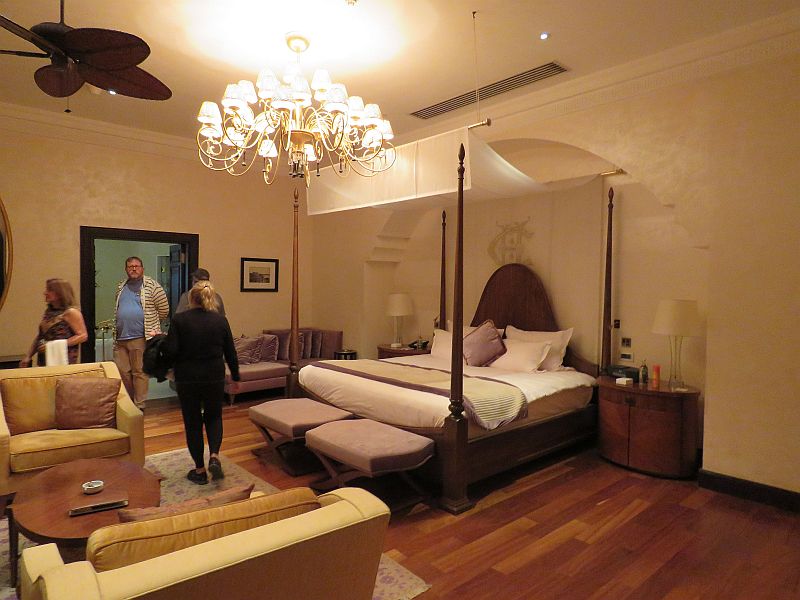
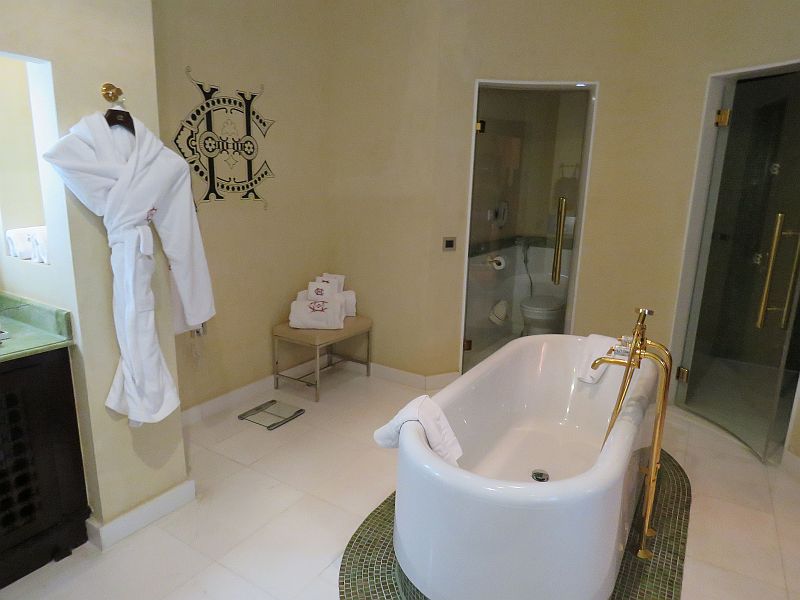
All of us are staying in the new wing of the hotel, known as the Nile wing, which is only a short walk from the old historic hotel. We are on various floors and the elevators are small only accommodating four people, but we eventually get to our room. When we exit the elevator, we are not impressed with the light green paint that covers the walls, in fact it is downright ugly. Our room is a different story however and we soon forget about the corridor color. The most fantastic aspect of our room is the balcony which overlooks the Nile and Elephantine Island which is across the Nile from us. It is absolutely gorgeous.
Slide show. Our bedroom and views from our balcony. The building on the hill is the main part of this historic hotel.
I do not have time to linger in the room as I must get back to the old part of the hotel or what is now called the Palace wing, in order to join the group for our Agatha Christie suite tour. When I arrive, (Paul opted out of this tour), there are a lot of guests taking the tour in addition to members of our group. It is going to be a bit crowded. Our tour guide is a young man who speaks fluent English and has an engaging personality.
First our guide takes us down a corridor that leads to the dining room where we will have our breakfasts. The young man points out many photos hanging on the wall of famous people that have stayed in the Old Cataract. He also shows us items that were salvaged from the hotel when it underwent restoration. Among the things on display in the corridor is the desk that Agatha Christie worked at while writing her famous novel.
Our young guide leads us back down the hall and up two flights of stairs to Agatha Christies’ suite. As we file into the room, our guide tells us that the famous novelist lived here for a year. The suite is decorated in furnishings depicting the time period. We are allowed to wander through the rooms which consist of a large sitting room, the bedroom, bathroom, and another side room I did not look into. Once everyone has finished looking around, the guide tells us to get ready for the best part, the view from the balcony. He opens the balcony doors, and everyone starts walking out onto the balcony. That is a lot of people going out there at once. Evidently another man on the tour thinks so too and calls out that maybe the amount of people on the balcony should be limited to a certain number. No one listens. Jennifer and I decide to forgo touring the balcony due to the crowd of people on it, besides I cannot imagine it is much better than our balcony view.
Slide show of Agatha Christie’s suite. It was pretty amazing to know you were standing in the room where the famous author wrote “Death on the Nile”.
Shortly after the Christie tour, our group meets in the lobby of the Nile wing and walk to the bus. Hussein is taking us to the spice market to experience this part of Egyptian life and to let those that want to, do some shopping. The bus drops us off at the spice market entrance and we follow Hussein to a shop that specializes in spices. The owner offers us a sample of some kind of sugared nut, they are good, and then begins to show us all the things he has for sale. Before we leave nearly everyone has purchased spices but Paul and I. Hey, I am lucky if I remember to add salt and pepper to a dish. Jennifer buys a sack of dried hibiscus flowers to take home so she can brew her own hibiscus tea, as she really likes the hibiscus tea that is served here.
The spice market. Paul’s photo.An example of what is for sale. Paul’s photo.
Upon leaving the spice store, one couple wants to purchase soccer jerseys for their grandkids. While they are negotiating with one shop owner, I observe the people around us and notice that there are a lot of young people walking up and down the wide aisle of the market. I see one group of teenage boys acknowledge a group of teen girls who titter and giggle at the boy’s attention. I am betting this scene is something you would see in our shopping malls at home. The couple did not find what they were looking for at this shop, or maybe Hussein thought the price was too high. Anyway, we follow our guide down the main corridor before turning into a narrow alley like passage. He tells the young man at the shop what the couple is looking for which sends the fellow scrambling to find the jerseys. He brings a few sample shirts out and the shoppers find one jersey that will work for them but the other shirts are to large. Upon searching further, a smaller jersey is found but this one is not acceptable because the name on it is that of a Russian player. In the end the shop owner does find a jersey that is the right size and even better the price is less than the initial shop!
It is time to return to the coach and on the way back through the market, a couple of young boys attach themselves to Paul, point to their bare feet. Paul assumes this means they are asking for money so they can buy themselves some shoes. Paul ignores them and eventually the persistent kids leave Paul’s side and attach themselves to the “tall guy” and go through the same ritual. They are still pestering our friend when we reach the area where our bus will come to pick us up. Hussein now notices the boys and barks out one word at them in Egyptian that sends the kids running away. They do not go far before turning around to watch us as we board our bus. I found it interesting that they would choose men to try and get money from and not the women in the group.
We stop at a small restaurant for supper and the only thing I wrote in my journal about the food is that only the appetizer and dessert were good. There are a couple of young men eating at a table near us and one of them is feeding tidbits to a feral cat. The hungry cat nips the fellows finger one time which only made him laugh and he continued to feed the white and yellow cat. I like that guy.
Temples of Philae, Farewell supper, morning flight to Cairo, museum, and final group supper before heading home.
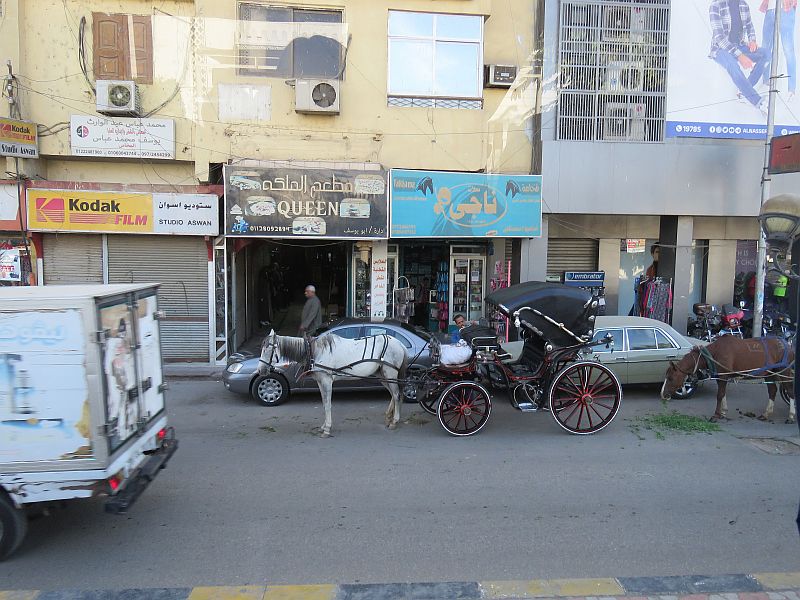
Street scene in Aswan.Our group in front of Ramses II temple. Hussein’s photo
We are up shortly after five and do a bit more packing. We go up to the dining room for an early breakfast and drop our tip for the ship crew in the box. This is one place that OAT does not take care of the tip. Upon returning to the room, we walk through the cabin and bathroom to double check that we did not overlook any of our things. We set our two large suitcases out in the hallway and lug our carry-on baggage to the observation deck. We are loading onto our coach by 7:30 and leaving this wonderful ship and the relaxing time we spent on her behind. Hussein tells us that the crew has four hours to get everything prepared for the next OAT group to board the Aida. This OAT group will be doing our adventure in reverse, sailing down the Nile from Aswan to Esna.
On our drive to Aswan High Dam, (finished in 1970), Hussein talks about the displacement of thousands of Nubian people, (Hussein is Nubian), due to the Dam’s construction and the forming of Lake Nasser, which is named after the man who was president of Egypt at that time. Naturally this was an extremely traumatic event for the Nubian people and anyone else who lived on the land that was inundated by the lake.
Our guide says the positive elements of the construction of the dam is that the annual Nile flood can now be controlled by humans. One other plus of the dam is that it generates a tremendous amount of hydroelectric power. Hussein also explains that the dam’s turbines are why there are no crocodiles in the Nile below the dam which is where we were sailing, (is that good or bad news?). The crocodiles cannot pass through the turbines as according to Hussein they would be chopped to bits. Hussein gives us the negative aspect of the dam’s construction, which is that controlling the annual flood has decreased the fertility of the riverside agricultural lands. This is because the rich silt ends up in the canals and reservoirs instead of being deposited on the farmland. The farmers have had to turn to artificial fertilizer which is no substitute for the rich nutrients found in the silt.
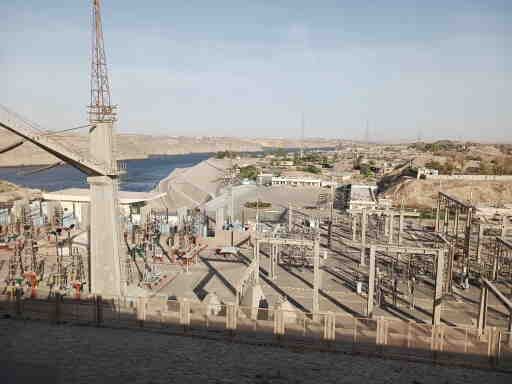
Part of the electric grid for Aswan Dam. Paul’s photo
When we arrive at Aswan High Dam, we see military presence here. I think this is where a soldier walks around the bus inspecting it before we are allowed to drive onto the dam and sees me looking at him through the window. The soldier gives me a big smile and a wink before he continues his inspection. There are two soldiers sitting on a wall along the dam road and if I remember correctly there was a tank at the dam’s entry point with a man looking out the top opening of the tank turret armed with a rifle. This is not the first time we have encountered the military; we have seen towers manned by soldiers with rifles, at the edge of towns. Most of us already know not to take photos of anything military but Hussein reminds us of this rule.
We leave the bus and Hussein points out the restrooms and observation areas where you can look over the lake, see the Nile, and the original Aswan dam that was built by the British in 1902. Paul and I take a quick look at the views and then go buy some potato chips from the vendor that is located nearby. We both have been craving a salty snack! All of us are back on the bus after a short time as truthfully, there isn’t a lot to see here but also because it is chilly and windy this morning.
Hussein tells us that we have a four hour drive to Abu Simbel but we will stop at the midway point for a bathroom break. Once we are on the road, Hussein plugs in his phone and somehow this allows us to use our electronic devices. I don’t understand how that works but I know it is astounding that I can email a friend, play words with friends, and read on my tablet while traveling down the Egyptian highway in the middle of the Sahara Desert!
There is not much to see along our route except sand but I still look out the window now and then. I do a double take when I see irrigation systems sitting in the desert. I point the rigs out to Paul, and he is as puzzled as I am. Paul asks Hussein why there are pivot irrigation machines out here. Hussein laughs and says because they are going to grow crops like wheat and corn. Our guide tells us we will see the growing crops in the Sahara farther down the road. What? But sure enough, we later come upon lush fields of wheat or barley, and corn fields that are dried down and ready to harvest. All of this is being done by the army/government. The ability to grow crops has been made possible because of canals bringing water into the desert thus the need for the irrigation systems in order to water the crops. It still does not answer the question we have on how you get any crop to take root in sand. Hussein admits he does not know but surmises that there must be a more compact soil just beneath the sand. Wonders never cease!
Irrigated crop in the middle of the Sahara Desert. Paul’s photo
At the rest stop, our group leaves the bus to use the restrooms. The water closets as they are called here, are surprisingly clean. Hussein gives us time to stretch our legs before we load up and continue our journey.
We drive by an area where a stone wall has been constructed with a barb wire fence built on top of it. The combination stone wall and barb wire fence, I would estimate is eight or ten feet high. Hussein explains that this is another army project which the government refers to as a ranch. There is a lot of irrigated areas which are vivid green with growing crops, quite a contrast to the desert outside the wall. We see no sign of any animals, but they could easily be out there as we are only seeing a small part of the government “ranch.” Hussein says the government will not answer the question that the people have asked on why they need such a barrier around the property. The wire that tops the fence is bent outward, which would keep anyone on the outside from crawling over the fence. Weird.
Paul using the internet with the “ranch” wall in the background.A closer look at the wall and all the green fields inside its boundaries.
As we draw close to Abu Simbel, Hussein gets on the microphone and says “Guys, you have stayed in two five-star hotels so far and although this hotel is nice you cannot expect it to be like those in Cairo and Luxor.” He reiterates this warning to us as we drive up to the hotel, telling us not to be too disappointed and try not to compare this place to our prior hotels. There is a stack of bricks piled up not far from the hotel drop off point which makes one wonder if there is still some construction going on. I tell Jennifer that I do not care at all if this hotel is not as fancy as our prior hotels but I do hope it is clean.
When we follow Hussein through the door of the Seti Abu Simbel hotel, it does not take long before we realize we have been duped! Somebody in our group exclaims, “you were kidding us.” Hussein is laughing as he got us to swallow his warning about the hotel, hook, line, and sinker! The rascal. Well played Hussein. This place is incredible. The hotel’s architecture is unique in that there are arches built off the main building which give you a cool view of the swimming pools, and rooms. It is stunning.
Cool arches at the hotel.
We eat lunch in the spacious restaurant before we go to our rooms. Our large room is gorgeous, and has a cool mural painted on the wall above our bed. There is a balcony that looks out on Lake Nasser affording us a beautiful view. Once we have halfway organized our belongings, Paul and I walk the grounds of the hotel. We admire the lake views, the colorful bushes that are blooming in front of the rooms, the swimming pools, and well-kept grounds. It is too bad that we are only here for one night.
Slide show of various aspects of our hotel. We loved this hotel.
At 4:30, Paul and I make our way back to the main part of the hotel. We are gathering in a small room to listen to a Nubian man whose family was one of the thousands that were forced off their land for the Aswan project. He is a well-spoken man who talks about the trauma to his family, he was very young, being uprooted from their land and moved to the desert. He remembers that they had to leave some of their cattle behind because there was not enough room on the boat. The man talks about the place the government moved them to which literally was in the desert with no grazing for the cattle. The houses were tiny and it was impossible to live the way they had before.
Many of his family, (including this man) among others left and took jobs in other places like Cairo or even other countries. Those that stayed did make the uninhabitable area habitable through hard work and by getting water to their new home via canals. I do not remember if the government dug the canals or how that happened. They turned the desert into a viable place to live which is something to be admired.
Nubian man that spoke about his life and also entertained us with his singing and playing Nubian instruments. Paul’s photo
I believe that our entertainer was working in another country, when the president, (Assisi I think), put out a plea for the displaced Nubians to come back. The president promised them they could settle near the same area that they had been removed from all those years ago. Our speaker came home and ended up working with the people that manage the Ramses II Temple which is located by Abu Simbel. At the end of his talk the man plays Nubian instruments and sings some Nubian songs for us. He has a nice voice, and it was a pleasure listening to him sing. I probably have some of the facts wrong and I know I have forgotten other things the man related to us but you can get an idea of what these people went through.
After the Nubian’s talk, we follow Hussein to the bus and take a short ride to the temple that draws people to Abu Simbel. Tonight, we are going to experience the sound and light show that takes place at Ramses II temple. Hussein tells us that in his opinion this is the best sound and light show to experience in Egypt. We have to walk maybe a quarter of a mile to reach the bleachers and I am glad that I have my fleece on under my jacket. It is quite chilly this evening. It is dark by the time we get to the temple and Hussein points out a spectacular extra which is Venus, Jupiter, and Mars, in a descending line in the night sky. It turns out that Hussein has an avid interest in astronomy. Our guide continues to amaze and surprise us.
We have front row seats for the show and after we are settled on the benches, Hussein passes out recorders that will narrate the show for us in English. The sound and light show is spectacular with thundering music and animated scenes depicting the life of Ramses II and Queen Nefertari flashing across the temples, (there is a temple for Nefertari also). On our walk back to the bus, Hussein stops at one place to point out different constellations in the sky. This was a great experience and a wonderful evening.
Ramses II Temple lit up for the night show. Paul’s photo.Queen Nefertarti Temple bathed in light. Paul’s photo.
Visiting the temples in daylight, driving to Aswan, visiting the spice market.
We sailed to the town of Daraw last evening where we spent the night moored across the Nile from Daraw. This morning there is a motorboat snugged up to the Aida, and after breakfast we board our water taxi. Three members of our group decide to stay aboard the ship but the rest of us are looking forward to another Egyptian adventure in this town.
Our boat taxi tied to the Aida in front of the tugboat.
We reach the opposite shore in ten minutes or so and climb out of our transport and up the riverbank to the street. Here we find an OAT representative waiting for us along with three or four pickup trucks parked along the road. The pickup beds are enclosed by oversized pickup toppers and there are benches for us to sit down on. Hussein had told us at the beginning of our adventure that we would experience every form of travel that the Egyptians used. He was not kidding.
A view of our pickup taxi’s. This pickup is sitting in the livestock sale yard.Not much headroom for the tall guys.
Daraw is known for its livestock market where locals bring various animals such as cattle, goats, and camels to trade or sell. Hussein informs us that the livestock sale is held once a week throughout the year. Unfortunately for us, today is not sale day, I would have loved to have experienced the market. There are farmers selling alfalfa today, so there is freshly cut alfalfa, stacked along walls, on carts and in pickup beds. I did see a buyer drive up in a pickup to one alfalfa dealer and the man filled the truck bed with the lush alfalfa. I have no idea how they determine what the hay is worth as there are no scales. I wished I had asked Hussein, but it didn’t cross my mind at that moment. Rats.
Walking by the alfalfa that is for sale.Buyers or sellers?
Hussein takes us into the area where the livestock market takes place. There is a tent to one side of the stockyard where a group of men are playing dominos. It is interesting to watch how they aggressively slap the domino they are playing onto the surface. They are all smiling but I have a feeling the men take the domino game seriously.
Domino players.
I believe this is where the man who is letting us tour his barn and livestock meets us. As we are following our host down the street, we meet a fellow that is riding a beautiful black Arabian horse. The horse becomes very skittish, and Hussein and our host ask us to move to the side of the road. The horse still is not happy, nor is the rider, but our host holds out his hand and speaks to the rider or the horse or both and slowly approaches the high-strung equine. After rubbing the horses muzzle and talking softly to him, the man takes hold of one of the reins and leads the horse past us. Once by us the horse prances on down the street. I find it so interesting as there are many locals walking along the street and as far as I can see the horse has no problem with them.
Our host talking to the horse and rider.After the horse gets by us, he seems to be calm.
We continue to our host’s home and walk into the spacious barnyard where he keeps his livestock. The barn has stone walls and a thatched roof with openings on one side of the barn to allow air flow. In this portion of the barn, we encounter chickens, a rabbit, a tethered milk cow who is conversing with her calf, that is tethered on the other side of the barn, and one camel. There is horse tack, feed and all the items needed to take care of livestock too. Paul and I admire the young calf who is of high quality. Our host does not speak English, so Hussein translates what the man says about his cow, and the camel, among other topics of interest.
Slideshow of barn animals.
We leave the barn and walk into a large pen that has high rock walls for its boundaries. There is a beautiful sorrel horse standing in a small corral, keeping him separate from the donkey and a juvenile camel that occupy the rest of the pen. It is obvious the horse is the pride and joy of our host. He relates through Hussein that his stallion has competed in eight races, (I think), and won seven of them. Jennifer reminded me after I published this blog that Hussein told us there is no purse money for winning a race and that no gambling is allowed. The races are strictly for enjoyment by the people. I rub the friendly stallions’ neck and nose which the horse enjoys and admire his muscular build. Yep, this horse looks like he could flat-out run. Hussein tells us that the neighbors bring their mares to mate with the stallion. I ask what our host charges for the stud fee. Hussein seems surprised at this question but relates it to our host. Hussein tells us that the man says he would never charge money for the stallion servicing his neighbors’ mares. That would be considered selfish and rude. Huh.
The young camel has been busy eating his alfalfa but has been eyeing the strangers that have invaded his space. The camel trots over to Hussein and stands next to him. Hussein drapes his arm around the youngster’s neck, who promptly curves his neck around the front of Hussein. A short time later, the rascal kicks forward but misses hitting Hussein. Our guide pushes the camel off him and walks away. The camel begins kicking and bucking, he is only being playful but if he connected with you, it would feel anything but fun. The yearling finds out he can make these humans move away if he comes running and bucking at them. The onery camel does this several times prompting us to quickly move away from the unwanted playmate. Our guide finally shoos him back to his pile of forage and I guess the youngster has had enough fun as he goes back to munching his breakfast.
The yearling camel before he gets onery.
The man’s sons in the meantime are filling tubs with water for the camel and donkey. The three boys hardly look at us, I suppose they are used to tourists visiting their home. Our hosts wife looks out a window at us from far above, I unthinkingly snap a photo and am immediately told by Hussein, not to take photos of her. I foolishly forgot that you do not take photos of people unless they say it is okay and I understand that. It was such a great photo op that I just reacted instead of thinking.
The boys filling water buckets for the animals.The sheep must have been in another pen because they weren’t in the barn nor with the young camel. Darned if I can remember going to another pen.
When we leave the village barnyard, Hussein takes us to a veterinary store which is stocked with all kinds of what I assume is medicine and vaccine for animals. Nothing is refrigerated as far as I can see. The two men, (one who is a veterinarian), occupying the small store are all smiles and willingly allow our group to snap their photo. One of the women in our group ask if there are female veterinarians. They answer, through Hussein, that yes, they have women vets.
Veterinary shop. The veterinarian moved his head as I took the photo.
We follow Hussein into a busy street that is filled with vendors selling everything you could want. Fruits, vegetables, hanging carcasses of meat including camel, hardware items, spices, etc. Hussein turns into an alley which leads us to a Coptic Christian church. A man is sitting behind a table just before we arrive at the church entrance. When he stands up, I realize he is a guard. Well, that is not surprising considering the treatment this religious group receives over much of the world. A man, arrives and lets us into the church, we file down the aisle, exclaiming over the ornate building. We sit in pews while Hussein talks about the Coptic Christians. Hussein also points out a painting that depicts Joseph, Mary, and baby Jesus, with the pyramids in the background.
A small sample of the ornate church.
Leaving the beautiful church, we dutifully follow Hussein back to the bustling street. Hussein chooses various members of our group to help him buy food items to take back to the ship. Bread, tomatoes, eggplant and other items. Paul ends up toting the tomatoes back to the Aida. I just take photos.
A slide show of our group buying vegetables and of the colorful market.
We crawl into our pickup boxes and begin the drive back to the Nile and our waiting motorboat. We haven’t gone far when two boys jump onto the pickup bumper and hang on to the topper. The surprise on their face when they see a bunch of foreigners sitting inside is priceless. I snap a photo, figuring the stowaways are fair game. I swear one of the boys tells his companion in English, ” she took our photo” and yet why he would converse in English doesn’t make sense. The two jump off at their stop and we continue on our way.
Our hitchhikers.
On our boat trip back to the Aida, Hussein plugs in his phone to speakers that are on the boat in order to play some Nubian music. Our guide begins to show us some Nubian dance steps and then asks Jennifer if she wants to join him. Jennifer dances her way up to the “stage” and the rest of us are entertained by the dancing pair on our return trip to our ship. I am so amazed how Jennifer just picks up the dance movements that I forget to take photos! So, we have a comedian that entertains us at mealtime and a dancer from Kansas who entertains us on our boat taxi! What more could you want?
A better look at our water taxi and owner.Jennifer boarding the boat she will soon be dancing on!
Shortly after we are back on board the Aida, the chef and ship captain gather people around for a cooking lesson on the observation deck. Using the ingredients that Hussein bought in Daraw, two women help put together dishes that are traditional Egyptian fare. We are served the two dishes at lunch, and they are quite tasty.
The cooking demonstration.Ingredients for one of the dishes.
Paul and I have been taking an after-lunch nap but there is no time for that today as the crew ties up at an island, shortly after we have finished eating. Hussein takes a few of us for a stroll on the island. It is another hot afternoon but tolerable. The sand near the river’s edge is deep and hard to walk through. As we get farther away from the Nile, the sandy ground is more solid making it much easier to get around. Hussein takes us to a small hut that is made from palm tree fronds. A man trots up on his donkey and Hussein tells us the man is here to let us ride the small donkey. Three of us, including me, opt to take a ride on the small donkey which is controlled only by its owner. No bridle, no stirrups or saddle, just an old blanket thrown over the mottled donkey’s back. The man maneuvers the donkey in a large circuitous route before we dismount the gentle critter. Once our rides on the gentle donkey ends, the owner jumps on the donkey’s back and his mount trots back down the trail. I only saw the man nudge the donkey with his heels, so I guess the donkey just knew where to go. Hussein takes us down a different trail where we walk by farm fields and through a stand of large trees. There is a web of irrigation canals running through the orchard. I believe these were mango trees.
Checking out the island.Hussein taking a peek into the hut.The gentle donkey we rode.
The before dinner movie tonight is Agatha Christies “Murder on the Nile” complete with bowls of popcorn. This is the 1970’s movies not the remake that was released last year. In my opinion this movie was better than the new movie but neither movie was as good as the book. Still, it was pretty neat to be sailing up the Nile while watching a movie that was set on a ship like ours sailing on the Nile!
The staff always takes our dinner order at breakfast and Paul and I both decided not to order a main course. It is just too much food for us in the evening. Paul and I have plenty to eat with only having the soup, bread, and dessert. Paul and I bust out laughing when Sayid sets an empty plate in front of us when he is serving the other people their main course. Paul picks up his empty plate and pretends to lick it clean while Sayid is laughing at the joke he has played on us. We have to explain the empty plate to our table mates which makes them laugh too. We love the Egyptians sense of humor.
After our meal we return to our cabin and begin to pack our suitcases. I am really going to miss the Aida, the kindness of the crew and particularly the relaxing atmosphere of traveling via the Nile River. I think it was the Minnesota women who threatened to lock themselves in their cabins in the morning, so they did not have to leave the Aida. I believe everyone in our group has loved this Nile adventure and are all sad to see it coming to an end.
Visiting the Aswan Dam and driving to Abu Simbel.
A loaded down cart pulled by a tired-looking donkey.Posing in their pink shirts.
Another pleasant morning “observing” life along the Nile from the observation deck. One of the first things we see this morning is a young boy riding a donkey. He is leading a reluctant Friesian cow down the quarry path that we were walking on yesterday. There is a yearling calf bringing up the rear. We sail past the cow and calf a short time later grazing in a small patch of reeds. The boy and the donkey are nowhere to be seen. We also float by stone structures along the riverbank that are part of the ancient quarry that were off limits to us on our tour yesterday.
Leading the cattle to pasture.A structure at the ancient stone quarry that can only be seen from the Nile.
We sail for an hour more or less until we reach the village where the craftsman we are visiting lives. Once the Aida is tethered, we leave the ship, pair up and crawl into tuk-tuks’ which will be our transportation to the local crate builder. Our driver pulls the heavy blanket aside that serves as the door and Paul and I crawl into the small vehicle and sit down. Paul holds the curtain back so I can take photos as we bounce down the sandy roads.
Paul holding curtain aside so I can take photos.
The caravan of tuk-tuks’ stop along the side of an unpaved road and Hussein takes us down a path that leads to the craftsman’s work shop. A wizened man is waiting for us, and he greets Hussein and our group with a wave and smile. There are handmade benches arranged in a half-circle around the man’s working area. The “workshop” consists of a portion of a tree trunk that serves as the man’s workbench and his chair is the ground. And to think I complain that my chair I sit in for computer work is not comfortable! There are piles of finished crates lined up behind the workman which he sells to his customers who use them for shipping farm produce. I wish I could remember what our host is paid for each crate. I want to say that it is twenty-five cents in our money but don’t hold me to that.
The crate builder, Hussein and inventory in the background.
The craftsman begins building a crate and it is fascinating to watch how quickly he measures the palm wood, cuts, and slices it, punches holes part of the way through the thin wood and more. The craftsman has two different knives he uses. One knife looks like a cleaver and the other large knife has a wicked curved blade. The fellow often uses his feet to hold the crate steady and I admit I check out his feet and hands to see if all his fingers and toes are accounted for.
A slideshow of the craftsman at work.
Once he has the framework of the crate completed, he points to the tall guy in our group to come help him finish the box, nope it is not Paul. The two work together building the box. The teacher corrects a couple of minor mistakes his pupil made which is impressive considering our friend is a novice. When the box is finished our host hands his apprentice one of the curved-bladed knives. The two men hold the knives over the completed project, blades touching in a symbolic gesture that the project is finished. A woman is selected this time to help the man build another crate. Again, the man has a good student and only has to remedy a couple of mistakes.
The touching of knife blades signaling the project is finished.
The craftsman then constructs a small box which he finishes in short order. When he completes the box, our host gathers up some items that are lying to one side. The craftsman hands each of us an Ankh also known as the key of life that he has fashioned from the same palm wood he uses to make his crates. The key of life symbolizes both mortal life and the afterlife. The Egyptian gods depicted in tomb paintings and carvings often carry the Ankh. Two women ask Hussein if they can buy the small box that the craftsman made. Hussein relates the question to our host who ends up giving each woman a box since he has extra boxes stacked inside a crate. This gift from the craftsman is the only souvenir that Paul and I brought home.
Hussein talks about our host off and on while we are watching him work. The craftsman has two men that help him in his business. Our host also has two wives, one in Cairo and one in this village. Hussein says that the fellow told him he had to marry a local village woman in order to be accepted here, but Hussein is laughing when he relates this info to us. Hussein also tells us how many crates the man can make in a day, who sells him the palm fronds, and what they cost, etc. but unfortunately, I cannot remember the details.
A good example of the crates our host makes being used to transport tomatoes. Jennifer’s photo
We leave our host after thanking him for giving us a glimpse into his life as a crate maker and for the gifts he gave us. We go back to the tuk-tuk’s which take us back to the Aida. Jennifer and Hussein have shared a tuk-tuk on this foray since the woman who fainted yesterday decided not to join us this morning. Hussein made a stop at a grocery store as he needed coffee, so lucky Jennifer got to see the village grocery store. Hussein bought Jennifer some chocolate covered Oreos, and she is kind enough to share a package with us. Yes, you have read this before because I mistakenly thought this happened two days ago. I should have read my journal as I had made a note of their side trip but now it is in the correct order.
The grocery store where Jennifer and Hussein stopped. Jennifer’s photo.
Today we eat lunch inside due to the heat and wind. Guess who we happen to eat our meal with? Yep, the women from Minnesota. Oh okay, we see that there is room at their table and ask if we can sit with them. I may not be eating much but I wouldn’t have the opportunity even if I was because our friend has me laughing all through our lunch.
We arrive at Kom Ombo mid-afternoon where the temple we are visiting is located. When we leave the ship, it is only a short walk to the temple. It is hot this afternoon, 90ish, and Paul wonders if I should go on this tour, since I do not handle heat very well. I decide to go as I figure I can find a place out of the sun to sit, if I begin to get too hot.
Fishing with a pole instead of a net.
Hussein explains that Kom Ombo is a twin temple meaning one side is dedicated to Horus, the Falcon God who is the ruler of all Gods. The other side is dedicated to Sobek the Crocodile God who is god of crocodiles, strength and power. This temple is unique as everything is doubled and symmetrical along the main axis: twin entrances, twin courts, and twin colonnades. Yea, I copied this sentence out of our OAT book, no way I would remember that.
Kom Ombo Temple as we are walking to it.
There are a lot of tourists here and everyone appears to be suffering from the heat. Hussein does his best to keep us out of the sun but that is not an easy task. Paul even admits he is looking for shade and Paul generally is not bothered by heat. We wander after Hussein looking at the temple depictions of the Crocodile God more than those of Horus since we have seen Horus in all the temples.
Slide show of the temple and carvings. Notice the key of life the seated crocodile god is holding. The green dot on the pharaohs chin is Hussein’s light he used to point things out to us.
There are archeologists working right by the temple and it is astonishing to look at all the pottery shards that are laid out on the ground. I wonder if they intend to try and put those pots back together as the pieces seem to be grouped in small piles. What patience that would take but how rewarding when you accomplished the task. I always thought it would be fun to go on an archeology dig but I wouldn’t last an hour in this heat.
There is a Crocodile Museum here, that as you can guess, is a museum that contains Nile crocodiles. The mummified crocodiles on display are all sizes from very large crocs that you would not want to encounter in life, to a crocodile that is still in the egg. The museum is kept relatively dark to preserve the mummified crocodiles plus it is air conditioned. Boy does that cool air feel good.
Mummified crocodiles. Paul’s photo.
This evening Hussein discusses modern Egypt using some film clips to highlight some of the topics he is covering. The main thing I recall Hussein discussing is the tough times Egypt has been through prior to the 2011 uprising and after that coup. Terrorism, attacks on tourists, government crackdowns before the coup and after the coup against protesters, resulting in deaths and injuries of citizens. The attacks on tourists through the years severely impacted tourism in Egypt which obviously impacted the economy. Hussein tells us that tourism had begun to recover when Covid shut down the world. Inflation is another huge problem in Egypt and the people are struggling. The government/ army is competing with private business in all aspects like farming, operating ferries, even gas stations and private businesses are having a tough time competing with the government run operations. Hussein is very candid when he discusses the country and government and seems to not be concerned at all about levying criticism along with the positive aspects.
When Hussein finishes his presentation, we go to the dining area where we sit with our friends from Minnesota and the woman who is traveling solo. Tonight, our humorous friend relates some of the pranks she played on her students. I will not relate the stories as I do not have permission to, but trust me, if you were a student of this woman, I doubt you would ever forget her! Our comedian also tells jokes and after one of the jokes, her traveling companion remarks with some surprise that she has not heard that joke before. That was funny in itself. Our day ends with laughter again which is always good.
Touring a man’s barn and livestock in a village, shopping for vegetables, taking a short walk on an island. Our last night on the Aida.
A beautiful cat that was at the craftsman’s workshop.Fishermen laying down their net, next to our boat.