Paul and I are up early, as we need to finish packing. Paul happens to glance out of our window and tells me to come look at the hot air balloons. What a nice way to start the morning gazing at the colorful balloons that dot the morning sky. It is too bad we did not look out the window yesterday when Jennifer was floating above Luxor, we could have claimed that she waved to us.

We deposit our luggage outside our door as we go down to breakfast. Jennifer happens to be walking out of her room as we are walking down the hall. We find a table for three and eat our last breakfast in this nice hotel. We have certainly enjoyed Luxor and the sites and activities we have experienced here but I believe all of us are ready to move on. I know that sailing the Nile on our private river yacht is what I have been looking forward to the most on this Egypt adventure.
We leave the hotel at 8:30, make sure our luggage is among the suitcases lining the sidewalk, then board our bus. After a short drive we arrive at Karnak where we follow Hussein to the visitors center to purchase tickets. As we enter the grounds, Karnak sprawls out in front of us dwarfing any other sites we have visited so far. The vast area of Karnak is eye opening but also surprising is there are very few tourists here. I know the Great Pyramids are the top destination for tourists in Egypt, but I thought Karnak was extremely popular too.
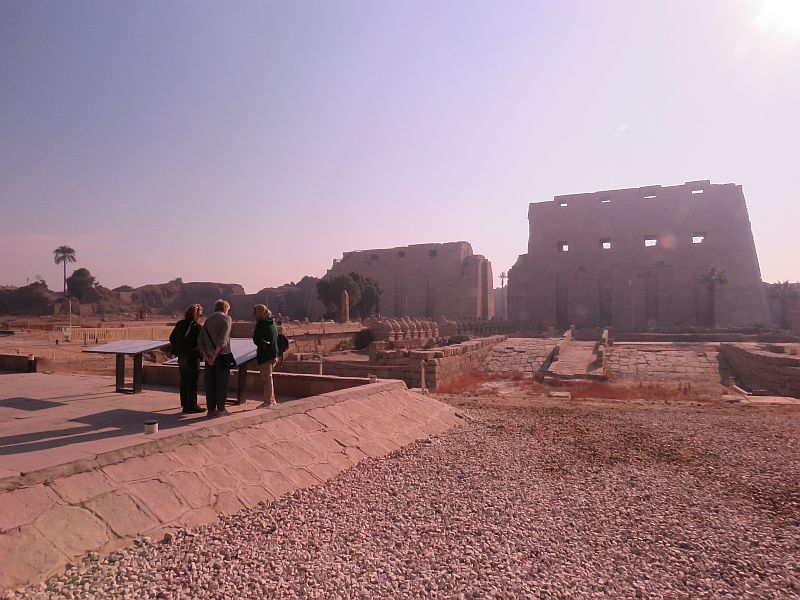
I read that Karnak covers over 200 acres and various Kings and Queens built the temples, and other buildings over a period of fifteen hundred years. I am sure Hussein gave us this information when he was giving his educative talk about Karnak, but I did not retain it. The main Gods that were worshiped here are Amun, Mut and Montu, with Amun being the most worshiped of the three Gods.
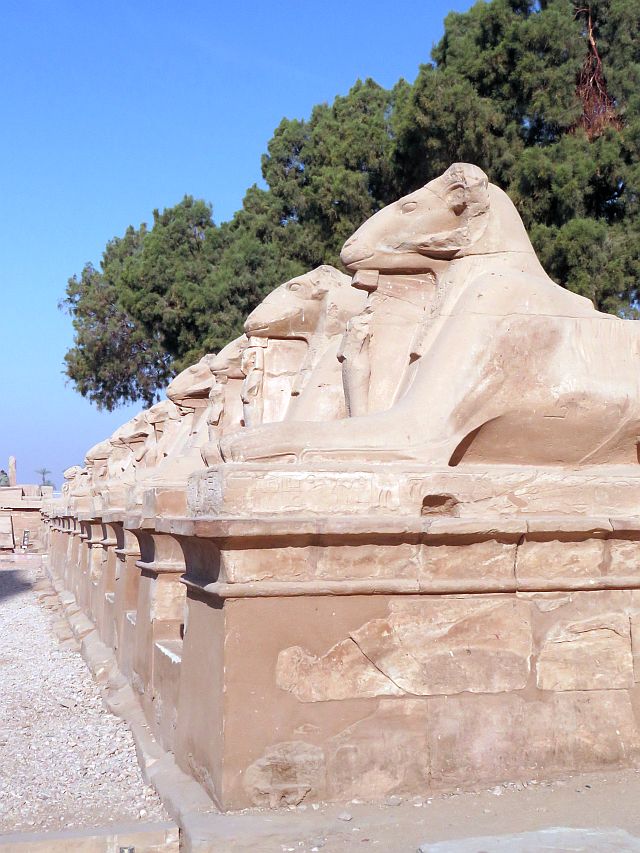
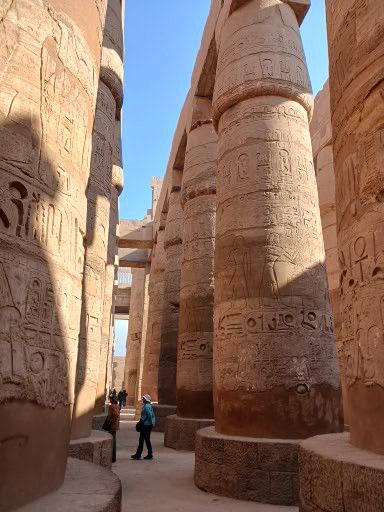
We stroll down the road leading to the entrance of Amun’s temple. The road has a line of criosphinxes on either side. The criosphinxes, (I saw this name in an article), have the head of a ram which is the God Amun’s emblem. Walking between the line of ram sphinxes, who seem to be staring sternly at you, is a bit humbling. Once we walk through the temple entrance, Hussein gathers us in a half circle and begins talking about various aspects of Amun’s temple. One of the highlights is the Great Hypostyle Hall which has over a hundred towering columns. Most of the paint has faded from the figures and scenes that cover these beautiful pillars so you can only imagine how stunning they were in ancient times.

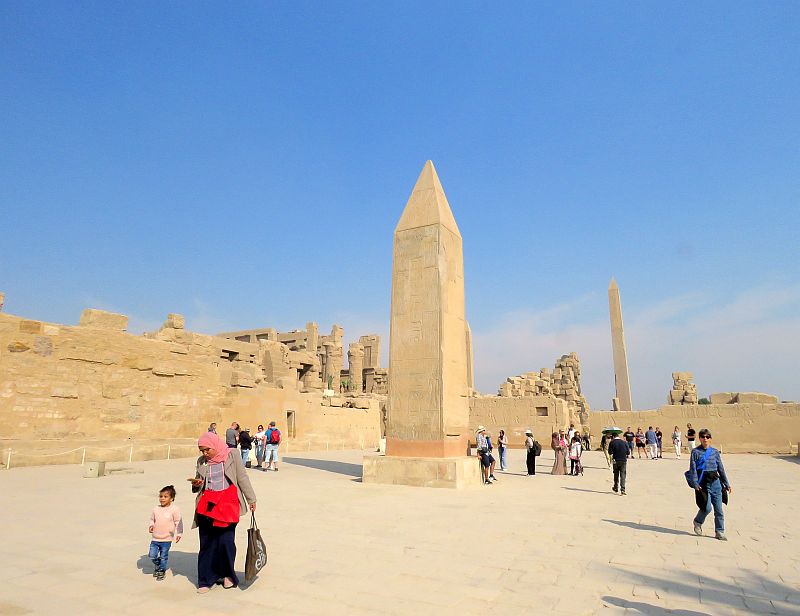
Hussein leads us to another area of Karnak where an obelisk stands among the ruins. I believe Hussein said it weighed one hundred ton and stood over eighty feet tall. The massive obelisk is carved from a single piece of red granite from the quarries of Aswan. Hussein explains how the obelisks were drug down to the Nile and loaded on a barge that was sitting in a dry dock. I think he said they flooded the dry dock once the obelisk was secured to the barge. The barge was then fastened to and pulled down the Nile by boats, each boat piloted with a crew of oarsmen. Hussein does admit that no one has been able to ascertain how they placed the enormous obelisk on a base and raised it to the upright position. Hmm.

After viewing other areas of Karnak with Hussein, including the sacred lake, he gives us time to look around the place on our own. He suggests walking through the Hypostyle Hall and exiting on the far side where there are some seated statues. Jennifer and I decide to go take a look at them but Paul has had enough and heads for the exit. Jennifer and I find the stone statues and after taking a few photos return to the main area of Amun’s’ Temple. When we arrive, we gasp in amazement. There are a horde of tourists, literally wall to wall, and filling the street that leads to the temple. Jennifer and I must weave our way through the crowd of people until we reach the end of the sphinx-lined road.

We are pleased to see Paul waiting for us because we were not excited about getting through the persistent dealers of keepsakes. Jennifer and I get on either side of Paul and loop an arm through his. I believe it is at this venue that we hear one of the shop owners say, “I am from Alaska.” Guess what, as disciplined as we have become at not looking at the people trying to sell us their wares, you could not help but look over at the speaker making this claim. He has our attention for a moment but to no avail as we steadily march on and finally escape into the parking lot.
We all thank Hussein for bringing us to Karnak early which allowed us to enjoy the temples and sites without fighting the crowd. I do not know how you could see much of anything with all those people crowded in the various rooms.

Our group returns to the bus and soon we are on our way to the town of Esna. There are plenty of interesting things to look at through the bus window, unfortunately most of the photos I took were blurry.
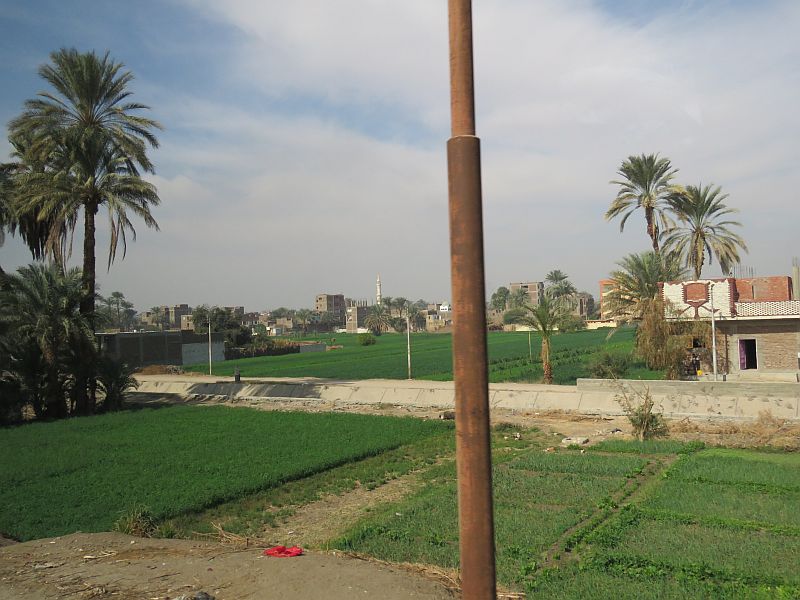
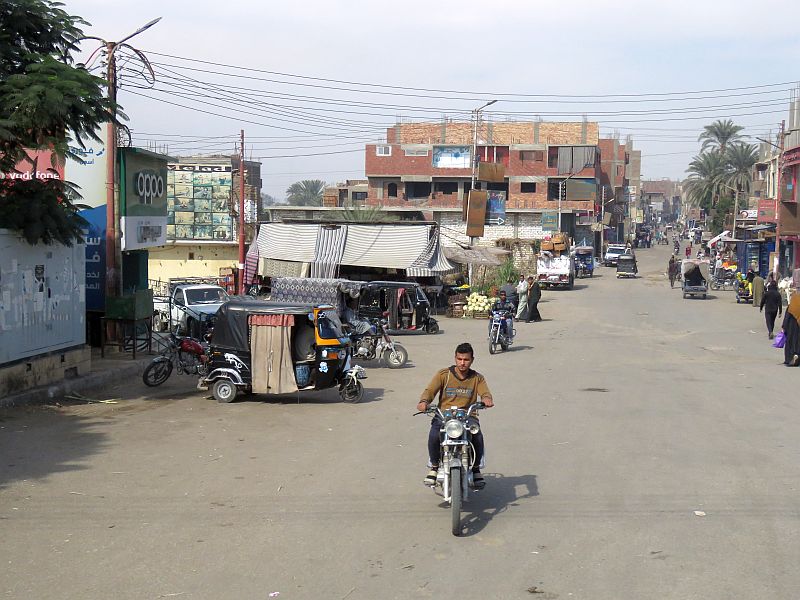
We reach the town of Esna where our dahabeya is anchored and we catch our first glimpse of her as we drive by the anchored ship. What a beautiful boat. However, we are visiting the Temple of Khnum first so the ship will have to wait. We leave the bus and follow Hussein a few blocks to the site. Nooo, another souvenir area filled with basically the same statues, clothes, and other items we have seen everywhere else. Of course, we must pass through the clamoring merchants in order to reach the temple. We just escaped the other tourist trap less than an hour ago!
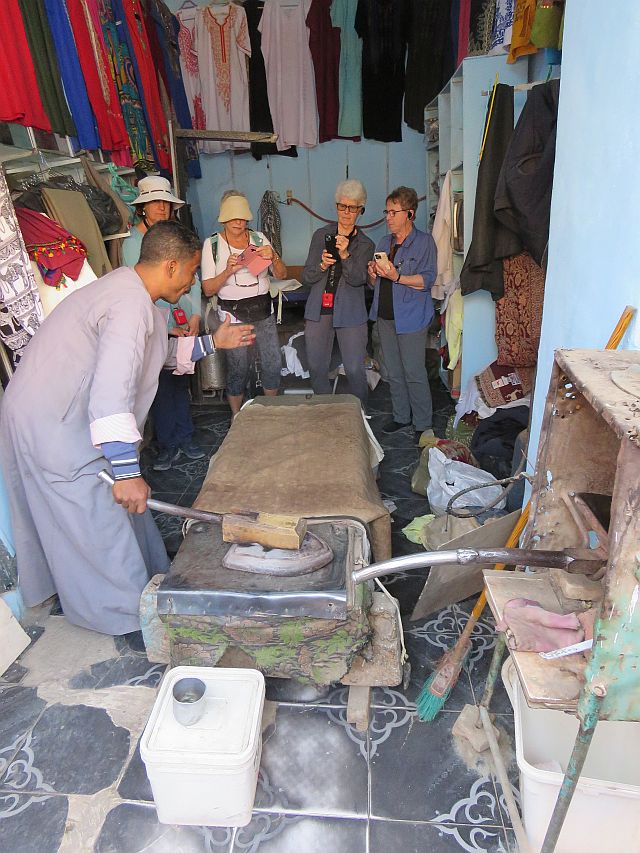
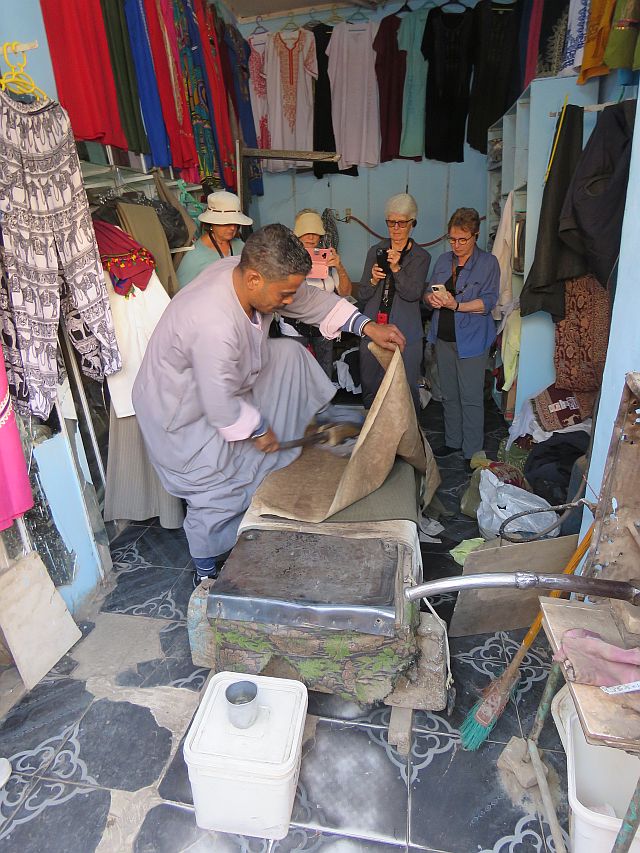
Hussein leads us over to a booth that has articles of clothing hanging along its sides. Our guide did not bring us here to give us any advice on what is worth buying but wants us to observe the fellow working. The man is ironing clothes for clients, why he is stationed here I have no idea. We watch as he is pressing a garment and then we are taken aback when he sprays water he is holding in his mouth over the item of clothing. Who needs a steam iron? I am just glad I was on the far side of where he was spraying the water out of his mouth! Okay, that was worth having to listen to the “only one dollar” chant again.
The temple is situated far below street level, so we traipse down a long staircase to reach the building. I cannot remember the particulars of this temple, but I believe it was buried in the sand, like many of the ruins, when it was discovered by archeologists. I do know that workers, although they are not working today, are painstakingly removing the soot and dirt that has covered the columns for 2,000 years. The soot coating has helped preserve the brilliant paint that was applied to the images, and it is stunning.


Our group climbs the stairs where we navigate through the merchandiser and reach the peace of the street. We board the bus and drive a short distance to our river yacht which will be our home for the next five nights. The ship is called the Aida. As we walk onto the boat a man takes our temperature. I find this interesting as we have not run into any covid protocol on the trip so far, except for our OAT man checking our vaccine card at the airport. Paul and I register a temperature around 97 and evidently everyone else pass too, as we are all allowed to continue onto the boat. I wonder what they would have done if someone was running a temperature, make them walk the gangplank?
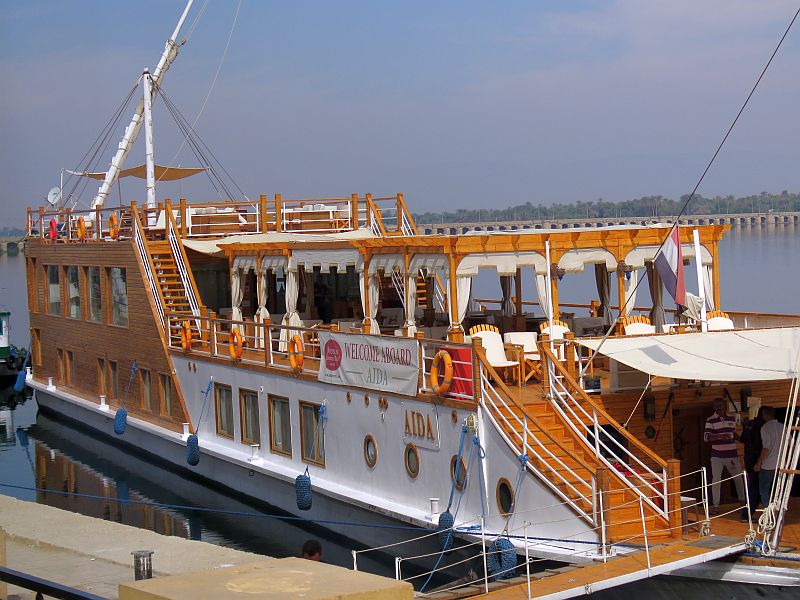
Hussein passes out our cabin keys and tells us to return to topside in fifteen minutes for the orientation talk. Paul and I are in the cabin called Horus III. After being told in pre-trip info that the ship cabins are very small, we are pleasantly surprised to find that our cabin has plenty of space for us. We probably will not be in the cabin except at night anyway.

When all of us are gathered in what I will call the dining and lounge room, the captain of the ship explains various things such as meals, the staff, and the Wi-Fi passwords, (yep, we can get the internet floating down the Nile), although he does warn us that on occasion, we will hit a dead spot. Oh no, let me off the boat, (total sarcasm). The captain also tells us that the advantage we have over the large tourist ships is we can tie up along the shore and stay away from the crowded docks where large ships must anchor. We also will be pulled by a tugboat, which we already knew, as there is not enough wind at this time of year to use the sails.

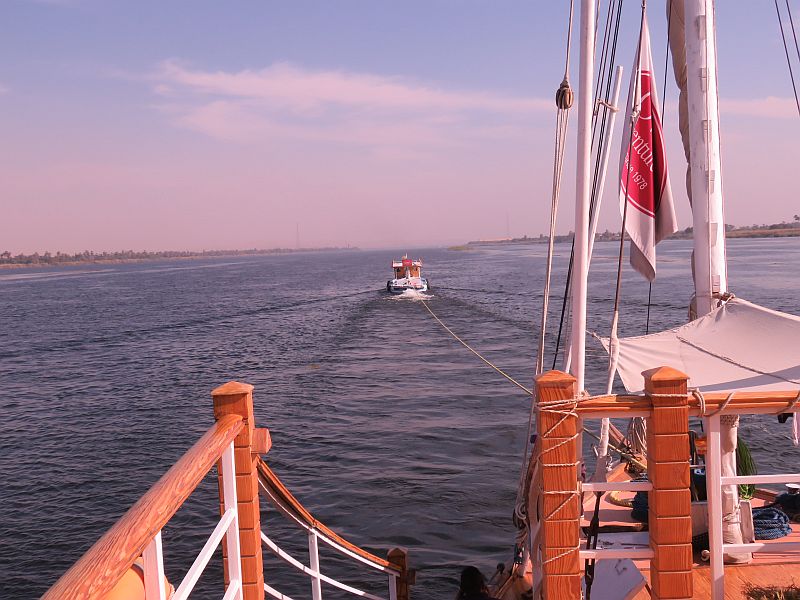
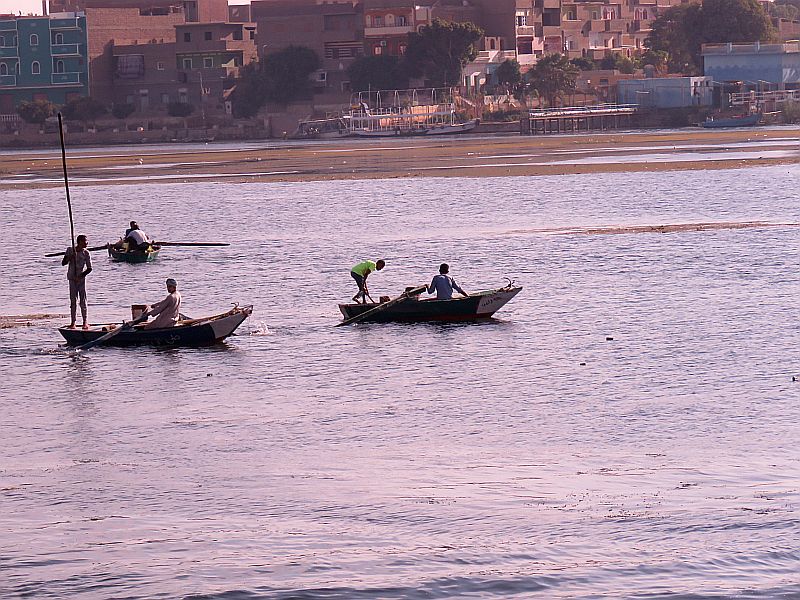
After the captain is finished, Paul and I explore the ship and then settle down on the observation deck. We watch fishermen lay nets out in the water and then one man will slap the water with a long rod. We ask Hussein, what the men are doing, and he says this scares the fish into the nets. There are two men per small rowboat.

The Nile is flush with birds, some of them we know, like cattle egrets and kingfisher. There are other birds that we are unfamiliar with so Paul goes to the captain and asks if he has a bird book we can borrow. He jokes with Paul and tells him he will sell him the bird book, and Paul replies that he will buy it from him. The captain laughs and hands the book over. I am loving this. Paul leaves to walk around, while I sit and enjoy the scenery, fishermen, life along the shore, and birds! The downside is that there is a lot of garbage along and in the Nile, mostly plastic. The grossest thing I saw was the bloated carcass of a donkey which bobbed in the wake from the ship traffic.

Lunch is served at one o’clock and the buffet consists of salads, soup, chicken kabobs and fish. The food was pretty good. There are three tables, and everyone sits where they please.
Around four o’clock we dock along the river’s edge which turns out to be quite entertaining. There are several young boys and a woman standing on the shore waiting our arrival. A member of the crew attempts to throw the mooring rope to one of the boys. It takes about six tosses before the crewman gets the rope close enough to the shore for our helper to grab it. The youngster runs along the rock- fortified riverbank, he is barefoot by the way, and loops the rope over a scraggly bush. This stops us from drifting, then another rope is tied up at the other end of the boat. The crew puts out a narrow gangplank and a stout crewman walks across it carrying a large hammer. He proceeds to drive stakes down and then fastens the mooring ropes to the iron rod. Oh yeah, this man is barefoot too. I am putting a slide show below this paragraph. I hope it works.


Our whole purpose in stopping here is to visit the nearby village. I am pleased to see that a wider ramp is put across to the shore for us to walk on. The young woman is to be our guide through the village. She leads us down a dirt path and when we reach a sugarcane field, Hussein stops to talk about this staple crop for the Egyptian farmers. It is used for producing sugar of course but also is fodder for the livestock. The downside of the cane is that it needs a lot of water to reach maturity.
The woman then shows us the water filtration system that the Egyptian government has installed for villages along the Nile. The people used to drink straight out of the Nile and Hussein told us that the result was a lot of kidney problems in the older folks. We were not allowed to take any photos of the complicated set up.
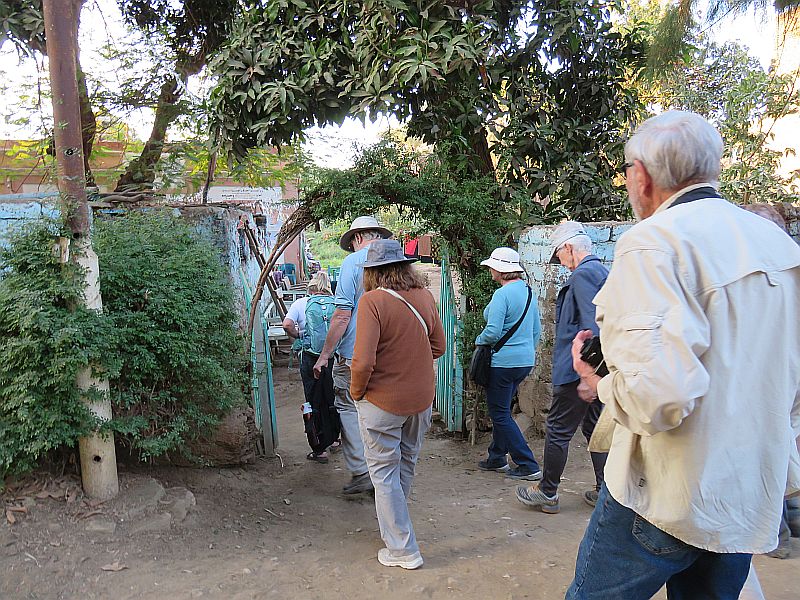
The woman takes us to the house where her family and her parents live. We sit outside in the fenced in yard, on chairs and benches. A couple of women in our group go to help make tea and the rest of us are invited to look at the kitchen while they are making the tea and pouring it into cups. Paul and I do not drink much of our tea and when the woman gathers the cups back up, she takes our left-over tea to her father, and he happily drinks it. Oh no, well I guess nothing goes to waste here. After finishing our tea, Hussein explains then demonstrates the use of a hookah. I am using another slide show. The young woman that was our guide is standing and her father, mother, and brother are seated. The photo of the one room I understood to be the kitchen of the young woman’s parents.


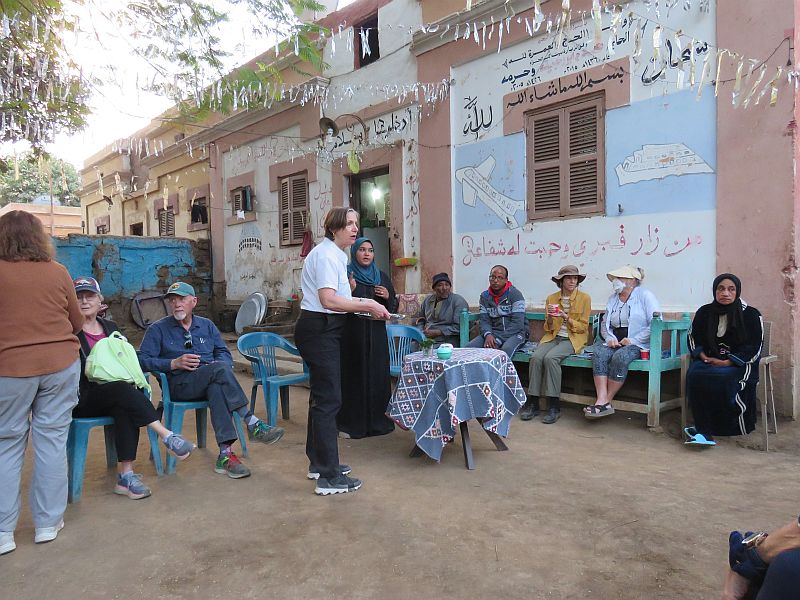
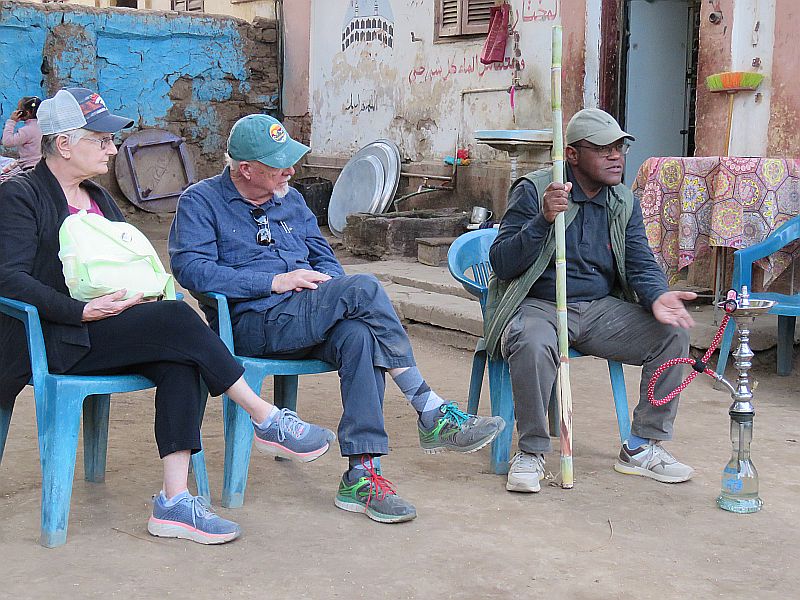
Our group thanks and says goodbye to the family who graciously allowed us a glimpse into their lives. The sun is setting when we return to our river yacht which is a wonderful way to end this very busy day. We will spend the night here, with no city lights or noise. Perfect.

Another temple, putting the sails up and sailing on the Nile, visiting a farming village. Nancy
 realityranching
Another nice writeup, Nancy. The pics are great, too. Thanks again for sharing. So interesting.