Paul and I meet Jennifer at eight for breakfast. I still cannot get over the array and amount of food that is offered. We meet Hussein and our group at nine o’clock at “point X” and Hussein leads us to our coach. It is a big coach so there is plenty of room for our group to spread out. This morning we have a security guard escorting us. The man sits up front so when Hussein introduces him, I cannot really see him as Paul, and I are sitting towards the back of the bus.
When we get off the bus at the Egyptian Museum, I notice a man wearing a very nice suit, scrutinizing us as we gather around Hussein. It takes me a minute to realize that this is our security guard. I suppose he is studying us so intently so he can recognize the tourists he is responsible for.

Once we are clustered around Hussein, he calls out a phrase we will hear often on our adventure in Egypt. In a very melodious tone Hussein says “Follow me” and we dutifully line up behind our guide and walk to the museum. Hussein purchases our tickets and when he passes them out to us, he rapidly says the word “ticket” over and over. His quick-fire chant would make the best auctioneer in the USA sit up and take notice. We get to listen to his auctioneer chant whenever we must have tickets to gain entrance to the various places we visit. I love it and it always makes me chuckle!
Because of the crowd of visitors in the museum, we must wait, or others must wait on us, as the guides stop at some of the most popular items to talk about the significance of the pieces. Hussein takes us to the Egyptian Rosetta Stone; well, it is just a cast or maybe even just a photo behind glass, hung on the wall, since the real Rosetta Stone is in the British Museum. Despite many requests from the Egyptian government asking for the return of the Rosetta Stone, the Brits are refusing to return it to its rightful owners (in my opinion). Anyway, this important tablet is what helped scholars break the mystery of the hieroglyphic language. This is because the same phrase on the Rosetta Stone is in three languages, Demotic, Greek, and Hieroglyphic. I have no idea what the Demotic language is.
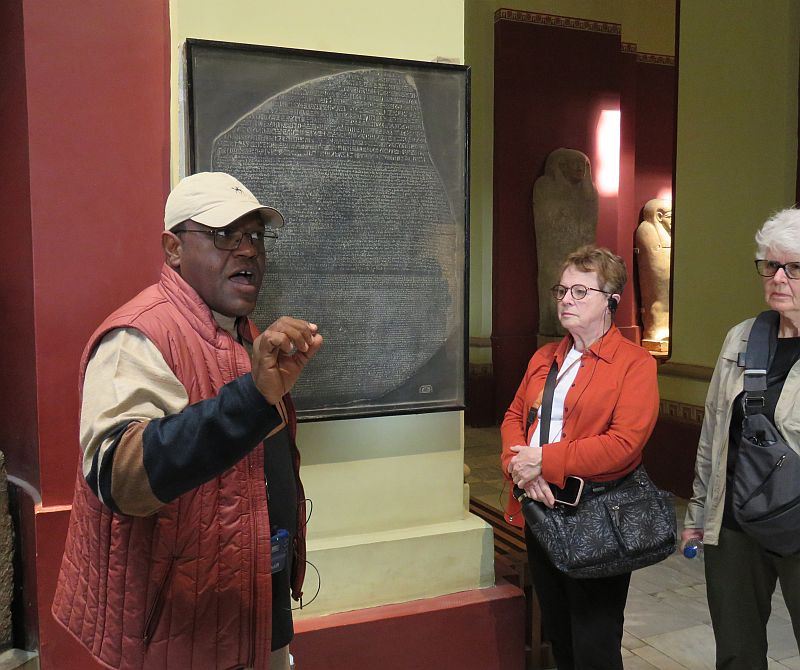
As we continue to be schooled about various items from Hussein, it becomes clear the man is a fountain of knowledge. Names, dates, and stories flow from him without any stumbling or pausing. We learn that Hussein is an Egyptologist, he also was an archeologist for a few years and then if I remember correctly, he became a tour guide. I believe we have a superb guide although this could be premature since this is our first real outing with him. I can already see that Hussein is humorous, knowledgeable, candid, and very personable.
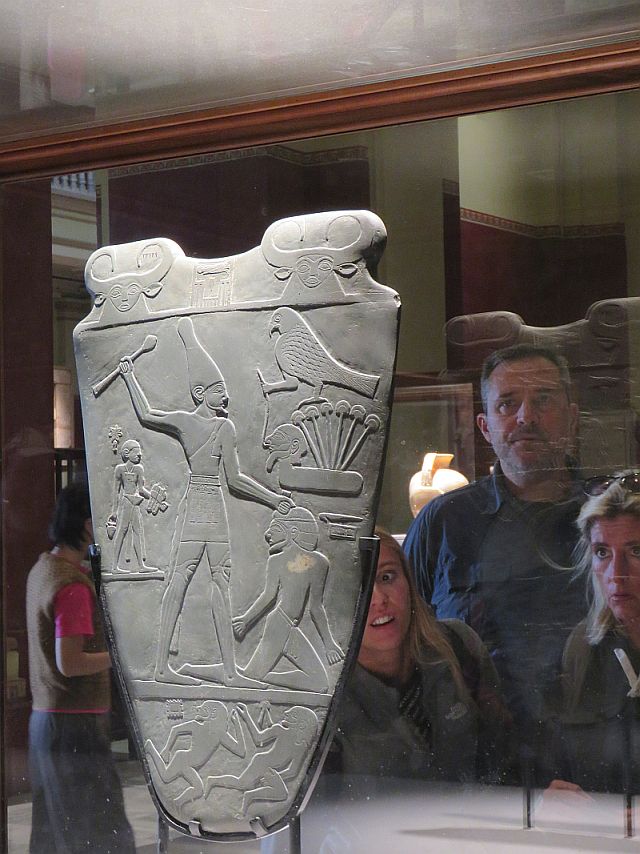
I am not even going to try to talk about the various items and ancient history Hussein talked about. For one thing all the information Hussein is giving us is overwhelming, at least for me, and we were witnessing this in person. I would probably get most of the details wrong even if I tried to pass them on!
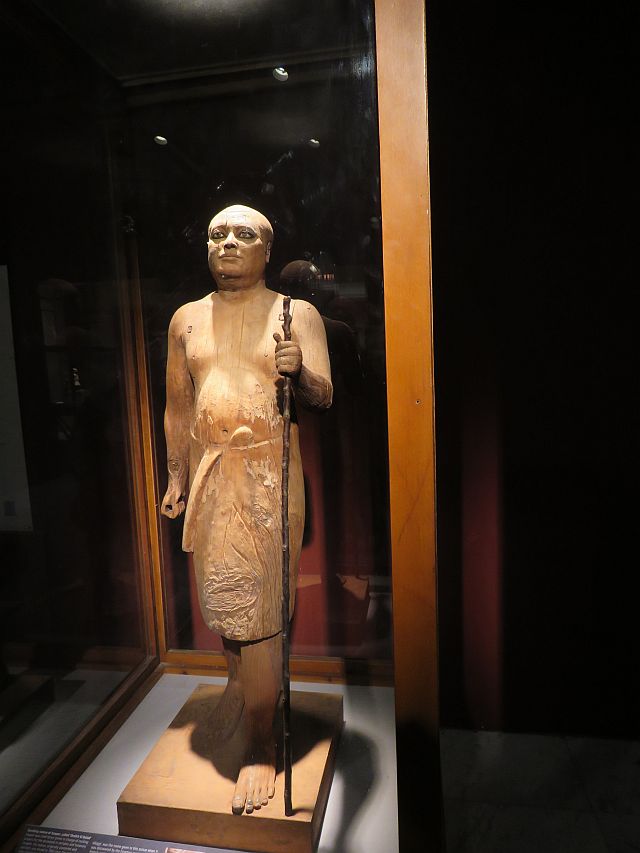
After Hussein finishes showing us the highlights of this immense museum, he gives us directions on where to exit the museum and where our meeting place will be. We are then given an hour to explore on our own.
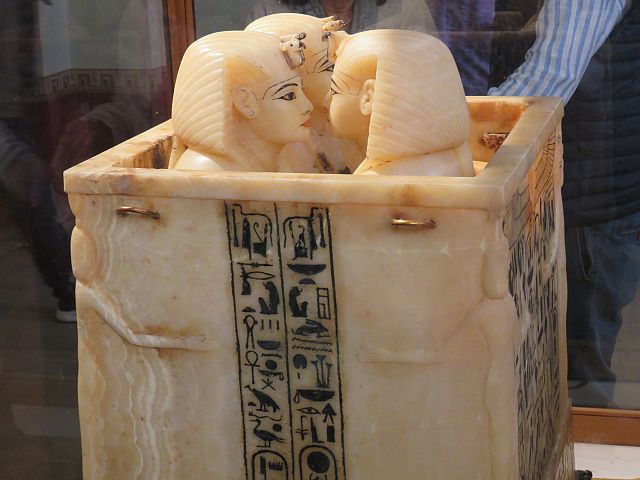
Jennifer, Paul, and I wander around looking at sculptures larger than life and marveling at items so tiny you wonder how anyone found them. We go to Tutankhamen’s special room where they do not allow any photos to be taken. The pieces on display are incredible but the coffin laden with gold is breathtaking. The museum does have an ornate golden chair and some other items just outside Tutankhamen’s room where photos are allowed. The pieces are displayed in a glass case so the reflections from the glass make it hard to take a decent photo.

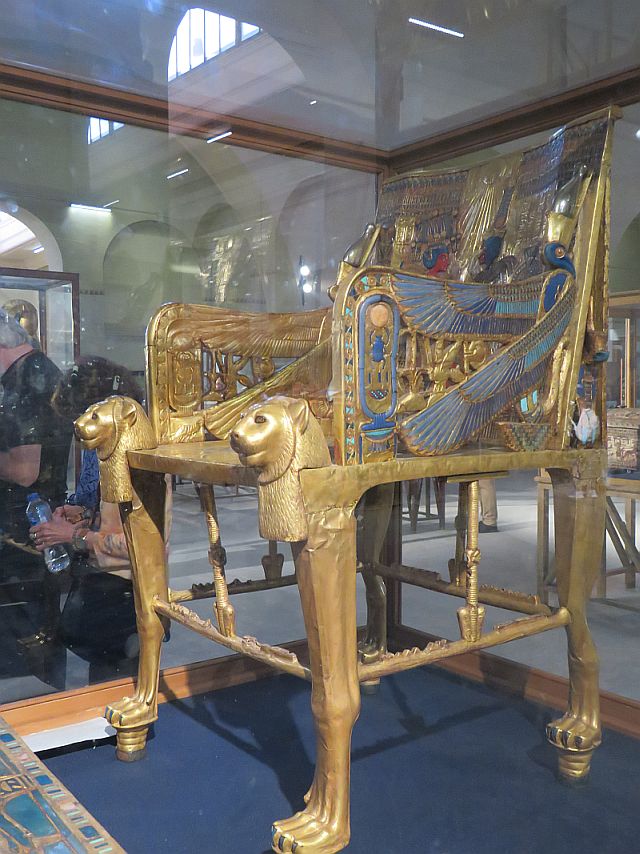
The three of us do not use up the allotted hour. After a while you cannot take in any more of the thousands of ancient pieces on display. We find the exit which makes you walk through a gift shop, (surprise, surprise) and arrive at the meeting point. There are already other members of our group waiting there, so we were not the only ones to cut our museum visit short.
We eat lunch at a nearby restaurant. Hussein had handed out a paper with two or three choices on the bus and we put our order in at that time. The preordering of meals is something that is done throughout the trip which sure saves time. Paul and I had ordered the beef kabob which was really a beef stew. It was very tasty.
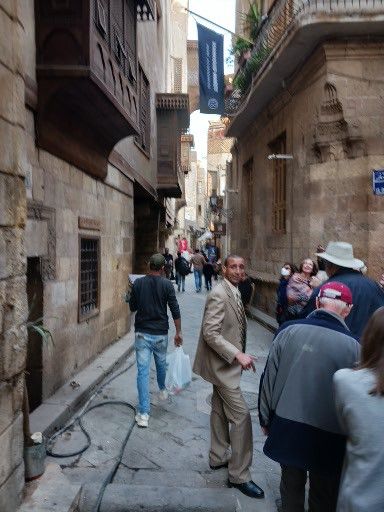
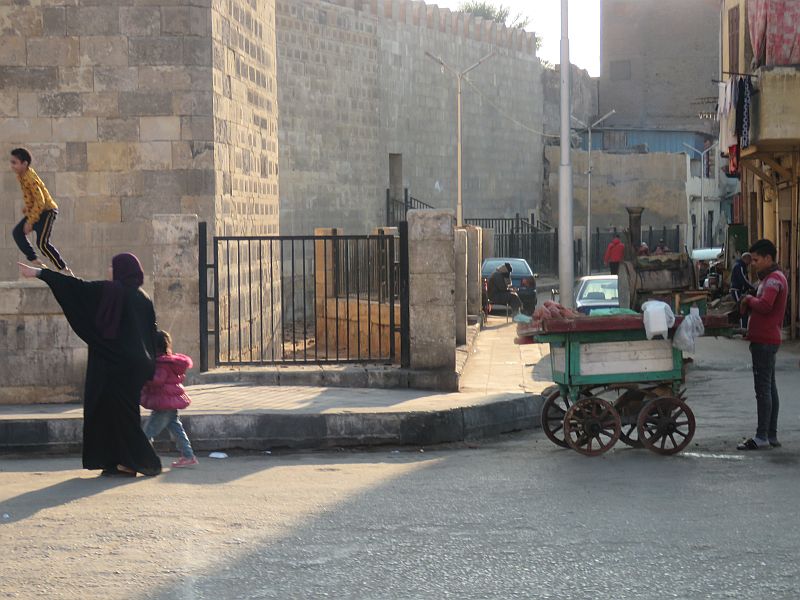
We return to the hotel for an hour and then gathered at “point X” for a trip to Old Cairo. It is here that our private security guard earns his pay. The congested streets, where cars and tuk-tuks’ expect pedestrians to make way for them, can be quite dangerous for tourists who are so busy staring at all the sights they forget to move out of the way. You just become oblivious at times due to the produce artfully displayed or meat dangling from a shop rafter, or intent on getting a good photo. This man is striding up and down, stopping cars, gently pushing us to the side of the street, and occasionally counting heads to make sure we are all present. Twice, when I am taking photos, I feel our guard’s hand in the small of my back pushing me to the side of the congested street. Both times I am moved aside, a car brushes by and I scold myself for being so careless. I see our guard perform this maneuver on almost every one in our group, except Hussein! Our guards’ eyes are always searching the crowd, checking out the people around us too.

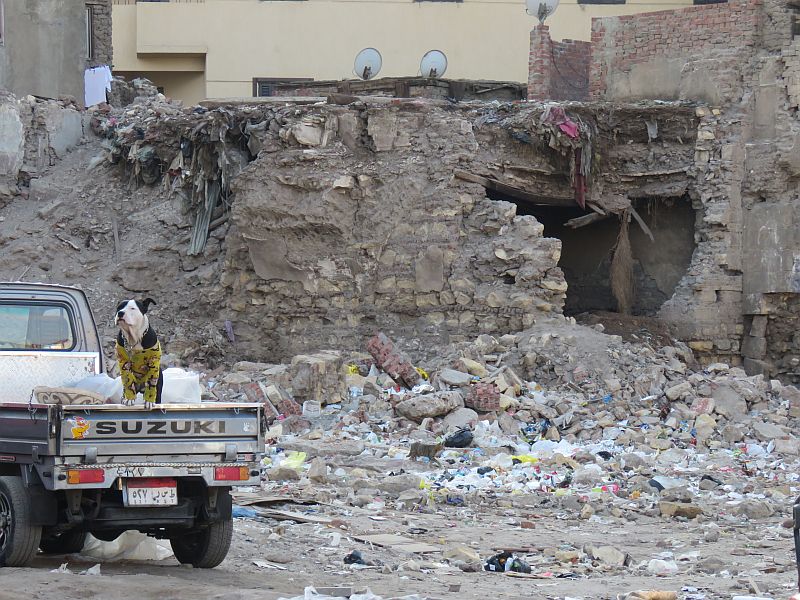
The crowds of people, the smog, and the areas of heaped up garbage here and there is the downside of this outing but overall, it was well worth experiencing.
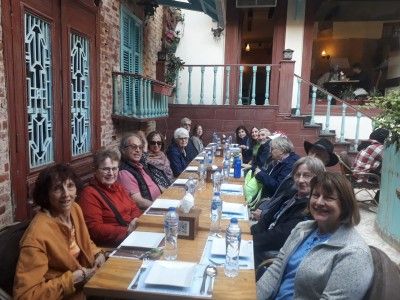
Tonight, we walk to a restaurant for our supper. Our guard is with us, I wish I could remember his name. The man has nerve, as he just walks out into the street and puts up his hand to stop the cars. Hussein is always leading us across the street, once our guard has stopped the cars, and urges us to cross as fast as we can. Geez.
This morning we are meeting at nine o’clock to see the Pyramids. I admit I am excited to see these ancient structures. Imagine standing next to The Great Pyramid, the only survivor of the Seven Wonders of the Ancient World! A structure that was built over 4,000 years ago by pharaoh Khufu and it is still standing. Amazing.
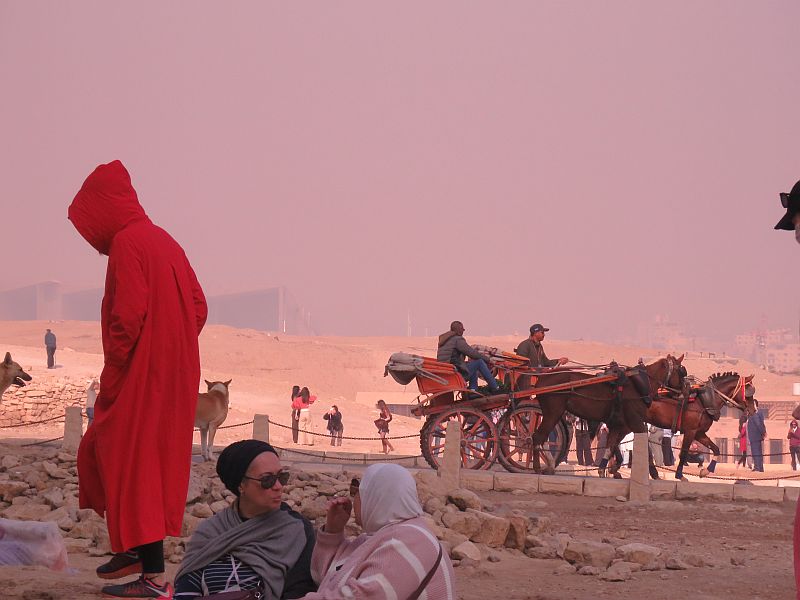
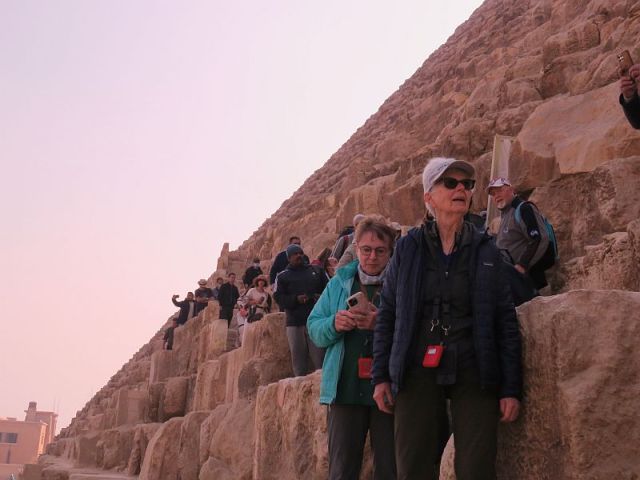
The bad news is that the smog is thick this morning and when we arrive at the Pyramids of Giza the air quality obscures the blue sky. The good news is that the air begins to clear after a while giving us a clearer picture of the three pyramids. Hussein leads us to The Great Pyramid showing us an area where we are allowed to climb upon the pyramid. I am surprised that the Egyptian government allows tourists to clamber up and walk a short distance along the base of the pyramid. One man in our group elects to go into a tunnel of the pyramid but the rest of us decline the offer when Hussein tells us that there is one place where you will have to get on your hands and knees and crawl. I am slightly claustrophobic and crawling inside a narrow tunnel inside the pyramid does not sound like fun to me. Evidently it is not appealing to the rest of the group either. Ironically the man from our group that chooses to take on this adventure is 6 foot 4 inches tall!

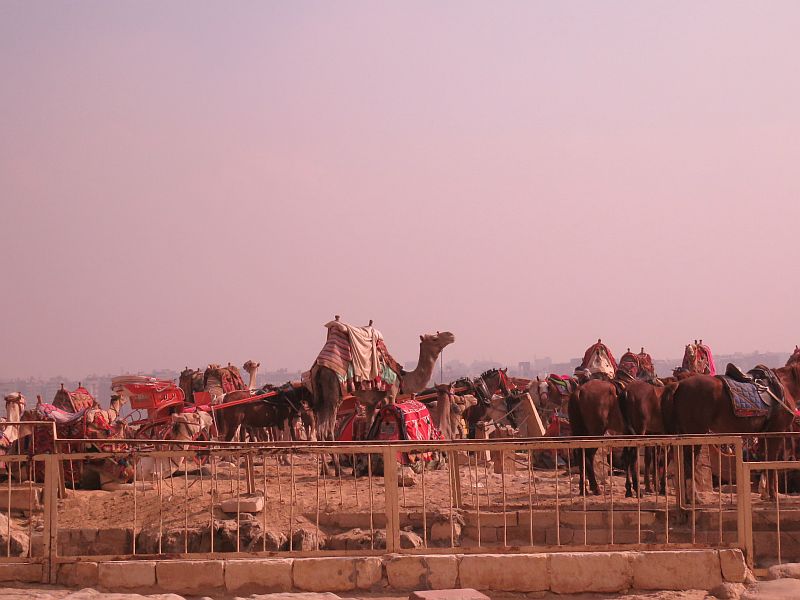
Once all of us are together, Hussein leads us to another side of the Great Pyramid to show us the place where archeologists had dug up a boat that was buried for the pharaoh to use on his journey to the next world. There is an area across from us filled with camels, decked out in colorful saddles and blankets. There are numerous horses saddled up too. The aroma of ammonia that permeates the air, smells like an enormous litter box that needed to be changed two weeks ago. There is also the usual lamenting by the camels which is very deep and guttural but there is one camel that is really raising a ruckus. Paul and I soon find the bellowing critter when we notice about four handlers yanking and whacking on a recumbent camel. Oh good grief, there is another camel lying underneath the caterwauling camel. We are witnessing the mating of camels and the camel care takers seem to be very unhappy about it. The men finally remove the male camel who voices his displeasure of being taken away from his girlfriend but allows himself to be lead away. Well, this was an activity that was not listed among the sites we would see in Egypt.
Hussein gives us time to wander around the pyramids on our own. At his advice we ignore the men riding camels or horses that ask to have their photos taken because if you take their photo, they will insist on being paid. I have a good zoom on my camera so I can get photos without them knowing it. The pyramids are so colossal that it is hard to get far enough away to get the entire pyramid in your camera frame.


When we meet up with Hussein, we return to the bus and our driver takes us a short distance to an area where camels await us. Yep, we are going to ride camels. You must lean back and hang on to the saddle pommel if you want to stay seated on the long-legged creatures when they stand up. The camels grumble about this, but camels seem to complain about everything. The camel owners take charge of three of us. The lead rope of the camel behind you is looped around the back pommel of your saddle. Once everyone in our group is sitting atop their camels, we begin our trek towards the pyramids.
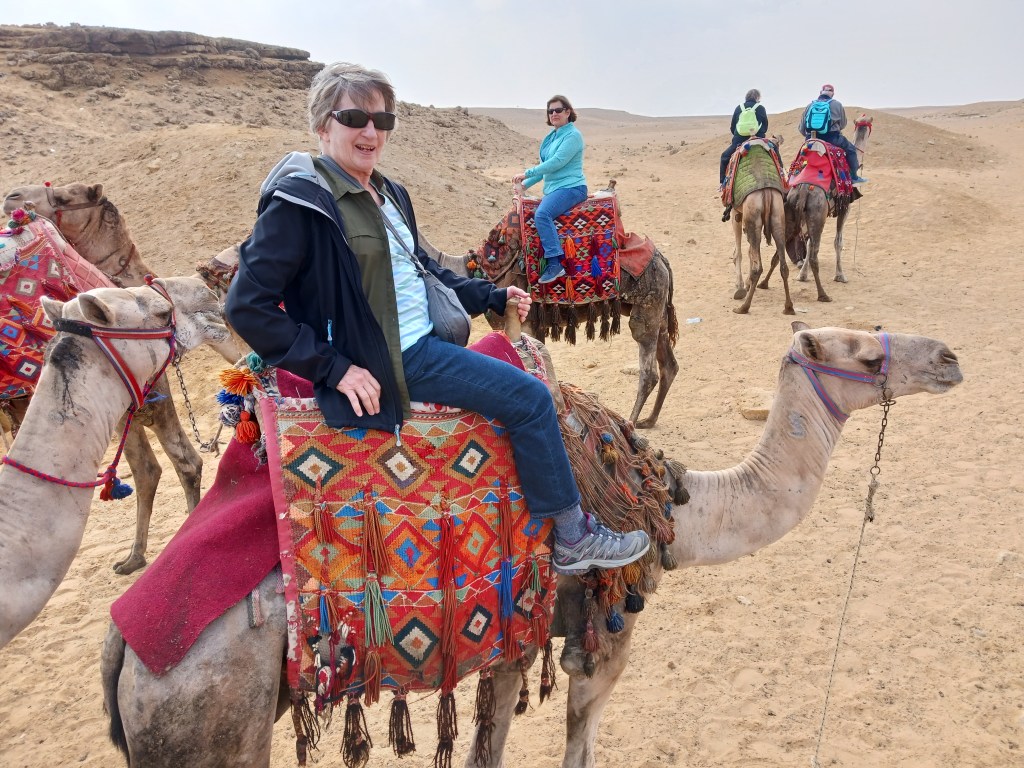
The woman that is behind me has a camel that keeps trying to walk around my camel. I do not really want to have the rope pushing against me, so I talk softly to the camel and then take hold of the rope and pull back on it. This makes the camel fall back in line but before long it is striding next to me again. I talk quietly and pull softly on the rope several times on this journey which sends the critter back where he belongs for a little while. One time when I am tugging on the rope, I am rewarded with a huge camel sneeze while he is walking next to me. I am sprayed with a fine aerosol from the sneeze that settles on my face, neck and probably my shirt. Oh well, I just wipe it off and figure it could have been worse, like it could have been actual snot. The woman that is riding this camel tells me that she will remember me as the camel whisperer which I get a laugh out of.
Paul is riding the camel bringing up the rear of our little caravan so I do not see him at all during our ride. The camel guide stops at a certain point where the three pyramids are spread out in front of us in the distance. He unhooks our camels, leads them to a certain spot and places the beasts’ side by side. The man asks for Paul’s phone and then has us raise our arms into the air and takes photos of us. Naturally, everyone in our group goes through this same ritual. Yes, the camel owners expect a tip for doing this and Hussein has told us how much to give them. Paul said our man told him it wasn’t enough but Hussein insisted we not give them more money if they ask for it.
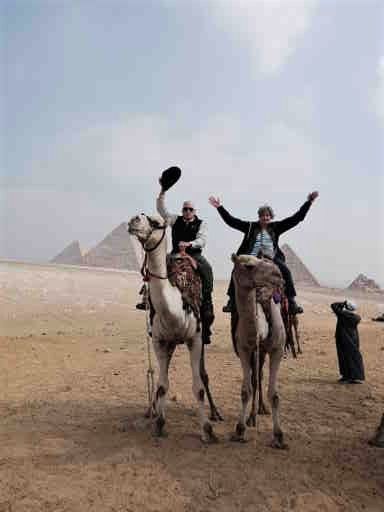
Camels are not comfortable animals to ride, their gait is very odd plus you do not have stirrups to steady yourself. I get somewhat accustomed to the sway of my camel and feel safe enough to let go of the pommel and manage to take a few photos atop this one-humped animal. Hussein rides past us and it is obvious he is used to riding camels. I wonder if he grew up riding camels? I don’t think I mentioned that Hussein is Nubian.

Paul spots our bus up ahead and lets out a sigh of relief. He told me he was going to walk back to the bus if we had to ride them back to our starting point, because he was so uncomfortable sitting astride his camel. I have a feeling everyone was happy to get off the cantankerous animals and trade them for the comfort of our bus. Oh yes, getting the camels to lay down so you can get off was not easy to do. Many of them belly-ached about having to lay down but you the rider must hang on tight to the saddle horn and lean back in order not to topple off the front!

Our next stop is to the Sphynx and I can’t even describe this massive statue in words. We aren’t allowed to go down to the base of the Sphynx, but there is a walkway that allows for great views of this intriguing work of art. Hussein gives us ample time to take photos. He talks a couple of the women in our group to stand in a certain place and purse their lips. I assume this looks like you are kissing the Sphynx. While we are admiring the Sphynx, a deep guttural noise fills the air. One of the women asks Hussein if what we are hearing is camels, (I thought the same thing). Hussein doubles up with laughter and tells her that it is the call to prayer! I will say that the call to prayer in Egypt is nothing like what we experienced in Istanbul, Turkey when we were there several years ago. In Turkey the call to prayer was melodious and pleasant. I cannot say the same thing for Egypt’s call to prayer.


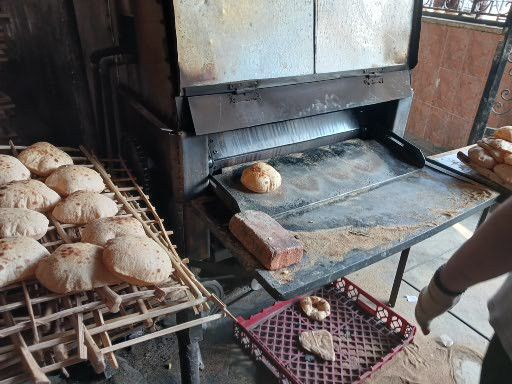
On our way back to the Marriott, Hussein has the bus driver stop at a government bread bakery. All this place does is bake bread where the citizens can buy six flat loaves of bread for twenty cents, (I think). The workers welcome us inside the bakery and we watch one man form the loaves, two other men place them on a conveyer belt that takes them through the heating element, while another man removes the baked loaves as they exit the conveyer belt. It sure does not take long for the bread to bake. I wonder how many loaves of bread this bakery puts out in a day. I wished I had asked Hussein that question. There were lots of people lined up waiting to buy their daily allotment of bread.
Time to call it a day and return to the Marriot. Tomorrow, we leave Cairo and fly to Luxor. Nancy
 realityranching
Very interesting and great photos. Thanks for sharing.
Enjoyed your third report on Egypt. It took me back to my visit in many ways. Am wondering if you saw the royal mummies, which are in the National Museum of Egyptian Civilization? Maybe that visit will be in your next blog.