Tarangire National Park, Part 2
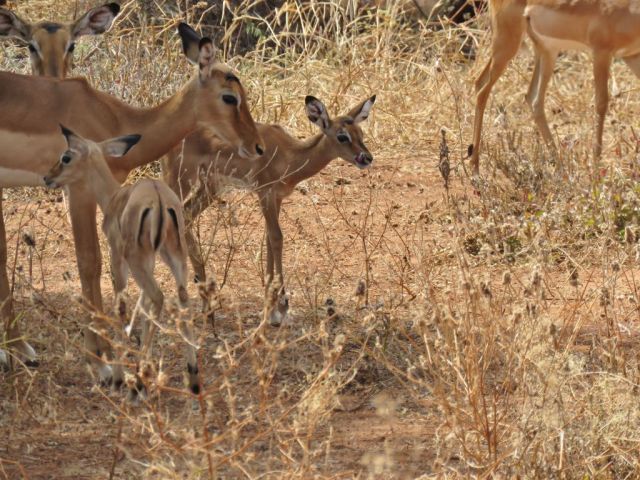
Baby impalas
Our drive into the park has barely begun when we catch sight of a small herd of impalas, some vervet monkeys, and one huge bull elephant. As George drives slowly along we comment on how one side of the road is devoid of grass and the other side has abundant grass, albeit very dry grass. When we quiz George on this oddity he informs us that the grubbed side is not part of the Park and the Maasai have grazed their cattle here. Wow, none of us can figure out how the grassland can recover after being this overused.

Zebra at the beginning of our game drive
We see a few zebra and Connie and Carl comment that they have now seen more zebra than they did on their safari last spring which was in Botswana and Zambia, and Zimbabwe. The North Millers, (C&C live north of I70, we live south of I70), also saw one lone wildebeest on that safari which they dubbed Willie. That record is soon to be broken too.
I am sure I see a giraffe in the distance as we are driving through the park but it looks odd so I’m not positive. I ask George to back up and am subject to some “sure you saw it” ribbing when I can’t locate anything. Finally, I find the long-necked creature but no wonder the giraffe was hard to find. The Maasai giraffe is standing with its front legs splayed, head down, browsing on a low bush or grass an uncommon stance for a giraffe that is eating. George says “good spot” which is always satisfying when your guide gives you a verbal pat on the back.
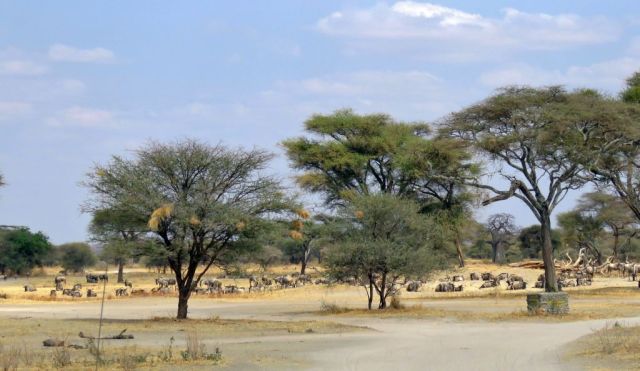
A small portion of the wildebeest that were surrounding this water hole

Another view of the water hole
A bit further on we come upon a myriad of wildebeest and zebra which are scattered around a waterhole. There are also a few olive baboons foraging in the brownish grass. Many of the wildebeest are just lounging about, some are grazing and a couple are drinking from the small pond. I think our traveling companions are a bit astonished with the number of critters in such a small area. Paul and I have seen this before and we are still in awe of all the life that this small body of water is sustaining. George finds a monitor lizard near the water’s edge half hidden under a bush.

One of many baboons we saw.
A lot of photos are taken, particularly by Jesse and me, in fact Paul doesn’t even take his small camera out and Jennifer has only brought her phone to take photos with. Why not, phone cameras take really good photos and they are much more convenient than the big cameras. George continues down the dusty road and we see many small waterholes that are nearly dry or completely dry. Now we know why the animals were so congregated around the two ponds we passed earlier.

An African Jacana that is foraging on a small pond that is choked with water plants
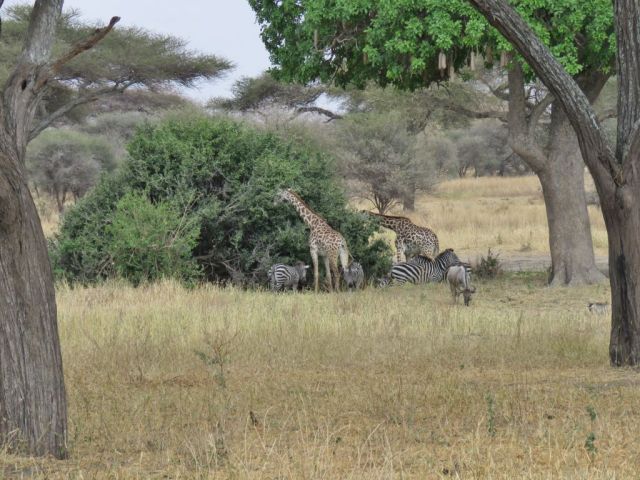
Giraffe, zebra and a wildebeest
Soon we see several graceful giraffes, browsing in trees or bushes. A few of them are on the move and I love watching the elegant animals as they seemingly glide over the land. We drive along a dry river bed and there is a lone elephant sipping water from a hole he has dug. The colorful bluffs behind him make for an image that I won’t soon forget. The elephant will leave the small hole of water open where other animals/birds will benefit from the tusker’s excavation. I am so happy to be back in Africa!

This landscape can even make an elephant look small
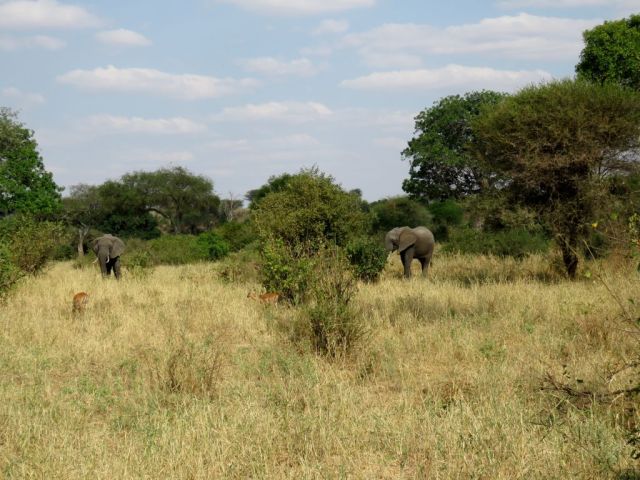
Elephants dining on leaves and a couple of impalas
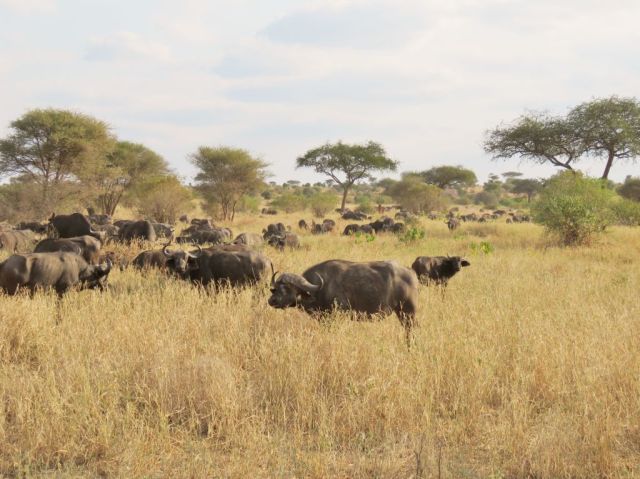
The calm Cape buffalo herd
As we drive deeper into the park we come across lots of elephants, such regal creatures. An enormous herd of Cape buffalo are standing near the roads edge, the sunrays making the buffalo’s backs glow. As we watch the sedate herd, they peer back at us with no snorty animosity like many cape buffalo we have encountered on other safaris. Jesse opens the door on the far side from the buffalo herd, and says he is going to “check the tires”. There is a collective gasp from the rest of us and mom informs her son he must always ask permission before getting out of the vehicle. In the “youngster’s” defense he is a game warden so knows how to read an animal’s body language. The Capes were so uninterested in us and calm that I am sure Jesse thought if he was on the side away from the beasts it would be okay. Yikes. George finds another area he deems safe for the bathroom break, where Jesse has a group of banded mongooses cross the road as he “checks the rear tires”. No danger from those cute little guys.

No animosity towards us from this old grandma
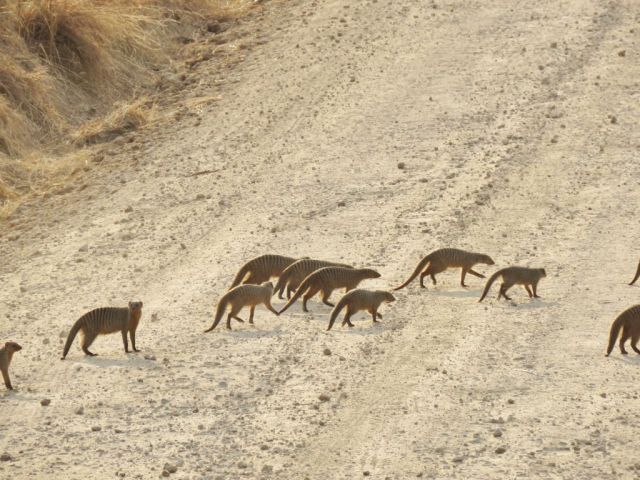
Banded Mongooses or Mongeese if you prefer. Both are correct.
As we are touring through more open country, George stops the vehicle and looks through his binoculars. We all raise our binoculars scanning the area that he is looking at. Soon he puts lowers his binoculars and declares “a bush faked me out” which sent us all into peals of laughter. We are all going to get “faked out” numerous times before this safari is over but it is better to take a look rather than ignore an “an animal like thing” simply for your peace of mind.
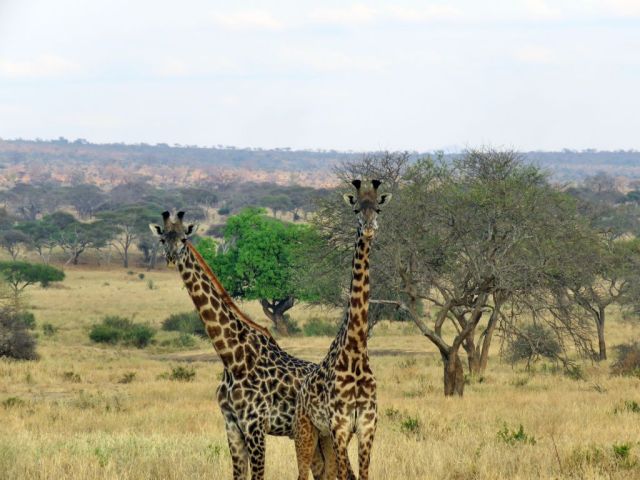
We encountered a lot of shy giraffe on this safari but these two were willing to have their photo taken
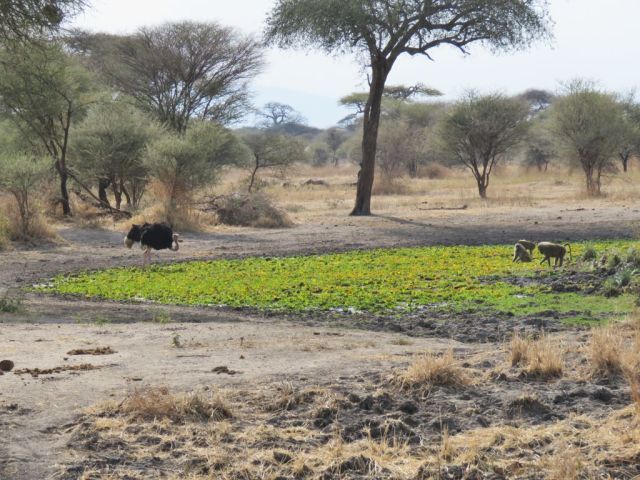
Male ostrich and baboons at a pool that is close to drying up

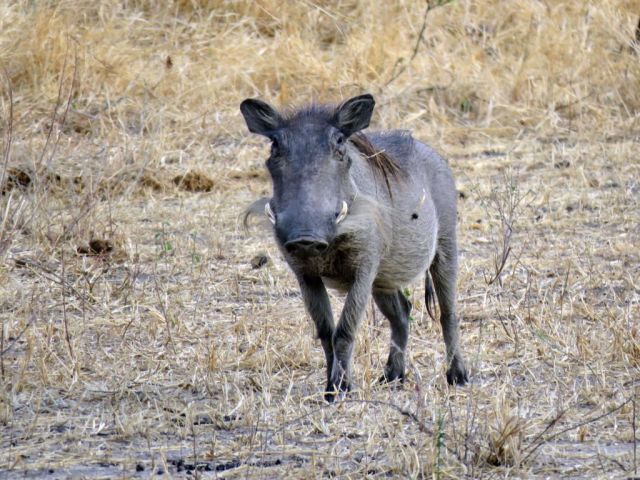
A bold wart hog
As our journey continues we spy several ostriches, these half-feathered birds are so huge and quite odd-looking, not that they give a hoot what we humans think of their appearance. We see numerous wart hogs and the unusual thing about these wild hogs is that they don’t run as soon as we stop the vehicle. Usually wart hogs turn and run in single file, with their skinny tails lifted straight up. Of course, there are so many different kinds of birds around it is simply astonishing. The interesting and numerous birds is another reason I love Africa. I would be remiss if I didn’t mention the grand baobab trees that dot this park. These massive trees top my list of favorite African trees with the acacia tree a close second.
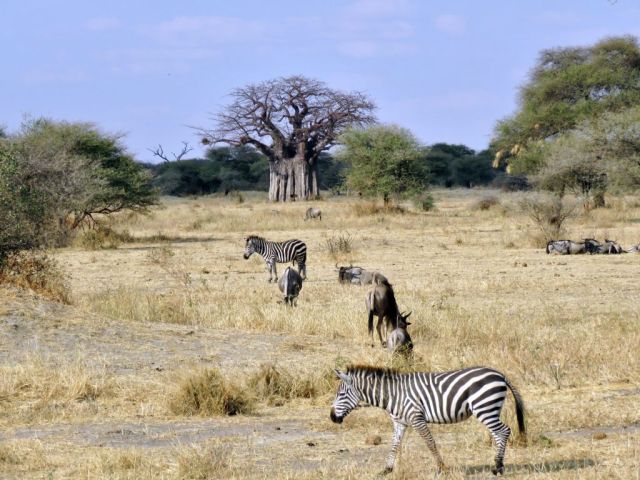
Zebra and a giant baobab tree
George drives really fast the last few miles to camp and we have a preview of what is to come in the following days. We hang on for dear life as we bounce and jounce down the rutted, washboard, road. As we pull into Ang’ata camp there is a welcoming committee waiting for us with hot wash cloths to wipe our dusty faces and a cold drink of juice to refresh us. After a briefing of camp policy and the details of our walk tomorrow, plus a night drive, we are shown to our tents. The tents are very basic fare but the one feature that puzzles us is the slatted wooden floor. You best not drop anything small on the floor or it will likely disappear down one of the cracks. Paul is using the toilet when he lets me know he is having a staring contest with a mouse. When he emerges from the lavatory he cautions me to carefully look around the room and check the floors when I get up at night. His reasoning is that if a mouse can get in the tent so can a snake. I will take that advice to heart.

Our tent at Ang’ata Tarangire camp
All of us order our hot water for our showers. With the bucket shower set up you must get wet, turn the water off, lather up and then rinse off. You get one bucket of hot water each so you don’t want to run out. Feeling refreshed after our showers, we get our stuff somewhat organized in what will be our home for the next two nights and then walk up to the dining tent.
Supper is at 7:30, too late for me, but I might as well get used to it. There is cream soup, not leek, and as usual it is delicious. Africa has the best soup I have ever tasted and if I was smart I would stop eating after the soup and the roll. I don’t though and we all enjoy the beef, potatoes, and the carrots/beans we are served. How they turn out such terrific food from these small camps I will never know.
Oh dear, Paul and I were assigned tent one which is just a stone throw from the dining area. Some of the other guests are having a good time, laughing and talking until after 11 p.m. Unfortunately, we are privy to every bit of the party. Paul manages to fall asleep but not me. I write in my journal and sigh with relief when the guards lead the revelers to their tents. Someone says lala salama to one of the guests who then calls the phrase out as he walks down the path by our tent. I hear him saying good night in Swahili until his voice finally dwindles away in the distance. We discover another problem with our tent when the wind comes up during the night. The canvas flaps and the tent shudders when it is hit with gusts of wind. Paul and I also hear something digging near our tent and what sounds like little creatures scurrying over the canvas roof. The good news is that I also hear lions roaring, hyenas whooping and some unidentified animal running down the path, twittering nonstop as if it is chastising itself for being behind schedule. I finally give up and take half an Ambien, managing to get four hours of sleep with the drugs help.

I’ll be honest, I don’t know if this is a sunrise or sunset at Ang’ata but regardless it is spectacular
Up this morning at 5:20 and our arrival at the dining tent coincides with a spectacular sunrise. We were supposed to eat at 6 a.m. but we didn’t get our breakfast until 6:30. George had hoped to be on our game drive by then if not sooner. There was a lone elephant eating leaves from a tree as we left camp. We stopped to take a photo of the enormous fellow stripping and munching on the leaves but he promptly stops eating, and turns to give us a view of his better side. On the North Millers last safari this was referred to as the African salute. It was amazing how often this happened on our safari. As soon as we had driven off, we looked back to see the elephant happily munching on the tree again. I guess the animals are sick of having their photos taken.
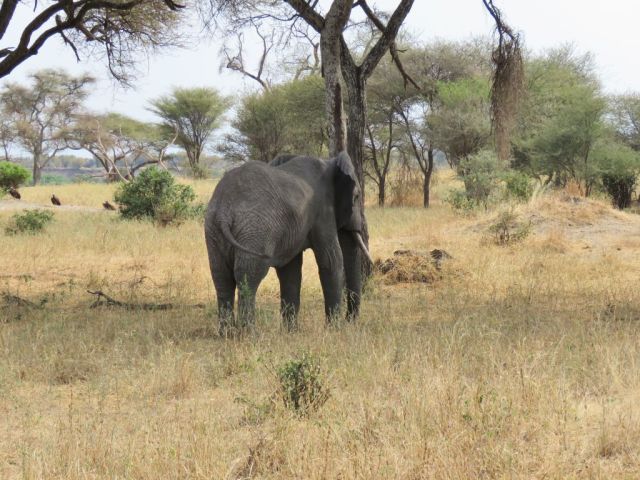
An elephant giving us the African salute
We drive through herds of zebra, impalas, and wildebeest. There are numerous ostriches, and Paul and I comment how we have hardly seen any ostrich on our last two or three safaris. It is good to see so many of the half-naked birds as they prance around on feet that resemble high heels. How can you take them seriously?

I think this is the mother cheetah. It was pretty hard to tell them apart.

One of the young cheetah is waiting to ambush his sibling. Can you find it?

The Siblings as Mom has already went up the bank and is lying in the grass
As we are approaching a river, George calls out that he sees cheetah. Are you kidding me. Jesse immediately finds the sleek cats and the rest of us soon have them in our sight. The North Millers had ordered cheetah on this safari since they were didn’t see any of the speedy cats on their last safari. Well, they are being given the gift of three of the beautiful felines, a mother and two nearly grown cubs. The sinuous cats seem to have no problem with us watching them as they continue along the river bed, coming in our direction. The two cubs occasionally chase each other before flopping down to rest after the expended energy. Mom even joins in the play briefly. Eventually, they climb up the bank on the opposite side and disappear into the tall, yellow, grass. We catch a glimpse of a head now and then as they continue walking which soon puts them on our left side instead of the right side. Soon the trio are fully visible and saunter to a grassless area above the river bank and plop down. How cool is this to have three gorgeous spotted cats allowing us to enjoy them with no qualms about our presence. Granted there is a fair distance between our car and the cats but still. We have had the pleasure of watching the cheetah family for a good half hour and we have had them all to ourselves. Unreal. Just as we are pulling away two vehicles are making their way towards us. Enjoy the cheetah folks.
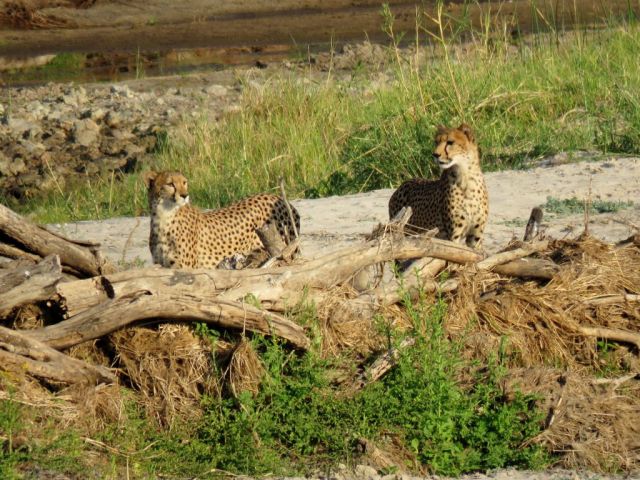
Where did mom go?

The cheetahs once they had come back into full view. Beautiful

What is that look?
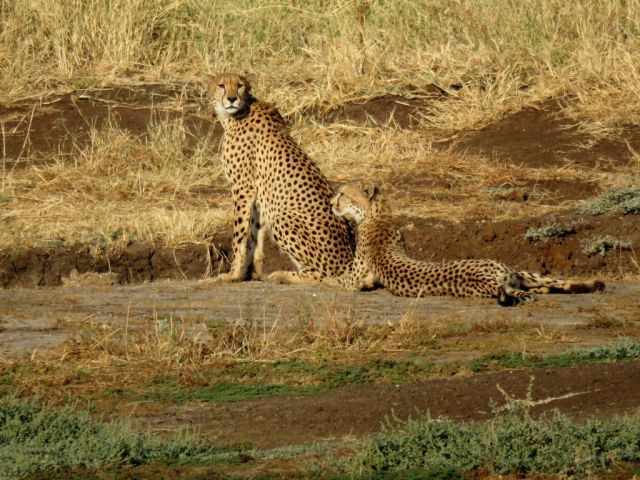
One last shot of the cheetahs.
George was taking us to the Silale swamp when we were side tracked by the cheetah. His plan was to get there early in order to find the predators that hang around this oasis due to the many grazers that come here to drink. Well, we don’t get to the swamp until mid-morning and the heat has ramped up so more than likely the lions and leopards are settled down for the day. Hey, seeing the cheetah was well worth the delay.
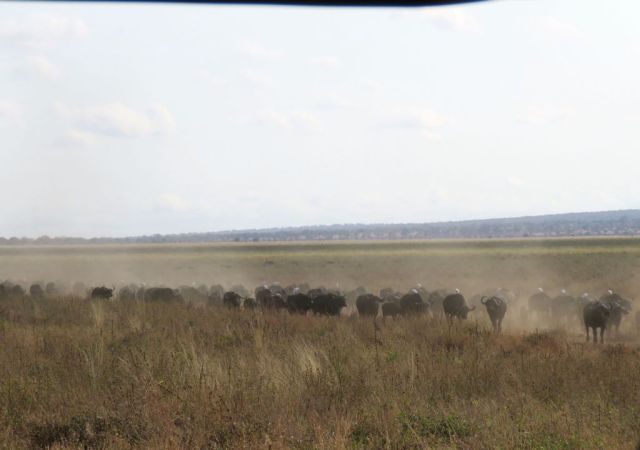
A tiny bit of the endless line of Cape buffalo walking along the swamp edge
As George motors along the road parallel to the swamp we can see lines of Cape buffalo coming towards us. George says they are looking for a good water hole to drink from. This herd is not placid like the first buffalo we encountered and in fact are downright unwelcoming to us. Many shake their ponderous heads at us and snort their displeasure at our presence. George says this is because the buffalo herd has so many small calves among them. At one point a group breaks off the endless line of the main herd and runs across the road in front of us. Great, now we are basically surrounded by cantankerous bovines. I can’t remember what George does, (rev his engine?) to keep the buffalo at bay but when he gets past the bunch that split off, he drives off-road for a bit putting more distance between our vehicle and the parade of Capes that are walking near the road. Thank you, George, Cape buffalo scare the bejesus out of me. We estimated that there were around one thousand buffalo making the trek to water. Seriously.
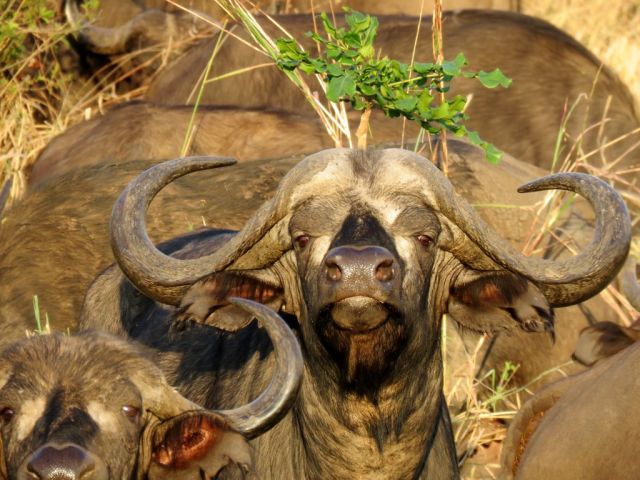
Are you talking to me?
We continue down the dirt lane where we encounter some other safari vehicles. George stops to talk to many of them and all of us enjoy listening to Swahili being spoken at lightning speed, with a drawn out ahhh or ehhh to punctuate the conversation. Sort of like our “hmm” or “really” in our own conversations I suppose. Unlike a lot of guides we have had, George informs us that there is a leopard in a tree up ahead. Are you kidding me, cheetah and now possibly a leopard.
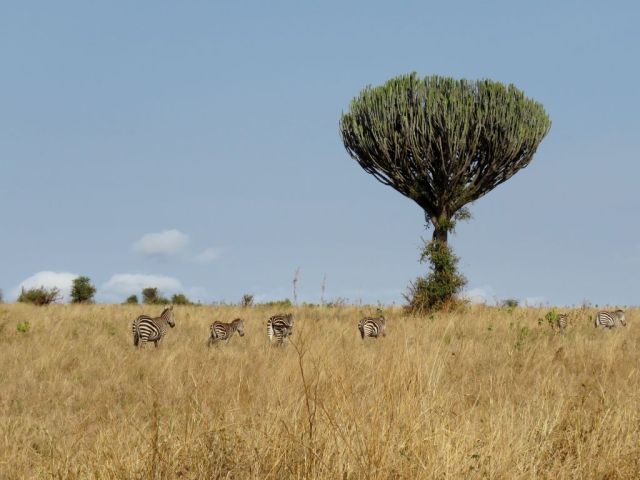
A candelabra tree with the always photogenic zebra
Advancing down the road we see several vehicles tightly grouped under a large tree. There is no doubt where the leopard is. George expertly maneuvers our Toyota into the scrum of safari trucks, getting us into a good position to see the small leopard that is sleeping on a large limb. How the feline can sleep with all the excited chatter that is permeating the air I don’t know but sleep she does. George has informed us that it is a young female. After taking numerous photos from this angle of the leopardess, George moves into a different position so we can see both the young cat and the hapless impala that the huntress has stashed in the fork of the tree. We spend ten minutes or so with the stunning cat and move on to make room for other onlookers.

The sleeping leopard.

She opened her eyes briefly
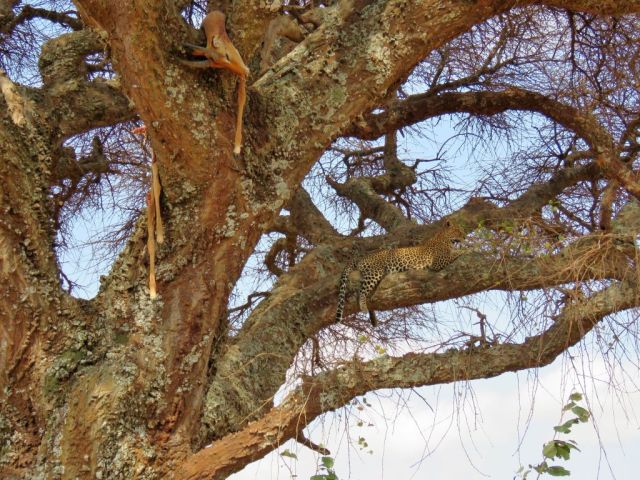
The leopardess and the half eaten impala. I’m always in awe with a leopards ability to pull their kill into a tree.
We head back in the direction we came from enjoying the abundance of wildlife along the way. There are hippos laying on the shore sound asleep and I can’t figure out why they aren’t in the water since they are prone to sunburn. Weird. There is a delicate reed buck grazing in the swamp and a variety of water birds. Herons, ibis, openbills, ducks and geese everywhere you look. We stop at a picturesque area for tea and to stretch our legs. I forgo the offered beverage but enjoy all the life that is around us. When we drove up a common waterbuck and her small baby ran into the trees but stopped long enough for us to get some photos. How cute is that!
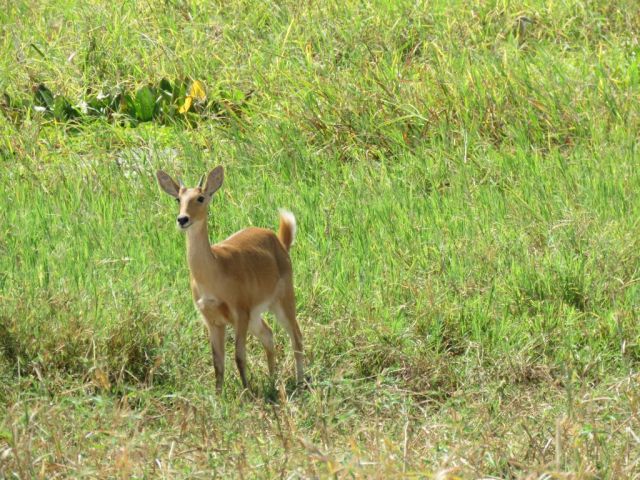
Pretty Reedbuck
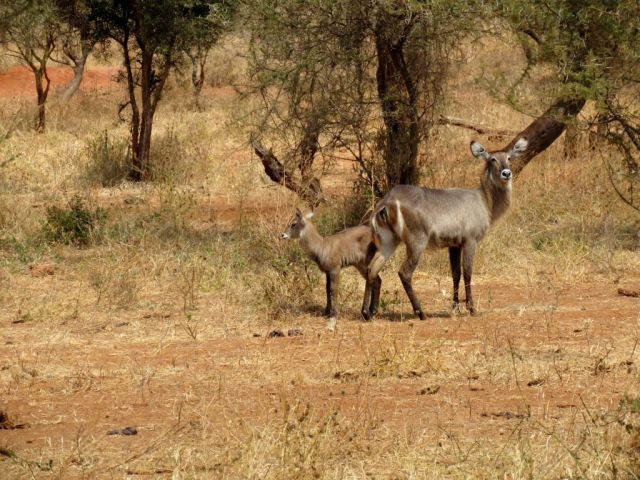
What a sweet baby waterbuck
George drives around the edge of the swamp so we are driving on the opposite side of where we had been. He has reports from fellow guides that there were lions over here but we have no luck finding them. If they are lying down in the tall grass only the flick of a tail or a raised head would ever give them away.
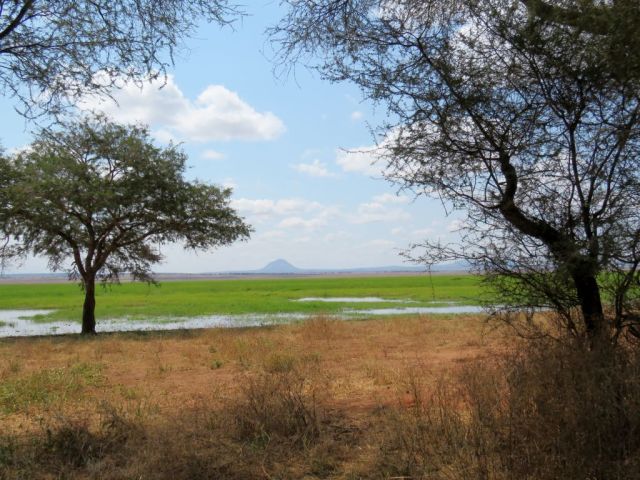
View of the oasis surrounded by dead grass
We do stop and watch a lilac-breasted roller decimate a large grass hopper he has caught. The roller wallops the insect against the limb of the dead shrub he is perched on trying to remove the wings. When the colorful bird has accomplished the wing removal the next task is to position the hopper so it can be swallowed whole. What a lot of energy it takes just to eat your lunch. The whole process was highly entertaining.

Lilac-breasted Roller and lunch
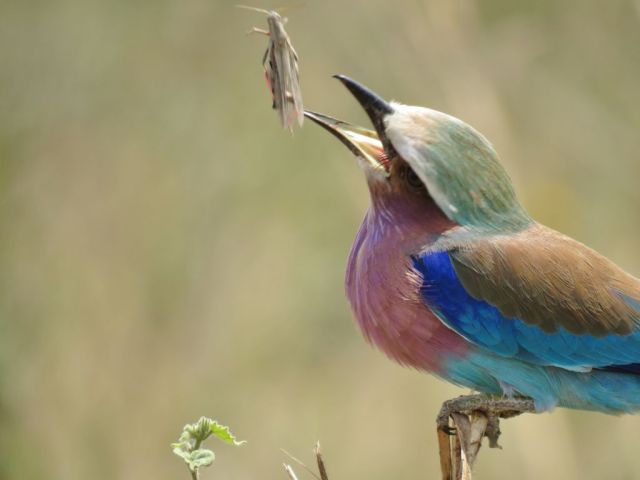
Flipping the grasshopper in the air to reposition it
George puts the pedal to the metal as we head back to camp. It seems we are late for lunch. What a half day this was and those of us who have been to Africa tell the newbies they have no idea how fortunate they have been this morning. Later, Nancy
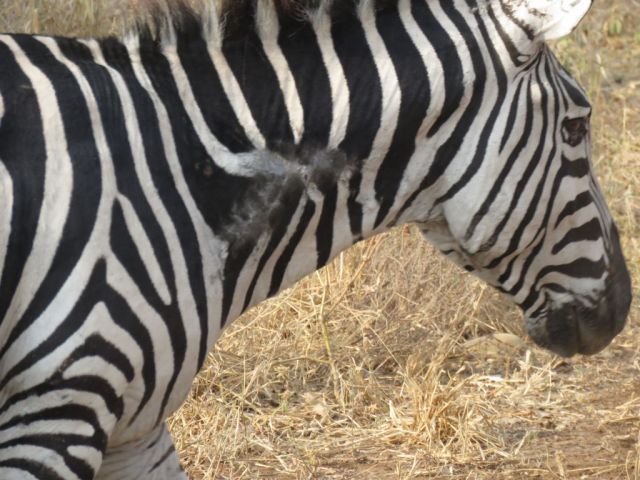
A zebra with an old scar. How did it survive?
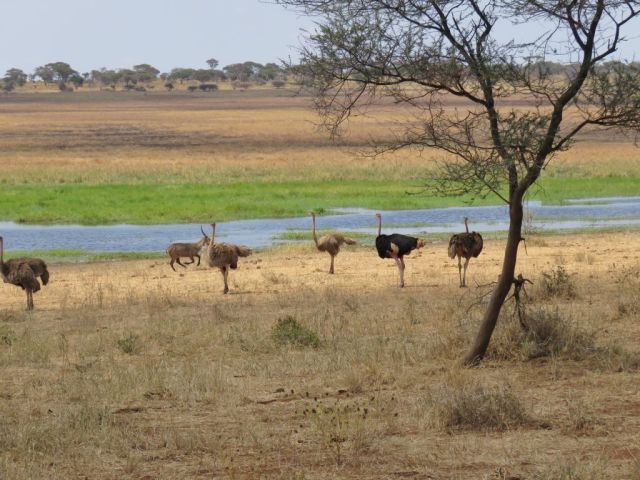
One of the larger groups of Ostrich we saw. Often it was two or three together.
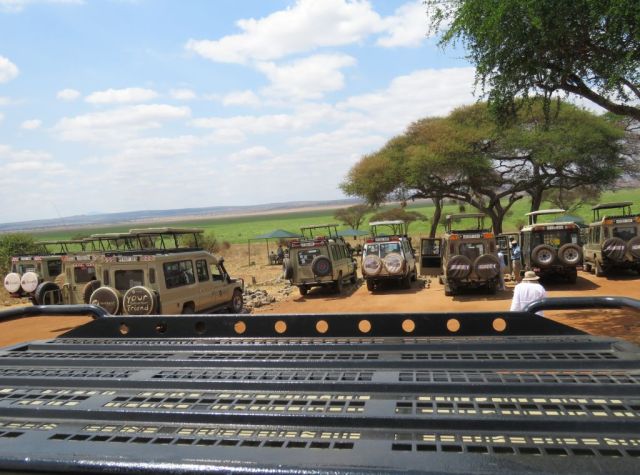
Tarangire had a restroom and as you can see it was taken advantage of.
 realityranching
Feel like I was there with you. Another excellent blog.
What an amazing place! I especially loved the picture of the elephant against the cliff and the cats! Wow- to see them in the wild has to be something.
Sent from my iPhone
So. MUCH. GAME!