Romania part 3
This morning Marioara serves us crepes with homemade jam and butter, cold ham along with a plate of local cheese, sausages, tomatoes and cucumbers. The food was delicious as were all the meals we were served at this guest house. We say our goodbyes to Marioara and thank her for making our stay comfortable and tasty!
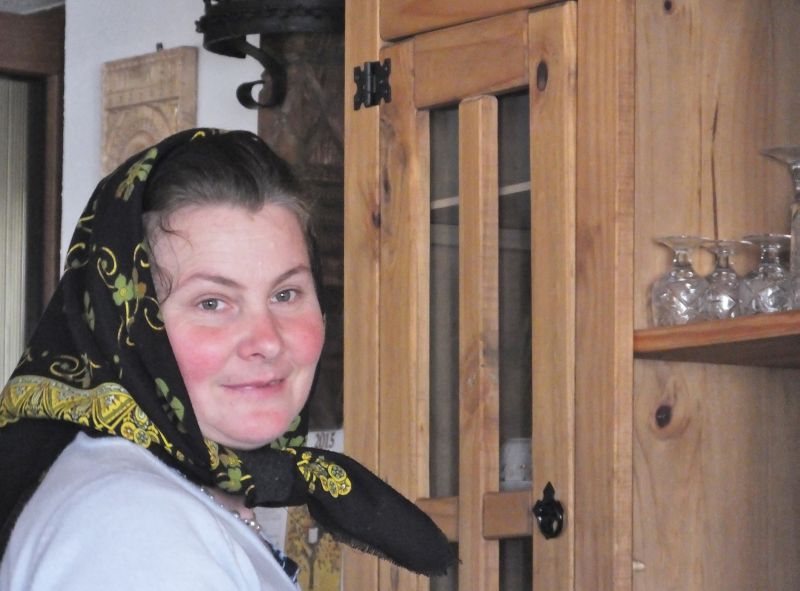
Marioara
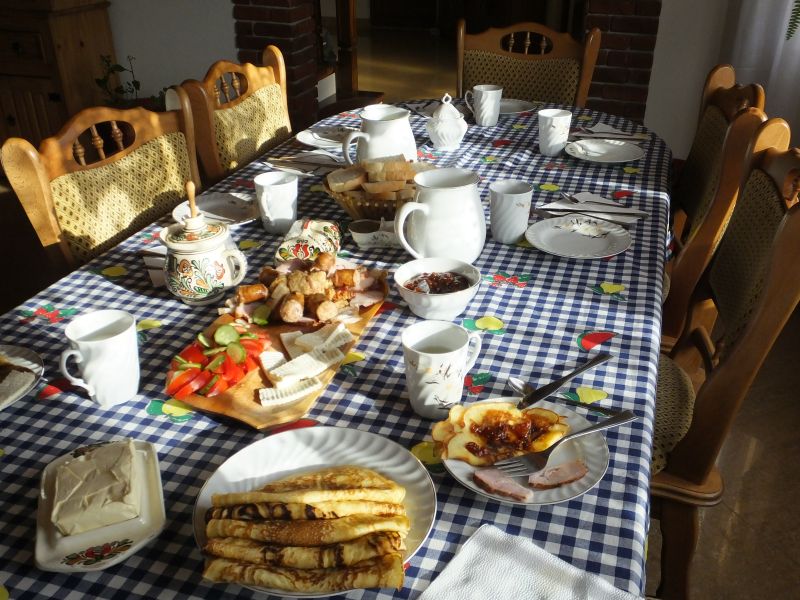
Breakfast our last morning at Marioaras’ guest house
Today we are leaving the Maramures region and will drive southeast to the region of Bucovina. Our journey will take 5-6 hours on this sunny day and we will be driving over the mountains. We also will stop at a few historical places along the way.
I haven’t mentioned all the White Storks we have seen on our trip thus far. The large white birds are nesting and they build nests of sticks, usually on top of a power pole. The nests are huge because the storks use the same nest year after year and just build a new layer over the old nest. Paul and Cornelia find it quite amusing since I am the “birder” that they are the ones that usually spot these lanky birds standing or sitting on the bushel basket sized nests. I have no explanation why I seldom spot these very obvious storks and nests. I took lots of photos but I got very few decent ones as it seemed I was always shooting up into the sun and through a wad of intersecting wires.

Storks on their nest
Farmers are taking advantage of this warm and sunny weather and we see lots of people in the fields cutting hay or piling it into haystacks. Cornelia stops alongside the road where a man and three boys are working in the field. The boys are scything the alfalfa and the man is stirring up the cut hay with a pitchfork. Cornelia calls out to the man and asks if it is o.k. to come down to the field. The pleasant-looking fellow nods his assent and we walk down to the hay field.
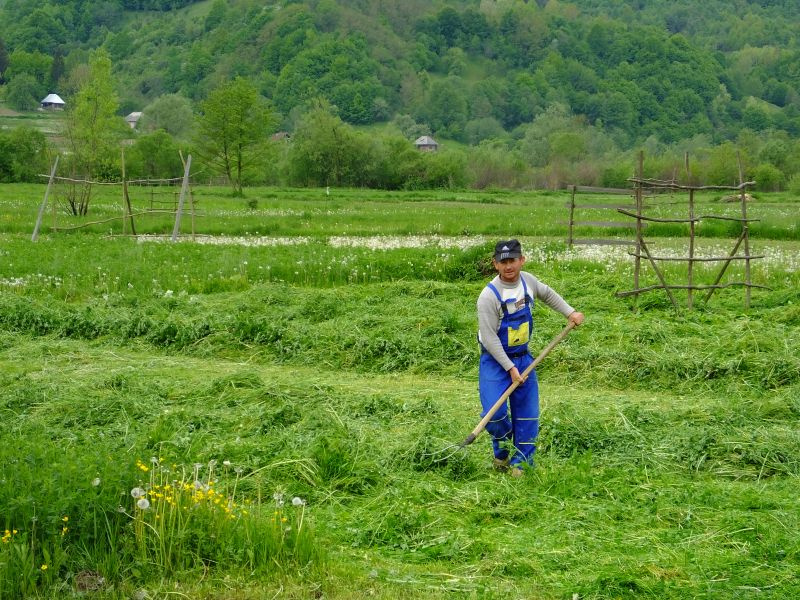
Man turning alfalfa by pitchfork
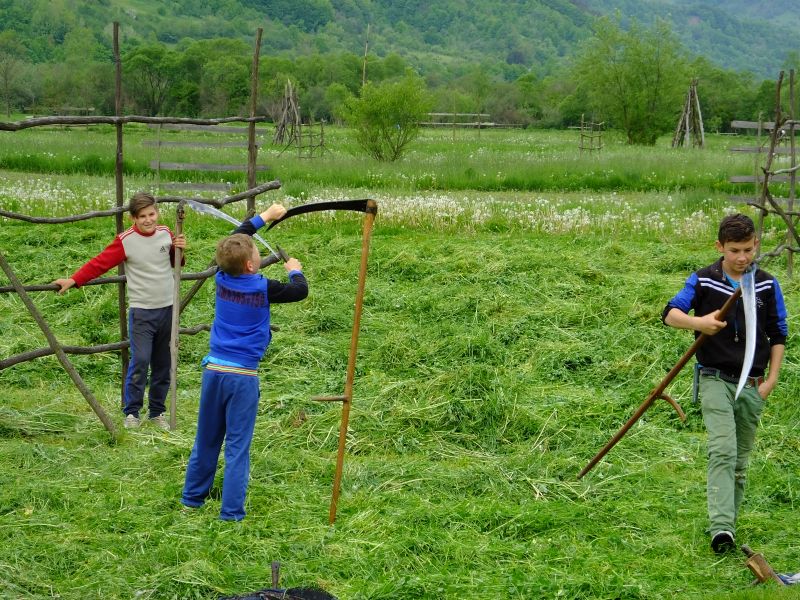
The mowing is finished but scythes are sharpened in prep for he next field

This young man liked being in front of a camera
The boys have just finished scything the field of alfalfa, although the blond-headed youngster is busy sharpening his scythe in preparation for next time I suppose. I think the older boys are enjoying the attention of foreigners because they seem to be more than happy to strike a pose for photographs. Cornelia fields questions from us to the man like, “Is all the land you own right here”, answer, “no, we have small fields scattered around the area”. “Are these your sons”? “Two of them are my sons and the third is a school friend”. After we are done visiting, Paul brings out his photo book and the four hay makers cluster around and seem genuinely interested in Kansas and our ranch. They ask their own questions such as “Are those beef or milk cows”. We thank them for taking time to visit with us, wave goodbye, and continue on our journey.
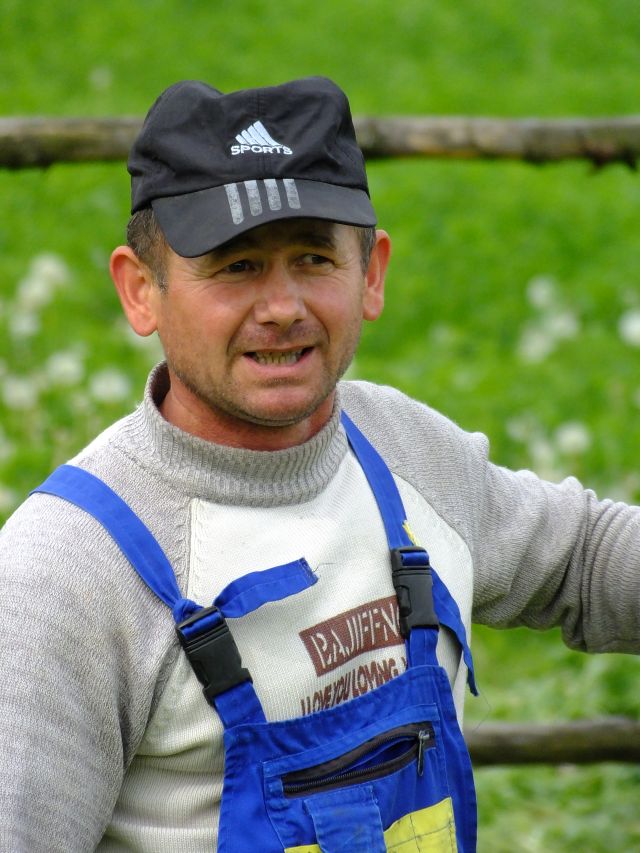
The people we meet are so pleasant and their faces show this I think
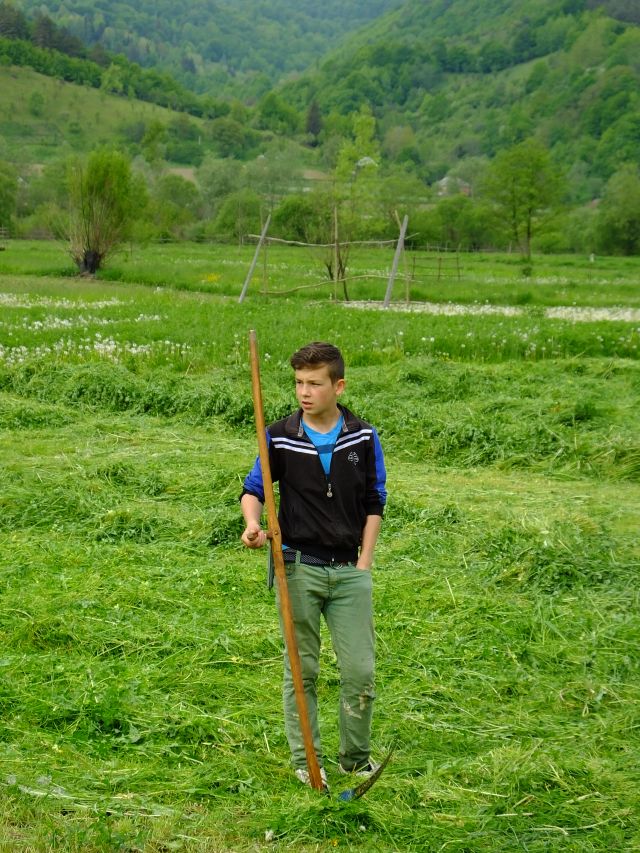
A boy and his scythe

Checking out Kansas photos
Cornelia exits the main road and drives to Leud. We are visiting the Church of Leud Hill, which is a UNESCO monument. Cornelia has called ahead to the caretaker of the church as he will have to unlock the historical building for us. The bridge over the small river that Cornelia normally would drive across to get to the Church is closed so we must walk across the swinging bridge meant for bikes and foot traffic. We are dogged by a young girl who is asking for lei (money), and Cornelia firmly tells her no. The little girl finally gives up and walks back across the bridge.
A man is waiting for us at the bottom of the drive that leads to the Church of Leud Hill. When we reach the church he unlocks the door and allows us to explore the inside of the 15th century church on our own. The church is designed like the one we saw in Budesti, with the back benchless room for women, and the front room with benches for the men. The walls are also covered with ancient paintings of religious portraits and scenes. The interior of the church is as fascinating as Josani was. The one difference between our visits to the two churches is that I am not allowed to take photographs of the interior.
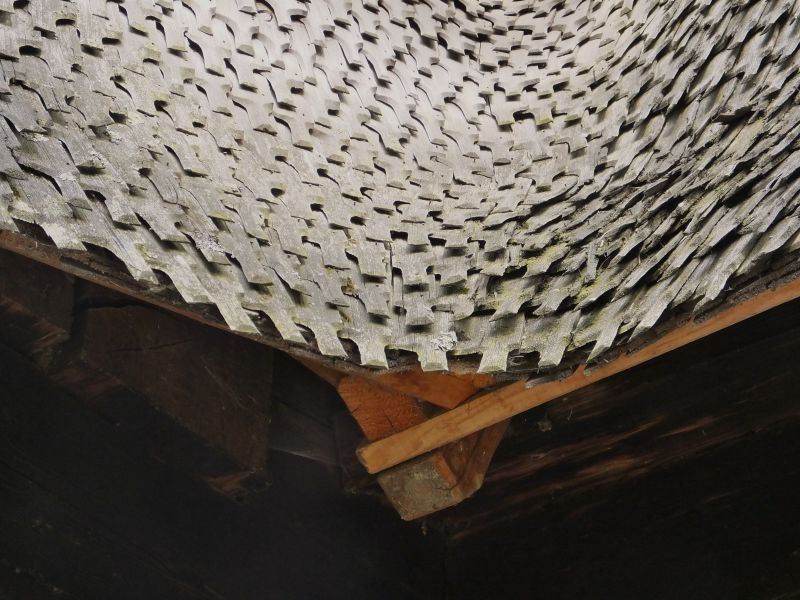
Uniquely shaped wood shingles

The corners of Leud Hill church
The three of us walk outside and look at the workmanship of the wooden church. The corners of the building are dove tailed and we get a close-up look of the faded wooden shingles on the roof, which are exactly like the ones we saw being hewn in Breb. Since it is impossible to get a good photo of the church at this level, we follow Cornelia as she picks her way uphill through the graveyard to the highest point. Wow, this is a great perspective of the historic church with the decorative graves surrounding it.

Church of Leud Hill
After leaving the wooden church behind, we walk down the dirt road to visit the Ethnographical Museum. A woman in traditional dress greets us and we find out that she is the owner and operator of this living history museum. The woman, I didn’t write down her name, focuses on demonstrating both plant fiber and wool weaving. The curator has every tool necessary to create textiles from raw material of either plant fiber or wool. We watch as she shows us how to “comb” the material, spin it into usable yarn and then demonstrates how to use the looms. Our hostess shows how she can rock a cradle while working on her loom. A wooden rod attached the cradle to a pedal which the woman can pump with her foot while she works at the loom. I have to keep from giggling because as the woman concentrates on her looming she is enthusiastically rocking the cradle via the pedal and the doll in the cradle is in danger of being ejected from the old wooden bed! We end up buying one of the woman’s’ embroidered dresser scarves for about seven dollars.

Combing hemp
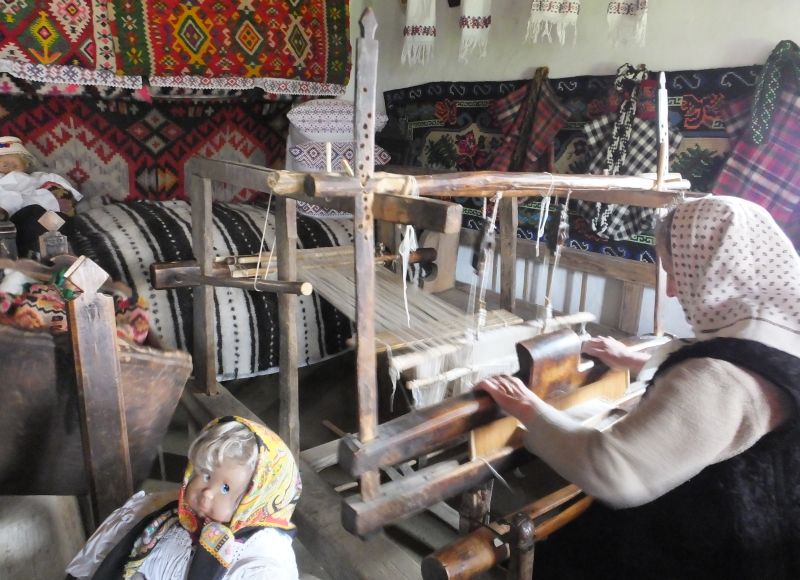
Note the tilted cradle as the woman works her loom

The museum lady saying goodbye over the gate
We say goodbye to this person who is so passionate about keeping the old traditions alive and start walking back to the car. We stroll by a cheerful man scything the tall grass around a religious statue and he strikes up a conversation with Cornelia. He offers the scythe to Paul who takes him up on his challenge. I see a surprised look come over the man’s face as he watches Paul work. The man turns to Cornelia, nods his head and tells her Paul is doing a good job (translated of course)! The man smiles, shakes Paul’s hand and we continue on to the van.
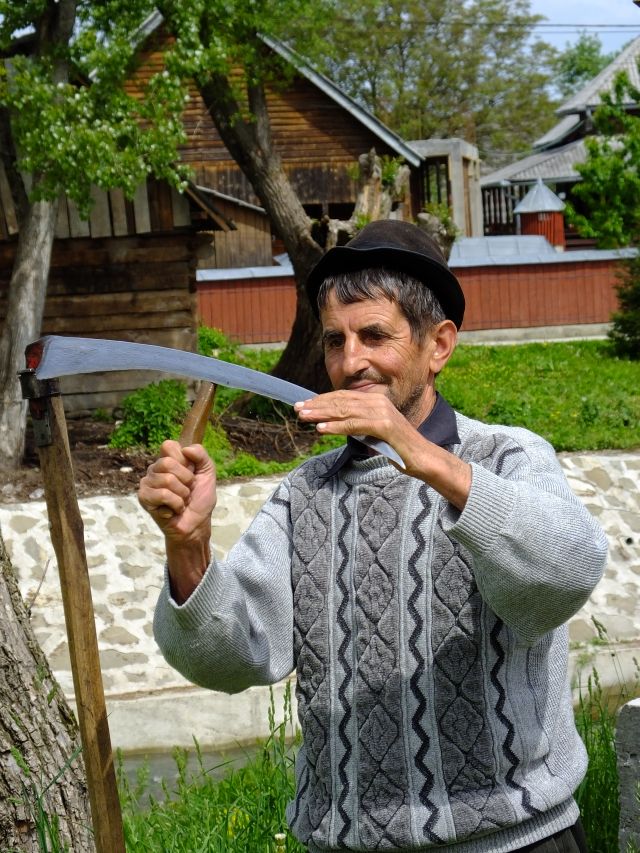
Sharpening the scythe for Paul
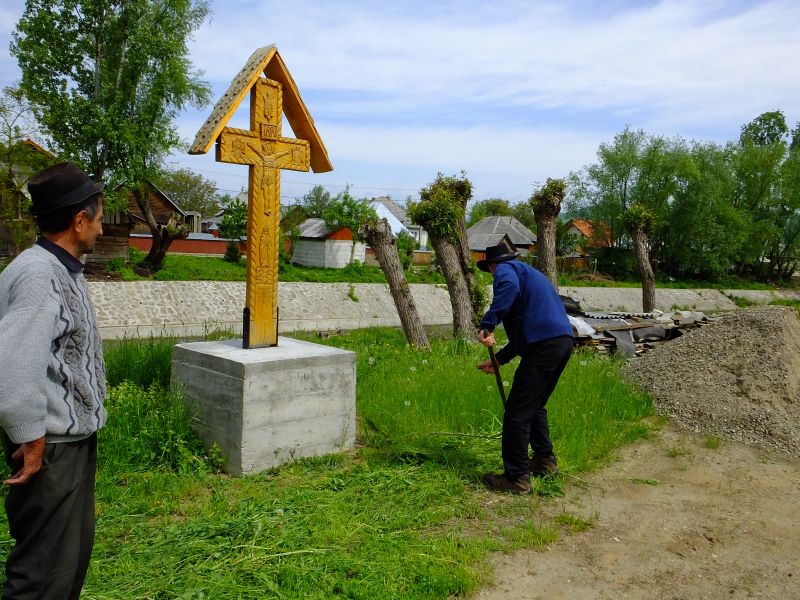
Paul scything under the gaze of the worker

Paul gets a handshake of approval
As we drive toward Bucovina we share the road with lots of horse-drawn wagons along the way, many of which are loaded high with loose hay. There is no impatient horn- honking from the automobiles at these extremely slow vehicles the cars share the road with which I find amazing. We also meet a young man herding cows on the highway for heaven’s sakes. I just wonder how often there are accidents between machines and the animals on the busy roads. Thank goodness, we never witnessed any accidents of any sort.

A big load of loose hay
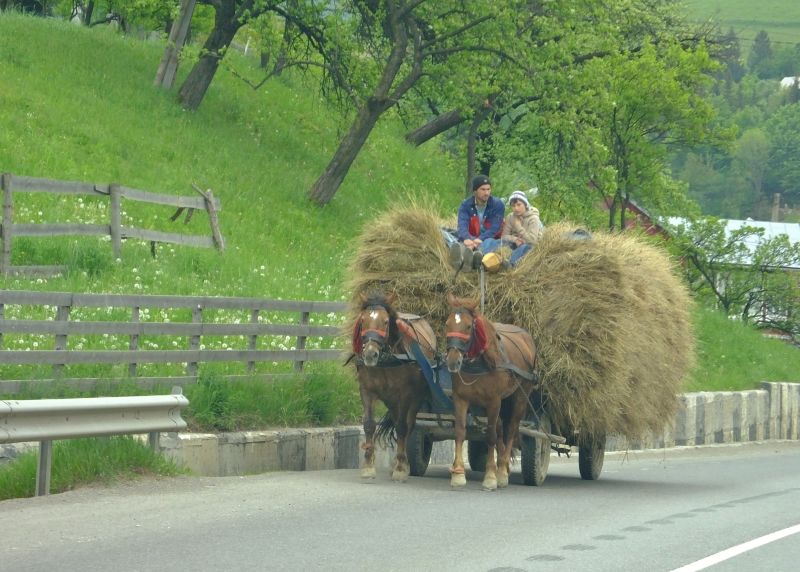
A bigger load of loose hay!

We met this small herd of cattle as we came around a curve.
As we are driving along the edge of one of the many villages we pass through today, we see two men and two boys actually making the conical hay stacks we have been seeing throughout our trip. Cornelia asks us if we want to stop and since she is slowing down at the same time I’m sure she anticipated our affirmative answer. We cross the ditch, (after Cornelia makes sure there is no sewage running through it!) and stand one hundred yards from the haying activity. I am taking photos of the hay crew when the two men wave their arms in a come on down gesture.

Walking down to the hay crew

The making of a haystack
We make our way through another field until we reach the fragrant field of mown alfalfa. Cornelia makes introductions all around, and Paul shakes hands with both fellows. I offer my hand to the man nearest me, which he takes in his, but instead of a handshake he gently kisses the back of my hand. To say I am taken by surprise is putting it mildly and quite frankly I don’t quite know how to react. I just smile widely and say something like “oh my” as the elderly man releases my hand.
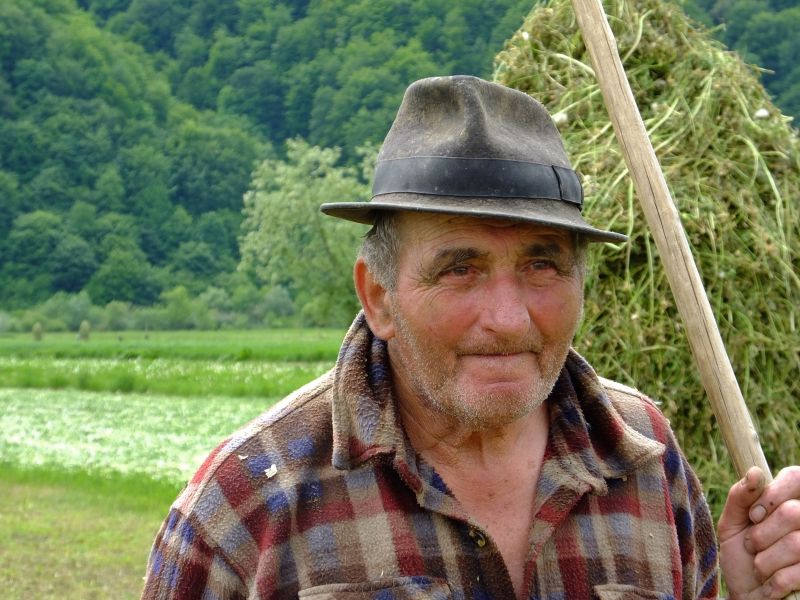
Working in the hay-field didn’t stop this man from being a gentleman!
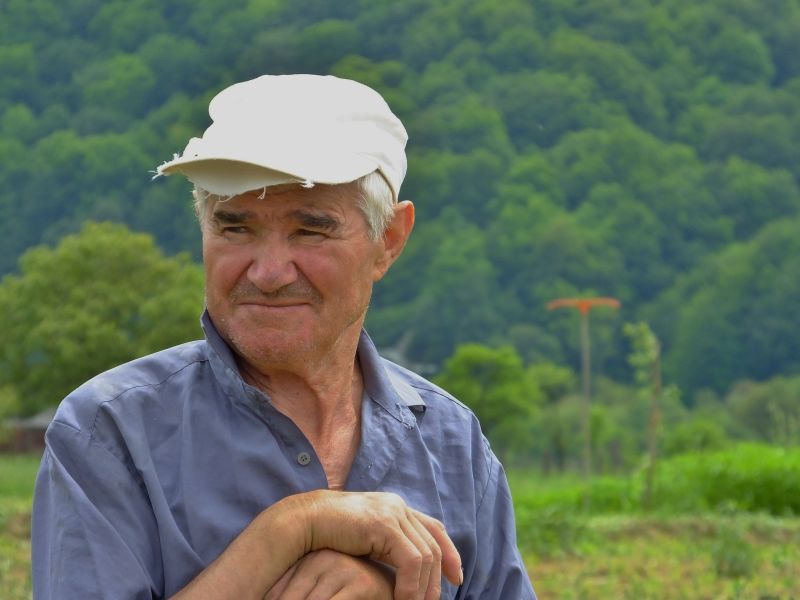
The other 72-year-old
The two boys, who must be grandsons or hired help, continue to rake the hay up while we converse with the two men. There is also a beautiful young girl who is standing around watching the others work. I ask if I can take her photo and she shyly agrees to pose for me. Paul and Cornelia are having an intense conversation with the two men and at one point I see the plaid-coated man and Cornelia stretching their arms wide as if they are one-upping each other on how big the fish was that they caught. The man in the plaid coat is the more talkative and he reveals to us that both he and the other fellow are 72 years old. When we prepare to leave, first one man and then the other man, kiss the back of my hand. I tell you, it made this plain- looking woman from Kansas feel like royalty! As we walk away the chatty man instructs Cornelia to tell us that if we return in ten years they will still be working their fields and Paul and I should come back and work the fields with them!

I’m not sure what was discussed here but it looked like the man was showing how big the fish he caught was:)

Isn’t this young girl beautiful!
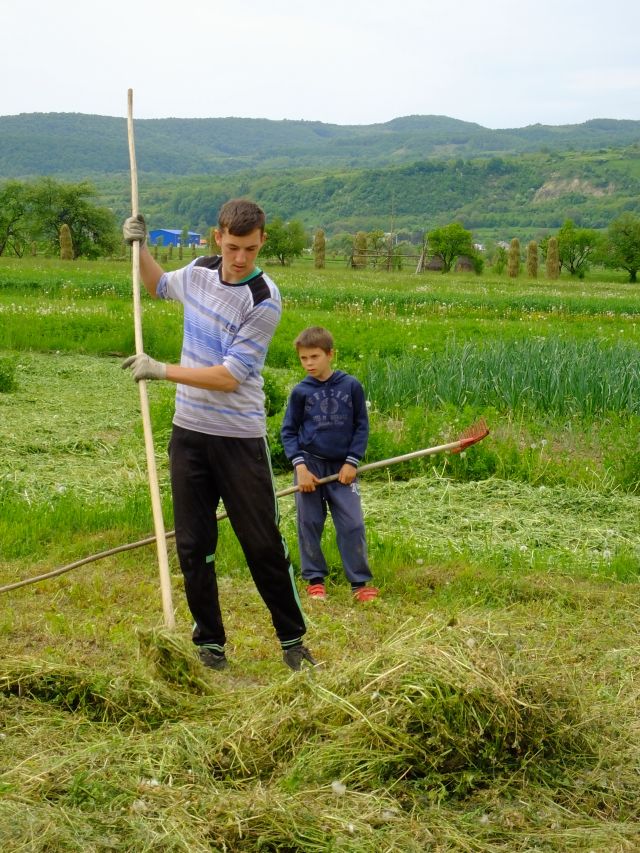
The two boys kept working while we were there.
As we drove through another village we must stop for a train and Cornelia comments that this is a long train. We laugh thinking she is making a joke because the train is pulling four passenger cars. Cornelia isn’t kidding at all as she tells us most of the time the engines only pull one or two cars behind them. As we continue down the street we must stop at another railroad crossing for the same train. We end up stopping for that “long” train five times before we exit the village. Crazy.
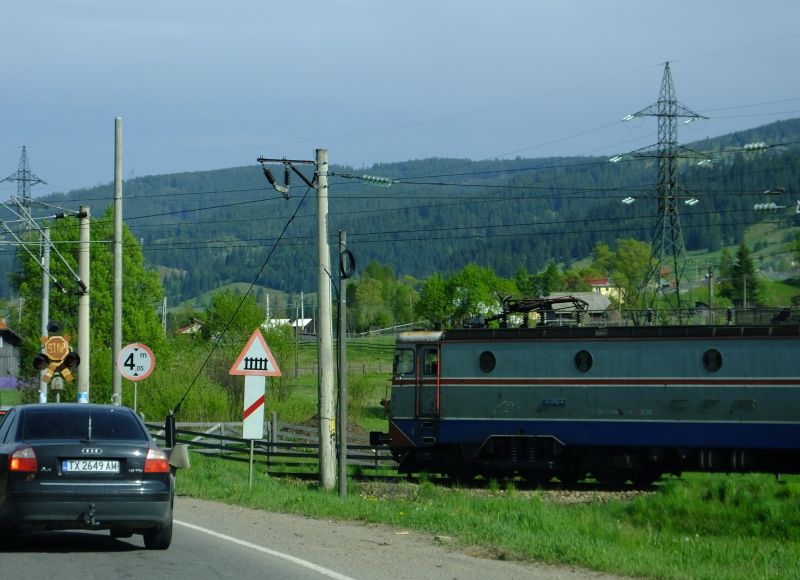
Our third out of five encounters with the same train
As we begin to climb in altitude more of the land is covered in forest. When we reach the mountain top we can see what looks like a miniature town nestled in the valley below us. As we descend into the valley we begin to see developed springs (well, the water is running through a pipe) alongside the road, where people stop and fill up their plastic bottles. We encounter gypsies for the first time as they drive their horse-drawn homes down the highway.
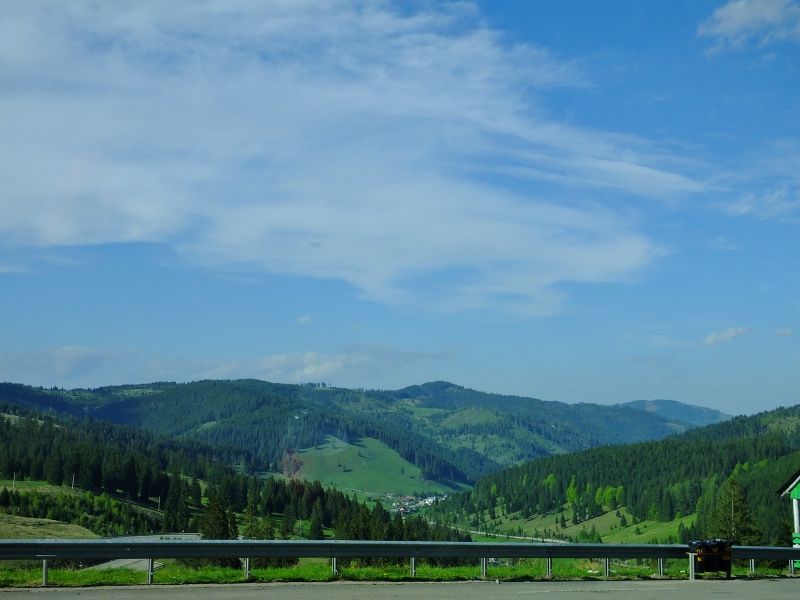
The valley view from the mountain top. Photos never do these sweeping vistas justice
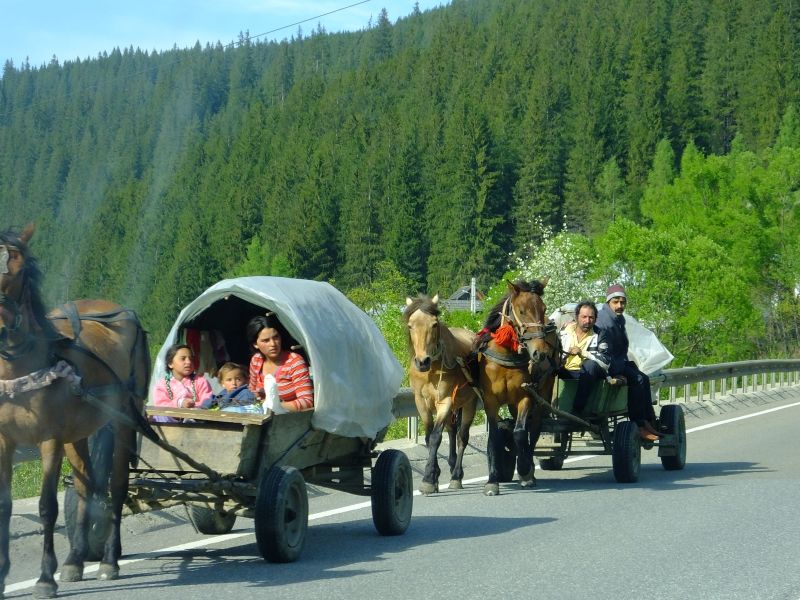
Gypsies and their horse-drawn houses
Cornelia has never been to the guesthouse where we are staying for the next two nights. The man Paul planned this trip through was busy with other clients for the first five days of our stay so he hired Cornelia, who has her own tour company, to guide us. Cornelia is excited to see this place because it is Daniels “secret” and now he has had to share it with her. Cornelia’s excitement wanes a bit when after following the directions through the village we end up on a very narrow, potholed, dirt road. We come upon a church where the Saturday night services have evidently concluded as there are a crowd of people getting in the numerous cars that are parked along the road barely leaving enough room for Cornelia to maneuver the van through. It is a bit chaotic but Cornelia finally manages to drive through the maze of people and cars.
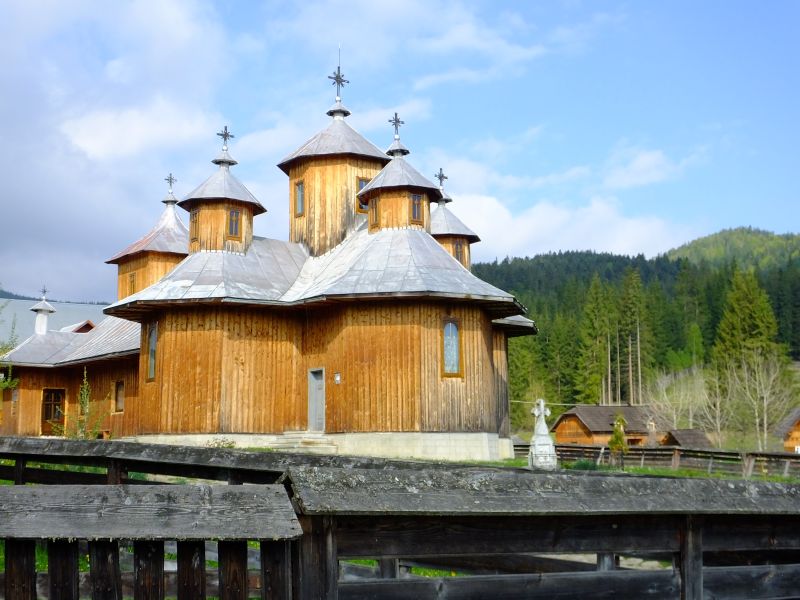
The monastery with our guest house in the background
We drive a few miles on the bumpy road with forest and grassy fields on either side of us. Suddenly the countryside opens up and there are several buildings dotting the area including a monastery. To get to the guesthouse we must go through a swinging gate that is situated next to the monastery, and then drive a short distance through a pasture to reach our destination. A pretty, young woman is standing by two small wooden houses; she greets us and introduces herself as Dana. There is a larger wooden house that stands a little way from the smaller houses. I assume that we will be staying in one of the smaller cabins but Dana tells us that the three of us will be in the big house. It seems Dana, her mother and her grandmother occupy the two-story cabin and the other building is the kitchen.We grab our luggage and follow Dana along the flower lined path to the guest house. When we walk through the door we see one half of the first floor is for dining and the other half has a sink for doing dishes, a bar type counter in one corner and there is a large wood-fired oven/stove that is made of clay (I think) and covered in smooth plaster. Dana leads us up to our rooms which are small but adequate. We do have our own bathrooms which is always a plus.
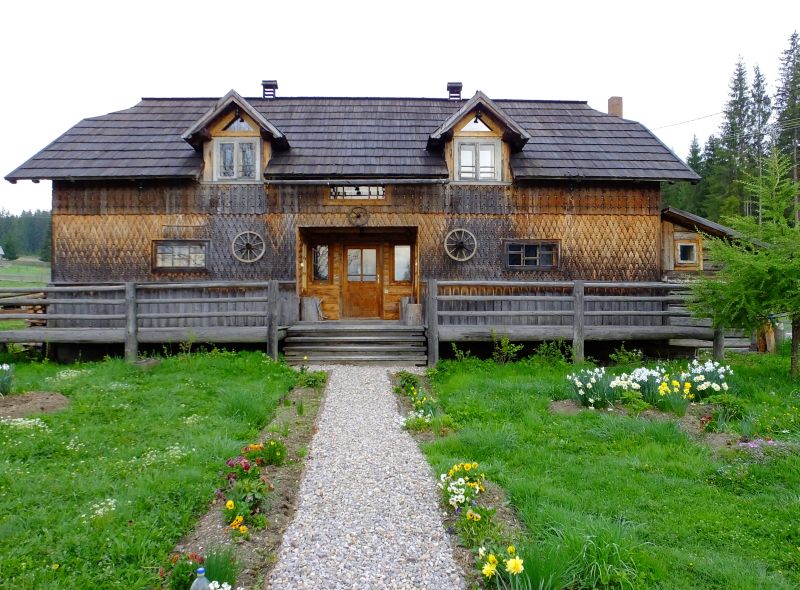
The guest house
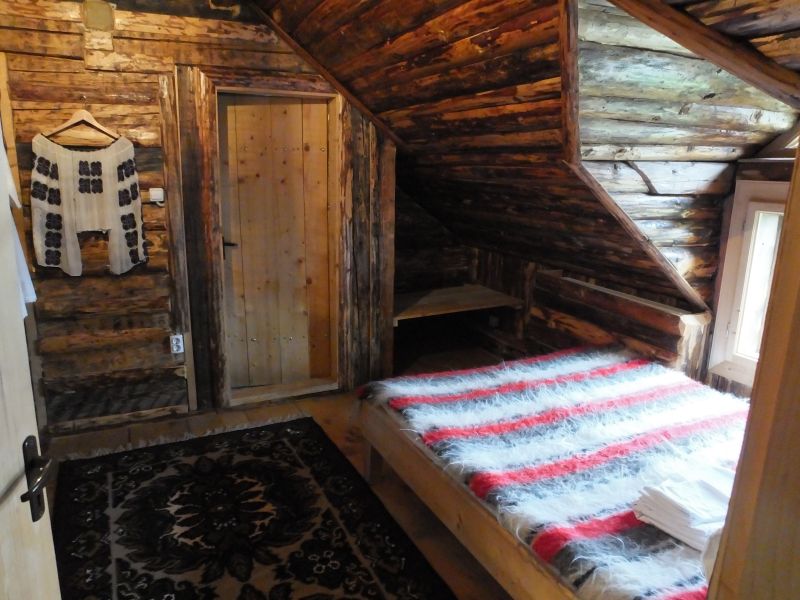
The bedroom
Dana informs us dinner will not be ready for another twenty minutes so the three of us decide to walk across the pastures to the barn where Dana’s mother is doing the nightly milking. As we near the barn a curious long-haired goat runs up to the wooden fence and pokes its head between two posts to take a look at us. A big spotted dog is chained up next to the barn and acknowledges our presence with deep, menacing barks. Dana’s mother steps out of the barn door to see what is stirring up the dog and welcomes us with a smile. She invites us into the barn which makes the pair of geese inside begin to honk hysterically. The chickens begin to run up and down the ramp that leads to their coop and the two cows are shifting nervously.

The curious goat
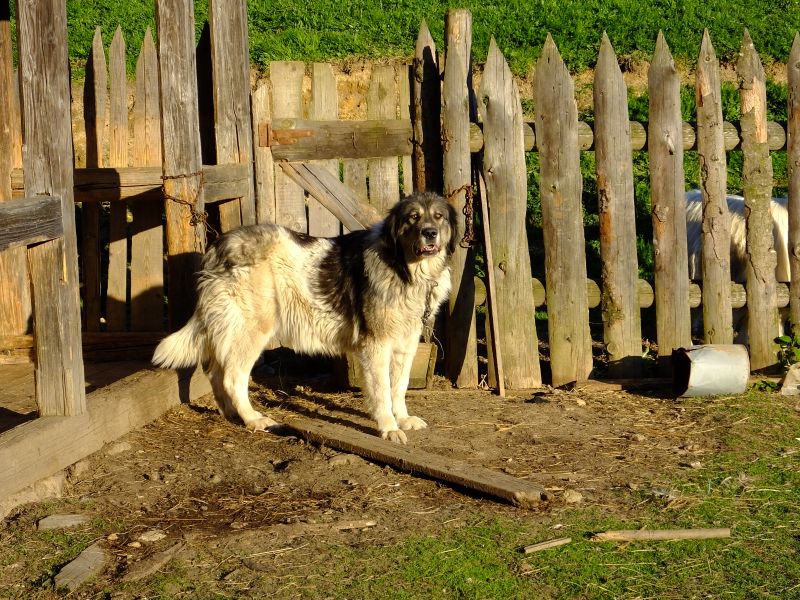
This dog did his duty by barking at our approach
All the hoopla doesn’t seem to bother the owner of the livestock as she proudly shows off her cows and a handsome calf. We stay long enough to watch as the lady thoroughly cleans the udder of one cow and then begins milking the cow by hand. That sure brings back memories for me; I always rather enjoyed milking cows, if they didn’t kick that is!
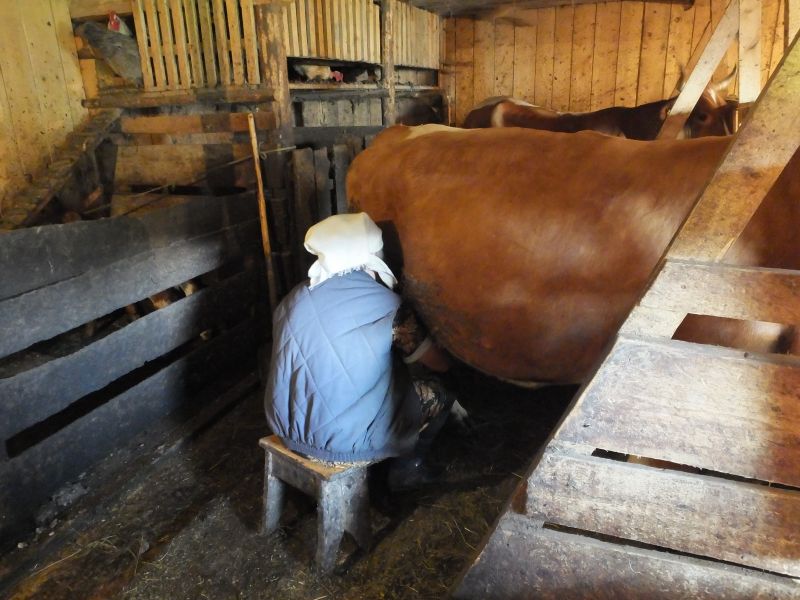
Milking the cow with the chicken coop overhead
When we return to the guesthouse Dana begins bringing food to our table but first, you guessed it, we must have some horinca! We raise the brandy size glasses, utter the toast “noroc” and take a sip of the throat burning liquor. There are five kinds of cheese on the table and all of them were made by Dana’s mother and the cheese is wonderful. What the rest of the meal was tonight I don’t recall, but I do know that every meal we had at this place was delicious. Later, Nancy
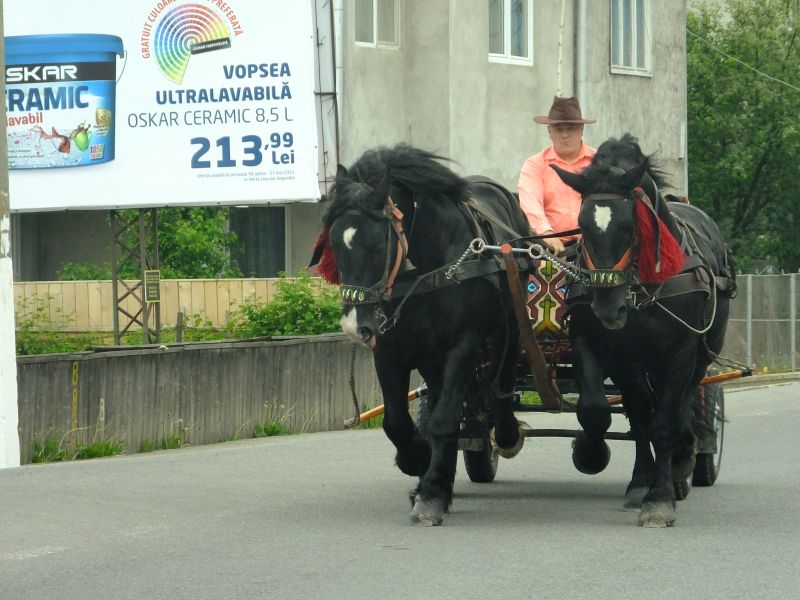
The most handsome matching pair of horses we saw in Romania

Quite a contrast
 realityranching
Between your photos and “commentary”, I almost feel like I am in Romania – “Noroc”.
I’m glad you are having fond memories of your travels in Romania when you read the blog Joy. My eyes water when I read the word Noroc! Nancy
Another wonderful view of Romania!
Thanks for letting me know you are enjoying the blog Alan. Nancy
I just love these blogs about Romania–and not just because those crepes you had for breakfast looked so good! It is so cool that you were able to get right up close and participate in the ranch work. It looks like a blast!! The hay fields, hay stacks and loads of hay are so interesting.