All day game drive in Ruaha, Part 9
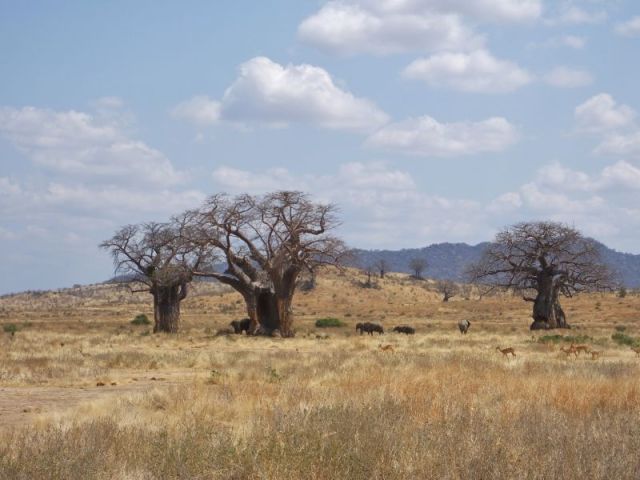
Elephants and Baobab trees in Ruaha National Park
In camp tonight, the usual activities play out, some of us wash clothes, look through photos, and we keep the camp staff busy heating water so we can shower. In fact the water for my shower is so hot tonight; I must step in and out of the water stream to keep from being scalded. Whew!
When we sit down to eat we visit about the day, laugh a lot, and enjoy the food Christophe has prepared, as usual the meal is accompanied by his famous dinner rolls. I know, I’m obsessed with those rolls but I am not the only one. For some reason, Christophe always has one more dinner roll than diners. This extra roll is always devoured by someone in our group, and at times two or three people divide the roll among them. I remember one evening when, Oscar I think, tried to remove the extra dinner roll from the table, and Vidole Juu told him not to even think of taking it away, making everyone around the table laugh. I think Oscar was hoping to consume the wondrous roll himself!
Tonight with the full moon shining down on the African bush, we again are serenaded by a patrolling lion as we are going to bed. The lion sounds much closer than the lion did last night, and this fellow repeats his territorial proclamation more than once. You would think a lion roaring and huffing about his importance would make one sit straight up in bed. For me I struggle to keep my eyes open so I can listen to the magnificent animal’s voice. In the end I drift off to sleep, the lion’s song still drifting through air.

Tea, coffee, and juice bar in the bush
I’m up early and follow the same ritual as yesterday morning. I wash up in cold water and take hot tea with me as I walk to the river bed. I tread cautiously as I make my way through the bunchy grass until I reach the open area of the dry river. This morning the river channel is quiet and empty. Perhaps the noisy lion passed through here last night and scared all the wildlife away. Paul, Ngruwe, and Nyama soon join me, in hopes that the honey badger might show up again but he doesn’t put in an appearance. I imagine I gave the badger such a scare yesterday that he will avoid this area of his territory for a few days!
Our guides encourage us to get around a bit earlier this morning as they are hoping to find the lion that was broadcasting his presence near our camp last night. As we drive through the narrow, wood lined, road leading away from our camp, Nyama points and exclaims, and I paraphrase, “there is something”. Yes there is, as a pair of Dik-diks is standing under a thorn-bush near the road! These diminutive antelope always remind me of a cross between a large rabbit and an antelope. Their almond-shaped eyes and narrow snout being rabbit like, but having the slender long legs and body of an antelope. I guess Nyama sees the same resemblance to a rabbit because another time when she spotted the tiny creatures, she yelled out “rabbit”! Throughout our remaining game drives, I remember that Nyama, Ngruwe, and Vidole Juu always find the Dik-diks; perhaps Paul and Uwiano spotted some too. I just know that I never see the little buggers until someone else alerts me to them, but I will give the lame excuse that I am usually searching further away from the roadside and the Dik-dik we see are always near the road.

One of the Dik-dik’s that Nyama found.
When our convoy emerges from the trees and we enter the more open area of the park, everyone sees a creature standing in the distance. I have this mental image of all of us peering at the object bare eyed, trying to discern what we are looking at despite the fact that most of us have binoculars hanging around our necks! Once we have the sense to use our binoculars, the unidentifiable object materializes into an enormous, golden-maned lion. I yell out “it’s a lion!” and find myself jumping up and down on the seat like a kid jumping on their bed. I am a little embarrassed when I become aware of what truly is an involuntary reaction by me, but since I have no recollection of what my vehicle mates say or do at this moment, I am hoping they were oblivious to me too. The way the lion is standing proudly with his head up, looking defiant, while confidently portraying the fact that he knows he is King of this part of the jungle. This scene reminds me of what one would see at the opening credits of an old-time movie. Is this the owner of the voice that was roaring last night? I think it is a pretty good bet that it is.

Fabio standing proudly in the African bush when we first saw him.
As our vehicles move toward the mature male, he lies down in the grass and we are able to take our time in photographing this incredible specimen. The lion is immaculately groomed and I believe it was Mbuzi who commented later in the day, please forgive me if I am mistaken on this fellow safarists, that it appeared as though the beautiful cat had just stepped out of a beauty parlor. Indeed the lion’s mane is tangle free, and gleams golden in the morning sun. Later, after looking at photos, I named the handsome rascal, Fabio for his golden tresses. The lion soon tires of our attention, rises to his feet and strolls across the road in front of us, disappearing into some bushes a few hundred yards away. In our vehicle, we speculate that there might be females already resting in the leafy foliage because surely, Fabio is too fabulous not to have his own pride.
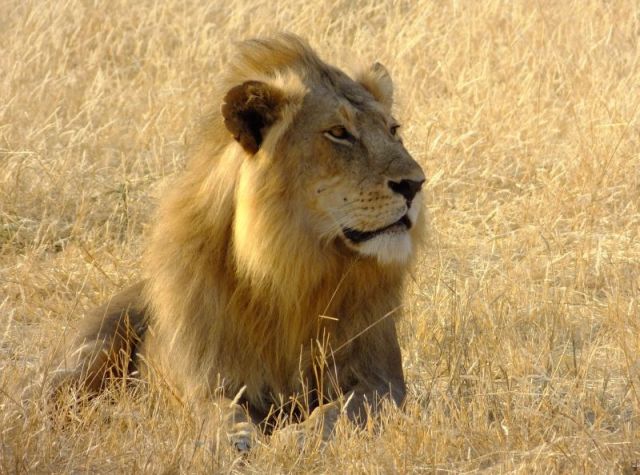
Fabulous Fabio
We follow the dry river bed again and see an enormous troop of baboons spread out over the sandy bottom. It is obvious that elephants have passed through here, and the baboons have been combing through the dung the pachyderms have left in their wake.

The baboon troop and sifted through elephant dung
Our wandering brings us to a giraffe drinking water at a small pool on the edge of the river. You can imagine how complicated this task is for the long-necked, long-legged animal. It is almost painful to watch as the rangy giraffe spreads its front legs wide so he can get his head low enough to reach the water. Brian tells us that the reason the giraffe snaps its head up quickly after drinking for a short time, is that the giraffe has a kind of warning system that tells it when too much blood is flowing into its head. The giraffe knows to raise its head when it feels pressure in its skull and must quickly pull their head up before they do damage to themselves. Brian explained the cause and effect of excess blood flowing to the giraffe’s head much better than I did, but you get the idea. Because of this blood flow problem, the giraffe must raise and lower his head many times in order to drink its fill. What an ordeal the poor giraffe must go through just to quench its thirst.
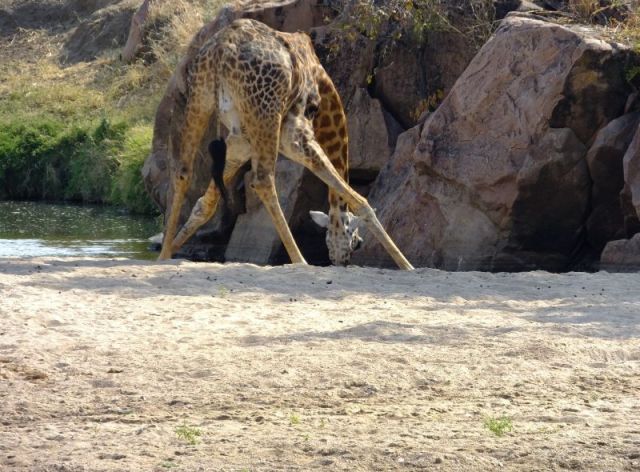
The awkward position giraffe must drink from.

The giraffe spraying water as it lifts up his head quickly
Our drivers pull into an area where we are allowed to leave the vehicles to stretch our legs and use the choo. The problem is the long drops are so nasty at this stop that we women decide to retreat behind a large boulder to answer the call of nature. Hiding behind a tree, boulder or bush is becoming common place because usually there aren’t any restrooms anyway! Aw, you just get used to it and one’s modesty disappears quickly!
There are other tourists here, some eating an early lunch on the jumble of boulders that are adjacent to the mostly dry river. Because the bird’s eye view from the kopjes is occupied, Paul and I walk next to the pile of rocks so we can look down the river channel where an elephant is drinking water from the “well” it has dug with its trunk. We watch as the large beast’s trunk disappears into the sand and then reappears with a trunk full of water which it transfers to its mouth. This female is accompanied by her baby who is having fun running around mom, and generally acting silly. The antics of young elephants, or any baby animal, always make me laugh out loud.
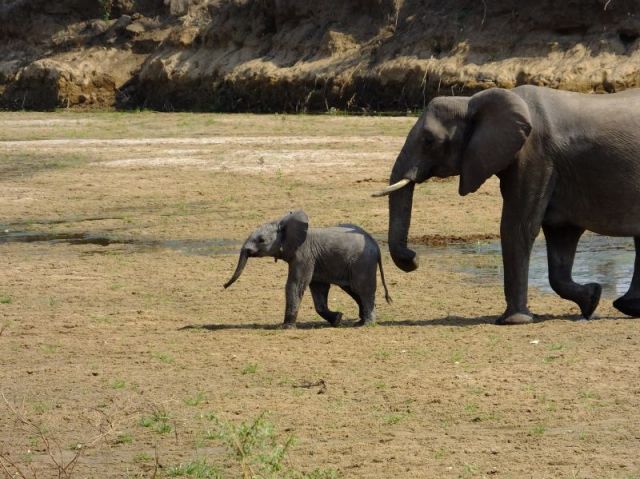
Wahoo, I can run!

If you look closely you can see water spilling from the elephants trunk
When Paul and I walk out of the weedy area we have been standing in, Paul finds a couple of small ticks crawling on his arm. Lovely, I don’t find any on me but every little tickle I feel for quite some time causes me to search my skin to make sure the nasty bloodsuckers aren’t crawling on me.

This is a sausage tree with fruit/seeds hanging from the branches
When we get back to where the vehicles are parked, Kevin points out a Black-backed Jackal across the river, trotting through the grass. Vidole Juu, Ngruwe, and Paul find a fallen fruit from the sausage tree near our Rover. They each take turns in holding the big seed from the sausage tree, comment on how heavy the fruit is and what damage the elongated fruit would do if it hit human, animal, or vehicle when it fell from the tree. There is always something to learn and contemplate on safari!! This was a nice area to stop and relax a bit but it is time to move on down the road.
Our convoy of three is moving right along when Mochie’s vehicle comes to a stop in front of us. After some initial conferring and looking under the hood, Kevin crawls back in our Rover, drives gently into Mochie’s defunct truck and begins to push him. Yikes. The ailing Rover’s engine comes to life after getting the boost but only manages to keep running for a short distance, before sputtering to a stop. The drivers and Brian all pile out of their vehicles and begin to comb over the broken Rover. They are under the hood and Kevin is crawling beneath the vehicle. Brian walks to our truck and asks Ngruwe if he will help them, because Ngruwe has shown prior to this incident that he is mechanical minded. Vidole Juu also leaves the vehicle to see if he can be of help.
Eventually, the way I understand it, the men have found that the switch between the empty diesel tank and the full tank isn’t working, (or was it the return hose?) and they can’t seem to fix the problem. Mechanical stuff makes my eyes glaze over, but I do know that the diesel isn’t being fed from the full tank to the engine. In the end they come and collect empty water bottles and drain diesel from the full tank into the bottles, pouring the siphoned fuel into the empty tank. Once they feel as though they have transferred enough diesel to the empty but good tank to get us to Park Headquarters they crank the engine over and it coughs but starts. There is no game sighting now as our guides drive quickly to the Park Headquarters.
Once we arrive at the working headquarters of the Park, all of us climb out of the trucks, grab a soda or beer, and sit around the tables that are situated outside the office buildings. There is an “elephant proof fence” around the building and yard but we muse at the fact that there is plenty of elephant dung inside this fence, though for the life of us we can’t figure out how the grey beasts managed to get inside! Mochie has driven back to where the Park owned vehicles are kept and soon reemerge with a full tank of diesel in the working tank. I have written in my journal that when asked what the diesel cost to purchase from the Park authorities, Brian told us they were charged eighteen dollars a gallon. Surely I wrote that down wrong, if not someone made a mighty good profit.

Some of our group relaxing at Ruaha Park Headquarters
Since Park Headquarters is obviously situated inside Ruaha we can begin looking for wildlife as soon as we board our Rovers. As we drive by one of the out buildings a lone elephant is standing next to it. Just a bit farther down the road a little girl happily waves at us from the doorway of her house as we pass by. Can you imagine this scenario? “Mom can I go outside and play?”, “Sure, honey but watch out for elephants” :).
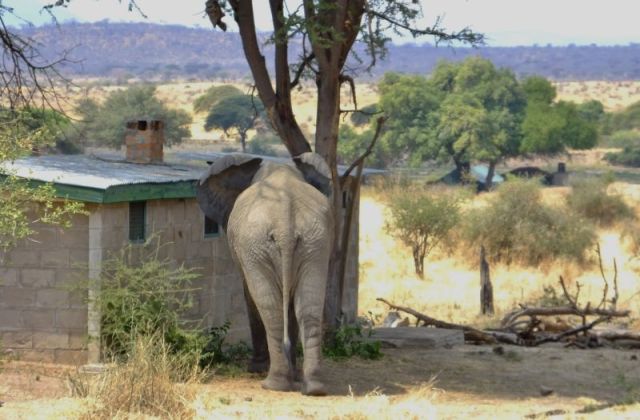
Your backyard visitor in Ruaha!
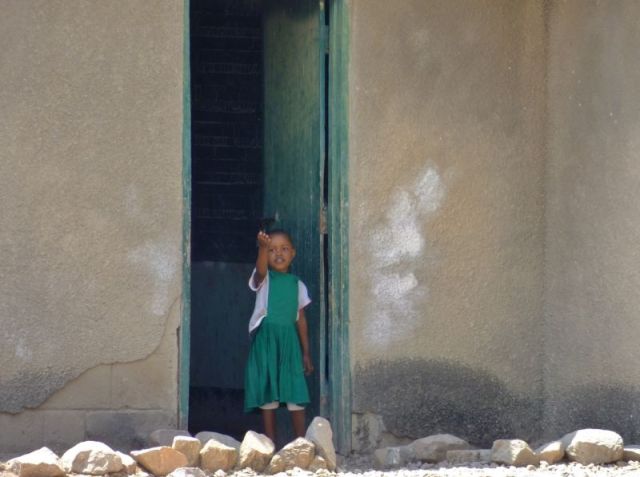
Little girl waving at us as we leave the Headquarters of Ruaha Park
Not much time has passed since we left Park headquarters with our expensive diesel when I see movement along the ridge of a hillock. Asking Kevin to stop, I try to figure out what I have seen. I can’t quite get a fix on the animal but I think it is a male Kudu since the animal is sporting a huge set of horns. Kevin is anxious to move on but I ask him to wait a bit still hoping that I can turn this antelope into a Sable or a Roan antelope instead of a Kudu. Kevin finally says to me with some exasperation that we must go as there are lions near the road up ahead of us. Aha, he had to break the code of silence that exits among guides and actually tell us why we need to rush somewhere! I exclaim “Let’s go” and within minutes we arrive to see a pride of lions on the move.
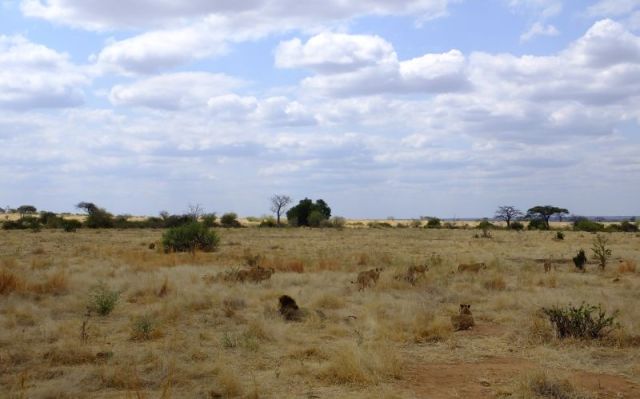
The Lion Pride when we first saw them. Wow!

This photo of the lions coming towards us makes my skin tingle!!
Our sister vehicles have been watching the Lion pride for a while but we still get in on the excitement of watching the lions move across the bush with a certainty that exudes from the felines that they own this place! The pride has twelve lions in it and this includes two mature males. Kevin tells us that the males are brothers and that is why they are willing to share a pride. The lions are heading for the river and they end up meandering right by our vehicles, hardly giving us a glance. As our guides drive slowly along it is interesting to see that two large females and one of the males break off of the group when they near the river and walk up to high ground that looks over the river. The two females walk to the edge of the bluff and lay down right on the edge of the cliff which gives them a clear view of the surrounding area. The male that split off the main group lies down under a tree not far from the female duo and appears to doze off.
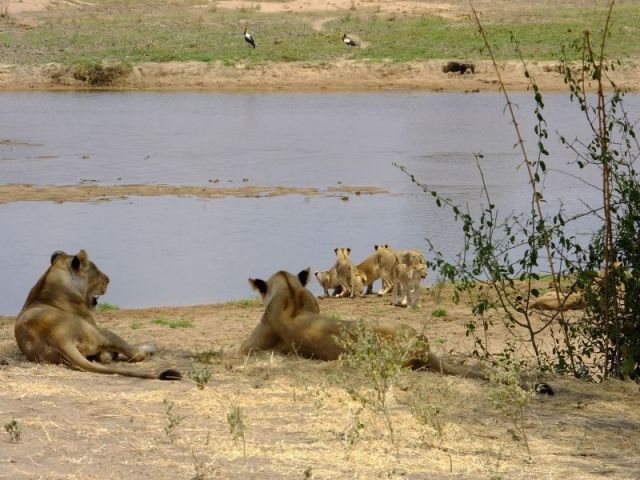
The two sentries watch as their pride members drink from the Ruaha River

The main body of the pride that went to the river to drink.
The remaining lioness and nearly grown cubs walk to the river and begin to drink. The other male walks to a puddle, lies down and laps his water from it. When the felines finish drinking they walk to the bottom of the bluff directly below where the lioness lookouts are situated and lay down. One of the lionesses has carried a plastic water bottle she found by the river and is having fun chewing on the debris some stupid human left behind. One of the nearly grown cubs decides he wants the noisy toy and takes it from the lioness, which willingly lets him have the bottle.
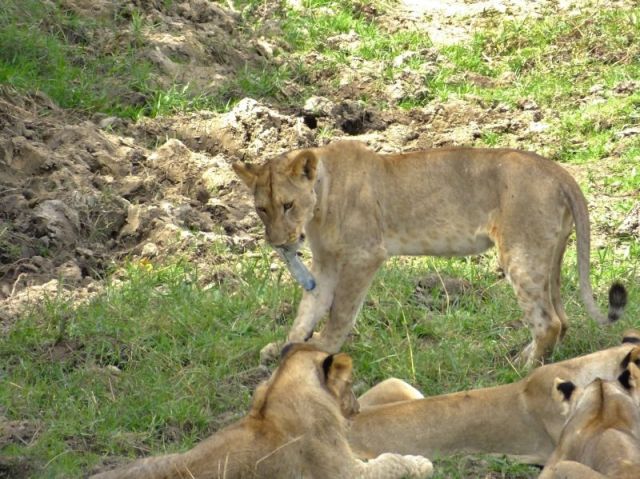
Playing with the plastic bottle
As I study this group of lion, I decide that they are not faring that well. The lions seem thin compared to the other lions we have seen on this trip so far. I notice one lioness has a blue eye, very likely blind in it. The male that stayed with the main group has an angry red splotch on his side. Is it an injury or a skin condition? So many mouths to feed means they need to have successful kills and a lot of kills. I don’t know how much a mature lion needs to eat to stay healthy but I don’t think these animals are meeting that requirement.

The lioness with the bad eye
We drive around to the other side of the lions so we can see the group who are lying down next to the bluff. I am taking photos of the sleepy group, when suddenly the male and a cub jump to their feet with the cub running up the hill to join the sleeping male and lioness lookouts. One of the lionesses in the group sends an intensive stare in our direction so we look around trying to find what has upset the lions. It doesn’t take long to see that some fool has gotten out of their car, is hiding behind a bush and taking photos. As the photo below shows, some of the lions had no reaction at all. I think everyone in our truck is turning bright red with anger, I know I am. Kevin calls over to the knucklehead and tells him he can’t get out of his car. He looks Kevin’s way and then a woman (his wife?) in the car, tells him he needs to get back in the vehicle. I hate to say it but by her accent they are obviously Americans. It takes my blood pressure awhile to return to normal after this incident to say the least.
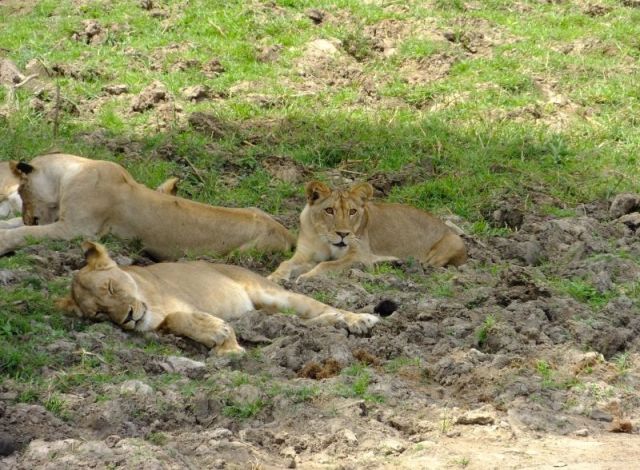
I would never want to see a lion staring at me like she was staring at the fool who left his car!
It is our own lunch time and our guides take us to a beautiful spot above the Ruaha River. There are elephants very near so our drivers place the vehicles in a semi-circle to provide a shield should the elephants get testy. It isn’t necessary because in the end the foraging elephants decide they would rather not share the area with us and vacate the premises.
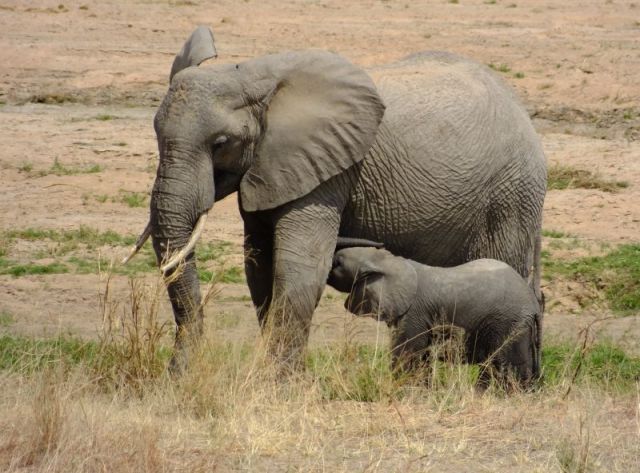
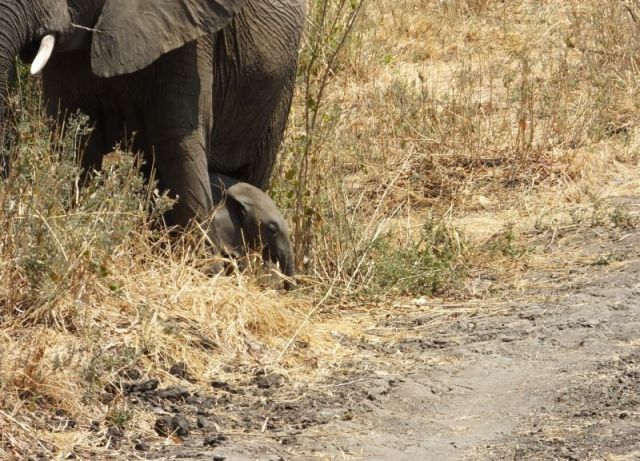
This baby elephant was having lunch himself.
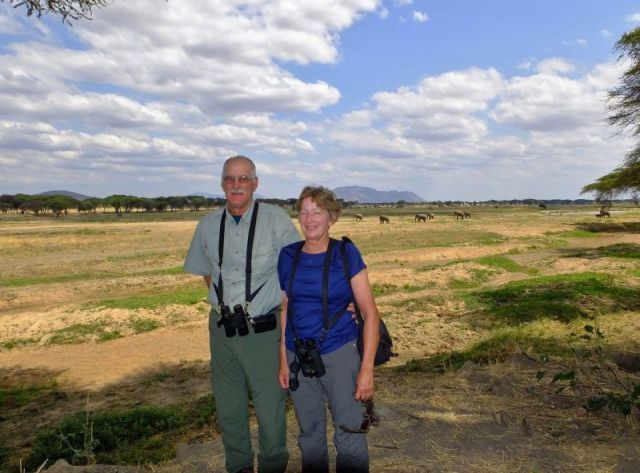
Paul and I posing at the place we ate lunch.
We continue our drive along the river and we find an abundance of birds, including Fire finch and Blue-capped Cordon-bleu (really that is their name). We watch in wonder as Pied Kingfisher hover over the water as easily as hummingbirds and then plunge like miniature torpedoes into the water, often reappearing with a small fish in their beaks. There are disheveled Speckled Mousebirds in a tangle of brush that appear like they have had one to many drinks, as the funny birds can’t even seem to perch upright.

Speckled Mousebird. they always look half-drunk to me

Pied Kingfisher
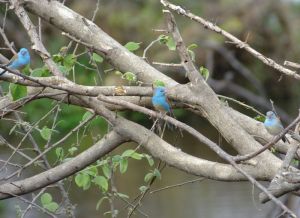
Blue-capped Cordon-bleu birds.
Our vehicle stops to look at some Grant’s gazelle and we end up losing sight of the rest of our group. The men decide they need to “check the tires” so Kevin obligingly stops for them. This is a good time to admit that the first time Kevin got out to “check the tires”; I innocently ask if we have a low tire! Oh go ahead and laugh, everyone else did. Nyama went one better than I, as when the Fearless Four were hiking to Sanje Falls their guide said he was going to look for something to barbeque tonight. Nyama started to follow him off the trail because she wanted to help! Brian called her back and explained that it meant the guy needed some privacy. I know another euphemism we heard by our drivers for answering the call of nature was that they needed to look for medicine in the bush.
Getting back on track, Kevin starts the motor and starts to leave while the guys are still “checking tires”. It is just reflex on our part, but we women tell Kevin the guys are still outside which makes him start laughing at our concern. Even the men admit when they return to the Rover, that for a moment they too wondered what was happening. About this time, Mochie begins to plaintively call Kevin’s name over the two-way radio. Kevin begins driving quite fast and makes a turn which leads us to the river again. Whoops, appears we went the wrong way so Kevin turns around and speeds down the road turning the opposite direction when we get back to where we were previously. Hmm, this is mighty reminiscent of Mikumi.

What a beautiful young male leopard
When we finally find our companions they have been watching a leopard that I believe Bahati Njema spotted. The good news is that the leopard is still here, and walks directly towards our Rover, crossing the road in front of us. The handsome male enters the tall grass and walks a few hundred feet into the natural cover. The leopard sits down and despite all the noise coming from the vehicles, honestly the drivers are shouting back and forth to each other, is concentrating on some impalas that are grazing in the distance. The young leopard begins to walk towards the antelope when he suddenly drops to his belly and just disappears. How does such a big cat do that? We know when he reaches or gets close to the impalas because we can hear the alarm snorts, and the antelope take off running. It looks like the leopard struck out although since we can’t see him, and the fleeing impalas have disappeared from sight, we can’t be certain that he didn’t manage to catch lunch.

Scouting out the grazing impalas before he begins stalking them.
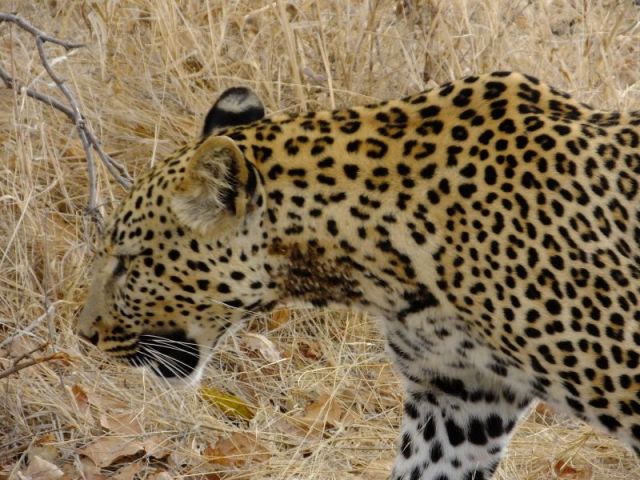
We can’t decide what is on this leopards neck. Stickers of some sort?
Moving on, the guides drive us down to the river where we are allowed to get out and wade in the Ruaha if we want to. Brian and several others do take their shoes off and slosh around in the river. I prefer to dip my fingers in the Ruaha River because I remember all the caution antelope take when they go to the river to drink due to crocodiles!
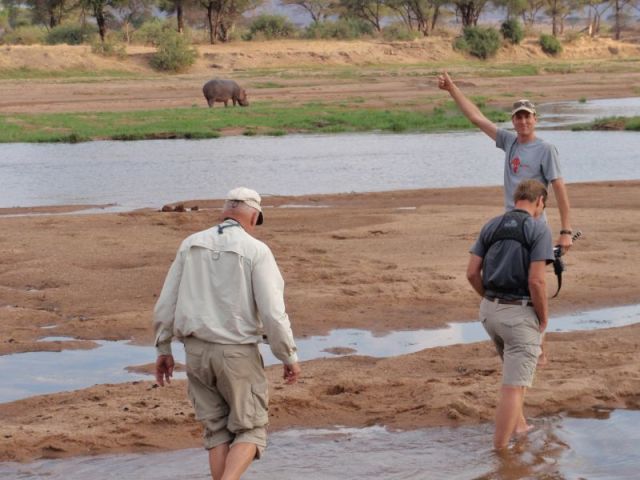
Wading in the Ruaha River with a grazing hippo in the background. Paul’s photo
What a day we have had in Ruaha! When we arrive at camp I realize how tired I am at the end of our all day game drive. My arms ache from hanging on for dear life as we bounced down miles of dusty roads, and there are sore spots on my side, from constantly bumping into the side of the Rover. Believe me this is a small price to pay for the wonders we have seen so far!
Tonight we talk about how we might have missed seeing some of the animals if our timing would have been off just a few minutes. What if we had been a few minutes later getting out of camp, we would have missed seeing Fabio. What if Mochie’s Rover had not broken down, would we have already driven by the area where the pride of lions showed up? It is quite possible we would have missed the lion pride on the move, without the hour delay of our breakdown. What if we wouldn’t have gotten lost, oh wait we would have been right with our fellow safarists when they saw the leopard from the beginning. Still we wouldn’t have had the excitement of speeding down the road, wondering what was waiting for us when we arrived! What a day! I think I have written that phrase in several blogs already!
Next blog, Flying to Selous Part 10, Nancy
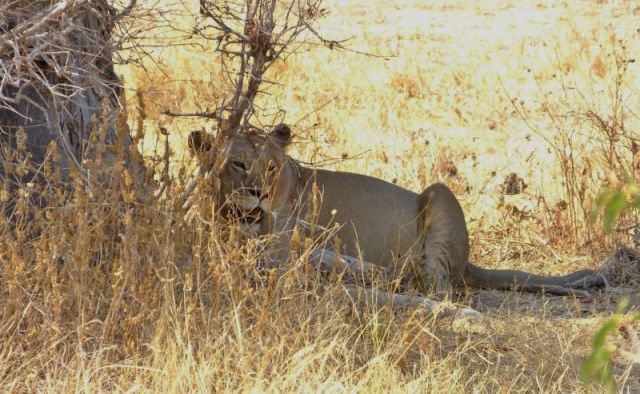
Enjoy some more Lion photos
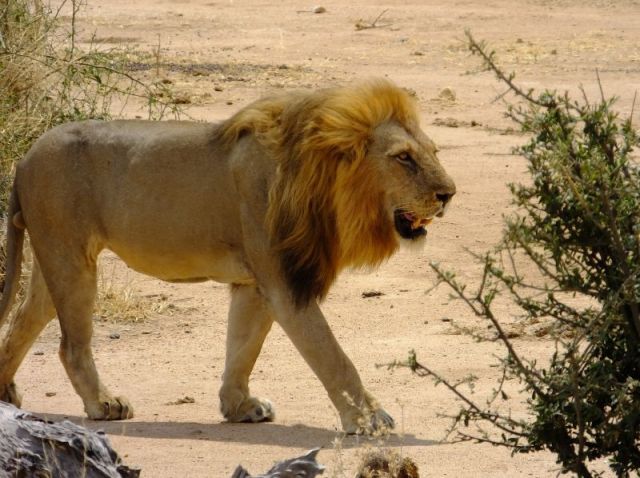
One of the males of the Pride
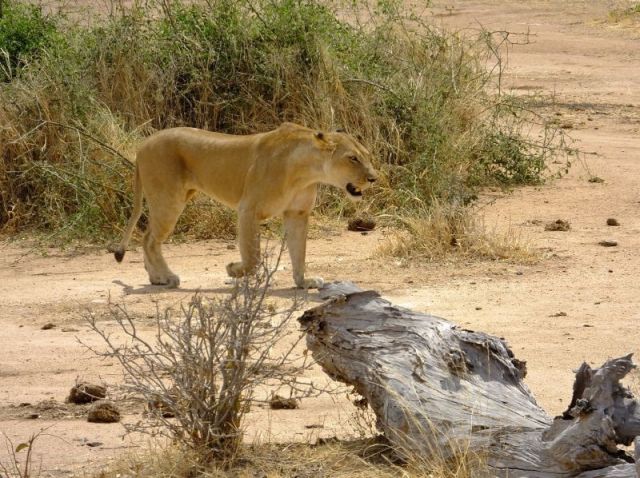
The lions walked within a few feet of us as they made their way to the river.











 realityranching