Chiloe Island, blog 2
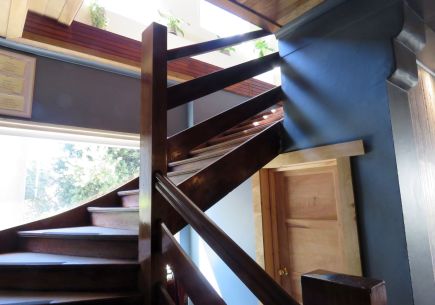
The neat staircase that led to the rooms at Mero Gaucho
Paul and I both slept amazingly well last night. The bed was very comfortable and if there was street noise, we both slept through it. Breakfast was to begin at 7:30 but we are downstairs before then and the food is already laid out. There are a couple of types of cereal, yogurt, fruit, all kinds of bread, but best of all an apple pie. A woman asks if we want eggs but neither of us can handle eggs in the morning so we decline. I must say the apple pie was outstanding. Hey, I am on vacation.
We return to our room, brush our teeth and haul our luggage downstairs. Our guide is waiting for us in the lobby. Over his camo jacket he is wearing a pair of binoculars. I think I see a glimpse of approval as he notices that both of us are sporting binoculars too. He introduces himself as Raphael but tells us to call him Rapha. We tell the receptionist we have enjoyed our stay, say goodbye, grab our bags with Rapha’s help and follow him to his car. The air is crisp but the sun is shining which is a great way to start off our Chilean adventure.
Paul insists that I take the front seat, thinking I can take better photos from here. Rapha tells us that we have approximately a thirty-minute drive to the ferry that will take us and the vehicle to Chiloe Island. Rapha has no problem identifying birds as he is driving while also talking to us. Rapha stops by a marshy area where we look at swallows, Chilean swallows I think, plus two different kinds of ducks. He saw these while driving the car and I have trouble finding one of the ducks while looking through binoculars. Yep, I believe the staff yesterday weren’t kidding when they said Rapha is one of the best birders around.
As we visit with our personable guide, I notice that Rapha has a definite English accent. Whether it is today or the next I don’t recall but Rapha informs us that he is Italian. He was born in Chile and spent his first three years here because his father was a diplomat. After the coup in Chile, the family returned to Italy where Rapha lived until graduating college. A job brought him back to Chile where he met his wife and he has been living here ever since. So, while I have been spelling his name with the Spanish version it is really Raffaele but he prefers to be called Rafa.
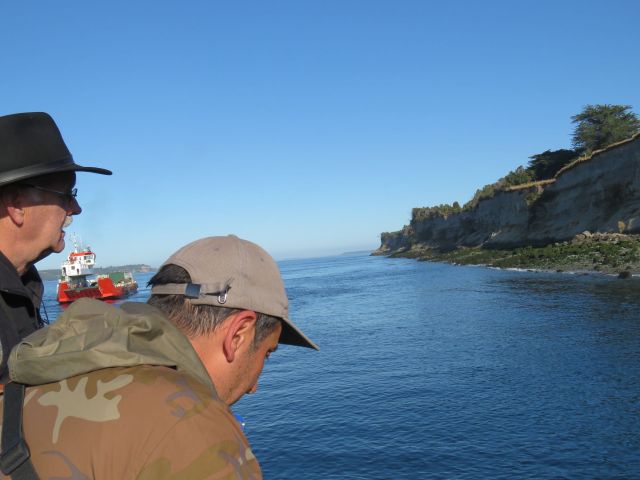
Paul and Rafa as we begin our ferry journey to Chiloe Island
We arrive at the ferry where there are two lines of cars and trucks waiting to load onto the ferry. There is an old ferry and a fancy new ferry and we get waved into the line which is for the old ferry. I don’t care which ferry we are on as long as it gets us across the bay! Rafa encourages us to use the bathrooms and then go up top so we can enjoy the scenery and watch for birds. As we churn towards Chiloe Island, Rafa points out the beginnings of a bridge that eventually will span this water channel so people can drive to Chiloe Island instead of using the ferry. It will spoil the wide-open view that we are looking at right now which is kind of sad plus there is something romantic about taking the ferry.
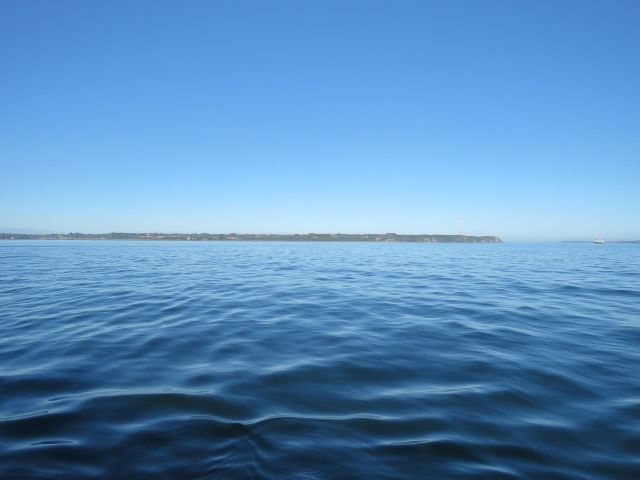
Chiloe Island in the distance
We enjoy looking at brown-hooded gulls and the larger Kelp gulls. Paul points at the water near the ferry and says what is that bird? By the time Rafa and I look the bird has dived under water but it soon resurfaces. I can’t believe it, Paul has spotted a Magellanic Penguin. As we get near Chiloe, there are sea lions piled on the big red buoys that float not far from the shore. As the ferry prepares to dock, the three of us hustle back down to the car, evidently the ferryman don’t take kindly to drivers that might hold up the line. I kind of hated that our crossing was over so soon as the sunny day and calm water was very enjoyable.
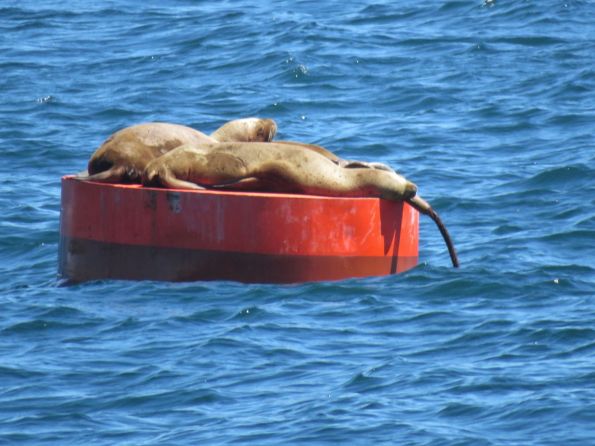
Sea Lions lounging on a buoy
We leave the ferry and drive into the village of Chacao where Rafa tells us about the pretty blue and white church that was built in 1567. It, like all the churches here are built entirely of wood but some churches like this one are encased in tin to protect the outside wood from the elements and fire.
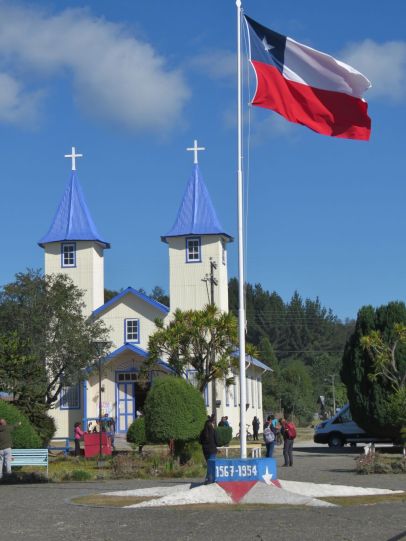
Pretty church in Chacao. One of Paul’s readers on safari talk commented how similar the Chilean flag is to Texas’ state flag.

A sample of the crafts people were selling
There is a wooden structure not far from the church on the edge of the water and Rafa sets up his birding scope as there are several sea birds in the area. Our binoculars are good but looking through the scope allows you to see incredible details of the birds. There are graceful Black-necked swans, a Black-crowned Night Heron, Whimbrels and more. Paul also finds a house sparrow, they are everywhere!

Black-crowned Night Heron

I will have photos of Black-necked swans later that look a lot more graceful than this one does

Our hotel for tonight
We leave Chacao and drive to Ancud to drop off our luggage at Hotel Mundo Nuevo where we are spending the night. Leaving Ancud, Rafa takes an alternative road, (gravel) and whenever we see a bird or anything of interest for that matter we just stop on the side of the narrow road. There is very little traffic which is quite nice since there is plenty of things to stop for.
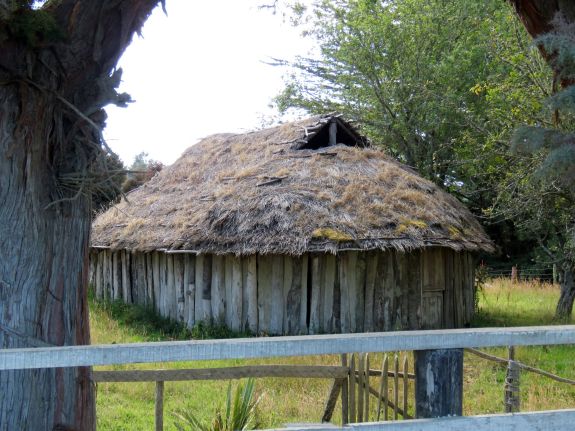
traditional house of the Huilliche people
We pull over to look at a traditional house of the Huilliche people, I assume it is a reproduction and not an original structure but I can’t say for sure. We stop at another wooden church that is nestled cozily in the countryside. A cemetery is situated nearby where a riot of colorful flowers are growing by the gravestones. Chiloe has a lot of wooden churches and sixteen of them have been designated World heritage sites by UNESCO. Although the two we have visited so far are not on the list, they are still impressive.
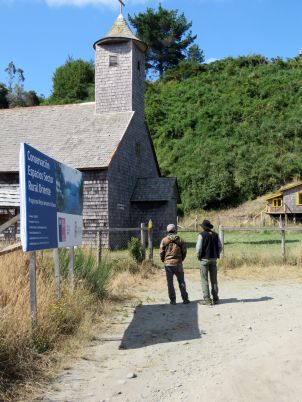
Paul and Rafa admiring wooden church. Notice how the two men are standing in an almost identical stance. I notice this throughout the trip!
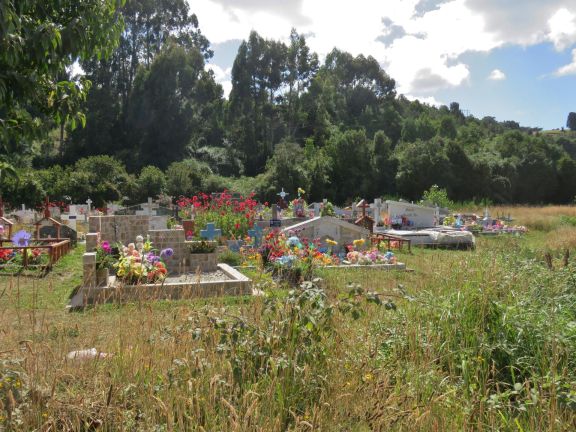
Cemetery and flowers
We pass a man walking beside a wooden cart drawn by two oxen which is something I didn’t expect to see here and in fact this is the only one we do see on this trip. A young woman is riding a bicycle just in front of the cart and Rafa slows the car down until we are just creeping along. He explains that he doesn’t want to cover the people in dust. I nod in appreciation at the thoughtfulness of our guide.

The only ox-drawn cart we saw.
Rafa stops on the edge of a larger town by a small private lake. The woman who owns the property runs a truck repair shop plus has a small store where she sells goods. Rafa says he always buys something there to keep in the owner’s good graces so he can continue to come and check out the bird life on the big pond. Paul and I wait by the car while Rafa goes to purchase some good will. He returns with a chocolate bar for me and a sprite for Paul. The chocolate is really good.
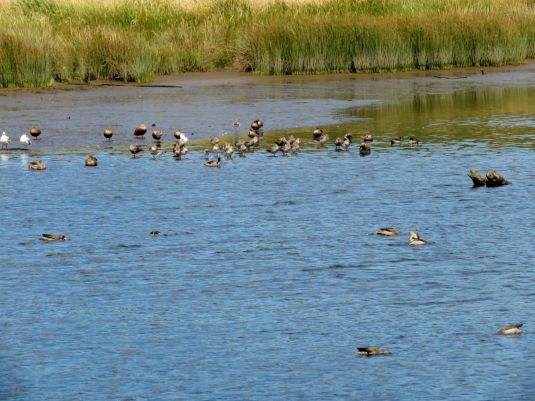
A few of the wide variety of birds we saw at the private lake
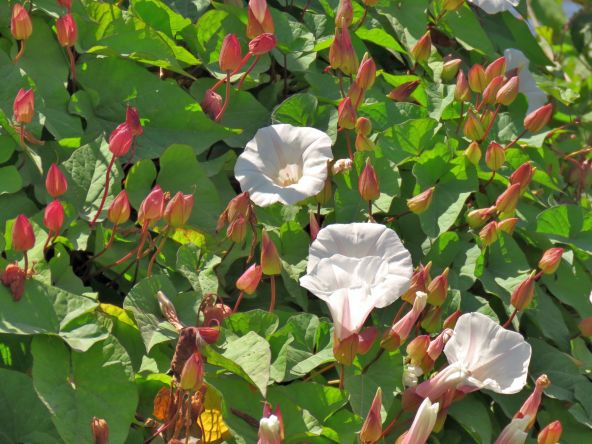
One variety of flower that were growing along the edge of the large pond
The pretty lake not only has a lot of bird life but various wild flowers are growing along the edges. For some reason I did not get very good photos here and could only salvage one flower photo and one photo of the waterfowl on the far side of the pond. There were Ruddy Ducks, Speckled Teal, sea gulls, grebes and coots. After we leave the busy lake, Rafa drives the gravel road next to the property looking for the Spectacled Tyrant that he knows lives here. He uses a call and on our second drive by the black bird, who appears to be wearing “spectacles” due to the large yellow outline around his eyes, lands on the top of a boulder. We get a good look at him through our binoculars but he is too far away for a photo.
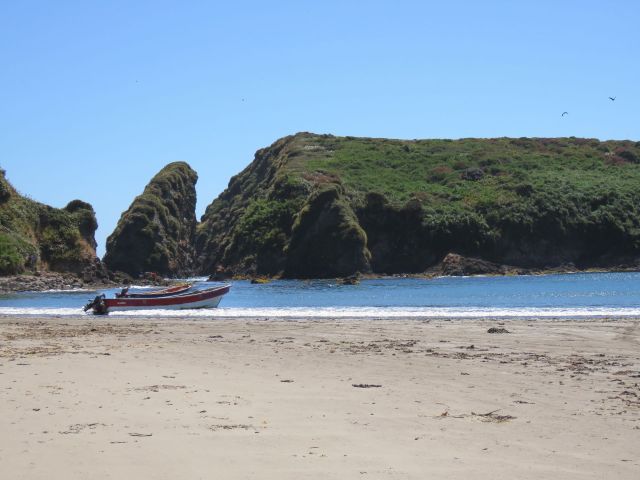
Beautiful seascape in Punihuil Bay
We continue on until we arrive at Punihuil Bay which offers stunning scenery. The small rocky outcrops and islands covered with flora randomly rise out of the bay. Rafa has a reservation for the three of us this afternoon to take a boat tour out to see the penguins who arrive here to raise their young. Most of the penguins are Magellanic but there are a few Humboldt penguins too. The Humboldt penguins are dwindling in number so if we see any of them, we will feel very privileged.
We have arrived early so we can have lunch at Bahai Punihoil restaurant which sits a hundred yards from the water. Our meal begins with empanadas, Paul has the cheese (due to his allergy to fish he is playing it safe) but I opt for abalone and cheese. The abalone is a bit chewy but as Rafa promised it has a mild taste and is not fishy. I could easily have managed with only the empanada as it was very filling. However, my hake arrives along with a lettuce salad, a huge boiled potato and rice. Paul has a pork chop with the same sides. The fish is very good and Paul says this is the best pork chop he has had in years. I take a bite and he isn’t exaggerating, the chop is tender, juicy and flavorful due to the fact that there is quite a bit of fat throughout the meat. I can’t begin to eat all my food and this will be a constant throughout the trip. Rafa forgoes a main course and eats a couple of more empanadas.
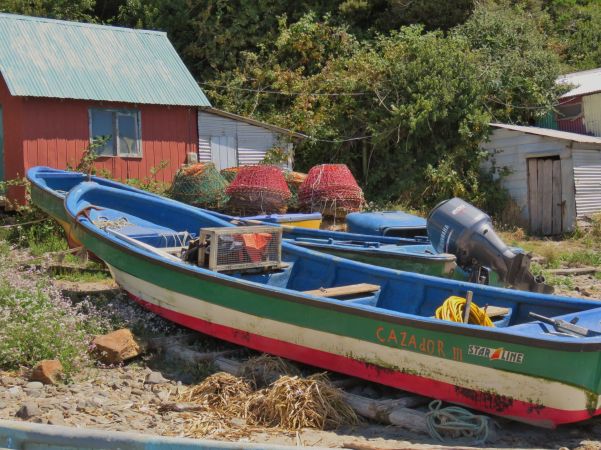
A boat equipped to go out for Abalone. The fishermen go under water up to 60 feet using the yellow air hose. Crab pots in the background
We still have some time before our boat excursion so we take a stroll along the beach. We watch as the fishermen load a tall wheeled cart with customers and then push the cart into the water to reach the touring boats. Rafa explains that fishermen run the penguin tours plus the families also own the restaurants such as the one we dined at. The government does have rules they must follow such as only two boats allowed around the penguin colonies at once and the boats can only stay out for 30 minutes. It looks like a pretty sweet deal for the fishermen, tourists and penguins who likely are protected by the fishermen because of this business.
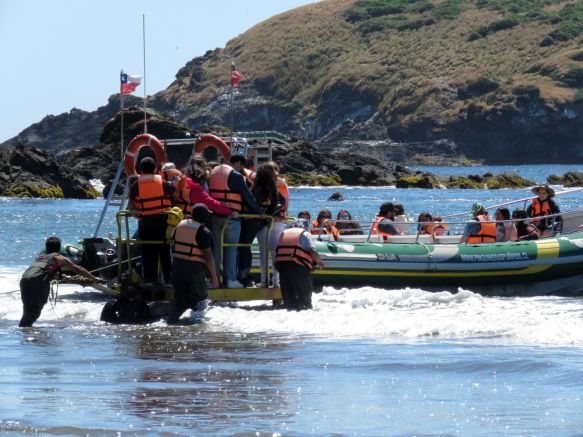
We watch as tourists are wheeled out to the boat that will take them to the Penguin colonies
Once our allotted time rolls around we don life jackets and walk to the awaiting cart. I snort with laughter when I see Titanic III printed on the back of Paul’s vest. Rafa half seriously says don’t ask what happened to the first two Titanic’s. This is another thing we are discovering, Rafa and the Chileans have a delightful sense of humor. The three of us crowd onto the cart with other customers and soon we are stepping onto the motor boat. One of the passengers offers me a helpful hand which I am more than grateful for.

Paul with other tourists on the Titanic III

Lovely scenery
The water is fairly calm and we motor towards the small islands that the penguins call home. It is easy to identify the Magellanic penguins as they have two black bands, one around their neck and the other band across their chest. Humboldts on the other hand have only one band. However, many of the tuxedoed penguins are in molt so it is difficult for me at least to tell what they are. We do see a few Humboldt penguins among the myriad of Magellanic. Hurray.

Magellanic Penguin
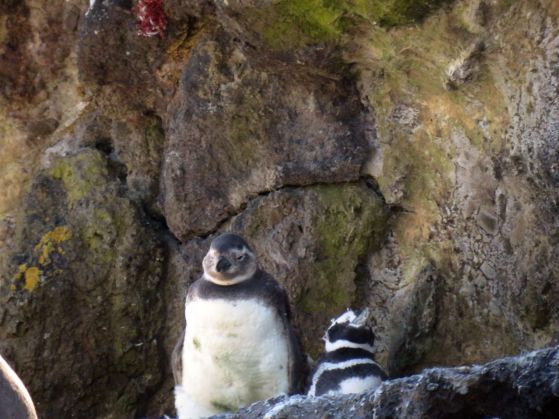
Humboldt Penguin on the left
We also see other sea birds including the Red-legged Cormorant. A gorgeous bird in my opinion and I can’t get over the tattoo like markings around the birds very blue eyes. There is a Kelp goose whose mate can just be seen in the rocks above the water probably sitting on a nest. A group of flightless steamer ducks bob on the surface like corks, there webbed feet must be treading busily beneath the water to keep them from ending up on land. We were introduced to these ducks in some of the books we read on Patagonia when the authors wrote about how the sailors would hunt the ducks for food but they were almost inedible. For those of you who enjoy a well written book may I recommend This thing of Darkness by Harry Thompson. It is a historical novel about Captain Fitzroy and the journey of the Beagle with Darwin on board. Paul and I could hardly put it down.
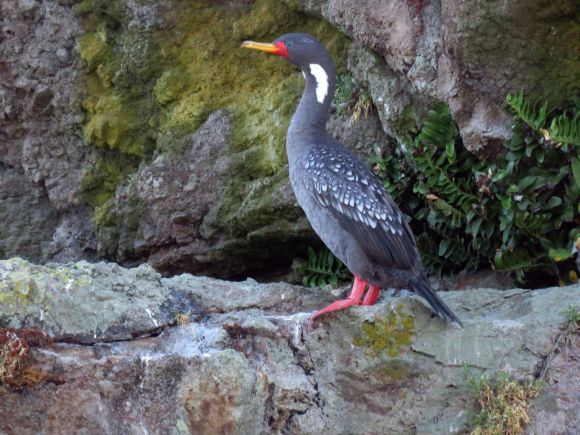
Red-legged Cormorant, they have the coolest eyes
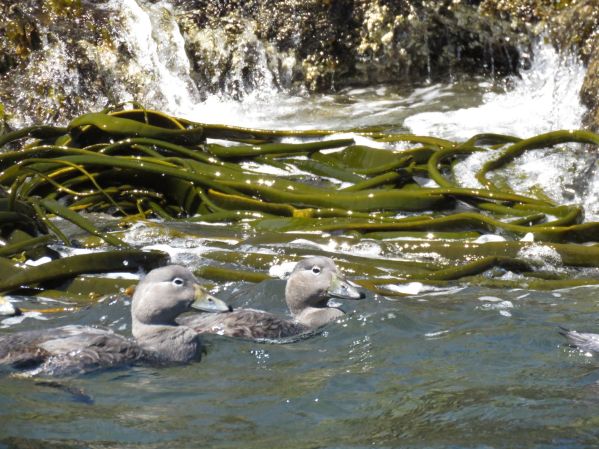
Flightless Steamer Ducks
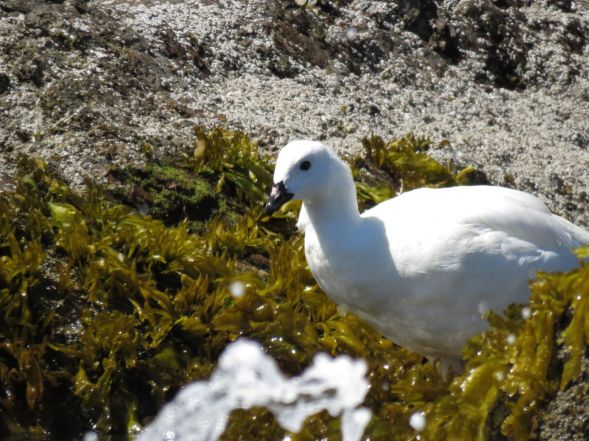
Kelp Goose-glaringly white which my camera doesn’t like.
Our thirty wonderful minutes have come to an end and we clamber back into the ingenious cart to be pushed back to the beach. We leave the bay and Rafa drives us to a windy stretch of beach where he often sees the Snowy Plover. The small wader isn’t to be found but we enjoy the wildness of the beach as the waves from the Pacific pound the shore. Rafa informs us that the Swiss, a company I assume, are trying to get permission to build wind towers off shore here due to the reliable wind. Sigh, it is so beautiful here plus wind towers are so deadly to birds that I can’t imagine the toll they would take on the birds that call this home.
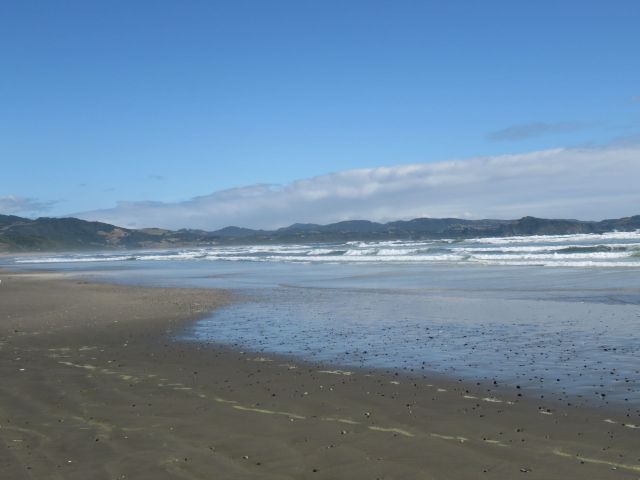
Wind swept beach
It is pretty hilarious when we drive away from the beach, as a big Angus cow with a yellow ear tag is standing by the road staring at us. Our fall cows sport yellow ear tags and this cow would fit right in with our herd. There are also red and white dairy type cattle that are the most prominent cattle in this area. Rafa tells us their Spanish name is Clavel Rojo and they are a cross between Holstein and Friesian, used for milk and meat. We have also seen Charolais, Simmental and Hereford.
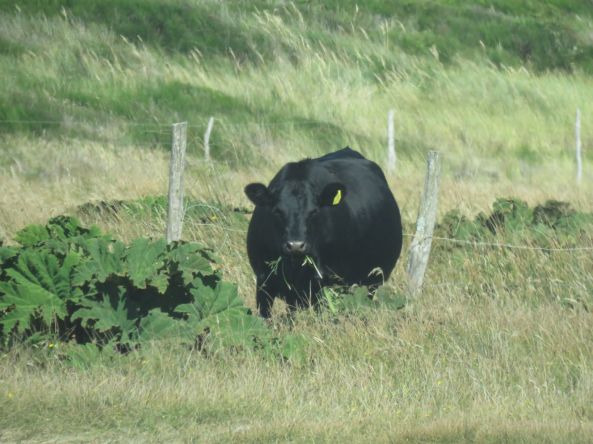
That is one good looking Angus cow. Look at the size of that rhubarb!
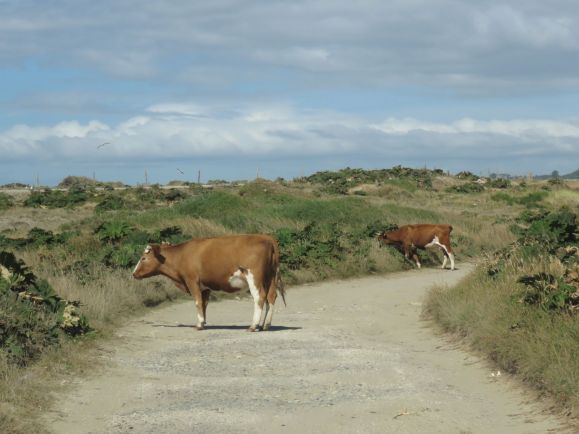
Holstein-Friesian cross that was predominant in this area
It is time to return to Ancud and our hotel. We do stop to look at drying seaweed by the road. The locals harvest and sell the dry seaweed which can be used in soups, etc. and is also added to various cosmetic and skin care products. Rafa has also educated us about the invasive bush called Gorse. It is one nasty plant; thorny and impenetrable whose roots are six feet deep making it nearly impossible to control. Unfortunately, we have driven through areas where the bush has nearly taken over the fields. Ah we humans never think about the consequences when we introduce non-native species to a new place.

Drying Seaweed

The invasive Gorse. Nasty stuff.
We arrive at the hotel at six o’clock where we thank Rafa for a terrific and educational day. Paul and I eat at the hotel restaurant and share another barbecue sandwich which is very good but not quite as good as the one we had last night. We also enjoy a refreshing Chilean beer. A great way to end a terrific day. Nancy
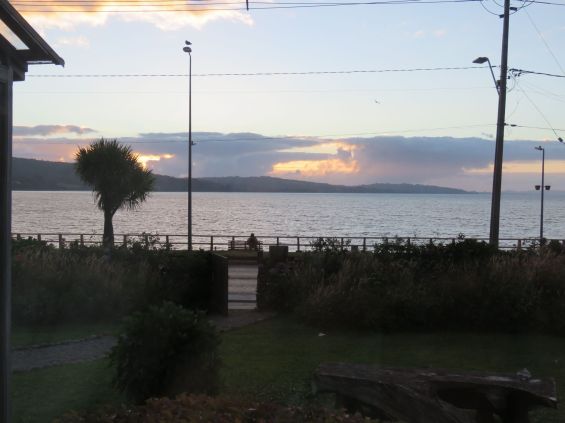
Sunset on Chiloe. I took this photo through the window in our room.
 realityranching