Chiloe Island, blog5

Chiloe Island, blog 5
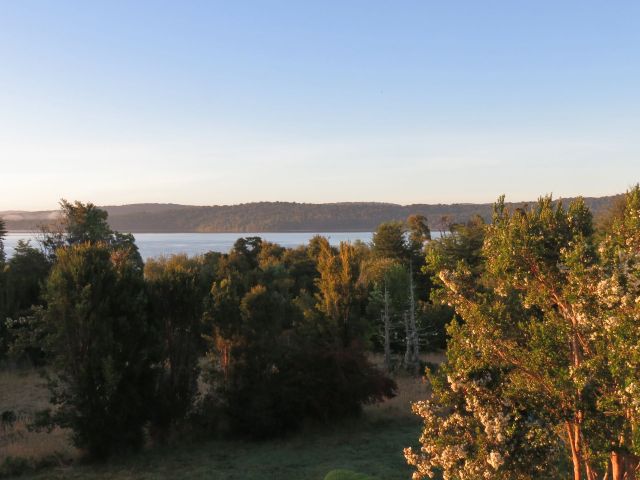
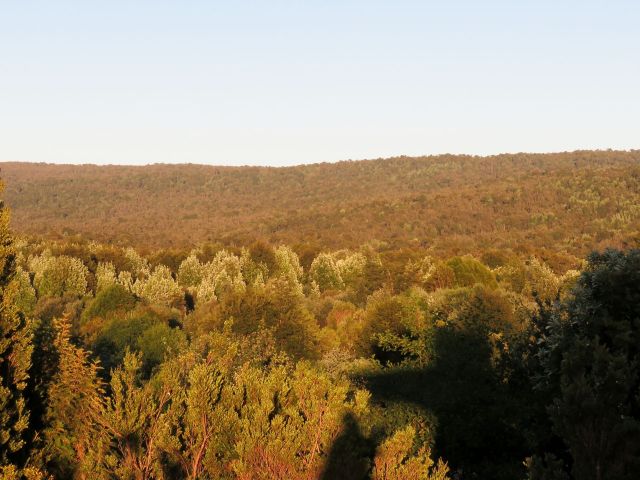
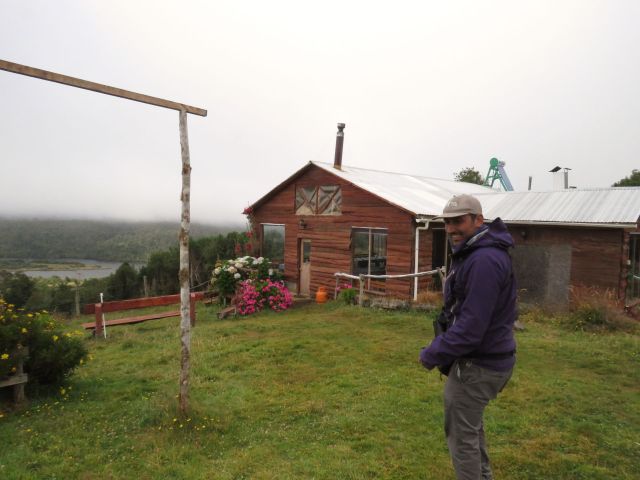
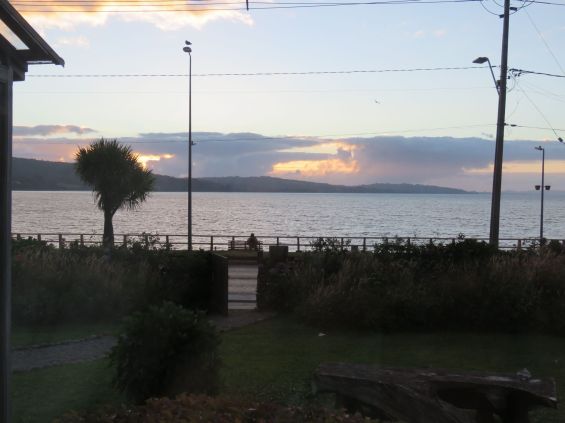
Early morning view from the lodges balcony

Paul and I were up at 5:30 at Rafa’s suggestion to see if there were Pudu on the lawn or grounds of the lodge but to our disappointment, none of the short, chunky deer were to be seen. We walk some paths and roads in hopes of espying a Darwin fox, an endangered species due to habitat destruction and dogs. Another reason the thousands of acres that Patrisio and his family are conserving is so important, there are no dogs here either. We see fox scat and tracks that are fairly fresh so we know that the rare animal is near. Darwin fox are only found on Chiloe island and in one National Park on the mainland of Chile.

Two cabins that can be rented where you cook your own meals as seen from the balcony

We return to the lodge after eight o’clock for breakfast and then Patrisio drives us to the head of a hiking trail to save us some time although we will walk back to the lodge from this point. While driving the narrow, tree-lined road the three guys exclaim as a female pudu dashes across the road in front of the car. I missed the little doe since I was not looking out the front of the car. Oh well, you can’t win them all.
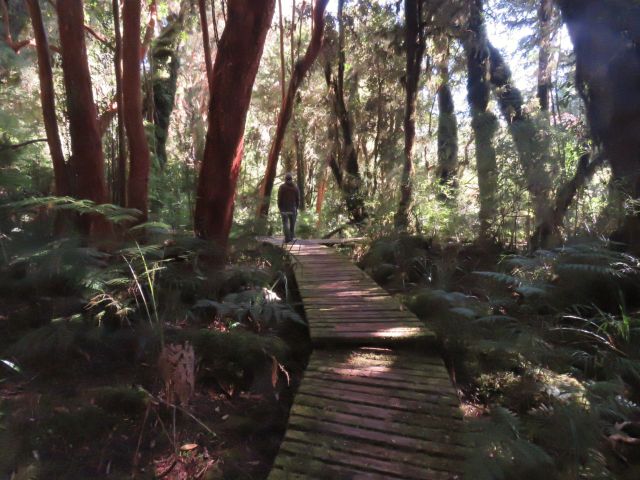
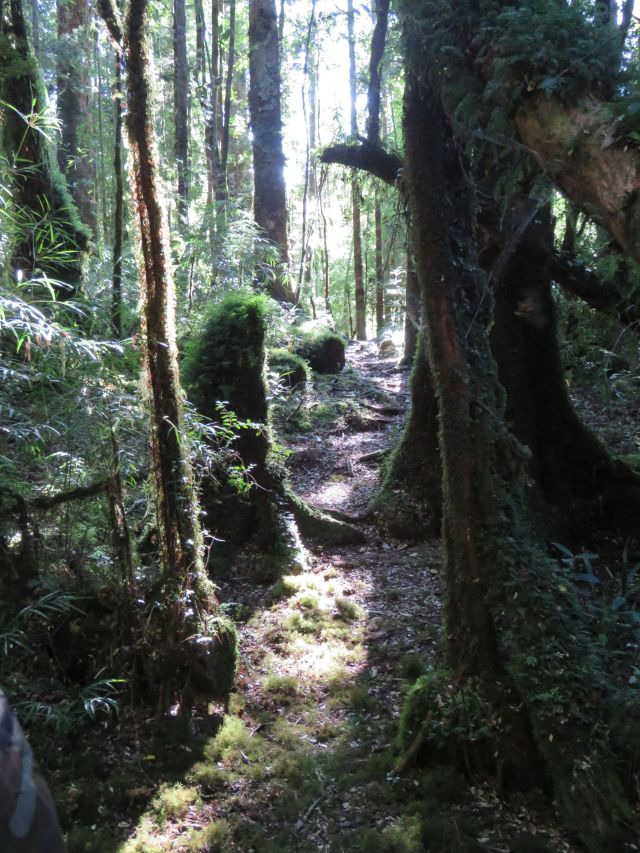
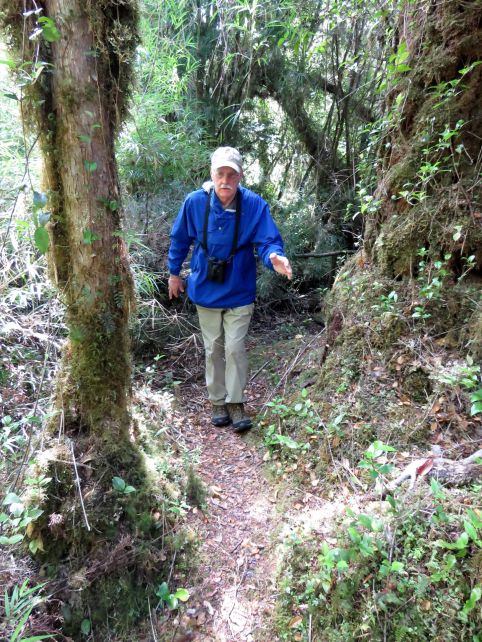
Part of the magical trail

Patrisio lets us out at the trail head and waves goodbye as he drives away. The three of us step off the dirt road into the forest and begin our last hike in this special place. Although the trail we hiked yesterday was terrific this trail feels and looks almost magical. Part of the reason is that the sunlight is filtering through the trees and the vegetation takes on an ethereal glow. The False Beech trees in particular are bathed in the stunning light and they are just breath-taking. I try my best to capture the essence of our surroundings in a photo but it proves to be impossible.
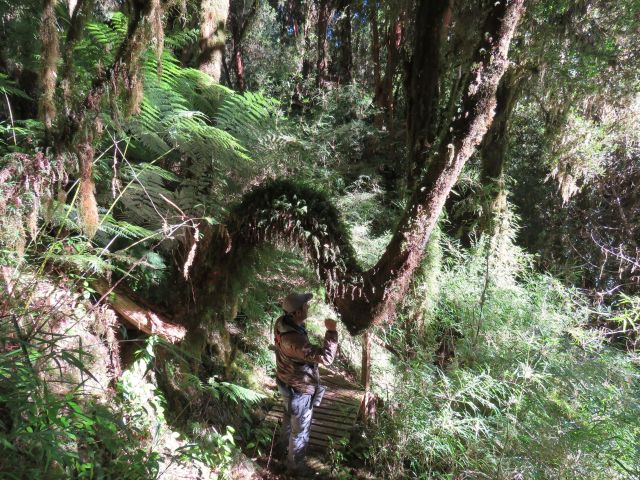
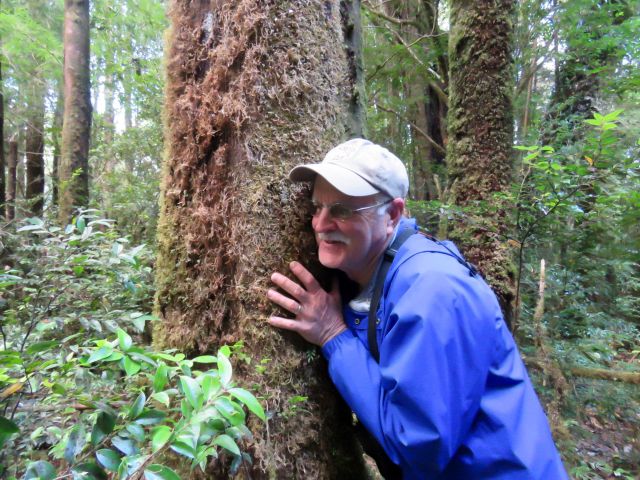
Rafa imitating the tree shape
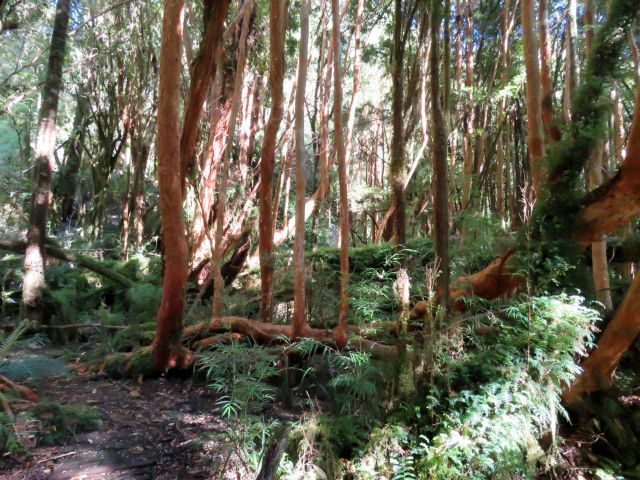
False Beech trees. I couldn’t capture the beautiful light that was filtering over the trees

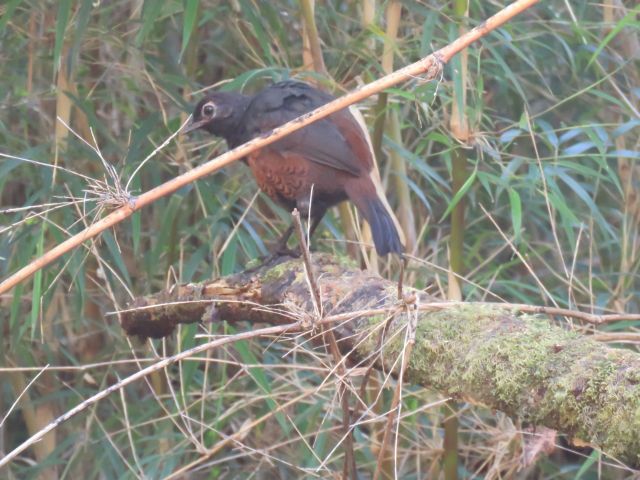
We have a close encounter with a Huit Huit which literally follows us down the trail at one point. Our companion puts on the same show as the one we saw yesterday. Scratching furiously in the loose forest litter while making sure he keeps us in his sight. Paul and I are chuckling over the comical bird when Rafa quietly gets our attention. We look down and nearly at Rafa’s feet is a Chacao peering curiously at these intruders into his domain. Wow, I can’t believe this. Two birds that are difficult to see and they show up on their own in plain sight. Hmm, maybe my description of this trail being almost magical should be revised and the almost taken out of that sentence.
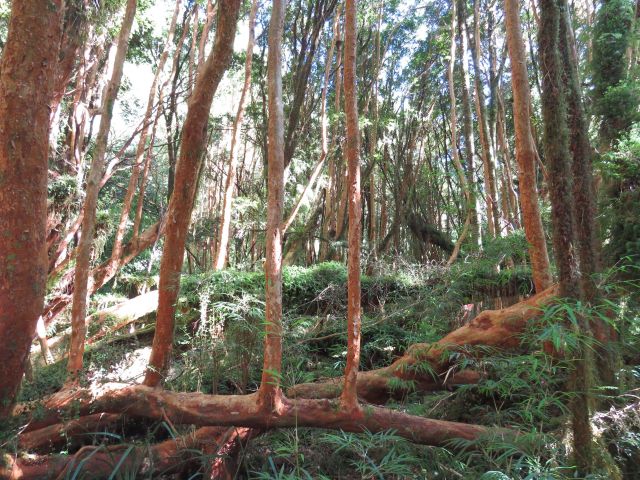
More beech trees. I actually used the Huit Huit photos in the last blog.

We walk to the river, the waters brown with tannin, and a Ringed Kingfisher is perched on a dead branch on the river’s edge. As our encounter with the forest birds on the trail, the Kingfisher seems to have little concern that three humans are standing a few yards away. The bird is bathed in sunlight and it willingly poses for several photos. Returning to the open road and bright sunlight we find ourselves visited by the pesky horseflies but they can’t dampen our enthusiasm for the incredible hike we just experienced.

Beautiful Ringed Kingfisher

When we arrive at the lodge, Pedro has a box lunch prepared for us but since it is nearly lunch time we opt to eat on the terrace before we leave. The sandwiches are huge so Paul and I split one and place the other sandwich in our pack. Supper is taken care of tonight. Once we have eaten, we fetch our luggage and place it in the van with Rafa telling us to make sure we have everything. It isn’t like we can come back and retrieve a forgotten item very easily. Rafa drives the white van to the dock as Patricio is already at the boat.

Oh boy, we carry our luggage to the dock and waiting for us is the worst swarm of horseflies we have encountered. Once we have all our stuff loaded, Rafa laughs out loud and says that he has forgotten his birding scope. That is too funny. Rafa returns to the van and drives away. Holy Smokes, these insects are relentless so Paul and I zip up our coats and put our hoods up. There is a father and son, friends of Patrisio, on the dock dressed in t-shirts and shorts. I see the young boy nudge his dad, and incline his head at these weird tourists. I look at the cute kid and then start shooing the flies that are buzzing around us. The kid laughs in understanding and demonstrates how he uses the plastic bucket he is carrying to swing the pail at the flies that are bugging him.

Leaving Tepuhulico Lodge. The lake was so calm.

Rafa returns, scope in hand, and we all settle into the boat. The lake surface hardly has a riffle on it, quite a difference from when we came yesterday. I am sad to leave here and if we ever return, I certainly would spend more time at this beautiful sanctuary. Once we reach the opposite shore, we thank Patrisio and tell him how much we enjoyed his wonderful place. Rafa goes to get the car and Patrisio waits just offshore until he sees his friend driving out into the road. He gives a final wave goodbye and motors back towards his beautiful home.

We meet several cars on the narrow, gravel road and all of them are taking more than their share of the road and driving too darn fast. One pickup begins to fishtail as the drivers is speeding down a hill towards us. Good grief. He gets the truck under control thank heavens.
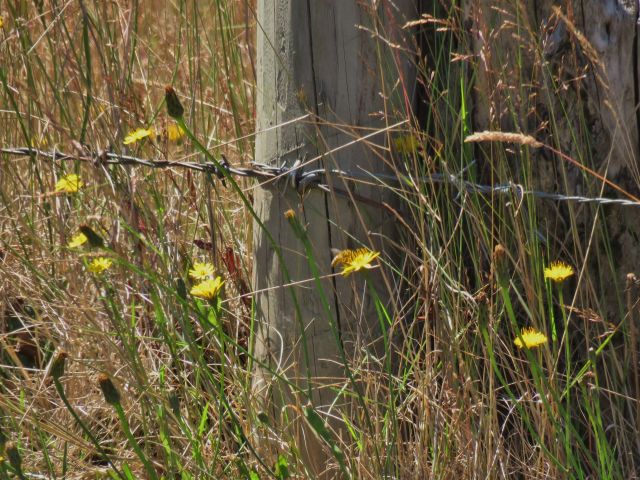
We were stopped at road construction for about twenty minutes. I took photos to pass the time

The Landscape was lovely as we waited for the pilot car

We stop at Chonchi to look at another wooden church. This is a Jesuit church, which is more simple in its decor than the Franciscan church we visited in Castro. Personally, I prefer the simple Jesuit church. Chonchi is also famous for the unique shingles that are used on the sides of many of the houses here.

Wooden church in Chonchi . I cut all the vehicles out so couldn’t get the whole church
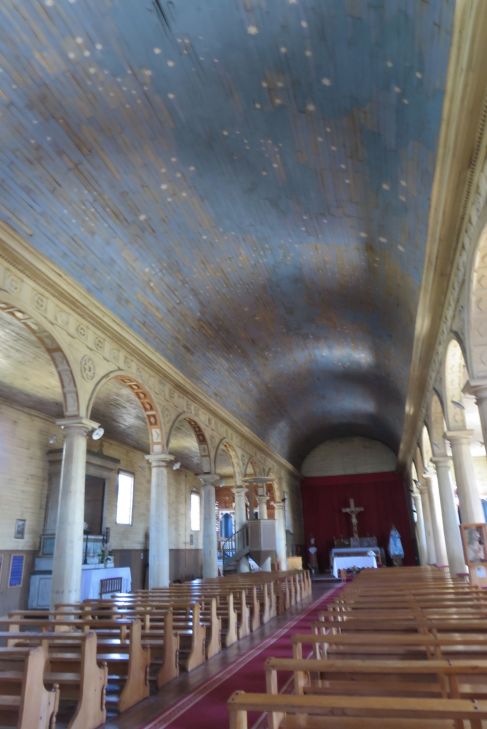
Wooden pillars and the ceiling painted to look like the sky
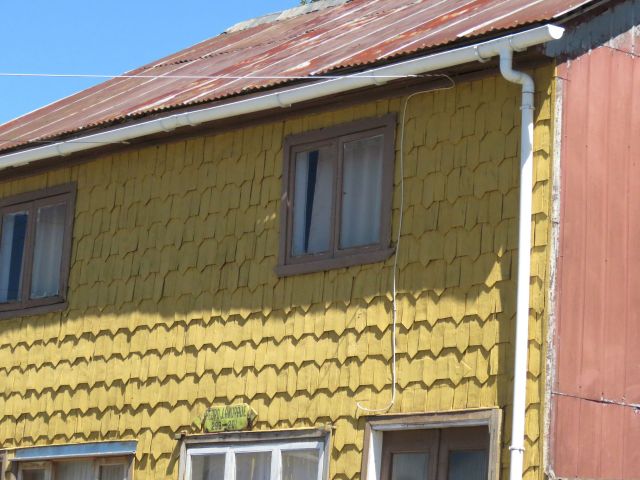
The side shingles that were seen on many houses in Chonchi

We arrive in Castro and go to our Palifito where we deposit our luggage in the same room, we had two nights ago. Paul also collects our laundry which cost ten dollars for the 2.5 kilo we left with the staff. I like that they charge by the kilo and not by the article of clothing.
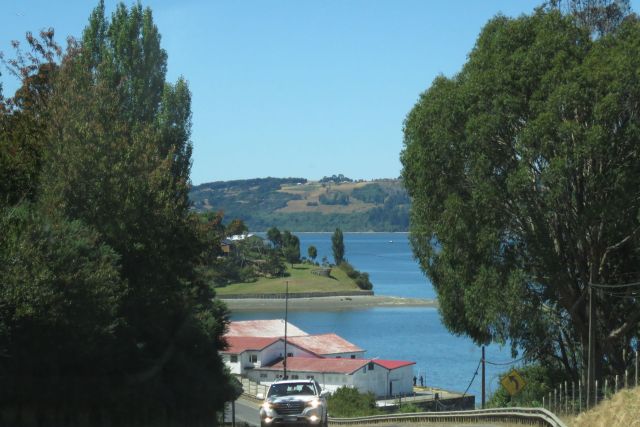
I snapped this photo as we drove into Castro

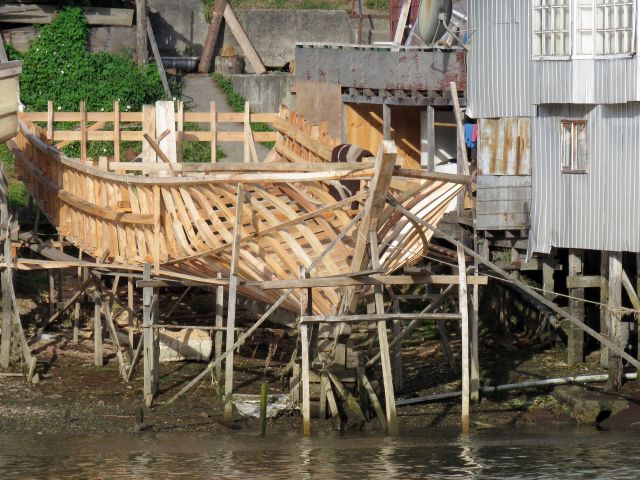
We hustle back downstairs and meet Rafa who suggested we go visit the wooden boat builders. Rafa speaks to a young woman who goes to talk to her Grandfather, (I think), then returns and says that it is okay for us to look around. I trail Paul and Rafa down to where three boats are in various stages of production. There is a young man working on top of one boat and he graciously agrees to visit with us. Paul and Rafa ask him a variety of questions and we learn a lot about the family business which is in its fourth generation. The boats are made of Cyprus and they make boats for fishermen and also build ferry boats. There are four men who construct the boats and there are four boats in production at one time. It takes them around five months to complete a boat and the cost for a boat is 150,000 which includes the engine and everything else. Paul and I think the price very reasonable considering these boats are built the old-fashioned way. As we walk by the ferry-boat that looks as though it is nearing completion, we notice a man underneath the boat, laying on his back, and sanding the bottom of the boat with a small hand sander!

Paul and Rafa checking out the skeleton of a boat that is being built by the business
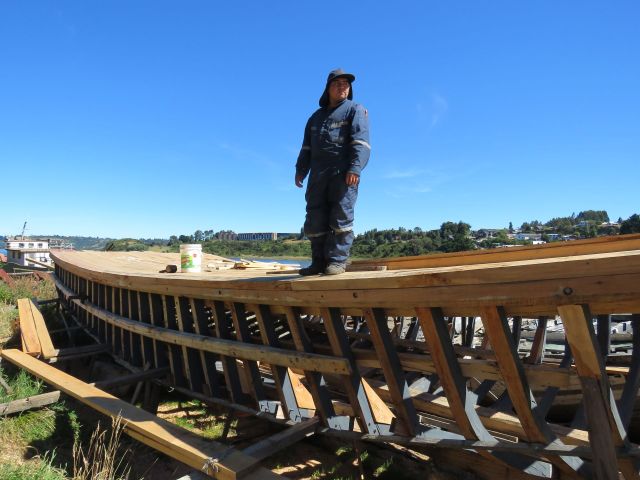
The young man who took time to answer our questions.

If you look reallyclose you can see the man who is wearing white coveralls, sanding the bottom of this boat.

We walk back to the Palifito and say goodnight to Rafa. Paul and I decide to buy a couple of beers from the Palifito stock to go with our half sandwich and apple. The beers are craft beers and pricy, four dollars each, and we don’t really like them as the beer is fizzy and bitter. Some of that pricey beer ends up being poured down the drain. We decide to walk a couple of blocks to a small grocery store the Palifito receptionists directs us to as we are craving an ice cream bar. With no dogs in sight we make it to the very simple market in time to see them unloading a quarter of beef from a truck and carry it into the store by hand. We peruse the ice cream treat offerings in the freezer and pay for our choices at the counter. The ice cream is just what we needed to kill the after taste of the bitter beer.

Kayakers and Black-Necked Swans

This evening as the sun is sinking toward the horizon, I go out to the deck to enjoy the scenery on our last night on the island. There are incredible colors reflected in the water and Black-necked Swans glide over the array of colors. It is a bit surreal and I feel as though I am looking at a painting. What a gorgeous ending to the day.
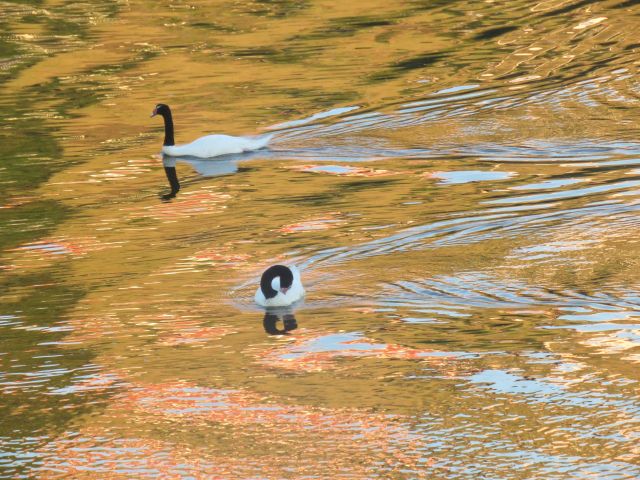
Beautiful colors reflected in the water with Black-necked Swans adding to the beauty of the scene
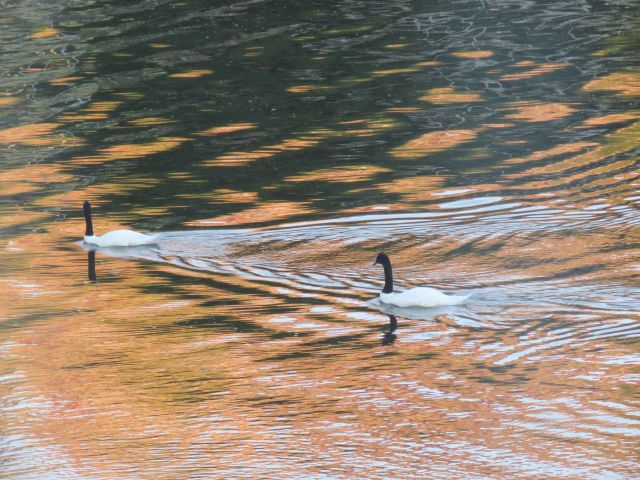
It looked like a moving painting.

There is no reason to get up early this morning as Rafa is taking us to a market here in Castro and it doesn’t open until nine o’clock. Paul and I had most of our stuff packed last night so there isn’t much to do after we eat breakfast. I do email Dr. Amy since I do not have an email from her updating me on Taz. I tell her that we will have email tonight and early tomorrow morning but after that we will be off the grid for the rest of our trip.
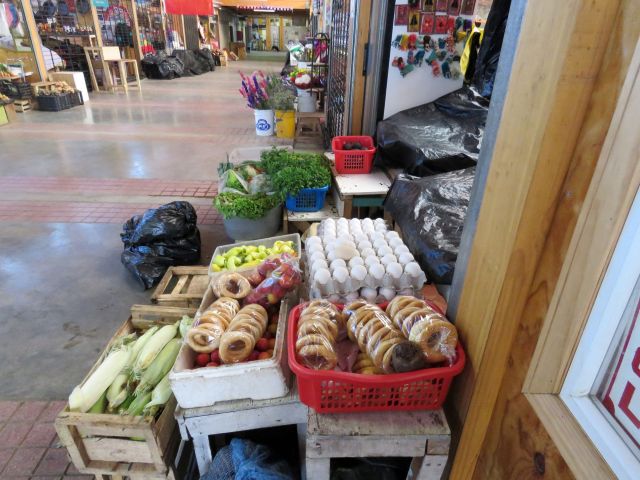
Castro market
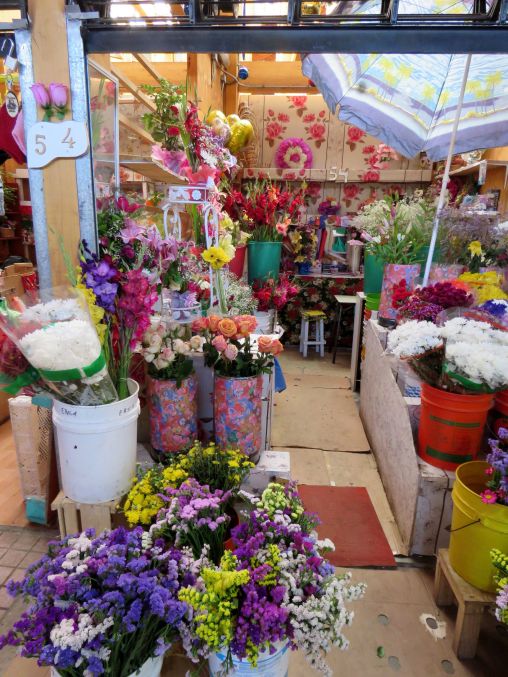
Lovely flowers

Rafa educating Paul
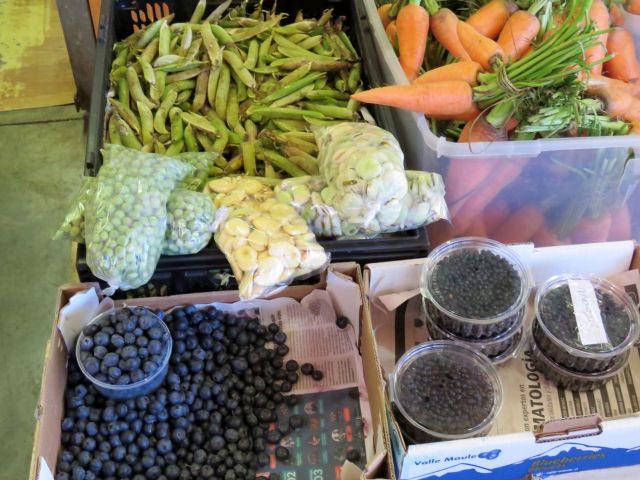
We bought our blueberries here

Fish for sale

We are at the market shortly after nine and a lot of the booths aren’t even open yet. Rafa tells us that in Chile people stay up late and are in no hurry to get started in the morning. Everything from vegetables, fruits, homemade liquor or cider, handcrafts, flowers and fish are being sold here. There is plenty of photo ops, that is for sure. When we walk to the part where the fish is being sold there are a few dogs wandering around. One dog is licking some fish that are sitting in a big tray on the floor in front of a stall. Yikes. The fish have ice on them so I think the dog is after the moisture. The woman who is arranging fish in this booth, comes out and shoos the dog away then drags the big pan of fish into the cubicle. Oh well, that fish is going to be cooked right? Paul decides to buy some blueberries from one vendor as we are leaving the colorful market. We return to the Palifito to get our luggage, load up and leave Castro and our Palifito behind. We really enjoyed staying here.
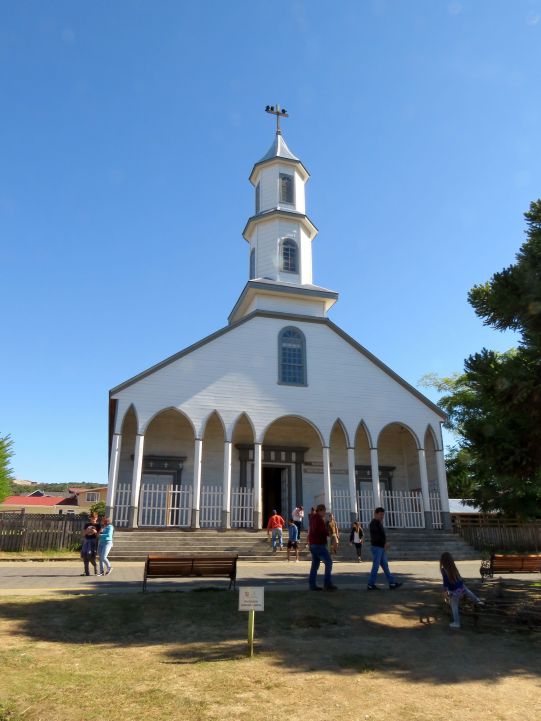
Another Unesco wooden church in Dalcahue
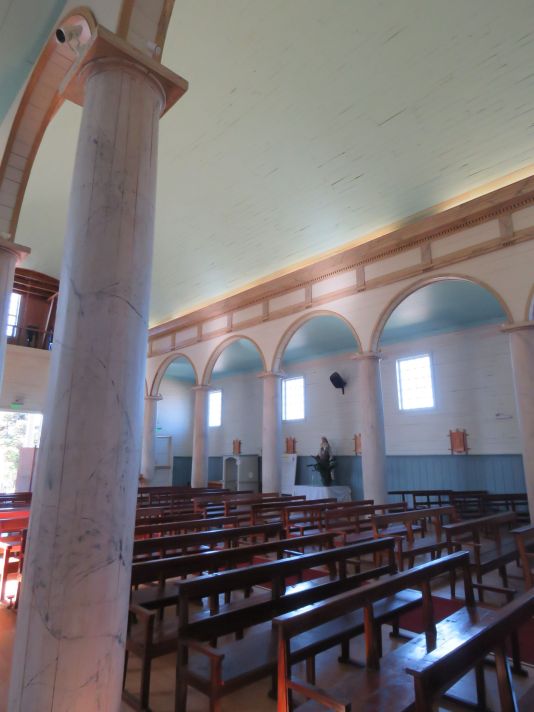
The simple interior

We make a stop on our way to the ferry which is in the fishing village of Dalcahue. There is another Jesuit church here that is on the UNESCO World Heritage list. We take a quick look inside and see the familiar sky painted on the ceiling and the impressive wooden pillars. Rafa is staying with the car and luggage, while Paul and I go to walk along the water front. It is just a beautiful day and the wooden boats that ply the water make for a very picturesque scene. There are Kelp gulls standing around on some of the boats plus we see a family of Flightless Steamer ducks paddling around some of the anchored boats. Tourists including us are strolling along the board walk just enjoying the atmosphere.

Love the boats
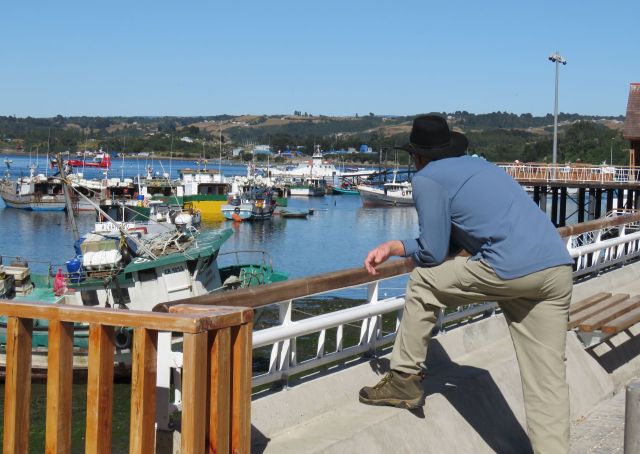
Paul looking over the water

Paul and I return to Rafa and the car and we continue on our way. Rafa informs us that he is taking us to a farm where the couple has been doing Agri tourism for twenty-two years. That is darned innovative. The Maldano’s cook a meal for large groups known as curanto which involves layering different kinds of meats and seafood on top of coals in a pit then covering the food with rhubarb leaves and letting the concoction cook for hours. Unfortunately, three people don’t constitute a large group but we are still served a scrumptious meal. We were served baked chicken and carrots, huge lima beans, bread, potatoes, and salad with rhubarb for dessert. Maria Luisa, her daughter and daughter-in-law have prepared our meal in an old-fashioned wood stove. Hardy, Maria Luisa’s husband, is recovering from health problems and was napping so we didn’t get to meet him. Maria Luisa was a vivacious and animated woman and we enjoyed our short visit here. Of course, Rafa had to translate for us.
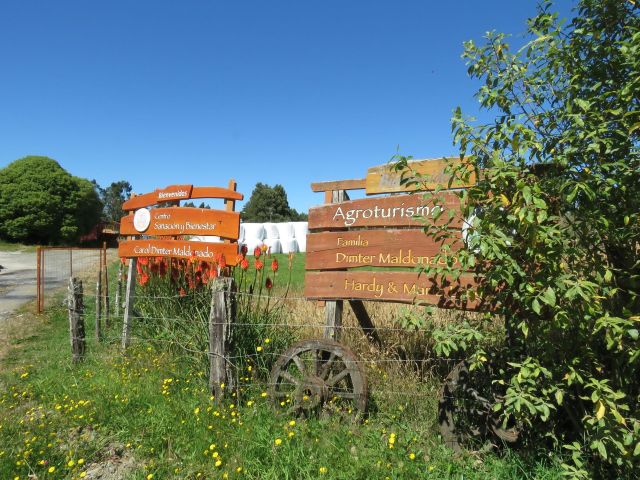
Farm where we ate lunch
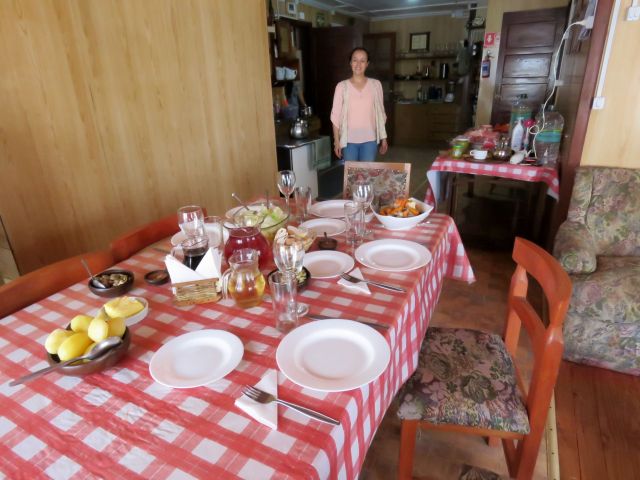
Lunch is served
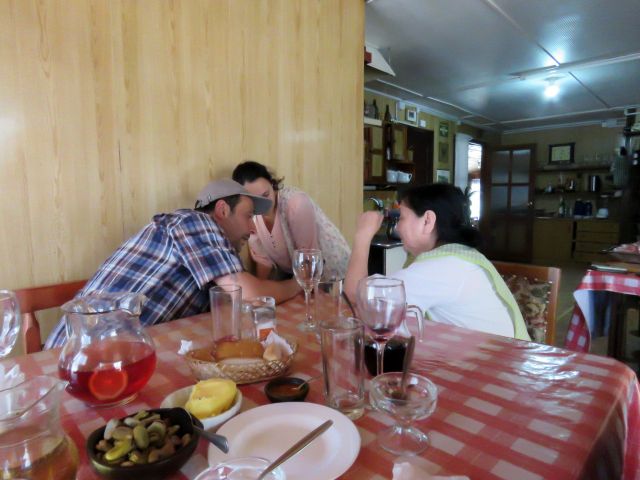
Rafa sharing photos of his daughters with his friends

We arrive at the ferry station and are soon parked behind a big semi on the ferry. We go up to the top for the ride back to the mainland. The sea lions are still piled on the red buoys, there are gulls and cormorants too. A flock of stately Peruvian Pelicans fly close to the ferry as we are pulling away from Chiloe Island. I loved our time on this enchanting island and would seriously consider returning someday. Nancy
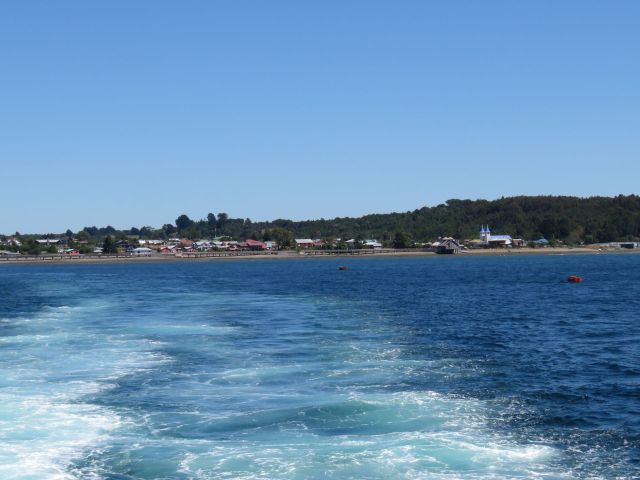
Chiloe Island receding in the distance
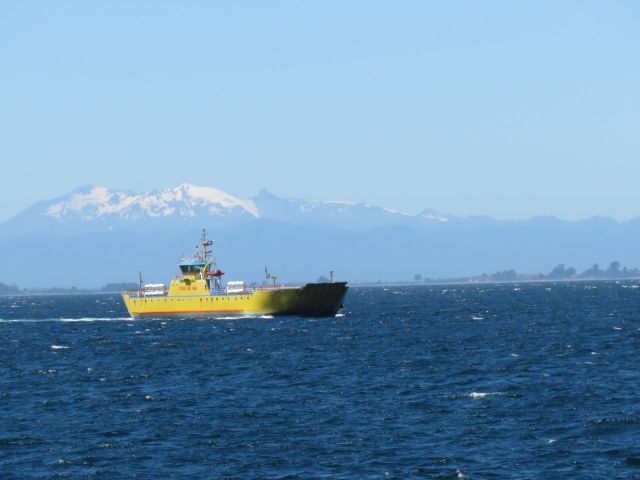
Snow capped mountains
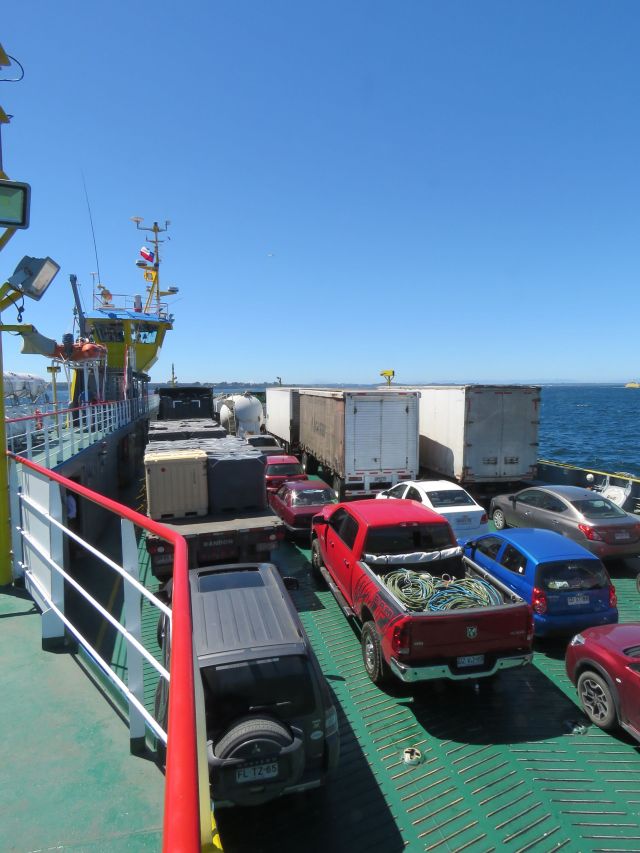
Our vehicle is behind the flatbed semi closest to the rail


Chiloe Island, Blog 4

Chiloe Island, Blog 4

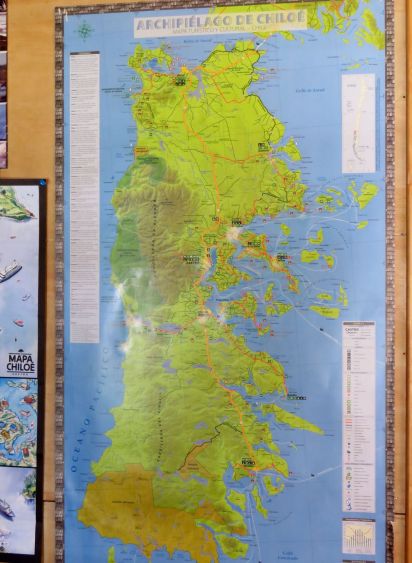
Map of Chiloe Island in our Palifito lobby

I forgot to write about our experience with some dogs when we came back from the supermarket. It was so nice out that Paul and I decided to explore the area that lay in the opposite direction of the town square. Paul has to return to the room for something so I tell Paul I will meet him outside our Palifito since I needed a photo of the front of our hostel.

As I walk down the hallway towards the exit I stop dead in my tracks because there is a young dog, a Pitbull mix, standing in the open doorway looking into the hostel. The panting dog sees me looking at him and his mouth snaps shut as he stares back at me. I quickly look away, then glance back at the brindle dog who gives a half wag with his tail. O.k. the brief tail wag gives me courage to approach the desk where I tell the man sitting behind it my problem, (that problem being that I am scared of dogs). He graciously gets up and shoos the dog away informing me when he returns that the dog is friendly.

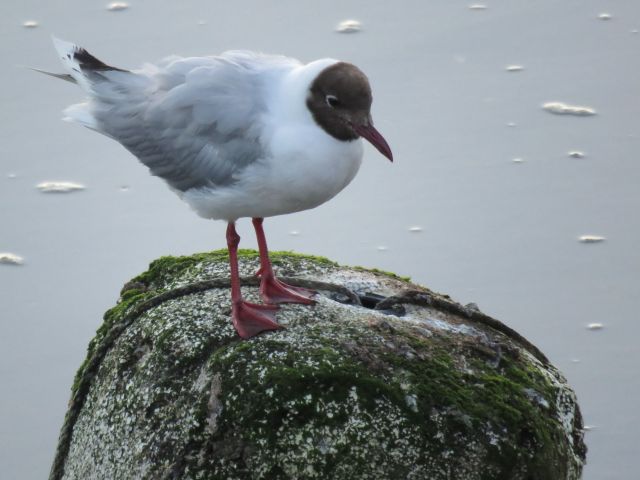
A photo of a calm Brown-hooded gull to take my mind off the dogs

I walk outside and am relieved when I don’t see the canine. I take the photo of the entrance and Paul shows up so we begin our walk. Oh great, the door-blocking pooch has spotted us from across the street and decides to accompany us on our walk. The dog must be an intruder in this area because two German Shepherds, that thankfully are fenced in, are barking frenziedly while running back and forth along the wire fence as we stroll by.

We continue down the sidewalk only to see two free-roaming dogs across the street who start growling at our unwanted companion. The darn Pitbull thinks the safest place for him is staying directly behind us. The fierce duo, their hackles raised, are smart enough to cross the street and try to sneak up behind us which we only notice when we glance back. Paul immediately pulls me off the sidewalk and into the street. Our unwanted companion seeing that his “protectors” have abandoned him, beats a hasty retreat through an open gate into somebody’s yard. Paul and I cut our walk short and return to the Palifito since there seems to be more dogs up ahead. That is one thing that is consistent in Chile as in other South and Central American countries we have been in. There are dogs running loose everywhere.

This photo with the dogs is actually taken in the last town we stayed in but the scene was the same whatever town we were in. Dogs on the loose

What a noisy night it was in and around our Palifito, of course it is Saturday. Some of the guests in the hostel are having a party in the common area with talking and laughing loudly as the music they are playing has to be at full volume. To add to the din, it sounds like every dog in Castro joins in on barking binges every few minutes. The canine serenade always starts when some little yapping dog next to our Palifito seems to be the instigator that sets the rest of the canines off. Thank heavens I have a pair of ear plugs which muffles the annoying noise and I actually get a decent night’s sleep. Paul has no ear plugs so I don’t think he was able to sleep very well.

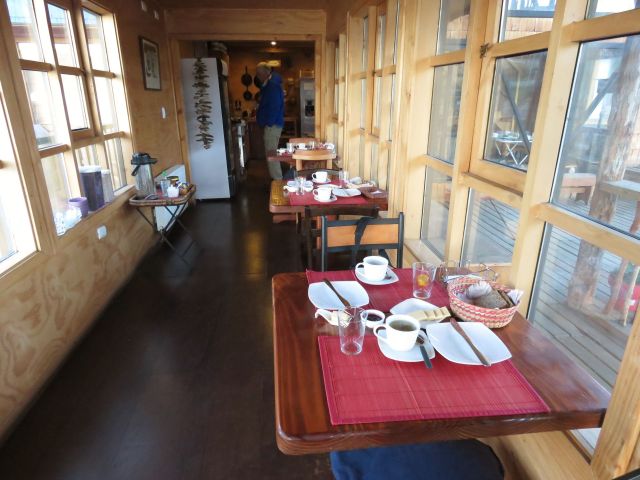
Breakfast area

After eating breakfast, we carry our luggage down to the lobby along with three small plastic bags full of dirty laundry (we both are down to one clean change of clothes). Since we will be back here tomorrow night letting them do our laundry works out great for us. It is nearly impossible to wash out clothes and get them dry when you are only spending one night in any place.

UNESCO church on the edge of Castro

The sky is heavy with clouds as we drive away from the Palifito at 8:30. Our first stop is another UNESCO wooden church in Castro. This lovely church, with the cemetery flanking it on two sides, is locked so all we can do is admire the architecture from the outside. One interesting or maybe sad thing is that an ultramodern school is being built next to this historical church. What a contrast.

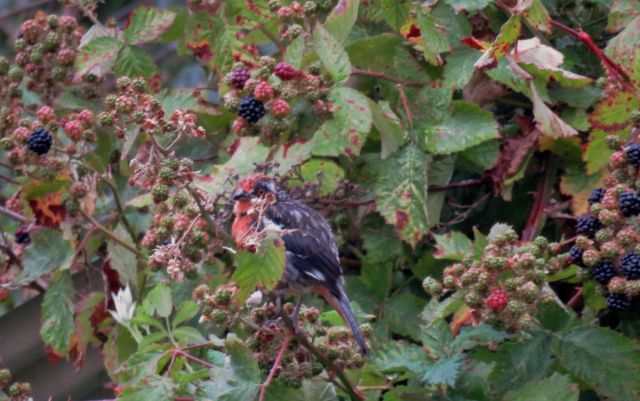
Rufous-tailed Plantcutter

We make frequent stops on our drive south to look at birds. One of the most colorful of the birds we see is the Rufous-tailed Plantcutter. The bright fellow just happened to be dining on blackberries where we stopped to look at another wooden church in a small village. We also see several Green-backed Firecrown Hummingbirds feeding on some flowering bushes at one stop. What a long name for such a small bird!

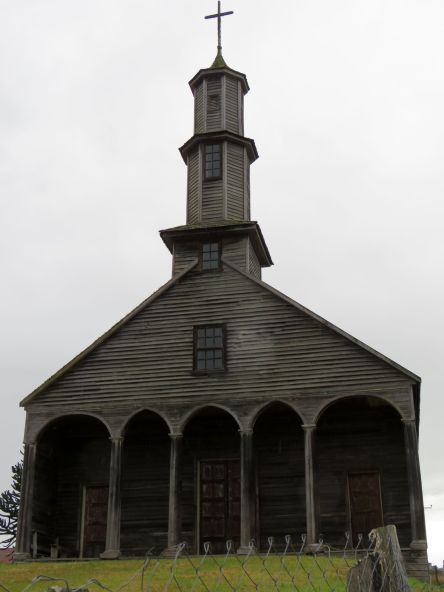
Another lovely wooden church

We stop here to look at various water birds. This is where we heard the Chucao that I refer to later in this blog

We turn off on a gravel road that leads to Lake Tepuhulico where we will be spending the night at a private lodge. Rafa makes a call once we are on the alternative road to Patrisio, the owner of the lodge, so he will be waiting for us at the boat dock. Yep, we must load ourselves and our luggage in a boat and cross the lake to get to the lodge. There used to be a bridge across the river that feeds into the lake but it was washed out by a flood a couple of years ago. Patrisio must replace the bridge himself and it is a very expensive project.

We have been driving through light rain off and on and it is spitting a bit when we reach the lake. We see the boat speeding towards us as we unload our luggage, (we leave one in the car that we won’t need), then Rafa drives the vehicle into a farmer’s yard which keeps the car out of sight from the road. Rafa pays the farmer a little money to be able to park the car there. We load the packs and ourselves, say hello to the smiling gentleman and motor out onto the lake. The lake is choppy and occasionally a spray of water comes into the boat. Paul and I are facing forward and so we catch the first spray of water in the face. Enough of that, we both twist to the right and let our rain coats do their job.

You can see the top of the unique lodge as we cross the choppy lake.

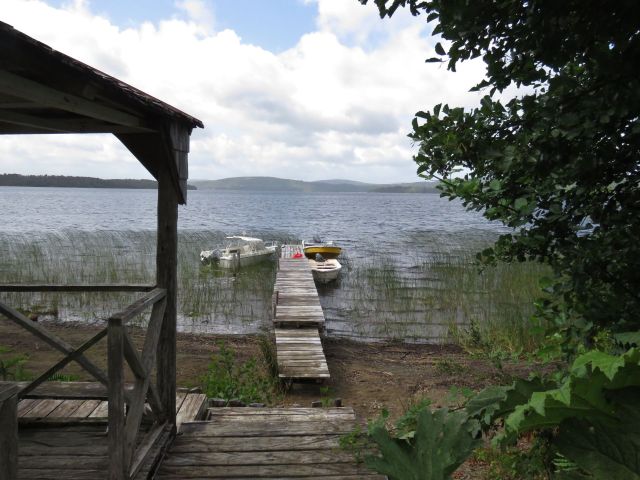
The dock and Lake Tepuhulico

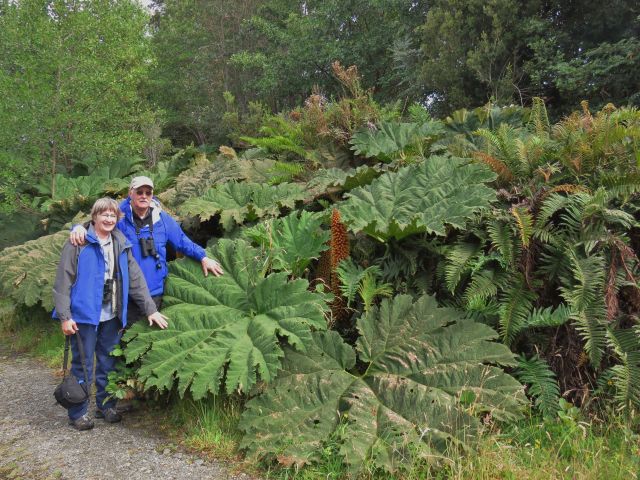
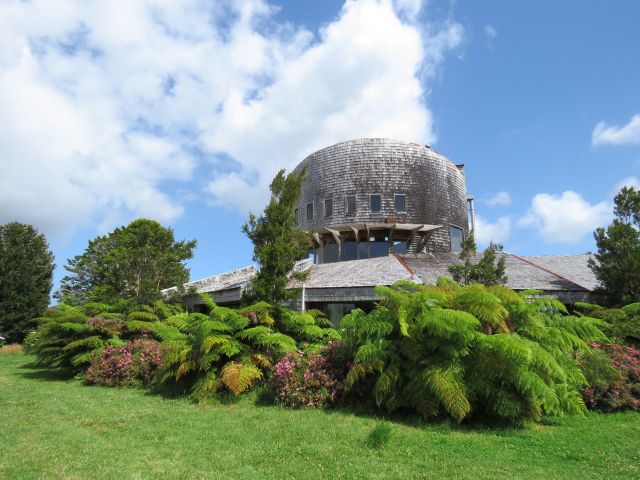
Twenty minutes later we reach the pier and tie up to the dock. We put our luggage in the white van that is parked here and walk to the very unique lodge. This place is lush with trees, bushes and flowers but Paul and I can’t get over the size of the rhubarb here. Many of the gigantic plants have blooms which are also incredible and a bit weird. Rafa tells us that the natives use this rhubarb exactly as we use our scrawny rhubarb at home, it is no different just gigantic.

That is some big rhubarb

The bloom of the rhubarb

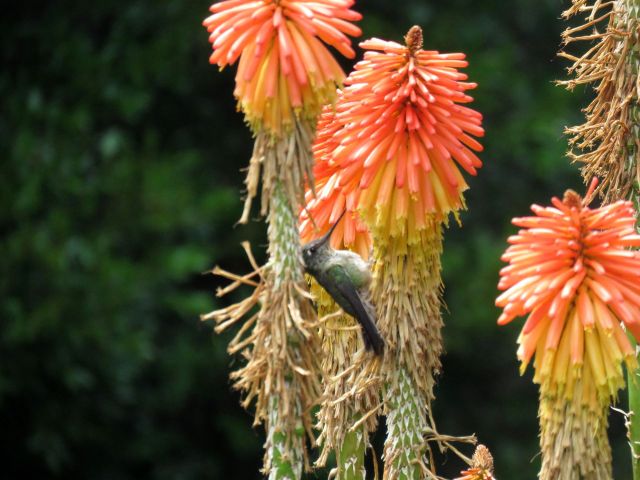
We place our luggage in our very nice room then Paul and I explore the grounds surrounding the round lodge. The flowers are past their prime but still lovely and the hummingbirds particularly like the red-hot pokers (at least that is what I call them). We return to the lodge after twenty minutes where we are served a very tasty gourmet lunch.

Tepuhulico Lodge. Beautiful

Hummingbird feeding on Red-hot pokers

After lunch Rafa throws his tripod and birding scope over his shoulder and we are off to see what we can find. We are literally just steps away from the lodge when we hear the loud call of the Chucao Tapaculo. We heard this small bird with the big voice this morning when we stopped to bird at a lake and Paul was determined to find it. Rafa told Paul that the Chucao, a ground bird, never comes out into the open but to satisfy Paul he tried to call the secretive bird out to no avail. Today the bird call works as the beautiful fowl can be seen scurrying along the ground toward us although it never leaves the cover of the trees. The bright-eyed bird seems to have no fear of us as it comes to a stop and checks us out as we do the same to him.

Chucao Tapaculo. What a gorgeous bird

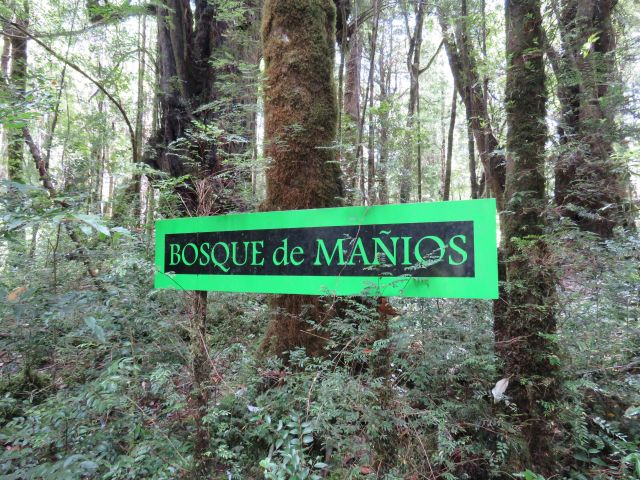
Rafa leads us to a trail and soon we find ourselves in a very primitive forest. Rafa said this land is unchanged from the time that Darwin was here. In fact, the owner bought these 40,000 acres nearly 40 years ago and his intent was to keep it as untouched as possible. It appears the man and his family have done a great job. There are trees we pass by that are 800 years old!

Trail we hiked through the primitive forest

Rafa hears a Black-throated Huet Huet, another forest dwelling bird that doesn’t stray into the open. Rafa plays the song of the Huet Huet and before long the big-eyed bird appears before us. The long-legged avian begins scratching in the litter like a chicken. We watch the bird for quite some time as it scurries around stopping to scratch vigorously through the debris on the forest floor.  I ask Rafa if the bird is so relaxed with us that it is scratching for food but Paul says he thinks that the comical bird is being territorial. Guess who is right? Well it wasn’t me. We continue down the trail but it seems the Huet Huet isn’t done with us, the funny bird follows us for several minutes, hopping up on branches, scratching through the litter, and keeping an eye on us.
Black-throated Huet Huet the huet is pronounced like whit which sounds like the birds call

The Huet Huet in scratching mode. It was hilarious to see.

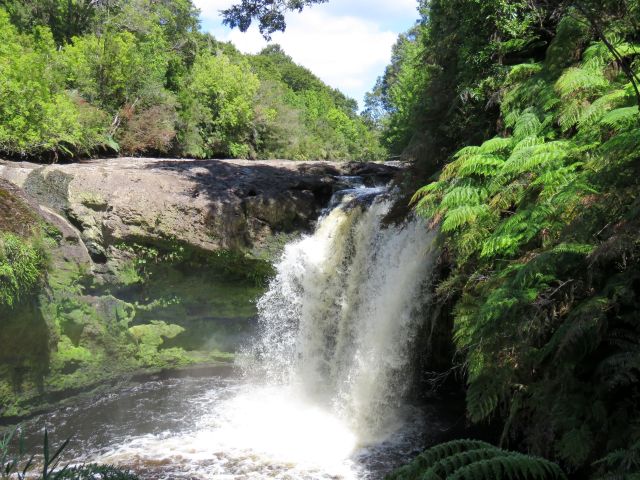
Rafa talks about the plants and trees that we encounter on our hike, and we marvel at the multitude of mosses, lichens, etc. that occupy a single rotten log or stump. Rafa even has a tiny microscope which allows us to see a bloom on one of the lichens that is barely discernible with the naked eye. Cool. There is proof that pudu, (a small endemic, rare deer), lives here as we find the deer’s scat on the trail. Rafa leads us to a small waterfall where the water is cascading with enough power to send spray into the now sunny day.

Nice waterfall

The only downside to our trek is that whenever we walk out of the shady forest into open areas and sunshine the stinking horseflies instantly find us and began to harass us by circling and buzzing around us, as they look for an opening to dine on us. Rafa says these irritating flies are females who need blood to finish the fertilizing of their eggs, (I wonder if I am remembering this quite right?). Anyway, the famished horseflies usually appear earlier in the summer but due to weather conditions the pests have only now shown up. Lucky us! The good news for later visitors is that the swarm of horseflies only last about two weeks.

Paul being silly

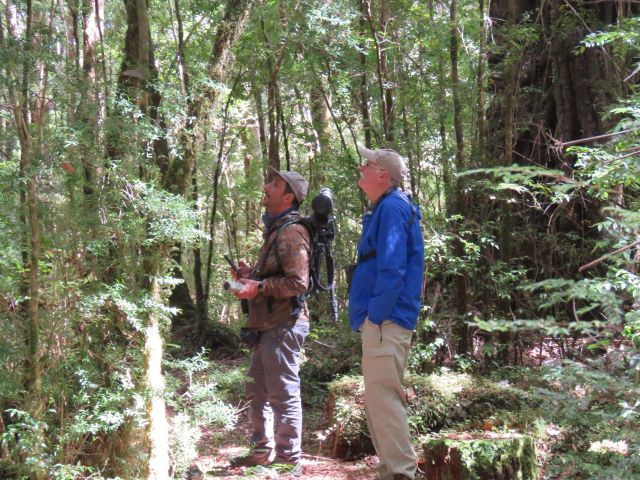
On our way back Rafa comments that we have seen the majority of the hardest birds there are to find in the forest with one exception which is the Magellanic Woodpecker. I swear we haven’t walked more than a couple of minutes after our guides statement on seeing tough to find birds, when we hear the loud drumming of a woodpecker. There is no question that a large woodpecker is producing that loud noise and Rafa confirms that it is the Magellanic woodpecker. We follow the drumming noise, which the helpful bird continues to produce at intervals for us. We know we are close so begin to scan the canopy of the trees high above us. Guess who spots the handsome red-headed bird first? Not me or Rafa but Paul. The woodpecker is so high up that I can only kink my neck and gaze up through my binoculars for a few seconds at a time but I still get a good look at the magnificent woodpecker. There is something hitting me on the head occasionally and when I look closely at the debris, I realize it is the pith of the tree that the woodpecker is removing to get at whatever insect is hiding in the tree. Rafa tells us to press an ear next to the trunk and listen when the busy woodpecker is drilling on the tree. Whoa, the drumming sound can be heard inside the tree trunk plus when the woodpecker strikes the tree a small shudder can be felt on the trunk too. Think of the power generated by the woodpecker to have that effect on this huge tree.

Listening to the drumming of the Magellanic Woodpecker through the tree trunk

Rafa is listening again and says, there is another Magellanic woodpecker drumming over that way as he points in the direction of the sound. Paul and I hear it too and we all begin looking for the second bird. Aha, there it is but we are a little surprised to find another male woodpecker pounding away on a tree. These woodpeckers like most birds are territorial. Rafa soon solves the mystery when he finds the female Magellanic not far from the second male, this must be a family! The female woodpecker only has a small spot of red around her beak with the rest of her head being black which makes her harder to find but eventually Paul and I do see her. Unbelievable, we go from not expecting to see this fantastic woodpecker to seeing three of them.

Paul and Rafa trying to pinpoint the other Magellanic woodpeckers we hear after the first one was spotted

We also caught a glimpse and I mean a glimpse of the Magellanic Tapaculo which is very small, black, and scurries around on the forest floor like a mouse. Another bird that played hide and seek with us was the Thorn-tailed Rayadito which is probably about the size of our smallest wrens but by gosh we finally got a look at the tiny bird.

The untouched forest seen from the lodge balcony that Patrisio and his family have conserved

We return to the lodge after our very enjoyable two-and-a-half-hour hike and just relax before dinner. We enjoy another tasty meal prepared by the young chef Pedro and then retire to the balcony and wait in hopes that some pudu will appear to graze on the lawn. We sit patiently for over an hour and as darkness begins to fall the air is getting chilly. There is an owl hooting in the distance and Rafa identifies it as a Rufous-legged Owl. When it appears that no pudu are coming, Rafa suggests that we go see if we can find the owl. As we are walking towards the door, I see something move on the edge of the lawn. Even though it is fairly dark I can see the shape of a small animal that looks sort of deer like. Rafa shines a red light on the creature which catches the animal’s eyes and he says “that is a kodkod”, (a rare cat which is the smallest cat in the Americas). Paul reacts by saying “I’ll be damned” but barely finishes this declaration before Rafa corrects his id of the animal saying that no, it is a pudu.

To see a kodkod would have been unbelievable as Rafa tells us that he has seen the endemic cat maybe ten times in his twenty years of guiding. Rafa’s initial thinking that this was the Kodkod was because the grazing deer’s eyes were so close to the ground. The Pudu is the world’s smallest deer, ranging from a foot to a foot and a half tall! We look at the pudu as best we can through our binoculars and our assessment is that it is a buck due to the small antlers. Our other observations are that this fellow is really fat and also that he is at the high-end of the height range for Pudu.

We wait a bit longer, watching the little buck munch happily on the lawn but no more Pudu come to join him. Rafa decides we should go look for the owl who seems to be quite close. I think the owl is having great fun with us as we will follow the sound of his hooting and Rafa will play his lights over the trees only to hear the owl hooting behind us. We play the game walking this way and that until we finally cry uncle and head for our rooms and bed. What an incredible day we had. Nancy


Chiloe, blog 3

Chiloe, blog 3

Paul and I are up early this morning and since breakfast isn’t until eight, we decide to take a stroll despite the overcast sky. When I walk out of the bathroom, Paul hands me the Kindle and says there is bad news from Dr. Amy about Taz. I immediately begin to cry as I assume that bad news means my cat has died. That isn’t the case but the fact is she is in very bad shape. For some reason her glucose readings were very low and this makes no sense because she was eating and getting her shots. Taz didn’t respond to the initial care from the boarding people nor to the veterinarian’s emergency work on my sick cat when they opened their clinic which is next door to the boarding place. Dr. Amy decided to take Taz back to her clinic in Wamego and see what she could do for her. I email back and say that I know she will do what is right for Taz and give her my permission to use her own judgement on what needs to be done.
Taz, like all cats loves sitting in boxes

Paul asks if I still want to take our walk and I nod my head that I do. I don’t take my camera as it is fairly dark and it appears that we could encounter some rain. It is low tide and in places the gulls and whimbrels are feasting on what was left stranded after the water receded. There also is a turkey vulture hopping around looking for food with the traditional sea birds. I found this a bit odd esp. since it is so early in the morning and vultures normally aren’t active until mid-morning.
At one point we notice a few segments of a splintered sea wall, left over from the tsunami that destroyed a large part of Ancud in 1960 (I think). The tsunami was the result of a strong earthquake that originated near Santiago. There is a plaque acknowledging the United States for their assistance in building the new sea wall that is in place now. It makes you look at the peaceful ocean today and know that it can turn deadly almost without warning.
Breakfast is the usual fare of cereal, breads, fruits, and the offer of eggs. I eat some toast and fruit but I don’t have much of an appetite. Rafa arrives shortly after eight so we gather our luggage and say goodbye to the owners of the hotel. I tell Paul to ride in the front today as with the low light this morning the photo ops won’t be good. Besides, I don’t feel much like conversing and Paul will be able to hear Rafa better if he is sitting beside him.

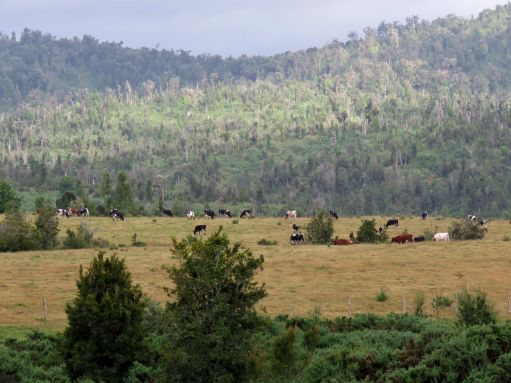
One photo I took on the way to the Chepu River of a herd of dairy cows.

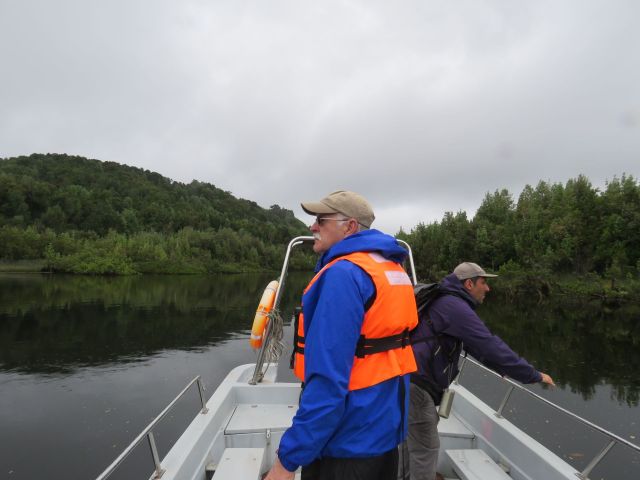
Our destination this morning is the Chepu River to search for the endangered Southern River Otter or “Hullin” as it is called here. We arrive at the river where there is a very small parking area right next to the dock. There is a man standing there and he motions to the spot that Rafa should park. It is beginning to rain a little and it is chilly so Paul and I put on our rain pants before we climb aboard the boat. Fernando who is the owner of the boat is a cheerful fellow who smiles and hands us our life jackets. The rain begins to fall more steadily so I wrap my camera in the rain cover I brought and place it under the bench seat. Rafa told us yesterday that the weather we experienced was not normal and we shouldn’t get used to it. Looks like he gave us good advice. Chiloe on average receives 60 inches of rain so overcast skies are more the norm then sunshine.

As we cruise down or maybe up the river, Rafa sees a Ringed Kingfisher which is similar to our Belted Kingfisher. After watching the bird for a bit, we continue on at a good clip down the river. We come to a place where the river narrows and the vegetation thickens and our search for the endangered Otter begins as this is where Fernando last saw an otter. The river otters need shoreline that has heavy vegetation and boy does this fit the bill. Paul and Rafa are looking off the left side of the boat and I am searching the water’s edge to the right. Suddenly I hear Rafa excitedly say “that was a Bittern”. I quickly turn to look but it is too late as the secretive bird has flown into the cover of the trees and bushes. Paul saw the Bittern standing on a dead tree just before it took flight. To tell you how rare it is to see a Bittern, later as I look at the list of birds for the Lake area to check the Bittern off (even though I didn’t see it), I don’t see the water bird listed. Rafa tells me that they don’t bother to put the Bittern on the list because no one ever sees it. Oh great, I can’t believe that I missed this elusive bird!

Paul and Rafa looking for the southern river otter

We continue down the river which in places is very narrow but there is no sign of an otter. We break into a wider part of the river where Rafa plays the call of the Many-colored Rush-Tyrant that lives in the thick patches of reeds growing here. Luckily for us a couple of the beautiful but tiny birds come to check out the stranger that is singing to them from our boat. It is impossible to get a photo of the vibrantly colored birds but we certainly enjoy watching them.

Imagine finding a mostly submerged otter in this cover

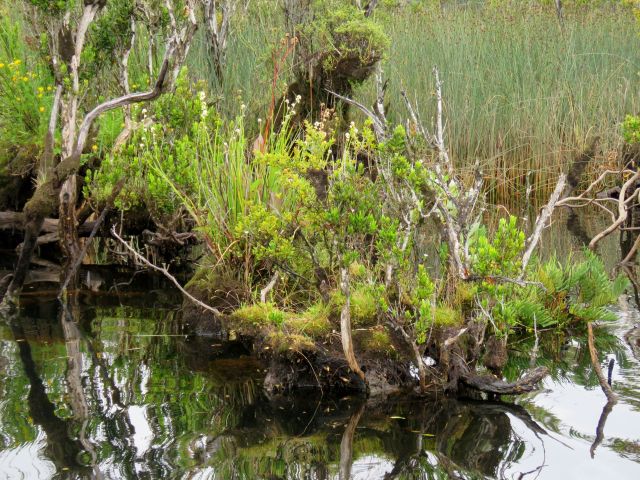
It is time to head back, the good news is the rain which has been getting lighter has now stopped falling entirely. Again, we all peer under the trees and bushes that grow in the water on along the edge of the water. At one point I hear a large splash but Rafa sees the Spectacled duck flying away that is responsible for making the noise. I missed that bird too! We take time to admire the flowers, grass and plants that are growing on top of the many dead logs and stumps that are submerged in the river. I am not sure a human could have created a prettier garden if they tried.

Miniature gardens planted by Mother Nature. Lovely

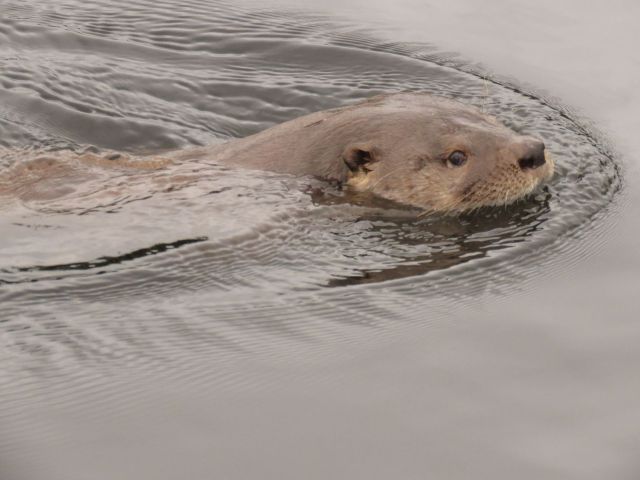
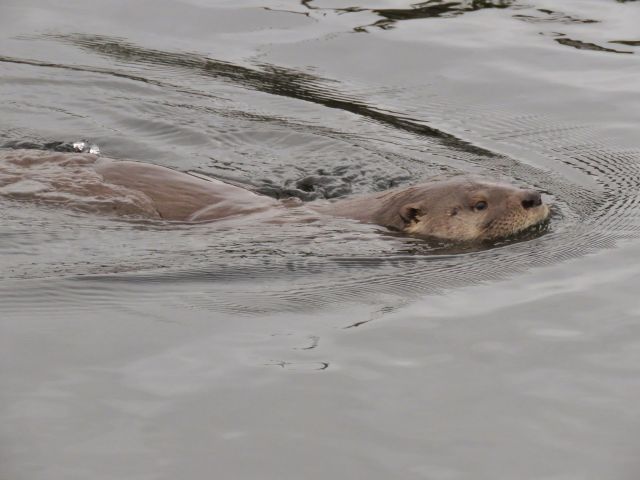
As we are nearing the wider part of the river Fernando, who is a master at navigating this river by the way, begins to throttle the engine up since we are leaving prime otter territory. Ahead of us In the distance I see a ripple and a small shape poking above the surface of the water. I half stand and point while saying “what is that”? Rafa looks in the direction I am pointing and declares, “it’s an otter”. The otter is swimming in our direction so Fernando slows down to see what the creature will do. In the mean time Rafa who is smiling widely high fives me and Paul who really wanted to see an otter says “way to go Nancy”.

Southern River Otter. Hurray!

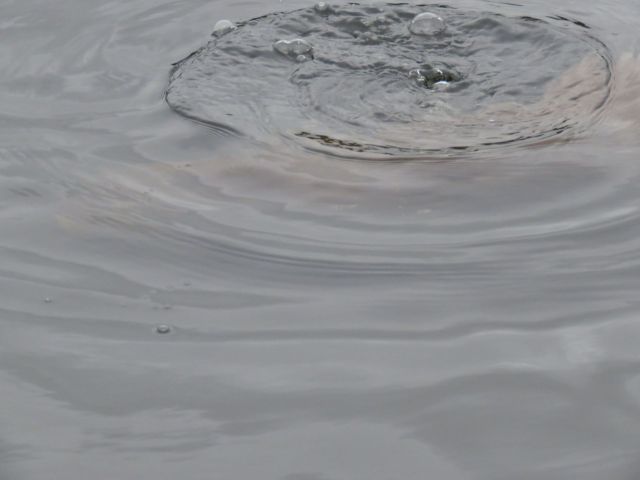
What happens next is unusual according to our guide. The inquisitive otter swims to our now idle boat and begins a game of hide and seek. Fernando begins to “talk” to the otter and the sound he makes is similar to the grunt of a pig. The otter will surface, take a look at us, submerge, swim under or along the boat before coming up to take another look at these odd things staring at him. It is very hard to get a photo of the otter as he can disappear in an instant but that doesn’t stop me from trying.  Rafa is videoing the rare otter with his phone and we all, (well not Fernando), are walking from side to side and end to end to try to keep tabs with our sleek visitor.  At one point the cheeky fellow stands halfway up out of the water but I didn’t get the photo of that either darn it. The otter is grunting himself part of the time and Fernando’s imitation of the otters’ voice is really good.

Often when I would click the shutter this was the result

The otter swimming by the side of our boat

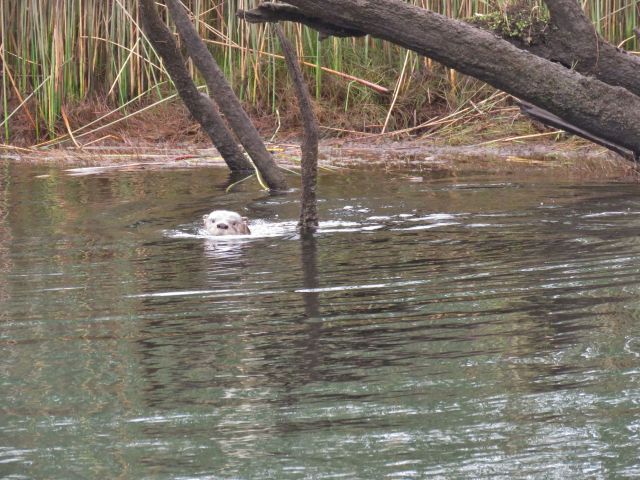
I’m not sure how long our curious visitor stays, several minutes for sure, but eventually he retreats to the other side of the river. The otter swims behind a bush and comes almost completely out of the water as he peers through the branches at us. We get a final look at the little fellow as he begins swimming down the river. We all have wide grins on our faces as Fernando fires the boat up and we speed back to the dock. Rafa has told us that the best estimate is that only two or three thousand of the river otters are left. Hunting, habitat destruction and the American mink are some of the reason these personable creatures are disappearing. How did the American mink get here? People brought them in of course and the mink thrived, competing for the same food the otters eat.

The otter after he left us behind

Once we dock, we thank Fernando for the great time we had and clamber up to the walkway. As we approach the tiny parking lot, (there is room for about eight cars), we are astonished to find that our vehicle is blocked in by another row of cars. Rafa goes to see if he can find the “parking attendant” in hopes that he has the keys for the car parked behind us. Nope, he doesn’t have them and evidently isn’t very concerned that we are stuck. There are some people walking down the road to the dock and we hope that they are the owners of the car but they aren’t. A boat docks a little while later but they aren’t the car owners either. Rafa and Paul speak with another man and they look at the raised walkway that borders the small parking lot. Paul walks off the width of the walkway and compares it to the width of our vehicle. The three men huddle together and they agree that it might be possible to drive forward onto the wooden walkway far enough and then to maneuver our car to the walkway that is parallel to the car blocking us.

I retreat across the road with several other people who are beginning to take an interest in what is transpiring here. I left my camera in the car darn it but half the time I can’t bear to watch as Rafa drives the car forward, (did I mention that the walkway is elevated from the parking lot by a foot or so?), then cranks it to the left and maneuvers the two left tires onto the parallel walkway. Paul and the other man help direct Rafa in this amazing escape plan while the spectators, including me, are laughing and shaking their heads. At least one person is filming the spectacle with his phone. There is probably a YouTube video out there somewhere. Much to my amazement, Rafa, extricates the car from what looked like an impossible situation. Paul and I climb in the car laughing and shaking our heads at our capable and determined guide. We are due at Fernando’s family restaurant and that is one reason Rafa was so determined to get the car out. He also said that people often take a boat to a beach on the river so they could be gone all day.

Rafa outside Fernando’s family restaurant

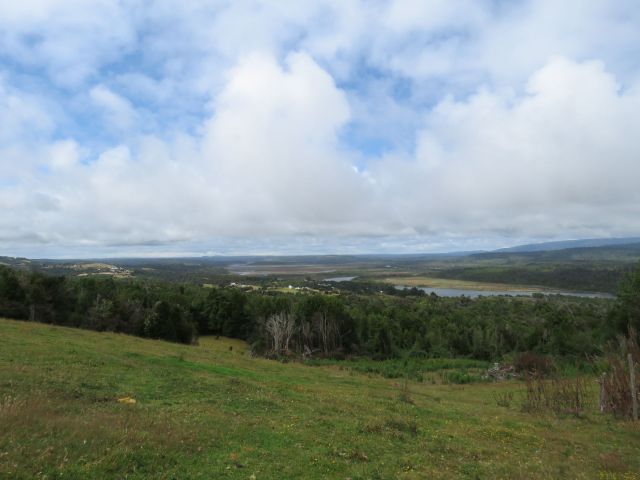
Beautiful view of the Chepu River valley from the yard of the restaurant, the clouds are breaking up.

We have a wonderful meal at the restaurant, delicious chicken, potatoes and green salad but as usual there is more food than I can consume. The restaurant sits above the Chepu river valley and despite the heavy sky the view is stunning. We do a little bird watching from the yard of the restaurant after lunch and see three Chilean Flickers that are clinging to some dead trees in the distance. On our drive to Castro we see a flock of Slender-billed Parakeets flying in front of us. We have seen these parakeets before but the difference this time is that the noisy birds land in a grove of trees right next to the road. Rafa stops the car and we finally get a really good look at the colorful birds as they feast on the fruits of the trees they have landed in.

Finally the Slender-billed Parakeet lands in trees close enough for us to get a good look at them

The entrance to the Palifito where we stayed

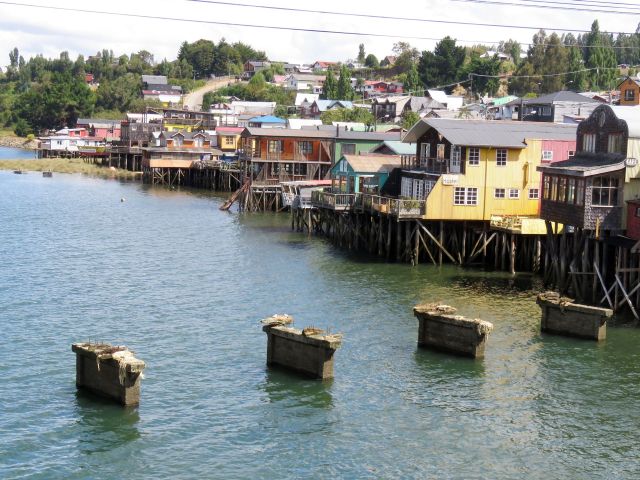
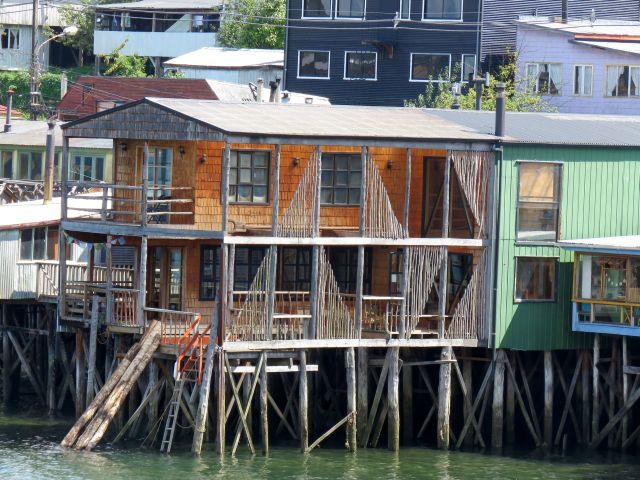
Rafa drives to the hostel Palafito Waiwen our abode for tonight. It is really a cool place. There is a whole row of these houses on stilts which allows them to sit over the water when the tide comes in. These Palafitos were once fishermen’s’ houses making it very convenient for them to step out of their stilted houses right into their boats. The Palafitos are now hostels and hotels. We take our luggage to our room which is small but adequate. Rafa is waiting for us when we go downstairs and we proceed to walk to the town square which is probably a mile away.

Palifitos lining the edge of the fjord.

The brown double decker is where we stayed

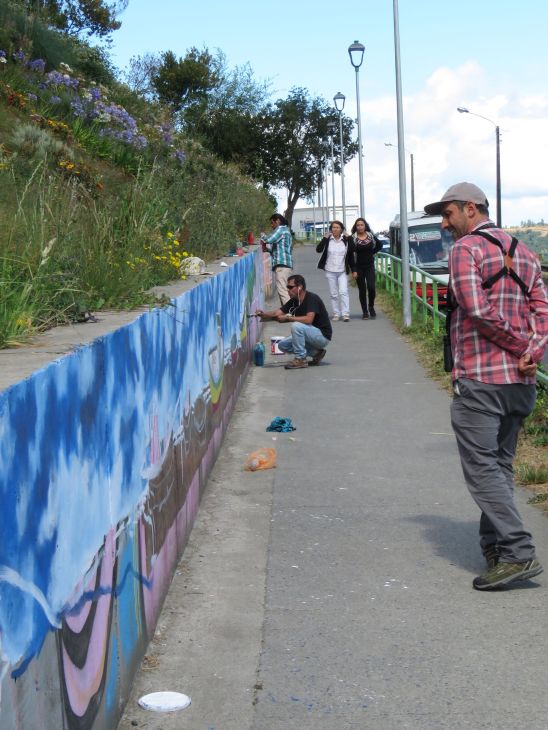
Rafa looking at a work in progress as two artists are painting scenes over the graffiti.

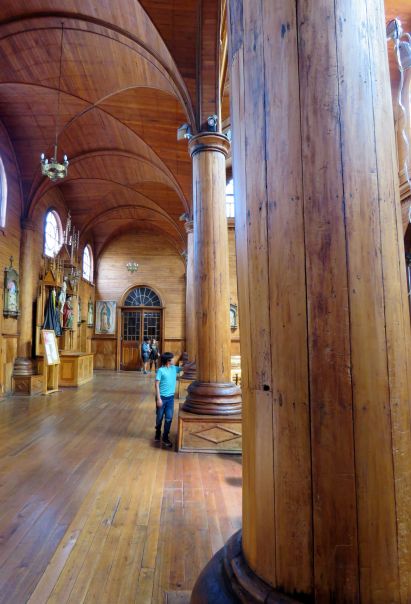
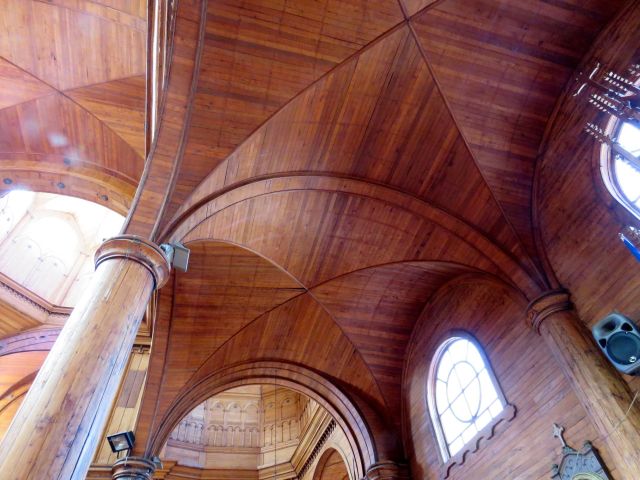
Our main purpose is to visit the San Francisco church, another wooden church but this one is designated as a UNESCO world heritage sites. Once we near the square you can’t miss the brightly colored church as it towers over the lovely park. The town square is filled with people enjoying the sunshine and each other. Yes, the sun has come out and it is quite warm. The three of us go inside the church where Paul and I marvel at the intricate work that is all made of wood. The huge wooden pillars fascinate me and the multiple arches are beautiful. I sit down on a wooden pew later to just soak in the beauty around me. Paul and Rafa peruse the posters that are set up in rows that are explaining the history of the church, (there are English versions clipped to the side). I take several photos which is allowed as long as you don’t use a flash.

Beautiful San Francisco church in Castro

Incredible wooden pillars.

Lots of shapes in this photo

We take our leave of the beautiful church and Rafa points out a super market to us as we want to buy something for supper. Rafa then leaves and Paul and I go into the market to purchase some bread from the bakery, sliced cheese and water. At first the women at the cheese counter try to sell us a big chunk of cheese but after using hand gestures indicating we want something much smaller the friendly women hold up some sliced cheese. We vigorously shake our heads yes at them. This is exactly what we are looking for. We have fruit left from one of our boxed lunches so the apple and a sandwich is all we need for dinner. We enjoy our supper in the community kitchen/dining area. Afterwards I go out on the deck and take photos of the wonderful views and birds. I really like this place.

Shot from the deck of the Palifito

Brown-headed gulls perched on a picturesque boat

Partially built wooden boat just across the fjord from our Palifito

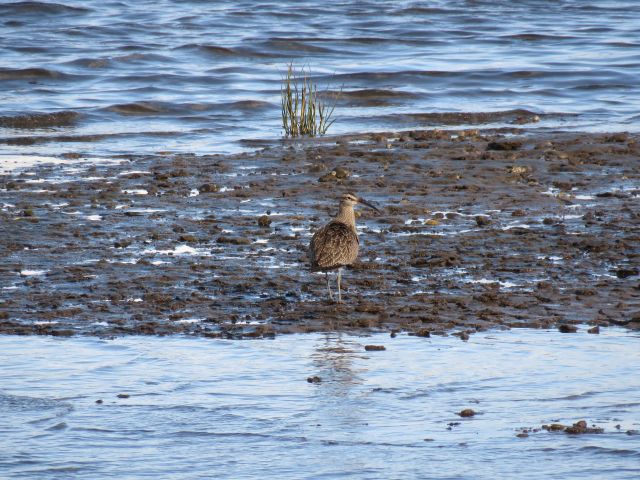
Whimbrel looking for food on a mud flat

There is an email from Dr. Amy tonight saying that Taz has slightly improved but now she is running a high temperature which doesn’t make sense to our vet. Dr. Amy is beginning to think that it isn’t the diabetes that is to blame for Taz’s illness but something else entirely. I write back and thank her for keeping me posted and again let her know I trust whatever decision she makes about my big black cat. I also let her know that we will be off the grid tomorrow and most of the next day. I have a flicker of hope for Taz but know her condition is still very bad.  Nancy


CHILOE ISLAND, BLOG 2

Chiloe Island, blog 2

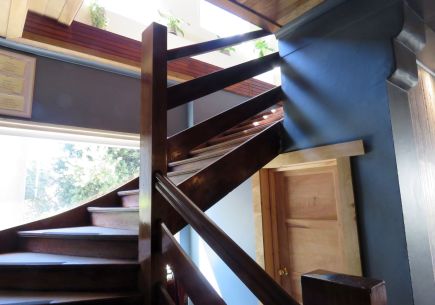
The neat staircase that led to the rooms at Mero Gaucho

Paul and I both slept amazingly well last night. The bed was very comfortable and if there was street noise, we both slept through it. Breakfast was to begin at 7:30 but we are downstairs before then and the food is already laid out. There are a couple of types of cereal, yogurt, fruit, all kinds of bread, but best of all an apple pie. A woman asks if we want eggs but neither of us can handle eggs in the morning so we decline. I must say the apple pie was outstanding. Hey, I am on vacation.

We return to our room, brush our teeth and haul our luggage downstairs. Our guide is waiting for us in the lobby. Over his camo jacket he is wearing a pair of binoculars. I think I see a glimpse of approval as he notices that both of us are sporting binoculars too. He introduces himself as Raphael but tells us to call him Rapha. We tell the receptionist we have enjoyed our stay, say goodbye, grab our bags with Rapha’s help and follow him to his car. The air is crisp but the sun is shining which is a great way to start off our Chilean adventure.

Paul insists that I take the front seat, thinking I can take better photos from here. Rapha tells us that we have approximately a thirty-minute drive to the ferry that will take us and the vehicle to Chiloe Island.  Rapha has no problem identifying birds as he is driving while also talking to us. Rapha stops by a marshy area where we look at swallows, Chilean swallows I think, plus two different kinds of ducks. He saw these while driving the car and I have trouble finding one of the ducks while looking through binoculars. Yep, I believe the staff yesterday weren’t kidding when they said Rapha is one of the best birders around.

As we visit with our personable guide, I notice that Rapha has a definite English accent. Whether it is today or the next I don’t recall but Rapha informs us that he is Italian. He was born in Chile and spent his first three years here because his father was a diplomat. After the coup in Chile, the family returned to Italy where Rapha lived until graduating college. A job brought him back to Chile where he met his wife and he has been living here ever since. So, while I have been spelling his name with the Spanish version it is really Raffaele but he prefers to be called Rafa.

Paul and Rafa as we begin our ferry journey to Chiloe Island

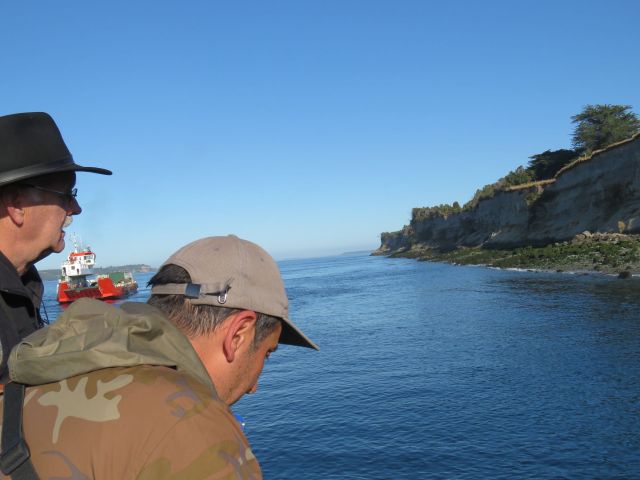
We arrive at the ferry where there are two lines of cars and trucks waiting to load onto the ferry. There is an old ferry and a fancy new ferry and we get waved into the line which is for the old ferry. I don’t care which ferry we are on as long as it gets us across the bay! Rafa encourages us to use the bathrooms and then go up top so we can enjoy the scenery and watch for birds. As we churn towards Chiloe Island, Rafa points out the beginnings of a bridge that eventually will span this water channel so people can drive to Chiloe Island instead of using the ferry. It will spoil the wide-open view that we are looking at right now which is kind of sad plus there is something romantic about taking the ferry.

Chiloe Island in the distance

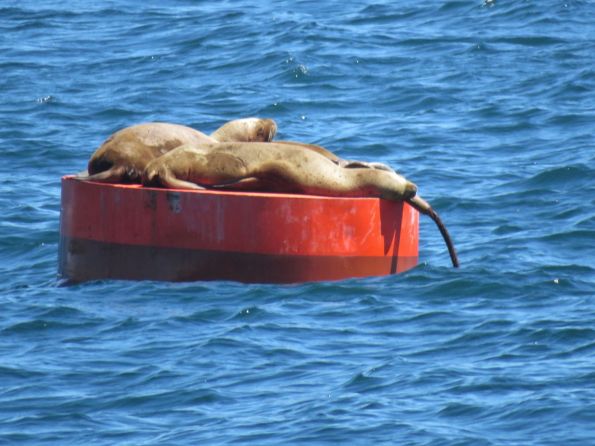
We enjoy looking at brown-hooded gulls and the larger Kelp gulls. Paul points at the water near the ferry and says what is that bird?  By the time Rafa and I look the bird has dived under water but it soon resurfaces. I can’t believe it, Paul has spotted a Magellanic Penguin. As we get near Chiloe, there are sea lions piled on the big red buoys that float not far from the shore. As the ferry prepares to dock, the three of us hustle back down to the car, evidently the ferryman don’t take kindly to drivers that might hold up the line. I kind of hated that our crossing was over so soon as the sunny day and calm water was very enjoyable.

Sea Lions lounging on a buoy

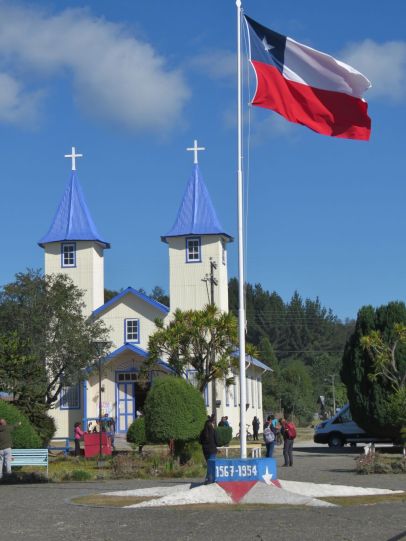
We leave the ferry and drive into the village of Chacao where Rafa tells us about the pretty blue and white church that was built in 1567. It, like all the churches here are built entirely of wood but some churches like this one are encased in tin to protect the outside wood from the elements and fire.

Pretty church in Chacao. One of Paul’s readers on safari talk commented how similar the Chilean flag is to Texas’ state flag.

A sample of the crafts people were selling

There is a wooden structure not far from the church on the edge of the water and Rafa sets up his birding scope as there are several sea birds in the area. Our binoculars are good but looking through the scope allows you to see incredible details of the birds. There are graceful Black-necked swans, a Black-crowned Night Heron, Whimbrels and more. Paul also finds a house sparrow, they are everywhere!

Black-crowned Night Heron

I will have photos of Black-necked swans later that look a lot more graceful than this one does

Our hotel for tonight

We leave Chacao and drive to Ancud to drop off our luggage at Hotel Mundo Nuevo where we are spending the night. Leaving Ancud, Rafa takes an alternative road, (gravel) and whenever we see a bird or anything of interest for that matter we just stop on the side of the narrow road. There is very little traffic which is quite nice since there is plenty of things to stop for.

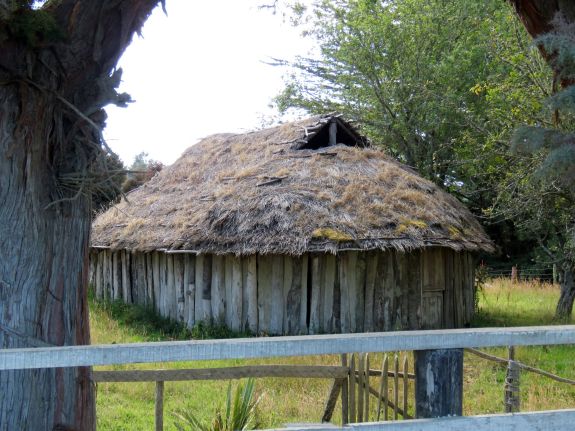
traditional house of the Huilliche people

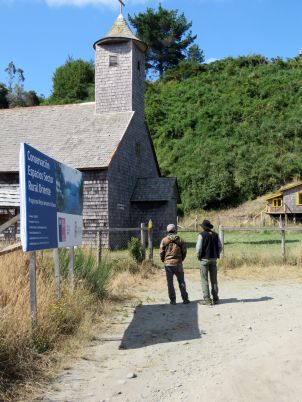
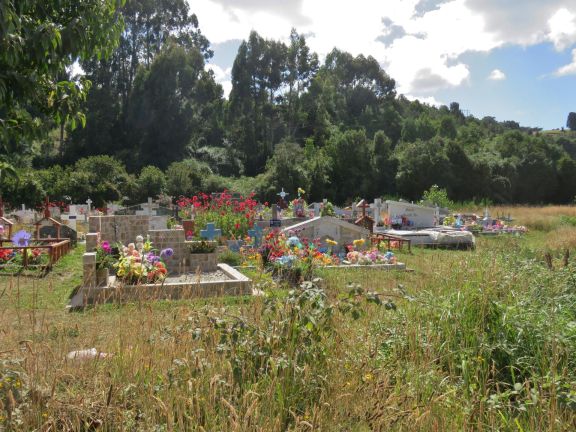
We pull over to look at a traditional house of the Huilliche people, I assume it is a reproduction and not an original structure but I can’t say for sure. We stop at another wooden church that is nestled cozily in the countryside. A cemetery is situated nearby where a riot of colorful flowers are growing by the gravestones. Chiloe has a lot of wooden churches and sixteen of them have been designated World heritage sites by UNESCO. Although the two we have visited so far are not on the list, they are still impressive.

Paul and Rafa admiring wooden church. Notice how the two men are standing in an almost identical stance. I notice this throughout the trip!

Cemetery and flowers

We pass a man walking beside a wooden cart drawn by two oxen which is something I didn’t expect to see here and in fact this is the only one we do see on this trip. A young woman is riding a bicycle just in front of the cart and Rafa slows the car down until we are just creeping along. He explains that he doesn’t want to cover the people in dust. I nod in appreciation at the thoughtfulness of our guide.

The only ox-drawn cart we saw.

Rafa stops on the edge of a larger town by a small private lake. The woman who owns the property runs a truck repair shop plus has a small store where she sells goods. Rafa says he always buys something there to keep in the owner’s good graces so he can continue to come and check out the bird life on the big pond. Paul and I wait by the car while Rafa goes to purchase some good will. He returns with a chocolate bar for me and a sprite for Paul. The chocolate is really good.

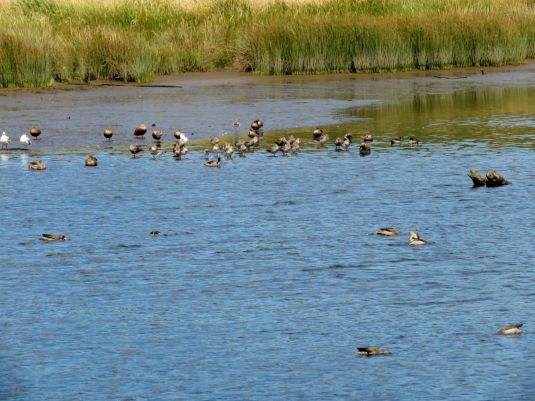
A few of the wide variety of birds we saw at the private lake

One variety of flower that were growing along the edge of the large pond

The pretty lake not only has a lot of bird life but various wild flowers are growing along the edges. For some reason I did not get very good photos here and could only salvage one flower photo and one photo of the waterfowl on the far side of the pond. There were Ruddy Ducks, Speckled Teal, sea gulls, grebes and coots. After we leave the busy lake, Rafa drives the gravel road next to the property looking for the Spectacled Tyrant that he knows lives here. He uses a call and on our second drive by the black bird, who appears to be wearing “spectacles” due to the large yellow outline around his eyes, lands on the top of a boulder. We get a good look at him through our binoculars but he is too far away for a photo.

Beautiful seascape in Punihuil Bay

We continue on until we arrive at Punihuil Bay which offers stunning scenery. The small rocky outcrops and islands covered with flora randomly rise out of the bay. Rafa has a reservation for the three of us this afternoon to take a boat tour out to see the penguins who arrive here to raise their young. Most of the penguins are Magellanic but there are a few Humboldt penguins too. The Humboldt penguins are dwindling in number so if we see any of them, we will feel very privileged.

We have arrived early so we can have lunch at Bahai Punihoil restaurant which sits a hundred yards from the water. Our meal begins with empanadas, Paul has the cheese (due to his allergy to fish he is playing it safe) but I opt for abalone and cheese. The abalone is a bit chewy but as Rafa promised it has a mild taste and is not fishy. I could easily have managed with only the empanada as it was very filling. However, my hake arrives along with a lettuce salad, a huge boiled potato and rice. Paul has a pork chop with the same sides. The fish is very good and Paul says this is the best pork chop he has had in years. I take a bite and he isn’t exaggerating, the chop is tender, juicy and flavorful due to the fact that there is quite a bit of fat throughout the meat. I can’t begin to eat all my food and this will be a constant throughout the trip. Rafa forgoes a main course and eats a couple of more empanadas.

A boat equipped to go out for Abalone. The fishermen go under water up to 60 feet using the yellow air hose. Crab pots in the background

We still have some time before our boat excursion so we take a stroll along the beach. We watch as the fishermen load a tall wheeled cart with customers and then push the cart into the water to reach the touring boats. Rafa explains that fishermen run the penguin tours plus the families also own the restaurants such as the one we dined at. The government does have rules they must follow such as only two boats allowed around the penguin colonies at once and the boats can only stay out for 30 minutes. It looks like a pretty sweet deal for the fishermen, tourists and penguins who likely are protected by the fishermen because of this business.

We watch as tourists are wheeled out to the boat that will take them to the Penguin colonies

Once our allotted time rolls around we don life jackets and walk to the awaiting cart. I snort with laughter when I see Titanic III printed on the back of Paul’s vest. Rafa half seriously says don’t ask what happened to the first two Titanic’s. This is another thing we are discovering, Rafa and the Chileans have a delightful sense of humor. The three of us crowd onto the cart with other customers and soon we are stepping onto the motor boat. One of the passengers offers me a helpful hand which I am more than grateful for.

Paul with other tourists on the Titanic III

Lovely scenery

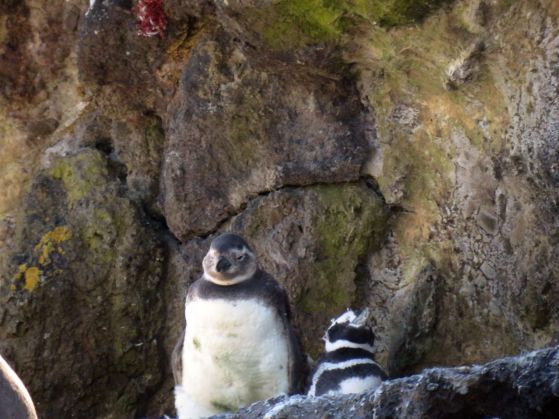
The water is fairly calm and we motor towards the small islands that the penguins call home. It is easy to identify the Magellanic penguins as they have two black bands, one around their neck and the other band across their chest. Humboldts on the other hand have only one band. However, many of the tuxedoed penguins are in molt so it is difficult for me at least to tell what they are. We do see a few Humboldt penguins among the myriad of Magellanic. Hurray.

Magellanic Penguin

Humboldt Penguin on the left

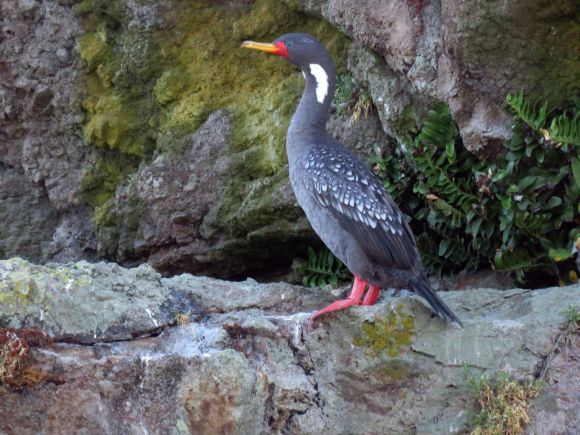
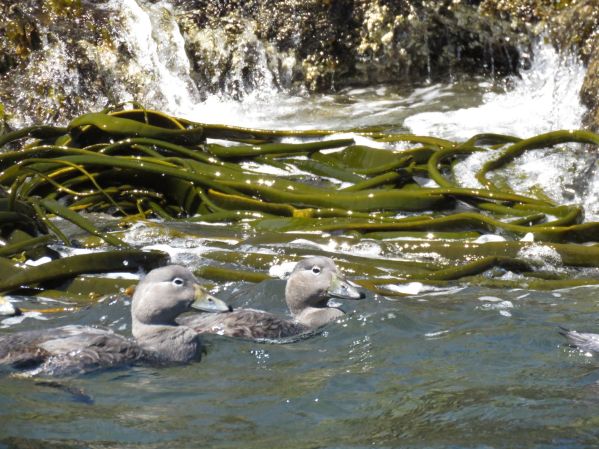
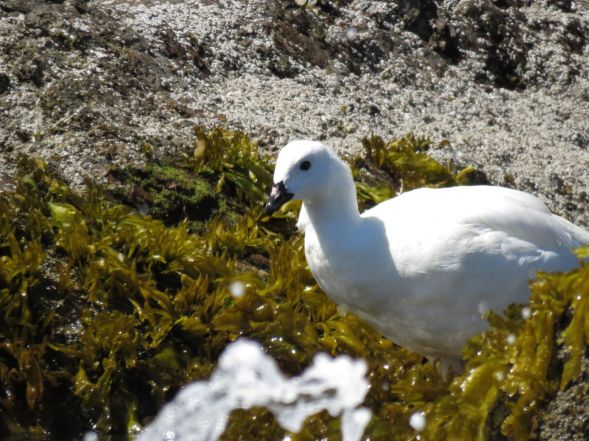
We also see other sea birds including the Red-legged Cormorant. A gorgeous bird in my opinion and I can’t get over the tattoo like markings around the birds very blue eyes. There is a Kelp goose whose mate can just be seen in the rocks above the water probably sitting on a nest. A group of flightless steamer ducks bob on the surface like corks, there webbed feet must be treading busily beneath the water to keep them from ending up on land. We were introduced to these ducks in some of the books we read on Patagonia when the authors wrote about how the sailors would hunt the ducks for food but they were almost inedible. For those of you who enjoy a well written book may I recommend This thing of Darkness by Harry Thompson. It is a historical novel about Captain Fitzroy and the journey of the Beagle with Darwin on board. Paul and I could hardly put it down.

Red-legged Cormorant, they have the coolest eyes

Flightless Steamer Ducks

Kelp Goose-glaringly white which my camera doesn’t like.

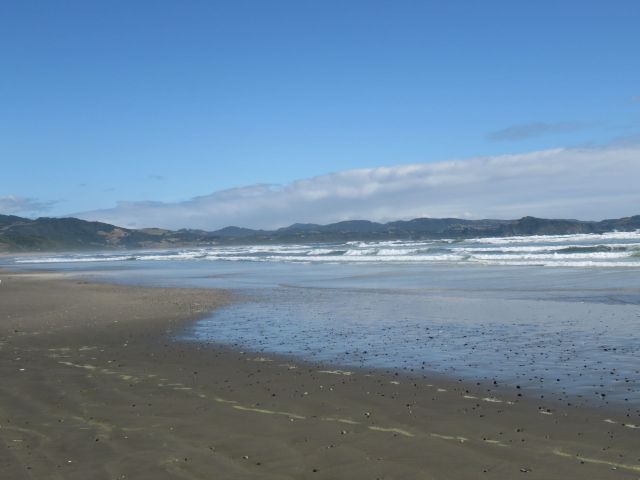
Our thirty wonderful minutes have come to an end and we clamber back into the ingenious cart to be pushed back to the beach. We leave the bay and Rafa drives us to a windy stretch of beach where he often sees the Snowy Plover. The small wader isn’t to be found but we enjoy the wildness of the beach as the waves from the Pacific pound the shore. Rafa informs us that the Swiss, a company I assume, are trying to get permission to build wind towers off shore here due to the reliable wind. Sigh, it is so beautiful here plus wind towers are so deadly to birds that I can’t imagine the toll they would take on the birds that call this home.

Wind swept beach

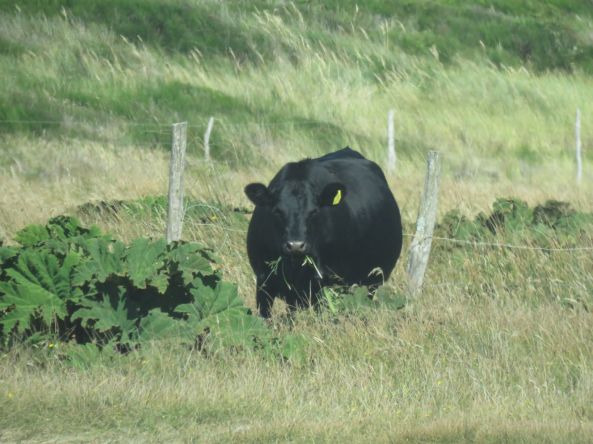
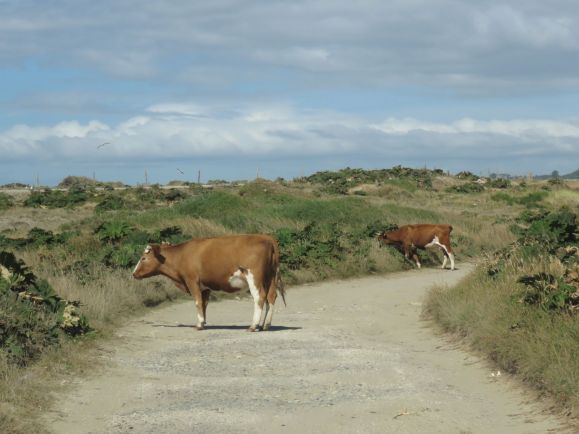
It is pretty hilarious when we drive away from the beach, as a big Angus cow with a yellow ear tag is standing by the road staring at us. Our fall cows sport yellow ear tags and this cow would fit right in with our herd. There are also red and white dairy type cattle that are the most prominent cattle in this area. Rafa tells us their Spanish name is Clavel Rojo and they are a cross between Holstein and Friesian, used for milk and meat. We have also seen Charolais, Simmental and Hereford.

That is one good looking Angus cow. Look at the size of that rhubarb!

Holstein-Friesian cross that was predominant in this area

It is time to return to Ancud and our hotel. We do stop to look at drying seaweed by the road. The locals harvest and sell the dry seaweed which can be used in soups, etc. and is also added to various cosmetic and skin care products. Rafa has also educated us about the invasive bush called Gorse. It is one nasty plant; thorny and impenetrable whose roots are six feet deep making it nearly impossible to control. Unfortunately, we have driven through areas where the bush has nearly taken over the fields. Ah we humans never think about the consequences when we introduce non-native species to a new place.

Drying Seaweed

The invasive Gorse. Nasty stuff.

We arrive at the hotel at six o’clock where we thank Rafa for a terrific and educational day. Paul and I eat at the hotel restaurant and share another barbecue sandwich which is very good but not quite as good as the one we had last night. We also enjoy a refreshing Chilean beer. A great way to end a terrific day. Nancy

Sunset on Chiloe. I took this photo through the window in our room.


CHILE, BLOG 1

Chile, part 1

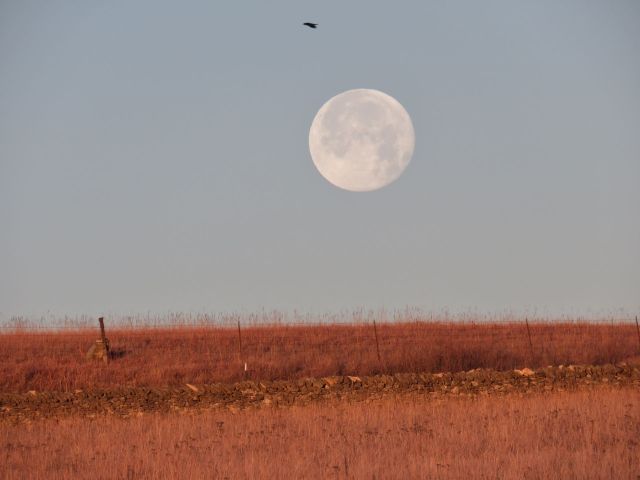
Since I have no photos for the first part of this blog I thought I would share the setting moon in December at Rock Hill Ranch

When we returned from Africa this summer our hopes of traveling to Egypt in 2019 with OAT were dashed as all their Egypt tours for 2019 were already full! In fact, we were lucky to get a spot in one of the OAT tours in 2020. When the Egypt trip for us and our good friend was confirmed the countdown to our departure date was over 600 days away. Well that did not set well with Paul who decided that we had to plan another trip to take in 2019. Have I ever mentioned that I married into a family that are travel addicts!

With Chile/Patagonia in mind, partly due to some incredible photos Paul had seen on Safari talk, Paul began researching for information about this area on the web. Paul, unlike me, can spend hours on the web and while doing research on Chile he stumbled upon a tour company called Swoop Patagonia that caught his attention. Paul liked what the English company offered for Patagonia and esp. that they would put together a private tour focusing on the things you were most interested in. Paul encouraged me to read about the wildlife and landscape found in Chile on Swoops’ website and I agreed that it was intriguing. I wasn’t real sure about the guaranteed windy conditions or the possibility of seeing every type of weather in one day in Torres del Paine, but the birds and wildlife possibilities won me over.

This sculpted snow was the result of high wind and snow we had in November

Paul contacted Swoop and the planning for a February trip began in earnest. We were told that it was very late to be booking for February (when we would be able to get away) as this was the high time for tourists in Chile. Most people book a year in advance esp. for the Patagonia area. So, we were asking this company that specializes in Patagonia to put a tour together in less than four months. Chloe took up the challenge of coming up with a tour following Paul’s suggestions of what we would enjoy. Chloe proved to be up to the task when a few weeks later she had put together what looked to be an incredible adventure. Chile here we come.

We are two days from winging our way to Chile and the weather looks as if it could be a problem as the day we leave the forecast is for freezing rain. The day before our flight Paul and I take our diabetic cat to a pet boarding place in Manhattan. We say goodbye to the loudly protesting Taz and go to run some last-minute errands. We arrive home before three and check the weather again. It hasn’t changed much for us but the forecast for KC is much worse. We waffle a bit wondering if we should leave this afternoon when an email from Paul’s cousin arrives in which he writes that if it was him he would leave now. The advice from the well-respected cousin helps us decide to do just that. We are already packed but we have a “things to do before we leave the house” list that we rush through and an hour and a half later we are motoring towards Kansas City.

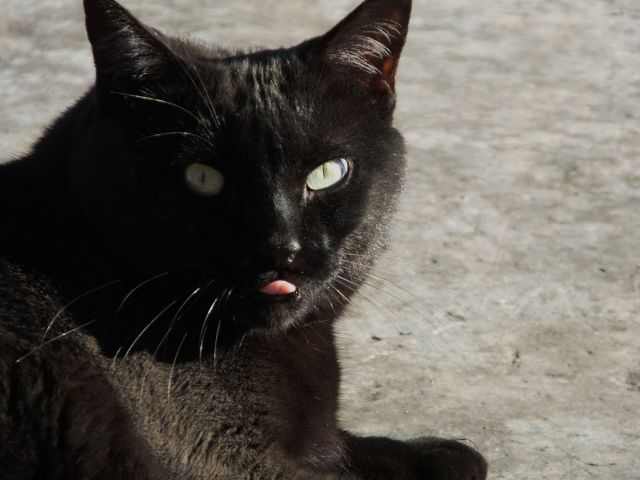
Taz our diabetic cat who has to be boarded when we are gone because she needs insulin shots!

We get on the turnpike at Topeka and once we pass Lawrence there are flashing signs at intervals cautioning motorists to watch out for ice on overpasses and bridges. Upon reading this information we call Air Park Express, where we will be leaving our car, and ask the very helpful woman who answers the phone about hotels close to them and about road conditions. It turns out there are lots of hotels to choose from within a mile of the facility and she gives us the exit to take off of I29 to get to the hotels. She also says that the roads were okay when she came to work about an hour ago but the forecast is for worsening conditions. Yikes.

The road conditions seem fine until we turn off the turnpike onto I435 and cross into Missouri. We soon begin to encounter the “worsening conditions”. There is snow blowing across the highway for a short distance, then we drive through some freezing rain, then there is an area where snow has blanketed the fields but the road seems to be okay. It is getting dark when we turn off on exit twelve and we breathe a sigh of relief since we made it without incidence. We nix the first hotel we stop at after looking at the room but find a Comfort Inn a block away and say this will do. There is no restaurant but Paul finds a vending machine in the lobby and we have a package of crackers and cookies for supper.  I reluctantly agree to watch the KU vs KSU basketball game since there really is nothing else to do and I am stunned when my team, K-State beats Paul’s team Kansas. Sometimes miracles happen!

The next morning, we go down for breakfast and it appears that the bad weather that was forecasted for last night never materialized. Cars and trucks are zooming by on I29 and Paul walks outside and says there appears to be little in the way of ice. After we eat, Paul goes to exercise on the hotels treadmill and I walk the hallways and stairs of the hotel. After all we will be sitting for hours on a plane before long.  We shower and laze around since we don’t have to check out until noon. I happen to look out our window just past eleven and tell Paul things have changed. Ice is building up on the windshields of parked cars and patchy ice can be seen on the asphalt. Shoot.

We carry our luggage downstairs and check out. Paul goes to get the car but due to having to scrape the thick coat of ice off of our windshield it takes him awhile to arrive at the door to load our luggage. Paul drives slowly and safely to the car park and then gives our keys to the attendant. There are two other people waiting for the airport shuttle who were driving on the highway just now. Both of them witnessed accidents along the way including one where a jeep slid across the highway barely missing a school bus. We encourage our shuttle driver to take his time as we pass some vehicles that have slid into the ditch. Our driver delivers us to the American terminal and now we have to hope no flights will be canceled. Our flight isn’t until three-thirty so I nervously look at the departure board now and then and am so grateful every time I see, “on time” next to our flight number.

More snow sculptures from the November storm

We arrive in Dallas a bit late but we have plenty of cushion time before our flight to Santiago. The jet is packed full with lots of people traveling with children but all is fairly tranquil for the duration of the flight. I manage to sleep four hours of the nine-hour flight but Paul only slept for a couple of hours. We arrive at Santiago a bit late but again we have plenty of time before we have to board our flight to Port Mont. Thank you Hillary for making sure we had adequate time between flights!

There is nothing that gives Paul and I more relief then walking out of the baggage claim area and seeing someone holding up a placard with the name Paul Miller written on it. The pretty young woman greets us with a smile and hug, then apologizes for not speaking much English. We apologize for not speaking any Spanish and follow her to the car. We are only 20 minutes from Puerto Varas where we are spending our first night in Chile. The young woman does point out the stunning trio of volcanoes, in which two of the cone-shaped mountains dominate the skyline. The most eye-catching volcano, Osorno, is the proverbial conical shape and snow-capped, while the middle volcano, Tronador, sitting far in the distance is also sporting a snow cap. The monstrous volcano Calbuco, on the left has no blanket of snow and we find out later that this volcano last erupted in 2015. Let us hope that this active mountain is not thinking about blowing its top any time soon.

Osorno on the left and Calbuco on the right.

Our driver parks the car and escorts us to the hotel, Mero Gaucho, where we are staying tonight. I already like this place because it has birds painted on the outside wall. The owners have turned this 1930’s house into a very attractive hotel. The floors are wood, (original floors I’m pretty sure), as are many of the walls, a beautiful staircase leads up to the small but adequate rooms, (our room has a wonderful terrace) and someone is a very good interior decorator as the lobby is very appealing.

A really poor photo of our hotel.

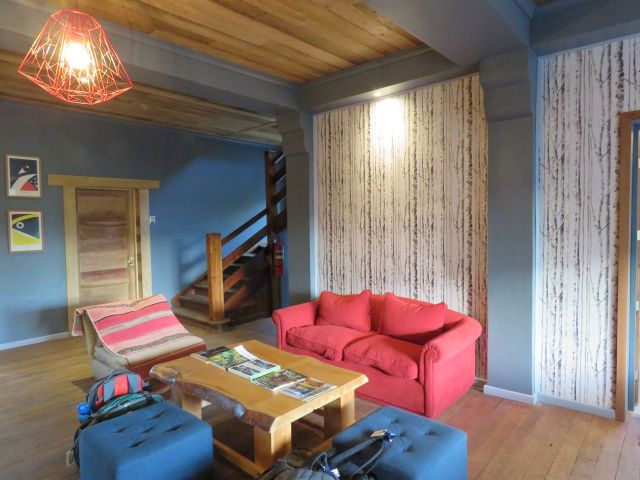
Mero Gaucho lobby

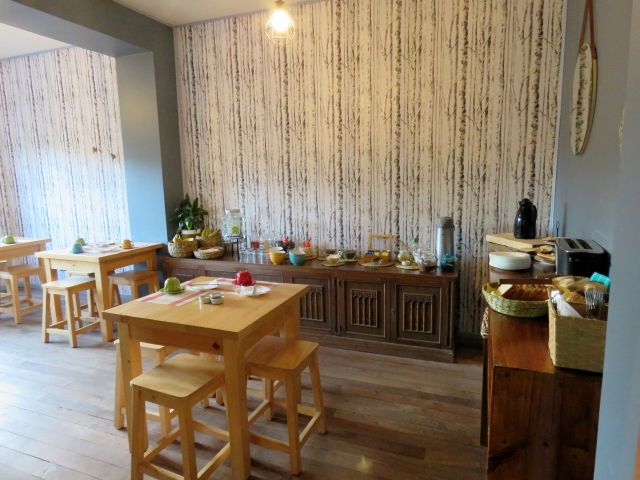
Breakfast area

After checking in with the friendly receptionist and depositing our bags in our room we decide to check out the small city of Puerto Varas. The receptionist has drawn suggestions of where to walk to see historical buildings, where some good eating places are, among other things of interest but we forgot to take the map along so we just wander. We first walk to Lake Llanquihue where the three volcanos serve as a backdrop. The view is just breathtaking with the deep blue water, the snow-capped volcano and the bright sunlight which accents the whole scene. The people we meet often look us in the eye and say “Ola” plus when we are crossing streets the drivers stop and politely motion us to cross. Wow, in every other South American and Central American country we have visited, crossing the street is a “run for your life” encounter as pedestrians get no respect.

Paul poses on our way to Lake Llanquihue

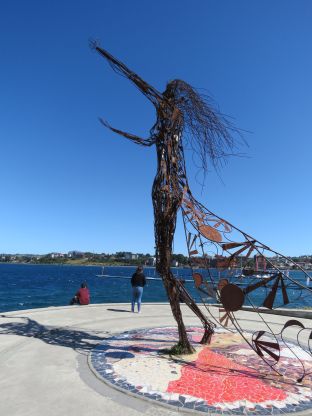
An interesting sculpture

Paul and I do find one of the restaurants our helpful receptionist suggested, The Daruma Tea House. We decide to share a barbecue pork sandwich and what a great choice we made. The meat is melt in your mouth tender and it is topped with a creamy coleslaw. A bit messy to eat but as good of a sandwich as I have ever had. Paul wants dessert and after agonizing over all the choices of delectable pastries on display, he settles on a piece of cake which the waiter explains is a special German recipe. I have a couple of bites and it is quite good.

Look at the size of these roses!

After our early supper we happen to walk by the office of Bird Chile which is the company that will be driving and guiding us for the next few days. We walk in and introduce ourselves to the young women that are in the office. We end up shoring up our plans for tomorrow and find out that the owner of Bird Chile is going to be our guide. Well all right!

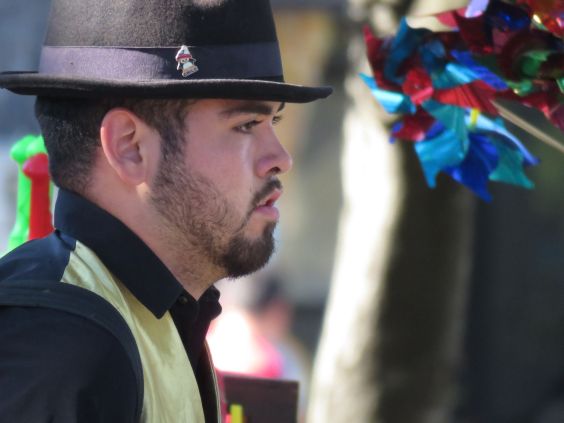
A close up of one of the drummers.

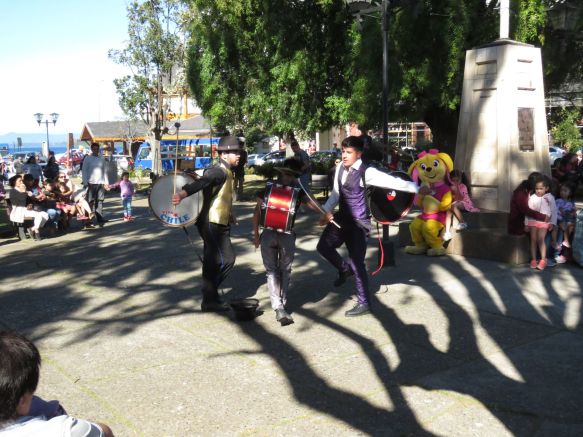
As we are heading back to Mero Gaucho, the sound of drums catches our attention and we turn left instead of right to search for the drummers. There is a small park where a trio of men are putting on quite a show. I wished I had taken video because the performance of the drummers was just incredible. The men, well two men and a boy,  beat out a tempo on the drum carried on their backs while spinning in an ever-tightening circle. A strap attached to their shoes would crash cymbals together whenever they placed their heels on the pavement. I have no idea how they managed to walk a straight line when they finished with their pirouetting but they did. It made me dizzy just watching them. Naturally, they passed a hat around at the end of the show and Paul gladly put money into it.

The trio of drummers that put on a heck of a show

The youngest member could spin like a top

We walk back to the hotel and prepare for our departure tomorrow. We both shower and are asleep by nine o’clock.

Next blog, Chiloe Island.


Saying Goodbye to Tanzania, blog 10

Saying Goodbye to Tanzania, blog 10

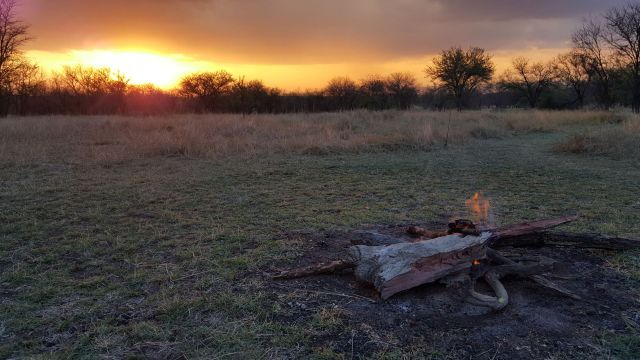
This is our last night at Njozi camp and we are treated to a beautiful sunset while sitting by the campfire. No rain!! The talented chef has prepared another wonderful meal for us.

Sunset and campfire. Jesse’s photo

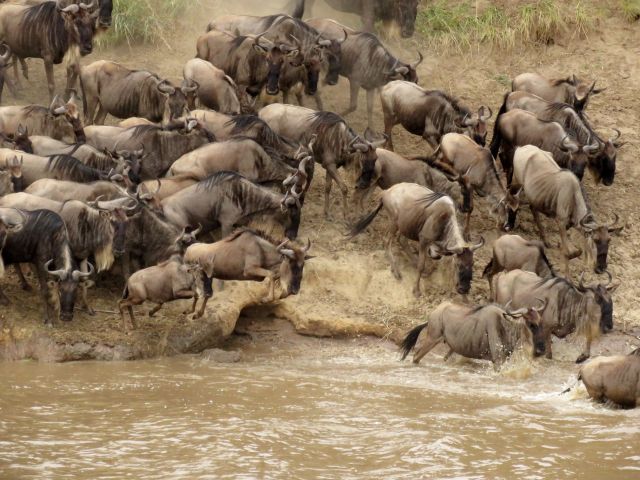
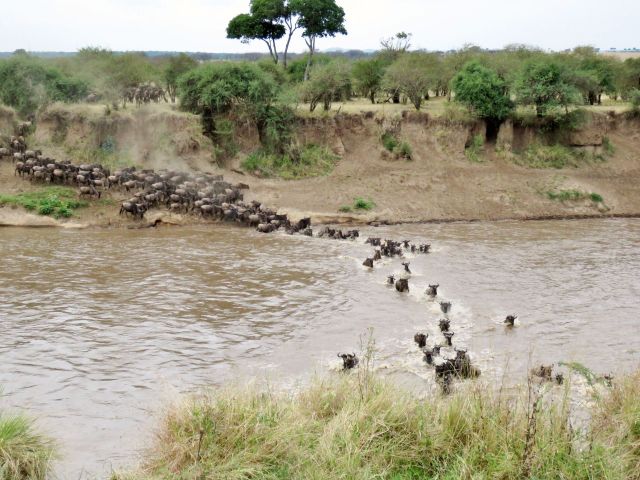
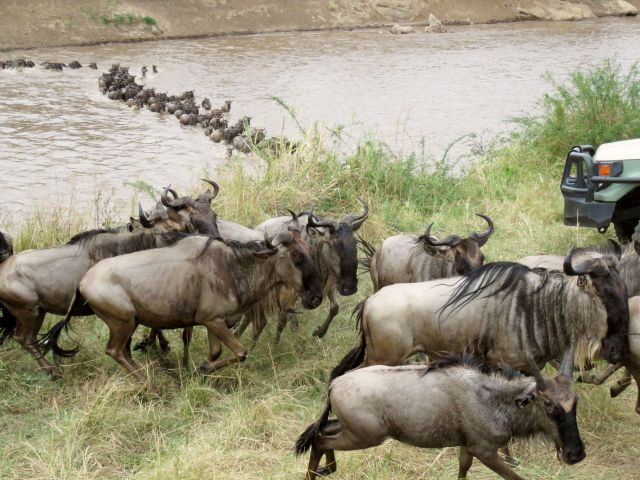
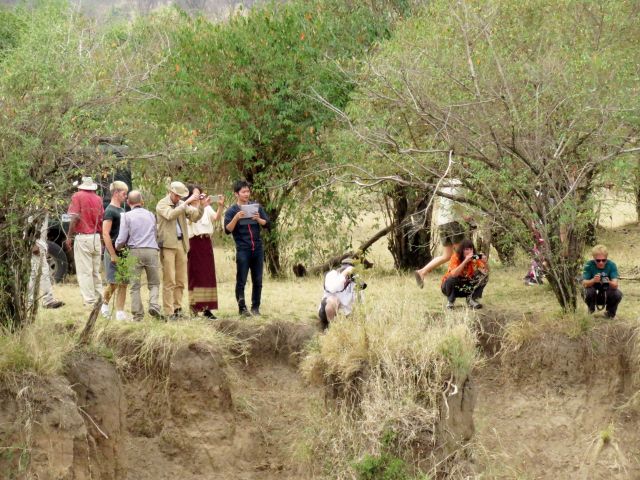
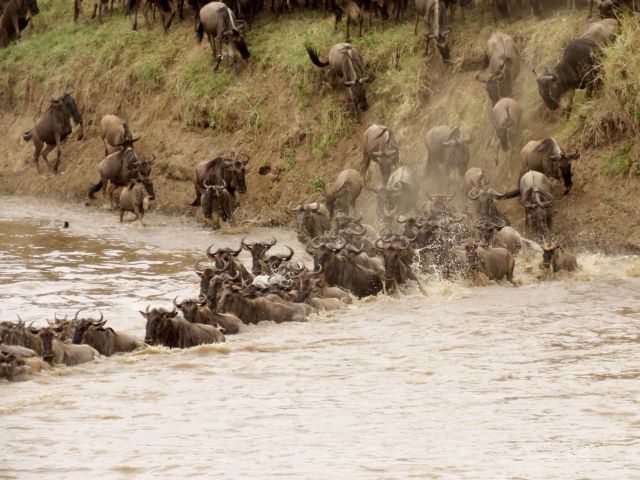
We have more discussions with Dave as we dine including what can be done about curtailing the crazy behavior of tourists at the wildebeest river crossings. A few ideas include raising the prices for tourists, fewer camps, (in the last Ang’ata camp there was actually light pollution from all the camps around us), allowing only so many vehicles to be at the crossings, barriers to keep vehicles from getting too close to the river, and maybe the most sure fired one would be to ban Wi-Fi in all the camps. Paul and I were amazed that all the camps this time had Wi-Fi as we have rarely had Wi-Fi on our past trips. Of course, what we think doesn’t matter and we suspect that nothing will change to take the pressure off the wildebeest.

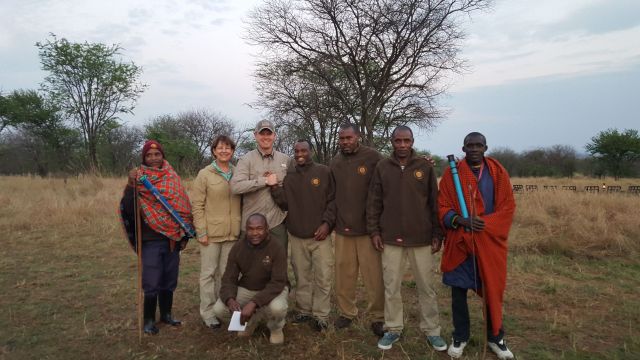
Paul and I heard the weirdest noises last night and we could not figure out what it was. No one else heard them including Dave. After breakfast the staff loads our luggage in the Toyota and we give our thanks to the staff along with the card/tip to Andre the camp manager. Jesse gathers the staff and hands out cloth uniform badges from his department (the badges are old ones that aren’t used anymore). The young men are delighted with them although the older Masai escort seems a bit befuddled as to what it is. The badge has a likeness of a bison on it and I wonder if the man can’t figure out what the animal is. Jesse asks for a photo of Jennifer and him with the entire staff. Once the photo session is over we clamber into the Toyota and George takes us on one last game drive.

Jennifer and Jesse with the Njozi staff. Jesse was a great ambassador on this trip. Everyone loved him.

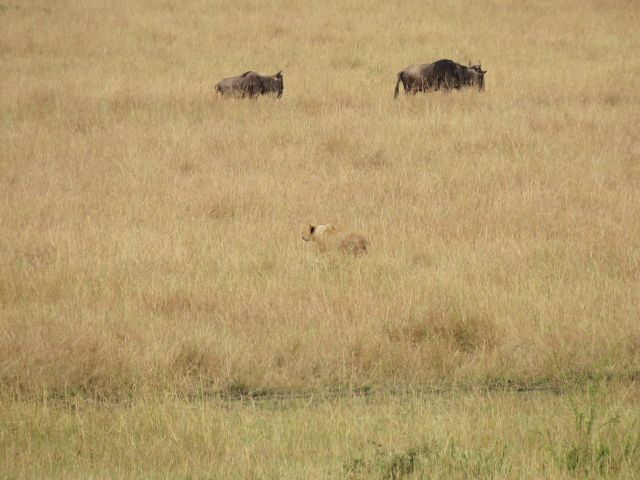
George sees a freshly killed wildebeest a few hundred yards from our camp, he noticed the dead animal because its exposed stomach was glistening in the sun light. Gross.  Now Paul and I know what we were listening to last night, the death struggle of the gnu and the feeding frenzy of the predators that killed it. Oddly enough there is no predators around the partly consumed carcass so we have no idea what killed the wildebeest. My best guess remembering the sounds Paul and I heard rumbling through the darkness would be lions but you would think they would still be in the vicinity. A mystery never to be solved.

Were the killers lions. We will never know.

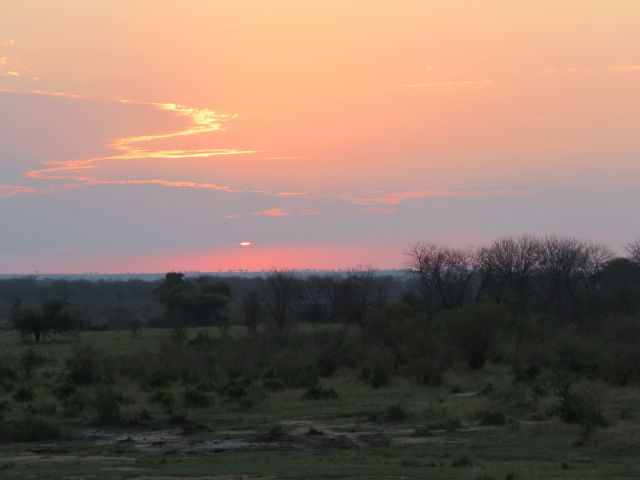
Impressive sunrise on our last morning in Tanzania

It is a gorgeous morning as we drive along the river and back to the kopjes that were so quiet yesterday morning. The countryside is even emptier today, in fact I only took a handful of photos and none of them are of animals. George drives us around the area for two hours and we just enjoy the solitude and scenery of the Mara River and the rugged kopje country. It gives us time to contemplate on the past two weeks in Tanzania and the spectacular things we have witnessed.

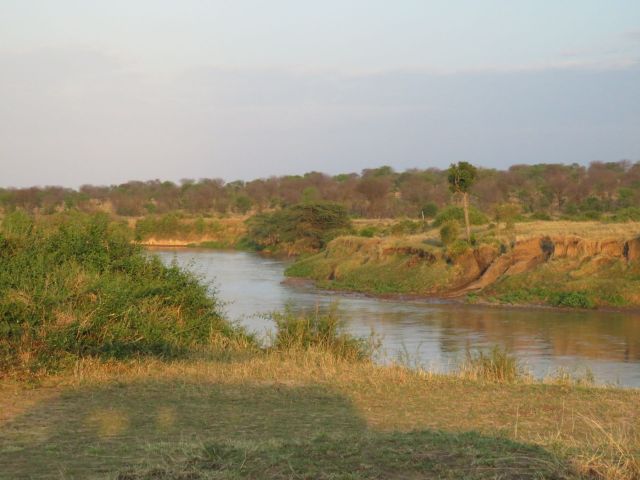
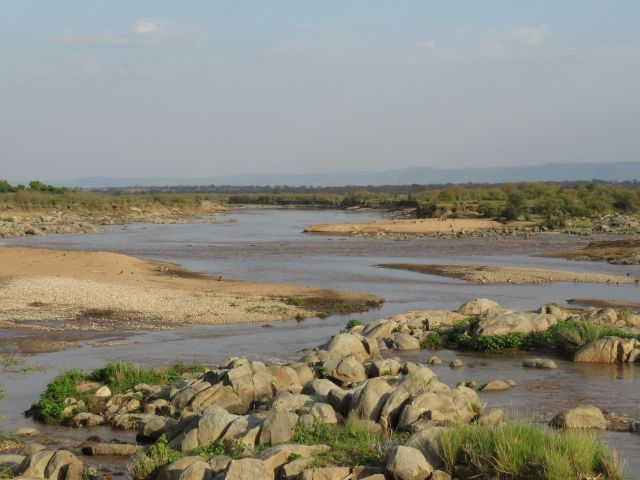
Very quiet along the river this morning

Along a very different looking stretch of the river. Nothing in sight

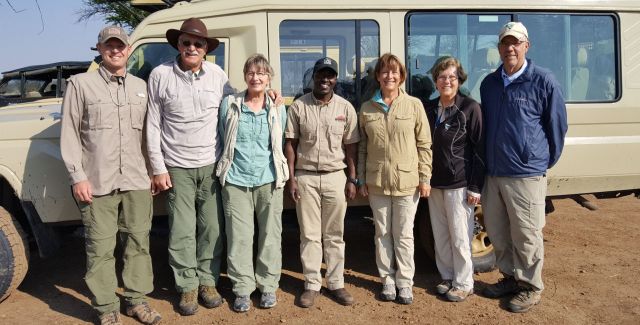
It is time to go to the airstrip but we need not have hurried as our bush plane is late. The dirt parking lot is full of vehicles delivering departing tourists or picking up new clients. There are small planes buzzing in and out of this one runway air strip but our plane isn’t one of them.  Poor George, he is anxious to get on the road as he has a long drive to Arusha where he will be united with his wife and children after an absence of a few weeks. All of us take a photo with our wonderful, kind, and ethical guide and then we ask another guide if he will take a group photo for us. We then give George the card with personal comments we have written along with our guides well-earned tip money.

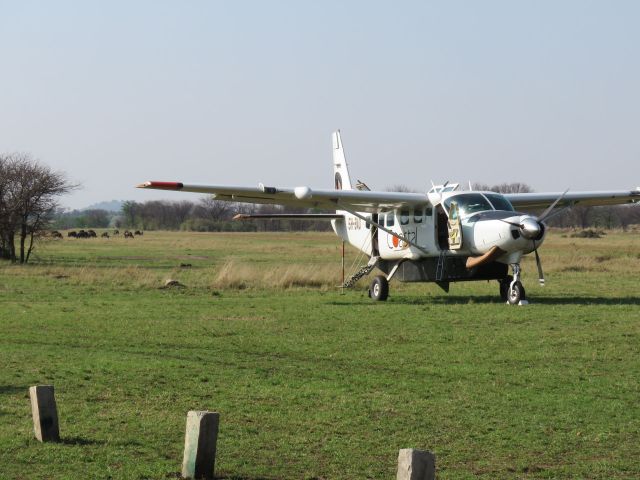
Wildebeest grazing near the airstrip. This isn’t our plane.

Group photo with George

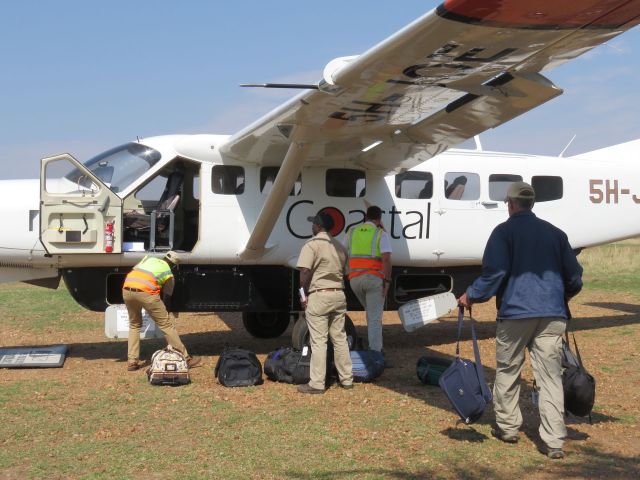
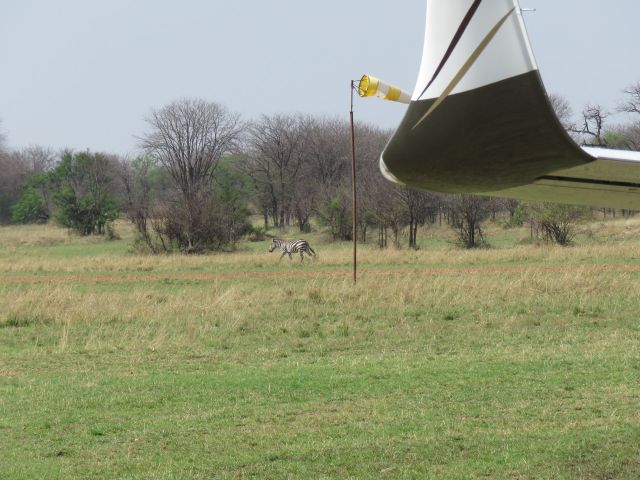
Eventually our Coastal plane arrives and George with Carl’s help begins trundling some of our luggage out to the twelve(?) seater plane. George then waves goodbye to us and returns to the Toyota. Soon the plane is ready for us and the other passengers to climb aboard. We are greeted by two friendly young men who will pilot the plane to Kilimanjaro International airport. The zebra that was loitering close to the airstrip when our bush plane landed has moved to the safety of the tree line and we are good to go.

Taking our luggage to our plane that finally arrived

Zebra walking across dirt airstrip

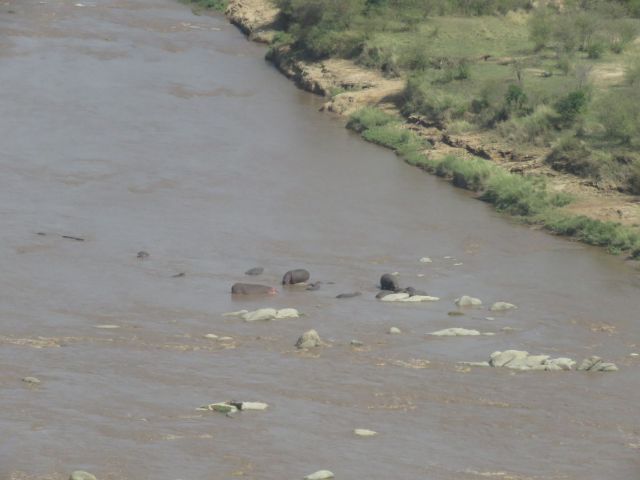
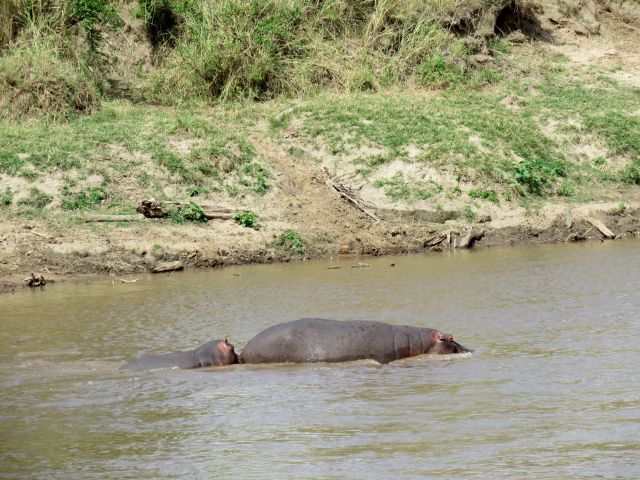
Earlier while waiting for the plane, I told Connie “don’t you dare cry because I will start crying too”.  I lose the battle once we are in the air and my tears begin to flow. I turn my head to the window, partly to hide my tears and also to take one last look at the Serengeti. We fly over the Mara River and I see some hippos through blurry eyes. I also see wildebeest and zebra peacefully grazing on the plains. Soon evidence of civilization begins to show up in the round huts of Masai followed by a large city which I assume is Arusha. Mt. Kilimanjaro’s snowcapped peak shows above the clouds and then we are landing at Kilimanjaro airport.

Looking down on hippos in the Mara River

Masai and huts

Farm ground and the edge of a city

Our tour company, Wild Source, has booked us day rooms so we don’t have to sit at the airport for several hours before our flight to Toronto. Kia Lodge is beautifully landscaped and I enjoy the multitude of birds that take advantage of the flowers, trees and bushes within the compound of the Lodge. We eat our box lunch that Njozi camp sent with us next to the swimming pool. Most of us walk laps through the beautiful grounds at some point during our four hours stay for exercise before the excruciatingly long flight home and then go to our rooms and shower.

Kia Lodge vehicle. Where is all that luggage going to go? Jesse’s photo

Eating our last box lunch in Tanzania

View from where we were eating lunch and one of the rooms at Kia Lodge, well there were two rooms in each of the round houses.

We climb into the Kia Lodge truck and the driver takes us back to the airport which is a five-minute drive. When we walk through the door the employees impatiently demand we show our passports plus proof of travel papers, then we are told to put our luggage through the initial screening machine. We walk around to retrieve our bags and a young woman thrusts a form at us and says we should fill it out as we wait in line to get our plane tickets. Paul and I have problems getting our tickets for some reason but finally the needed tickets are spit out of the machine. Geez, I hate this part of travel. We have to get our passports checked again, then our luggage goes through a stricter security check before we are free to go to the waiting area.

Maybe if I remember these tranquil scenes it will help get me through the chaos:).

The flight is on time and we get to Addis Ababa early. Instead of the horrid domestic terminal we had to wait in on our way to Tanzania, this is a typical international terminal with restaurants and shops and lots of people. There are several flights that leave from our gate within twenty or thirty minutes of each other so we get into the waiting line before we want too. As we shuffle along through the aisles formed by silver rails Carl quips that now we know what cattle feel like when you herd them down working alleys to the chute, (this is very paraphrased, Carl said it much more succinct than this). Boy is that a good analogy.

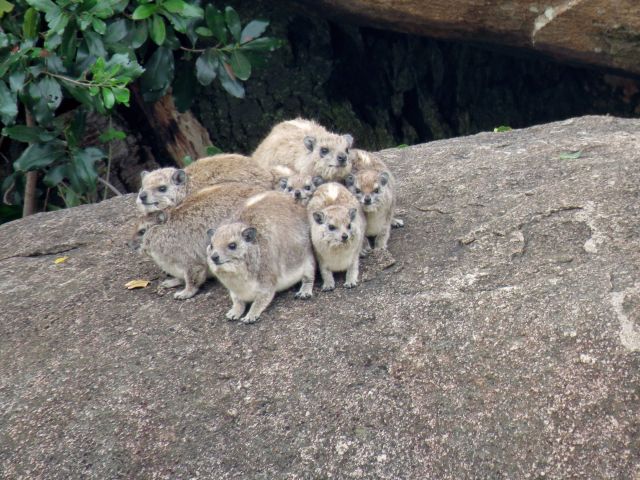
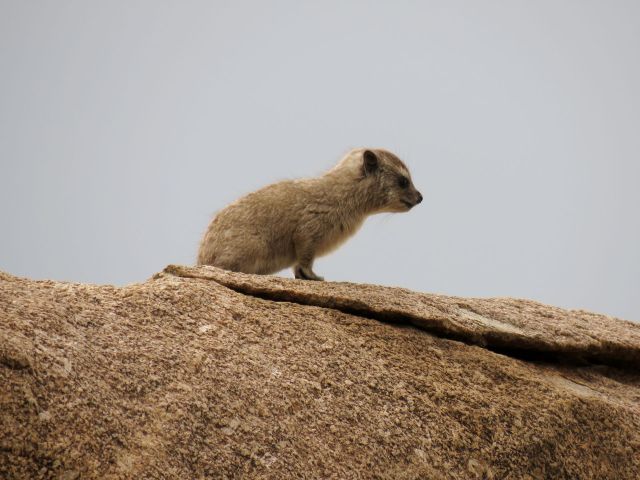
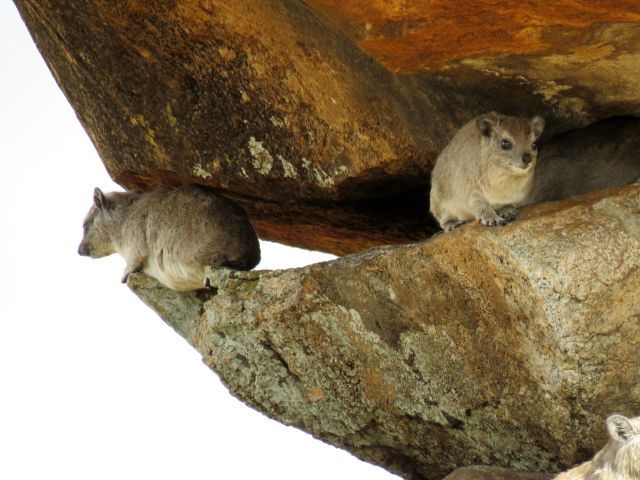
Perhaps these smashed together hyrax are practicing for going through airport lines

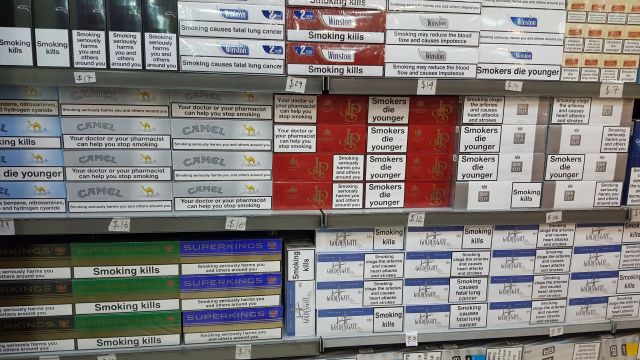
A different way to try to get people to stop smoking. The store had gobs of cigarettes on display so I don’t think the scare tactic is working. Jesse’s photo

Paul and I visit with a young woman on her way home to California who successfully climbed Kilimanjaro. The personable woman was quite proud and even said she would probably climb the daunting peak again if given the chance. She also told us that the company took some of them on a three-day safari. When the woman was telling us about the animals they had seen she included tigers in her list. We assured her that she hadn’t seen tigers, which made her laugh and to admit she didn’t know the animals very well. The Californian also said one of her group asked their guide what the dumbest animal in the park was and the guide without hesitation replied “humans”. That made us all laugh.

Jennifer and Connie are frisked after they walk through the screener even though it never beeped. I also saw a few other women being checked too, hmm wonder what that is all about. Paul and I are in line to have our tickets scanned so we can enter the waiting area when an uniformed woman pulls us out of the line and grabs our passports. This woman also snatches several other people’s passports and carries them to a table where she begins copying information from them onto a sheet of paper. To say the least all of our mouths are slightly agape as there was no information given to us for this action. The brusque woman did return our passports thank God and we proceed through the ticket booth and into our gate area. The rest of our group is waiting for us as they managed to sneak by the passport confiscating woman.

Another soothing scene. Take deep breaths

Our flight is late but when they call for passengers going to Toronto we all dutifully line up in the zone lanes that match the zone that is on our ticket. There are five zones and we are all in zone four. When our lane is allowed to make our way down stairs we have to laugh as most of those that were ahead of us are standing outside waiting for the bus to arrive to take them to the plane which is sitting out on the tarmac. So, we all dutifully stayed in our zone only to be packed together on a bus where once we get to the plane it is a free for all. Holy Smokes, people are pushing and shoving to get to the steps that lead up to the plane. It is definitely every man for himself. We all make it aboard in one piece and settle into our assigned seats.

Maybe that screaming kid was trying to eat a thorny branch like this elephant.

I think we are in the air for fourteen hours and there are lots of children around us. One of those kids takes great delight at shrieking in a very high-pitched voice off and on for much of the flight. Amazingly, with the benefit of ear plugs, Paul and I both sleep for several hours of the flight. I’m afraid our friends didn’t manage to get hardly any sleep.

We land in Toronto and the airport workers are organized, friendly and polite. Because we have several hours to wait for our departing flight, Jennifer has set up an interview for a Global Entry Pass which will allow her to bypass the endless waiting lines when you come home and have to go through customs, plus it gives her precheck for domestic flights. It makes sense for Jennifer to do this as she is a frequent air traveler. The rest of us wait in the terminal and when Jennifer joins us twenty minutes later, we make our way to our departure gate which is far away from the bustle of the main terminal. We all agree that we are craving a hamburger and conveniently there is a restaurant near our gate that specializes in burgers. We enjoy the excellent burgers and an hour later we are boarding our plane destined for Kansas City.

I think most of us slept for a good part of this flight, it helps that no shrieking children were on this flight. We collect our luggage, hurray everybody’s suitcases made it here, and wait for the Park Air Express shuttle to pick us up and deliver us to our cars. We say goodbye to Jesse and Jennifer and the four Millers climb into Connie and Carl’s car and we begin the final leg of our journey on our way to Wabaunsee county and home. We marvel at the change in the Kansas countryside. When we left we were in the grips of a terrible drought and two weeks later it looks like the Garden of Eden.

I took this photo two days ago. Absolutely amazing.

Another photo of Rock Hill Ranch taken two days ago.  Mama and her baby calf

So that is the end of our adventure to Tanzania. A wonderful, exciting trip that we got to share with four of our friends. Paul is already thinking about where and when we will return to our favorite travel destination. I can’t wait. Later, Nancy


More Adventures in Northern Serengeti, Part 9

Northern Serengeti, Part 9

There were lions, hyenas, and wildebeest calling last night and also more rain fell.  The roads are very muddy when we leave camp for our outing today. We stay on this side of the Mara River today as due to the heavy rain the river is running faster and the water level is higher. George doesn’t want to take the chance of going to the Lamai Wedge and perhaps getting stranded if more rain would fall today. There are lots of wildebeest standing around the muddy river’s banks along with trucks full of tourists hoping to witness a crossing. George tells us he is taking us back to the plains and to the kopjes.

George dealing with muddy roads

The Toyota sloshes over the wet roads and sends sprays of dirty water into the air when we drive through puddles. We come upon a pack of hyenas who are feasting on the fresh carcass of a wildebeest. Vultures are trying to join the varmints that are gorging on the remains but one hyena takes an exception to the pesky birds. When any of the winged scavengers come too close to the dead wildebeest he charges at them, keeping them at bay.

Hyena feasting on the remains of a Wildebeest

George drives back to the beautiful area where we saw the two lionesses and the mating lions. On our way we see a large herd of the cattle-like eland along with numerous zebras and more wildebeest. The air is fresh and crisp this morning and the rain-washed plains are just stunning.

Farther on we see a vehicle stopped ahead of us and Jennifer spots the lion that they are looking at. The lioness disappears into an overgrown ditch about the time we drive up. We sit there for a while hoping she will reappear but the big cat doesn’t comply with our wishes. Just as we are preparing to leave I happen to focus my binoculars under a bush that the other truck is parked by. For crying out loud, there are two lions sound asleep under the greenery. Everyone else takes a look and Jesse finds a third prone lion tucked behind her friends.  How in the world did we miss them as the sleeping felines are literally right in front of us? The mating pair of lions we observed yesterday are not around as far as we can see although after missing the sleeping lionesses that isn’t saying much.

The sleeping Lions that were right in front of us.

Giraffe near the Sand River

George proceeds to the Sand River which is the border between Kenya and Tanzania. He stops to talk to the occupants of two vehicles that are parked on the side of the dirt road. They tell him that a Rhinoceros was seen here earlier and they are hoping that it will return. We stay here for a few minutes but George tells us that Rhinos are very shy and it is likely the prehistoric-looking beast will not show itself with humans in the vicinity so we move on.

A fun photo of wildebeest lying down. Well, all but one.

Lunchtime. What a view

George parks the Toyota under a solitary tree that overlooks the endless plains. There are zebra and wildebeest to watch while we enjoy our lunch. We are in no hurry to climb back into the truck so stand around and feast our eyes on the scenic landscape surrounding us. Once we decide it is time to go, George drives to the kopjes looking for spotted cats but once again we come up empty on finding a leopard. We do find the usual denizens of the kopjes and enjoy watching Klipspringers, agama lizards and also some baby hyraxes.

Klipspringer on guard duty

What a crazy color scheme. Agama lizard

Okay, that baby wart hog is pretty cute

There are two Topis in the vicinity who are seriously fighting. The two bruised colored antelope lower their heads, run at each other, then drop to their knees right before they clash their heads together. We observe the battling bucks repeat this over and over and although one appears to be dominating his foe, they are still fighting when we drive on.

Topi just before clashing their heads together

Boom, they mean business

We have been watching some black clouds on the horizon since before lunch which have been moving our way little by little. George decides to head back to camp because he suspects it is going to rain. Soon big fat rain drops are splattering against our windshield and before long it is pouring. George urges the Toyota along as the roads begin to run with water making them very slick. The streams we have to cross aren’t running too much water yet and the closer we get to Njozi it is obvious they haven’t had the heavy rain we had driven through. We do see several vehicles by the bridge that crosses over to the Lamai Wedge trying to decide if they should take the chance of driving across. No way would I want to traverse that bridge as there is several inches of water flowing over the top of the cement structure.

this is the short bridge we crossed today

We reach camp around three o’clock and decide we should play some cards to pass the time. Connie and Carl retrieve the card game they brought called 5 Crowns from their tent. We sit in the lounge tent and allow Jesse to clean us old folks clock but we all surmise that if you throw Jesse’s high score out the rest of us had a good close game. It was a fun way to end the day and to just relax in camp.

young hyrax

Tonight, the chef out does himself serving us delicious beef stroganoff, vegetable lasagna along with several other vegetable dishes. We visit with Dave who stayed out in the bush looking for photo ops despite the rain. Dave recounts the harrowing tale of trying to cross the bridge that goes to the Lamai Wedge last year, (I think). Dave and his guide thought the water had receded enough that they could make it to the other side over the flooded bridge. I don’t recall how far they had driven onto the bridge before the truck was tipped over by the fast-flowing water. The two men managed to get out of the vehicle but Dave lost thousands of dollars’ worth of camera equipment to the Mara River. The two men perch on top of the vehicle and wait five hours for a helicopter to rescue them. No thanks to that kind of adventure!

More rain in the night and more noisy wildebeest near our tent. We had an unusual item on the breakfast menu this morning, chicken wings! Surprisingly, the wings were pretty tasty for breakfast. This morning George drives in the opposite direction of where we have gone the last two days. It is a little quiet in this part of the Serengeti but we do see an impala with atypical horns. Instead of sweeping up and back his horns bow down towards the ground. George said he has never seen anything like that before. We also see a hyena and a pup in the distance.

Atypical horns on impala. A good comparison with the impala with normal horns. Jesse’s photo

These are the same piglets we saw yesterday. George said their den flooded from the heavy rain . They look miserable

A baby baboon. Other baboons aren’t far away

Why not a baby elephant too. How sweet

George decides there is not much going on here so he reverses direction and drives back to the plains. No complaints from me as it is so gorgeous in this part of the park. It isn’t long before we find the four lionesses that we saw yesterday. Three are lying down but one of them walks right in front of us to reach her pride mates. The four girls give us a lot of photo ops as they stare back at us and I for one take full advantage, snapping photo after photo.

Gorgeous lioness

Posing behind a spray of grass

Another portrait

As we tour on through the grasslands we see Topis running as though they have been frightened. Nearby the topis, George spots a lioness lying to the left side of three vehicles that are parked on a parallel road from where we are. Jesse finds another lioness sauntering across the plains to the right of the vehicles. George parks the truck so we enjoy the beautiful felines and the other wildlife that is present. A lone wildebeest is walking in the direction of the other safari trucks. The gnu keeps stopping and looking back at something, perhaps our vehicle or the other lioness that is disappearing in the distance. The lioness that is resting by the three vehicles gets to her feet and walks across the road. There is no cover for her to hide in so she just strides with a purpose towards the distracted wildebeest. The bold lion gets closer than we figured she would before the foolish gnu sees her and starts running. The golden cat makes a half-hearted attempt at chasing the galloping wildebeest but she doesn’t even come close to her target. Even so it was exciting to watch the predator and prey in action.

The lioness giving chase but she didn’t come close. Jesse’s photo

Impalas with babies

Handsome Defassa Waterbuck

George takes us back to the Sand River to look for Rhino again but again there is no sign of the nearly extinct animal. However, we find our second oddity of the day while on this track. There is a zebra that has no stripes on its back and sides located about where you would lay a saddle on a horse. George speculates that the zebra has a skin disease. Perhaps so but the outline of the strip less patch is so even I wonder if an infection is the cause or if it might be a genetic abnormality. No matter the cause it is quite odd.  We enjoy lunch on a high point of the plains where we can look over the landscape and enjoy the zebra herd grazing on a distant hillside. I love it here.

Oribi in Sand River. I was wrong in a prior blog. We did see more Oribi including this one

Zebra with no stripes over its back

Another lunch served on the hood of the Toyota

Time to drink some Kilimanjaro beer

After lunch the sun is shining brightly and it is quite warm. George takes us back along the Sand River where the rhino has been seen in hopes that the grey ghost has decided to come out of hiding. As warm as it is the ponderous beast will likely be shaded up though, so I stand up and peer into the brushy undergrowth as George drives down the road. After we have driven for a while, I hesitate before asking George to stop and back up. I direct George to a break between two trees where something just didn’t quite fit in amidst the underbrush. Using my binoculars, I hem haw around, saying “no”, “wait a minute”, and then excitedly “yes, it is a rhinoceros”!! The animal turns its massive head and looks directly at me then melts away into the brambles. Holy mackerel, I almost didn’t ask George to stop the Toyota because all I had was an impression that something wasn’t quite right.

Looking down towards the Sand River. You can see how many trees and underbrush there is bordering the River. Jesse’s photo

Jesse finds the big rhino immediately, grabs for his camera but it is too late, the rhino has disappeared. George, Carl, Connie, and Paul don’t see the rhino’s head but see the rest of his body, Jennifer unfortunately is looking between two different trees than where the rhino is standing so didn’t get the very brief glance of the rhino. Yahoo! Finding the hidden rhino can probably be credited to forty plus years of staring into heavy brush and trees along our creek while searching for cows that are hiding with their new-born calves in the timber. A twitch of an ear, a switching tail, or a shape or color that doesn’t fit is often how we find cows who are doing their darndest to stay out of sight. So, all those years peering into weeds, bushes and trees looking for cows pays off in Africa😊. I heard George laughing and Paul tells me he also said “Good spot” a couple of times which I didn’t hear, I guess because I was so excited about seeing a Rhino.

This is Kansas and you are looking into the cover that grows along our creeks. Can you see the cows?

Same place a few seconds later. Now can you see the cows?

George continues driving along the river and we see two vehicles parked ahead of us. The guides tell George there is a rhino lying down by the green bushes, and wave in a general area where there are several “green bushes”. Although they themselves haven’t really seen the beast they are sure it is in there as someone else did see it when it laid down. We sit here quite sometime and I focus my binoculars on the biggest, greenest shrub in the vicinity the guides had indicated the rhino was seen. I see something move at the bottom of the bush where there is a small opening and decide it is a switching tail. I stare through my binoculars at this hole in the shrubbery until my eyes become fatigued but I see the tail flip across the opening four more times. Carl says he sees something move once but isn’t sure what it is. Everyone else has had enough so I finally give up on seeing what belongs to that tail and we move on.

How did this elephant get that perfect hole in its ear?

George makes the decision to return and check on the four lionesses that we saw this morning. Sure, enough we find the girls who haven’t strayed far from where we saw them a few hours ago. The lazy lions are all sleeping but a parade of wildebeest are plodding down a road which isn’t far away from the big cats. One lioness takes note of the string of gnus and walks into the tall grass where she is instantly camouflaged. The lone lion inches her way towards what appears to be an endless line of wildebeest. A few minutes later a second lioness joins her friend, stepping into the cover of the grass. We watch as the huntresses stalk the wildebeest creeping forward a few steps at a time. When the lions are just lying still watching their prey, we are entertained by some baby elephants cavorting farther up the hill from the line of wildebeest. You can’t help but laugh at the antics of the two cuties as they run with their little ears flapping and trunks waving.

A small part of the line of wildebeest with the elephants and babies in the back. Well one baby anyway

After about half an hour one wildebeest strays out of the line into dry grass near the waiting lionesses. One of the lion’s bursts out of the dried grass and lunges at the wildebeest, but the gnu easily outmaneuvered the predator. The other lioness makes no effort to help her friend out. George shakes his head and says “they are bad hunters”.  We figure the gig is up but George suggests that we should stay here as “wildebeest forget quickly”. Our guide is right about that as after the startled wildebeest move away from the road to walk in the adjacent field the gnus that were a hundred yards away and didn’t witness the failed hunt continue to walk in or along the road again.

Beginning to stalk the wildebeest

We have lost track of the lioness that chased the gnu but can still see the lion that first became interested in the wildebeest. Now another of the quartet has joined her and the two of them begin creeping ever closer to the unaware gnus. The fourth lioness stands up and it appears as if she too might get involved but after a minute or so she drops to the ground leaving her mates to do the work. I’m sure she won’t turn down the meat if her two cohorts are successful in taking down one of the tasty gnus.

Somewhere in this wait and watch episode, Dave and his guide have joined us and we get a good look at his camera. Whoa, I would love to see some of his photos. I bet he can zoom in on an individual lion’s whisker from a quarter-mile away with that massive lens! Three other vehicles show up, two pull up beside our truck and the occupants chatter away in a foreign language not bothering to keep their voices down. Good grief. The third vehicle drives past the rest of us and gets very close to the lions. This doesn’t set well with George or with Dave and his guide but there is not much they can do about it.

That is a huge lens!

There is a crippled gnu running toward the parade of wildebeest that stretch from horizon to horizon. If the lions see the injured animal the odds are he is doomed. The poor creature has to stop and rest several times even lying down at one point. The gimpy critter is lucky as the lions don’t notice him plus he begins to veer away from the line of travel that would have brought him straight into the lions’ mouths so to speak. I would guess the wildebeest has a broken leg and that sooner than later his luck will run out.

This bull elephant appeared as if he was going to come right to our truck but he ended up turning and walking away

The two stalkers continue to creep closer to the migrating wildebeest but they had better hurry because at long last the line of travelers is coming to an end. We have been watching this scene for nearly an hour and a half so we can’t imagine how many wildebeest have passed us by, hundreds of them for sure. There have been a few zebras mixed in with the wildebeest and the striped equine are much more alert than their companions. Whenever the zebras get near the lions, the felines lay flat, disappearing completely. When it is just wildebeest the lions will often raise their heads above the grass tops to check out the tantalizingly close gnus.

So close and yet so far away. Two lion heads blending in with the grass

The line of wildebeest on the horizon walking our way.

Zebra in the vicinity of the lions

The plodding wildebeest have passed the lions by and George says with some disgust “They are very bad hunters”. There are a few zebras now walking in the field where the lions are lying and George thinks we should wait a bit longer. At one point it appears the dazzle of zebra will walk right up to the lions but they suddenly reverse course and walk away from the hidden lions. George concedes that the hunt is over and we drive back to Njozi. This is our last full day in the Serengeti and what a wonderful, exciting day it has been.

We crossed this bridge going back to camp. It didn’t rain on us but it must have somewhere.

Wrapping it up in the next blog. Later, Nancy


Northern Serengeti, Part 8

Northern Serengeti, part 8

Boy was it noisy last night, mostly from the wildebeest that ventured very close to the tents. The wildebeests were grunting, (they almost sound like bullfrogs with varying pitches), every time I woke up. I swear one critter was standing right by our tent as every time it grunted the sound reverberated through the tent. The wildebeests’ conversations didn’t keep me awake but I did enjoy listening to them for the brief moments I was awake.

You can see wildebeest in the background if you look close. I took this photo from the front of our tent

This was part of our breakfast fare at Njozi camp. You could also order eggs, bacon or sausage. Jesse’s photo

We were up early for breakfast and left camp shortly after six. George drives to the river and there are wildebeest everywhere. There are ten or eleven crossings along the Mara river where the herds of wildebeest cross. As we near one of the crossing places, (4 maybe?), wildebeest are amassing near the river bank. We surely wouldn’t be so lucky to see a crossing right off the bat. Some people sit for hours and never do see this phenomenon. George parks the Toyota a fair distance away from the river and we watch the wildebeest approach the bank, peer down at the water, then move away. The skittish animals do this several times before turning around and walking away. George has warned us that this is often the case when hoping to see a crossing, you can never predict when or if the wildebeest will actually traverse the crocodile infested river.

Wildebeest thinking about crossing the Mara

Because of the rain, yes George calls the weather weird again, our guide decides to cross the Mara into what is known as the Lamai Wedge. The Lamai Wedge is land that belongs to Tanzania north of the Mara River that borders Kenya. The wildebeests are crossing from where we are situated now over to the Lamai Wedge and you want to see the wildebeest coming towards you. So, we drive across the “bridge” which in our county would be called a low water crossing. This cement structure only has about two feet to spare on each side of your vehicle, yikes. The water is a few inches from going over the top of the bridge and George tells us at times you can become stranded on either side if there is a down pour of rain. To add to the atmosphere there is a dead wildebeest that obviously didn’t make it across the river floating next to the bridge and vultures are feeding on it. Yeesh.

I think this is the bridge that crosses over to the Lamai Wedge. You can see a couple of wildebeest carcasses against the right side of the bridge. Jesse’s photo

George drives to crossing 3 where a large number of wildebeests, (or gnus), are accumulating. Many of the long-headed animals are packed together standing next to the steep bank. Hundreds more are scattered throughout the area behind those next to the river. On the horizon, a line of wildebeests is on the move so while we are waiting to see what the nearby herd is going to do, Paul begins to count the marching wildebeest. When the far-off parade comes to an end, Paul has roughly counted eight hundred gnus. We estimate there must be at least one thousand wildebeest waiting at crossing three.

These are the line of wildebeest that Paul was counting

George finds us a good place to park, well away from the river, and we settle down to see what the gnus will do. There are lots of vehicles all around us and plenty more trucks on the other side where the herd is standing as they contemplate whether they will or won’t brave the Mara river.

Hot air balloon getting a different perspective of the Serengeti

Elephant feeding near the river

There is other wild life around too, some behind our vehicle and more across the river. We see elephant, zebra, gazelles, and giraffe. At sometime during the waiting game we all need a bathroom break, so George must drive us away from the clutter of our fellow tourists. Our guide finds a fairly innocuous place to “check the tires” and we women clamber out and walk around behind the truck. There are some impalas, wildebeest, and zebra not far away who pay us little mind. While we three gals are using the open air restroom, Jesse tells us we have a hyena for company. We laugh at Jesse’s attempt to scare us but he insists that there is a hyena. Looking behind us sure enough there is a hyena skulking behind some bushes peering at us. As we stand up the peeping tom turns and runs away. Well, that is a new experience for we three ladies that will probably never happen to us again😊.

Zebra relaxing where we took our bathroom break

Jesse and George visiting at some point during our four-hour wait.

The wildebeest repeat the antics of the first group we watched, the gnus approach the river, then turn around and walk away. Twice it appears some of the gnus are ready to step into the river but they end up jumping sideways as something real or imaginary spooks them. We have been sitting here for nearly four hours and some of the Kansas crew are getting a bit antsy. George insists that we should be patient yet and it isn’t long after his advice that a wildebeest jumps in the water and the chaos begins.

Wildebeest starting across the Mara River

George has told us that as soon as one of the gnus touches the water the rest of the bunch will blindly follow. He also said that all the guides will speed down to the river once the crossing begins to procure a good position to watch the frantic beasts swim the river. George wasn’t kidding about the guides as suddenly it seems we are in a cross-country race with no rules applied. I am into it at first, saying “go George go” until I see that this is turning into a melee. The safari vehicles are jostling as close as they can get to each other without running into anybody. Not only that but we are parking just a few feet away from the river bank. This is nuts.

Pouring down the river bank

Well, George does get us a good location as we are directly across from where the nervous wildebeest are launching themselves into the Mara and swimming for all their worth. The poor creatures know that there is danger lurking in these waters in the form of big crocs but we see no evidence of the toothy reptiles. The wildebeests are dangerous to themselves as many launch themselves into the air, preferring to jump into the river instead of just stepping into the water. Crocodiles often wait right at the river’s edge so maybe they leap from the bank in hopes of clearing the jaws of a waiting croc. Unfortunately, the gnus that vault into the air often come down onto the backs of those in front of them taking the chance of breaking a leg or injuring the animal they land on.

You can see how they might jump on top of each other as they launch themselves off the bank

As the front-runners make it to the opposite bank they begin to struggle up steep inclines where all of we tourists are parked. There is half a dozen of the wide-eyed gnus that are clambering over the edge right by our truck. The terrified animals actually turn back towards the river and I fear that we have scared them into jumping back into the Mara to return to where they came from. I hear myself saying “This is not right” several times and then I tell George to pull up so the poor animals can find a way through the fence of vehicles. George does so only to have some knot head immediately pull his vehicle forward to take our spot, again impeding the panicked animals. Fortunately, a few of the wildebeest duck their heads down and weave through the maze of trucks and the rest of the herd follows them. Everyone in our vehicle is upset, we all work or have worked with cattle and know what extra stress this is putting on the wildebeest.

The Wildebeest coming out of the Mara river and running the gauntlet of tourist vehicles

As we are voicing our disapproval of the fiasco on this side of the Mara something even more incredibly stupid is taking place on the other side of the river. The tourists have clambered out of their vehicles and walked to the edge of the river bank to take pictures and in doing so they cut off the rest of the wildebeest that are trying to get down to the river. These morons have placed themselves between the river and a bunch of wild animals that are trying to follow the two or three hundred gnus that are in the river or have crossed the river. These ignorant fools are lucky that the wildebeest put on the brakes and turned around instead of continuing to the Mara and trampling them.

Are you kidding me!

We are not done yet with this drama. Several of the guides on our side of the river begin yelling over at the guides who let their customers disembark from the trucks. I’m sure they are letting them know that they have messed up big time. George tells us that if any Rangers had been here the guides would have had to pay a big fine for letting their clients out of the vehicles. The guides obviously knew no rangers were close by. With ten crossings to patrol there is no way the rangers can man every one of them.  We tell George we are ready to move on. Yes, we were glad to see the crossing but none of us wants to be part of that disgusting circus again. There is so much adrenaline shooting through me I am trembling. Part of it is the excitement of the crossing and part of it is my anger at the way we tourists behaved.

The second crossing

There is more current at this crossing

A half-grown calf jumps off the bank and is undercut by an adult. Can you see it?

George has driven maybe a quarter of a mile when he slows down and says he believes more wildebeest are thinking about crossing here. I don’t know if this is another crossing or still part of crossing three. There are only a couple other vehicles here and we decide to see what happens albeit we don’t go right down to the river bank. I’ll be darned, the gnus begin plunging into the Mara and there is no human folly messing anything up at the present. The wildebeest are unimpaired coming up the river bank and once they are back on dry ground they walk calmly down the road. The guides who are parked on the other side keep their occupants inside the vehicles this time and they also park back from the edge of the river so the gnus are moving freely towards the Mara. That is until one moron drives his truck directly through the line of gnus heading for the river so he can park on the edge of the bank. Again, the herd turns and runs back inland. At least this time seven or eight hundred of the migrators made it across the Mara.

A mass of wildebeest

Jumping as if their lives depended on it

All was going great until the Duma vehicle cut the gnus off. Why??

Feeling fortunate to have seen a second crossing that was more acceptable than the first one we move on. We drive along the Mara away from the wildebeest crossings to see if we can find any crocodiles. There are plenty to be found from small ones to humongous ones. There are plenty of hippopotamus in the river, including one big mama and a few month old baby. Vultures seem to be everywhere taking advantage of the numerous wildebeest that perished while trying to cross the Mara River.

A large crocodile showing off his sharp teeth.

Mama hippo and baby

Vultures feeding on carcass of an unlucky gnu.

George takes us to more Kopjes where once again we search for lions or leopards. One thing we see plenty of on our drive are vultures and why not. We see or smell carcasses occasionally so there is plenty for nature’s undertakers to eat. We also see lots of colorful agama lizards, well the males are colorful dressed in their blue and red skin. There are also the ever-watchful Klipspringers perched on the top of rocks, still as statues, staring out into the landscape as they watch for danger. You can always count on finding hyrax when checking out kopjes.

Interesting rock in Kopje country

It is a little hard to hide when you sport these bright colors. Agama lizard

Two of the numerous hyrax we saw.

Klipspringer keeping watch

Time to go back to Njozi after another interesting but frustrating day. Before dinner is served there is a heavy rain so no nibbles by the campfire tonight. It is a special evening again as the youngest member of our group is a year older today. Although the participants are less than they were for Jennifer’s birthday celebration the staff’s enthusiasm is just as great. The very young chef leads the others in a conga line around our table. The chef whirls and twirls with Jesse’s birthday cake in his hand. He pretends to give it to the other guys sitting at the table, only to snatch the cake away at the last second. It is hilarious. Finally, the animated chef presents the cake to Jesse and the chant to “cut the cake” rings through the air. It is a great way to end the day. Happy Birthday Jesse!

Waiting out the rain in what I called the lounge tent

Heavy rain doesn’t keep Amos from delivering Jesse a beer, nor does it keep that wonderful smile off his face. Jesse’s photo

Jesse’s birthday cake. Pretty fancy. Jesse’s photo

Coming soon, more adventures in Northern Serengeti


Driving to Northern Serengeti and Njozi Camp, Part 7

Driving to Northern Serengeti and Njozi Camp, Part 7

Last night instead of lions and hyenas we were serenaded with rolling thunder and the pounding of rain on our canvas tent. Um, this is supposed to be the dry season. George had called the afternoon showers that occurred when we were at Kusini “weird”, so I wonder what he will say about this deluge.

What a sunrise we are treated to.

We are up before daylight and Paul turns our flashlight on, sticks it out the tent opening and waves the beam of light into the darkness. Before long a staff worker is trotting our way, he calls out “Jambo” and escorts us up the soggy path to the main tent. The rest of the crew has arrived and soon we are clambering into the Toyota that we have spent so many hours riding in the past several days. We do take time to admire and snap photos of the incredible sunrise that has greeted us this morning.

As we drive over muddy roads in the predawn we see a grazing hippo with a tiny baby at her side, but it is to dark for a decent photo. We see more hippos out grazing that are startled by our presence. They gape at us and break into a stiff-legged run heading for the safety of nearby water.

No photos of the early morning hippos but here is a hippo with a black crake walking on its back

It seems that the heavy rain has dispersed the wildlife because we really don’t see many critters. Carl spies a bird in the road which appears to be dying to me, so I turn my head. I only look back when Paul studies the tiny bird closer and proclaims that there are two birds and they are fighting. George takes a look, identifying them as cisticolas and says when they fight the small birds lock legs and whack away at each other using their wings and beaks. There are lots of feathers scattered all around the birds proving that this is a vicious fight. I suppose the birds spat is over territory and/or a female. One of the cisticolas breaks free and flies away with the victor literally on his tail to make sure the loser leaves the area.

Some of the safari vehicles lined up looking for the leopard. I took this photo before we knew there was a leopard in that field of grass.

We turn back for Ang’ata camp as we are scheduled to eat breakfast at eight o’clock. Up ahead of us we see lines of vehicles on parallel sides of a field of high grass and bushes. One of the guides we pass by points to the field and tells George there is a leopard in there somewhere. Jesse soon finds the head of the leopard poking out of the tall cover. Jesse tells the rest of us where to look, (the cat is to our left, near the bank, close to the dark green bushes, etc.). Okay I’m making all that up to demonstrate how darned hard it is to tell people where the subject you are looking at through your binoculars can be found. All of us end up finding the regal feline except Connie, darn it. It is hard to keep track of the leopard as he ducks in and out of sight. Luckily, the leopard briefly walks out into the open and we get a really good look at it. The beautiful cat is so far away that I don’t attempt a photo instead I just enjoy looking at him through my binoculars. When we arrived, there were around twenty vehicles parked along the roads bordering the field. There are more trucks streaming in and since the leopard has disappeared again we say “good enough” and head on to camp.  A great way to end the early morning game drive!

The leopard is in about in the middle of the photo. Very hard to see. Jesse’s photo

After eating breakfast all of us finish last-minute packing and let the staff carry our luggage to the main tent. Paul presents the card containing the tip money for the staff to the manager who thanks us. Since George hasn’t returned most of us walk up and down the paths leading to the tents to get some much-needed exercise. George pulls into the camp entrance just before ten, it seems there was still some problem getting everything to work on the new computer system, plus he had to drive to the ranger station to fill up with gas and also to buy water for us. We pull away from Ang’ata at ten o’clock and begin the final leg of our safari.

Waiting on George

George informs us that there were two bull giraffes fighting just outside of camp when he came back so he is hoping the duo are still there. The towering giants are still present and are using their heads like sledge hammers to whack each other. The giraffe on our left seems to be landing more and harder hits on the slightly smaller fellow. We watch for several minutes and when we leave the combatants are still sparring.

Sparring Giraffes

Somewhere on our drive to the north.

I think these were the only Oribis we saw.

The farther north we drive the landscape becomes greener. We also begin to see lots of grazers. Topi, hartebeest, impalas, Thompson gazelles, cape buffalo and giraffe. The eye opener however is the herds of zebra that go on for several miles. We all agree that we had to have seen thousands of the striped beauties.

A try at showing how many zebra dot the landscape

This photo shows how a predator could get mixed up trying to sort out an individual zebra.

The zebra with its rear end showing has brown shadow stripes. I think we have only seen this a couple of other times.

George finds a spot overlooking a lush valley and decides this is a good place to have lunch. We place the lunch boxes on the “bonnet” of the truck and enjoy looking over the sweeping vista while we eat. There is wildlife scattered over the verdant valley but they are barely visible to the naked eye. When scanning with binoculars we find gazelles, wildebeest, zebra, and some warthogs.

Having lunch on the way to Northern Serengeti. Carl’s photo

Our view at lunch

Carl checking things out

Continuing our northern drive, the herds of zebra are replaced by thousands of wildebeest. I wish I could do justice with a photo to the seemingly endless numbers of the odd-looking critters but it is just impossible. We stop to observe one wildebeest acting completely silly as he gallops and bucks and entices a couple of his herd mates to playfully fight.

Wildebeest everywhere

The playful wildebeest

As we continue driving next to the legion of wildebeest we notice a vehicle parked a few hundred yards away observing a couple of lionesses. We drive closer to the splendid pair; one lion is lying in the open while the other girl is partially obscured by a mound of dirt. Eventually, both cats stand up and walk very close to the truck, heading in the direction of the enormous herd of wildebeest that are grazing a few hundred yards away. The wildebeests are browsing in a field of short green grass that has been burned. There is a plot of tall dead grass across the road from the wildebeest which will give good cover for the lions.

Looking toward the herd of wildebeest

Crossing behind our vehicle towards better cover

George reads the body language of the lions once they reach the lofty grass and tells us he believes the two cats will try to creep up on the wildebeest. George decides to move back to the road next to the wildebeest so we can watch the hunters approach.  Sure enough, the pair begin stalking the herd of wildebeest using the thick grass to help conceal their approach. Although the lions manage to get within a couple hundred yards of the wildebeest their hard work is foiled by the sharp eyes of several Thomsons gazelles. The little gazelles stand at attention, staring out to where the lions are lying in the grass. Soon a topi takes the small sentinels seriously and begins snorting and peering around trying to find the danger. After the Topi alarm call the wildebeest begin to calmly move away from the edge of the road. This leaves a lot of area where there is no cover so the lions would be in full view of their prey. The two girls don’t stand a chance in this scenario and they know it. The pair stop stalking, sit down and just begin looking around knowing full well their cover has been blown by the alert Tommie’s.

Beginning to stalk the wildebeest

The Thomson gazelles on alert. The topi hasn’t become alarmed yet.

We noticed a half-dozen vehicles lined up just down the road when we began watching the two lionesses. There are still a couple of trucks parked there so George drives over to see what the people are watching. Aha! A male and female lion who are obviously only interested in each other. We have hardly come to a stop when the two lions begin mating. Boy did we time that perfectly as lions’ mate over several days and often you must sit for long periods of time to witness the pair mating if you get to see it at all. There is no sense staying around now since both lions have collapsed to the ground and fallen asleep.

Mating lions.

A big yawn

The female sound asleep

We aren’t far from the lion pair when George drives the Toyota through a dip in the road with deep tire ruts. I’m not sure what happened but we slip over so the left tire is in the track where the right tire should be and the right tire is completely off the dirt road. When George tries to maneuver forward the tires just spin and threaten to slip further into the grass, if we slip sideways much more we will end up in a ditch. Our rear bumper is bottomed out so George can’t back up in order to take a run at getting the truck out of this dilemma. All of us crawl out of the marooned truck and look the situation over. George, who I am sure is a bit embarrassed, checks to see if he can get a jack under the back bumper but though possible it will sure take digging away a lot of mud to make that happen. Fortunately, a couple of vehicles drive up and George and the other guides consult about the situation we are in. One vehicle drives within a few feet of our truck’s front bumper and hooks up a strap to both vehicles’ front ends. George and the other driver get back into their trucks and in no time at all our Toyota has been pulled free. The six of us just stayed out of the way, looking over our shoulders from time to time as the lioness’ we were watching earlier weren’t far from here and we sure can’t run as fast as a wildebeest .

Oops. Jesse’s photo

Help has arrived. Jesse’s photo

We reach Njozi camp which is nestled right in the bush. Stepping out of the truck I instinctively know that I am going to like this camp. There are wildebeest scattered around in the timber and the crew meets us with friendly smiles. After the ritual of washing our faces with the hot towels and sipping our welcome drinks we listen to Andrew give us the camp instructions. Don’t go to or from your tent after dark without an escort who you beckon to come get you by using your flashlight. The times our meals will be ready are given to us and after you order your hot water for bucket showers it will take ten or fifteen minutes to be delivered. Got it. Laundry and drinks are included here. Yes! our clothes need to be washed again.

The staff, carrying our luggage, leads us to our tents and we await the hot water that arrives shortly. Paul showers first only to discover that our shower head only has four holes where water is coming out. If you think trying to get wet, lathered up and worst of all getting the shampoo and soap rinsed off is hard with that little dribble from the shower head you are right! It was kind of funny though. Paul takes a toothpick after we both have finished and pokes it into several of the shower head holes. Paul’s ingenuity works as now instead of four jets of water there are about ten which proves to be adequate for the rest of our stay.

The tents are small but have everything we need

Paul and I walk up to the campfire and join our friends. We both order a beer from Amos who has the most endearing smile. Later they bring nibbles which include samosas. We had samosas in one of our lunches earlier in the safari which we loved them and these are just as delicious. Chopped and seasoned vegetables or meat, wrapped in a pastry sheet and deep-fried. Yummy. Amos comes later to take us to the dining tent for supper. We are joined by the only other guest in camp, Dave, who is an avid photographer and from Colorado. Dave is a soft-spoken man and extremely interesting. I believe he has been coming to Africa for twelve years and often takes multiple trips in a year.

Our soup tonight is carrot soup with ginger spice, this is the first African soup I don’t care for so I leave most of it in the bowl. To our delight at Njozi camp they serve the meal family style. The staff bring out the food in big bowls and we just take what we want. This is wonderful, as at the other camps I probably left half of the food on my plate. We visit after our meal for a bit but most of us retire to our tent by nine or so because we have an early morning wake up call. Another great day in Tanzania!

I am only blogging about one day here instead of the usual two days I have been doing. There will be lots of photos included in the next blog so decided not to make this one so long.

Next blog, Northern Serengeti and wildebeest river crossing. Later, Nancy


Ang’ata Serengeti Camp and Central Serengeti, Part 6

Ang’ata Serengeti Camp and the Central Serengeti, part 6

The Wabaunsee crew of six are up early and eating breakfast at sunrise. Our bags have been brought from our tents by some of the staff and are loaded into the truck. We say our goodbyes to this friendly group of people who genuinely seemed to enjoy having us at Sanctuary Kusini camp. The workers were always smiling, friendly and had a great sense of humor. The chef even shared his recipe for squash soup with us!

George wants to drive up to the plains to look for Cheetah before we head off for Central Serengeti. Everyone searches the wide-open grassland for the fastest land animal, (they can reach 75 miles an hour), but none of the spotted cats are found. This looks like prime country for cheetah, it just isn’t this morning. I believe it is Jennifer who does notice a bat-eared fox near the road with that perpetual grumpy look on its face.

Bat-eared fox, a poor photo as it is very early.

We may not have found cheetah, but we see something else that Paul and I have never witnessed. George points out a male ostrich in the distance, fanning his wings and dipping his head. George says that this is a courtship dance and the display is quite flamboyant. Hey, there is a female intently watching the flirting male and after a few minutes she lies down on the ground, signaling to the male that she is accepting his overtures. The flushed pink rooster struts over to the willing hen and the two begin to mate. Honestly, it is like watching a choreographed dance. The male fans his wings and moves his head back and forth as the hen also sways her head from side to side. Once the mating is over the two ostriches walk away, soon to build a nest and raise a brood of chicks I assume. How cool was that!

Male Ostrich approaching the hen with his wings outstretched. Jesse’s’ photo

The mating ostriches

George says he is going to drive by the area where we watched the lions and cubs yesterday in anticipation that the pride won’t have moved very far. Before long, Jesse calls out that he has seen lions and tells George to stop and back up. Lying off the road in the distance is a beautiful male lion along with four, maybe five lionesses. There are no cubs in sight, but George assures us that this is the same pride since we are not far from where the lions were lounging yesterday. We watch the gorgeous cats for a while, but the females seem out for the count and even though the male is awake, he doesn’t seem to have any ambition either. Great spot Jesse! Jesse can’t help but tease George for not seeing the big cats.

Lion pride that Jesse spotted. They are a long distance from the road

A wider shot which includes a lioness laying by the grey tree trunk on the left. You might need a magnifying glass!

Just liked this shot with so many shades of grey including the heron and all the different shapes.

Traveling on, George brings the truck to a halt so we can watch two Tawny eagles that are eating on a carcass. At first, I think I am looking at ribs through the tall grass but once I use my binoculars I can see that the “ribs” are the black stripes on a zebra hide. Soon vultures begin to arrive, swooping in from every direction and the tawny eagles are pushed away from the feast. As we observe the big birds, one vulture hops into a clump of brush and grass. The vulture emerges with a string of intestine and is tugging on it as the ugly bird tries to pull the guts free. We watch in amazement as a black-backed jackal emerges from the cover of the brush hanging tight to the other end of the intestines. No wonder the vulture was having such a time getting its prize free of the weeds.

The Tawny Eagle that started this whole episode

The jackal chasing vultures while two vultures now are playing tug of war with the intestines

The vulture wins the tug of war which seems to make the feisty jackal furious. The jackal runs to the zebra remains and chases several vultures away from their breakfast. The jackal then takes a bite from the carcass, gulps it down and charges a vulture that sidles up and tries to grab a beak full of zebra. The battle between fowl and canine lasts for several minutes. At one point the small jackal is literally air born, he must have sunk his sharp teeth into the vulture’s leg because he obtained lift off for a few seconds. I wish I had caught that on camera! Suddenly the brave fellow stops eating, turns around and trots away. The jackal’s belly is so swollen with the meat he has consumed it is a wonder he can even move. As soon as the jackal leaves, the zebra carcass is swarmed by vultures until there is just a heap of moving feathers. Pretty gross.

The feisty jackal chasing away a Lappet-faced vulture. That is a big bird.

We are in Kopje country again and these formations are called the Moru Kopjes. Many of the kopjes have “balancing rocks” on them. It looks like the slightest touch would send the boulders tumbling off their precarious perches. There are Rhinoceros in this gorgeous place, but we aren’t lucky enough to find any of the endangered beasts.

Moru Kopje area

George does spy a group of lionesses sleeping in the yellow grass, their hides blending perfectly with the dry forage. Who would believe lions would be lying around snoozing. The backdrop for these seven lions is a magnificent kopje so the scene is quite breathtaking. One of the seven lions does sit up at one point. Another member of the pride is lying on her back, feet in the air and never even twitches while we are there as far as I know.

Part of the 7 lionesses, two were lying farther away from these

Beautiful backdrop for the pride of lions

We redirect our attention to a Black-headed heron who is stalking across the road in front of the Toyota. It appears the stately bird is walking towards the lions, but it veers off to the right and comes to a standstill. The long-legged bird begins to shimmy its neck while somehow keeping its head still. The heron does this several times and on one occasion the shimmy extends through the birds’ body, giving new meaning to “shake your tail feathers”!  I for one can’t take my eyes off this strange behavior. Suddenly the bird plunges its bill into the soil at its feet. When the heron raises its head there is a tail and hind feet of a black lizard sticking out of its beak. The lizard disappears down the herons’ long throat in short order. Whoa, I wonder if that morsel wiggled all the way down. Someone, (Carl I think), wonders if the herons’ shivering movements might somehow hypnotize the birds’ prey. I don’t know but the shimmying bird sure hypnotized me.

The stalking Black-headed heron

I understood that the white spots were where people have hit the rocks with smaller rocks to produce the musical notes. The spots seem awfully uniform tho.

George takes us to N’gong rock for lunch. A beautiful kopje where people congregate at times to bang rocks against some of the large boulders to make music. This explains the white spots on the said rocks. Jennifer gives it a try and the various musical sounds that are produced is amazing. We enjoy our lunch as we look out over the endless plains. A male ostrich and several hens can be seen in the distance. As we are finishing our lunch, a herd of elephants are climbing up on a kopje a half mile from where we are eating. George says they are drinking water from the depressions in the rock that were filled up when it rained last night. Yes, we have run into some wet roads today which is nice compared to all the dust we have endured the past few days.

Jennifer,Connie, and Carl climbing N’gong rock

We hurriedly pack up the lunch debris and drive closer to the drinking elephants. Some of the pachyderms have already come down from the kopje when we arrive but there are two elephants atop the large boulder who are still drinking. It is quite a sight to look at elephants standing on top of this big rock. George says that the elephants can have some problems walking off the slick granite. We watch these two elephants come down from the steep rock and they handle it just fine.

Elephants on the kopje. I think Jesse took this photo while we were still on N’gong rock. Jesse’s photo obviously

Drinking water which was caught in depressions of the kopje

Coming off the kopje

The matriarch of the group looks ancient and George estimates that she is around forty years old. In contrast there is a baby elephant, but I forgot how old our guide said this cute thing was, a few months I believe. As the elephants walk away from the kopje they pass very close to our truck. Even though they have a little one in their midst they show no sign of stress due to we curious humans. We can hear the low rumbles some make as they walk by our vehicle.  What a terrific experience.

The old matriarch

The youngest member of the herd

Leaving the elephants, we come across a very placid bull giraffe. The grand fellow chews his cud and stares at us before gliding behind our vehicle hopefully on his way to find some friends. George drives around a small lake where flamingos are feeding around the edges. We also encounter a Defassa waterbuck, more handsome in my opinion than the common waterbuck that were in Tarangire and Kusini. I love the Defassa’s heart shaped nose.  What a wonderful morning we have had.

Close up of the friendly giraffe

Defassa waterbuck . Look at that heart-shaped nose

As we draw closer to Ang’ata Serengeti camp we begin to meet lots of safari vehicles. On the next road over from the one we are traveling on there are thirty or forty vehicles lined up along the road. George asks if we want to join the melee to see what the tourists are watching and I say that I am not interested. No one else wants to go either so we continue down the road. We have been so spoiled having most of our sightings to ourselves that it will be hard to adjust to the hordes of vehicles and people who occupy them.

Pretty flower along the edge of the road

Our next encounter is with a vervet monkey sitting near the edge of the road. He suddenly walks off a few steps, bends over and gives us an unobstructed view of his very blue testicles. What the heck? George then drives us along a waterway lined with palm trees. Yes, palm trees and yes, they are an invasive species to Africa and doing quite well. The stench of the water is overwhelming but when we see the raft of hippos that have deposited themselves in the receding stream we know why. I would guess there are at least fifty of the bulbous beasts half-submerged in the fetid water. Jesse thinks you could run across the hippos backs to reach the other side and never touch water. The hippos are so smashed together that it might be possible, but I don’t think anyone is willing to give it a try.

A serious looking vervet monkey

Serious until he does this!

The raft of hippos, there are more that I didn’t get in the photo

We reach Ang’ata camp where the routine of hot towels and cool drinks is offered and gratefully accepted by this happy but tired group of Kansans. We are escorted to our tents which are unsurprisingly duplicates of the first Ang’ata camp we stayed at. What a great day we have had.

Our home for the next two nights

There were lions roaring and hyenas whooping during the night. I love lying in bed and listening to those wild sounds. We had an early breakfast and were out of camp by 6:15. George had driven only a short way when he stops by a pride of lions bedded down next to the road. Two males, several lionesses, several cubs, most are half-grown except for one small cub. We count a total of twelve lions. The light is very dim, so my camera is protesting that it can’t take a photo in these conditions. Soon the sun is creeping above the horizon, so my camera is happy, and I am happy. I think there was only one other vehicle at this incredible scene and they didn’t stay long.

A dim-light photo of the lion pride. The two males were off to one side. I am thinking that maybe there were 14 lions counting the two males. It is hard to see for sure but I believe there are 12 lions smushed together in this photo.

What a beautiful cat

Some mutual grooming

The young male is restless and when a flock of guinea land across the road he gets to his feet stares at them then wanders close to the noisy birds. The flock of guineas know he is there and know that they can escape the hungry cat easily so they don’t panic. The old grizzled male has disappeared into the long grass, possibly because we have made him nervous. The lionesses and cubs stay huddled together for warmth and are unconcerned with our close proximity.

The young male watching the guineas

The old male before he disappeared into the grass. It looks like he has been in a recent battle. Jesse’s photo

Pride members watching the young male who is watching the guineas

Suddenly we see the young male lion dashing after a dark critter in the grass just beyond where the rest of the pride is lying. How did he get over there, a few minute ago he was on the other side of the road? None of us could make out what he was after, perhaps a wart hog. Almost as one the pride sits up staring at the area where we had caught a glimpse of the running lion. The little cub begins walking in the general direction of where the hunter had been, and it is followed by a few other lions. The lions soon come to a stand still and seem to be listening. After a bit they turn around and come back to the few lions who had settled back down. I guess they know that the hunt was not successful as we too had come to that conclusion since we heard no struggle or squealing of a captured animal.

Some of the pride walking in the direction of the failed hunt.

A half-grown cub trying to grab the small cubs tail.

I’m not sure what this look was all about

Perhaps what the lion was chasing was a baboon because a troop of baboons are roosting in a yellow fever tree situated a short distance from the pride. The primates are waking up, with many just sitting in the branches soaking up the sun. The younger members are beginning to play climbing up and down the limbs and trunk of the massive tree. I’m not a huge fan of baboons but watching them interact this morning is fascinating.

Baboon in yellow fever tree

Two young baboon wrestling, the sun came over the horizon. What a difference that makes for photos.

George is taking us to Nimiri Plains today which will allow us to escape the circus closer to camp. On our way we see a couple of vehicles parked along a road across a field of grass. They are watching lions which are walking down the dirt track. The beautiful cats are far away but we see three lionesses and at least two small cubs.

Two of the five lions we saw across the grassy field.

The vehicles are thinning out and as George navigates the truck down a quiet road he slams on the brakes and says there is a Serval cat walking on the road. It is mid-morning so having this small cat out in the open seems a bit unusual. Even more surprising the stunning feline continues walking straight at us and upon reaching our truck, it walks into the grass. Unbelievably, the serval sits down in the waving grass right next to our vehicle. We take photos and just enjoy the privilege of observing the little cat as it pays us no mind. At one point the serval acts as though it has heard prey in the turf and looks as though it is getting ready to pounce. It must have been a false alarm as the serval sits down and eventually lies down in a bed of grass.

Serval cat coming our way

Walking next to our truck

Sitting down by the truck and posing for us

At the same time, we were watching the serval George spots a hyena that has emerged from the grass onto the road a few hundred yards ahead of us. A Thompson gazelle is barely visible in the lanky grass to the hyenas left but the skulking animal either smells or sees the small antelope. The hyena runs into the field as the gazelle beats a hasty retreat. The hyena rears up on its hind legs occasionally in order to see over the lofty grass trying to locate the gazelle. It doesn’t take long for the hyena to say to heck with it and ambles away.

Topi with hot air balloon in the background

As we continue on our way to Nimiri Plains we enjoy watching a parade of elephants walking through the dry plains while above the regal tuskers is a vivid blue sky dotted with puffy clouds. Except for the elephants it reminds me of the prairies of Kansas.

If you take out the elephants and the Acacia this could be Kansas in the winter time

Oh why not! A handsome male lion is lying a short distance from the road. At times the big male is looking very regal for us and at other times is literally nodding off. It is hilarious to watch the massive head move downward as the big lion begins to fall asleep, only to jerk his head back up bringing himself back to wakefulness. Who can’t relate to that feeling of trying desperately to stay awake.

Lion that kept nodding off

I’m awake, I’m awake!

After a long drive we arrive at the east side of the Serengeti which is known as Nimiri plains. This country is wide open, a few kopjes here and there but very few trees. George picks out a small kopje and once our guide scouts around the rock to make sure nobody is home, this is where we have lunch. All of us are ready to stretch our legs and relax. There is no one else around, no fences, no electric lines, no hint of humans at all except for the tracks left by tourist vehicles. What an incredible feeling of freedom out here.

A view that goes on forever

Time for lunch

George pouring Jennifer a cup of hot tea.

The guys looking over Nimiri plains

After lunch George drives around a few of the kopjes but all we see are several jackals. One of the jackals is being fiercely pursued by another and the chaser even knocks the fleeing canine down at one time. George says it must have strayed into the other fellow’s territory. This wide-open grass land appears to be empty of wildlife but we see giraffe, topi, hartebeest and other animals scattered about.

Giraffe eating on one of the few trees around. Ouch

Two topi and a hartebeest

A topi with an itch

As we draw closer to our camp there is a large herd of elephant strolling towards our truck. The pachyderms are completely relaxed, very unlike many of the elephant we encountered on our last safari in Kenya. Frankly, many of those elephants were irate and down right scary. George has stopped the truck and there are a few other vehicles that are also parked. Soon we are surrounded by calm elephants. Some are in the road, some have crossed and are on our left while others are still on our right side. George is a bit nervous because there is one very small baby but none of the elephants become protective. It seems George literally had a run in with a mother elephant in the past that left his truck a bit bent up. Luckily, the elephant didn’t stick around to finish the demolition job. I can see why George would be a little shy when elephants come so close.

Elephants coming right at us.

They have arrived at our truck

The tiny baby

Oh for crying out loud, this is just nuts. There are two lionesses lounging in the grass a fair distance from us. We also saw the paw of a lion sticking up above a pile of dirt closer to camp. Carl says we can’t count this as an actual siting because all we saw was a paw, (we think he is kidding) but the rest of us vote him down. I have written in my journal that we saw 25 lions today!

Two more lions for the day!

One disturbing thing we came across as we near camp is a vehicle off-road looking at a cheetah. We can only see the cheetahs head and we couldn’t understand why George wouldn’t take us over to get a closer look at the cat. George points out that there is no road that leads there and this is as close as we can get.  Soon another vehicle plows through the tall grass and joins the other rule breakers. This obstructs our view of the cheetah’s head so we leave. George tells us we will find another cheetah but he refuses to break the rule of going off-road. All of us praise him for having the integrity to stay on the road. We meet several vehicles speeding down the road towards the cheetah siting and I would bet money that all of them will drive into the bush to get their clients close to the cheetah. Hopefully a ranger will catch them and they will have to pay a stiff fine.

A beautiful scene

As we are nearing Ang’ata camp, George lays out our plans for tomorrow morning. We will go on a game drive before breakfast, then at 8 a.m. he will take us back to camp so we can eat while he goes to the airstrip to get our permit that allows us to enter the northern Serengeti. Since we are driving right by the airstrip now we encourage George to just stop and obtain the permit today. He seems delighted that we are willing to wait while he gets the permit and that he won’t have to return in the morning.

George and Paul looking very serious about something.

All of us take the opportunity to use the nice restrooms and then we wait. We wait some more at which time we three women decide to do laps around the dirt parking lot even though it is darned hot. The guys have a conversation with a guide who is waiting on his clients. We wait and wait and then George finally shows up without the permit. It seems that the airport has a new computer system that is giving them fits plus it is Sunday so the main headquarters is understaffed which is where the permit number must be faxed from. TAB, That is Africa Baby. George delivers us to camp and we are back to plan A for tomorrow morning.

Although we are all tired, we enjoy a tasty dinner and marvel at our incredible day before retiring to our tents .

The charging station at Ang’ata camp is in the main tent. Yikes. Jesse’s photo

Next stop, Njozi Camp and the Northern Serengeti. Later, Nancy