VISITING A LOCAL CRAFTSMAN AND THE KOM OMBO TEMPLE, part 9

    Another pleasant morning “observing” life along the Nile from the observation deck. One of the first things we see this morning is a young boy riding a donkey. He is leading a reluctant Friesian cow down the quarry path that we were walking on yesterday. There is a yearling calf bringing up the rear. We sail past the cow and calf a short time later grazing in a small patch of reeds. The boy and the donkey are nowhere to be seen. We also float by stone structures along the riverbank that are part of the ancient quarry that were off limits to us on our tour yesterday.

Leading the cattle to pasture.
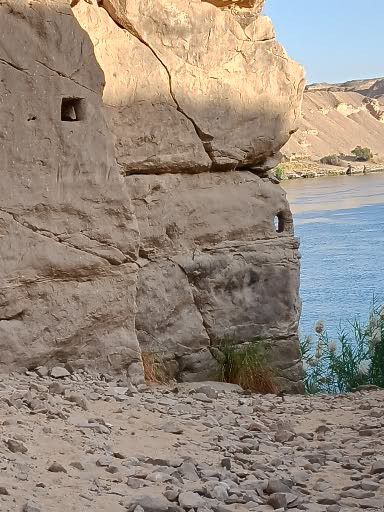
A structure at the ancient stone quarry that can only be seen from the Nile.

    We sail for an hour more or less until we reach the village where the craftsman we are visiting lives. Once the Aida is tethered, we leave the ship, pair up and crawl into tuk-tuks’ which will be our transportation to the local crate builder. Our driver pulls the heavy blanket aside that serves as the door and Paul and I crawl into the small vehicle and sit down. Paul holds the curtain back so I can take photos as we bounce down the sandy roads.  

Paul holding curtain aside so I can take photos.

    The caravan of tuk-tuks’ stop along the side of an unpaved road and Hussein takes us down a path that leads to the craftsman’s work shop. A wizened man is waiting for us, and he greets Hussein and our group with a wave and smile. There are handmade benches arranged in a half-circle around the man’s working area. The “workshop” consists of a portion of a tree trunk that serves as the man’s workbench and his chair is the ground. And to think I complain that my chair I sit in for computer work is not comfortable! There are piles of finished crates lined up behind the workman which he sells to his customers who use them for shipping farm produce. I wish I could remember what our host is paid for each crate. I want to say that it is twenty-five cents in our money but don’t hold me to that.
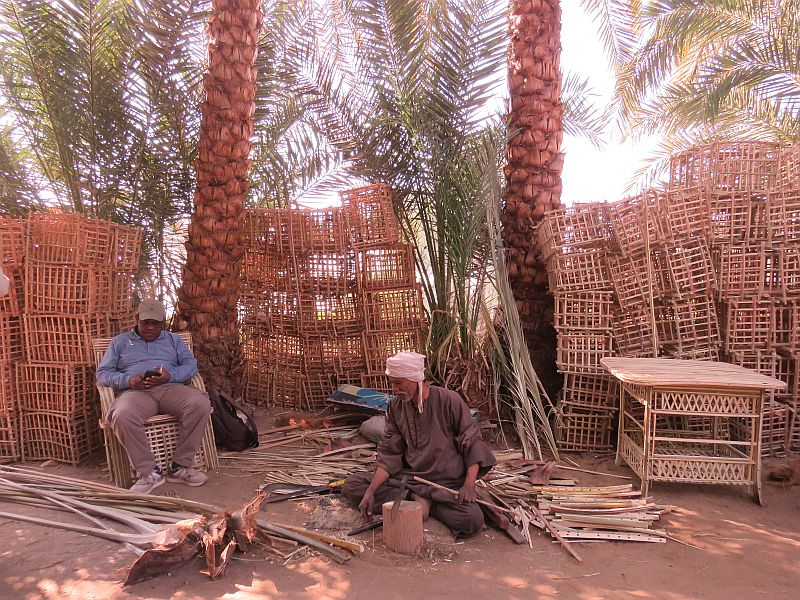
The crate builder, Hussein and inventory in the background.

    The craftsman begins building a crate and it is fascinating to watch how quickly he measures the palm wood, cuts, and slices it, punches holes part of the way through the thin wood and more. The craftsman has two different knives he uses.  One knife looks like a cleaver and the other large knife has a wicked curved blade. The fellow often uses his feet to hold the crate steady and I admit I check out his feet and hands to see if all his fingers and toes are accounted for.

A slideshow of the craftsman at work.

    Once he has the framework of the crate completed, he points to the tall guy in our group to come help him finish the box, nope it is not Paul. The two work together building the box. The teacher corrects a couple of minor mistakes his pupil made which is impressive considering our friend is a novice. When the box is finished our host hands his apprentice one of the curved-bladed knives. The two men hold the knives over the completed project, blades touching in a symbolic gesture that the project is finished. A woman is selected this time to help the man build another crate. Again, the man has a good student and only has to remedy a couple of mistakes.
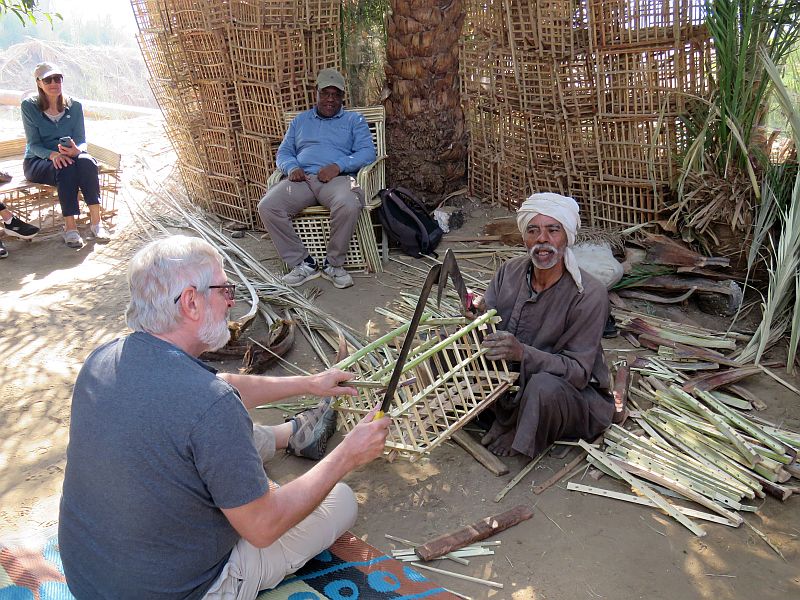
The touching of knife blades signaling the project is finished.

    The craftsman then constructs a small box which he finishes in short order. When he completes the box, our host gathers up some items that are lying to one side. The craftsman hands each of us an Ankh also known as the key of life that he has fashioned from the same palm wood he uses to make his crates. The key of life symbolizes both mortal life and the afterlife. The Egyptian gods depicted in tomb paintings and carvings often carry the Ankh. Two women ask Hussein if they can buy the small box that the craftsman made. Hussein relates the question to our host who ends up giving each woman a box since he has extra boxes stacked inside a crate. This gift from the craftsman is the only souvenir that Paul and I brought home.
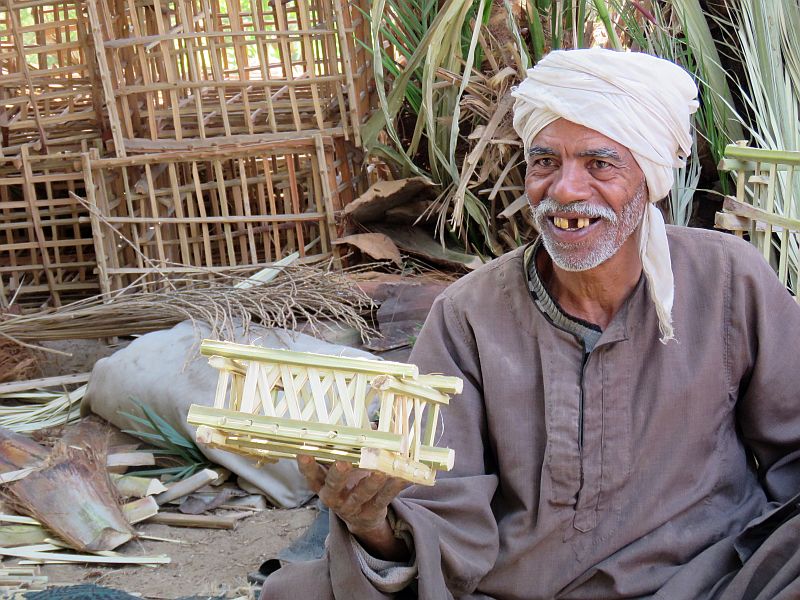
    Hussein talks about our host off and on while we are watching him work. The craftsman has two men that help him in his business. Our host also has two wives, one in Cairo and one in this village. Hussein says that the fellow told him he had to marry a local village woman in order to be accepted here, but Hussein is laughing when he relates this info to us. Hussein also tells us how many crates the man can make in a day, who sells him the palm fronds, and what they cost, etc. but unfortunately, I cannot remember the details.
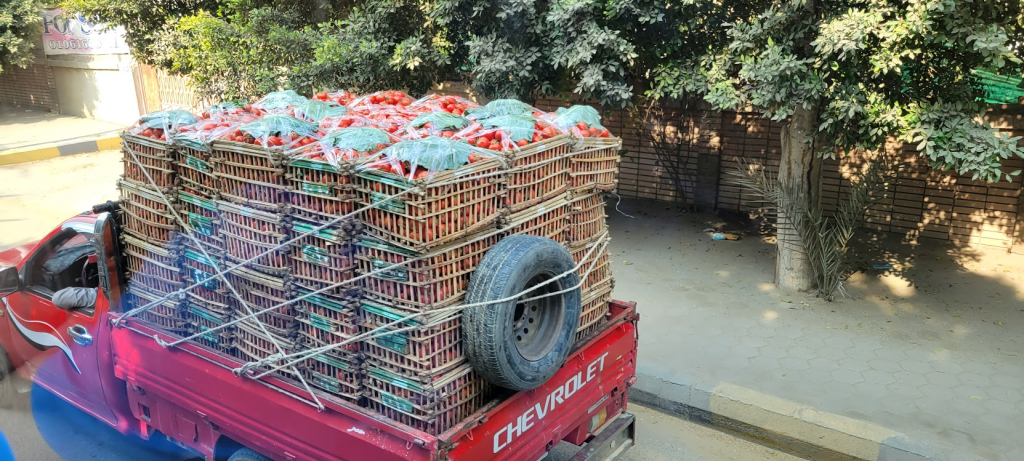
A good example of the crates our host makes being used to transport tomatoes. Jennifer’s photo

    We leave our host after thanking him for giving us a glimpse into his life as a crate maker and for the gifts he gave us. We go back to the tuk-tuk’s which take us back to the Aida. Jennifer and Hussein have shared a tuk-tuk on this foray since the woman who fainted yesterday decided not to join us this morning. Hussein made a stop at a grocery store as he needed coffee, so lucky Jennifer got to see the village grocery store. Hussein bought Jennifer some chocolate covered Oreos, and she is kind enough to share a package with us. Yes, you have read this before because I mistakenly thought this happened two days ago. I should have read my journal as I had made a note of their side trip but now it is in the correct order.
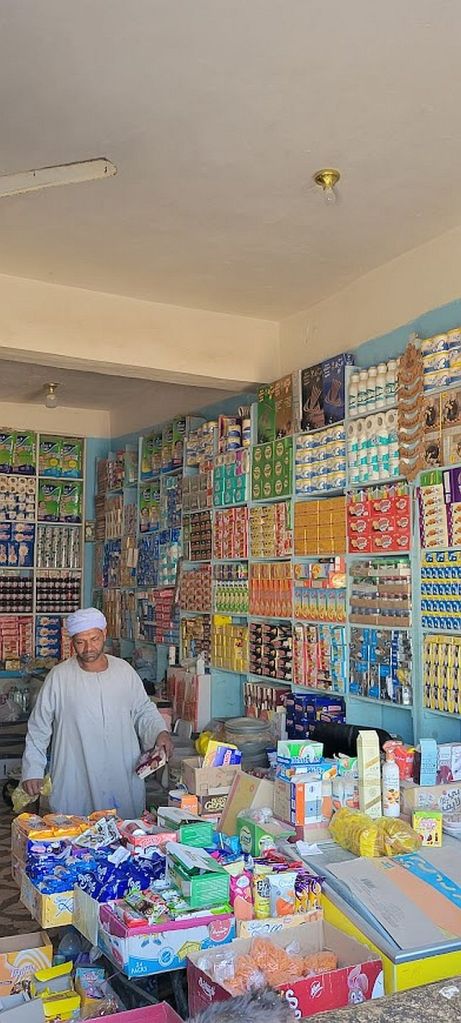
The grocery store where Jennifer and Hussein stopped. Jennifer’s photo.

    Today we eat lunch inside due to the heat and wind. Guess who we happen to eat our meal with? Yep, the women from Minnesota. Oh okay, we see that there is room at their table and ask if we can sit with them. I may not be eating much but I wouldn’t have the opportunity even if I was because our friend has me laughing all through our lunch.  

    We arrive at Kom Ombo mid-afternoon where the temple we are visiting is located. When we leave the ship, it is only a short walk to the temple. It is hot this afternoon, 90ish, and Paul wonders if I should go on this tour, since I do not handle heat very well. I decide to go as I figure I can find a place out of the sun to sit, if I begin to get too hot.
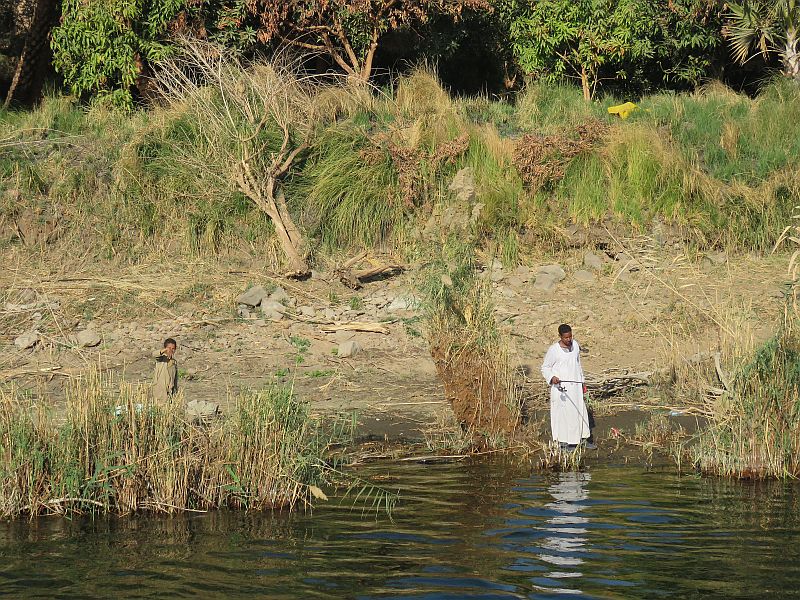
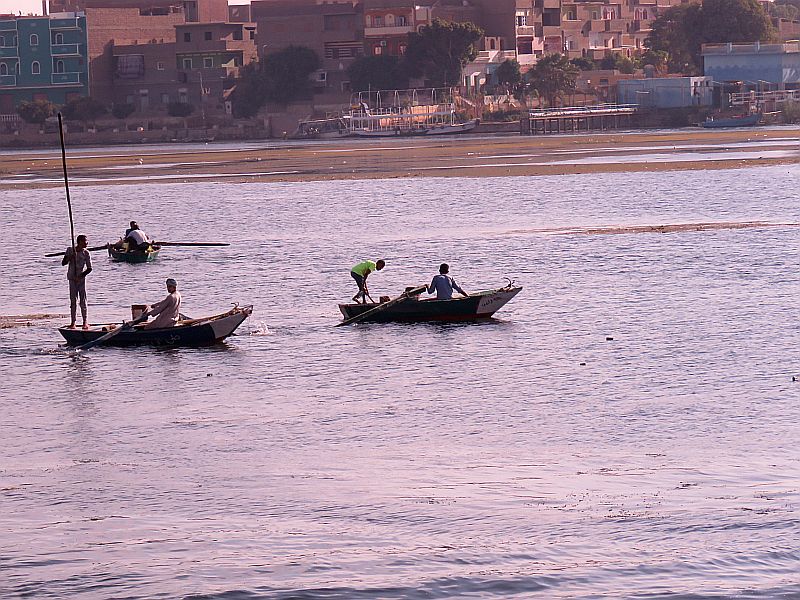
Fishing with a pole instead of a net.

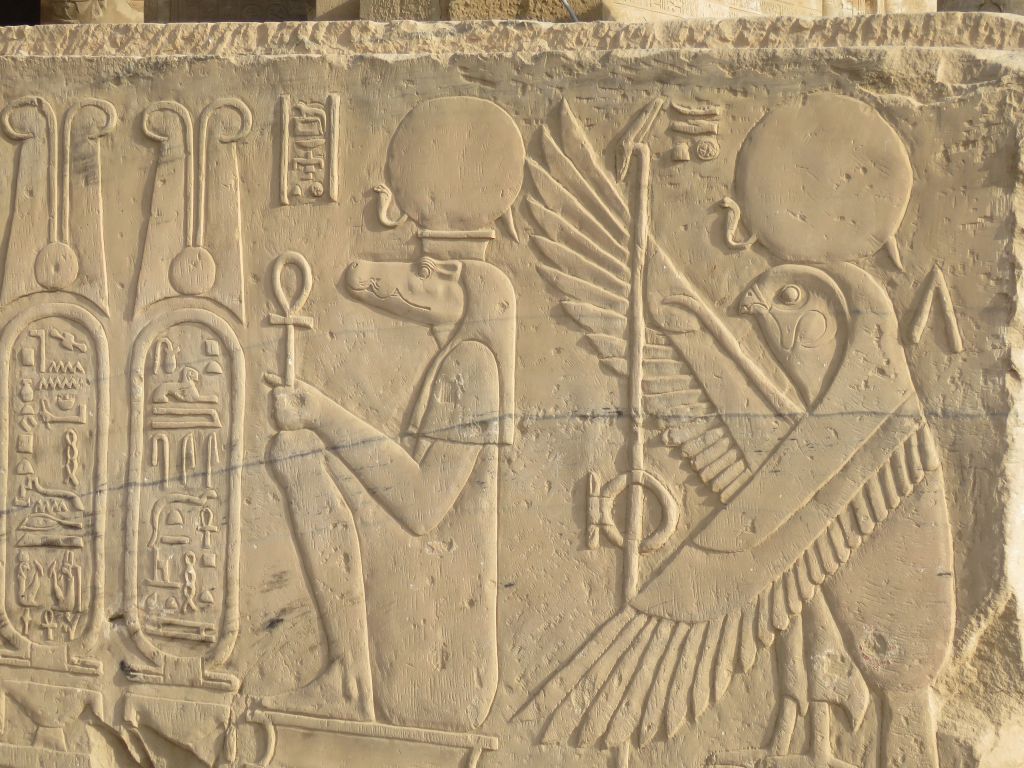
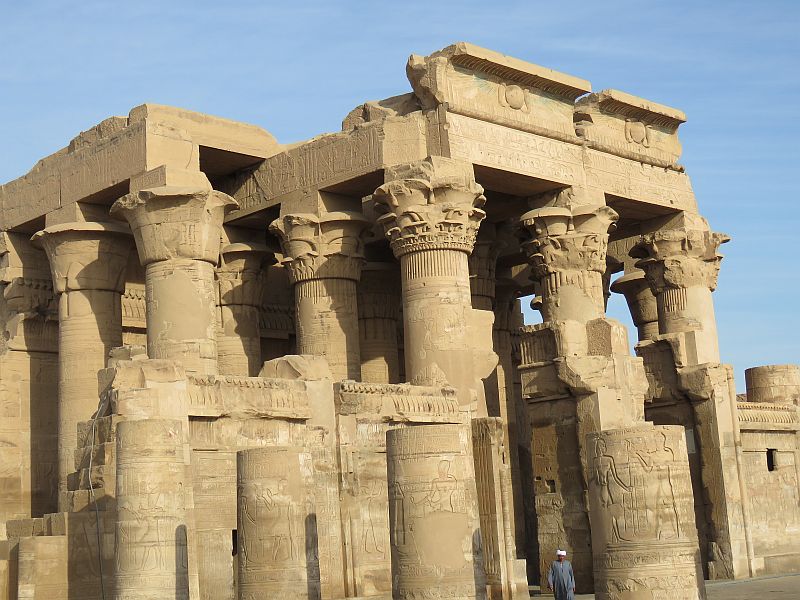
   Hussein explains that Kom Ombo is a twin temple meaning one side is dedicated to Horus, the Falcon God who is the ruler of all Gods. The other side is dedicated to Sobek the Crocodile God who is god of crocodiles, strength and power. This temple is unique as everything is doubled and symmetrical along the main axis: twin entrances, twin courts, and twin colonnades. Yea, I copied this sentence out of our OAT book, no way I would remember that.

Kom Ombo Temple as we are walking to it.

    There are a lot of tourists here and everyone appears to be suffering from the heat. Hussein does his best to keep us out of the sun but that is not an easy task. Paul even admits he is looking for shade and Paul generally is not bothered by heat. We wander after Hussein looking at the temple depictions of the Crocodile God more than those of Horus since we have seen Horus in all the temples.

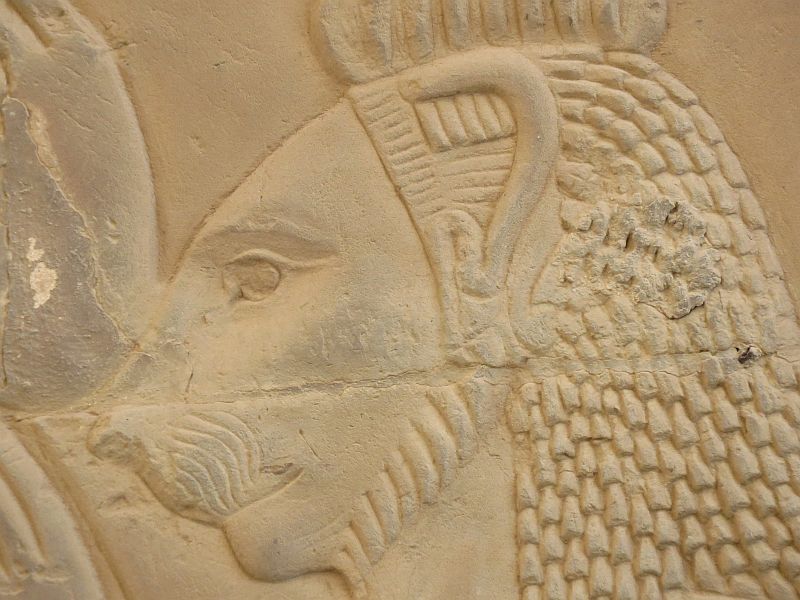
Slide show of the temple and carvings. Notice the key of life the seated crocodile god is holding. The green dot on the pharaohs chin is Hussein’s light he used to point things out to us.
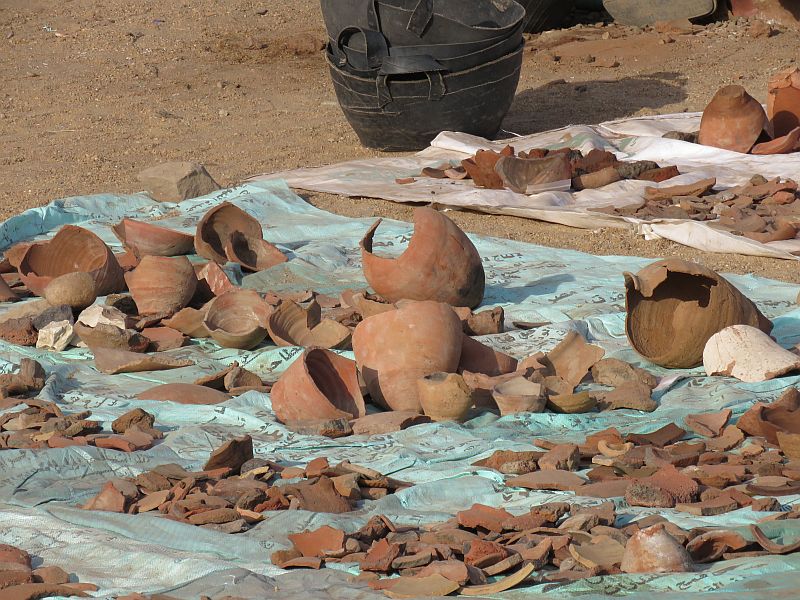
    There are archeologists working right by the temple and it is astonishing to look at all the pottery shards that are laid out on the ground. I wonder if they intend to try and put those pots back together as the pieces seem to be grouped in small piles. What patience that would take but how rewarding when you accomplished the task. I always thought it would be fun to go on an archeology dig but I wouldn’t last an hour in this heat.
    There is a Crocodile Museum here, that as you can guess, is a museum that contains Nile crocodiles. The mummified crocodiles on display are all sizes from very large crocs that you would not want to encounter in life, to a crocodile that is still in the egg.  The museum is kept relatively dark to preserve the mummified crocodiles plus it is air conditioned. Boy does that cool air feel good.   
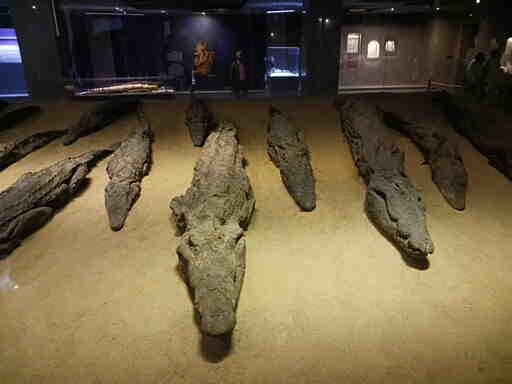
Mummified crocodiles. Paul’s photo.

   This evening Hussein discusses modern Egypt using some film clips to highlight some of the topics he is covering. The main thing I recall Hussein discussing is the tough times Egypt has been through prior to the 2011 uprising and after that coup. Terrorism, attacks on tourists, government crackdowns before the coup and after the coup against protesters, resulting in deaths and injuries of citizens. The attacks on tourists through the years severely impacted tourism in Egypt which obviously impacted the economy. Hussein tells us that tourism had begun to recover when Covid shut down the world. Inflation is another huge problem in Egypt and the people are struggling. The government/ army is competing with private business in all aspects like farming, operating ferries, even gas stations and private businesses are having a tough time competing with the government run operations. Hussein is very candid when he discusses the country and government and seems to not be concerned at all about levying criticism along with the positive aspects.

    When Hussein finishes his presentation, we go to the dining area where we sit with our friends from Minnesota and the woman who is traveling solo. Tonight, our humorous friend relates some of the pranks she played on her students. I will not relate the stories as I do not have permission to, but trust me, if you were a student of this woman, I doubt you would ever forget her! Our comedian also tells jokes and after one of the jokes, her traveling companion remarks with some surprise that she has not heard that joke before. That was funny in itself.  Our day ends with laughter again which is always good.

  Touring a man’s barn and livestock in a village, shopping for vegetables, taking a short walk on an island.  Our last night on the Aida.

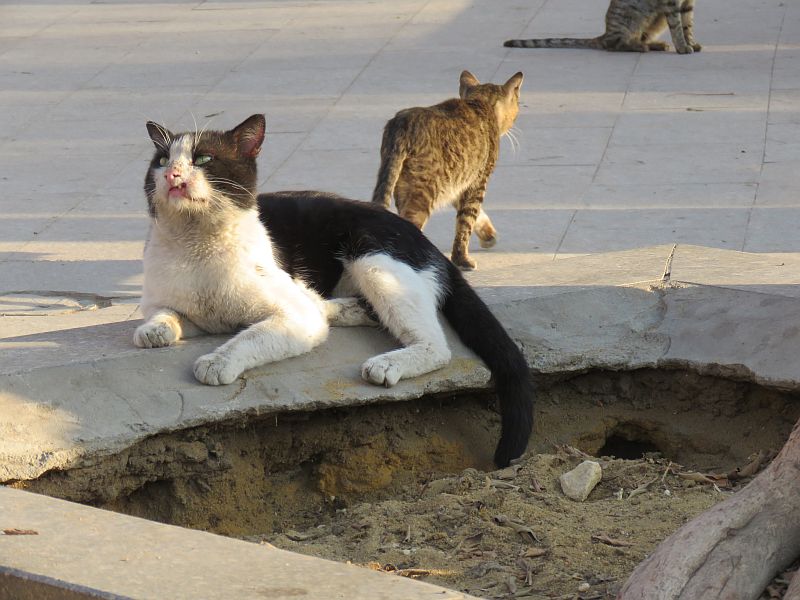
A beautiful cat that was at the craftsman’s workshop.
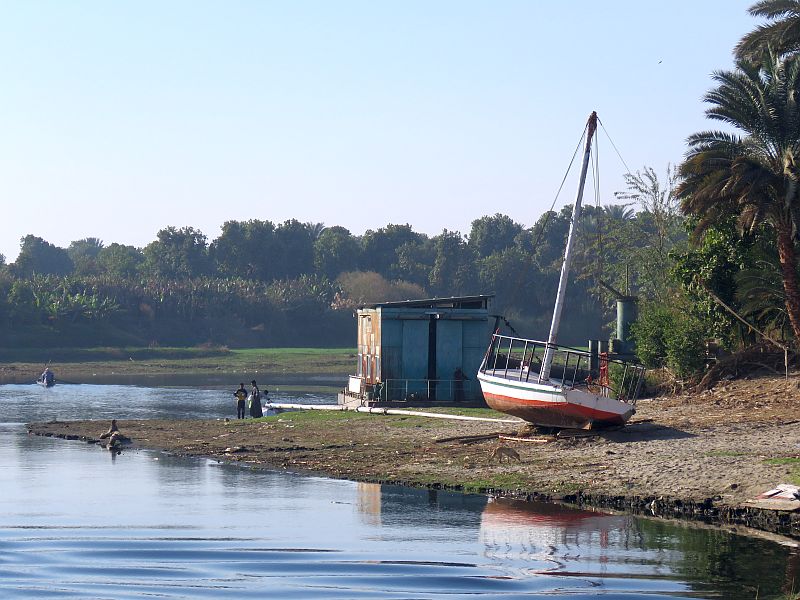
Fishermen laying down their net, next to our boat.

ENJOYING THE NILE CRUISE, VISITING A FARMING VILLAGE AND AN ANCIENT STONE QUARRY, part 8

    It looks like I am in a routine on the Aida, as this morning I arise at 6 a.m. and am sipping tea on the observation deck by seven. It is cooler this morning but not enough to keep us from eating on the deck. It is so peaceful out here and plenty of interesting things to look at. I love this!

Slide show of a few things we saw as we cruised this morning.


    I am going to relate a story here that may or may not have taken place this morning, but I have a photo that I believe is of the man that was part of this tale. Jennifer and I are walking laps again when the tugboat and our ship crew begin maneuvering our ship towards the shore.  Once the Aida is close to the riverbank, the crew slides the narrow gangplank over to the shore. A man walks across the makeshift bridge onto land and the crew pulls the gangplank back onto the boat.  Who is that guy and why was he on the ship?

I have used this photo before, but this allows you to see the ledge the man walked on to get to the bow of the ship.

    Jennifer and I look up at Paul who is standing on the sundeck above us. We ask him if he knows what is going on. He laughs and says he watched the whole episode unfold below him. Paul said there were two men in a rowboat that came alongside the Aida and grabbed onto our river yacht letting the ship pull them up the river. Paul said they must have grown tired of using their hands to hang onto the boat as one man took off his turban and tied it to something on the Aida and fastened the other end of the turban to the rowboat.  Now they have themselves a makeshift tow rope although that must be some very strong material to withstand the pull of a rowboat and two passengers. Paul estimated that our ship towed them for about a half-mile when one of the men hoisted himself onto the narrow ledge that sits just under the windows of the ship cabins. According to Paul, the fellow carefully shuffled along the ledge until he reaches the bow of the Aida. Paul said that in the meantime, the man in the rowboat untied the end of the turban fastened to their boat and rowed away from the Aida. The man that climbed onto our ship was not on board for long as the crew quickly finds a place to deposit the stowaway on shore. It was not until this part of the story took place that those of us on the observation deck were aware that anything out of the ordinary was taking place. The finale of the story was when one of the crewmen threw the abandoned turban into the Nile. Oh yes, Paul is lamenting that he took no photos of this unusual activity. He said he was so captivated by what was unfolding before his eyes that it never crossed his mind to take pictures!

I am almost certain this man talking on his phone is our stowaway.

    Hussein joins us on the observation deck and tells us that the man was calling friends on his cell phone when he safely made it to the bow, to see if anyone could come and pick him up. According to Hussein the man’s destination was too far for him to walk. He must not have found anyone willing to rescue him while aboard the Aida, as he was on his phone as soon as he sat foot on land. What Hussein did not explain or I missed that part of the story was why the man climbed onto our ship. You would have to surmise that the stowaway had hoped he would be allowed to stay on the Aida until he reached his destination because if he only wanted to get ashore the rowboat could have easily taken him there. You can see why Hussein and the crew refused to let the fellow stay on board because if you do it for one person how do you stop other river hitchhikers from boarding in the future with expectations to be delivered to their destination.

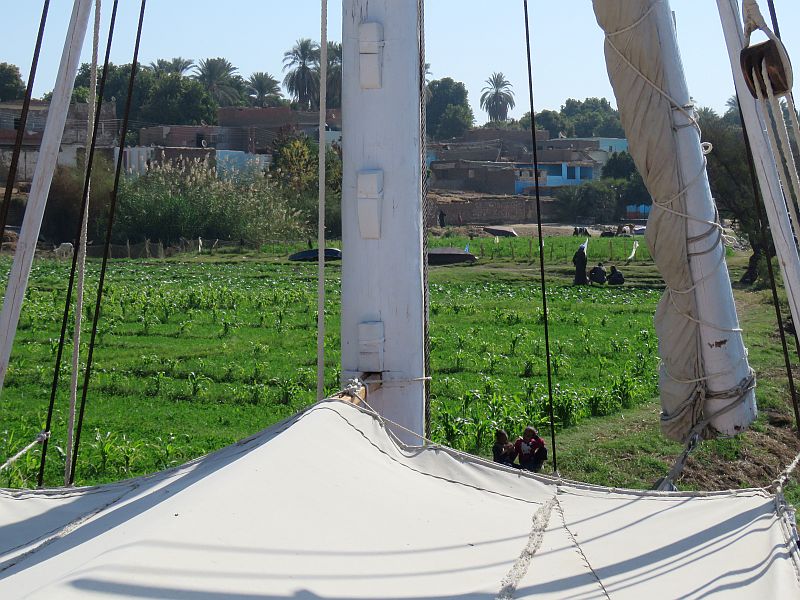
Looking through the masts of the Aida at farm plots and the village.

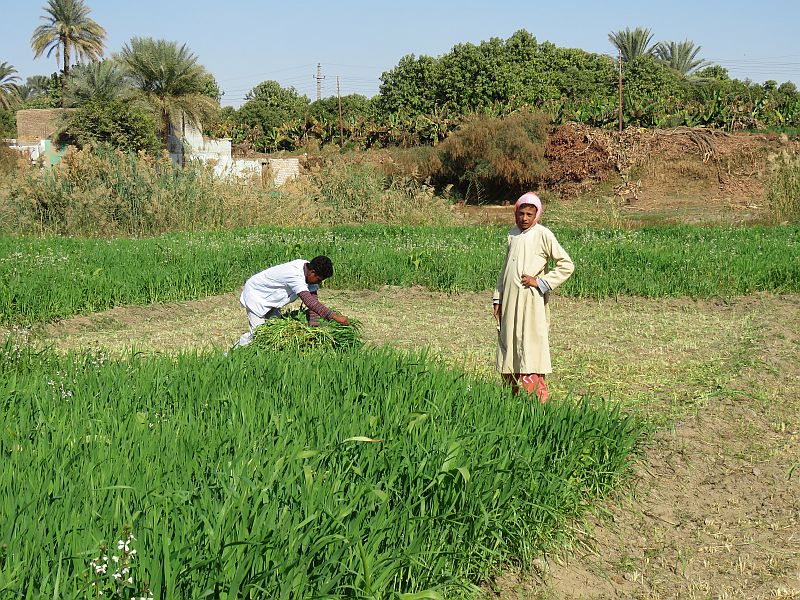
    We have a wonderful view of the farming village as we approach the docking area. The green, symmetrical plots where a few head of cattle stand along the edges of the fields is beautiful. There are field workers carrying bundles of freshly harvested grass out of the fields with the village in the background. The man who will be educating us about farming and life in the village is waiting for us on the river’s edge as we dock.

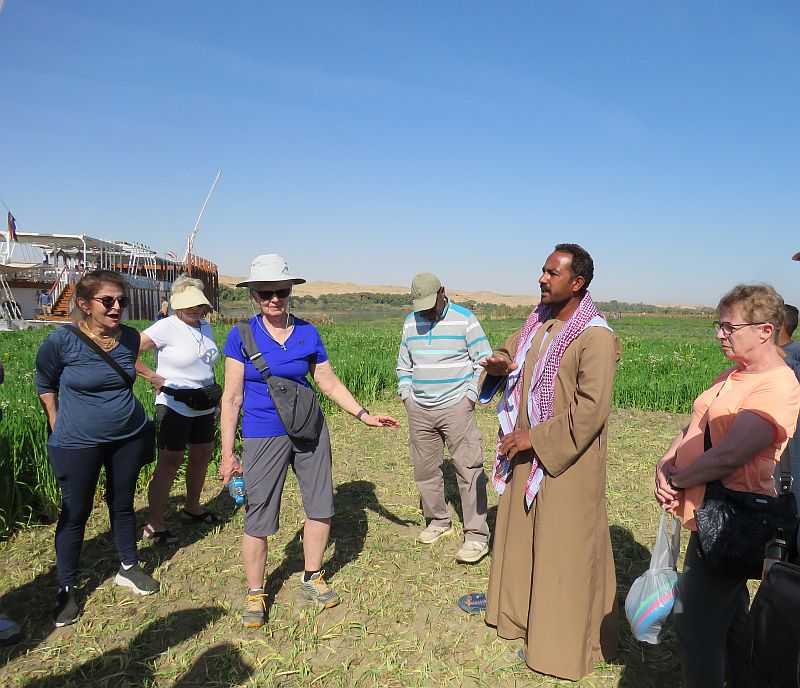
Sayed, the head of the farming village, educating our group about agriculture in Egypt.

    Hussein introduces us to our guide, whose name is Sayed, and informs us that he is the head of the farming village. Our first lesson is only a few yards away from the boat in a small field of barley. As our group walks to the barley field, we pass by a plot that appears to be alfalfa, but if it is, it puts the alfalfa we raise at home to shame. The leaves on these lush plants are huge compared to our alfalfa.

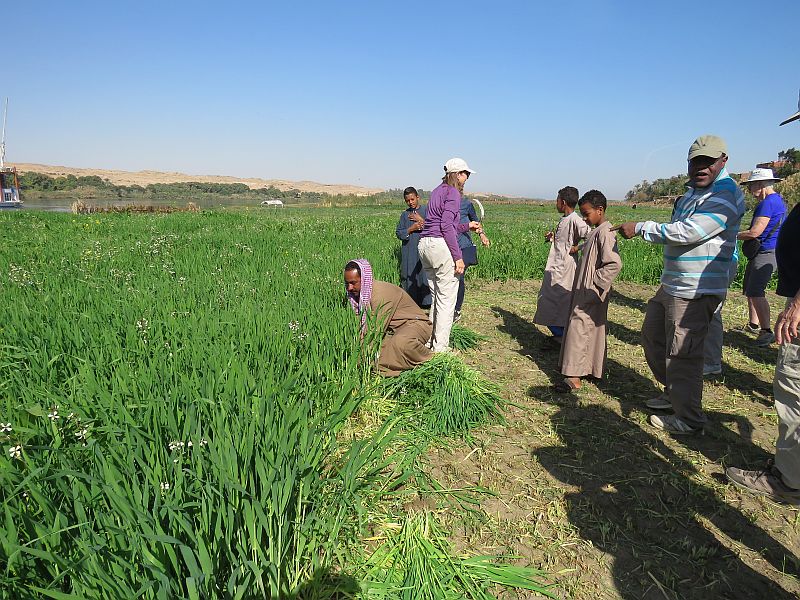
  Sayed talks about the barley, which they cut before it heads out, which is used for livestock feed. He asks if anyone would like to try to harvest the lush grass using a hand-scythe. After a young boy demonstrates the technique of cutting the barley, many in our group try our hand at harvesting the forage. Hussein warns all of us to be very careful and keep our fingers out of the blades path. Good advice as the scythe blade is very sharp.

   We work in pairs under the watchful eye of our youthful teacher while Sayed is busy answering questions from members of our group. Oh yes, Sayed speaks fluent English. When it is my turn to cut the barley, I get on my knees and swing the scythe in an arc as close to the ground as possible, just like the young fellow demonstrated. I bunch the cut grass together and pile it off to one side. I cut one more swath than stand up and pass the blade to the next volunteer. The young fellow flashes a big grin at me and gives me a thumbs up. It occurs to me this could be a likened to the Tom Sawyer story when he gets his friends to whitewash the fence!

Sayed scything barley grass. If you look close you can see the hand scythe in the woman’s hand.

   When everyone has had a turn at harvesting the barley grass, Sayed proceeds to demonstrate the art of scything barley. He gets on his knees and makes long, sweeping cuts that lays down a large area of the grass. I cannot imagine working like this for long but a seasoned worker like Sayed, could cut a lot of grass in a short amount of time.  

    Before we walk to the village, Hussein tells us to give the pens, crayons, papers, etc. we brought for the children to Sayed who will distribute them later. Since several children have begun to shadow us, Sayed decides to line them up and let members of our group just pass their gifts directly to them. Paul and I did not bring enough ink pens and paper pads to give to each of the kids that are in the line up, so we do not participate in the handout. Jennifer and a couple of other members of our group are in the same spot as we are. Those of us who didn’t have enough gifts for all the assembled children had understood that the items would be collected and given to the school.

Village children lined up for gifts.

    There are a couple of kids who hide what they have been given and then they go to the back of the line where they receive even more loot. Rascals. The saddest thing is when someone from the village carries a young boy up to the group whose father has recently died. The gifts have already been distributed by then, but I hand this little guy a pen and a pad of paper.  I believe everyone else finds something to gift to the grieving child.

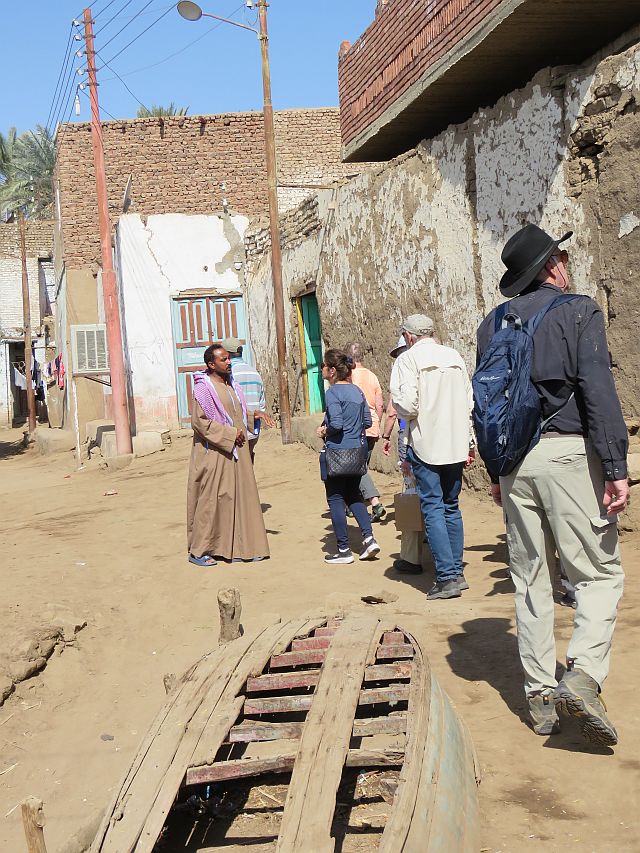
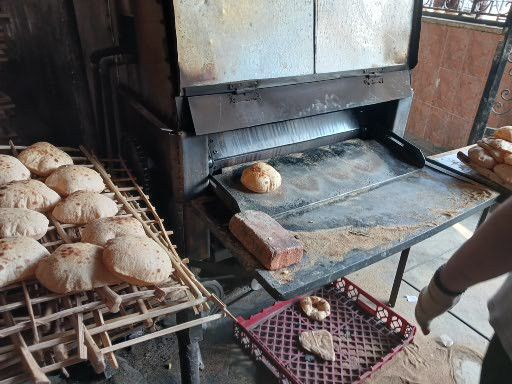
   Not long after we have entered the village, we are ushered into a small room where two women are preparing to bake bread. Sayed talks about the bread and then turns it over to the two women who demonstrate by dusting the bread with flour and then slapping it hard against the thin plate of steel that is attached to a long handle. One of the women slides the bread “shovel” into the oven and deposits the bread onto the oven rack.  Sayed asks for volunteers to give this a try, and three or four people participate in this way of baking bread. As we are leaving the bakery, Sayed’s son runs up and proudly shows his dad a picture he has drawn with the items that were passed out to them. Everyone admires the boy’s work; it really is quite good. It is determined that the colored pencils used for this artwork was provided by the couple from Connecticut, (I think), and the boy agrees to let them keep the picture.   

Sayed talking about the process of making and baking the bread.
This is the oven, and the woman is holding the tool that is used to place the bread into the oven.

    We follow Sayed and Hussein through the village and into a banana grove. We learn a lot about bananas from this young farmer, not that I knew anything about them to begin with. Sayed and his brother bring a large sprout that was taken from a mother tree for our group to plant. Three men, including Paul, dig a hole using a root hoe and then three women, including me, plant the banana tree to be.

Paul digging the hole to plant the immature banana tree.
Nancy holding the sprout while other’s begin to fill the hole with dirt. Paul’s photo.

   It is very warm by now and as Sayed is answering our questions, one member of our group passes out. Paul said he saw the woman drop her water bottle, reach over to pick it up, and then just fall to the ground. Hussein is at the woman’s side immediately as are Sayed and his brother. Our friend comes to quickly and the men gently lift her to a sitting position. The woman has bloodied her nose and seems a bit dazed but is coherent. Hussein assures us that she will be fine and says that she is dehydrated. Once everyone is assured that she is fine, Hussein sends us with Sayed who leads us back to the village and to his house. Sayed’s brother stays with Hussein to attend to our friend.

Slide show of scenes in the village, the photo with the round white objects are loaves of bread sat outside to make the bread rise.

    As we gather in front of Sayed’s house, we are all amazed when we see the woman walking up to the house, with the aid of Hussein and Sayed’s brother. Hussein takes us into Sayed’s house and has us take seats in a narrow room, then they bring the woman in to join us. Hussein brings a bottle of water that he has added salt and sugar to and directs the woman to sip on the home-made electrolyte solution. This is one tough, amazing woman who could have gone back to the boat but was determined to stay and experience the rest of our time in the village.

  Once we have been served drinks, tea or sprite, Sayed picks up a laminated map, of the United States. He asks that each of us point out the state we are from and tell everyone what we do for a living. Sayed demonstrates his request by pointing to Colorado and stating that he lives in Colorado for six months where he farms. He then points to Texas and says that he lives in Texas for six months and is a fisherman. This of course, makes us all laugh. The man’s English is amazing, and he has shown us throughout this tour that he has a great sense of humor. Once everyone has identified their home and occupation, Sayed introduces his wife and sister. We are encouraged to ask questions which many do, some for Sayed, others for his wife and sister who is soon to be married. 

Sayed introducing his wife, in the discussion room. Sayed’s brother standing in the door.

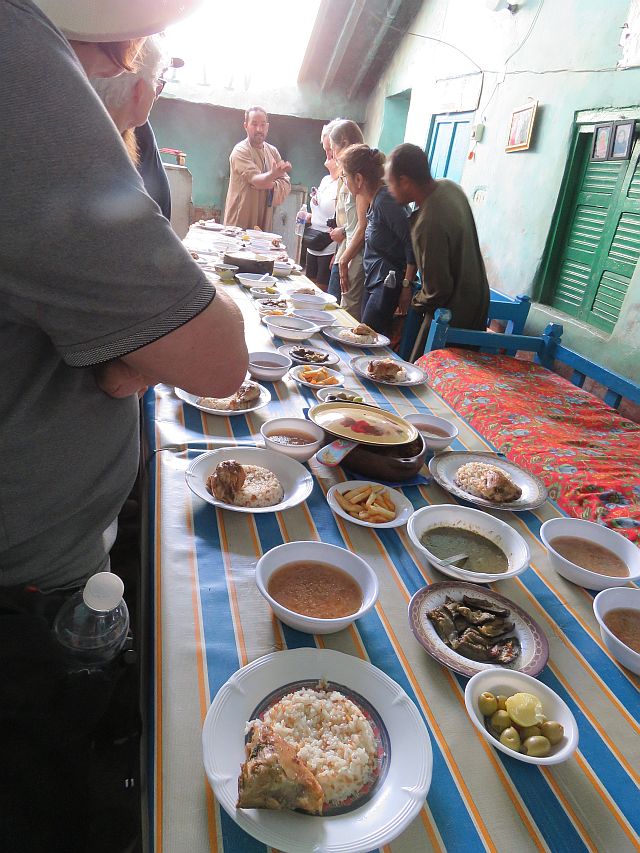
    After the meet and greet we are ushered into another room where the women have laid out a feast for us. There is chicken, bread, rice, and other side dishes. Someone asks Hussein if the family eats like this every day, and he replies in the negative. Hussein tells us that a meal like this would be eaten once a week and that the people only have meat with their meals two or three times a week if I recall correctly.

The feast that the women had prepared for us.

   After we have finished eating, we are taken back to the discussion room where Sayed again takes our questions. I ask him how they control pests in the alfalfa. He says they have cattle egrets that keep the bugs under control. I shake my head in disbelief and tell him that we have insects that can quickly damage the alfalfa if you do not catch a bug infestation quickly. He assures me that the egrets take care of the bugs in their crops, and this is not a problem. Amazing.  Later, when thinking about this, it dawns on me that the birds have a very small corridor in this country to find food. The farmed area of Egypt only occurs along the Nile which does not extend far from the water. Therefore, the birds are highly concentrated, unlike in our country, and have a limited area to find food. This is purely a hypothesis on my part.

Our group in front of Sayed’s house. This must be a photo Hussein sent us.

   It is time to return to the Aida and we thank Sayed and his family for the meal and the interesting tour. After we leave someone asks Hussein if Sayed is highly educated. Hussein shakes his head and says that he is not, Sayed reads all the time and has gained his knowledge on his own. Imagine that. Paul and I agree that so far this has been the highlight of our visits in Egypt and we both were impressed and amazed by Sayed intelligence, ability and wit.

    Our next stop is at an ancient stone quarry. We stroll along a trail and Hussein stops here and there to talk about the quarry. One stop is at a small tomb that our guide says that only a person of some importance would have warranted, but it is nothing compared to a King’s tombs. He points out where workers chiseled out big blocks of building stone. Hussein shows us the path that was used to drag the rock to the Nile. The workers bored out holes in the rock cliffs that line the trail. Ropes were placed through the holes which helped the laborers control the multi- ton blocks as they pulled them down the slope to the waiting barge.

Paul relaxing on deck waiting to disembark at the stone quarry.
Evidence of chisel marks where stone blocks were cut from the cliffs. I have forgotten what those oval indentions are.
Holes cut into the rock that lines the path which leads to the Nile from the quarry. Paul’s photo.

    We return to the Aida but the crew does not pull up the anchor as this is where we will be spending the night. Hussein informs us that there will be a film shown in the lounge at five o’clock. The film is about a man, British I believe, that walked the full length of the Nile. When the film is over it is time for dinner. Paul, Jennifer, and I sit at the table with the two women from Minnesota. They are delightful people and one of the women is a card. She enjoys telling jokes and keeps us laughing throughout the meal. I am as amused with her body language and how she cannot keep from laughing before she gets to the punch line, as I am with her jokes! Writing this is making me grin just thinking about her! A good way to end a very good day.

    Tomorrow, we visit a crate maker and the temple of the crocodile God, Sobek. Nancy

The cat that came to dinner at Sayed’s house
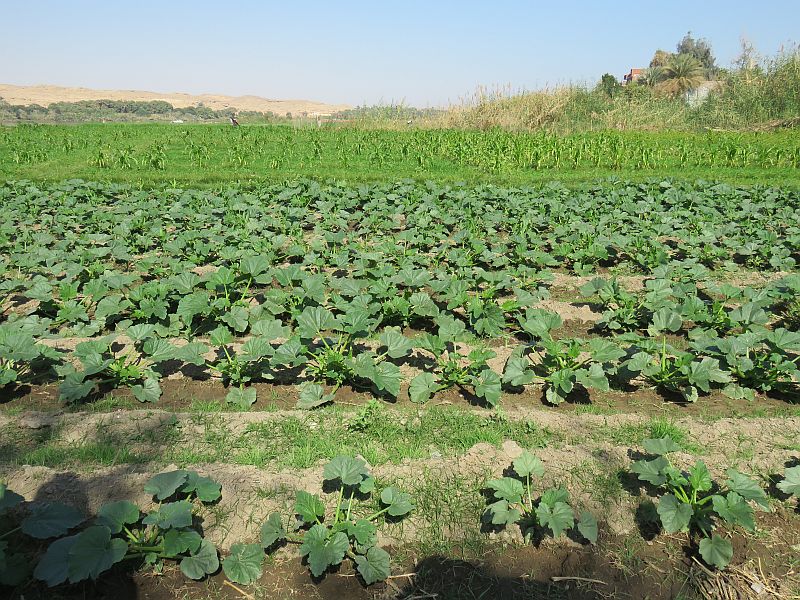
A field of squash.
Tying up a bundle of barley grass.

QUIET MORNING ON THE NILE, CARRIAGE RIDE TO TEMPLE OF HORUS, UNFURLING THE SAILS, part 7

QUIET MORNING ON THE NILE, CARRIAGE RIDE TO TEMPLE OF HORUS, UNFURLING THE SAILS, DINING AND DANCING ON SHORE THIS EVENING, part 7

    Our first night on the Aida allowed for a decent night’s sleep for me, (finally). It was so quiet and very dark which is what Paul, and I are accustomed to. There is no heating on this ship, but our room was very comfortable temperature wise. On our pre-trip instructions we had been warned that we should bring flannel pajamas, gloves, long underwear, and a warm coat, for our time on the ship, as the nights in Egypt this time of year can be quite chilly. Paul and I ignored the flannel pj’s and long underwear but did bring gloves and a fleece to go under our jackets. Unless things change drastically, we are not going to need those articles of clothing.

   I leave our cabin at seven, (Paul is still sleeping), and go to the dining room to make myself a cup of chamomile tea. I don’t know when the crew untied our river yacht, but we are already sailing down the Nile. I go out to the observation deck where the only other person on the deck is a crew member busily cleaning the floor. I will say that this ship is spotless. It seems someone is always sweeping or wiping surfaces down.

Black-winged Stilt

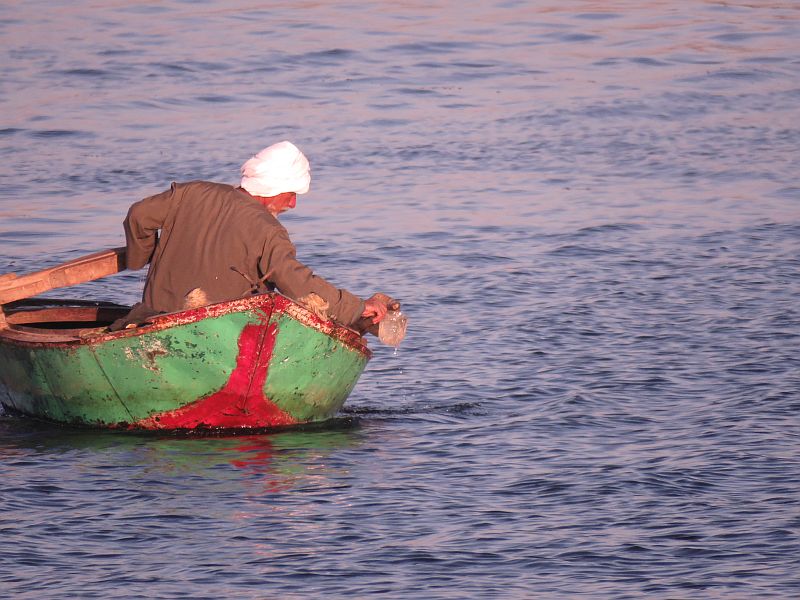
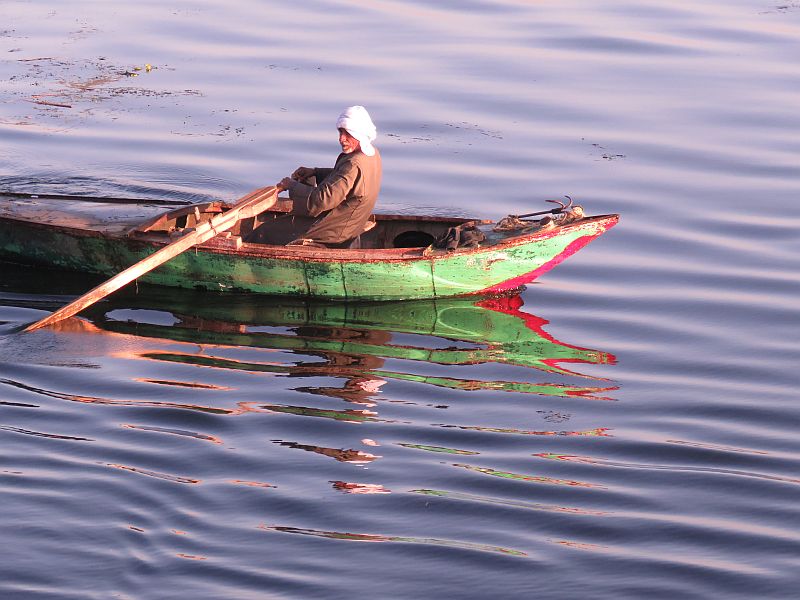
    As I sit and sip my cup of tea, I enjoy the scenes along the Nile as we float along. The fishermen are already out, and I begin taking photos of one fisherman occupying a colorful green and red rowboat. The turbaned fellow is moving right along when he suddenly stops paddling. I assume he is going to pull up his fishing net or wire fish traps as there is no fishing gear in his boat. However, the boatsman picks up a drinking glass which he dips into the Nile, filling it with water. As I continue to snap photos, I watch in horrid fascination as the man thirstily gulps the water down. Well, the fellow must have an incredible immune system to be able to drink directly out of the Nile. The photos are a slideshow, but you must click the arrows, it doesn’t go on its own.

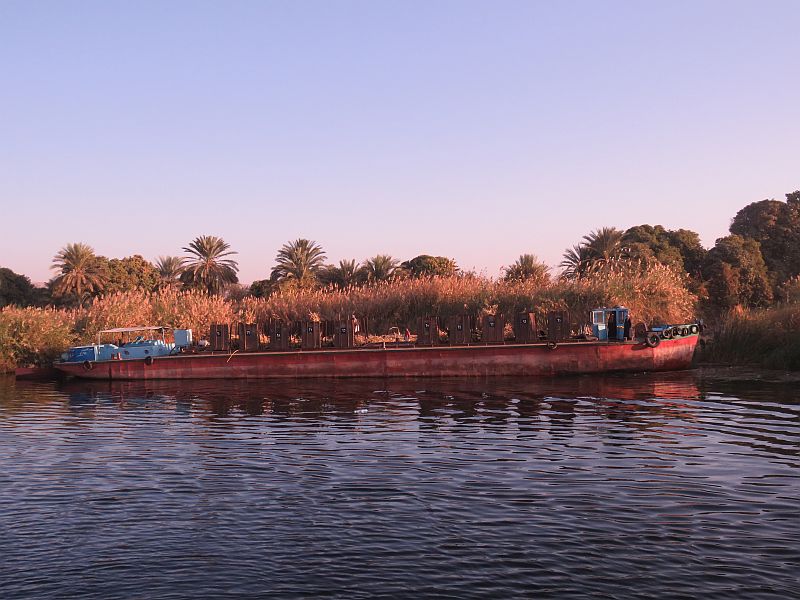
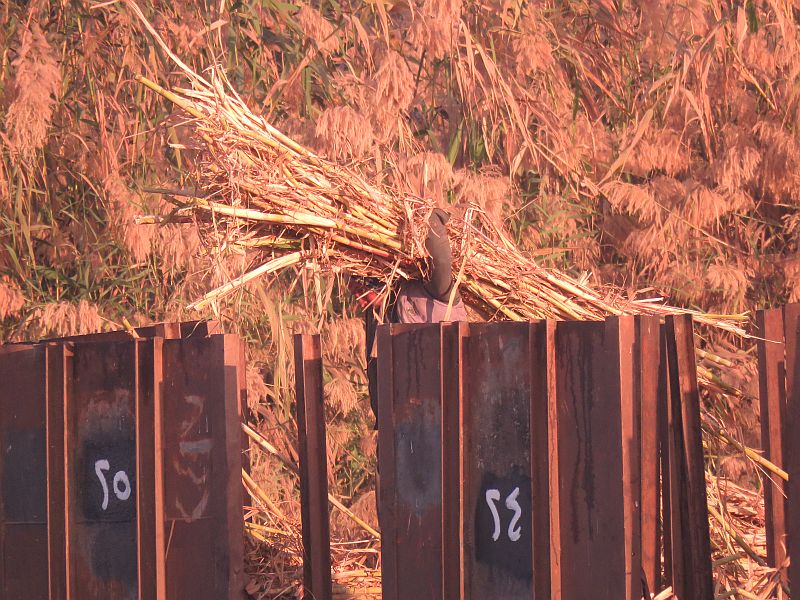
    I also observe a long barge moored along the bank of the Nile. There are men hauling what looks like dried sugar cane onto it. Most men are carrying large sheaves of the yellow stalks on their backs, while another fellow is using a wheelbarrow or cart of some kind.  There are two camels standing alongside the barge. One of the camels has a man astride him. I cannot tell if the camels are being used to pull or haul the dried cane to the barge. Photo slideshow.

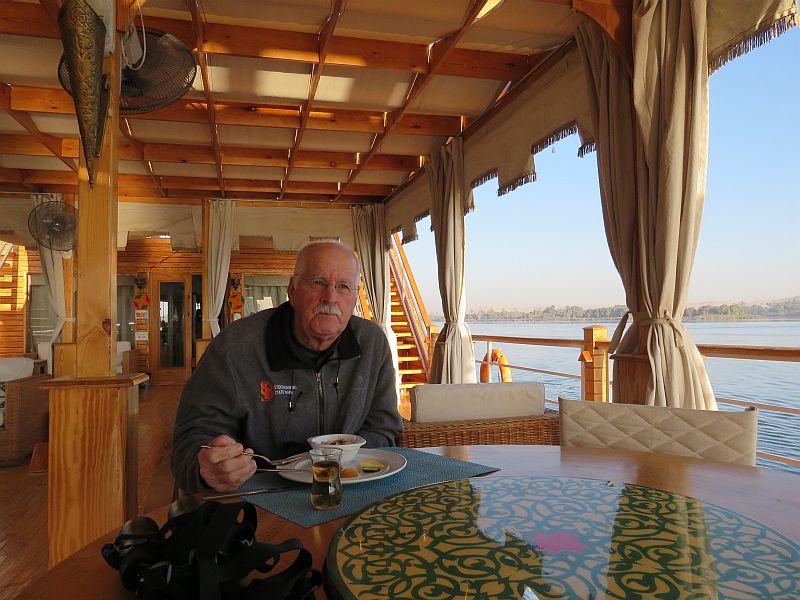
    Paul shows up and we go into to the dining room to see what is on the breakfast buffet menu. There is all kinds of fruit, breads, oatmeal and cold cereal, beef bacon, (no pork in Egypt), various juices, tea, and coffee. The chef has a cook station set up on the observation deck where you can order an omelet or eggs fixed any other way you can think of.  Paul and I pass on the eggs. It is warm enough that Paul and I eat breakfast on the observation deck, as do some of the other members of our group. Pretty cool to be eating breakfast as we float down the Nile.

Paul enjoying his breakfast. Quite a view.

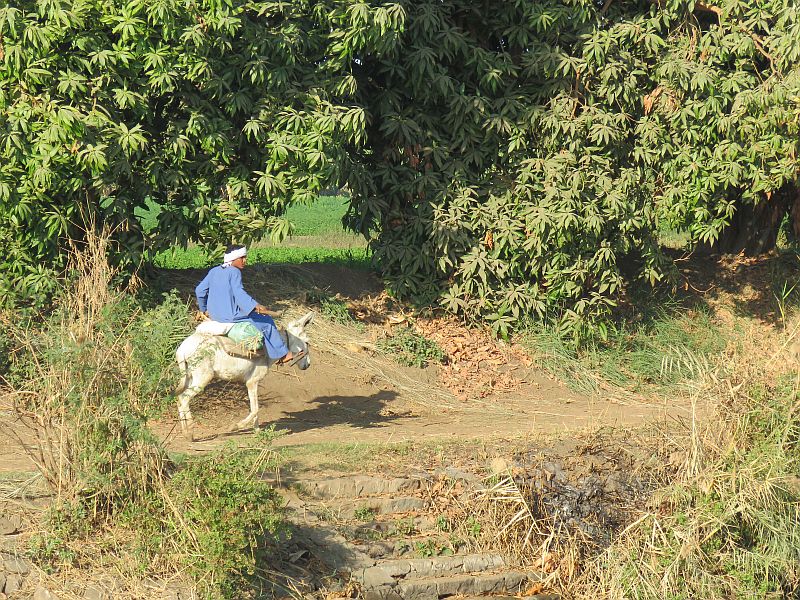
    After breakfast, Jennifer and I get some exercise by doing laps on the observation deck and walking up the stairs to the sundeck. Most of the group has assembled on the observation deck by now. I think everyone is enjoying watching life along the Nile. People are walking or riding donkeys along the riverbank, we pass by colorful villages and children wave as we pass by.  Sailing down the Nile is everything and more that I imagined. Another slideshow.

    Around ten a.m. our ship docks at the city of Edfu and we take off our boat shoes and put on our walking shoes. I think I forgot to mention that we were asked not to wear our excursion shoes on the boat in order not to track sand and grit all over the Aida. When we disembark, Hussein is telling us about taking horse and buggies to the temple which is on the other side of Edfu. There are probably a dozen horse and carriage on the street waiting for customers. There is an altercation between some of the horse and carriage owners and they begin yelling at each other.  Hussein laughs and tells us that this is just the way these guys talk. Might be, but I look up to see a man, (who is standing behind one of the men who is arguing), wrap his arms around the guy. This peacekeeper pins the angry man’s arms to his side while at the same time keeping him from advancing towards the guy he is at odds with. A man in uniform appears and talks to the pair which seems to calm them down. Once he gets this spat under control, the policeman begins directing the horse and buggies into a line along the side of the street. I am guessing the altercation came about because everyone was jockeying to get close to the stairs that we must climb to get up to the street. They probably assume if they are closest to the stairs, they will be guaranteed customers. I admit I paid more attention to the drama than I did to Hussein.

The line up of horses and carriages. Paul’s photo.

    Hussein calls out “follow me” and our group ascends the stairs towards the waiting carriages. The horses are not in good shape, their ribs and backbones are prominent. I cannot tell if the horses are very old, which could be part of the reason for their condition or if they are not being fed well.  Hussein takes two people from our group at a time and walks down the line of buggies carefully studying each one. I am not sure what he is assessing, the drivers, horses, carriages, or all three. When Hussein finds what he is looking for he stops and has the people following him find the number that is painted on the carriage. Hussein imparts to the people that it is important to remember the number because you will ride in the same carriage on the return trip to the ship. He also says to not tip the driver until you are delivered back to the ship. Hussein instructs us to give the driver fifty Egyptian pounds and no more. By the way, OAT does all the tipping for things like this, so Hussein handed fifty pounds to one of the riders in each carriage. We love this about OAT as it is one less thing to worry about.

    Before we leave, every driver asks for their customers phone, and they proceed to take photos of you seated in the carriage. We are looking directly into the sun so our photo results in two people with their eyes squinted to slits.  Our driver is very quiet and does not talk to us on the jaunt to the temple which is fine. What we like best about him is that he does not use a whip on his horse as many other drivers do to make the horses gallop.  I hope the poor things have good shoes to help cushion the impact on their joints from the solid surface of the road.

Paul and Nancy squinting into the sun.
Heading to the temple. The man just ahead of us didn’t score any customers.

   We clip-clop through the town of Edfu which is a little rundown. The people are going about their business and do not take much interest in us. We have arrived on the other side of the small town when I see a young boy dash out into the street ahead of us. I exclaim to Paul that the youngster is trying to race the horse and carriage that is ahead of us. Not quite, the rascal runs up behind the buggy, jumps onto the back of it, and hangs on. The driver lashes his horse into a gallop, so we lose sight of them and their stowaway. At the entrance to the temple, we catch up to the carriage and there is no sign of the boy. I guess this practice of catching a ride not only gets you to your destination quicker but probably adds a little excitement to the day.

The town of Edfu.

    The area where the carriages let us off is a hundred yards from the temple entrance. There are a few men waiting here that immediately begin trying to sell us souvenirs as soon as we set foot on the ground. Hussein is telling us that we will come back to this spot to find our carriage when we are finished exploring the temple. During Husseins’ instructions, I hear a sharp, “Hey” behind me. I turn around to see one of the vendors glaring at Paul as he reaches down to retrieve a bracelet off the ground. When the fellow stalks away, I ask Paul what happened. Paul says the guy laid a bracelet on his arm and when Paul moved his arm the jewelry fell to the ground which elicited the angry exclamation from the seller. Well, that is a new tactic. We find out from another woman that they did the same thing to her and when she moved her arm away the item also fell to the ground. As we follow Hussein to the temple entrance, we hear a member of our group who is walking behind us, shout a loud and angry “no.”  Another member of our group immediately walks back to see what is happening and to help ease the situation. We find out later that an aggressive vendor tried to attach a bracelet around the wrist of the man’s wife and that is why he yelled at the guy. Jeez.

Our group walking to the temple of Horus

    Okay, I will admit that I don’t remember much about this temple. I do recall that the temple was buried in the sand for centuries maybe millennia and some French archeologist discovered it in the late 1800’s. In our OAT book it says that this is the second largest temple, but it does not specify whether this is in Egypt or the world. I do remember that the temple is dedicated to Horus, the falcon- headed God. Hussein talks about the temple and then allows us to look around the structure on our own. We are to meet back at the carriage drop off at a certain time. After we have explored the temple, Paul and I exit the temple grounds and wait in front of the ticket office. There is another couple from our group waiting there too. Hussein walks up and tells us we can go out to the parking lot and find our carriage. I think we all mentally sigh because we must walk through the souvenir trap to get there.  Just as we are preparing to face the inevitable circus, we see two workers walk through a small gate. We look at each other, shrug our shoulders and exit through the gate allowing us to miss the keepsake sellers all together!

Beautiful stone sculpture. Horus is the God represented by the falcon.
Hussein talking to our group in the temple.

    When we reach the ship, Paul goes against Hussein’s’ instructions and gives our driver an extra fifty Egyptian pounds. He tells me it is because the young man treated his horse well and did not bother us while we were in his carriage. I totally agree with his decision.

Our driver. Paul’s photo

     This afternoon our ship comes to a halt and the crew hoists the sails which is quite an ordeal. We are invited to go aboard the tugboat and see the Aida with her sails up and functioning. Paul, Jennifer, and I believe, four more folks take the crew up on this offer. The rest of us are content to see the billowing sails from the deck. Paul and Jennifer say they enjoyed seeing the Aida in full sail, from the little tug, and they did get some nice photos. Once the tugboat riders are back on the ship, the crew continues to use the sails and wind to navigate up the Nile. To be honest, we can hardly tell that the ship is moving. You must fixate on a point along the shore to confirm that, yes, the boat is inching along. No wonder we must have the tug pull us. At this rate it would take days to reach our final destination of Abu Simbel. Regardless of our rate of speed, it is fun to go up the Nile in slow motion for a couple of hours.

Member of the crew unfurling the sails.
Group members on the tugboat.
The Aida with her sails up. Paul’s photo.

    Tonight, we are having dinner on shore. The Aida is maneuvered over to the riverbank and moored next to a riverside café. These outside cafes are like roadside diners for river traffic, and I assume for village people too.  We passed by many of these colorful riverside cafes all day. You could also see an ample number of hookahs at many of them including this one.

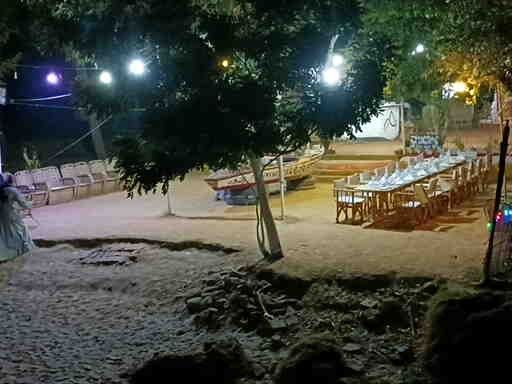
    The crew sets up the buffet on the shore a few yards from our boat. There is a long dining table and strings of light are hung above the area where we will eat our dinner. I do not recall the food that was served in the buffet. I hardly eat anything because I cannot get my digestive system straightened out. Since my stomach becomes upset out of the blue, I have concluded that there is some Egyptian food that is not agreeing with me. Consequently, I have not been eating much but meat, bread, and fruit and not a lot of those items. Rats.

Paul’s photo from the boat showing our dining area for tonight.
The chef and captain putting food on this unique buffet table. Paul’s photo.

   After we have finished our meal, the captain introduces the crew that has been taking such good care of us on the Aida. Once we acknowledge them with applause the captain tells us that they are going to play music and sing for us.  Once they begin singing and playing their simple instruments, Hussein calls out to Jennifer and escorts her to the “dance floor.” The pair begin to cut a rug or in the case to kick up a “sand” storm. I know that Hussein discovered that Jennifer loves to dance prior to this evening, so they have danced together before this occasion, but I cannot remember where that occurred.
    A couple members of the crew come over to the rest of us and encourage us to join the dancing duo. I decline as I have absolutely no rhythm so would probably be running into everyone or be stepping on my own toes. Paul joins in the fun as do most of the rest of the group. I think there are five or six of us that prefer to watch the rest of group dancing and laughing along the Nile.

   The tugboat operator, a large man with a great smile, belts out the words to the songs they sing, drowning out the other singers. He seldom is on key but makes up for this flaw with his exuberance. Ouch. One woman returns to the table and tells me that she loves music and cannot handle this anymore. I acknowledge this fact by nodding my head but figure the crew is having fun as are the dancers so what the heck.    

   The owner of the café has a son that is probably eight or so, and he is singing and clapping along with the crew. Jennifer gets the boy to dance with her which makes the little fellow beam. The wide grin that splits his face when the song is over tells you all you need to know about his delight in dancing with a tourist. Way to go Jennifer, you do have a way with kids!

  Tomorrow, Visiting a farm and an ancient quarry. Nancy

Another riverside cafe.
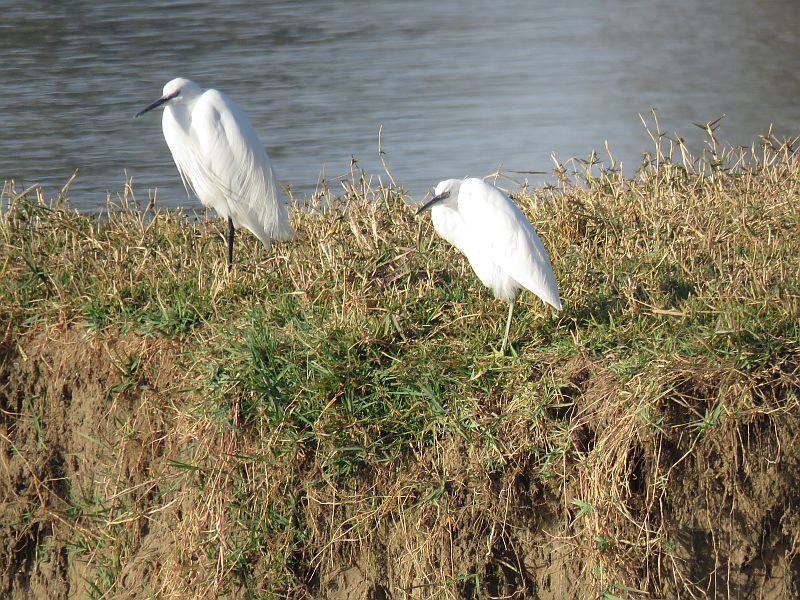
Cattle egrets along the Nile.
Setting out wire fish traps.

KARNAK, TEMPLE OF KHNUM IN ESNA, BOARDING OUR DAHABEYA, part six

    Paul and I are up early, as we need to finish packing. Paul happens to glance out of our window and tells me to come look at the hot air balloons. What a nice way to start the morning gazing at the colorful balloons that dot the morning sky. It is too bad we did not look out the window yesterday when Jennifer was floating above Luxor, we could have claimed that she waved to us.

Hot air balloons over Luxor

    We deposit our luggage outside our door as we go down to breakfast. Jennifer happens to be walking out of her room as we are walking down the hall. We find a table for three and eat our last breakfast in this nice hotel. We have certainly enjoyed Luxor and the sites and activities we have experienced here but I believe all of us are ready to move on. I know that sailing the Nile on our private river yacht is what I have been looking forward to the most on this Egypt adventure.

    We leave the hotel at 8:30, make sure our luggage is among the suitcases lining the sidewalk, then board our bus. After a short drive we arrive at Karnak where we follow Hussein to the visitors center to purchase tickets. As we enter the grounds, Karnak sprawls out in front of us dwarfing any other sites we have visited so far. The vast area of Karnak is eye opening but also surprising is there are very few tourists here. I know the Great Pyramids are the top destination for tourists in Egypt, but I thought Karnak was extremely popular too.

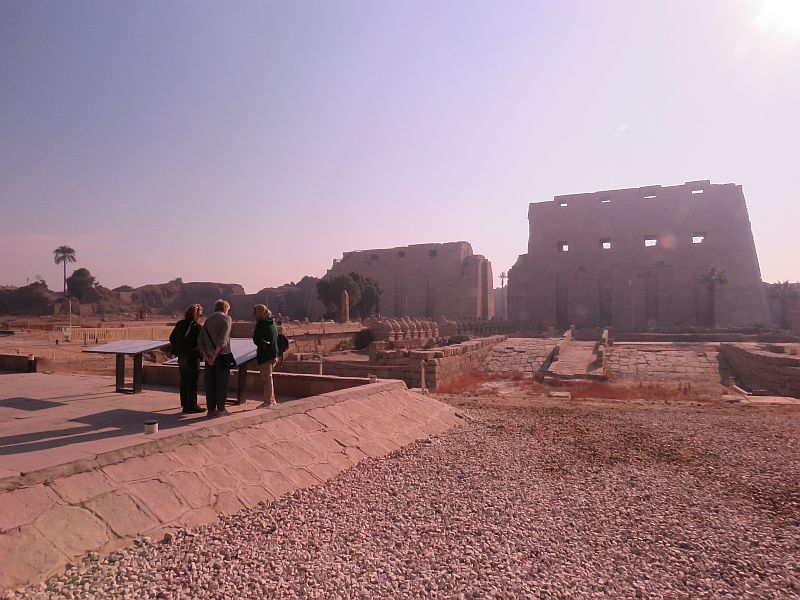
Karnak. The temple ruins of Amun.

  I read that Karnak covers over 200 acres and various Kings and Queens built the temples, and other buildings over a period of fifteen hundred years. I am sure Hussein gave us this information when he was giving his educative talk about Karnak, but I did not retain it. The main Gods that were worshiped here are Amun, Mut and Montu, with Amun being the most worshiped of the three Gods.   

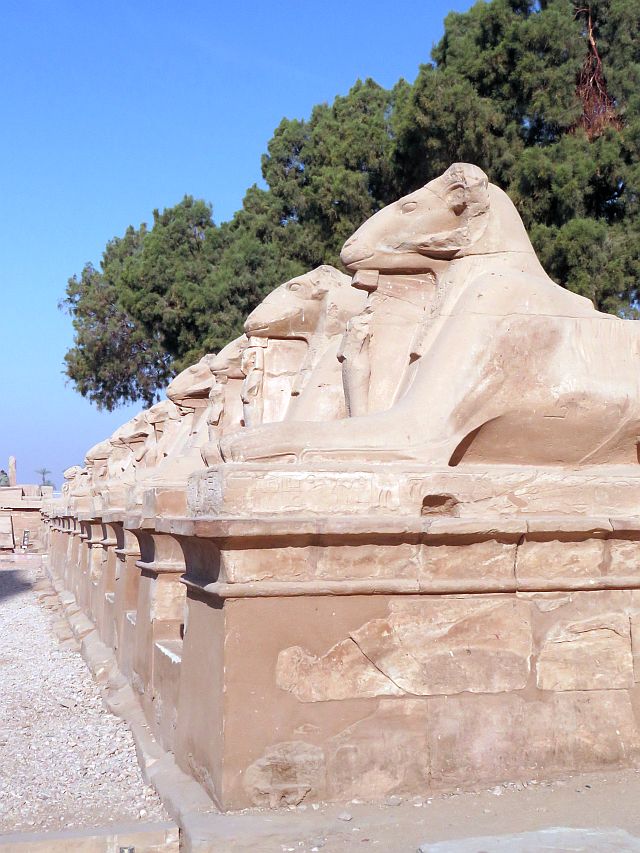
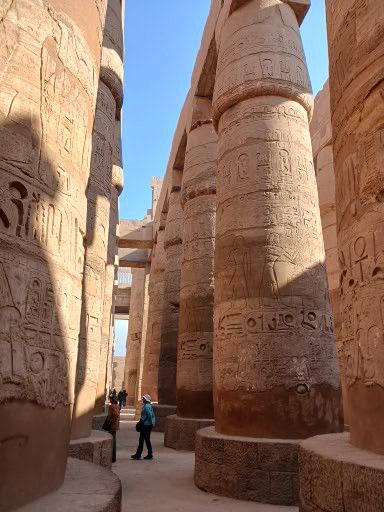
    We stroll down the road leading to the entrance of Amun’s temple. The road has a line of criosphinxes on either side. The criosphinxes, (I saw this name in an article), have the head of a ram which is the God Amun’s emblem. Walking between the line of ram sphinxes, who seem to be staring sternly at you, is a bit humbling.  Once we walk through the temple entrance, Hussein gathers us in a half circle and begins talking about various aspects of Amun’s temple. One of the highlights is the Great Hypostyle Hall which has over a hundred towering columns. Most of the paint has faded from the figures and scenes that cover these beautiful pillars so you can only imagine how stunning they were in ancient times.

Criosphinxes lining the road leading to Amun’s temple.
The Hypostyle Hall. Some paint can be seen where it was protected from the sun and elements.
This people give perspective on how gigantic these pillars are. Paul’s photo

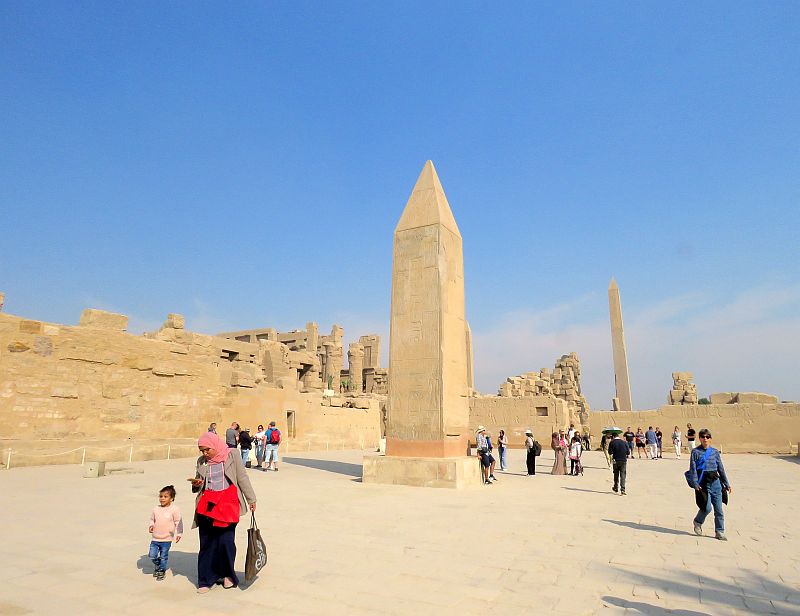
   Hussein leads us to another area of Karnak where an obelisk stands among the ruins.  I believe Hussein said it weighed one hundred ton and stood over eighty feet tall. The massive obelisk is carved from a single piece of red granite from the quarries of Aswan. Hussein explains how the obelisks were drug down to the Nile and loaded on a barge that was sitting in a dry dock. I think he said they flooded the dry dock once the obelisk was secured to the barge. The barge was then fastened to and pulled down the Nile by boats, each boat piloted with a crew of oarsmen. Hussein does admit that no one has been able to ascertain how they placed the enormous obelisk on a base and raised it to the upright position. Hmm.

The obelisk. Actually, there were two obelisks, but this was the tallest and most ornate.

    After viewing other areas of Karnak with Hussein, including the sacred lake, he gives us time to look around the place on our own. He suggests walking through the Hypostyle Hall and exiting on the far side where there are some seated statues. Jennifer and I decide to go take a look at them but Paul has had enough and heads for the exit. Jennifer and I find the stone statues and after taking a few photos return to the main area of Amun’s’ Temple. When we arrive, we gasp in amazement. There are a horde of tourists, literally wall to wall, and filling the street that leads to the temple. Jennifer and I must weave our way through the crowd of people until we reach the end of the sphinx-lined road.

This part of Karnak was near the sacred lake. Both obelisks are in this photo. The tall one looks like it is leaning in this photo?
The seated statues that Jennifer and I went to see.

    We are pleased to see Paul waiting for us because we were not excited about getting through the persistent dealers of keepsakes.  Jennifer and I get on either side of Paul and loop an arm through his. I believe it is at this venue that we hear one of the shop owners say, “I am from Alaska.” Guess what, as disciplined as we have become at not looking at the people trying to sell us their wares, you could not help but look over at the speaker making this claim. He has our attention for a moment but to no avail as we steadily march on and finally escape into the parking lot.

     We all thank Hussein for bringing us to Karnak early which allowed us to enjoy the temples and sites without fighting the crowd. I do not know how you could see much of anything with all those people crowded in the various rooms.

This is what Hussein saved us from by getting us to Karnak early!

   Our group returns to the bus and soon we are on our way to the town of Esna. There are plenty of interesting things to look at through the bus window, unfortunately most of the photos I took were blurry.

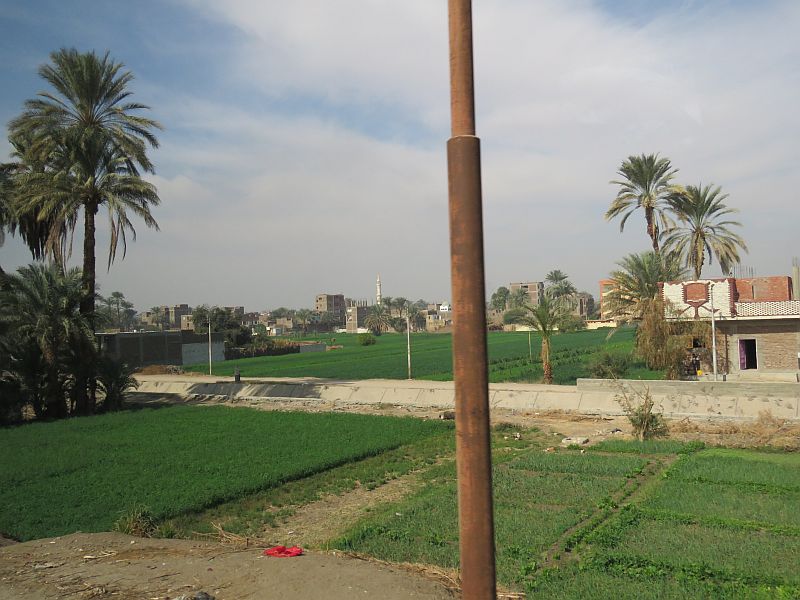
Farming around the villages.
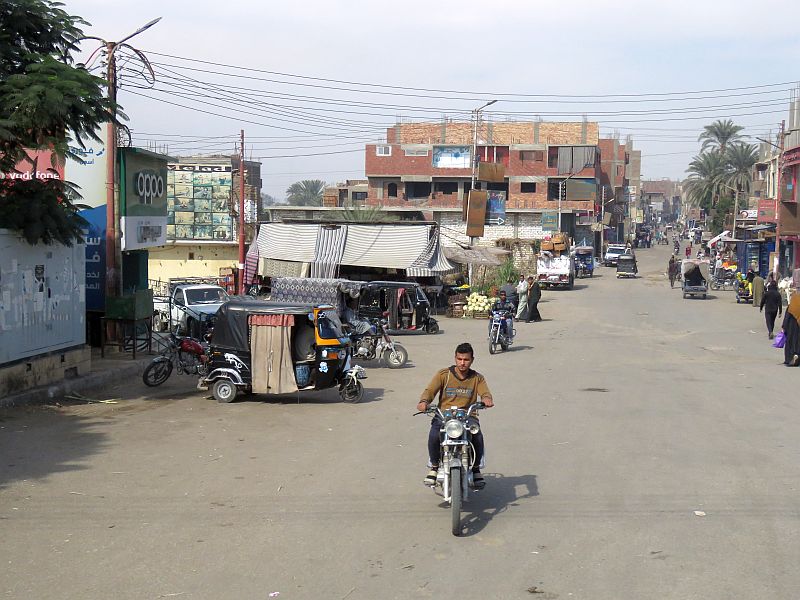
Tuk-Tuks, the three-wheeled cycles with drapes, are like taxi cabs. Lots of citizens ride motorcycles.

   We reach the town of Esna where our dahabeya is anchored and we catch our first glimpse of her as we drive by the anchored ship. What a beautiful boat. However, we are visiting the Temple of Khnum first so the ship will have to wait. We leave the bus and follow Hussein a few blocks to the site. Nooo, another souvenir area filled with basically the same statues, clothes, and other items we have seen everywhere else. Of course, we must pass through the clamoring merchants in order to reach the temple. We just escaped the other tourist trap less than an hour ago!

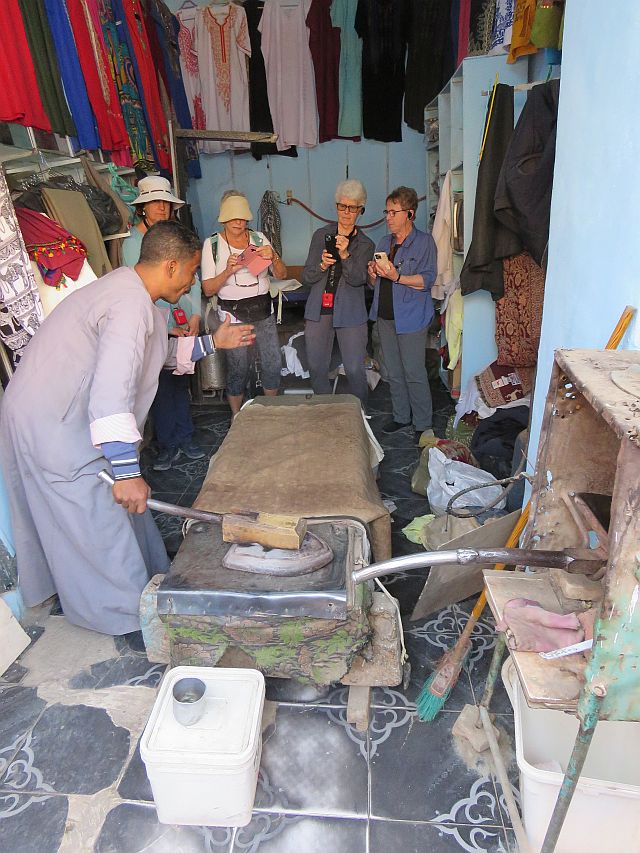
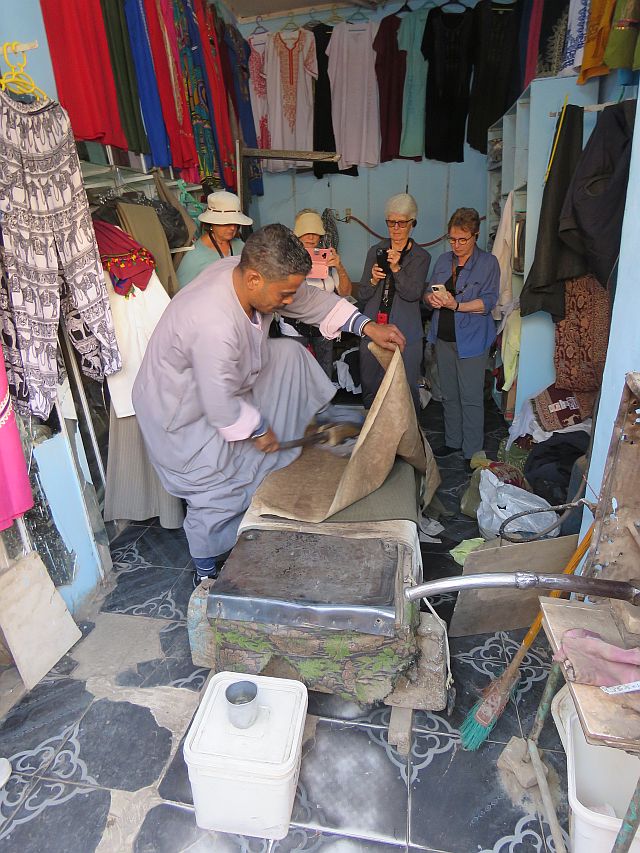
    Hussein leads us over to a booth that has articles of clothing hanging along its sides. Our guide did not bring us here to give us any advice on what is worth buying but wants us to observe the fellow working. The man is ironing clothes for clients, why he is stationed here I have no idea. We watch as he is pressing a garment and then we are taken aback when he sprays water he is holding in his mouth over the item of clothing. Who needs a steam iron? I am just glad I was on the far side of where he was spraying the water out of his mouth! Okay, that was worth having to listen to the “only one dollar” chant again.

Can you see the water he is spraying out of his mouth? The source of his water is in the tin cup.
Ironing the garment.

   The temple is situated far below street level, so we traipse down a long staircase to reach the building.  I cannot remember the particulars of this temple, but I believe it was buried in the sand, like many of the ruins, when it was discovered by archeologists. I do know that workers, although they are not working today, are painstakingly removing the soot and dirt that has covered the columns for 2,000 years. The soot coating has helped preserve the brilliant paint that was applied to the images, and it is stunning.

Looking down on the Temple of Khnum from the street. Paul’s photo.
The brilliant paint that workers have exposed after removing the layer of soot and dirt.

   Our group climbs the stairs where we navigate through the merchandiser and reach the peace of the street. We board the bus and drive a short distance to our river yacht which will be our home for the next five nights. The ship is called the Aida. As we walk onto the boat a man takes our temperature. I find this interesting as we have not run into any covid protocol on the trip so far, except for our OAT man checking our vaccine card at the airport. Paul and I register a temperature around 97 and evidently everyone else pass too, as we are all allowed to continue onto the boat. I wonder what they would have done if someone was running a temperature, make them walk the gangplank?
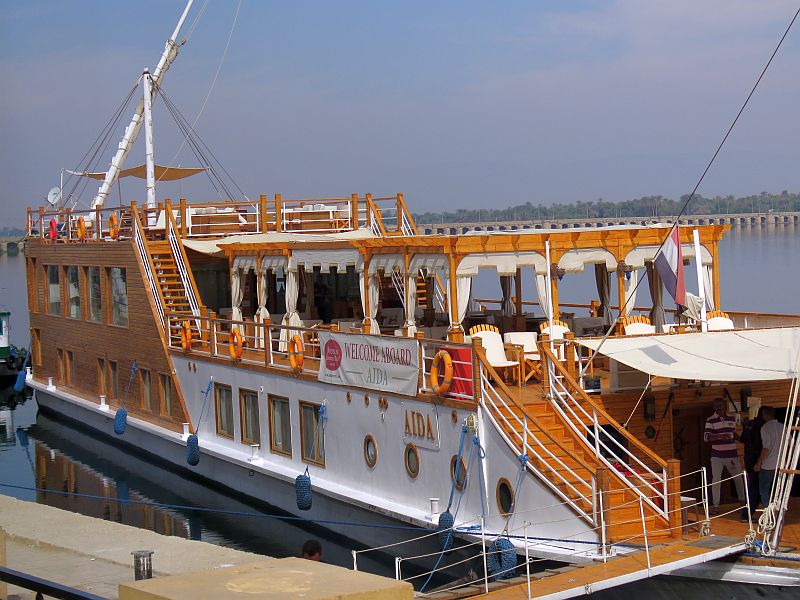
Is this the coolest river yacht or what?

    Hussein passes out our cabin keys and tells us to return to topside in fifteen minutes for the orientation talk. Paul and I are in the cabin called Horus III. After being told in pre-trip info that the ship cabins are very small, we are pleasantly surprised to find that our cabin has plenty of space for us. We probably will not be in the cabin except at night anyway.

Our cabin Horus III.

    When all of us are gathered in what I will call the dining and lounge room, the captain of the ship explains various things such as meals, the staff, and the Wi-Fi passwords, (yep, we can get the internet floating down the Nile), although he does warn us that on occasion, we will hit a dead spot. Oh no, let me off the boat, (total sarcasm). The captain also tells us that the advantage we have over the large tourist ships is we can tie up along the shore and stay away from the crowded docks where large ships must anchor. We also will be pulled by a tugboat, which we already knew, as there is not enough wind at this time of year to use the sails.

The dining and lounge room. Hussein flashing his wonderful smile.
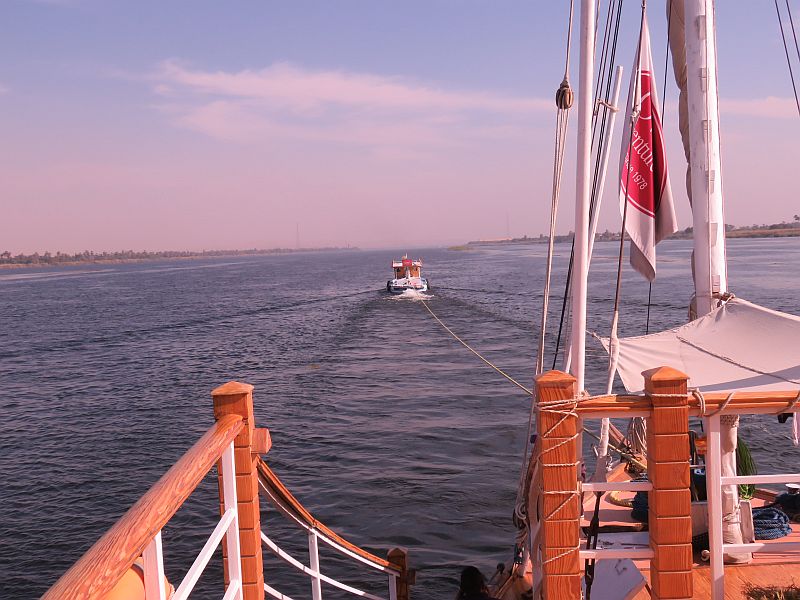
Our source of power the tugboat.

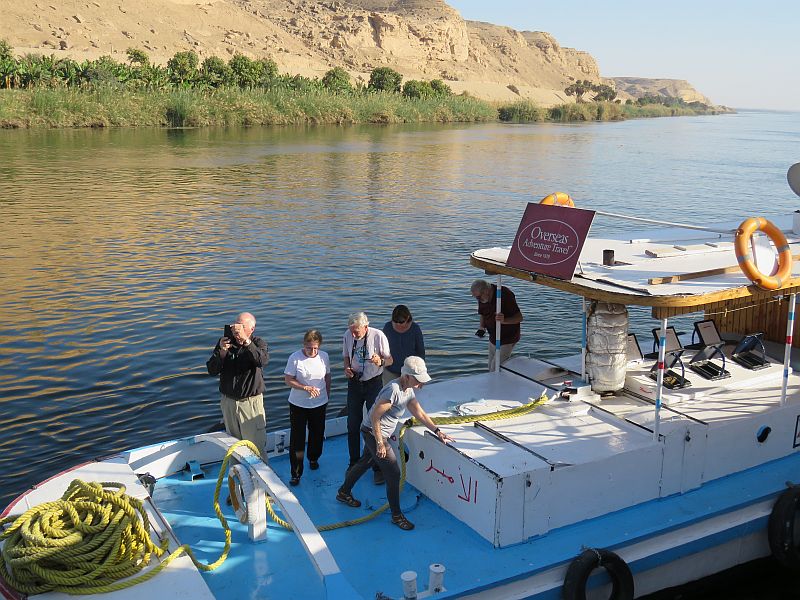
   After the captain is finished, Paul and I explore the ship and then settle down on the observation deck. We watch fishermen lay nets out in the water and then one man will slap the water with a long rod. We ask Hussein, what the men are doing, and he says this scares the fish into the nets. There are two men per small rowboat.     

Getting ready to put the fishing net out.
Must be a good spot for fish.

    The Nile is flush with birds, some of them we know, like cattle egrets and kingfisher. There are other birds that we are unfamiliar with so Paul goes to the captain and asks if he has a bird book we can borrow. He jokes with Paul and tells him he will sell him the bird book, and Paul replies that he will buy it from him. The captain laughs and hands the book over. I am loving this. Paul leaves to walk around, while I sit and enjoy the scenery, fishermen, life along the shore, and birds! The downside is that there is a lot of garbage along and in the Nile, mostly plastic. The grossest thing I saw was the bloated carcass of a donkey which bobbed in the wake from the ship traffic.

The observation deck. Paul’s photo. Life is tough.:)

   Lunch is served at one o’clock and the buffet consists of salads, soup, chicken kabobs and fish. The food was pretty good. There are three tables, and everyone sits where they please.

    Around four o’clock we dock along the river’s edge which turns out to be quite entertaining. There are several young boys and a woman standing on the shore waiting our arrival. A member of the crew attempts to throw the mooring rope to one of the boys. It takes about six tosses before the crewman gets the rope close enough to the shore for our helper to grab it. The youngster runs along the rock- fortified riverbank, he is barefoot by the way, and loops the rope over a scraggly bush. This stops us from drifting, then another rope is tied up at the other end of the boat. The crew puts out a narrow gangplank and a stout crewman walks across it carrying a large hammer. He proceeds to drive stakes down and then fastens the mooring ropes to the iron rod. Oh yeah, this man is barefoot too. I am putting a slide show below this paragraph. I hope it works.

   Our whole purpose in stopping here is to visit the nearby village. I am pleased to see that a wider ramp is put across to the shore for us to walk on. The young woman is to be our guide through the village. She leads us down a dirt path and when we reach a sugarcane field, Hussein stops to talk about this staple crop for the Egyptian farmers. It is used for producing sugar of course but also is fodder for the livestock. The downside of the cane is that it needs a lot of water to reach maturity.

    The woman then shows us the water filtration system that the Egyptian government has installed for villages along the Nile. The people used to drink straight out of the Nile and Hussein told us that the result was a lot of kidney problems in the older folks. We were not allowed to take any photos of the complicated set up.

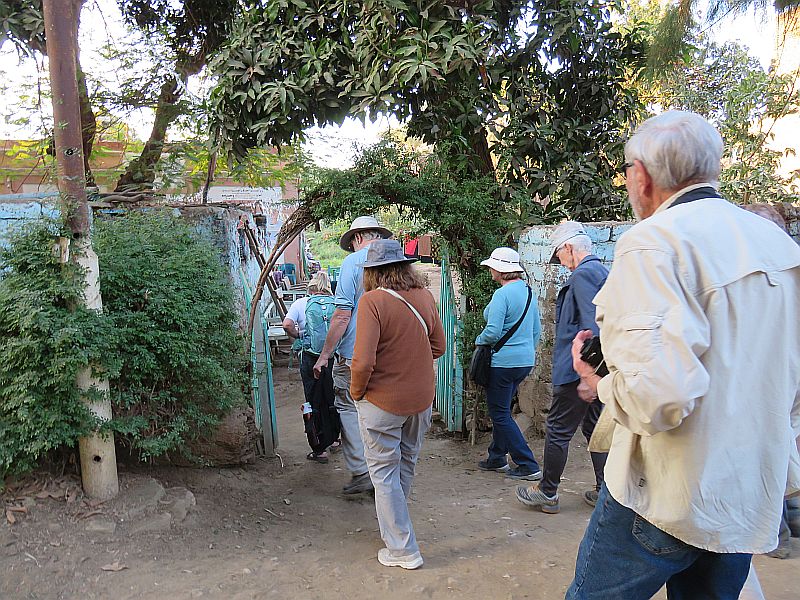
Our group walking through the gate to our hosts home.

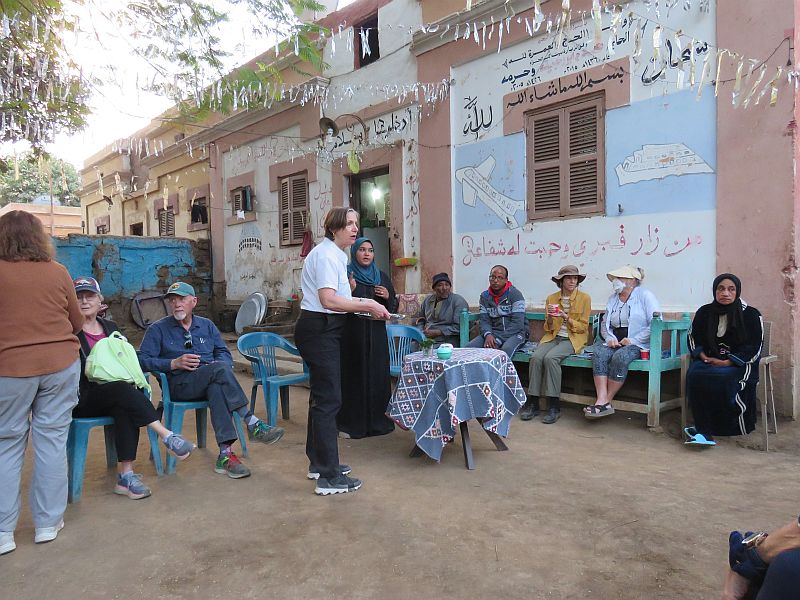
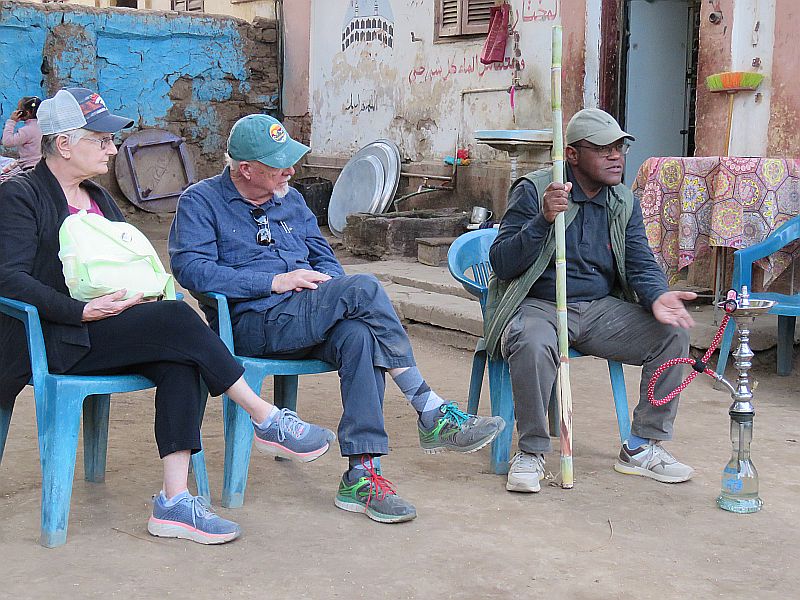
    The woman takes us to the house where her family and her parents live. We sit outside in the fenced in yard, on chairs and benches. A couple of women in our group go to help make tea and the rest of us are invited to look at the kitchen while they are making the tea and pouring it into cups. Paul and I do not drink much of our tea and when the woman gathers the cups back up, she takes our left-over tea to her father, and he happily drinks it. Oh no, well I guess nothing goes to waste here. After finishing our tea, Hussein explains then demonstrates the use of a hookah. I am using another slide show. The young woman that was our guide is standing and her father, mother, and brother are seated. The photo of the one room I understood to be the kitchen of the young woman’s parents.

    Our group thanks and says goodbye to the family who graciously allowed us a glimpse into their lives. The sun is setting when we return to our river yacht which is a wonderful way to end this very busy day. We will spend the night here, with no city lights or noise. Perfect.

What a sunset.

Another temple, putting the sails up and sailing on the Nile, visiting a farming village. Nancy

VALLEY OF THE KINGS, HOME-HOSTED DINNER, part 5

VALLEY OF THE KINGS, HOME-HOSTED DINNER, part 5

     Paul and I ate breakfast this morning with another couple from our group who were kind enough to invite us to sit with them as all the tables were occupied. The buffet has a large variety of food, but it is not as expansive as Marriotts. Jennifer walks into the breakfast room about the time we have finished eating. Jennifer and some other members of our group left early this morning to go on the optional hot air balloon ride. They had to take a boat across the Nile, continue by car for quite a distance and then hope that the wind was cooperating when they arrived at the balloon launch. Fortunately, the wind was fine and Jennifer and the others that went raved about the experience of their hot air balloon ride. Paul and I opted not to go because we had taken a hot air balloon ride while on one of our earliest, maybe our first trip to Africa, and we were happy with that memory.

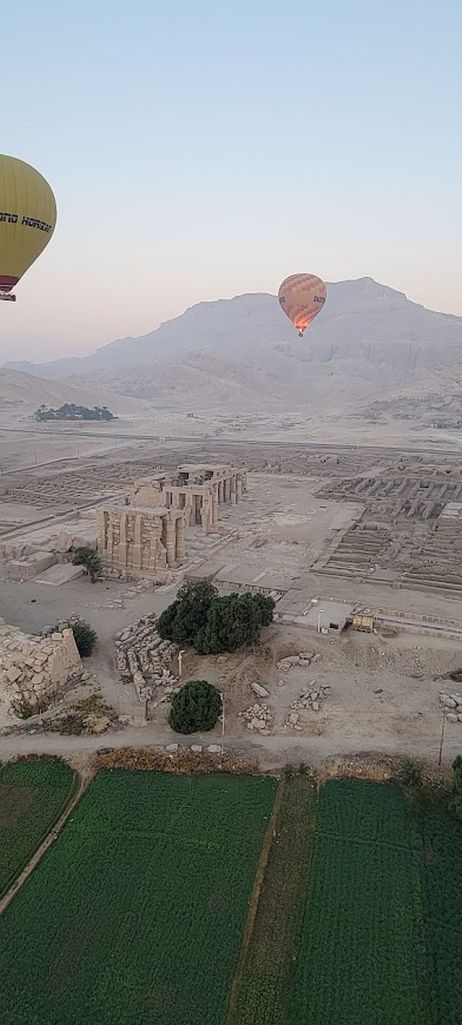
Inflating the hot air balloon. Jennifer’s photo of course
Great photo showing the abrupt change from farm ground to desert. Jennifer’s photo

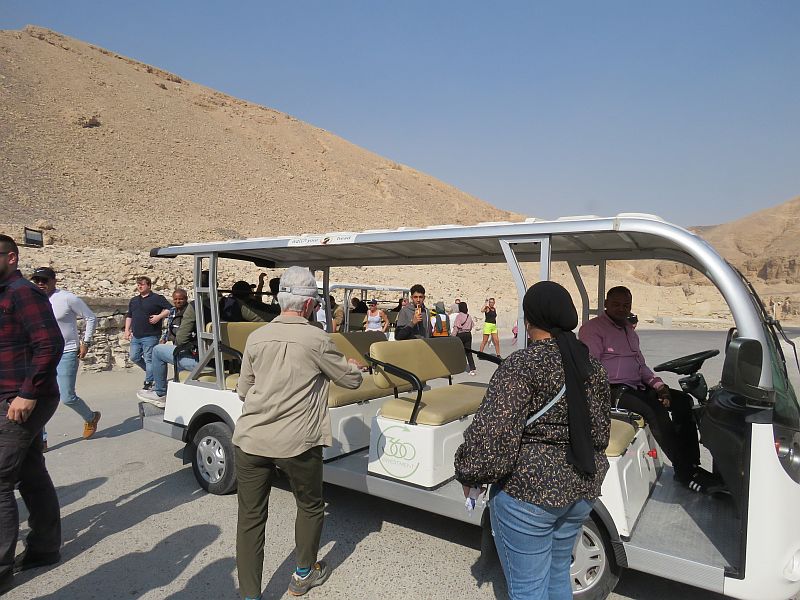
    We are off to explore the Valley of the Kings this morning. We board a motorboat that takes us across the Nile to where a bus awaits us. Our first stop is at the Mortuary Temple for Queen Hatshepsut. All visitors must walk through the vendor tent in order to get to the ticket office. Oh my gosh, the people are very persistent and aggressive. Hussein stops at one stall and shows us the things he would recommend buying here if one is interested and then tells us what we should pay for these items. Hussein reminds us that you must bargain, it is expected. We finally reach the ticket office, after listening to the phrase “only one dollar” being shouted at us as we walk the length of the souvenir filled tent. Hussein hands us our tickets and points out the location of the restroom, which several of us take advantage of before we proceed. Have I mentioned that you must pay five Egyptian pounds to use a public restroom? This is equivalent to around 15 cents. When our group is all accounted for, we climb into carts and the driver takes us the short distance to Queen Hatshepsut’s Mortuary Temple.

Crossing the Nile. The man in the suit is our security guard for the day.
The carts that transported tourists to Queen Hatshepsut’s temple.

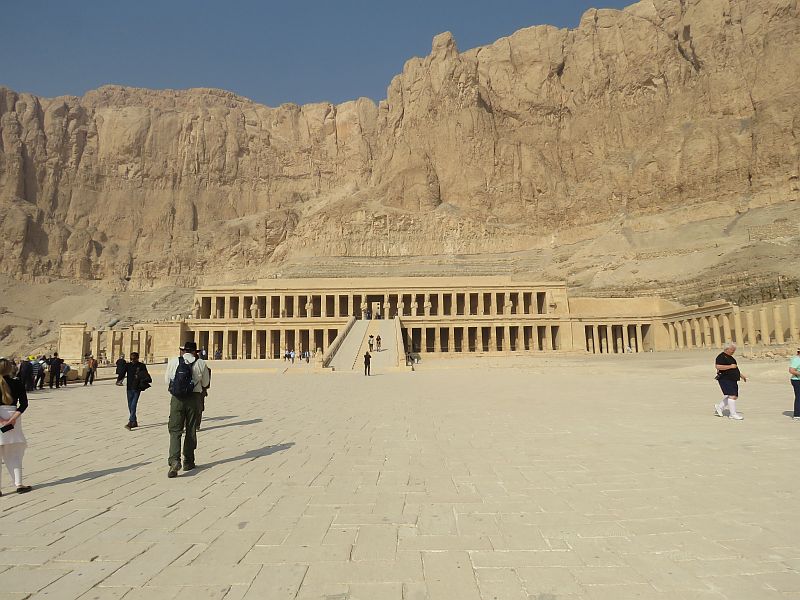
   We follow Hussein to the steps of the temple where he gives us the history of Queen Hatshepsut, which is complicated. The Queen was married to Thutmose II, who was her half-brother. Between Hussein’s lessons, books I read, and watching shows on the History Channel, ancient Egyptians marrying half siblings or cousins was common. The Pharoah’s believed that marrying within the family would ensure that their family would maintain control in Egypt for generations.  When Thutmose II died, the throne passed to an infant son from a “lesser” wife because he and Hatshepsut had produced only a daughter, not a son.

Walking to Queen/King Hatshepsut’s mortuary temple.

    Queen Hatshepsut, who was Thutmose II’s principal wife, became Regent upon his death and acted, (ruled), for the baby Thutmose III. When he was still a child Hatshepsut was installed as the first female King of Egypt although how she achieved this is not clear.  King Hatshepsut was considered a successful ruler because during her twenty-year reign, Egypt was at peace.  Hatshepsut also opened trade with many of the countries that her predecessors had been at war with.

    When Hatshepsut’s nephew took his rightful place on the throne after the female King’s death, he ordered all evidence of her to be erased. Hatshepsut’s’ monuments were defaced, her statues were torn down, and her name was removed from the official Kings list. Some Egyptologists theorize this was revenge taken by Thutmose III for being denied the throne when he came of age, another theory is that he did this to make sure the Thutmose line would not be interrupted by a female again. It sounds more like revenge in my opinion.

Stone statues lining the front of the temple.

    Hussein also told us what paintings or monuments we should look for once we were inside the temple. He particularly wanted us to find the stone pillar on the outside of the temple that depicted the face of Hathor, the goddess of love and motherhood. This goddess is depicted with a human face that has the ears of a cow. When she transformed into her animal form it was that of a cow. Hussein also told us this impressive mortuary temple was only used for seventy days which was how long the mummification process took.

The column carved with Hathor’s face. Paul is hiding behind it.

   Hussein is not allowed to lead us through the temple. I understood him to say that this was because they were trying to limit the number of people inside the temple. That does not really make sense so maybe I misunderstood. Jennifer’s theory was that a guide would stop to explain things to his group which would block the flow of people. Now that does make sense.

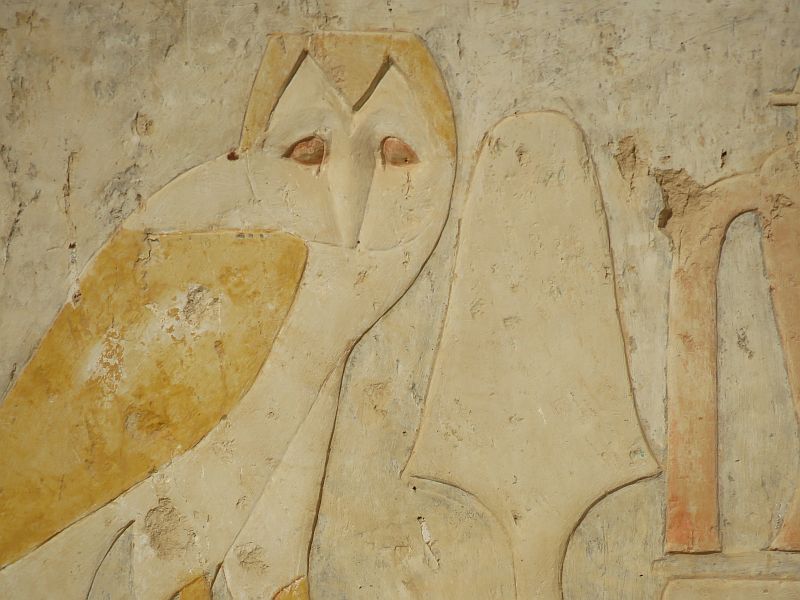
I just liked this owl. Found inside the temple.

   We gather outside by the steps of the temple, where Hussein is waiting and take the carts back to the parking area. Unfortunately, we must run the gauntlet of vendors to get back to our bus. You have to admit that this is a good marketing tool for these shop keepers but boy is it annoying.

   We load up on the bus and in a short time we have arrived at the Valley of the Kings. There are carts to drive us to the tombs here also. One of the carts carrying members of our group comes to a halt and the woman from Pennsylvania hops out. It seems that her ticket blew out of her hand. A cart driver behind them saw the ticket and picked it up. The driver that picked up the wayward ticket insists on a tip and the woman hands him some Egyptian pounds. Really, shouldn’t that just be a kind thing to do for someone?

Hussein talking to us before we go inside one of the tombs.

   When we reach the tombs, we form a half-circle around Hussein, who talks about the history of Valley of the Kings. Hussein also gives us useful information at the entrance of each individual tomb we are visiting and describes specific scenes or figures to look for among the paintings on the tomb walls.  The tomb of Ramses IV is included with the ticket that allows you entrance to the Valley of the Kings. King Tutankhamen’s tomb is included with our OAT package. Hussein has personally purchased the ticket for Ramses VI tomb for us as he insists, we must experience, what in his opinion, is the most spectacular tomb in the Valley. How kind and generous is that?

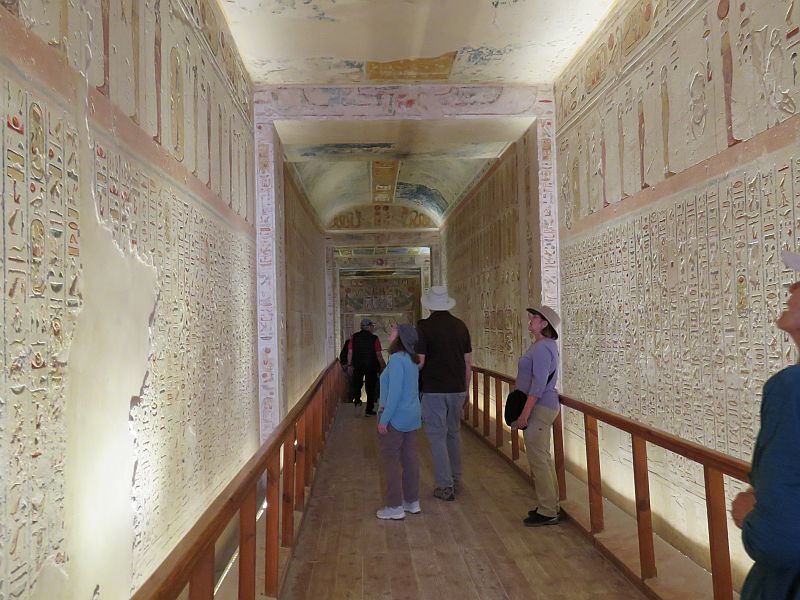
Walking down the tunnel to Ramses IV tomb.

   The number of people allowed into the tombs is limited, and rightly so as the area in the tunnel and tomb is not that spacious. We descend a staircase that takes us to Ramses IVs’ tomb. As we walk through the hallway we gaze at the painted scenes and hieroglyphs that cover the walls on both sides. We occasionally stop and admire a particular scene or figure. It is hard to fathom the work and time it took to carve this tomb out of the rock and to paint or carve all the scenes and figures that plaster every inch of the rock walls. What we are looking at is awesome. It is hard to imagine that Ramses VI’s tomb could surpass what we are experiencing in this tomb!

The falcon represents the God Horus who was god of Kingship and the sky.
The light was not the best but you get the idea. No flash allowed but mine doesn’t work anyway!
    Jennifer and I leave the tomb and we have climbed halfway up the stairs when the lights go out. What the heck? The sunlight filters down weakly from the entrance/exit but we take our time and carefully climb to the top of the stairs. There were several people still in the tomb when we left, and I can only imagine how dark it is down there. Paul had left before Jennifer and me so he missed out on this fun experience. We had not been told or perhaps did not hear that tourists are allowed only so much time to be in the tomb which makes sense. The warning that your time is up is the extinguishing of the lights which seems a bit dangerous. I have a feeling a lot of cellphones were lighting the way for the people behind us.

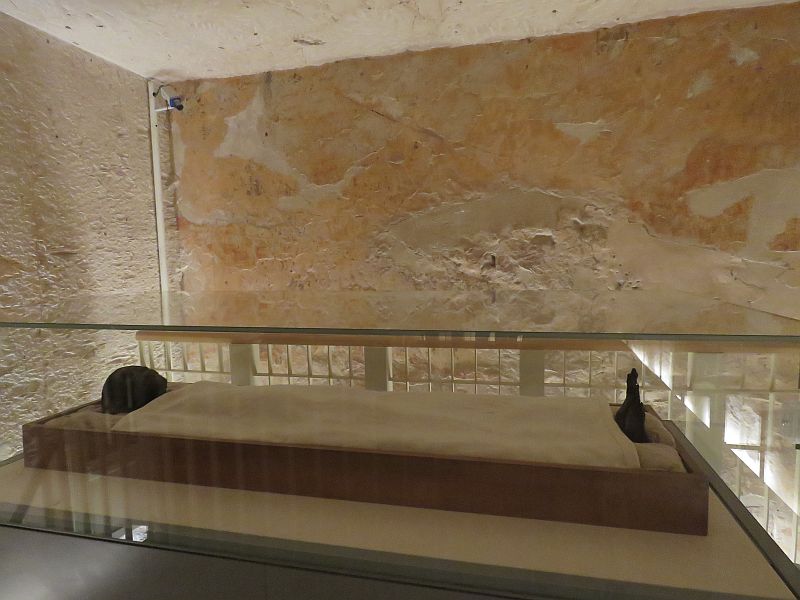
   Hussein leads us on to the tomb of Tutankhamen, where he tells us the tomb robbers never found it because rubble had covered any signs of the tomb due to an earthquake (I think). Hussain also explains how Howard Carter finally figured out where Tut’s tomb was which is fascinating but too long of a story to write here. King Tuts’ tomb is small in comparison to the first tomb we were in, but the scenes painted on the walls of his tomb are amazingly vivid. King Tutankhamen’s mummy is on display, but I could have done without seeing Tuts’ mummy as it is not a pleasant sight.

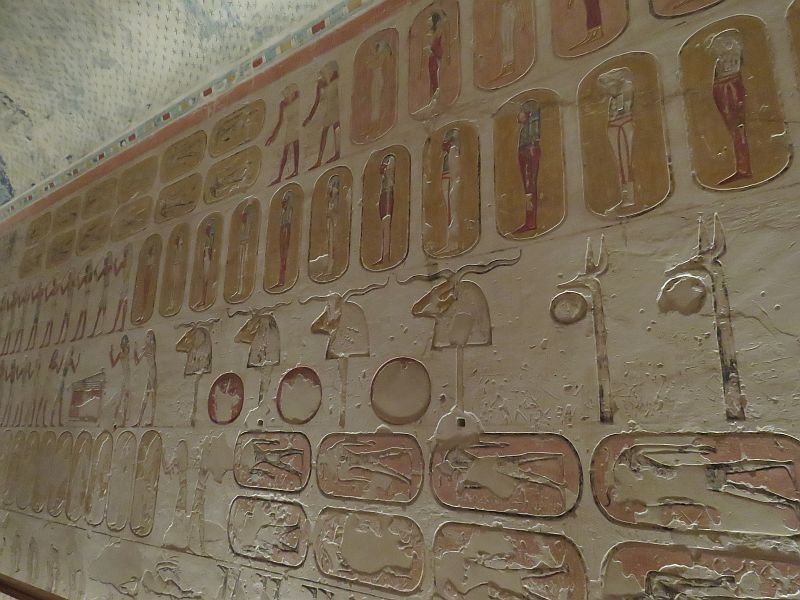
Paintings adorning King Tut’s tomb walls. The paint was so vivid.
King Tut’s mummy. Lucky for you it is not areal sharp photo.

      Ramses VI tomb is our last stop, and we enjoy more history given to us by our excellent guide. As we begin walking down the long tunnel to Ramses VI tomb the depictions on the walls and ceiling are overwhelming. The deeper we get the more vivid the colors are. It is on this walk that I see a member of our group point out a very odd figure and says something about aliens which causes his wife to snort with derision. I speak up and admit that I do not discount the alien or otherworldly theory many people have, which makes her throw up her hands in exasperation. My open-minded friend and I continue talking about the possibility of alien influence or help building these structures throughout our trip, much to the hilarity of the rest of our group including Hussein. Yeah, we both watch Ancient Aliens on the History Channel, but my doubts started long before I began to watch that show. After Paul and my visit to Peru and Machu Pichu, I wondered about the ability of these ancient people being able to build such structures with only stone hammers and copper tools. Just saying.

Hussein was right in my opinion. Ramses VI’s tomb is spectacular. Incredible scenes and the paint is still so bright.
Ramses VI’s damaged coffin. I think the facial carving is a replication.
This is the ceiling of the tomb.

   We stop for lunch on the way back to the hotel. I had ordered potatoes au gratin and was disappointed to find that they had been baked to the point of being dried out. Oh well, that was the only disappointment today.

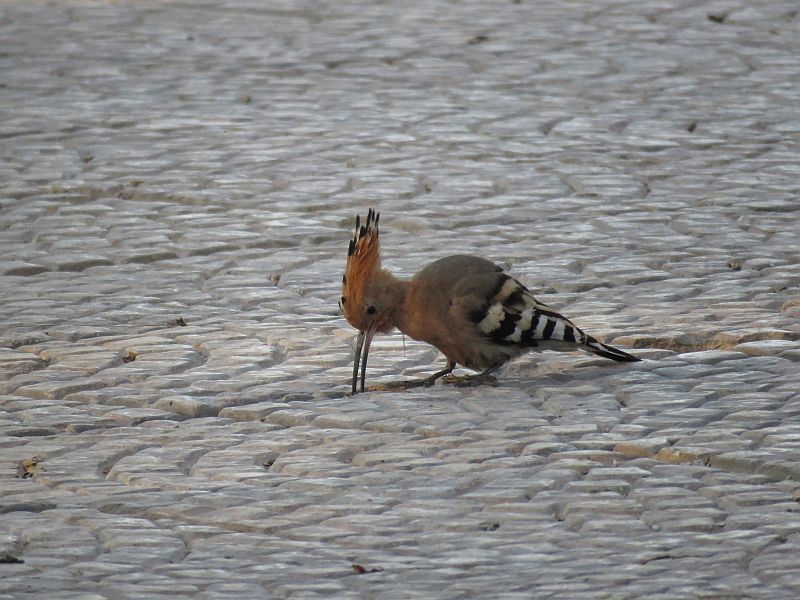
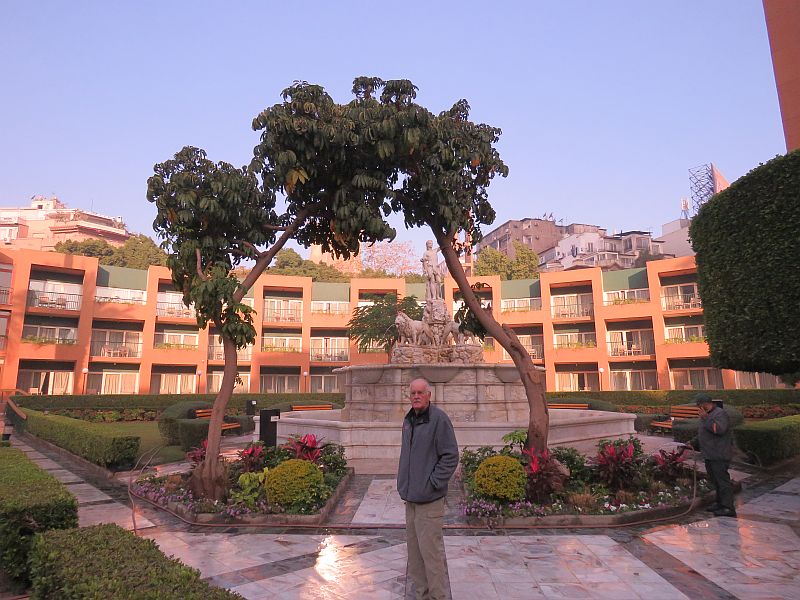
    When we return to the Winter Palace hotel, Paul and I take a much-needed nap. When we wake up, we decide to go down and check out the hotel courtyard. The manicured garden is absolutely beautiful. We find Jennifer lounging by the large swimming pool, so we sit down for a bit and just relax. I was delighted to see a Hoopoe while we were exploring the grounds. He was so busy probing the ground for worms he paid no attention to us. The low light of our courtyard tour was seeing several flamingos that are enclosed in a small wire pen.

Can you believe the courtyard of our hotel? Gorgeous.
An inviting place to have a drink and relax. This was also in the courtyard.
The unconcerned Hoopoe probing for lunch.

   Tonight, we are going to our Home-hosted dinner. Hussein divides us into two groups. One group will be hosted by a farmer and his family who live in Luxor and the other group will be hosted by a retired chef and his family. The two women from Minnesota, and the solo traveler from Maryland are in our group. Hussein assigns our group to the retired chef which I admit, the three of us were a little disappointed as we had hoped to go to the farmer’s house.

   The bus stops and lets us off at a side street where we follow Hussein down the dark, narrow street to our host’s house.  A man is waiting for us, and he raises his hand while calling out a greeting to Hussein and our group. We follow our host into his house where Hussein introduces everyone. Hussein then leaves after telling our group that he will return later this evening to accompany us back to the coach.

    It is a bit awkward at first. We all hand our small gifts to the host; we Kansans have given them a magnet featuring photos of things Kansas is known for like sunflowers and wheat. We also wrote a message of thanks inside the card which has a beautiful photo of the Flint Hills on the front. Jennifer, Paul, and I forgot to bring any gifts for the two little girls which are our hosts granddaughters. The women from Minnesota have brought a large sack of balloons and tell the girls that it is from all of us. How generous of them.

Paul took this photo of our group and our host family. The only photo we have of that fun evening.

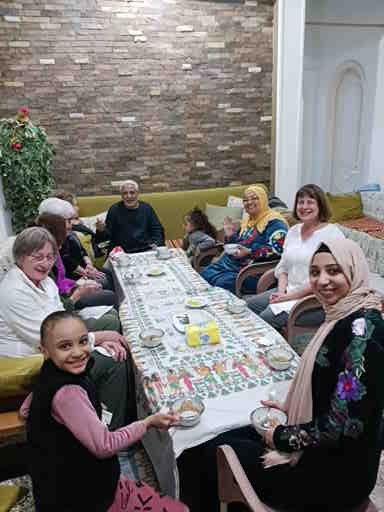
   The retired chef tells us his son, the father of the young girls and the husband of the young woman that is helping prepare dinner, will join us later. Our host takes us on a tour of the house which consists of a large dining/sitting room, a good-sized kitchen, large bathroom and two bedrooms. When we have finished the house tour we sit down at the table and the two women begin bringing food to the table. The main dish is a favorite dish of Egyptians, and I would liken it to a stew. As we all prepare to begin eating the Hostess says “bon a petit” with a big smile on her face. We soon figure out that although all the other members speak fair English, our hostess does not speak English at all.  She says “bon a petit” several times throughout our meal which is endearing.

   The couple’s son walks in as we are being served dessert. He greets us and apologizes for not being here earlier, but he has been working. This man speaks excellent English and soon all of us are asking him questions on various topics. He talks about how the high inflation is hurting the Egyptian people. We learn that family is very important in Egypt, and he answers any questions we have on other topics.

   At some point Jennifer pulls out her phone and calls the little girls over to see photos of her eight grandchildren. Boy does this break the ice. The hostess and daughter-in-law crowd around Jennifer so they can look at her photos too, and they ooh and ahh over her grandkids’ pictures. This prompts the older couple and younger couple to retrieve their wedding albums and we all look at the photos and comment about how beautiful everything was.  Our host laughs and says his wife was crazy about Omar Shariff and claims she only married him because of his resemblance to Omar. We all laugh at this story and when looking at his wedding photo from decades ago we see that there is some resemblance to Omar. They tell us that an Egyptian wedding takes place over three days and the guests can be in the hundreds. Weddings also cost a lot of money and with the high inflation they are experiencing today, some people are reducing the wedding celebration from three to two days.

   The girls want grandpa to blow up a couple of balloons for them which he gladly does, I think these girls have grandpa wrapped around their finger. The two girls begin to bat the balloons back and forth and then Jennifer gets up to join in the fun. Boy do the girls, especially the youngest, get a kick out of this. After the balloon games come to an end our host announces that the girls would like to sing for us. We listen to the “ABC” song and “Twinkle Twinkle Little Star.” The oldest girl, probably ten years old, has an incredible voice. I lean over to her mother and tell her what a wonderful voice her oldest daughter has which makes her beam with pride.

     Shortly after the girl’s finish singing, a smiling Hussein walks into the house and greets everyone. We all shake hands and thank our hosts profusely for welcoming us into their home and for their wonderful hospitality. We follow Hussein back to the dark street and walk back to the bus. We tell Hussein what a great time we had and of course he is delighted to hear this. This was a really great day.

   Leaving Luxor to board our private dahabeya, (sailboat), for a six-day cruise on the Nile. This is the part of our journey that I have been really looking forward to. Nancy


LEAVING CAIRO FOR LUXOR, TEMPLE RUINS, part 4

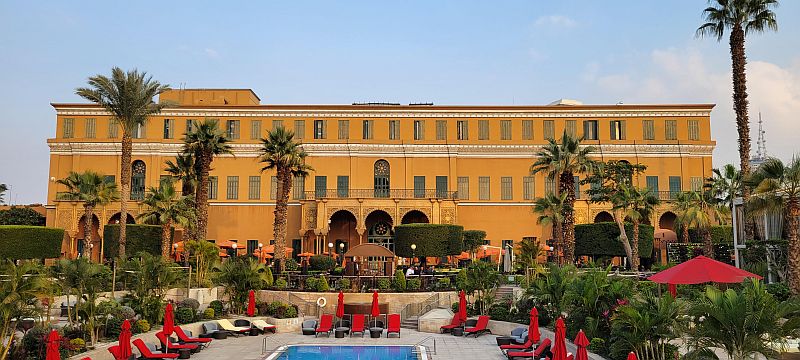
     Before we leave the Marriott, I should point out that this hotel has a lot of history behind it. The main area where we eat breakfast and where the reception desks are located among other things was built in 1869. The ruler of Egypt at that time, Ismail Pasha, ordered the construction of a Royal Palace to use for celebrating the finish of building the Suez Canal. He copied many elements in this Palace that were found in Napoleon III and Empress Eugenie’s Palace as he wanted the Empress to be comfortable in Egypt when she visited. Why Paul, Jennifer, or I did not take photos of the inside of this Palace or of the small courtyard in front of it I do not know. You will just have to take our word for it that the interior of the Palace was beautiful with its period furniture and grand staircases. The small courtyard was pretty too. The Royal Palace changed hands numerous times over the years until Marriott purchased it in the 1980’s. They added two towers that stand on either side of the Palace where guests stay.

This is the “Palace” part of the Marriott. Jennifer took this excellent photo.
This photo shows a part of one of the guest towers. There were two towers, one on either side of the Palace.

    We board the bus this morning and on our way to the airport we are going to visit a historic Mosque.  While driving down the thoroughfare, our driver brakes to a stop and begins backing up. Everyone in our group is a bit stunned, and I hear murmurs like “what is he doing” and I think I say out loud, “why is he backing up”? Hussein begins laughing and informs us that the driver thought we were going straight to the airport and hence he missed the turn that leads to the Mosque. So, in this country, I guess it is okay to back up fifty or so yards to get to the turn that you drove by. The road we are on is a main avenue but the traffic is light compared to what we have seen and oddly enough I do not remember anyone honking their displeasure at us.

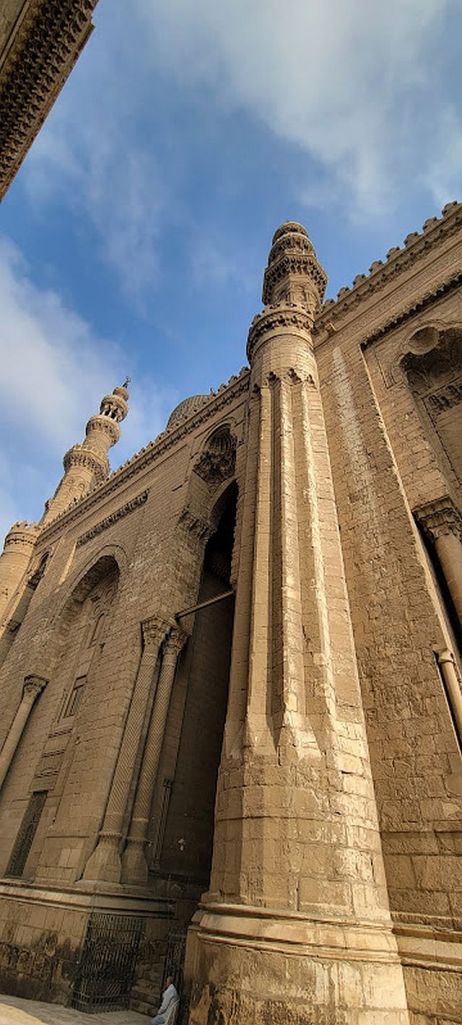
    The bus driver parks on a busy street, and we must walk down a narrow street to the mosque. This mosque has been historically preserved and is not used for worship. My main memory from this experience is that Hussein has us sit down on some chairs that are arranged in a half-circle while he talks about the history of the mosque. There are three half-grown kittens that decide people’s laps look much more comfortable than the floor they had been lying on or the kitties are hoping for something to eat. Unfortunately, the kittens are constantly scratching themselves, (can you say fleas), and their eyes and noses are a bit runny. Needless to say, no one wants them on their laps. The felines jumped up on four or five members of our group, who pushed them off their legs or laps quickly. The rest of us were not selected for the kittens’ attentions I am thankful to say. Poor little things, but the last thing one needs is a bite from a dog or a cat in Egypt or in other foreign countries where access to a rabies shot is not going to be easy to obtain.

The front of the Mosque. Jennifer’s photo.

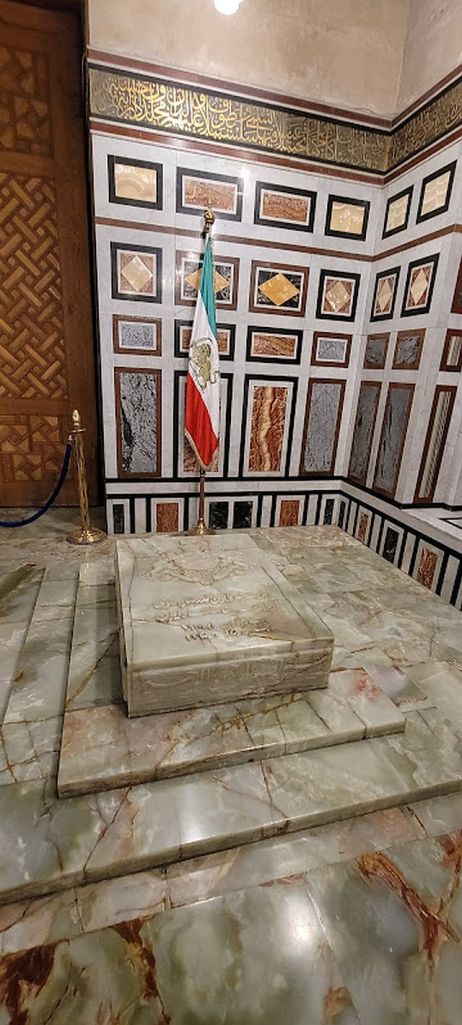
    On our walk back to the bus there is another Mosque where worship is held that we are going to visit. When we arrive at the Mosque, I whisper to Hussein that I need to go back to the bus, (the bus is in sight of where we are standing) to take some of the medicine he gave me yesterday for my digestive problem. I brought the standard medicine with me but Hussein had told us in our initial meeting to take his medicine if we became afflicted as it works better than ours. Hussein informs me that he will call the driver to alert him to open the bus door for me. Was this caused by Caesar salad I ate for supper the night before last?  After swallowing the pills, I stay on the bus and take a little nap while awaiting the return of the group. When they get back Paul tells me that the main thing I missed was a man that sang for them in the Mosque.

Jennifer said there was somebody famous buried in this tomb in the Mosque that I didn’t go to. Paul thinks it was the Shah of Iran. Jennifer’s photo.

    We arrive at the airport and must go through security as soon as we walk through the airport door. Men and women are separated into different queues because everyone is patted down, even though we do not set off the metal detector. We check in and receive our tickets, and check our big suitcases through to Luxor. We go through another security check, this time taking off our shoes and belts. Hussein leads us to our departure gate, where he hands us sacked lunches. Yikes, cold, mushy, fries and a hotdog type sandwich which is not warm either. I really do not want to eat anyway but choke a few fries down and two bites of the sandwich. Paul does not do much better than me, and I notice most everyone visits the waste can fairly quickly after receiving their lunch.

    Since we all checked in individually, none of us are sitting together on the plane for the hour plus flight. Once we land, Hussein leads us to the luggage claim. When the luggage shows up everyone points out their suitcases for the porters, who pile them onto carts. Hussein calls out “Follow me” and we trail our guide to the waiting coach. Yes, we have another security guard with us also dressed in a suit. In case you are wondering, our security guards are packing a pistol, but unless you really look it is hardly noticeable.

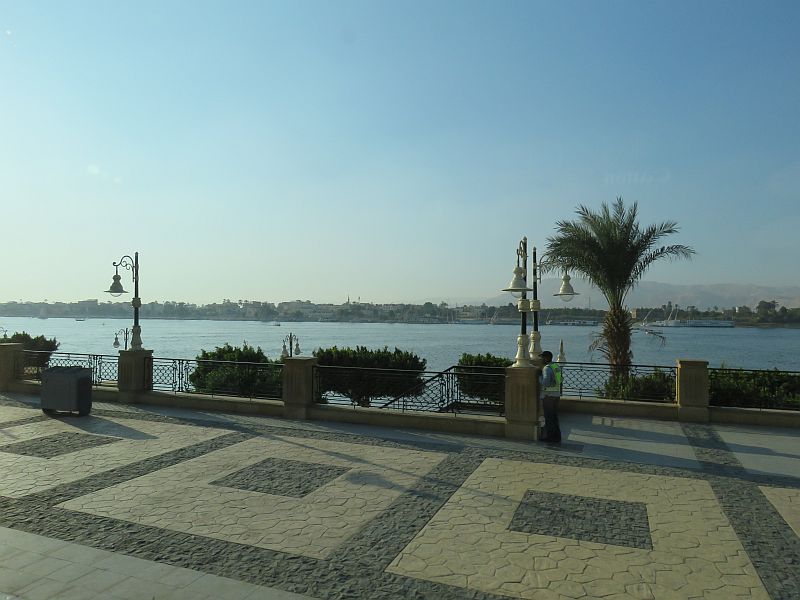
   Gazing out the bus window, my first impression of Luxor is clean air, no crazy traffic or constant honking, the streets seem devoid of garbage and there is a wide walkway along the Nile. It looks like a very lovely city.

I took this photo while we were driving along the Nile on our way to the Luxor Temple ruins.

   We stop at the Luxor Temple ruins on the way to the hotel. There is an Avenue of Sphinx that stretches for 1.5 miles which connected Luxor Temple and Karnak. It is an astounding sight to behold. Hussein tells us that this sphinx avenue was used once a year for the Opet festival by the ancient Egyptians. I think this avenue was built over many decades by various pharaohs.

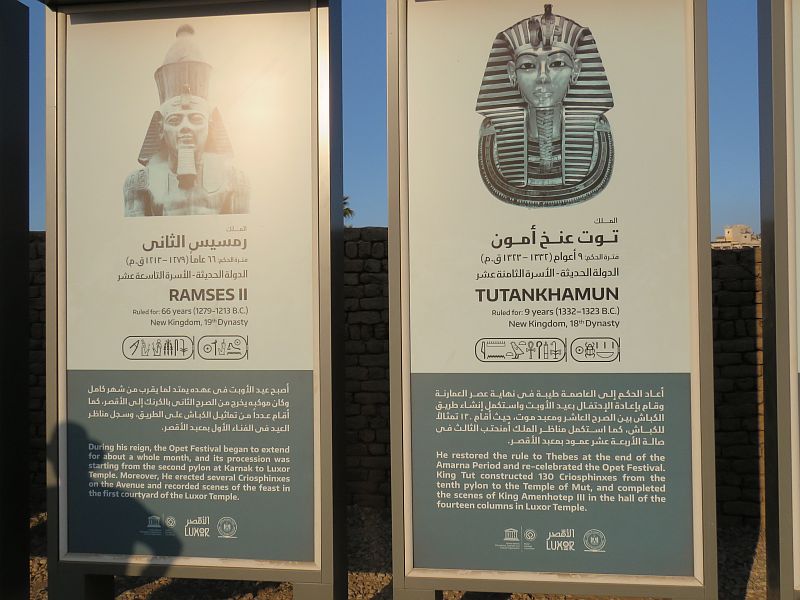
A little bit of the history of the Avenue of the Sphinx and Temple if it is readable?
One side of the Avenue of Sphinx. It takes your breath away.
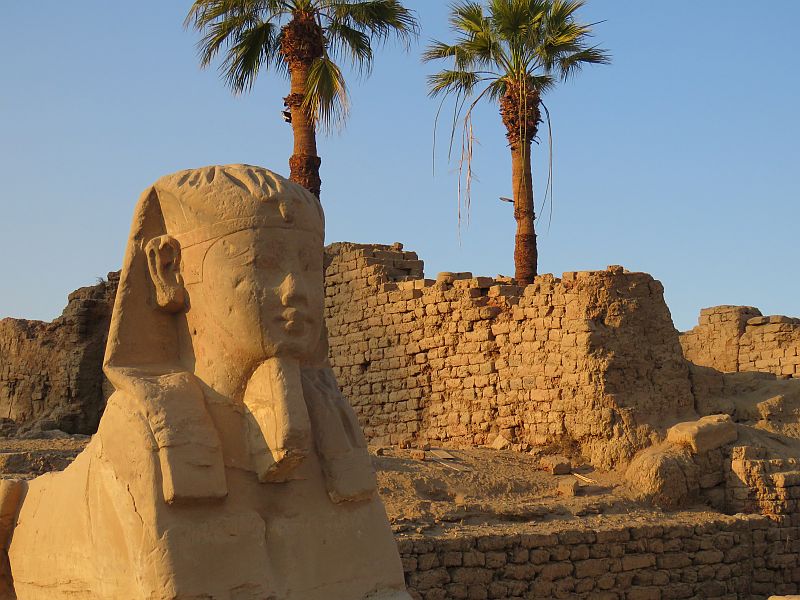
A close up of one of the Sphinx that is in remarkable shape considering they are 1,000’s of years old.

   Hussein gives us twenty minutes to walk down the avenue and admire the stately sphinx. Some of them hardly have any damage while others might not have any facial features left. It is hard to fathom that this sphinx lined avenue is thousands of years old.

The massive columns of Luxor Temple. The people give you a good perspective of their size. Paul is always easy to spot because of his stetson.
I believe all these statues are of Ramses II.

    Hussein gathers us up and talks about the ruins of Luxor Temple that stands a few yards away from the avenue of the sphinx. I will not even attempt to relay any of the information that Hussein shared with us. Mainly because I cannot remember! The enormous, ornate, columns towering above us, makes me feel very small. As we move inside where areas of the temple are more protected, the painted scenes are remarkably preserved. We wander around looking at paintings, hieroglyphs, and stone columns on our own. After exploring the incredible temple ruins, we proceed to our hotel.

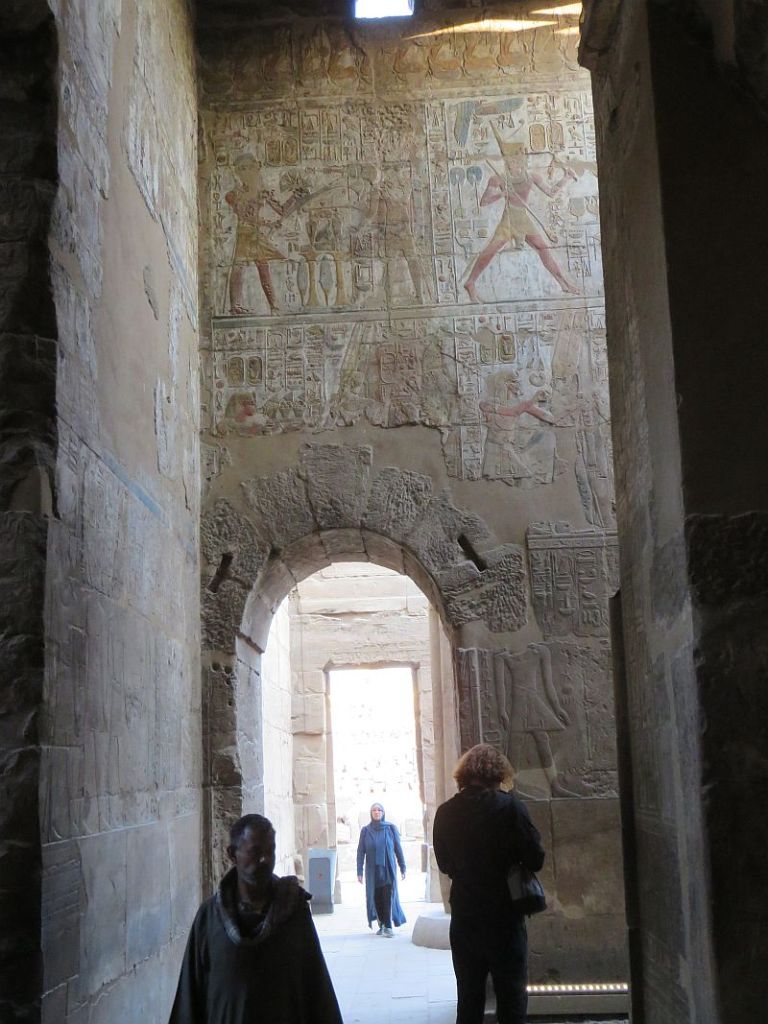
Not a great photo of the scenes that still had paint on them, but you can see that the paint is still vivid.
The sun is lighting up these columns beautifully.

   We are staying at the Sofitel Winter Palace and it is beautiful. We gather around Hussein who hands out our room keys. Hussein leads us down a long hallway to show us where the breakfast buffet is, also pointing out the elevators to us as we walk by them.

   Paul, Jennifer, and I look around a bit then make our way to the elevator. There is a staff member there who opens the door and we step into the old lift. Paul and I have our backpacks on plus we are carrying some hand luggage so the three of us nearly fill the small elevator car. A couple walks up and decides there is room for them and now we are squeezed together to the point we can hardly move. The elevator man shuts the door behind us.

   When the elevator stops on the second floor which is where our rooms are, the elevator door does not open. The man pushes on the door, but nothing happens. Paul is stuck clear in the back and is unable to give any help. The guy starts punching buttons and soon we have arrived at the third floor. Again, the door does not open, and I believe it is Jennifer that tells the fellow to pick up the emergency phone and ask for help. 

    He does follow Jennifer’s advice but since he cannot hear or maybe does not understand the person on the phone, he hands the phone to me since I am closest to him. I tell the staff member we are in the elevator on the third floor, and we cannot get the door to open. The man informs me that someone will be there immediately. For some reason the man could not resist pushing another button while I am on the phone, and we are now going down to the first floor. Are you kidding me! Fortunately, there is a staff member waiting outside the elevator and he opens the door just like you would open the door to a room. Obviously, none of us paid any attention to how the door on the elevator worked when we got on the old lift. We exit as quickly as we can and the three of us vow to not set foot on that elevator again. I think we are all dealing with some claustrophobia.  Walking up two flights of stairs is no big deal even with our hand luggage, hey we need the exercise anyway. I do not remember thanking the man that rescued us which makes me feel bad.

    Tomorrow, we visit the Valley of the Kings. Nancy

Cairo, Egyptian Museum and the Pyramids, part 3

   Paul and I meet Jennifer at eight for breakfast. I still cannot get over the array and amount of food that is offered. We meet Hussein and our group at nine o’clock at “point X” and Hussein leads us to our coach. It is a big coach so there is plenty of room for our group to spread out. This morning we have a security guard escorting us. The man sits up front so when Hussein introduces him, I cannot really see him as Paul, and I are sitting towards the back of the bus.

   When we get off the bus at the Egyptian Museum, I notice a man wearing a very nice suit, scrutinizing us as we gather around Hussein. It takes me a minute to realize that this is our security guard. I suppose he is studying us so intently so he can recognize the tourists he is responsible for.

The Egyptian Museum

   Once we are clustered around Hussein, he calls out a phrase we will hear often on our adventure in Egypt. In a very melodious tone Hussein says “Follow me” and we dutifully line up behind our guide and walk to the museum. Hussein purchases our tickets and when he passes them out to us, he rapidly says the word “ticket” over and over. His quick-fire chant would make the best auctioneer in the USA sit up and take notice. We get to listen to his auctioneer chant whenever we must have tickets to gain entrance to the various places we visit. I love it and it always makes me chuckle!

   Because of the crowd of visitors in the museum, we must wait, or others must wait on us, as the guides stop at some of the most popular items to talk about the significance of the pieces. Hussein takes us to the Egyptian Rosetta Stone; well, it is just a cast or maybe even just a photo behind glass, hung on the wall, since the real Rosetta Stone is in the British Museum. Despite many requests from the Egyptian government asking for the return of the Rosetta Stone, the Brits are refusing to return it to its rightful owners (in my opinion). Anyway, this important tablet is what helped scholars break the mystery of the hieroglyphic language. This is because the same phrase on the Rosetta Stone is in three languages, Demotic, Greek, and Hieroglyphic. I have no idea what the Demotic language is.

Hussein telling us about the Rosetta Stone

    As we continue to be schooled about various items from Hussein, it becomes clear the man is a fountain of knowledge. Names, dates, and stories flow from him without any stumbling or pausing. We learn that Hussein is an Egyptologist, he also was an archeologist for a few years and then if I remember correctly, he became a tour guide.  I believe we have a superb guide although this could be premature since this is our first real outing with him. I can already see that Hussein is humorous, knowledgeable, candid, and very personable.

This piece shows a Pharoah killing his enemies and standing on top of those he has already slain. I put this in mainly for the expression on the young lady’s face which says it all.

   I am not even going to try to talk about the various items and ancient history Hussein talked about. For one thing all the information Hussein is giving us is overwhelming, at least for me, and we were witnessing this in person. I would probably get most of the details wrong even if I tried to pass them on!

This statue’s eyes are so realistic.

   After Hussein finishes showing us the highlights of this immense museum, he gives us directions on where to exit the museum and where our meeting place will be. We are then given an hour to explore on our own.

I think these are canopic jars although there should be four. The deceased’s liver, stomach, lungs, and intestines were placed in the jars at the time of mummification.

     Jennifer, Paul, and I wander around looking at sculptures larger than life and marveling at items so tiny you wonder how anyone found them. We go to Tutankhamen’s special room where they do not allow any photos to be taken. The pieces on display are incredible but the coffin laden with gold is breathtaking. The museum does have an ornate golden chair and some other items just outside Tutankhamen’s room where photos are allowed. The pieces are displayed in a glass case so the reflections from the glass make it hard to take a decent photo.

This jackal statue was found in Tutankhamen’s tomb. Paul’s photo.
This gold covered chair was also in Tutankhamen’s tomb. Lots of glare in this photo.

   The three of us do not use up the allotted hour. After a while you cannot take in any more of the thousands of ancient pieces on display. We find the exit which makes you walk through a gift shop, (surprise, surprise) and arrive at the meeting point. There are already other members of our group waiting there, so we were not the only ones to cut our museum visit short.

   We eat lunch at a nearby restaurant. Hussein had handed out a paper with two or three choices on the bus and we put our order in at that time. The preordering of meals is something that is done throughout the trip which sure saves time. Paul and I had ordered the beef kabob which was really a beef stew. It was very tasty.

Our group. This photo was emailed to us from Hussein, I think.

   We return to the hotel for an hour and then gathered at “point X” for a trip to Old Cairo. It is here that our private security guard earns his pay. The congested streets, where cars and tuk-tuks’ expect pedestrians to make way for them, can be quite dangerous for tourists who are so busy staring at all the sights they forget to move out of the way. You just become oblivious at times due to the produce artfully displayed or meat dangling from a shop rafter, or intent on getting a good photo. This man is striding up and down, stopping cars, gently pushing us to the side of the street, and occasionally counting heads to make sure we are all present.  Twice, when I am taking photos, I feel our guard’s hand in the small of my back pushing me to the side of the congested street. Both times I am moved aside, a car brushes by and I scold myself for being so careless. I see our guard perform this maneuver on almost every one in our group, except Hussein!   Our guards’ eyes are always searching the crowd, checking out the people around us too.

This is our security guard dressed in his dapper suit. Paul’s photo.
Love the colorful display of the fruit.

   The crowds of people, the smog, and the areas of heaped up garbage here and there is the downside of this outing but overall, it was well worth experiencing.

This photo was taken in Old Cairo. The dog in his sweater cracked us up.

   Tonight, we walk to a restaurant for our supper. Our guard is with us, I wish I could remember his name. The man has nerve, as he just walks out into the street and puts up his hand to stop the cars. Hussein is always leading us across the street, once our guard has stopped the cars, and urges us to cross as fast as we can. Geez.

    This morning we are meeting at nine o’clock to see the Pyramids. I admit I am excited to see these ancient structures. Imagine standing next to The Great Pyramid, the only survivor of the Seven Wonders of the Ancient World! A structure that was built over 4,000 years ago by pharaoh Khufu and it is still standing. Amazing.

This road is by the pyramids, although my camera darkened the sky a bit, you can see how thick the smog is. Those buildings in the background are in Cairo. You see a couple of dogs in this photo. I forgot to mention that there were dogs everywhere.

   The bad news is that the smog is thick this morning and when we arrive at the Pyramids of Giza the air quality obscures the blue sky. The good news is that the air begins to clear after a while giving us a clearer picture of the three pyramids. Hussein leads us to The Great Pyramid showing us an area where we are allowed to climb upon the pyramid. I am surprised that the Egyptian government allows tourists to clamber up and walk a short distance along the base of the pyramid. One man in our group elects to go into a tunnel of the pyramid but the rest of us decline the offer when Hussein tells us that there is one place where you will have to get on your hands and knees and crawl. I am slightly claustrophobic and crawling inside a narrow tunnel inside the pyramid does not sound like fun to me. Evidently it is not appealing to the rest of the group either. Ironically the man from our group that chooses to take on this adventure is 6 foot 4 inches tall!

Jennifer, Paul, and other members of our group walking on the pyramid.
A little better idea of the path we walked on the pyramid.

   Once all of us are together, Hussein leads us to another side of the Great Pyramid to show us the place where archeologists had dug up a boat that was buried for the pharaoh to use on his journey to the next world. There is an area across from us filled with camels, decked out in colorful saddles and blankets. There are numerous horses saddled up too. The aroma of ammonia that permeates the air, smells like an enormous litter box that needed to be changed two weeks ago.  There is also the usual lamenting by the camels which is very deep and guttural but there is one camel that is really raising a ruckus. Paul and I soon find the bellowing critter when we notice about four handlers yanking and whacking on a recumbent camel. Oh good grief, there is another camel lying underneath the caterwauling camel. We are witnessing the mating of camels and the camel care takers seem to be very unhappy about it. The men finally remove the male camel who voices his displeasure of being taken away from his girlfriend but allows himself to be lead away. Well, this was an activity that was not listed among the sites we would see in Egypt.

Lots of camels and horses.

   Hussein gives us time to wander around the pyramids on our own. At his advice we ignore the men riding camels or horses that ask to have their photos taken because if you take their photo, they will insist on being paid. I have a good zoom on my camera so I can get photos without them knowing it. The pyramids are so colossal that it is hard to get far enough away to get the entire pyramid in your camera frame.

Paul and Jennifer giving perspective on how huge the pyramids are.
The smooth casing on the tip of this pyramid shows what would have encased all of the pyramids. I believe it was earthquakes that dislodged the outer covering of the pyramids.

   When we meet up with Hussein, we return to the bus and our driver takes us a short distance to an area where camels await us. Yep, we are going to ride camels. You must lean back and hang on to the saddle pommel if you want to stay seated on the long-legged creatures when they stand up. The camels grumble about this, but camels seem to complain about everything. The camel owners take charge of three of us. The lead rope of the camel behind you is looped around the back pommel of your saddle. Once everyone in our group is sitting atop their camels, we begin our trek towards the pyramids.

Nancy and Jennifer astride their camels. Paul’s photo

   The woman that is behind me has a camel that keeps trying to walk around my camel. I do not really want to have the rope pushing against me, so I talk softly to the camel and then take hold of the rope and pull back on it. This makes the camel fall back in line but before long it is striding next to me again. I talk quietly and pull softly on the rope several times on this journey which sends the critter back where he belongs for a little while. One time when I am tugging on the rope, I am rewarded with a huge camel sneeze while he is walking next to me. I am sprayed with a fine aerosol from the sneeze that settles on my face, neck and probably my shirt. Oh well, I just wipe it off and figure it could have been worse, like it could have been actual snot. The woman that is riding this camel tells me that she will remember me as the camel whisperer which I get a laugh out of.

   Paul is riding the camel bringing up the rear of our little caravan so I do not see him at all during our ride. The camel guide stops at a certain point where the three pyramids are spread out in front of us in the distance. He unhooks our camels, leads them to a certain spot and places the beasts’ side by side. The man asks for Paul’s phone and then has us raise our arms into the air and takes photos of us. Naturally, everyone in our group goes through this same ritual. Yes, the camel owners expect a tip for doing this and Hussein has told us how much to give them. Paul said our man told him it wasn’t enough but Hussein insisted we not give them more money if they ask for it.

Paul and I following instructions from our camel trek guide. Well, Paul flourished his hat on his own.

   Camels are not comfortable animals to ride, their gait is very odd plus you do not have stirrups to steady yourself. I get somewhat accustomed to the sway of my camel and feel safe enough to let go of the pommel and manage to take a few photos atop this one-humped animal. Hussein rides past us and it is obvious he is used to riding camels. I wonder if he grew up riding camels? I don’t think I mentioned that Hussein is Nubian.

I took this photo while riding the camel. This was as clear as the sky got today while at the pyramids.

     Paul spots our bus up ahead and lets out a sigh of relief. He told me he was going to walk back to the bus if we had to ride them back to our starting point, because he was so uncomfortable sitting astride his camel. I have a feeling everyone was happy to get off the cantankerous animals and trade them for the comfort of our bus. Oh yes, getting the camels to lay down so you can get off was not easy to do. Many of them belly-ached about having to lay down but you the rider must hang on tight to the saddle horn and lean back in order not to topple off the front!

Some of our group at the end of our camel trek.

    Our next stop is to the Sphynx and I can’t even describe this massive statue in words. We aren’t allowed to go down to the base of the Sphynx, but there is a walkway that allows for great views of this intriguing work of art. Hussein gives us ample time to take photos. He talks a couple of the women in our group to stand in a certain place and purse their lips. I assume this looks like you are kissing the Sphynx.  While we are admiring the Sphynx, a deep guttural noise fills the air. One of the women asks Hussein if what we are hearing is camels, (I thought the same thing). Hussein doubles up with laughter and tells her that it is the call to prayer! I will say that the call to prayer in Egypt is nothing like what we experienced in Istanbul, Turkey when we were there several years ago. In Turkey the call to prayer was melodious and pleasant. I cannot say the same thing for Egypt’s call to prayer.

The sphynx with a pyramid in the background. I wonder what the body looked like before it was scoured by sand and wind.
A closer look at the head of the Sphynx.

   On our way back to the Marriott, Hussein has the bus driver stop at a government bread bakery. All this place does is bake bread where the citizens can buy six flat loaves of bread for twenty cents, (I think). The workers welcome us inside the bakery and we watch one man form the loaves, two other men place them on a conveyer belt that takes them through the heating element, while another man removes the baked loaves as they exit the conveyer belt. It sure does not take long for the bread to bake. I wonder how many loaves of bread this bakery puts out in a day. I wished I had asked Hussein that question. There were lots of people lined up waiting to buy their daily allotment of bread.

This shows the baked loaves at the government bread factory. Paul’s photo

   Time to call it a day and return to the Marriot. Tomorrow, we leave Cairo and fly to Luxor. Nancy

This old Tom cat has been in a few battles. Phot taken in Old Cairo
This optical illusion makes it appear that the boy is walking up the woman’s arm.

Cairo, part 2

    Paul and I both woke up at 1 a.m. so we took a sleeping pill and got a few more hours of sleep. Once we got up and around this morning, Paul and I went down and toured the grounds around the open-air restaurants before meeting Jennifer for a late breakfast. The breakfast is a buffet, and it is huge. Just about every kind of food you can think of is offered. Cheese, cold meats, fruit, lots, and lots of bread, hot or cold cereal, eggs however you care to order them, pastries and so much more. Paul and I are not big breakfast eaters, so I stick to fruit, oatmeal, a croissant and one small pastry. I think Paul and Jennifer might have had an omelet.

I got Paul to pose in front of the fountain which unfortunately I didn’t have centered.

   After breakfast we walk with Jennifer around the same area Paul and I toured earlier and inspect the beautiful fountain, manicured trees, and the large pool.  The staff tending to the grounds are very friendly. Since we have the morning to ourselves, we decide to walk to the Nile River. We ask one of the hotel staff directions and he tells us to exit the Marriot grounds via the parking lot and turn left. He tells us the Nile isn’t far away and when we ask if it is safe to go on our own, he assures us we will be fine.

Photo taken as we walk to the Nile. Look what is ruining the scenery which I mention further down in the blog.

   We do not walk far when we catch a glimpse of the famous river, but we cannot see a way to get down to the Nile nor do we see any kind of a walkway along the river. The biggest problem is there is a very busy street between us and our goal. Hmm, there are two young men dressed in suits standing on the sidewalk not far from us. We decide to approach them to see if they might speak English. No, they don’t speak English, but I gesture towards the Nile and say we want to go to the Nile. They seem to understand this and beckon for us to follow them. The two men lead us down the sidewalk a block or two and point out some stairs leading up to a bridge. The problem is we need to cross the street through heavy traffic and the three of us are not keen on running this gauntlet.

   Approaching us is a young man who is walking along the edge of the busy street.  I inform Paul and Jennifer I am going ask him if it is okay for us to cross the street here as we haven’t seen anyone dodging the traffic to get to one side or the other. I smile at the young fellow and ask if we can cross here, gesturing to the other side of the road. He doesn’t answer me but he puts out his arm and I take it. He then watches the approaching traffic carefully and when a small break comes, he hustles me across with Jennifer and Paul close on our heels. How kind was that?? I thank him and he touches me on the shoulder and smiles, then he dashes back across the street.

   We walk along the congested road to the staircase only to realize these steps are leading up to a bridge where the traffic is even heavier. I guess the first fellows we consulted thought we wanted to cross over the Nile. Paul rules out going up the stair steps as it will not take us next to the Nile, only over it. A man at the top of the stairs begins yelling down at us in Egyptian and pointing in the opposite direction of where we were headed. He comes down to where we are standing, I suppose we look lost, and begins talking to Paul. Of course, Paul can’t understand a word he is saying.  The friendly man indicates that we should follow him and feeling fairly safe in broad daylight and the fact that there are three of us and one of him we let him lead us back in the direction we came from. We arrive at a side street where he points across the road and sure enough there is the Nile. The problem is the riverbank is lined with riverboat casinos and restaurants so we cannot walk down to the Nile. How the heck did this guy know what we wanted? We smile, thank him, and wave goodbye as he continues on his way.

    Paul and Jennifer decide to just walk onto one of the boats, naturally I follow them.  When we get inside the large boat, there is a man in a uniform sitting behind a desk. He looks up and smiles at us and when we walk over to the window to gaze at the Nile the man walks over to us and unlocks a door that leads out to a small balcony. We step out and gaze over the wide Nile. Okay, it isn’t exactly clean, there is garbage, particularly plastic floating on the water. Across the way there are three large pipes spewing what I hope is not raw sewage into the waters of the Nile. Still, it is the Nile, and one cannot help but marvel that three Kansans are gazing over this famous river. After Paul proofread this, he reminded me of the enormous McDonalds sign, the golden arches standing out against a bright red background, that we saw across the river. Good Grief.

Looking across the Nile from a Riverboat balcony

   When we step back inside the boat, we thank the man that let us go out on the balcony. He nods his head in acknowledgment, smiles at us, and locks the balcony door behind us. So far, the Egyptian people we have encountered have been so friendly and kind. We check out one room on the boat before we leave where clothes are being offered for sale. I spot a lovely top and seriously consider buying it. You can see in the photo why I was so attracted to this unique blouse. Just kidding.

Does this look like me? Jennifer is trying to grab it from me as she really wants this top!

   We manage to cross the busy street on our own and walk back to the Marriott. We all go back to our rooms. Paul takes a nap and I go sit on our balcony. Our balcony looks out on the lot where buses unload guests. Jennifers room looks out on the manicured lawn near the outside eating area. Our view isn’t pretty, but it is rather interesting to watch the various buses either loading or unloading tourists.  

   We eat a late lunch in the same outside restaurant where we had such a good meal last night. Paul and I order a saffron shrimp dish to share, and Jennifer orders a minced lamb dish. I do not care for the shrimp at all so Jennifer is kind enough to share some of her lunch with me which is quite tasty. We take our time eating and marvel at all the people smoking with hookahs while drinking beer and nibbling on snacks. When one fellow next to us leaves his table the doves and sparrows move in. He has left a bowl of peanuts on his table and the beautiful doves are feasting on them. It is hilarious.

Doves feasting on peanuts.

    When we met Hussein yesterday, he had given us a time to meet this afternoon at point X (the lobby of our wing of the hotel). We will be meeting our group for the first time. Once the sixteen, well fifteen as one woman is not feeling well and has stayed in her room, of us have arrived at point X, Hussein leads us to the other wing of the hotel to a meeting room. Hussein goes over some things with us and then has us introduce ourselves, tell what state we are from, and inform everyone how many times we have traveled with OAT. I believe there is one couple where this is their first time with OAT and then Paul and I are the next lowest having taken two trips with OAT. The most astounding is a woman who is traveling by herself, and this is her twenty-seventh trip with OAT! That is amazing.

    Our group has two women from Minnesota that are friends traveling together, a woman from Arizona and a woman from Pennsylvania that are traveling together, a couple from Colorado, a couple from California, a couple from Connecticut, a couple from Minnesota, a woman from Maryland, the one who has made 27 trips with OAT, and we three Kansans. As you can see this is quite a diverse group. On first impressions everyone seems to be very nice. I would guess the age range of the group is early 60’s to mid-80’s.

   After the meeting, Hussein walks us to a women’s craft store that isn’t far from the hotel. We have to cross a few busy streets and you can imagine getting sixteen people across safely is a challenge. The cars are constantly honking, and I literally plug my ears with my fingers at times just to get some relief from the noise. The smog is really bad, and you can literally taste the air. We country people are not used to breathing in such nasty air.

These women asked Paul to take their photo and only wanted to see the photo. They didn’t ask for money.
Street scene on our walk to the Women’s Craft store

  When we arrive at the building where the women’s craft store is located, our group follows Hussein up a couple flights of stairs to reach the craft store. There are all sorts of homemade crafts such as jewelry, purses, knitted items and so on. My favorite of everything offered are the wooden crafts. There are a couple of items that are tempting to purchase but I have no room in our luggage to get these lovely creations home. Many members of our group do purchase some things, including Jennifer. Jennifer found a cute Christmas ornament and a knitted eyeglass holder, both of which will be easy to tuck away in her suitcase.

There are some beautiful wooden pieces on display.

   Supper is on our own again, so we choose to eat in the international part of the Marriott’s open-air restaurant. There are other restaurants to eat at inside the hotel, but they don’t have the atmosphere that the outside venue has. The couple from Colorado joins we three Kansans and we have a nice visit with them. Paul and I split a meal again, a club sandwich, which is good. We had a beer and they brought peanuts and chips with our beer, so we had more than enough to eat.

   Tomorrow we are going to the Egyptian museum and to Old Cairo. Nancy

There were lots of cats in Egypt. These two were in good shape, unlike a lot of other felines we saw.

OFF TO EGYPT


Sunrise on Rock Hill Ranch a few days before we left for Egypt

  The day has arrived to leave on our long, awaited trip to Egypt. It is hard to believe we booked this trip in 2019 for a 2020 departure, which of course was canceled. We rescheduled for later in the year. Nope, that didn’t work out and a third time in 2022 which was nixed too. Finally, on January 19th of 2023 we are headed for the KC airport.

   Paul needs to drop the ranch pickup off at the local mechanics on our way to Jennifer’s which will help Randall out so I follow him in the car and pick him up at Mike’s Repair. We arrive at our good friend Jennifer’s on the agreed upon time. We load our suitcases and backpacks in Jennifer’s car and head for Kansas City.

   We decide to eat lunch before dropping the car off at Park Air Express since there will be no food on our flight to Chicago. There is a barbeque restaurant close to Park Air, so we take advantage of the location. The food is fine and after we pay and are headed back to the car, Jennifer reaches into the inside pocket of her new jacket to get her wallet. It isn’t there! Not only isn’t it there Jennifer discovers that this “pocket” is open on the top and bottom. She rushes back to the restaurant only to meet the waitress who is hustling out the door with the lost wallet. That could have been a disaster! Why the heck is there a “pocket” that is open on both ends?

   We drop the car off at Park Air and climb into the shuttle which delivers us to the airport. Paul and I go to the check in counter and ask the woman there to add Paul’s global entry number into the system.  My number is in the system, and we have no idea why his isn’t but the woman adds it and we are good. We check our one bag and gather up all our boarding passes and wait. Jennifer has checked her bags and also received her boarding passes.

   When the time comes to board the plane, we are in the last group. The people checking tickets have been announcing over the microphone that they need passengers to check their carry-on bags as they are running out of overhead bin space. When it is finally our turn to board the plane, the woman scanning our boarding passe tells us we have no choice but to check our bags all the way to Cairo. Jennifer and I argue and tell her that is not going to happen as there is stuff in our carry-on bags that we need with us. The woman says she has to put the check through tag on anyway and then we can see if the flight attendants can find room for our bags.

    I am in the lead and walk onto the plane with my bag and tell the flight attendants that I need this bag with me. They say no problem, the bag is small enough and there is room for it. Jennifer and Paul are given the green light too. I swear, I get anxious enough in airports without this conflict to start our day off.

   We made it to Chicago on time which is a good thing as it is a madhouse here. We have a long way to walk to the international wing of the airport and we had to go through security again. For some reason of the three of us I am the only one that has Pre-check for this leg of our trip. A lot of good it did to get the woman at KC to put Paul’s global entry number in the system and why Jennifer’s isn’t pre-check makes no sense at all. Jennifer and Paul have to join the mass of humans inching along in the regular line. Oddly enough the pre-check line hardly moves at all and people including me are grumbling about the snail’s pace of our supposedly faster security line.  I soon lose sight of Jennifer and Paul which doesn’t help my nervousness.

  There is only one person in front of me now and I’ll be darned if a huge flight crew shows up at this time, at least 15 people. The crew walks around we two women to go through the security ahead of us. Are you kidding me! I finally am allowed to proceed to the conveyer belt, and I walk with confidence through the metal detector. The damn thing starts making a loud squealing noise that I have never heard before. I have nothing on me to set it off and the guy manning the detector tells me it is a random check. For crying out loud! Another woman is already waiting, and she is upset because she has a flight connection to make as I do, and we both don’t have that much time.

   Ten or fifteen minutes later I am finally motioned to go to the man that is conducting the search on we randomly chosen victims. He asks me for my cellphone and when I tell him I don’t have a cell phone, his eyebrows arch up. He speaks in a firm, loud voice and says, “Ma’am, I need to have your cell phone. I reply “Sir, I honestly do not have a cell phone. He sizes me up and decides I am telling him the truth. He then asks for my electronics. Oh brother, Paul has my tablet in the bags he is carrying, and I have to tell this guy that I have no electronics either. After a brief pause to scrutinize my face, I guess he decides that I am telling him the truth on this too.

    He waves me over to a machine and asks for my right hand which I do have with me. He begins to wipe it down and then crisscrosses it with something. I ask him what he is doing, and he tells me that he is checking for certain chemicals and powder. After that I have to place my palm on the machine and thankfully it turns green, and I am free to go.

    When I walk out of the security area there is no sign of my traveling companions. I see people walking with their luggage on the far side of where I am standing, and I wonder if Paul and Jennifer go out a different way. A young man is waiting in the same area, and I ask him if the pre-check line exits in a different place than the regular security. He assures me everyone comes out to the same area. He can see that I am very nervous and talks to me, assuring me that the plane will not leave without us since we have checked in. He then asks where we are going and gives me directions to our gate, admitting to me that we still have quite a distance to cover to reach our departure gate.

   I finally see Paul and Jennifer putting their luggage on the belt and walking through the metal detector. Paul never took his liquids and electronics out of his bags, and nothing was said to him. I should have just gone with Paul and Jennifer.

   We made it to our gate with ten minutes to spare but we have to get new tickets issued for some reason. We are nearly ready to hand our tickets over to board the plane when I realize my boarding pass is not in my passport. I lose it, wailing to Paul that I have lost my boarding pass. Jennifer assures me that they will issue a new pass, so I rush over to the desk and tell them in a shaky voice that I have lost my boarding pass. The woman calmly tells me that it is no problem and I soon have my new pass in hand. I am still shaking when I take my seat on the plane.

    Paul and I try to settle into what are extremely uncomfortable seats. If I find my seat unbearable you can imagine how miserable Paul is. I watch the new Top Gun movie which was really good and then try to sleep. Neither one of us can fall asleep so we split a sleeping pill and manage to get some shuteye, though it is not enough. Somewhere over the Atlantic Ocean, Paul and I agree that we are done with international travel and seal the deal with a high five slap.

   Nine and a half hours later we land in Zurich. We have no problems on this connection and board the plane without any glitches. Paul and I are sitting in an emergency exit so there are lots of leg room, but we are not allowed to have any of our carry-on luggage, so it gets scattered around to various overhead bins. After the cramped misery of the last flight, we are okay with that. Four hours later we land in Cairo. As Paul is pulling our coats out of the bin above our head a flight attendant sharply tells us we were not to put anything in that overhead as it is for emergency equipment. I inform her that we did not place them there, a flight attendant put them there when she saw them laying in our laps before we took off. The ticked off attendant wants to know who it was, and I tell her I thought she was the one that did it. The young woman insists it wasn’t her and Jennifer speaks up saying it was not this attendant but also backs up our story that it indeed it was another attendant that placed our coats in the forbidden bin.

    There is a helpful man sitting behind us that hands Paul and I our bags that got put in bins behind us. We shuffle out of the plane and as Paul is ready to step out of the plane into the walkway, he realizes he has left his Stetson on the plane. The attendant tells him to step aside and wait until everyone is off before he can go back to retrieve his hat. Well, isn’t this just a fitting way to end our marathon trip of twenty-four hours.

   Our OAT rep is waiting for us and is that a welcome sight. Ayman introduces himself and then asks for our visas. Umm, we were told to buy them here, so we join the rather long line of visitors waiting to get a 25-dollar visa. Ayman excuses himself and, in a bit, returns and beckons us to follow him. He takes us to the Egyptian Bank where there is one person ahead of us and then asks us for our passports and 25 bucks. Great. He takes us through passport control and then we go to the luggage carousal. While we wait for the luggage to show up, he asks us for our covid vaccine card so he can take a photo of them.  I can’t remember where my original card is, but Paul is carrying a copy and Ayman is fine with this. A few minutes later I remember where I stashed it and pull it out to see if he wants a photo of the original card, he shakes his head and says all is well.

   Our luggage shows up, Hurray, and we walk out to a waiting van. The traffic of Cairo is crazy. Where there should be two lanes of traffic sometimes there is 3 or 4 cars across. Ayman tells us lanes are only a suggestion here. To make things worse everyone is constantly honking. And there are pedestrians darting in and out of traffic as they try to cross this insane traffic. No rights for pedestrians here, you are on your own!

   We arrive at the Marriot hotel forty minutes after leaving the airport. We thank Ayman for making our arrival in Cairo so easy and he hands us off to the man that will be our guide for our adventure in Cairo. Hussein calls each of us by name and then gives us our room keys and a quick tour of the outside eating area and the building where we will be eating breakfast. Hussein leads us back into the hotel and bids us goodnight. We will not see him again until tomorrow afternoon when we will meet the rest of our group. We have come a day early.

Waiting to be served our first meal in Egypt. Paul’s photo

    Once we get our things into our nice rooms, we meet in the lobby and go to eat supper. We decide to eat in the outside restaurant that serves Egyptian food. Paul and I order a chicken/eggplant/ rice dish which is very tasty. Jennifer had a fish dish if I remember right and thought it was very good too.

   We go back to our rooms, shower off the remnants of that long trip over here and go to bed. Nancy

ONE LAST NIGHT IN NJOZI CAMP BEFORE RETURNING TO REALITY, BLOG 15, APRIL 2OTH 2020

ONE LAST NIGHT IN NJOZI CAMP BEFORE RETURNING TO REALITY, BLOG 15, APRIL 19TH 2020


On our drive back to camp we again enjoy the lines of cattle egrets skimming just above the ground on their way to Lake Ndutu for the night. We also reflect on all the astounding encounters we have had on this safari with George. What amazing things we have had the fortune to experience.

Long-Crested Eagle

As we pull into the camps driveway, George tells us we should leave Njozi by 7:30 in the morning since the journey to Arusha will take seven or eight hours. Salama and Lema are waiting for us as usual and we take the warm towels they offer with appreciation. We bid George goodnight and tell him we will see him in the morning.

As we walk to our tent there are new guests being escorted by staff members to their tents. George told us this morning that two groups of people were arriving at Njozi today. Paul and I look forward to meeting the guests this evening. We both agree at the two camps where we were the only customers, we missed the socializing with other safari goers at the end of the day. It is always fun to compare notes of your days sightings and to get acquainted with other folks that love Africa as much as we do.

Another photo of Paul relaxing in front of our tent. Did I already use this photo??

When we walk to the bonfire tonight there are two young men seated near the crackling flames, each enjoying a beer. We introduce ourselves and find that the California natives are traveling with their parents and an uncle. When the rest of the family arrives and once Joseph has taken their order for drinks, we greet one another. The second group of people join us and we go through the same process of introductions, not that I will possibly remember all their names! One couple from the second group is from Colorado and their traveling companions are from California. As everyone is chitchatting, the two couples from California realize that they actually live in the same area and have attended functions together.  How small the world is!

Flowers that were growing around the tents in Njozi. Couldn’t do them justice.


David and Useph have joined this noisy crowd and readily answer questions from the new guests about their work in Ndutu.  At some point, Paul shows the researchers the video he took of the stealthy lion who got put in his place by the angry lioness. I can’t remember if it was David or Useph who nearly doubled over with laughter while watching the video.

David listens to a conversation Paul and I have with the Colorado couple about our African safaris. One of the topics we discuss is how disgusted we were with the behavior of humans at the wildebeest crossings that we witnessed in 2018 and they had witnessed on one of their safaris. David interjects that there is a new warden now and that rules have been put in place for guides at the river crossings. One of them is that vehicles must stay a certain distance from the riverbanks, (I think it was 80 meters). Another rule is that no one is allowed out of vehicles. The four of us are delighted to hear about these changes!

Another shot of Joseph and his liquor cart. Paul got in this shot.

Vana appears in front of us and announces that it is time to come to the dining tent for dinner. The staff have seated us all at the same table which proves to be a tight fit but we make it work. Paul spends his time enjoying the company of the California couple that are traveling with their sons. I am seated next to the couple from Colorado and the three of us visit all through the meal about our African adventures and travel in general. It is quite noisy in the canvas tent with all of us happily chatting away.

Paul and I are the first to leave since we need to prepare for our departure tomorrow. Our dinner companions say goodnight and tell us that they will see us tomorrow. We reply that unfortunately we won’t have that pleasure since we are going home tomorrow. We bid everyone goodbye and wish them the best of luck on their safaris in the coming days.

This morning we eat our last breakfast at Njozi alone as the people we met last night have already departed on their morning game drive. I wish I was out in the bush with them! We gather our luggage and meet George at the truck. We say goodbye to the staff and hand over the thankyou note which includes the tip money. For some reason we didn’t take a photo of the Njozi camp staff! I was sure we had but if we did it was deleted somehow. We wave so long to the wonderful people of Njozi camp as we drive down the driveway for the last time.

George has not popped the top of his safari truck this morning since we are in travel mode and not game drive mode. George does stop before we exit Ndutu so we can watch a hot air balloon land. The colorful balloon sits down near a line of grazing wildebeest and most of the animals ignore the colorful bag of gas.

Hot air balloon landing as we are driving out of Ndutu

Serengeti gate and sign pointing to Ndutu

We reach the Serengeti gate and continue towards Ngorongoro Crater. There is a scattering of zebras, various antelope species and wildebeests. I ask George to stop briefly so I can take a photo of a tower of giraffes looking elegant in the morning light. We begin to see Maasai herding their cattle to grazing grounds plus the neat circles of huts that make up the Maasai bomas.

Giraffe along the road to Ngorongoro Crater

Monument for Olduvai Gorge

In some place’s there are vivid purple flowers carpeting large swaths of ground which makes for a stunning scene. Regrettably, George informs us that the flowers are an invasive species but I can’t remember where the flowering plants came from.

A carpet of purple blooms

Two hours after leaving Njozi we reach Ngorongoro Crater. George parks the truck and Paul and I walk over to the viewing platform and look down at the crater floor far below us. Even with binoculars it is impossible to clearly make out the wildlife at the bottom of this deep hole. Paul and I visit the restrooms before clambering back into the truck.

Looking down into Ngorongoro Crater

George has to stop at the Ngorongoro entrance gate in order to sign out before we can continue our journey to Arusha. As we drive away from the Ngorongoro gate a troop of baboons is walking down the middle of the highway. The primates take their sweet time moving out of our way so we can continue on. The baboons are our last wildlife sighting I am sad to say!

Baboons on the road after we left the Ngorongoro Crater entrance gate

We drive in and out of small villages with plenty of interesting scenes to take in. We also converse with George on various subjects including George asking me how I got my Swahili name. I tell him a guide in Tanzania by the name of Tumani (sp), gave me that name because I was so interested in birds. George exclaims that he knows Tumani and that now Tumani has his own business. I’ll be darned.

I’m not sure what the woman in back is carrying but that appears to be a wing spread out behind her. A chicken maybe?

Paintings for sale along the road side.

Typical overloaded cart on the blacktop road

There is always room for one more!

We follow a tractor hitched to a disk and George explains that this is one of many custom workers who go around and disk up fields for villages or individuals. This practice of disking gets the fields ready for planting much faster than the old way of digging the soil up by hand or using oxen teams. It is bound to save a lot of aching backs and arms too.

Following a custom worker’s tractor and disk.

These trees with yellow blossoms were common. Quite beautiful.

We stopped more than once to let the Maasai boys move their herds of cattle and goats across the road.

One of the most heart wrenching things I see is a woman with a baby attached to her back, walking down into a river bed where there are only potholes of muddy water. She is carrying a small plastic container and I hope I am wrong but I think she is there to dip up some of the foul water.

Woman with her baby walking down to the muddy pot holes in the river.

When I blew this photo up I could see a small plastic container in her hand

Seven hours later we arrive in the bustling city of Arusha. There are numerous motorcycles and they follow no traffic rules, weaving in and out of the crush of cars which irritates our low-keyed guide. George has to make a stop to get the Masai sandals he ordered for me as a gift. George had to know my shoe size so that is why he didn’t have them with the gifts he presented us at the beginning of the safari. When George returns to the truck, he is holding two pair of sandals. I assume one pair is for Paul but George says no, he ordered me a second pair because I saw the first honey badger😊. I try the on the colorful sandals at George’s request and sure enough they fit. I thank this generous man for the sandals and all the other gifts he showered on us. It wasn’t necessary nor expected but much appreciated.

Often these two wheel carts were pulled or pushed by humans.

How does this man balance those buckets?

The Maasai sandals George gave to me. I made them part of my African wall display.

We arrive at the day hotel mid-afternoon, (we ate boxed lunches as we traveled that Njozi camp provided for us), and George makes sure that the hotel has a reserved room for us and plans to take us to the airport before he says goodbye. We profusely thank our guide for the wonderful experiences we had in the Serengeti and Ndutu. We hand him a thankyou card with his well-deserved tip money. As George drives away I stand at the doorway and wave at him but he doesn’t see me.  I think his thoughts have turned to seeing his wife and children who are waiting for him on the other side of Arusha.

I had to go back and get a photo of George from 2018. I can’t believe neither Paul or I took a photo of George or with George. Geez

We have our room for three hours so we shower and I repack our suitcases as our weight limit for our carryon luggage is 26 pounds each. I have a set of luggage scales and with a few things stuck in our coat pockets we manage to keep our two sets of carryon luggage around twenty-five pounds. Paul says he bets they won’t even weigh our luggage here in Africa and I bet him that they will. I lost that bet by the way!

While I was packing Paul went to use the complimentary computer the hotel provides to check in and print our boarding passes. Paul got along fine until it came to printing out the boarding passes and the office staff couldn’t figure it out either. Tenacious Paul kept trying various things to get the tickets printed and, in the end, he got it done. Once our time in the room is up, we go to the restaurant and share a pizza then wait for the shuttle to take us to the airport.

At the airport we wait in line to put our luggage through the first screening machines. Then we wait in line to check in. Once we reach the desk Paul drops my Swahili name to the woman who is helping us. The young lady starts laughing and says no she is Bibi Ndege and tells Paul he is Babu Ndege. Paul and I had wondered why several people would laugh at my name on this safari and now we know. I am too old to be Mama Ndege, I am a Bibi, translation Grandma while Babu is of course Grandpa. Hilarious. Paul again drops my Swahili name at the passport check desk and he gets the same reaction, laughter. Hey if it puts the security folks in a good mood it is worth it.

You might be yawning like this lioness through this part of the blog:)

From Arusha we fly to Dar es Salaam where we sit on the tarmac for over an hour while people got off and others boarded. From Dar it is a seven-and-a-half-hour flight to Amsterdam where we have a two-hour layover. I find a café where I buy a triple chocolate muffin and chocolate milk. I was craving chocolate to say the least and oh my gosh was that muffin delicious! We leave Amsterdam and nine hours later we arrive in Atlanta where we use our global entry card for the first time. It was so easy, no long lines to stand in and we just breeze through customs. We leave Atlanta and arrive in Kansas City and we are so tired when we get here that we spend the night in KC.

So that is the end of our adventure. We have had eight wonderful safaris to Africa but if I were to rank them, I would have to put this trip at the top of the list. The camps were incredible, our guides just fantastic, all the staff people friendly and caring, and the wildlife sightings and behavior we experienced was unbelievable.  Nancy

A good photo for the end of my blogs.