Iringa to Ruaha part 7

Iringa to Ruaha Part 7
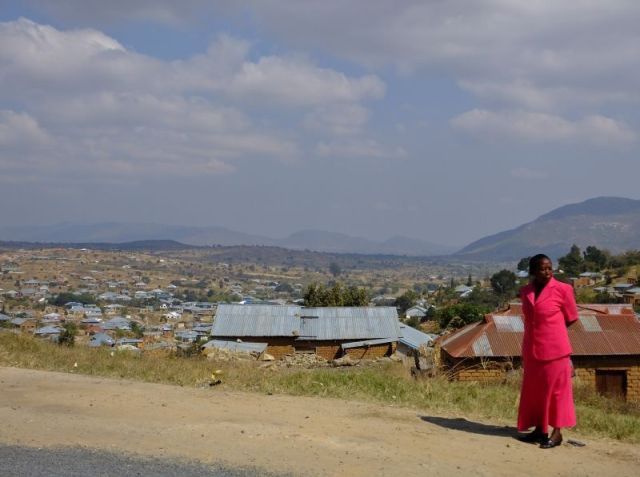
Leaving Iringa and looking down onto the outskirts of the city

Leaving Iringa and looking down onto the outskirts of the city

Paul and I had just settled into bed last night when we heard running accompanied by what sounded like a rolling ball overhead.  After the third frenzied episode, Paul went outside to determine if there was a hotel room above us. Returning from his reconnaissance tour, he reported that there is no second story to the hotel. Luckily for us, whatever was cavorting on the roof or worse yet in the ceiling finished their rambunctious play and we were able to go to sleep. We were woken once in the night to an encore performance, but luckily the culprits only made one curtain call.

Paul and I have an adjoining room with Brian and Daktari, who also heard the impromptu game being played over our heads. At some time between eating breakfast and leaving the Savilla Hotel, Brian told one of the young waiters about the noise last night and asked him what was responsible for the ruckus. Without blinking an eye the young man said “rats in the ceiling”.  I was hoping more for a “there were monkeys on the roof” explanation!

As Paul and I are leaving our room to go to breakfast, we meet Bwana Cheka who tells us that Bibi Vitabu fell ill during the night. Oh man, we have a long drive ahead of us today and a lot of it will be on rough, country roads. Though we haven’t spent a lot of time with Vitabu she seems to roll with the punches. Still, how miserable to have to ride over bumpy, dusty roads when you are not feeling well.

The Savilla restaurant has a breakfast buffet and we dine on cereal, toast and yogurt, although they have plenty of other food choices if you want them. Everyone in the group comes to dine at their leisure as there is no rush to depart this morning. Once we are preparing to leave, Vitabu joins us, looking pale but determined.
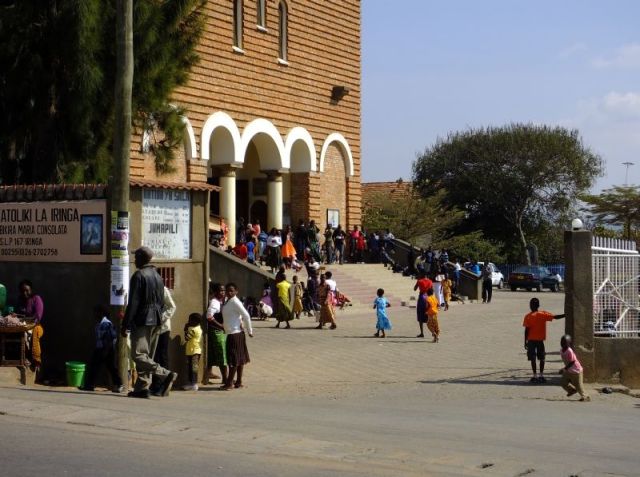
Church goers in Iringa

Church goers in Iringa

As we drive through Iringa I am surprised at how large the city is. Today is Sunday but the city is bustling with residents shopping, selling, or going to church.  Brian and our drivers need to buy bottled water for the camp and we stop at an African version of a mini mart. I never heard why but the men come up empty on this task. Next the drivers find a gas station and fill the Rovers with diesel. When our leaders finish with the errands we have become familiar with one street of Iringa because we have driven on it three times now! At last we are exiting the city to begin our journey to Ruaha National Park.
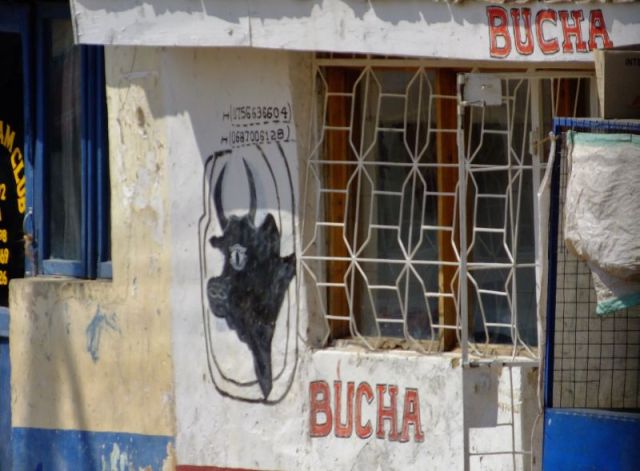
We saw a lot of these small butcher(bucha) shops, often with meat hanging in the window.

We saw a lot of these small butcher(bucha) shops, often with meat hanging in the window.

A busy street in Iringa

A busy street in Iringa

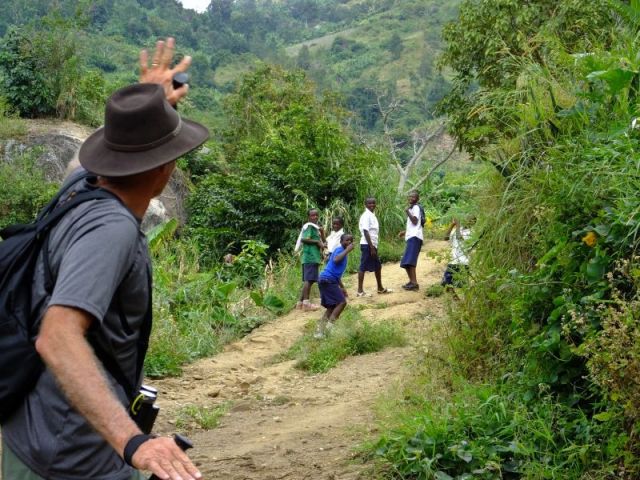
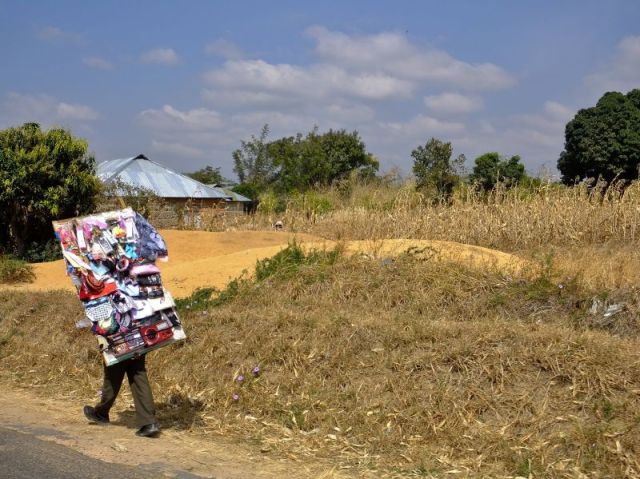
As usual, the roadside scenes are fascinating and there is always something to marvel at. We pass a peddler walking along the highway, carrying a peg board on his back which is hung with a wide assortment of articles. We cruise by students dressed in white and navy uniforms, as they walk along the shoulder of the road. There are golden sheaves of dried grass leaning against sheds, along with crudely made elevated corncribs, filled with ears of corn. Little children wave and yell at us, as our vehicles pass them by.
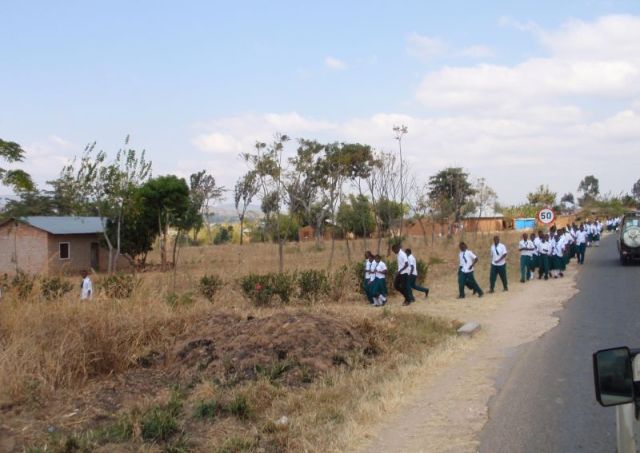
The students we met. Paul's photo

The students we met. Paul’s photo

Sheaves of grass and corn in the crib.
Sheaves of grass and corn in the crib.

The peddler, what a variety of merchandise he has.

The peddler, what a variety of merchandise he has.

DSCF4191We stop at an Orthodox church, gleaming white in the dusty landscape, which is open for the public to visit. If I understood correctly, they only hold one service a year at this country church. Can that be right? We enter the church and look with curiosity at the framed pictures depicting biblical figures and scenes, including one painting of the Last Supper. The religious articles the priest would use during the service are sitting on a table in the curtained alcove, although the bible is lovingly covered with a silken cloth. There is a small settlement just across the road from the church and curious children come out to stare and smile at the tourists, or peek in through the church doors at us.
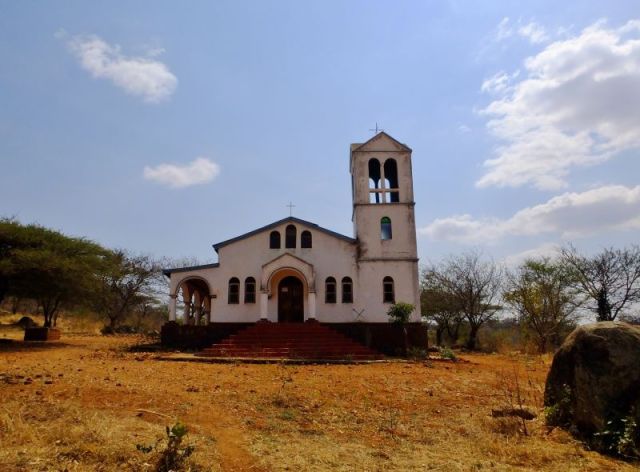
The Orthodox church

The Orthodox church

DSCF4193

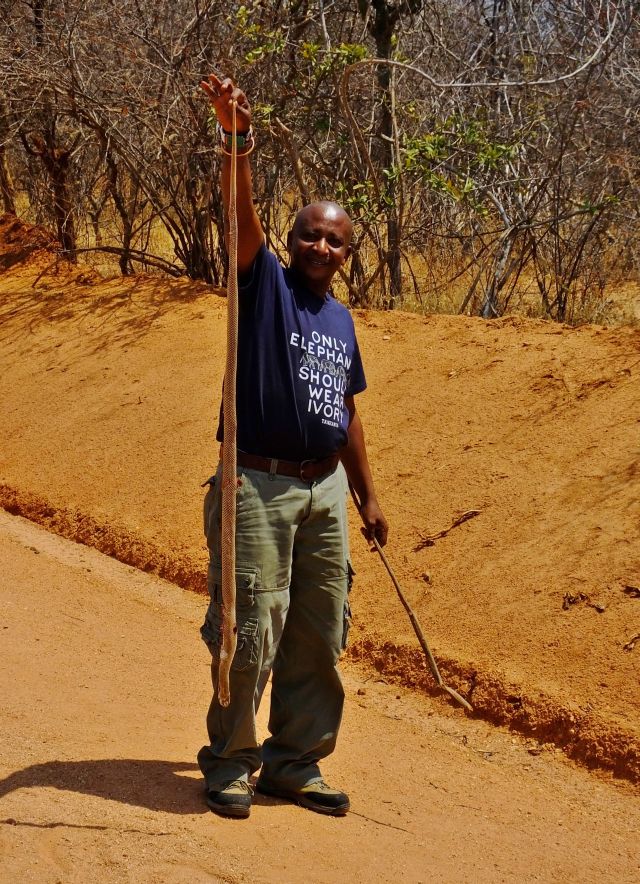
Continuing  down the sandy road, our guides bring the Rovers to a halt because there is a dead snake lying in the road. Many people get out of the vehicles to take a closer look at what Mochie identifies as an Egyptian cobra. I just take photos of the deceased reptile and its human onlookers from the window. The smushed snake isn’t very impressive until Bacari holds the snake up by the tail, and suddenly you realize how long the reptile is.
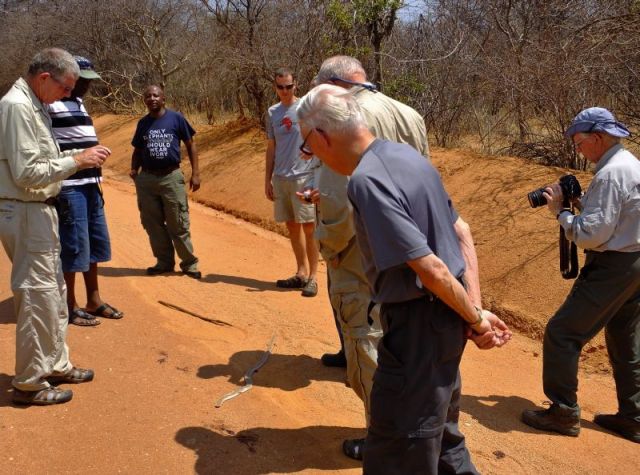
Members of our group getting a close up look at the dead snake
Members of our group getting a close up look at the dead snake

The Egyptian Cobra looks a little more impressive once Bacari picks it up.

The Egyptian Cobra looks a little more impressive once Bacari picks it up.

We stop for lunch at what we would call a one-horse town back in America, (my kind of town). We tourists, along with some natives, crowd under the thatched roofs of two open-sided structures to escape the searing noonday sun. The atmosphere here is relaxed, as children play checkers, and adults play the confusing game of bao, while we eat our boxed lunches next to them. We have a surprise at lunch because there are various types of sandwiches instead of the normal chicken/boiled egg lunch. The Savillas’ reputation for good food continues as the sandwiches are very tasty. Vitabu seems to be doing better too, which is certainly good news.
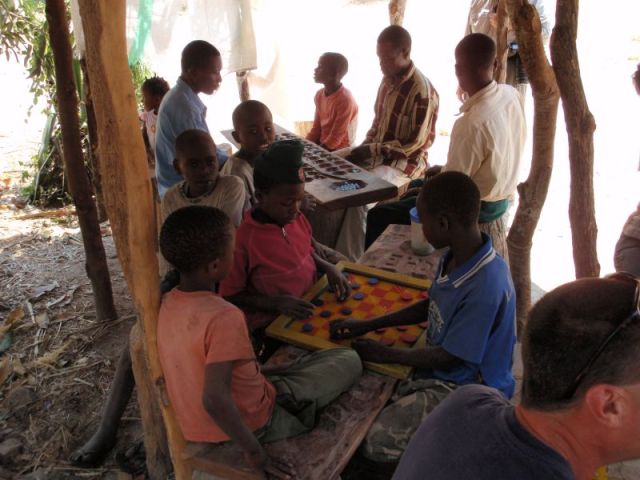
Playing checkers and bao Paul's photo

Playing checkers and bao
Paul’s photo

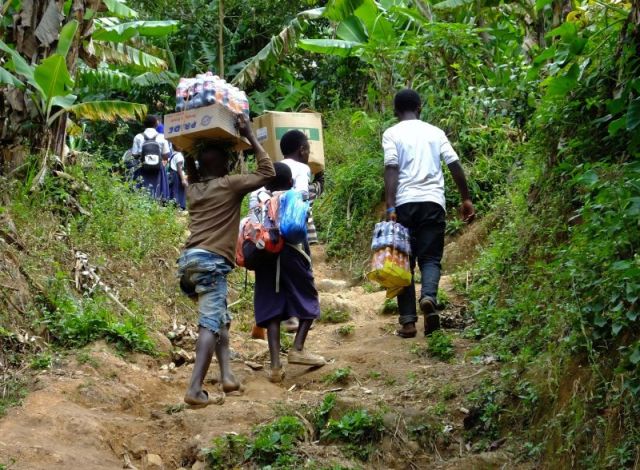
We are eating next to a “strip mall” in this sleepy village. I couldn’t figure out the number systems on the shop doors for the life of me but I’m sure there is a reason for the out of sequence numbering. Most of the shops in the building are closed, but a couple of shops are open offering basic staples, and one even has jars of candy on the counter. The candy selection doesn’t include chocolate, (which many of us are beginning to crave), because there is no way to keep it from melting. One of the shops has the bottled water needed for our mobile camp and Brian buys several cases from the happy store owner. Now the question arises, where do we put the stuff since the vehicles are already packed full? Our Rover has one empty seat in the back so we pile some boxes on the seat and floor. There is a permanent cooler between the two back seats and we put two boxes on it, plus some backpacks. Brian finds room for the rest of the water boxes in the other Rovers.  Nyama selflessly volunteers to occupy the seat next to the tower of supplies and luggage when we leave town. Nyama is often shoving the load back into its allotted space since the stuff keeps shifting into her territory, as we bounce our way towards Ruaha. Paul and Ngruwe each take turns in the cramped back seat before we reach our mobile camp, so Nyama doesn’t have to endure the tight quarters for the entire journey.

Some of the shuttered shops in the mini supermarket:). I love a good oxymoron.

Some of the shuttered shops in the mini supermarket:). I love a good oxymoron.

Nyama sharing space with boxes of water and backpacks. Pauls' photo

Nyama sharing space with boxes of water and backpacks. Pauls’ photo

As we approach the outskirts of Ruaha National Park, there is a single giraffe near the road and I think of him as our welcoming committee of one. I take this lone sentry as a good sign of things to come for our safari in Ruaha!
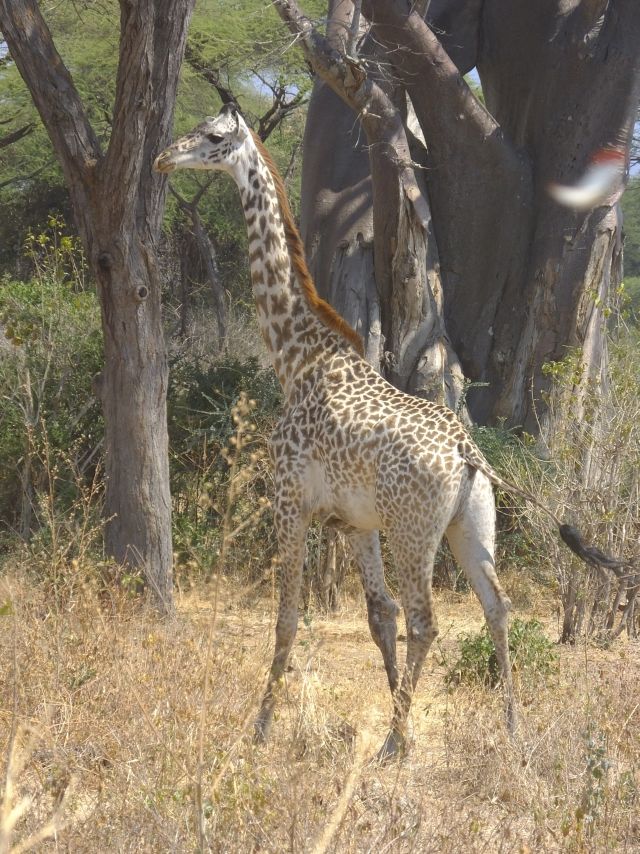
Giraffe just outside of Ruaha National Park

Giraffe just outside of Ruaha National Park

While our guides check in and fill out the mandatory paperwork, our group peruses the various postings around the porch that surrounds the office, describing the origins of the park and the wildlife that is found here. We study the log book where people write down their wildlife sightings and other comments about the park (all good). One of the more exciting comments is that someone saw wild dogs in the past few days. Could Paul and I, (others in this group have seen them on prior safaris), be so lucky to finally see wild dogs?

After our guides finish wading through the red tape, it is time to pop the tops on our vehicles and enter the park. I guess I haven’t really talked about our safari vehicles in detail. The Rovers have a roof that pops up leaving a wide space between the roof and the side of the truck. For me, the best way to see what is out there in the wild is by standing up in the vehicle. We can stand on the seats but only if you take your shoes off. Since I am so short, I must stand on the seats because if I stay on the floor I can barely see over the top of the sides of the Rover. Nyama, Uwiano, and I almost always stand up on the seats; the guys generally stand on the floor. I think Vidole Juu stands on the seat if he is riding next to Kevin as it is harder to see out of the front while sitting down, there is a section of the roof that pops off in the cab too.
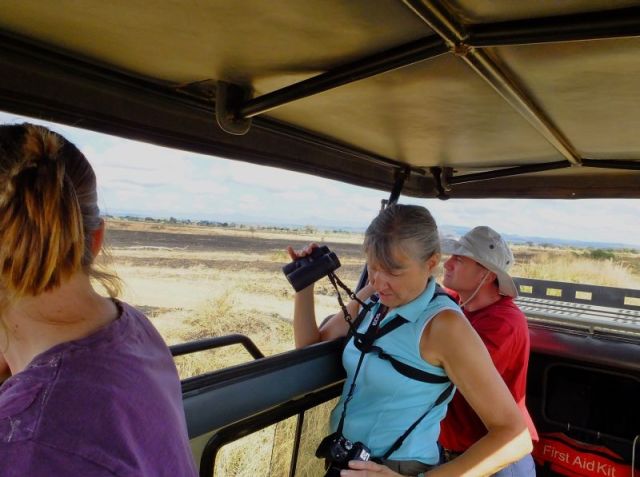
This photo was taken in Mikumi National Park but it shows how the tops of the safari trucks pop up.
This photo was taken in Mikumi National Park but it shows how the tops of the safari trucks pop up.

DSCF4227

As we begin our drive through the park, my first reaction is that it is dry, brushy, and empty. There is a type of palm tree here, which I don’t remember seeing on other trips to Africa, (but perhaps I have forgotten), and it seems odd to see palm trees here. After driving a short distance in the Park, I see something move a long ways from the road in a small ravine. I yell out “Simama”, Swahili for stand or stop, and Kevin complies with my request. I ask Kevin to back up until we reach the spot where I saw movement. Sure enough there are three animals in the ravine; one is standing in the open while the other two critters are obscured by brush. I point and try to give verbal directions to where the animals are and eventually everyone sees the animals. Kevin identifies the big antelope as Kudu. These are the first Kudu we have seen on this safari, and they are all males, easily identified as such by their long spiraling horns.  Our Rover is trailing the convoy again, and the other two vehicles have long disappeared from our sight so they miss out on the three “grey ghosts” of Africa.

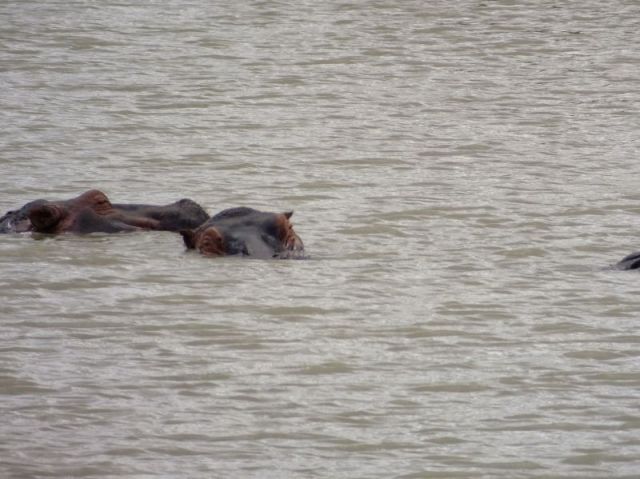
We catch up to our companions at the Ruaha river and they are feasting their eyes on a variety of wildlife including, grazing hippopotamus and waterbuck, crocodiles and a large array of birds. There is one enormous hippo, well most adults are enormous, who is lying out of the water and I ask Bacari if the animal is dead. He assures me the blob of blubber is very alive and shortly after my question, I see the sleeping behemoth shift slightly. Holy Cow, I never get over how massive these mammals are.
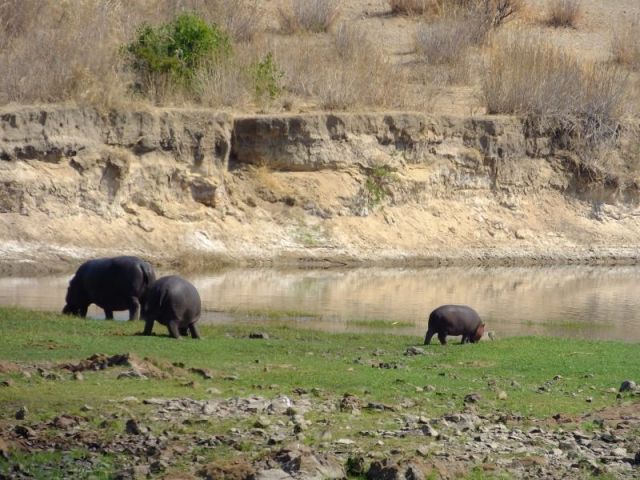
Grazing Hippopotamus

Grazing Hippopotamus

Several of us walk onto the bridge and we peer down at the clear water and see schools of fish. The sight of the fish makes Brian wish aloud for his fishing gear.  A fish eagle careens down to the water, talons at the ready, and comes up with a large fish. We watch as the raptor goes airborne with his prey and flies in a circle several times before carrying his dinner to a nearby dead tree. I wonder what the purpose of the circling was, to make his catch so dizzy it couldn’t flop around? It made me half dizzy watching the white-headed eagle doing his loop-de-loops in the air, so maybe that isn’t such a farfetched thought!

Looking over the Ruaha river from the bridge. The water looks murky but you could see down into it quite well.

Looking over the Ruaha river from the bridge. The water looks murky but you could see down into it quite well.

As we are standing on the bridge watching a bloat (yep, that is one word for a group of hippo) of hippos lazing in the water along with some nearby crocs, several truckloads of soldiers trundle across the bridge. Later, we see these soldiers marching through the bush in what I assume are training exercises. Still, this isn’t something you expect to see taking place in a National Park and I find it a bit disconcerting. It is time to move on so we leave the Ruaha River that is bursting with wildlife, to venture into the dry plains of the National Park.
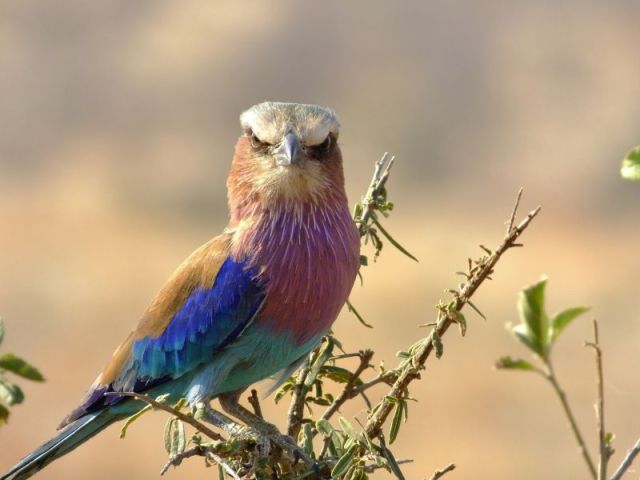
I laugh every time I look at Mr. Grump the Lilac-breasted Roller.

I laugh every time I look at Mr. Grump the Lilac-breasted Roller.

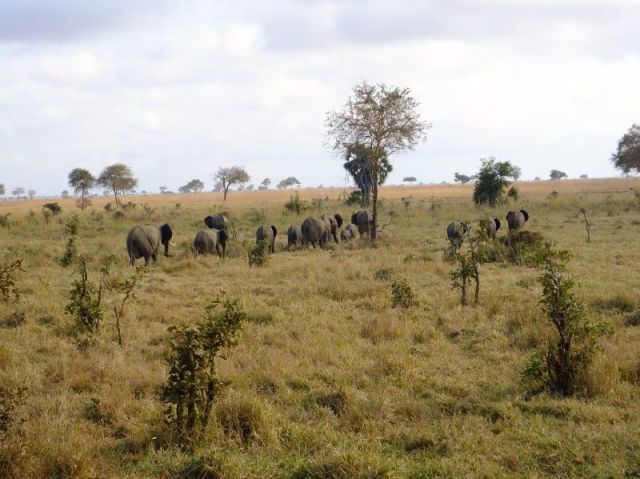
As we motor through the park on the way to our mobile camp we see plenty of animal life.  One of the funniest encounters for me is one I have dubbed the grumpy Lilac-breasted Roller. I have so many photos of various Rollers from this safari and I can’t find another one with the scowling features of Mr. Grump. It makes me laugh every time I look at this birds’ portrait.  We observe elephants plucking and munching on the leaves of thorny bushes, which look not only painful but nearly impossible for the elephant to manage. However, the big pachyderms seem to be indifferent to the thorns. There are also stately giraffe to enjoy as they glide in slow motion across the arid bush.
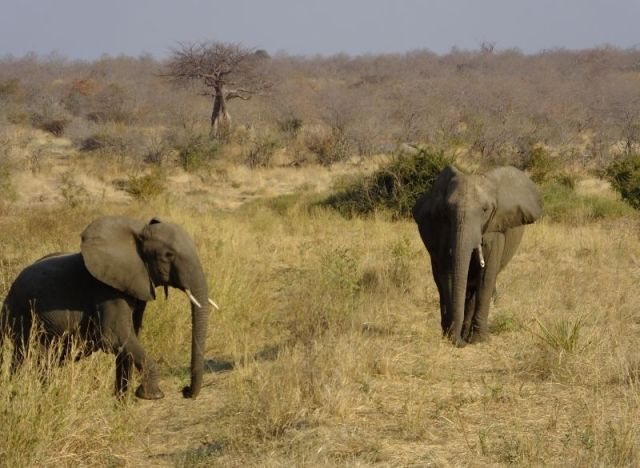
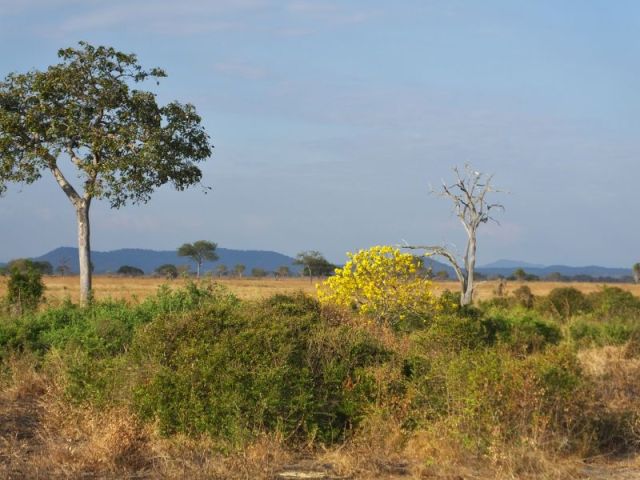
Two elephants and a look at the arid plains of Ruaha
Two elephants and a look at the arid plains of Ruaha

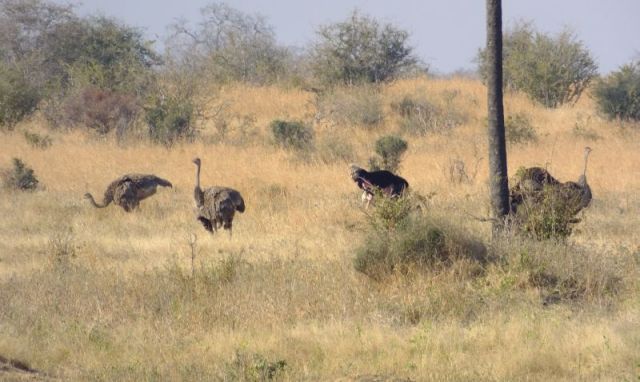
I took this photo on maximum zoom. The ostrich were a long ways off.

I took this photo on maximum zoom. The ostrich were a long ways off.

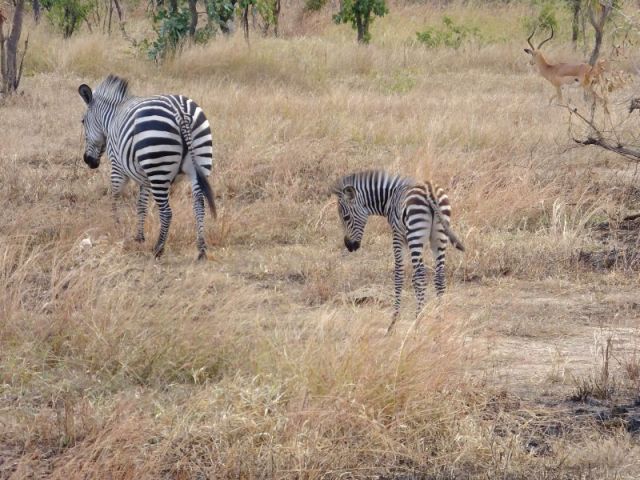
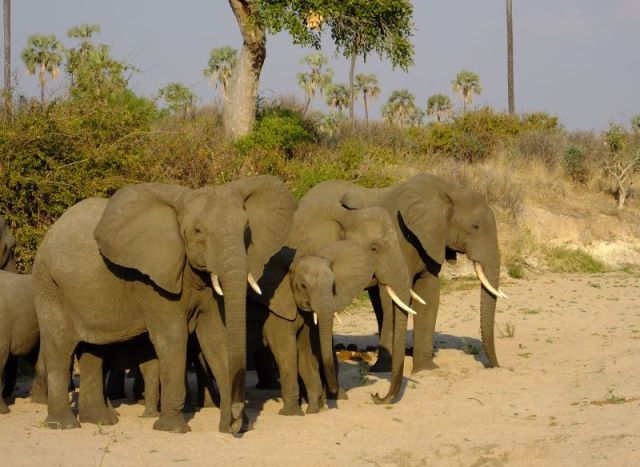
Coming to a dry riverbed, there are elephants and impalas scattered about the area. Across the dry channel are a male ostrich and several female ostrich. We will only see these large birds one more time and unfortunately we never get close to either group. Our drivers prepare to cross this sandy river bottom and they must put the vehicles in 4-wheel drive to make it through the deep sand. There is a herd of elephant with a small baby and several juveniles standing next to where our vehicles are exiting the riverbed. The adults and youngsters close around the small baby, in a circle the wagons defense, ears fanned out to warn us they mean business. I am always enthralled with the instinct for all of the elephants, not just the mother, to protect the youngsters. Once the matriarchs decide we mean them no harm, they break rank and begin walking through the sand to only they know where. We encounter some handsome zebra too, and as usual they seem to perk up at the sight of a camera.
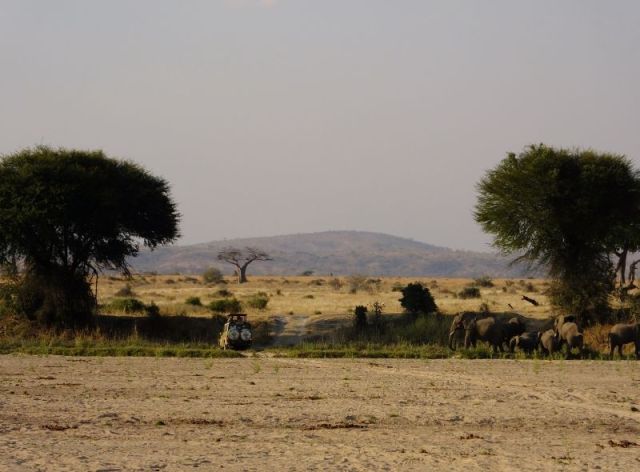
Watching one of our group vehicles cross the sandy river bottom
Watching one of our group vehicles cross the sandy river bottom

The herd of elephants closing ranks around their most vulnerable member as we drive next to them.

The herd of elephants closing ranks around their most vulnerable member as we drive next to them.

We continue driving near the river bed through brush that slaps and scrapes at vehicle and humans alike. Vidole Juu and Uwiano become very adept at warning their fellow passengers when a low-lying branch is likely to whip an inattentive person in the face or hands and the two continue to be our warning system for the remainder of our safaris. I know they saved me from the sting of a branch, often thorny at that, many times.
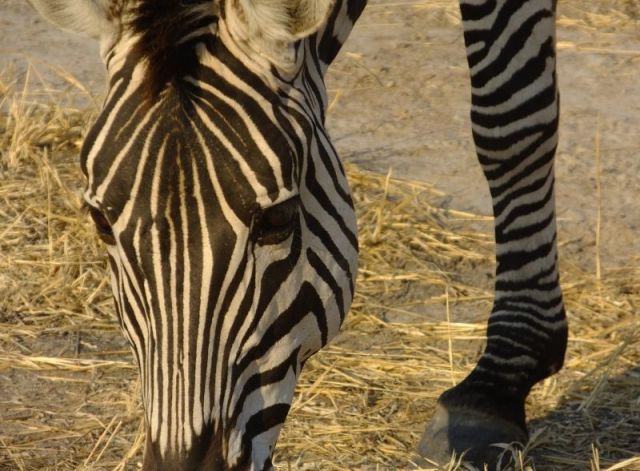
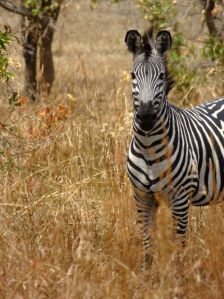
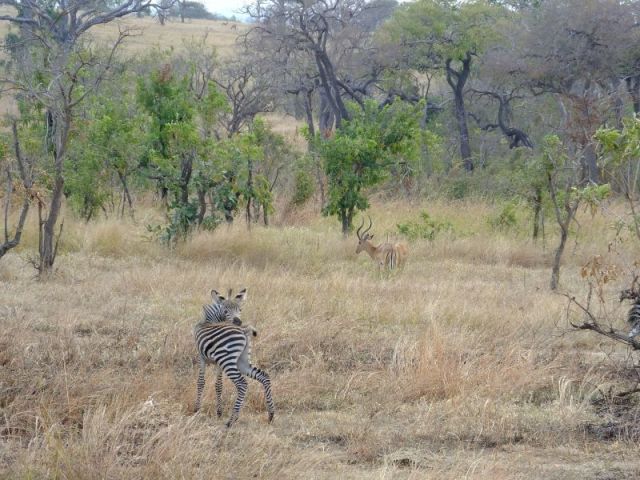
I can't leave the zebra out. Yes I meant to take the photos this way!
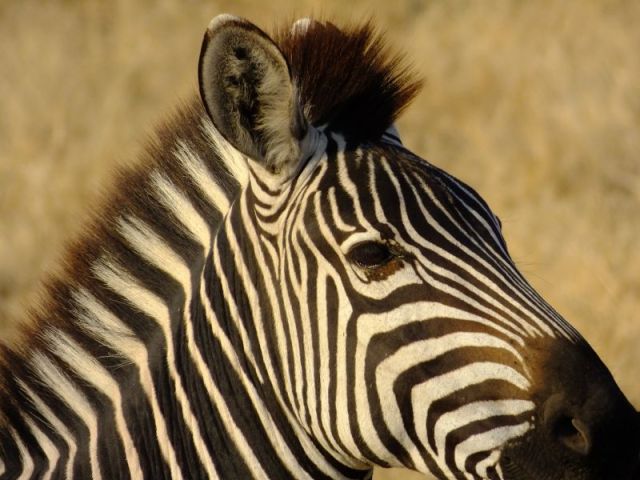
I can’t leave the zebra out. Yes I meant to take the photos this way!

DSCF4288

We arrive at our mobile camp and it is isolated and perfect. Our tents are situated near the dry river channel and as we have seen on our safari today, the river bed seems to be a preferred mode of travel by a lot of wildlife. It is good to see Christophe and the camp staff again, (I’m ready for those delicious dinner rolls), and to settle into the number eight tent again.

Next installment, Game drives in Ruaha National Park. Later, Nancy
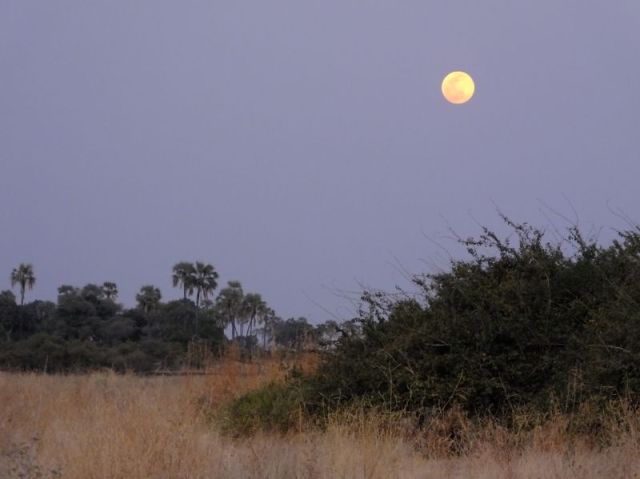
I walked out into the river channel to take this photo of the full moon rising the first night in our Special Camp in Ruaha. Gorgeous!!
I walked out into the river channel to take this photo of the full moon rising the first night in our Special Camp in Ruaha. Gorgeous!!


Isimila, Part 6

Driving to Iringa and visiting Isimila, Part 6

Not a bad view from our balcony

Not a bad view from our balcony

Brian announced last night during dinner that we would leave Udzungwa Mountain lodge mid-morning to drive to Iringa. He also informed us that Sykes monkeys were roosting (my word, do monkeys roost?) in the trees behind our duplex, and the monkeys would begin to stir around dawn, for those that were interested.

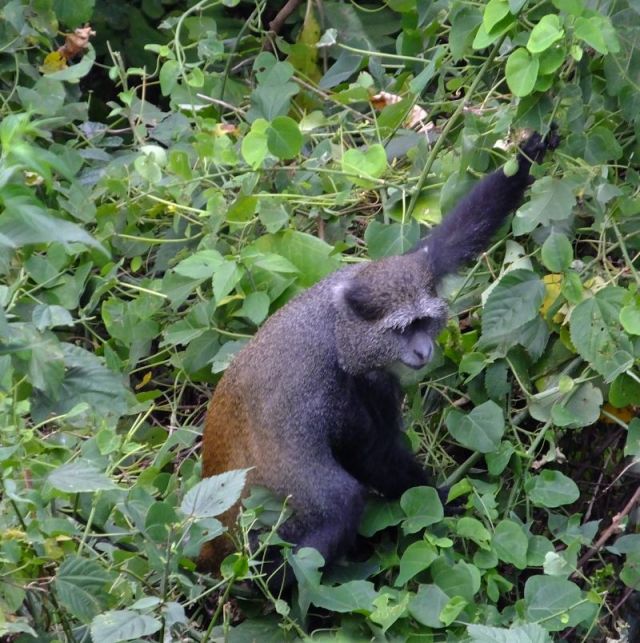
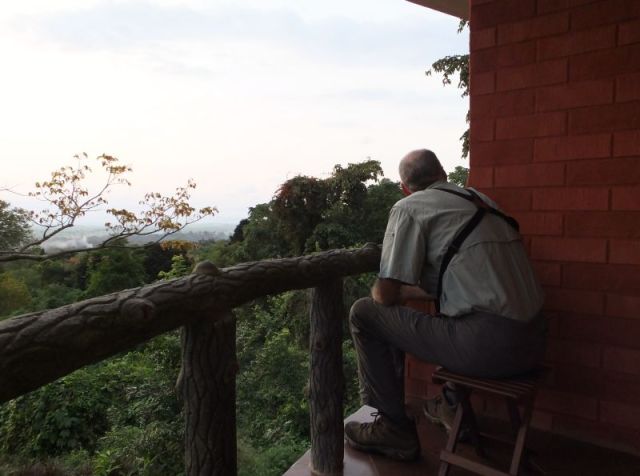
This morning Paul and I are up by daybreak and scoping out the trees for the russet-backed primates. Nyama, tousled haired and sleepy-eyed, is sitting on their balcony, but when no monkeys appear after waiting for some time, she decides to go back to bed. Nyama and Ngruwa saw them yesterday morning anyway, so it’s not like they will be missing out.

Paul looking for Sykes monkeys

Paul looking for Sykes monkeys

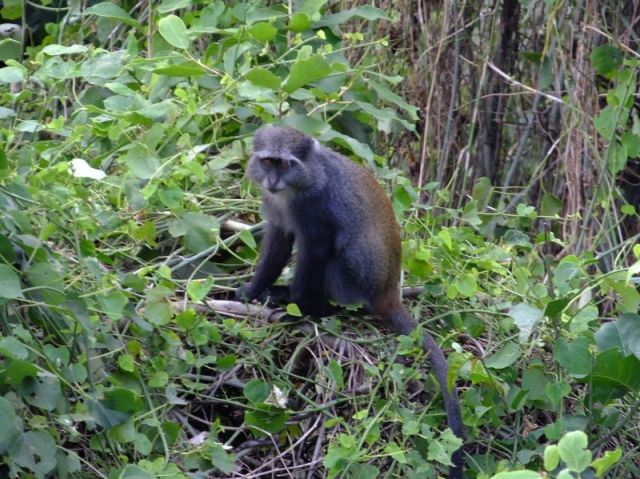
Paul and I rotate between the balcony and the room as we check for monkeys and pack our suitcases. Finally we see a Sykes monkey sitting on a tree limb near Nyama and Ngruwa’s balcony. The sun has yet to fully illuminate our back yard so the dim light makes for fuzzy photos of the monkey. Upon closer scrutiny through binoculars, we see that the monkey is holding a half-grown baby. Eventually, the youngster leaves its mothers arm and scampers around in the tree. Another Sykes joins the pair and begins feeding on the fruit or leaves of the tree. The breakfasting monkey, often stands precariously on shaky tree limbs as it reaches up or over to another branch, for a particularly tempting morsel.

When the steadily rising sun sends tendrils of light into the copse of trees, the rapidly warming air brings the troop of monkeys to life. Most of the Sykes monkeys leap from the big tree down into smaller bushes and disappear from sight. Some monkeys stay and feed in the roost tree, but one monkey ventures into a verdant bush not far from our balcony. Paul and I watch as the female monkey sorts through the leaves of the bush in search of the perfect leaf, pluck it and pops the tidbit into her mouth. The monkey is aware that she is being watched and occasionally makes eye contact with us, or in most cases makes contact with a camera lens or binoculars. Mostly she ignores us as she dines on an endless buffet of leaves. The scheduled time for breakfast arrives so we leave the foraging monkeys to their feast.

Sykes monkey in the nearby bush

Sykes monkey in the nearby bush

Plucking a leaf

Plucking a leaf

Enjoying a leaf

Enjoying a leaf

While at breakfast, Paul and I learn that Vidole Juu, Uwiano, and their guest Brian, were watching for the monkeys from their balcony too. They told us that they would just look over at our balcony from time to time, because they knew if I was taking photos, this was confirmation that the monkeys had arrived! One of them even took a photo of me, taking a photo of the monkeys. What can I say; I am a photo taking fanatic.

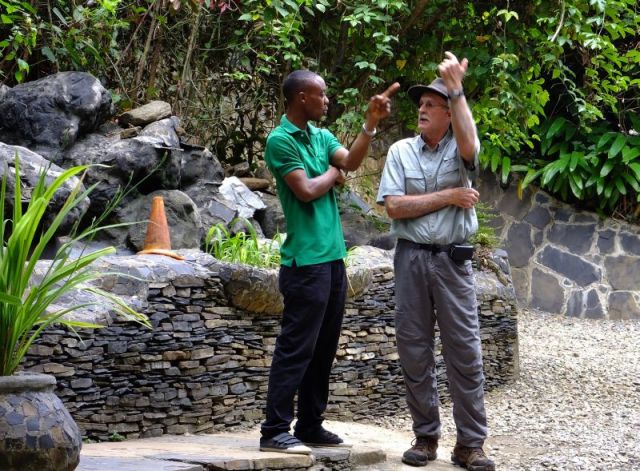
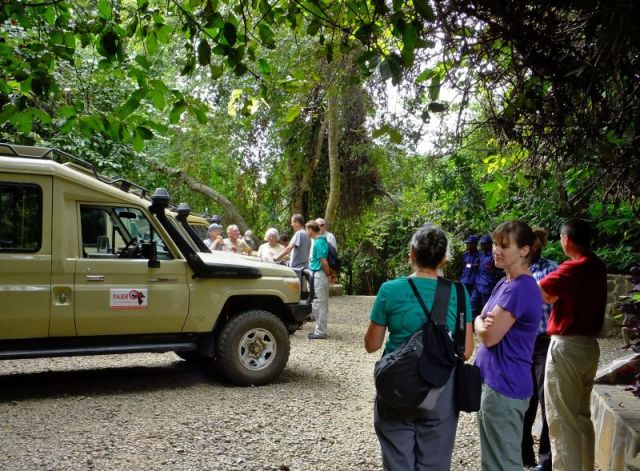
After a leisurely breakfast, we return to our room to brush our teeth and gather our luggage. We make our way to the reception area and settle our bill for laundry and drinks. Paul and I carry our luggage to the parking lot where our drivers are busy packing luggage in the Rovers. Paul strikes up a conversation with a young man while we are waiting for the all aboard call. I don’t know what they were talking about but they were quite animated.

Paul in conversation with a staff member

Paul in conversation with a staff member

The manager appears and I go to thank him for a wonderful stay in his establishment. I inform him that Paul writes reviews on Trip advisor and that I’m sure Paul will speak highly of the Lodge. Kenny’s (the manager) face lights up and says he will be looking forward to reading the review, after which he hands me his business card. Paul goes over to Kenny a few minutes later to thank him and assures him that his review of the Lodge will be a complimentary one. I think Paul just made the man’s day because he shakes Paul’s hand and thanks him profusely for the endorsement of the Lodge. Trip Advisor is a powerful site that travelers the world over use to research trips including Paul. I notice several other members of our group having words and shaking hands with Kenny. I think everyone enjoyed our stay here.

Getting ready to "Kennel up" as Tembo would say

Getting ready to “Kennel up” as Tembo would say

It is time to load up and head on down the road for Isimila and Iringa. For some distance we drive through villages with the typical market stands, or pastoral scenes where we occasionally see herds of goats and cattle. We leave this peacefulness behind when we must travel a busy mountain highway to reach our destination. This highway is congested with overloaded trucks, public buses crammed so full of people you wonder how they can breathe, along with cars and motorcycles.

Notice the slogan on the bus.

Notice the slogan on the bus.

We haven’t driven far when I feel tenseness in the air of our Rover and a lot of it is coming from me. The people driving on this road seem to have no fear or sense! The public bus drivers in particular seem to enjoy playing chicken on this narrow, winding road. The drivers of the colorful buses have no qualms in passing slower vehicles on blind curves, and since the bus drivers are driving at excessive speeds just about every car are slower than they are. We see the aftermath of three accidents, none of the crash sites looked like the occupants would have escaped injury to me.

You can sort of see how narrow this road is. This was one of three wrecks we passed.

You can sort of see how narrow this road is. This was one of three wrecks we passed.

I don’t know how long we drove that highway from hell, but I think there was a collective sigh of relief from all of us when we left the mountain road for the calmer and more level roads we had become used to. When Brian was questioned about the driving of the public bus drivers, he explained that part of their behavior is competitive. The drivers are trying to be the first to arrive at the next bus stop so they will have first dibs at the waiting customers. The more customers they can cram in their bus, the more money for their bus line I suppose.  The other reason the bus drivers speed like they are competing in the Indy 500, is so they can finish their route and go home. They obviously have little regard for the wellbeing of their customers. Brian tells us he rode one of the buses over this highway on a prior visit and he doesn’t seem too fond of the memory. You couldn’t get me on one of those buses for the world!

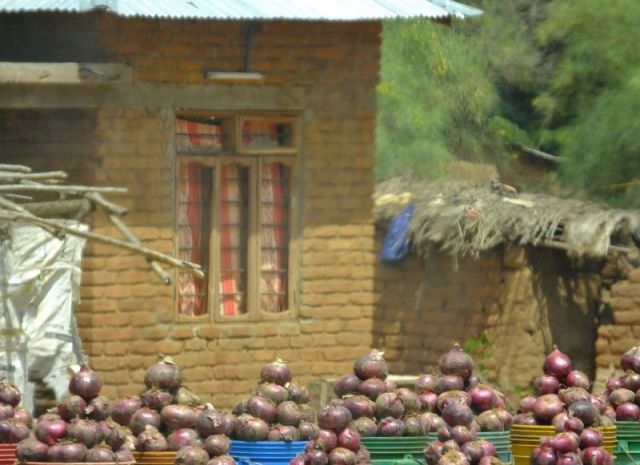
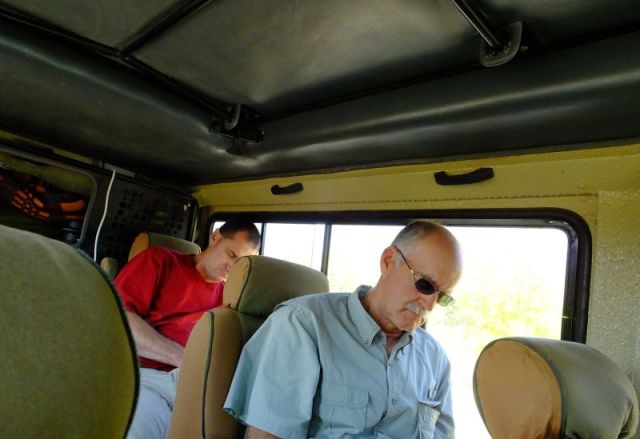
It is nice to be traveling a more benign road where we can again enjoy the life that goes on along the roads of Tanzania. I notice two women visiting, while balancing baskets of vegetables on their heads. There is a man by the side of the road, crushing large rocks into gravel by pounding on them with a big ball peen hammer. Can you imagine doing that job all day! We drive through miles of countryside where red onions are being offered for sale along the edge of the road. The onions are piled up into pyramids which seem to be the popular way to display most vegetables in the places we have visited so far. I don’t understand how anyone gets any onions sold as the red bulbs are everywhere you look. We meet traveling salesmen riding a bicycle on the highway, who has fixed up an ingenious rack on the back of his bike. The rack is full of children’s clothing, mostly frilly dresses for little girls. I am feeling much more relaxed now and obviously others in the vehicle are too. Ngruwa and Paul (Mapumbo) are napping though one of them swears he wasn’t really sleeping.

Onions for sale, taken as we were driving

Onions for sale, taken as we were driving

One of these guys isn't sleeping.

One of these guys isn’t sleeping.

We drive through part of Iringa and continue to the road that is marked,” to Isimila”, some 15 miles from the city of Iringa. Our guides turn onto the dirt road that leads to the Isimila Stone Age Site, and our drivers must slow the trucks to a crawl, as we bump and bounce our way down the narrow tree-lined road. The bruising ride ends at the headquarters of the Isimila Stone Age Site.

The staff welcomes us to Isimila and a man leads us on a tour of the small museum that occupies half of the building. There is a display of some of the stone tools and artifacts that were used by the hunter-gathers that frequented Isimila when the now dry lake bed, was a thriving lake with plenty of creatures to hunt. The artifacts on display date back tens of thousands of years. After perusing other displays that pertain to the area, our guide leads us to the trail that descends down into the dry lake bed.

Our guide at Isimila

Our guide at Isimila

Whoops, Paul and I didn’t think that we would need our hiking poles, and I don’t have my good hiking boots on. What were we thinking?  Right off the bat, we must walk down a steep, sandy slope and the traction is not good. Once we manage to navigate this short stretch, thankfully there are steps that lead to the bottom of the old lake bed. Walking across the gravely bottom to the other side is no problem but now we must climb out of here. The path up is just as steep and slippery as our walk down was. All of us manage to stay upright as we climb to the top, but I did have one major slip which gave me a good scare. When we arrive on the plains above the old lake, Paul finds a dead branch and breaks it off so it is the perfect length for a walking stick. I intend to put it to good use for the rest of our hike. Vidole also finds an old branch for Uwiano to use. As we catch our breath before walking on to the canyon, there is a Grey-headed Kingfisher perched in a tree and his call rings out like choppy laughter. If the bird is looking for water, he is a few thousand years too late, so the joke is on him.

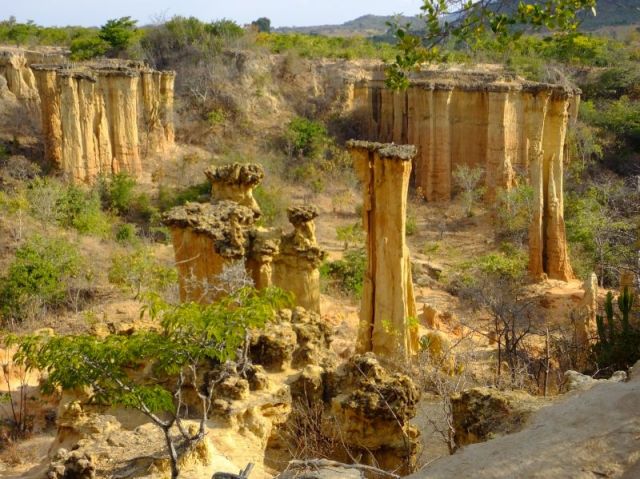
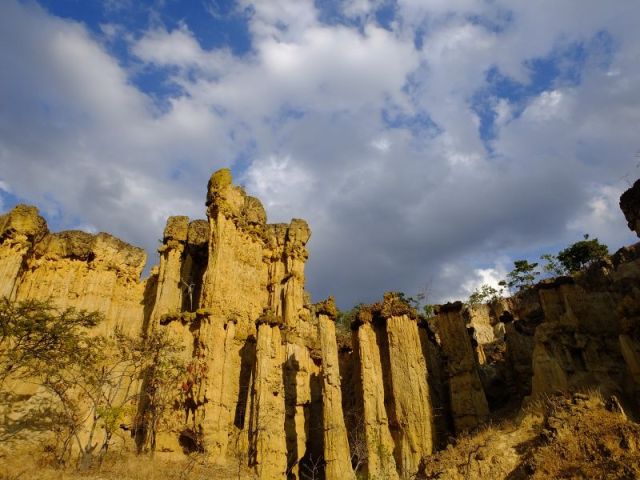
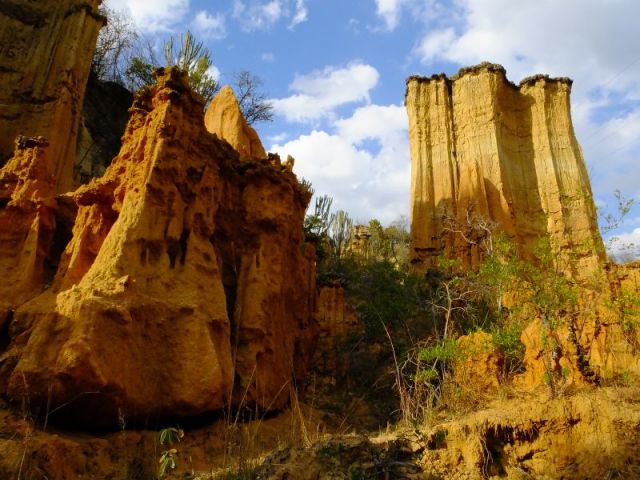
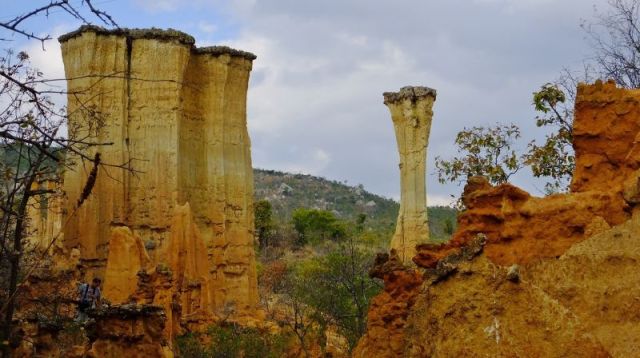
Our group traipse across the dry grassy field until we come to the edge of the small canyon that contains the famous stone pillars of Isimila. All I can say is “Wow” as the sandstone towers that were formed due to weather erosion are just jaw-dropping beautiful. We stand at the rims edge admiring the various shades of reds and yellows in the sculptures formed by Mother Nature. The sun is playing peek-a-boo, in the partly cloudy sky, so we wait patiently for the sunlight before snapping pictures because the stone shafts truly glow under the sun rays. The one problem with these geological phenomena is that someone in their infinite wisdom decides the high power electric line should pass over the top of this small section of the canyon. Never mind that just a few yards to the left the lines could have been built on level ground, and they wouldn’t have had to pass over a huge hole in the ground. Honestly!

Sandstone pillars, you can see the electric tower even though I tried to hide it with the tree branch

Sandstone pillars, you can see the electric tower even though I tried to hide it with the tree branch

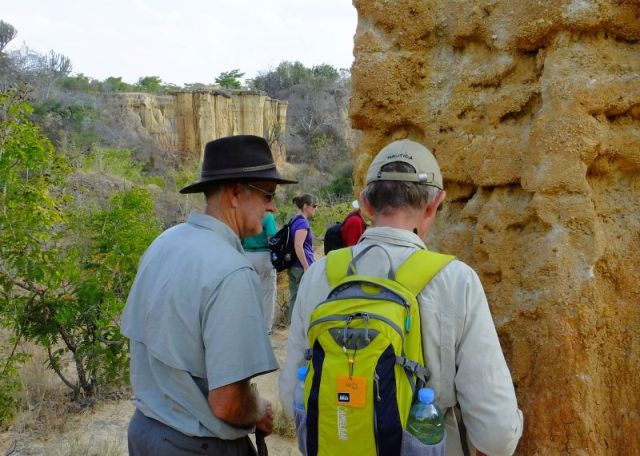
Paul and Mawe checking out the rock.

Paul and Mawe checking out the rock.

Another problem arises because in order to get up close and personal with the stone pillars we must walk down into the abyss, so to speak. I stand back and watch as people carefully short step their way into the canyon. Those with walking sticks still slip and slide at times but at least their staffs help them maintain balance. I can’t remember who, but one of the women after observing the problems of getting down the path, decides to sit and scoot her way down the path.  When Nyama starts walking down she is nearly at the bottom when one foot slips, sending her sliding on the sandy soil. Nyama keeps her balance, and by using Brian as a backstop manages to bring herself to a halt. Holy smokes, I wonder how Brian’s nerves are holding up as he watches his group, stumble and slide, but fortunately never fall, out here literally in the middle of nowhere. It is my turn to start down the treacherous trail and I decide to walk sideways using my staff to steady myself and my nerves. Made it! Paul and Scott bring up the rear and seem to have no problem on their trek into the canyon. The columns are just as stunning up close as they were from the top of the gorge. Of course, most of us have our photo taken in front of some of the pillars, and Brian patiently becomes the photographer for the group.

These photos are an example of the scenery we walked through in the canyon. Gorgeous!

These photos are an example of the scenery we walked through in the canyon. Gorgeous!

DSCF4103


Brian snuck into this photo

Brian snuck into this photo

We wander down the sandy channel enjoying the various size and shapes of the rock skyscrapers that are in every direction we look. The sun has managed to escape the thinning clouds, and is lighting up the canyon as the deep azure sky helps accentuate the glory of the multicolored sculptures. The day is marching towards its end so our guide tries to hurry us along towards the headquarters. However Usiku, Mochie, and I discover a bird singing heartily as it perches on a bedraggled bush on the canyon rim. We search Usiku’s bird guide for the scarlet bellied bird but are having no luck in finding a match for it. Brian comes along and we point out the singing bird to see if he knows its identification. Nope, but he watches over Mochies’ shoulder as he rifles through the book again. Brian catches a glimpse of a similar bird, thumbs through the book himself, and we soon know that we are looking at a Cliff Chat. We can mark another bird off our list!

The rest of the group has disappeared from sight so we hurry along in hopes of catching up. As we round a bend in the canyon, they are standing around discussing the snake that Ngruwe saw disappear into a hole in the ground near the trail. The guide insists that there are no snakes in Isimila which causes some raised eyebrows among us. We have no doubt Ngruwe saw a snake and besides this country appears to be prime snake habitat. I wonder why the young man was so adamant that they have no snakes. We have good laugh about the whole thing, and the no snake statement becomes a running joke throughout the rest of our safari.

Some of the ancient tools in the first shed.

Some of the ancient tools in the first shed.

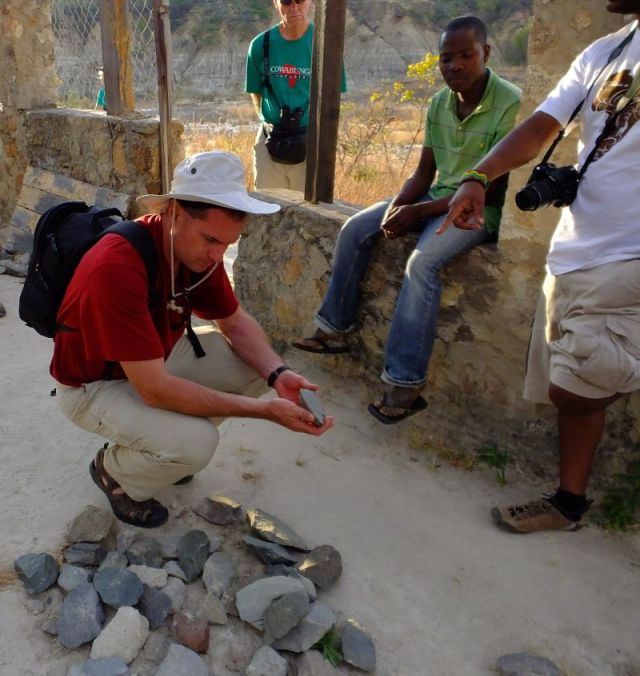
Ngruwe examining the still sharp ax.

Ngruwe examining the still sharp ax.

Our guide takes us to a small shed with open sides and we peer at ancient stone tools that have been unearthed around and in the lake bed. There is another shack across the way and we are able to go inside and handle some of the tools that are just lying in heaps inside the building. There is an axe that still has a sharp edge among the various artifacts. Some of these tools are huge and I don’t see how the ancient people handled the unwieldy objects.

Resting at Isimila headquarters after our trek

Resting at Isimila headquarters after our trek

Taken on our drive to Iringa. No camera tricks, that is just the way the lowering sun lights up this red earth.

Taken on our drive to Iringa. No camera tricks, that is just the way the lowering sun lights up this red earth.

It is time to return to our Rovers and drive back to Iringa where we will spend the night at the Savilla hotel. Our room is a bit worn and the lighting dim but it is clean. We settle into the room and have time to shower before going to the hotel restaurant for dinner.

Tembo and Mbuzi are occupying a table for four and we ask if we can join them. We were on safari with them a few years ago so we often sit together during meals so we can visit with our old friends. Tembo enjoys teasing me so I’m not sure why I subject myself to this! Just kidding, we enjoy bantering back and forth and it’s all in good fun (I think?).

The food here turns out to be excellent. I have pea and potato soup, with nan (bread) on the side. Scrumptious. Mbuzi orders a pizza which she shares with us and it is delicious. Paul had some kind of chicken which was excellent but there was so much he gave the excess to Brian. Brian and Ngruwe are always the recipients of extra food that the rest of us can’t finish, the group’s garbage disposal I guess you could say :). Tembo had a bowl of French onion soup that we all agreed (Tembo let us sample it) was the best we have ever tasted. You know this food was top-notch because I seldom remember what we have to eat at meals.

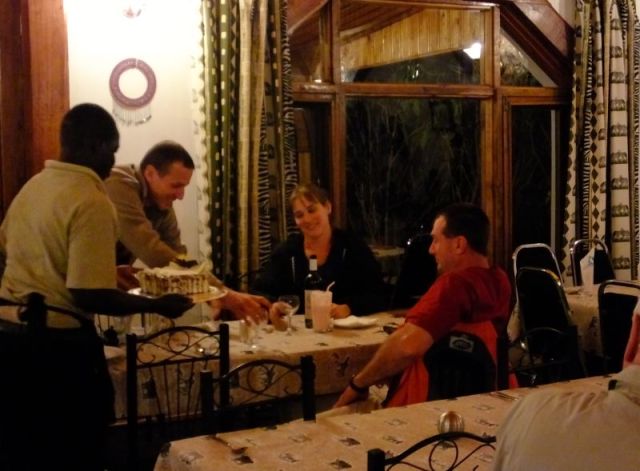
When we finish eating the four of us get up to leave when Brian approaches us to ask to wait a bit. It seems he has ordered a cake for Ngruwe and Nyama’s eleventh anniversary. How cool is that to celebrate your anniversary in Tanzania! We go back to our table and await the appearance of the celebratory dessert. Scott and Jennifer are completely surprised when the staff approaches their table with the lovely decorated cake. Everyone in our group, plus another couple that is dining here, get to enjoy a piece of the delicious cake as we congratulate the couple on eleven years of marriage. I hope they will be able to celebrate another anniversary on the African continent in the near future!

A fuzzy photo of the anniversary cake and couple.

A fuzzy photo of the anniversary cake and couple.

Tomorrow we go to Ruaha National Park and stay in the mobile camp. Nancy


Hiking to Sanje Falls Part 5

Hiking to Sanje Falls, Part 5

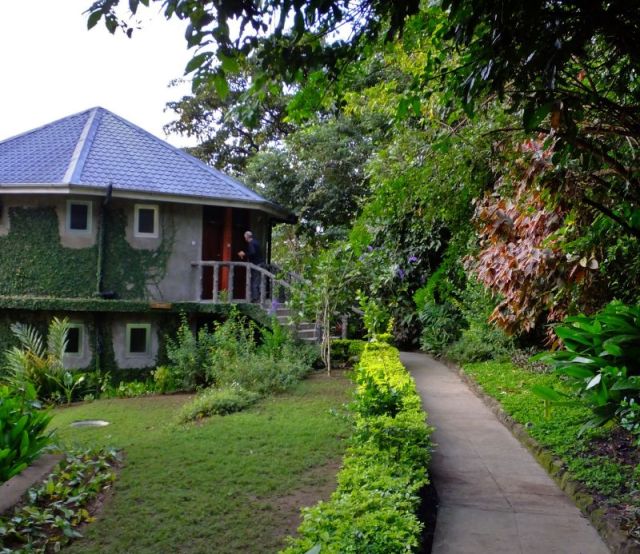
Our room at Udzungwa Falls Lodge

Our room at Udzungwa Falls Lodge

Paul and I slept well last night in our oversized bed under the hum of the air conditioner. I sort of missed that squawking bird though:). We were up early so we decide to see if we can eat breakfast now, even though the restaurant has our group scheduled for a 7:30 breakfast.  When we arrive at the open air dining room, the wait staff is happy to seat us at our groups prepared table, and we soon have our food.  One unusual practice here at the Lodge is that you must order your evening meal at breakfast. When we arrived yesterday they took our dinner order after we received our room assignments. Interesting.

The rest of our companions begin filtering into the dining area as we are finishing our meal. We find out that we missed seeing monkeys that were climbing in the trees near our balcony. Rats, sometimes the early bird misses out. Hopefully the monkeys will show up outside our room tomorrow morning.

Tembo and Mbuzi decide to forego the hike and enjoy the beautiful surroundings of the Lodge, as we have been told the Sanje Falls hike will be tougher than the Morogoro hike. I am surmising that another reason our friends are staying behind, is that Mbuzi needs to recuperate from tsetse fly bites. For some reason, these nasty flies decided that Mbuzi was the tastiest member of our group. While we were in Mikumi, the stinking tsetse flies were relentless in pestering Mbuzi, and their bites left welts and even bruises on her arms and legs. Mbuzi was obviously having a reaction to the bite of the pesky insects, but she never lost her sunny smile despite this misery. In our vehicle, I only know of Paul and Ngruwe who were bitten by the nasty flies. If Uwiano or Vidole Juu were ever feasted on by the insects, they never told us.  Ngruwe learned the hard way that you really need to think about where the enemy has landed, before you viciously swat a tsetse fly. It took twenty minutes for Ngruwe’s voice to come back down two octaves! Poor Ngruwe, it’s a heck of a deal when your friends laugh at your demise instead of commiserating with you.

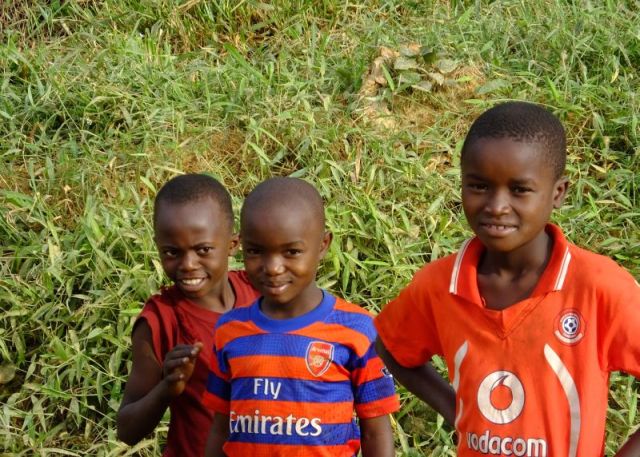
We stopped to take a far away photo of Sanje Falls along the road and I found these curious  boys a better subject.

We stopped to take a far away photo of Sanje Falls along the road and I found these curious boys a better subject.

Well to get back on track here, we climb into the Rovers and take an extremely bumpy, dusty ride to the headquarters of the Udzungwa National Park. Once we arrive, we are ushered into a room where a ranger talks to our group about the Park, and the endemic species that are found in the Udzungwa Mountains. Unfortunately, I really can’t understand the man so my attention is wandering. I notice Nyama keeps looking out the door and eventually she leaves the building. Being curious, I look out the door myself and see that she has returned to our Rover. I walk over to the vehicle and ask Nyama if everything is alright. Nyama motions to a trio of young men she has been keeping an eye on as they began moving toward our unlocked vehicle. Nyama felt it might be wise to stand vigil since our packs and some cameras were left in the truck. The fact that the young men are leaning on a fence right next to our Rover might be completely innocent, but we both decide to sit in the truck while the others are still inside.

Eventually, Bacari appears at the door, but when he rushes out to return to his truck, it is because a baboon is walking towards the Rover, and the driver’s window is rolled down. Bacari makes quite a ruckus in order to chase the marauding baboon off the premises. The baboon has obviously found goodies in vehicles before and was again hoping for easy pickings.

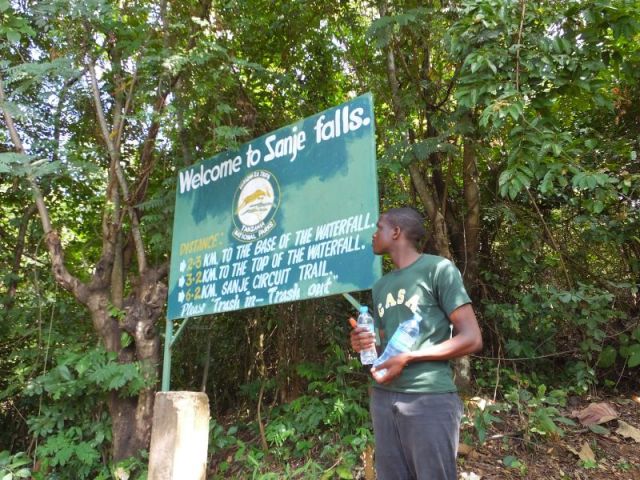
When the program is over, everyone returns to their vehicles and we backtrack over the bone jarring road. Somewhere (due to my lousy journal keeping I’m not sure where) we stop and divide the box lunches among those who are trekking the long hiking trail and those of us who are taking the short route. We shuffle around so the long trekkers are in one of the trucks and those of us going the short route take the other two Rovers.  Brian, Vidole Juu, Nyama, Ngruwe, our driver Kevin, and a local guide are taking the circuitous route. That leaves seven of us going up the shorter trail, plus Bacari, and our local guide. We go our separate ways now, as our trailheads begin in different areas of the park.

I am surprised that Njema, Mawe, and Uwiano didn’t hike the long route because they had no problems, as far as I could see, on our hike in Morogoro. Earlier, I had told Paul that he certainly didn’t need to stay with me if he wanted to hike the long trail. Paul waffled a bit but then decided the short way was fine with him.

The stairs are the start of our hiking trail

The stairs are the start of our hiking trail

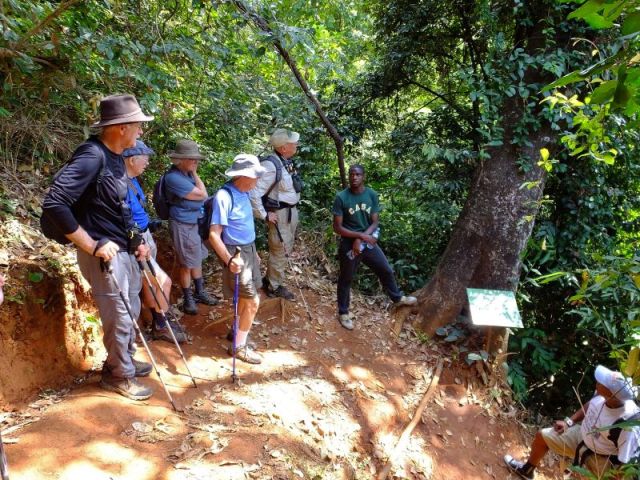
We arrive at what appears to be a private home and sure enough this is where the trail begins, so we prepare to follow our young guide up the mountain to the top of Sanje falls. The trail is steep but well maintained and our guide has obviously been instructed to go “pole, pole” (poh-lay, poh-lay) which means slowly. The young man evidently took it to heart as sometimes it feels like we are standing still! Oh wait, often we are standing still, as many of the trees and bushes have educational signs by them containing the trees name, and all the products that can be derived from that tree.  We stop by every one of the labeled trees and listen as our guide tells us the name, plus all the products, be it lumber, medicine etc., that the particular species is used for. Some of the trees and bushes are also poisonous or have mind altering properties if its leaves or seeds are ingested. At one place our guide uses a rock to pound on the huge trunk of a tree (I don’t remember the name of the tree). We listen as the hollow sound booms through the valley below us. In ancient times the natives used these trees to communicate with each other. It was pretty cool.

Our local guide

Our local guide

One of many stops to learn about the flora from our guide

One of many stops to learn about the flora from our guide

The education of the forest is very interesting for a while, but at least for me there is getting to be too much information. Several of us become restless and are ready to walk steadily up the mountain.  Some of us, me included, ask the young man leading us if we can’t walk faster, but he insists we go “pole, pole”.  I suppose to this youngster we look ancient, (anyone over 35 probably looks old to him), but hey, we are not in that bad of shape. Eventually, Njema and Uchunguzi begin walking in front of our guide which seems to speed things up a bit. At times, Paul and I take the lead and walk faster too.

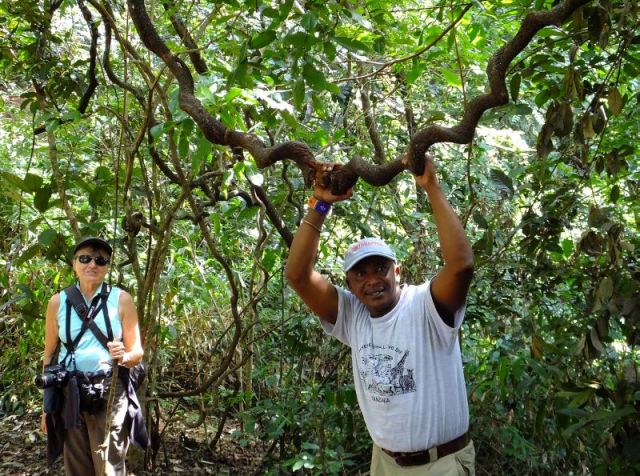
Bacari puts this interesting vine to good use

Bacari puts this interesting vine to good use

Our group reaches a point in the trail that opens up for a wonderful view of Sanje Falls. We stop to take photos of the waterfall as it plunges over 500 feet down the mountain cliff.  I notice, (I do have an imagination) that the rock ledge at the top of Sanje Falls, looks like an African mask. Paul agrees, and points out an elephant shape in the rock towards the bottom of the waterfall. Sure enough, I see it easily. I can’t remember who else admits that they see our fanciful images, but it certainly is not Daktari ya Moyo. With his usual dead pan humor, Daktari questions whether Paul and I sampled some of the hallucinogenic leaves we were schooled about along the trail! Daktari delivers a lot of priceless one-liners throughout our safari that always makes us laugh out loud.

Can you see the African mask at the top and the elephant shape at the bottom?

Can you see the African mask at the top and the elephant shape at the bottom?

I am surprised that we have seen virtually no birds or even heard much for bird song on our hike.  Maybe it is just too late in the morning. We do see Black and white Colobus monkeys, but they are obscured by the foliage of the trees they are perched in.

The back of a Black and White Colobus monkey. The best view we had unfortunately

The back of a Black and White Colobus monkey. The best view we had unfortunately

When we reach a fork in the trail, our group splits up as three members decide to go down to the bottom of Sanje Falls and Bacari will take them there. The rest of us opt to travel onwards and upwards.  There are lots of manmade steps in this segment of the trail and they vary in height, which adds to the challenge of climbing them.  At least as we climb higher the air is cooler and it certainly isn’t as humid. I am going pole, pole now and it has nothing to do with the pace of our guide! The sound of the falls continues to grow louder with each step and finally we reach our destination. Yea, we made it and I feel pretty good!

Our guide takes us down a short path which leads to a huge slab of rock situated at the top of Sanje Falls. There is another man and his guide occupying the rock ledge, (truthfully, this duo breezed by us like we were a bunch of turtles, quite some time ago) but there is still plenty of room for our group too. We ohh and ahh, as we look out over the expansive valley from this birds eye view.  There is a gush of water tumbling down a small rock face behind our stone picnic table, and the water gathers in a channel carved by water erosion. The small river flows along the edge of the rock ledge, and then fans out as it approaches the precipice, before plunging hundreds of feet down to the valley.

The spectacular view

The spectacular view

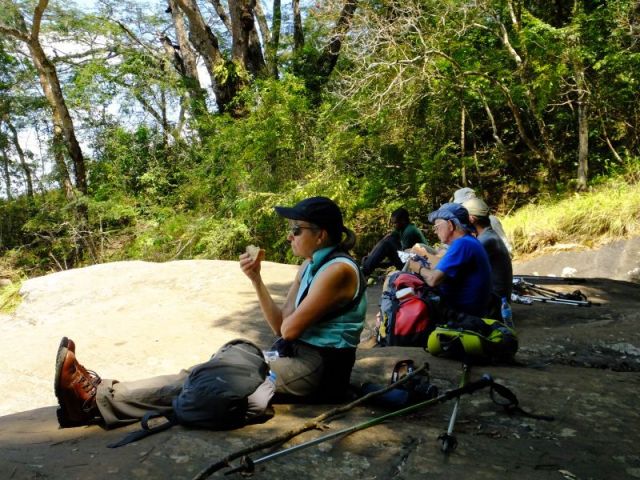
The stunning overview and the soothing sound of rushing water makes for a great backdrop to eat lunch. Hey, we have cold chicken, boiled egg, an apple, and a cucumber/tomato sandwich. All kidding aside, I really do enjoy the chicken and boiled egg; these two items travel well and they always taste good to me.

Some of the group enjoying lunch

Some of the group enjoying lunch

There is a pair of Mountain Wagtail who entertains us, particularly Usiku, Paul and I, as the birds forage in the crevices of the rocks. We discover that the birds have a nest tucked under an outcrop of rock, close to the small waterfall. We are delighted to discover with the aid of our binoculars that there is a chick in the nest. These birds crack me up as they never stop moving their tails up and down, hence the name wagtail.

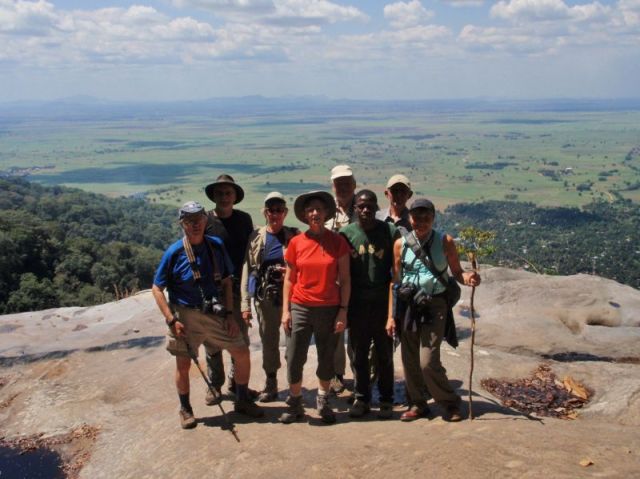
We had the other visitor take this group photo

We had the other visitor take this group photo

DSCF3901We relax in this special place for a short time after lunch and then begin walking up to the main trail. We haven’t traveled far when we hear the sound of familiar voices. I wish I had a photo of the rather shocked look on the faces of the foursome when they see us. I hear Nyama exclaim (is that disbelief in her voice?), “It’s Nancy!” which makes me laugh out loud. After exchanging some pleasantries, the long haulers, tell us we should hike on to the other small falls which are farther up the mountain. Vidole assures us that it is only a hundred yards or so to the first waterfall. Oh why not, we had a nice rest while eating and if they are that close, we can handle it.
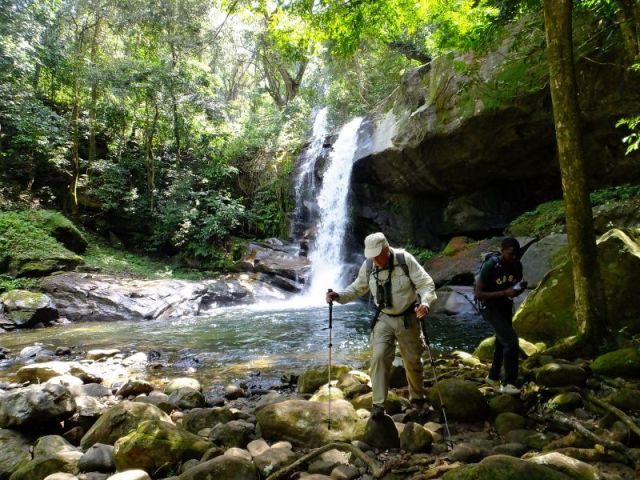
The first waterfall with the innocent looking pool

The first waterfall with the innocent looking pool

A least a quarter of a mile later (was Vidole pulling our leg?); we arrive at the first waterfall.  There is a sign that proclaims you are not to swim here and we are told that there is a deep hole beneath the surface of this innocent looking pool of water, which has a whirlpool effect. If you get sucked into the dervish, you aren’t coming back out. We continue up a steep path until we find the second waterfall which plunges down a vertical wall of stone. The water is falling with such power that mist is spraying through the air. With the roar of the waterfall and the spray of mist, this falls is quite dramatic.

Paul, Nancy and squid at the second waterfall. Squid will be explained in a future episode!

Paul, Nancy and squid at the second waterfall. Squid will be explained in a future episode!

This time we really are returning to our Rovers, and the steps are no easier to navigate going back down.  Sometimes you must take giant steps, then regular steps, baby steps, and too often, rickety steps. Brian’s crew catches up with us and we hike the trail together. When we reach the fork in the trail that leads to the base of the falls, the fearless four along with Uwiano decide they will make the trip to the base of Sanje falls. The rest of us say no thanks and continue to where our Rovers await. The reason I call them the fearless four is because Nyama told me they had to cross a suspension bridge while hiking the long trail, which is a bit thrilling in itself. This bridge went beyond thrilling though, as it was missing some planks, so they had to shimmy along the support wires to get across the thing!! No Thank You.

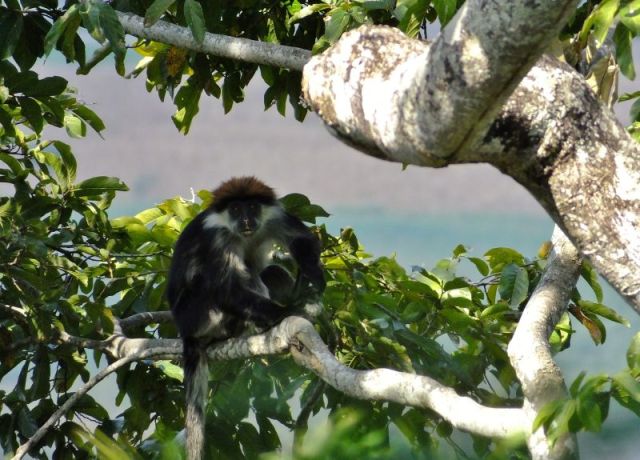
As we continue down the path, I see a long branch hanging down from a tree just off the trail. Except this isn’t a branch at all, it is a tail, and the tail belongs to a Red Colobus monkey. Hurray! I really wanted to see one of these red-headed primates and I am pretty excited at spotting the monkey. Usiku, Paul and I show our enthusiasm verbally with the sighting of the Red Colobus.  Daktari and Mawe enjoy the primate in their typical quiet demeanor. We realize there are several monkeys when they begin to vacate the tree, and are making acrobatic leaps to tree limbs below them. It dawns on me that I have hogged the prime spot to take photos of the primates, which makes me feel terrible. Everyone, including Paul, should not have been so polite, and told me to move!DSCF3913

The Red Colobus monkeys we saw on our way down

The Red Colobus monkeys we saw on our way down

When we reach our truck, the trio who went to the bottom of Sanje Falls this morning, are waiting for us, along with Njema and Kevin, who left those of us walking at a more leisurely pace in the dust. Kevin agrees to take five of us back to the lodge since we see no reason to wait for the people who are hiking down to the base of Sanje falls. It was a tough, tiring hike but the spectacular view was certainly worth it. Plus we were able to spend some quality time with others in our group that we are separated from when we are on game drives.

In visiting with Tembo and Mbuzi this evening they tell us they saw three different species of monkeys on the grounds of the lodge including the Red Colobus. Excellent! We also see photos of the fearless four spelling out KSU(Kansas State University) on the peak of the mountain. I would guess they are the first KSU graduates to strike this pose in the Udzungwa Mountains in Tanzania!

Tonight our dinner entertainment includes a flute player who is very talented. The dancers have a wider variety of moves than the guys last night too. The food is excellent once everyone gets their order straightened out. Well, a few people just give up on receiving what they ordered this morning and take the plate of food that is offered to them!  Nancy

P.S, If you want to confuse spellcheck, Swahili is the way to do it:).


Mikumi to Udzungwa Mountains, Part 4

Mikumi to Udzungwa Mountains, Part 4

Framed elephant in Mikumi

Framed elephant in Mikumi


I guess I slept better in the level bed because I only heard that annoyingly loud bird during the night, in addition to a flock of birds which announced themselves before dawn as they flew over the camp. Paul was able to remedy, to some degree, the tilting cot by yanking the thin mattress into its proper place on the frame. Paul did awaken me in the wee hours of the morning when he got up to answer his third nature call. He announced in a disgusted voice “this is ridiculous” as he left the tent. I laughed and turned back over to go to sleep. So much for Pauls’ leek soup theory.

We eat breakfast and prepare to leave on our last game drive in Mikumi National Park. Mkatagiza Usiku, my fellow bird watcher, is feeling under the weather so decides to stay in camp. I am afraid I would be near tears if I couldn’t participate in a game drive!  The staff will tear the unoccupied tents down first, leaving Usiku and Njema’s tent for last so he can rest. We will return by mid-morning to pick up Usiku and travel on to the Udzungwa Mountains.

Brian suggests we take our time on this game drive and just observe the animals as they go about their business. This “take it easy’ plan is gladly accepted by us. I think we are all ready for a leisurely pace since we have had such wonderful animal sightings the past two days.

I haven’t talked about the fact that our vehicle companions, Nyama, Ngruwe, Vidole Juu, and Uwiano, are what Brian refers to as newbies because they are on safari for the first time. All of them are world travelers and excited for this new adventure although Ngruwe admits he is skeptical that an African safari is really all it is cracked up to be. He speculates, tongue in cheek I think, that the animals are probably trucked in just as the tourists arrive! Paul and I surely enjoyed watching the “newbies”, Ngruwe in particular, fall under the spell of Africa! Ngruwe had announced early on that he had been reluctant to travel to Africa and was only 50% committed to taking the trip. I think it was after our first game drive in Mikumi that Ngruwe announced he was now at 90 %. If I remember right, that night as we sat around the fire, Ngruwe proclaimed with a smile, that he was all in at a full 100% for this African adventure! Yep, that is the effect this wild country has on people.

The elephants strolling towards our vehicle

The elephants strolling towards our vehicle

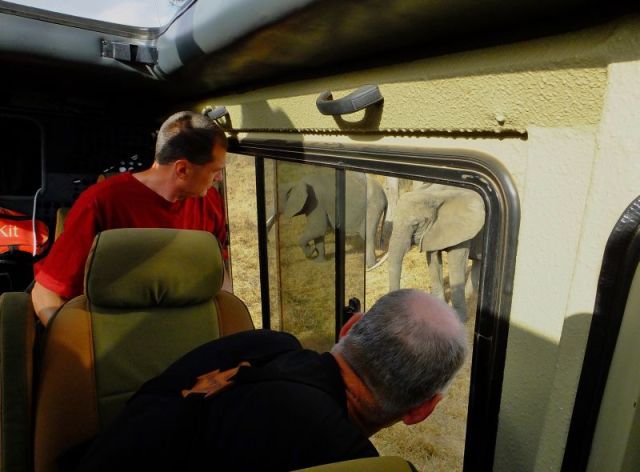
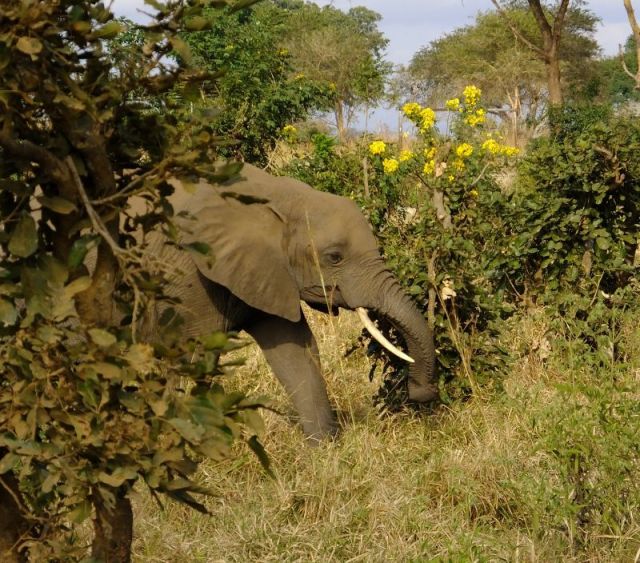
We haven’t been driving in the Park long when we come upon a pair of foraging elephants. The two pachyderms are browsing on bushes and slowly walk toward our Rovers. ( Oh yeah, I was looking at photos today and saw that the safari vehicles are Land Cruisers but figured no one really cares so I’ll stick with the shorter incorrect version!)   Eventually the elephants are eating tree nuts that are lying on the ground within a few feet of us. It is so interesting to watch the elephants pick up the small nuts with their prehensile trunks that are as functional as fingers and transfer the nuts to their mouths. When the elephants have sated their hunger, they walk right by our vehicles as they cross the road. It is amazing how such huge animals can walk so silently!

The elephants really were right next to us

The elephants really were right next to us

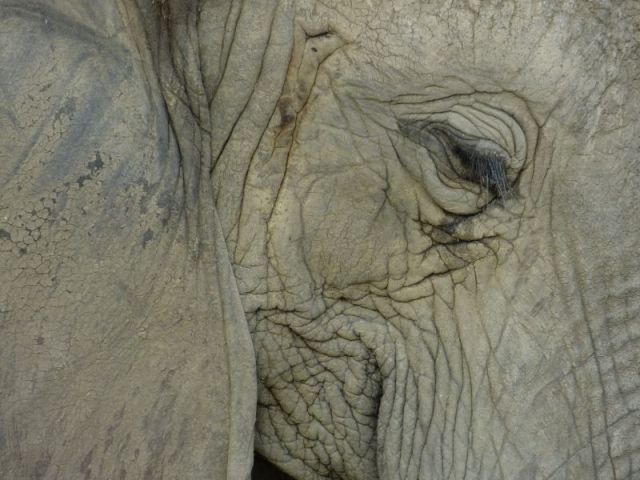
So many wrinkles and intricate lines

So many wrinkles and intricate lines

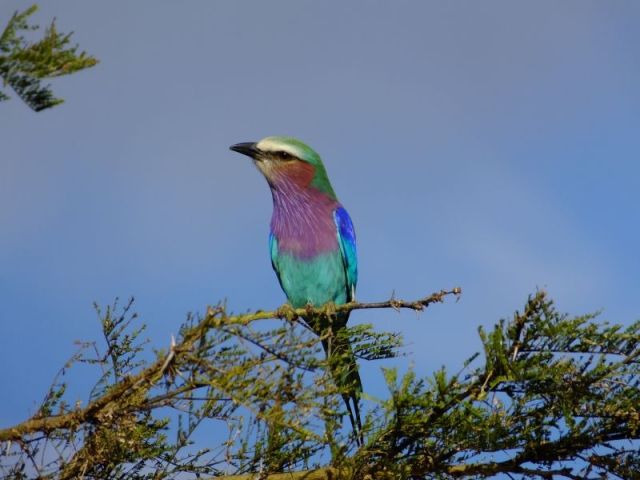
While watching the elephants, a beautiful Lilac Breasted Roller lands in a tree next to the road. We shift our attention for a short time to the brightly colored bird, which seems to enjoy having its photo taken. The picturesque bird gives us his profile from both sides in addition a full on frontal view. I took his photo in every pose:)!

Lilac-breasted roller, one gorgeous bird

Lilac-breasted roller, one gorgeous bird

Often there have been false sightings by those of us searching the African bush for wild life. Today is no exception, and I call for Kevin to stop when I think I see an animal in the distance. Kevin, as always, complies with the request and after scoping the unidentified animal with my binoculars, I say, “nope, it’s a large boulder”. Kevin laughs and says you found an ALT, and then interprets the phrase for the acronym as Animal Like Thing. This makes everyone laugh and we agree that it won’t be the last ALT we will find.

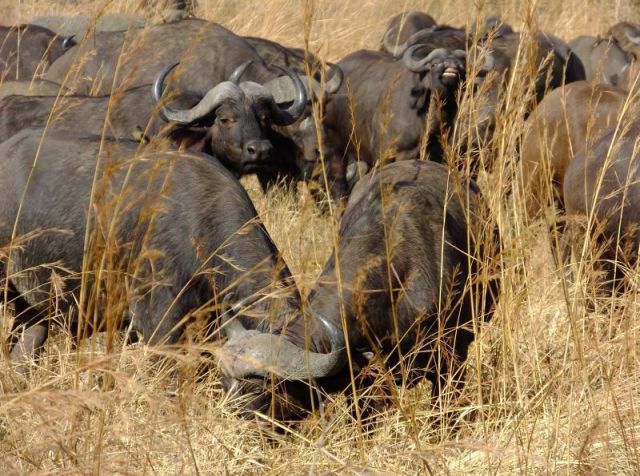
Cape Buffalo

Cape Buffalo

Since the elephants have left us, we cruise on down the dusty road. A large group of Cape buffalo is strung out across the plains as they head for a water hole. As the herd plods by us we scrutinize them, and they often stop to stare back at us.  The bovids are dusty, some even mud encrusted, with plenty of pesky flies annoying them. As the stragglers amble by we see one animal with an open wound between its shoulders and we can only guess what caused the large wound. There are oxpeckers (birds) sitting on the buffalos back and pecking around in the raw flesh. I ask Kevin if these birds will help the animal by keeping flies and other nasty things out of the wound. Kevin tells us that the birds probably will do more harm than good, since their constant pecking at the wound will not let it heal. Well that wasn’t the answer I wanted to hear but it does make sense.

It looks like the Cape in the background is smiling. Those who raise cattle know he has been checking a female for estrus

It looks like the Cape in the background is smiling. Those who raise cattle know he has been checking a female for estrus

Another buffalo walks by and we see that its tongue is lolling out the side of its mouth. As we study the animal it is obvious the tongue is not functional.  What a horrific problem for that poor creature as without a working tongue it won’t be able to eat or drink. All of us agree that this animal won’t last much longer, and it soon will become a prime target for predators that are always on the lookout for weak and vulnerable prey. As sad as this seems, we all understand that this is just the circle of life in the wild.

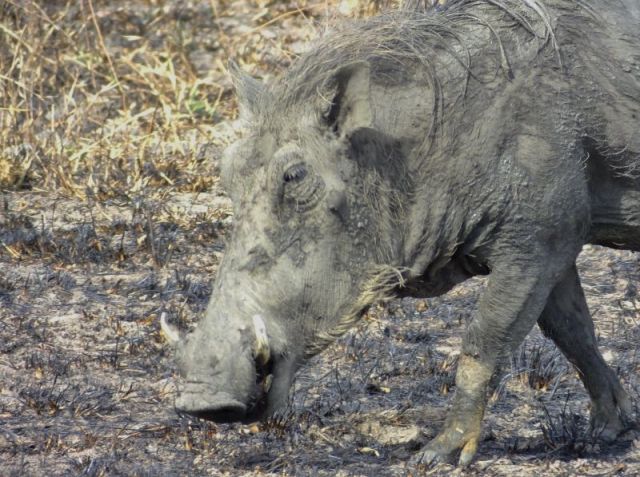
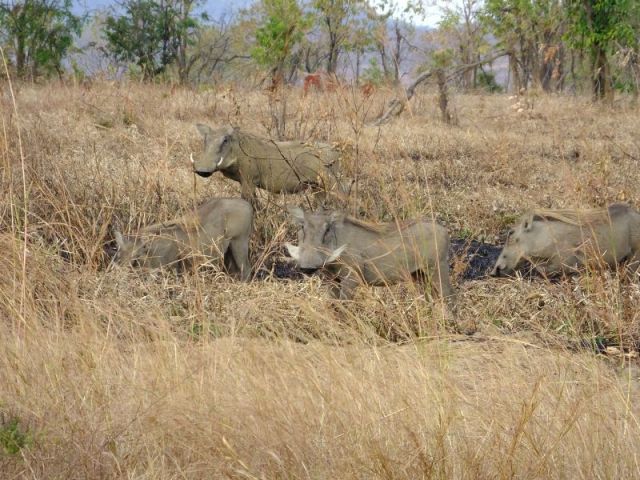
Somebody in the lead vehicles found a monitor lizard in a tree. It’s quite large with a pretty golden tinge to its hide.  We also watch a few warthogs as they graze on grass, some on bended knee. One of the hogs has been wallowing in mud somewhere this morning, and the sticky dirt is matted in their bristly hair and mane. We leave the warthogs behind and Kevin turns the truck toward the exit gate of Mikumi National Park for the last time.

Warthogs and the Mikumi landscape

Warthogs and the Mikumi landscape

A muddy warthog

A muddy warthog

When we get to the parking lot we see that one of the staff members has brought Usiku here to meet up with us. Usiku looks like he is doing well, thank goodness. Having to travel on the road when you are ill certainly is not fun. We all take advantage of the Park’s rest rooms before loading back in the vehicles, so we can move on down the road to our next adventure. We will meet up with the camp staff in two days in Ruaha National Park.

It will be hard to top this wonderful place and Paul tells the newbies, if we don’t see another animal we still have had one incredible safari! Mikumi not only gave us unbelievable animal encounters, but the landscape was quintessential Africa. Another plus was that there were very few tourists here, so often our convoy of three trucks was all alone as we drove through the park. Would I return to Mikumi? The answer is an emphatic “absolutely”!

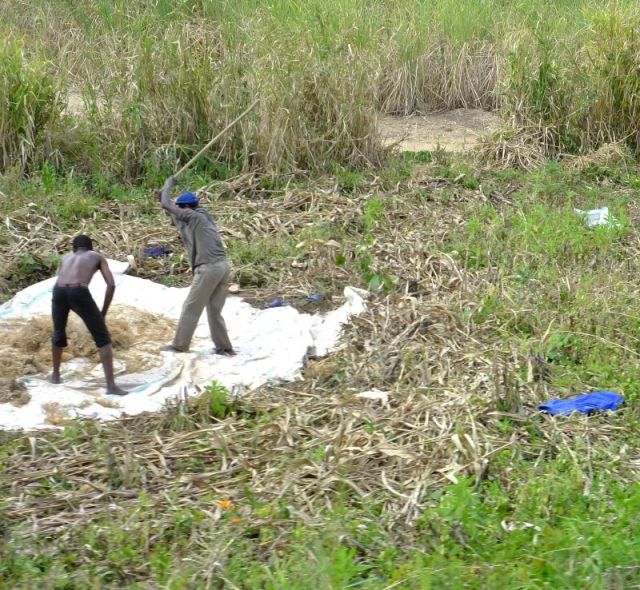
Men threshing grain

Men threshing grain

As usual there is plenty to see along the road as we drive toward our destination. We pass by small villages, little children who yell and wave to us, wares for sale displayed near the roadside, people walking down the roads, farming activity and so on. I continue to shoot photos hoping that now and then I will get lucky in capturing the exotic sights.

Christophe has prepared box lunches for us and we stop in the town of Ruaha (at least that is the name I put in my journal) to eat the lunches. A restaurant agrees to let us eat our food on the second level of their establishment.  Can you imagine that happening in the U.S.? We all buy sodas from the proprietor so that at least puts a little money in their pockets. There is plenty to watch and take photos of, as we survey the people in the street below while enjoying our cold chicken and boiled egg among other goodies.

Grains for sale in Ruaha

Grains for sale in Ruaha

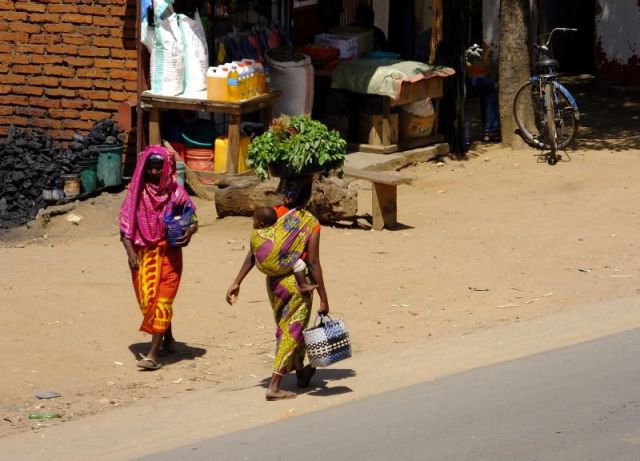
Street life in Ruaha

Street life in Ruaha

Brian has the restaurant owner prepare chicken and goat in the local style. I can’t remember what the dish was called but the chicken was quite tasty although a bit tough. Brian commented that he knew the chicken was fresh; because there were some feathers floating around the kitchen when he went down to see if the chicken was ready. I think he was teasing but I’m not sure. We finally give up being served the goat meat as time is slipping away. We were stuffed full anyway. We have all settled back into our Rovers when someone appears with the goat meat and Brian divides it among the vehicles. We all sample the flavorful although chewy meat.

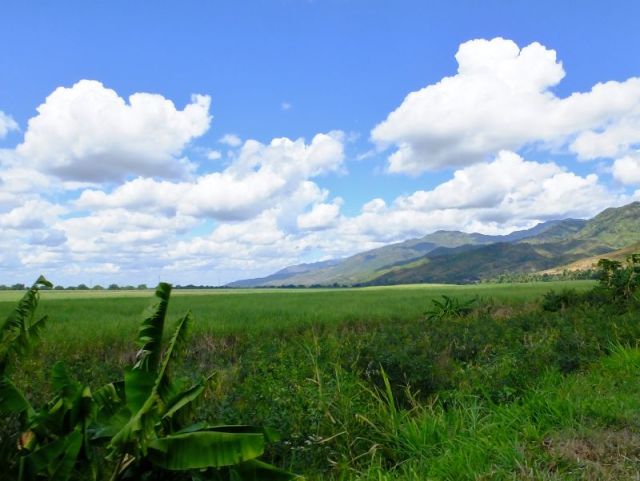
We continue to enjoy watching the scenery roll by as we make our way to the Udzungwa Falls Lodge. The mountains form a boundary around the valley we are driving through, that is planted with huge fields of sugar cane, while marshmallow clouds laze in the deep blue sky. It really is gorgeous.

Mountains and Cane fields on our way to the lodge

Mountains and Cane fields on our way to the lodge

Our extra wide bed with flower petals

Our extra wide bed with flower petals

We arrive at the Lodge and is this place nice! As we wait in the lounge area for our room assignments, staff members pass out hot face towels and cold drinks. Both of these thoughtful items are much appreciated. Once the room keys have been passed out among the Cowabunga group, we make our way to where the workers are gathered by our luggage. A young woman picks up our large duffel bag and begins to lead us to our chalet. We are walking steadily upwards and I suggest to the young lady that she pull the wheeled duffel instead. The woman gives me a smile and extends the handle rolling the duffel over the cement path. Thank goodness, that thing is heavy!

Wow, this place is something else, beautifully landscaped and appealing chalets that are duplexes. Our neighbors are none other than Nyama and Ngruwe and we can chat with them when we are out on the balconies. The room has the biggest bed I have ever seen with flower petals arranged in patterns over the sheets. The bathroom has flower petals arranged around the sink too. This is quite a difference from what we were sleeping in last night!  I will tell you right now if I had to choose between staying in a lodge or our mobile camp for the entire safari, I would without hesitation pick the mobile camp! Not that I won’t fully enjoy being here of course.

Scott and Jennifer, our neighbors. They gave me permission to reveal their identities:)

Scott and Jennifer, our neighbors. They gave me permission to reveal their identities:)

Paul and I return to the lobby area once we have deposited all our stuff in the room so we can check our email. Randall and Erin took the rest of our steer calves to the auction yesterday, and we want to see how they sold. We also are hoping there is news that we had rain. I know, if we were in a mobile camp we would not have Wi-Fi so we couldn’t check on things back home. I could live with that too. The good news is that our calves sold very well, the bad news is that we still haven’t had rain.  I leave Paul checking out more email and walk back to the room. On my way I hear voices drifting up from the swimming pool and find our neighbors enjoying the water. Vidole Juu is off on a bike ride touring the cane fields and villages, with one of the guides from the Lodge. This man never seems to get tired!

I intend to take a nap as soon as I get socks and underwear washed out and clothes unpacked and hung in the roomy closet. Brian calls and wonders if we are interested in walking to a small waterfall that is a ways up the mountain behind the lodge. I tell him that I am not interested and inform him several members of our group are already enjoying the pool. I know this as I was on the balcony enjoying the view and saw more of our group making their way to the pool. I tell him Paul is in the lobby and he might want to accompany him to the falls.

A really bad photo of the falls, part of it is obscured by the tree

A really bad photo of the falls, part of it is obscured by the tree

Within a few minutes, Paul has arrived at our room, changes into his swim trunks and flip-flops, ready to venture up the mountain. Am I the only one that is tired in this group? I do stretch out on this ridiculously oversized bed and take a short nap.  Paul returns within an hour having enjoyed the walk and Brian’s company although the pool at the waterfalls base was too shallow to swim in. Since I am refreshed from my nap, we decide to return to the waterfall so I can enjoy it too.

Paul leads me to the dirt path and we walk through the forest and up the mountain. This is where the lodge gets their water and we chuckle at the water that is spouting from leaks in the rubber hoses that run to the water holding facility for the Lodge.  Soon we are walking on a rough, slick path and a black hose, maybe 6 inches in diameter, is lying in the path. I begin to question Paul about this trail as it doesn’t appear to be very well-traveled. Paul says he thinks this is the way Brian and he came, but it doesn’t seem quite right. When we see the waterfall we realize we are approaching the top of the falls, instead of the base where the pool is! Obviously we missed a turn somewhere! We retrace our steps, slipping and sliding on the way down.  We find the trail we should have taken and there are a series of steps to climb down. We laugh about our side trip as we make our way to the bottom of the falls. There is not a lot of water volume falling over the wall of stones but it was still worth seeing.

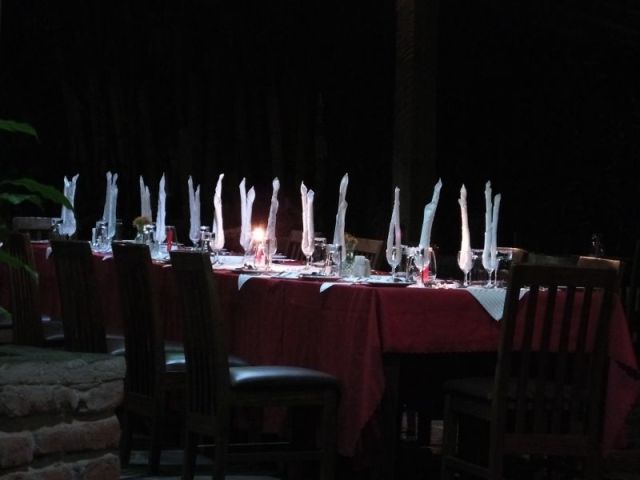
Tonight we have locals entertaining us before and during our dinner.  We watch the performers while drinking cold Tusker beer and snacking on homemade potato chips, although Mbuzi actually joins the dancers for a few minutes much to our and the dancers delight!  The wait staff seats us for dinner at a table that is lit with candles, and there are more utensils around my plate than I know what to do with. The food was good, the company great and another wonderful day is coming to an end in Tanzania.

Our table for dinner that night

Our table for dinner that night

Tomorrow we hike to Sanje Falls, Nancy


Mikumi National Park, part three

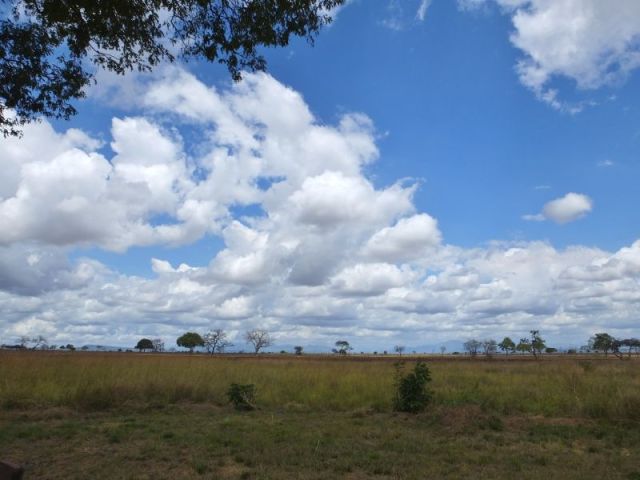
This could be a Kansas sky in June!

This could be a Kansas sky in June!

Mikumi Day Two, Part 3

Ah, our first night sleeping in a mobile camp in Tanzania. When Paul and I are ready to retire, I discover my pjs are missing and deduce that I must have left them at Hotel Oasis. We checked the room over twice before leaving, so I have no idea how I missed packing them. A borrowed t-shirt from Paul covers me for the rest of the trip! Our tent is pitched with one side slightly uphill, so my cot listed to the left and I felt like I was sliding off the narrow bed all night. I told Paul this morning that tonight he could sleep in the left leaning bed.

The best part of sleeping under canvas is the sound of an African night. We heard the whoop of hyenas, the trumpeting of an elephant and one very loud, annoying call that was repeated over and over, which I attributed to some bird that had its night and day confused. Also intermingled with the creatures calls, were the sound of tent zippers throughout the night as the camp occupants answer the call of nature.

Paul and I add the rasp of our tent zipper to the night’s musical repertoire and follow Brian’s directions before we step out of our tent. First unzip your tent, stick your head out and listen, next shine your torch all around the area (never mind that you are lighting up your neighbors tent) and see if there are any eyes glowing in the dark. If you hear or see anything, step back inside, zip your tent up, and suffer:). If you detect no sign of wild animals, you can leave the tent and take care of business. Once outside make sure you don’t trip over the tent stakes!

Those of us far away from the choo, (the choo consists of a hole in the ground, topped with a wooden stand that has a hole cut in the middle, surrounded by a rubber curtain), have permission to visit the back of our tents instead. I know, more information than you needed.  This is fine, but Paul and I can’t get behind our tent due to brush and trees. Instead we will go by the side of our tent and we broker a deal with our neighbors that if we venture out at the same time, we will just turn our backs on each other. Most of us have been in mobile camps before and so we know a person’s modesty disappears in a hurry! For some reason, Paul and I must exit our tent three times during the night, and Paul blames this on the leek soup. I know, go ahead and groan. At least we are on the same schedule and could venture into the darkness together.

After eating a breakfast of eggs, sausage, fresh fruits, cereal, toast and hot tea or coffee, it is time to load up in our designated vehicles to venture forth and see what the morning will bring. It’s eight o’clock before we leave the camp and I admit that I am fretting that we aren’t out viewing game at the crack of dawn. Hey, I am a morning person and daylight is wasting.

Zebra we admired on road out of camp

Zebra we admired on road out of camp

A small herd of zebra ready themselves for our cameras along the dirt road as we leave the camp. When we reach the busy highway we must drive across to enter Mikumi, there is a trio of giraffe that want to cross the highway to reach the protected area. We drive on the black top road until we are near the giraffe, park on the shoulder of the road to photograph and watch what the graceful, towering creatures will do. The giraffe walk near the edge of the highway, then retreat, and then come back. Finally, the three long-necked beasts seem to think better of walking across the highway and begin to glide back in the direction of our camp. With the giraffe decision to stay put, our driver’s make a U-turn and drive back to the entrance of Mikumi. After we enter the park, we look back to see that indeed the trio of giraffe have safely crossed the road and are striding across the safe ground of Mikumi.

giraffe trio that wanted to cross the highway

giraffe trio that wanted to cross the highway

This morning we are taking a different route in the National park, and in my mind we are heading north instead of the westerly direction we took yesterday. Of course, my compass, like some peoples clocks, might be reversed since crossing the equator! One of the first animal encounters we have is watching an elephant feint a charge at a lone cape buffalo. The buffalo is facing the elephant and seems to have no fear of him. I think he knew the big bull elephant wasn’t serious. A bit further down the dusty road, we find a herd of elephant with a very young baby in their midst. Hmm, which is more adorable, baby elephant or baby zebra? I won’t even try to choose as I thoroughly enjoy both of the diminutive animals. We see lots of baby elephants before our safari is over and I will admit the little pachyderms prove to be ornery and very playful.

There is a baby elephant in the midst of this parade of elephants

There is a baby elephant in the midst of this parade of elephants

Elephant that mock charged the Cape buffalo

Elephant that mock charged the Cape buffalo

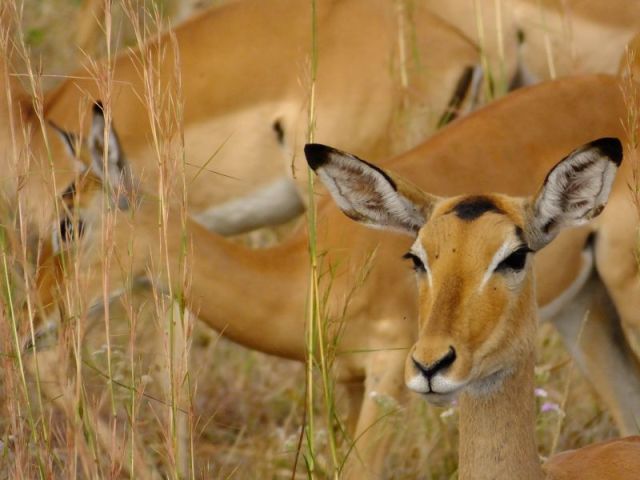
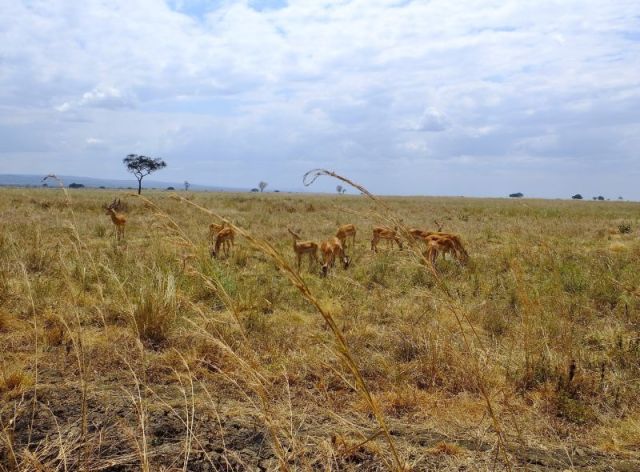
There is no shortage of impalas, and their numbers range from large herds of the bronze antelope, to single males with their impressive spiral horns, standing like statues in the shade of a tree. It is great fun when a herd of impalas run across the road in front of us, leaping high into the air as they perform their own graceful ballet.

I never got a good photo of leaping impalas. This will have to do

I never got a good photo of leaping impalas. This will have to do

Kevin is very patient with his six passengers and is willing to stay in one spot so we can enjoy the behavior of the animals and birds we encounter. Also, Kevin is an avid birder and because this part of Tanzania is unknown to him, some of the birds we are seeing are a first for him too. Kevin also loves to take photos and joins in with his wards when we go into a photo frenzy mode like a bunch of paparazzi. Because of our vehicle lagging behind, Kevin is often trying to catch up with the other two vehicles carrying our fellow safari mates.

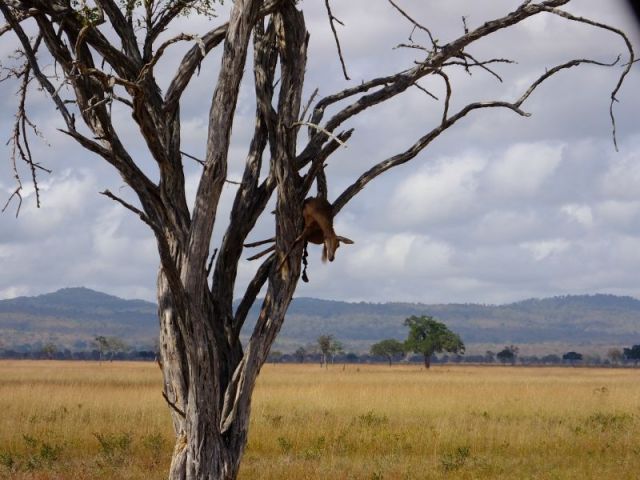
This morning is no exception and when we finally catch up with our group, they are sitting next to a dead tree that is standing just a few yards from the road. It doesn’t take us long to spy what has brought their Rovers to a stop. A carcass of a reed buck is hanging among the bare branches of the grey tree, blood still trickling down the small doe’s throat. Wow, we obviously just missed seeing a leopard bring down the unlucky antelope and after killing it, dragging the carcass into the tree. Can you imagine the strength it takes for a leopard to pull dead weight up into a tree!! It sure keeps their kills safe from the likes of lions and hyenas.

The reed buck that a leopard had stashed in the tree

The reed buck that a leopard had stashed in the tree

We look everywhere for signs of the leopard. One vehicle drives under a nearby leafed out tree, thinking the leopard took refuge in the cool canopy to rest after the exertion of what took place here a short time ago. We all scan with our binoculars, the expanse of grass that reaches as far as one can see behind the storage tree. Is that something lying in the shorter grass just before the expanse of towering grass starts?  I hold my binoculars on the dark spot and swear I see a yellow eye looking back at me. I can’t explain to anyone where I am looking at because it is just an expanse of grass. Brian tries to follow the direction my binoculars are pointed but has no luck in seeing what I think I have seen. There again, I swear I see a slow motion turn of the head and the eye is gone. My arms are getting tired and no one else is having any luck finding my ” leopard”. Again I am sure a yellow eye appears through the leaves of grass before slowly turning away. I know if I lower my binoculars and try to point out where I am looking I will never find the area with my bare eyes. We finally give up and move on down the road with the intent of returning to the stashed carcass on our afternoon drive. Before we leave, I take one last look and am sure “an eye” is staring back at me.

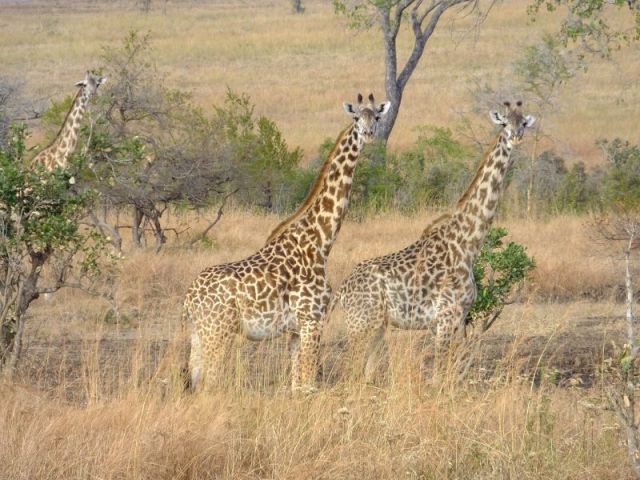
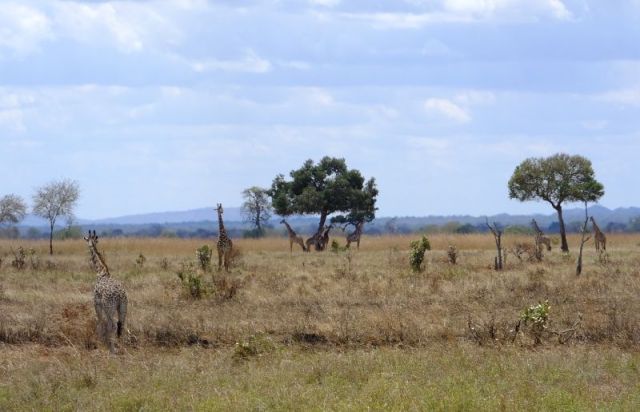
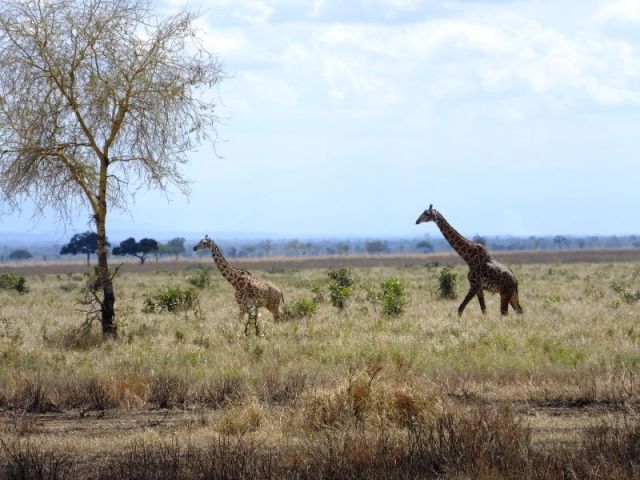
As we move on through the park, there is a tower of giraffe scattered over the plains under a beautiful blue sky filled with puffy, white clouds. I have never seen so many giraffe in one group! Several people decide to count these skyscrapers of the African plains, and settle on thirty-four giraffe. Paul asks Brian what is the largest number of giraffe he has seen on his forays in the African continent, and his reply is twenty-six. Wow, this really is something special.

A few of the 34 giraffe that were together in this area

A few of the 34 giraffe that were together in this area

There is an enormous bull giraffe who is a giant among giants, and his coloring is nearly black compared to the reddish-brown of his companions. This handsome male is paying a lot of attention to one of the smaller females in the herd. It is quite obvious to us, as we observe the males antics, the young female is coming into estrus. We watch as the male sniffs around on the female, or dips his chin towards her back. The cow always walks away when the male makes his advances and when she retreats, the big bull trails after her. Again we have been left in the dust by our companions so must move on darn it. Ngruwe and I stare back at the amorous pair until they become specks in the vastness of the bush. Wouldn’t that have been interesting to see such gangly creatures mate!

The amorous couple

The amorous couple

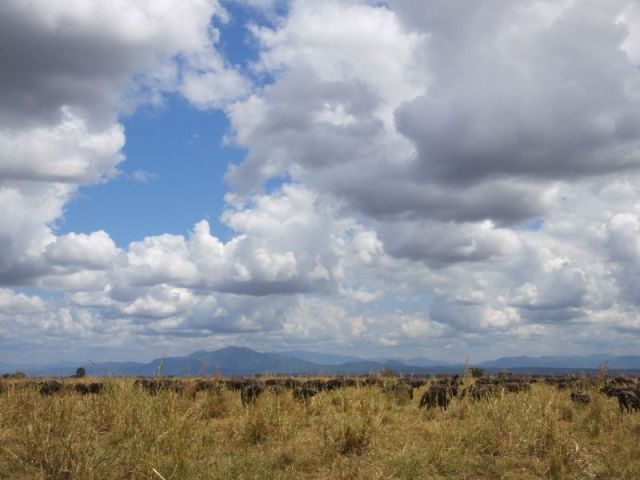
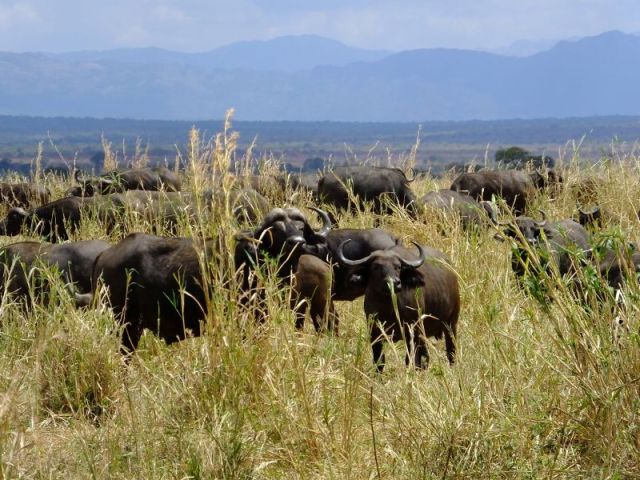
You do realize that we are still on our morning game drive and I have only hit the so-called highlights! We have one more encounter this morning and that is a seemingly endless herd of Cape buffalo. The surly buffalo are strung out over the plains of Mikumi, and I can’t back my camera off enough to come even close to capturing where the string of bovids start and where they end! Again, Paul and I have never seen so many Cape buffalo at one time.  I don’t even try to guess at the number, but Paul and others that are better at such things; guess there must be three to four hundred of the hulking beasts. Holy Smokes, what a morning we have had and my worries about leaving camp late certainly prove to be unwarranted.

A small portion of the enormous herd of Cape buffalo

A small portion of the enormous herd of Cape buffalo

Cape buffalo peering back at us

Cape buffalo peering back at us

Oops, I forgot that we make a stop at an ancient baobab tree where a rectangular hollow is big enough for a person to walk into. Brian asks us to join hands and see if the whole crew can encircle the monstrous tree. We link hands and with our backs against the “upside down tree”, we encircle the enormous girth of the baobab trunk. After this experiment, Brian then takes a group photo of us gathered at the base of the tree.

We return to camp for lunch, and in my journal I have jotted down how great the lunch of kabobs, quiche, tomato/cucumber/avocado salad, and oranges was. I don’t recall the meal at all which proves I’m not traveling for the food (except those dinner rolls!).

After eating, I decide to wash out a few clothes and hang them from the cords that run from our tent to the ground stakes. Others are showering now so there aren’t so many of us lining up to shower when we get home from our afternoon game drive. As I am washing out t-shirts I hear some excited female voices from the direction of the shower area. I later learn that a snake decided to take a tour near the shower stalls while Bibi Bahati Njema and I think Mama Uchunguzi were either in or preparing to shower. Well, that will get your blood coursing through the old heart.

It is time to venture out to see what is taking place in Mikumi this afternoon. This time we are the lead vehicle in line as the decision has been made to go see if the lion pride is still at the Cape buffalo carcass, and Kevin knows his way. I think Kevin is tired of playing catch up and eating the other vehicles dust. We are clipping right along as we aren’t seeing a lot of animals at the moment, when Kevin receives a call on his two-way radio from Mochie(sp). Mochie is always the second vehicle in our convoy while Bacari (sp) is the leader. Bacari is the native of this part of Tanzania and knows the parks. Bacari’s radio is broken, so he calls Mochie on the phone if need be, and Mochie then passes the info on to Kevin via radio. Did you follow that? The next thing we know Kevin is turning the Rover around and stepping on the gas pedal. There are a couple of other safari vehicles driving in front of us and Kevin buzzes around them like they are sitting still. My proof reader, Paul, thought I should inform you that the times when our vehicles were racing down the roads, we obviously knew some special sight had been relayed to us via our group or the bush telegraph (other guides). In our vehicle at least, there seemed to be an unspoken code that the driver wasn’t going to tell us what we were rushing to see, and we passengers never asked the driver what information had been conveyed to them. Perhaps the drivers didn’t say anything to us since the wild animal they were speeding towards might not be there once we arrived, thus saving us from being disappointed. For me at least, I was willing to wait until we arrived at the destination and enjoy the surprise.

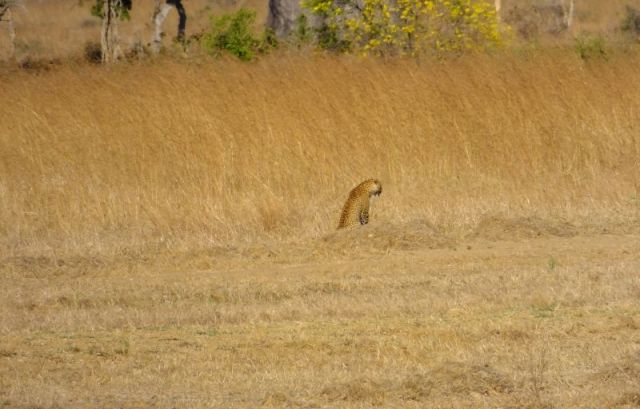
When we reach our sister vehicles they are parked along the road staring towards the grass airstrip. Oh my gosh, sitting along the edge of the short grass of the landing strip is a large leopard. Kevin apologizes to us for driving so fast but explains that often a leopard will disappear in minutes. I don’t think any of us were upset as we figured there was a good reason for the urgent driving.

Leopard that Brian spotted next to the airstrip

Leopard that Brian spotted next to the airstrip

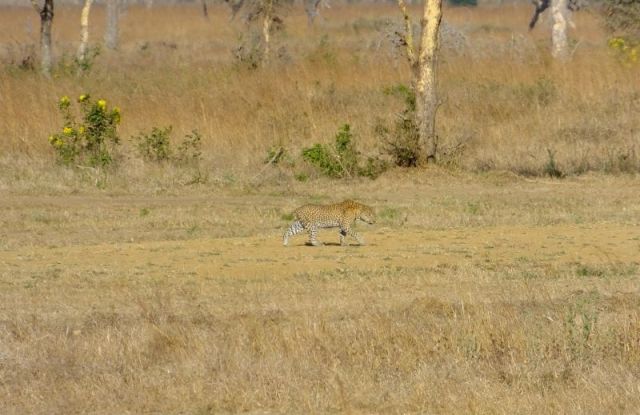
The big cat is paying no attention to us and is staring intently down the landing strip. It appears the object of his attention is a big impala buck, sporting a nice pair of black spiral horns. The leopard rises to his feet and my goodness,  is this an impressive male cat. As he walks onto the airstrip you can see this massive cats muscles rippling. The magnificent feline specimen has one odd thing about him, I don’t remember who noticed this and alerted the rest of us, but he has no tail! How in the world does a leopard lose its tail?

The leopard has no tail but what a gorgeous animal anyway

The leopard has no tail but what a gorgeous animal anyway

The cat moves across the airstrip without the impala, which is a long ways off, noticing him. Once he reaches the tall grass he disappears without a trace, even though the leopard is actually closer to us now. Our drivers move down the road in the direction of the impala, anticipating that the feline is sneaking through the grass towards the antelope. More safari vehicles have arrived now but most came too late to see the leopard while it was in the open. Thank you Kevin! After several minutes the impala begins to snort and look towards the area of the unkempt grass. It isn’t long before the buck loses its nerves and takes off running, but there is no leopard in pursuit.

Our group and a half-dozen more vehicles drive slowly along the road in hopes the beautiful leopard will materialize again. We know the cat is in all that cover somewhere as several wart hogs come running out of the grass, their little tails pointed skyward as they flee from danger. We continue to wait for quite some time but eventually conclude that our hope of seeing the tailless leopard isn’t to be. I ask who spotted the cat and how they saw it because the leopard was a long way from the road and just sitting still. Brian has the honor of taking credit for the awesome find and explains that he once saw a cheetah sitting on a landing strip on another safari. He figured it was worth checking out the area as they drove by. Yes it was oh great safari leader:).

Our guides turn the vehicles around and we make a quick visit to the lions. The pride is still there along with a bunch of vultures skulking around acting like, well vultures. We don’t stay long to watch the lions, which are still lying around looking miserably full. We spent quite some time with the leopard and the drivers want to go back to where we saw the stashed reed buck this morning. That is a long drive and the afternoon is slipping away.

vultures at the lion kill

vultures at the lion kill

Our convoy moves along at a good clip and when we arrive at the dead tree we are dismayed to see that the reed buck is gone! We are looking all around the area when Ngruwe sees the carcass lying on the ground fifty feet from the tree. Where is the leopard? Everyone is scrutinizing the area with and without binoculars. Suddenly, Kevin yells out, “There he is”. No way, that leopard was lying almost next to the dead reed buck in scant cover and none of us saw it until it got up. The big cat slinks behind some small bushes and disappears from sight. How do such big animals do that. We are all staring at those bushe, hoping he will move again when Nyama cries out that she sees him. Where?? Nyama directs me to an area behind the dead tree a good 50 yards away. What the heck, the leopard must have been flat on the ground and belly crawled until he felt like he was far enough away to safely expose himself. Again, he disappears from sight and again it is Nyama who finds the leopard as he continues to retreat further from our intrusive presence.

Photo I took when Kevin first spotted the leopard

Photo I took when Kevin first spotted the leopard

The sun continues to slip toward the horizon and I am ready to leave the beast in peace, so he can return to his kill. Our drivers decide they want to drive out to where the leopard was last seen before disappearing again. I am completely against this as I consider driving off the road after animals,  harassment. Out we go anyway and it is our vehicle that approaches the area where we had our last look at him and we scare the leopard out of his hiding place. This seems to satisfy our drivers and they turn around and drive back to the road. This action leaves a bad taste in my mouth and when we return to camp, I ask Brian if what our guides did was legal. He explains that there are areas where you are allowed to go off-road and this was evidently one of them. Well, I’m glad we weren’t doing something illegal but it still didn’t feel right.

When I saw this fuzzy photo of the leopard looking through the grass, I was sure that I had indeed saw the leopard this morning.

When I saw this fuzzy photo of the leopard looking through the grass, I was sure that I had indeed saw the leopard this morning.

There is no way we are going to get out of this park on time. Our guides are driving with urgency, when we come across animals that are stampeding across the plains near the road. There are zebra, wildebeest and best of all thirty or forty of the largest antelope in Africa, eland. It is a surreal scene as dusk is falling and the herds of running animals are throwing clouds of dust into the air which obscure them even more as we race toward the exit. What an interesting way to end this incredible day.

I am so ready for a shower and I follow the camp staff as they carry buckets of steaming water to fill the shower canister. I hear branches snapping in the woods that are close to the shower stalls. As I peer into the gloom I can see a big tree moving back and forth. “What is that” I ask one of the guys as they finish filling the canisters. “Elephant” but he quickly adds that they aren’t coming this way. Maybe not but they aren’t feeding that far away either. I’m having second thoughts about this shower! I convince Paul that he should stand guard while I shower. Paul agrees but tells me that he doesn’t see what he can do if the elephants make an appearance. Well, that’s true but just having Paul nearby at least gives me some moral support. I finish my shower in record time and when I emerge from the cubicle, I see three staff people shining a light into the trees as the sound of breaking branches punctuates the air. Ha, they must be worried that the grey ghosts of Africa might be heading this way after all!

As our tired, but happy group sits around the fire before dinner, the whoop of hyena breaks into our discussion of the events of the day. We stop talking to listen to the eerie sound and because of our silence, we also hear the low rumbling of elephants. I love it.
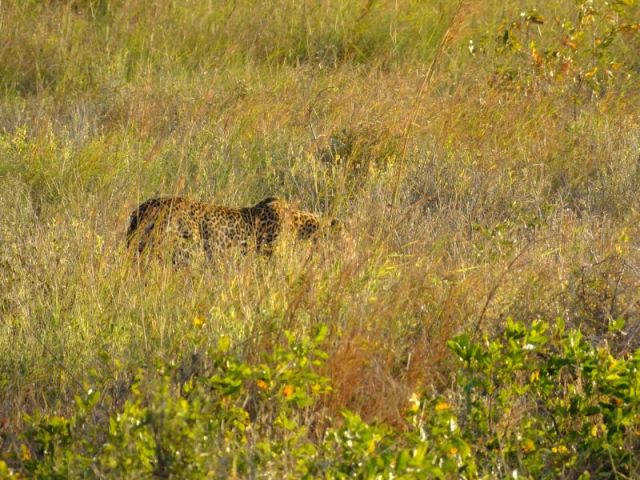
Next installment, our final game drive in Mikumi National Park then we  move on to the Udzungwa mountains. Nancy


Mikumi National Park, Part 2

Mikumi National Park Part 2

Taken as we were driving to Mikumi

Taken as we were driving to Mikumi

Today we leave Morogoro for Mikumi National Park after having breakfast at the hotel. Most of us have shown up at the dining area together and Vidole Juu directs our attention to the TV, which is anchored on the wall. Oh yuck, a big rat is crawling up the cable and then disappears into the ceiling. Lovely! After our initial gasps and groans, we settle down and continue to eat our meal. Vidole Juu tells us later on that he has listed the rat in his journal as his first mammal sighting. That’s funny.

I forgot to mention in my first blog that on our drive from Dar es Salaam to Morogoro we met up with our actual safari drivers around the midway point between the two cities and transfer into three vehicles. Paul and I are riding with two other couples from Kansas, Vidole Juu, Uwiano, Nyama, Ngruwe, and our driver/guide is Kevin. After breakfast, our luggage is being packed in the vehicles and we are waiting to load ourselves into our designated vehicles. An employee of Hotel Oasis walks out of the lobby carrying my red fanny pack and asks who it belongs to. Good grief, how did I not gather that bag up with everything else? Thank goodness the honest woman found it before we left. Although I could have survived without it, it did contain the bird book I borrowed from my sister-in-law, my journal, and other items I wanted to be able to get my hands on easily.

An unique way to display wares for sale

An unique way to display wares for sale

As we speed our way toward Mikumi, I try to take photos from the moving Rover. On past trips I have had really good luck capturing road scenes through the window but so far my results on this trip are not good. I finally figure out why most of my efforts are proving disappointing on this trip. The windows on our Rover don’t roll down; they slide open and only halfway at that. I can’t get the camera lens out the window far enough to point it forward thus the camera can’t focus well. Pooh.

As we near the outskirts of Mikumi National Park, there is a troop of baboon along the edge of the highway. They act like beggars and I suppose foolish tourists have tossed them food from car windows. Don’t get me started on people who feed human food to animals in National parks and then wonder why they become a nuisance. A bit farther up the road I spy several elephants in the distance.  Impalas and ground hornbills (these birds are huge) have been spotted by the lead vehicles in our group. All Right! We haven’t even entered through the official park gate yet.

Bats occupying the rafters of  Mikumi National Park headquarters

Bats occupying the rafters of Mikumi National Park headquarters

Our drivers pull into the dirt parking lot adjacent to the official entrance to Mikumi. They have to check in and fill out paper work that will allow us to legally enter the park. All of us unload from the vehicles and gratefully make our way to the restrooms. We then walk into the Parks headquarters to look at their displays of various items such as skulls, maps and photos of the wildlife found in Mikumi. The main “attraction” is a group of bats that are hanging from the rafters. Someone comments that they aren’t real and gullible me actually believes them. Well, in my defense, they do look a bit like a stuffed display but once you begin to scrutinize the rather creepy creatures, you can see some of the bats moving around, or opening and closing their eyes.

Once we load back into the safari trucks, the guard lifts the wooden barrier for us and we are off on our first game drive! Holy Smokes, it didn’t take long for us to find what we were searching for. Within a few hundred yards of the gate we see a few wildebeest (they really are the oddest designed critters), zebra (they always seem to be posing for the camera), elephant (the true king of the bush), impalas (such fine boned and graceful antelope), a giraffe (giraffe are oddly hard to see sometimes), plus numerous birds. All of us are snapping photos as fast as we can and I am surprised our shutters are not smoking with the nearly nonstop punching of our camera buttons.

Graceful impalas and the landscape of Mikumi

Graceful impalas and the landscape of Mikumi

Wildebeest

Wildebeest

The lone giraffe

The lone giraffe

Zebra always seem to be posing for you

Zebra always seem to be posing for you

Earlier in our trip, after we had been divided into the three safari vehicles, Brian gave us a lesson on helping your fellow passengers find an animal or an unusual roadside scene that you have found. Using the direction the arms of an imaginary old-fashioned clock would point to on the hour, is supposedly the easiest way to direct people’s eyes to the area they need to look. The front of the vehicle is designated as twelve o’clock.  So if you see an animal to your immediate right of you, one should yell out “three o’clock”. Now that may seem easy enough but with most of our time pieces digital now this simple directive isn’t as reflexive as you would assume. I for one must think for a moment before yelling out the corresponding time, by then we may have driven far enough that the animal that was at one o’clock is now at three o’clock.

The lovely landscape of Mikumi

The lovely landscape of Mikumi

This lesson in alerting fellow passengers to an animal you have found reminds me that I left out an amusing story in my first blog, so I have included it here.

The first time Vidole Juu called out “three o’clock” was when we were riding back to the hotel from our hike to the falls. The five of us dutifully direct our gaze to the right and see nothing. Vidole Juu apologizes and says he really meant nine o’clock. I can’t even remember what Vidole Juu was trying to get us to look at, but we do give the man some grief for the mix-up. When Vidole Juu mixes up three and nine o’clock occasionally on our game drives we tease him unmercifully, partly because Vidole Juu’s career is all about working with numbers. We keep telling him we are going to ask Brian to change his name to Mr. Three o’clock. Being a good sport Vidole Juu banters back and offers the excuse that his mix up is because we are on the other side of the equator and the hands of the clock are reversed! Good come back but not enough to keep us from kidding him when he slips up.  Paul reminds me after he proofread my blog that the first time Vidole Juu made this mistake, Paul actually looked towards nine o’clock when Vidole Juu called out three, so I guess the hands on Paul’s clock had reversed directions too.

Notice at hippo pool

Notice at hippo pool

We are the trailing vehicle in the convoy because our driver, Kevin, is not familiar with this part of Tanzania, thus he needs to follow the other guides that know the roads in this park. As we continue down the dusty, red, dirt road, our vehicle leaves the main track to check out the hippopotamus pool. We see a few bulbous heads poking out of the water but mostly the large mammals are keeping as much of themselves out of the hot sun as possible. There are also some small crocodiles that we observe sunning themselves along the edge of the water.

Hippos hiding from the sun

Hippos hiding from the sun

We leave the hippo pool and drive in the direction our sister vehicles went. As we round a corner we find them and three other safari trucks sitting on the side of the road. Well no wonder the rest of our group drove by the hippo pool, a small pride of lions have killed a Cape buffalo right by the side of the road. There certainly was no hurry for us to get here as the lions are lounging around, so stuffed full of meat they can hardly move. There are two male lions, lying off by themselves, while two lionesses and three cubs have found shade in a clump of bushes not far from the kill. Our poor cameras are given another frenzied workout!  Nyama hauls out a long lens and attached it to her canon camera. I admit I look at that powerful lens with some envy. I would guess if she gets a photo of one of these lions yawning, Nyama will be able to see if they have any cavities! We sit for quite some time watching the lions, which mostly just lay around trying to alleviate the pressure on their bulging bellies.

A male lion and the Cape buffalo carcass

A male lion and the Cape buffalo carcass

Isn't this male lion a beauty?

Isn’t this male lion a beauty?

Look at the cubs bulging belly

Look at the cubs bulging belly

Since we are to be in camp at 1:30 for lunch we reluctantly leave the lions behind. We do stop at the hippo pool on our way back to camp, where we are allowed to leave the vehicles and stretch our legs. The hippopotamuses still are just grey bumps in the water but we do see some larger crocodile lying on the dam across the water from us. They are camouflaged so well that it takes a while to convince ourselves that what we are looking at aren’t just dead logs.

Glad this bug was outside our tent

Glad this bug was outside our tent

When we arrive at camp we must all choose a tent where we will sleep for the next two nights. There is one large open air tent and the rest are small two person tents, each containing two cots and a wooden table. Paul and I settle on tent number eight, and when the camp staff sets up our mobile camp in other parks, tent number eight will always be ours. The inside of the tent is really hot, so Paul goes to open the back rain flap in hopes that some air will find its way through the tight mesh of our canvas house. Paul calls to me and shows me the darndest insect, happily perched on the side of our tent. Yikes, I’m glad that thing is on the outside and not crawling around on our beds.

Our camp

Our camp

Christophe the chef puts a meal of spaghetti, watermelon, salad and cheese in front of his safari clients. Despite the fact that we rolled into camp late (hey it was lions!), then had to choose our tents and retrieve our luggage, Christophe managed to keep the spaghetti and sauce hot and edible. Christophe is cooking over wood and it is amazing the meals this man puts in front of us over the next two weeks. The fact that he can produce such fare while preparing the food over an open flame or coals while using just a few pots and pans is unbelievable.

Christophe and his kitchen

Christophe and his kitchen

After the satisfying lunch, we have some quiet time before we leave on a late afternoon game drive. Paul manages to take a nap in the stuffy tent, but I can’t tolerate the heat so retreat to a chair outside. I look over my photos, good grief at this rate I will fill my cards up before we are halfway through this safari. I delete a few photos that are obviously blurry, and some that are exact copies of each other. I admonish myself to try to temper the urge to photograph the same animal or a landscape shot every few seconds. I write a few notes in my journal and before you know it, 4:30 has arrived and it is time to leave for our second game drive.

One of the jackals

One of the jackals

Our camp is not far from the park entrance and we haven’t driven far when someone observes two jackals trotting through the underbrush. They are smaller than our coyotes and like most predators are very well camouflaged. We watch the little canines until they trot out of sight.

Our drivers take us back in the direction of the lion pride we saw this morning. Along the way we find a group of zebra that contains a baby zebra. I can’t help but verbally gush over the cute, toy like creature. I’m pretty sure that the other females in the vehicle joined in my out loud admiration, but I was so engrossed in expressing my own delight I can’t be sure :).

The baby zebra

The baby zebra

How cute is that

How cute is that

We watch a group of warthogs for a while but they mostly just stare back at us. Good heavens, these animals have a face that only a mother could love. Brian and Mbuzi will probably scold me for that critique!  Also, why do these warthogs have a mane, and what is its purpose?  Our convoy also encounters more regal elephant and graceful impalas. We watch a lone reed buck exhibit some odd behavior. The antelope lays down, then jumps up and runs for a short distance before lying down again. Kevin tells us (or maybe it was Brian) that this is classic behavior of a reed buck when it is nervous about a nearby predator. We leave the reed buck behind after scrutinizing the brushy area for big cats. We saw no sign of a predator but that doesn’t mean something wasn’t hiding in the tall grass.

Wart hogs, the poor things

Wart hogs, the poor things

When we reach the lion pride again one of the male lions is partaking of some more Cape buffalo meat. The sun is sinking low in the African sky and the rays are lighting the lions up as if they were spun of gold.  Although some might find it gruesome, the power of the lion in stripping the meat off of the carcass was something to see. The big male doesn’t eat for long and as he is walking away from the buffalo one of the lionesses walks up to him. The two big cats head butt each other in the exact manner that domestic cats greet each other. The majestic male then lies down by the base of a tree and begins grooming himself. Once he is satisfied that he is clean, he rolls over on his side and points his overstuffed gut to the sky.

Lion and Lioness greeting each other

Lion and Lioness greeting each other

Grooming session

Grooming session

He looks miserable!

He looks miserable!

The female has two cubs trailing behind her, their little bellies so full they appear to be sway backed. The lioness goes up to the Cape buffalo, sniffs at it, takes one bite, than sits down near the carcass. The two cubs do begin eating more meat, one cub practically crawling in the cavity of the old buffalo’s stomach. How in the world the youngsters manage to make room for any more meat is a mystery to me, but eat they do.

The lioness couldn't bring herself to eat anymore

The lioness couldn’t bring herself to eat anymore

We must leave the satisfied lions as the sun is beginning to set and our guides must be out of the park by 6:30. We don’t quite make the deadline but the guard at the gate just opens the barrier and waves us on through. I have a feeling they are used to late departures.

When we arrive at camp, the staff has hot water ready to fill the bucket showers for us. There are two shower stalls but with bucket showers one doesn’t spend much time in them, maybe five minutes tops. Basically, you open the spigot and wet yourself down, shut the water off, lather up, turn the spigot back on and rinse off, put your towel or clothes on and let the next person have their turn. After a long day of driving, we are dusty and sweaty so a shower feels wonderful!

It might not look like much but this bucket shower does the job

It might not look like much but this bucket shower does the job

The only thing I remember about the meal Christophe put before us tonight is the homemade dinner rolls and the leek soup. The dinner rolls are out of this world, raised up to great heights with a crusty exterior and perfectly done in the middle. The soup is thick and wonderfully seasoned. If the man only put soup and rolls in front of me for the remainder of the safari I will be completely satisfied.  Our first game drive was stupendous but also tiring so we turn in soon after the meal. Next installment, Mikumi day 2. Could it top today?? Nancy

Sunset over Mikumi National Park at the end of our first day

Sunset over Mikumi National Park at the end of our first day


Tanzania Part 1

I can hardly believe that 5 months after our wonderful Sri Lankan adventure, Paul and I are returning to the African continent, looking for adventure in our favorite country of Tanzania. The hay is harvested and stacked away for the winter. The heifer calves are weaned and most of the steer calves were loaded on a semi-trailer last week headed for their new home in Iowa. Our luggage is packed although it is over the 25 pound limit per person we were supposed to aim for. We will eat our way through some of that extra poundage via the snacks we packed, before we have to meet  that limit and will worry about the rest when the 13th arrives that involves an in country flight.

Paul and I drive to the Topeka airport after lunch to catch our flight to Chicago. We meet three members of our group of sixteen here, who also took advantage of the closeness of the Topeka airport versus Kansas City. How nice it is to be able to fly from the capital city with only the people on one flight to contend with! Sadly, we will be one of the last few to use the airport as United is folding up the Topeka operation after opening the service less than a year ago. Darn it.
We have no issues on this first leg of travel and have plenty of time to kill in the Chicago airport before boarding our flight to Istanbul. We begin to get nervous when 20 minutes before boarding, Brian, of Cowabunga safari fame, and 4 more members of our group flying in from Kansas City, have not appeared. A text message is sent to our safari leader and soon a reply is received that the group are making their way to the boarding area. Pheww. Our jet lifts off on time and we settle in for the 10 hour flight.

Istanbul airport, seven more hours!

Istanbul airport, seven more hours!

When we land in Turkey we have a couple of hours before we board the jet for the final leg of our journey to Dar Es Salaam, another 7 hours sitting on a plane. There are 2 more members in our group that join us at the Istanbul airport. The last 4 people in the group will meet us in Dar.

We land in Dar Es Salaam at 2:30 in the morning, disembark and fill out a custom form. We then hand over our custom papers along with our passports and 100 bucks for the cost of a visa, to an uniformed official. The woman sticks the hundred dollars in the individual passports, stacks up as many passports as she can carry and passes them off to two men sitting in an office. The two men evidently are the ones who will approve everybody’s visa. Eventually, passports are handed back to the people who collected them from the tourists. These folks proceed to read off the names one at a time without aid of a microphone. We strain to hear the names the official is calling out and eventually the owner of said passport walks forward to claim their document. The airport official scrutinizes the claimants face to make sure it matches the photo on the passport they have claimed. When one passes muster the frazzled passport owner is directed to a booth where the person behind the glass, takes their photo and fingerprints, stamps the passport, and finally the person is free to go and claim their luggage.

To say this visa ordeal is a test of one’s patience is being kind, particularly in the wee hours of the morning. Once we gather all the luggage, yes everyone’s arrived, there is another airport employee waiting to x-ray your luggage as you exit the airport. I don’t remember this requirement before, but Brian charms the woman into allowing our group to skip this final act of bureaucracy and we are free to go. Our driver is waiting outside with countless other drivers, Cowabunga sign held high, and he leads us through the humid night air to a big white van. The twelve of us pile into the vehicle and in thirty minutes we have arrived at the Tanzanite hotel.

Dar es Salaam from the balcony of our room (when we finally got one)

Dar es Salaam from the balcony of our room (when we finally got one)

Oops, it seems the hotel has given our rooms back to the occupants that were in the rooms last night as they missed their flight, at least that is the hotel manager’s story and he is sticking to it. The only thing the Tanzanite has available is a suite which has three bedrooms, a large living/dining room and a kitchen. Two of the bedrooms have private bathrooms and there is another stand-alone bathroom which those of us without a bedroom take advantage of to shower off the past 20 plus hours of travel.

Sooo…three bedrooms only takes care of half of us but this group seems to take it all in stride. We come up with a solution which has three couples in the bedrooms; the young couple in our group gathers cushion backs from the couches and chairs and builds a makeshift bed in the kitchen. Paul, Brian, Daktari ya Moyo and I camp out in the living room, so technically on our first night in Tanzania, I sleep with three men:). Did that statement wake you up!

I get a couple of hours of shut-eye on my short couch but I don’t think Paul slept at all in his chair. The four of us that camped out in the living room and another couple wander down to eat breakfast around eight. The buffet offers a nice variety of cereal, breads, eggs, and sausage. After eating, Brian leads us a few blocks from the hotel to change some money into shillings. Brian then takes the five of us on a short walking tour through the city and down to the Indian Ocean. Brian, who is fluent in Swahili, makes an impression on a couple of curious young men who approach our group with the typical “where are you from” question. Although the young men speak English, the two are obviously impressed with the American who can converse with them in Swahili too.  Before we continue on our way the young men insist that I take their photo and I am happy to comply.
Friendly young men we encountered while on our walk in Dar

Friendly young men we encountered while on our walk in Dar

It was a memorable walk as we enjoyed the interesting street scenes and ocean vistas.  Unfortunately we will mostly remember this morning because Bwana Cheka had his small camera pickpocketed! If you don’t know how to pronounce that name it is because it is Swahili. Brian gives all members of his safari group Swahili names and I will use them in my writing to protect the innocent or guilty! Needless to say this cast a pall on our first morning in Dar es Salaam but Cheka handled it with much more grace than I would have.

Photo taken as we walked along the Indian Ocean in Dar

Photo taken as we walked along the Indian Ocean in Dar

We all have individual rooms by noon so Paul and I settle in for an afternoon nap as the very short night has caught up with us! All of us meet this evening in the reception area and Brian leads us a few blocks to a Lebanese restaurant that he has frequented on prior visits. The food is plentiful and tasty so the day ends on an up note. We also enjoy entertainment during dinner thanks to Bwana Vidole Juu. It seems the ketchup bottle he attempts to use has pressure built up in it. When he pops the top, Viole Juu manages to spray his wife, Mama Uwiano with a liberal dose of the red stuff, starting with the side of her face and continuing down the front of her shirt. Another safari member showing grace over mishap, as Mama Uwiano laughs about the incident which allows the rest of us to join in.

Woman bargaining for melons in Dar

Woman bargaining for melons in Dar

The final four members of our safari group arrived in Dar late last night so we are all present and accounted for.  This morning we are leaving Dar (thank goodness) and driving to Morogoro. For those of you who know me well, my tolerance for big cities is two days tops, get me out of the city after that as I need to breathe!

Traveling hat salesmen I took this as we were driving to Morogoro.

Traveling hat salesmen I took this as we were driving to Morogoro.

We were to stay at a working farm on the outskirts of Morogoro but they canceled our reservations so we are staying at the Hotel Oasis. We all settle into our rooms (everyone comments that their rooms smell of bug spray) then we return to the lobby to meet a local man who will guide us through the city and market.DSCF3122

The market is a sensory overload with yelling vendors, crowds of people, vibrant colors and an unpleasant odor in many areas of the maze of shops. The passage ways through the market are narrow making it necessary to bump and jostle your way through the shoppers. There are pleasing pyramids of vegetables, colorful sacks of grains and heaps of dried fish that your nose can identify before you see the fishy offerings. Clothes, kitchen ware, jewelry and about anything else you might want or need can be seen in the ramshackle market.

Stalls at the Morogoro market. Excuse the purple halo spot in the photo

Stalls at the Morogoro market. Excuse the purple halo spot in the photo

Our guide, Charles, sets a fast pace and with such a large group, those of us who are taking photos or have short legs, sometimes lose sight of our friendly escort. Bwana Ngruwe has a neon yellow “glow in the dark” Cowabunga shirt on which comes in handy for those of us who tend to fall behind the main group. Searching the mass of humanity for our group, the bright yellow shirt is always the first thing to catch our eye and allows us to reunite with our fellow sightseers.  Ngruwe will take a lot of grief about the brilliance of that shirt before the trip is over but it is a welcome beacon more than once today.

An example of the wide array of things offered at the market

An example of the wide array of things offered at the market

Those of us snapping pictures missed the instructions before we left that we weren’t to take photos unless Charles told us it was o.k. Oops. I wondered why some guy walked by me and was basically yelling at me! Later, Paul was told by a vendor “no photo” and it wasn’t until then that a member of the group informed us that taking pictures was prohibited except at a few stalls. Well, up to that point we got some pretty good photos even if they were taboo.

I wonder where the shop owner came up with these manikins?

I wonder where the shop owner came up with these manikins?

Sacks of grain in the market

Sacks of grain in the market

Can you imagine the time it must take to stack tomatoes like this??

Can you imagine the time it must take to stack tomatoes like this??

The craftsmen that are permanently located in the town were much more accommodating with us and seemed tickled that we were interested in their craft. We visited with a tinsmith and a cabinet-maker, admiring their handy work. The craftsmen were more than happy to have us take photos and seemed to revel in being part of the photos.

The tinsmiths storeroom

The tinsmiths storeroom

Tinsmith

Tinsmith

Our market/town tour lasted three hours and all of us are ready to return to the hotel. As we wearily trudge back in the direction of the Oasis, we pass a church where the youth are having a dance and some members try their best to get us to join the festivities. The catch is that we must pay to attend their dance; I would guess this gala is a money-maker for them.  When we decline the invitation due to exhaustion, the recruiters keep reducing the entrance price hoping that this will entice the foreigners to join in the fun. It would have been an interesting experience but we really were finished for the day.

The following morning, Charles, our guide from yesterday is taking our group on a hike to a waterfall in the Uluguru Mountains. Two members of our group walk with us for a ways but opt out once it becomes obvious the hike will be steep and over rough terrain. I hate that they can’t go with us but admire them for knowing their limits.

These kids weren't quite sure about those foreigners.

These kids weren’t quite sure about those foreigners.

Brian entertaining the school children

Brian entertaining the school children

As we hike through small villages and a school we have the opportunity to interact with the uniformed school children. We ask and are granted permission to take their photos. When one little boy is shown his photo taken by Bibi Nyama, he bursts out in the most incredible belly laugh I have ever heard from a child! His laughter is so infectious that it sends Nyama and me into peals of laughter too.

After a couple of hours of walking we stop at a small restaurant to use the facilities. Three members of the group decide they will return to the van as we are only at the halfway point of our hike. We are leaving the drivable road; where we have been meeting lots of motorcycles, and will be hiking higher into the mountains which mean steeper grades and more narrow passages. Fortunately, the temperature is warm but not hot or I might have turned back with this trio.

Paul on hike. Imagine walking this terrain with heavy loads on your head!

Paul on hike. Imagine walking this terrain with heavy loads on your head!

I have discovered that Bwana Mkatagiza Usiku is a fellow bird lover, so we are stopping frequently to enjoy the bird life along the way. We are often lagging behind the rest of the hikers but boy are we enjoying ourselves. Paul stays with us most of the time too.  We see the Urugulu violet-backed sunbird which if I understood correctly, is only found in these mountains! Exceptional find but too far away for a photo. One of our driver/guides is there to confirm the spotting of the small, colorful bird. We also see an African hawk harrier, Collared sunbird; Tawny flanked Prinia, among numerous other birds.

Usiku suggests we take a shortcut via a trail that cuts through the farm fields, because he has spotted the rest of the group on the road above us rounding a curve. Paul and I figure why not and follow his lead. An old farmer passes by and offers his hand to each of us while uttering what we presume is a phrase of welcome. We all shake his hand and say hello before tramping up to the main road. Imagine our surprise when a short time later our group appears behind us! Imagine their surprise when we laggards magically appear in front of them. It draws laughter from all when we admit that we cheated by walking off the beaten path. By now we are walking through beautiful mountain scenes and as usual photos just don’t do the vistas justice.

The scenery we were enjoying as we hiked

The scenery we were enjoying as we hiked

It is obvious as we near the end of the hike who the fit and seasoned hikers are in this group as they continue to easily walk up the mountain trail. I am not one of them! Another woman and I are struggling up the final steep, slippery slopes, as Charles encourages us by telling us we are almost to the top.  I walk twenty steps and stop to catch my breath, finding that this technique we were taught in climbing mountains in Russia, allows me to keep inching upward. Once we are at the top, Charles gives us a few minutes to catch our breath before leading us down a very narrow trail to the base of the pretty waterfall.

Children who were following us.

Children who were following us.

Three young boys have shadowed us partway down the trail and stare unabashedly at the tourists who have come to picnic by their local waterfall. The more surefooted among us, help the rest of us cross the slippery rocks to a large slab of stone where we will eat the box lunches that those with daypacks carried with them. The lunches contain grilled chicken, cucumber/tomato sandwich, banana and a piece of cake.  A local man brings blackberries and raspberries that are grown nearby and offers them to us picnickers. Paul and I pass the lovely berries up as we are suspicious of the water the fruit would have been washed in. Everyone else ate some of the plump berries and as far as I know they had no ill effect from them.

Some of the crew at the base of the waterfall

Some of the crew at the base of the waterfall

Charles amuses us all as he takes photo after photo of his clients, while we dine to the music of falling water and occasionally are refreshed by a light mist coming from the falls, driven by a gust of wind. Most of our group takes the proverbial photo, standing on a rock in front of the waterfall. Brian insists on a group photo with the Cowabunga banner held proudly among us smiling trekkers. Yes, the strenuous hike was well worth it for the bird life, mountain views, people encounters, and lovely waterfall.

Paul waving goodbye to these children he made laugh when he joined in their dancing.

Paul waving goodbye to these children he made laugh when he joined in their dancing.

We met these children on the trail. Look at the loads they are carrying!

We met these children on the trail. Look at the loads they are carrying!

It is time to start back and as always going downhill is so much easier for me than walking uphill. As we pass by a house there is a woman hanging out laundry in the yard. A rooster has his way with one of the hens as we walk by and some of us yell out the phrase that alerts the other safarists that we have witnessed the mating act of the chickens. This is an inside joke and I cannot give you that phrase that all Cowabunga alumni are privy too, for that you must go on safari with Brian! Anyway, the rooster then unfurled one wing and does a little jig around the hen that completely ignores him. I snort at the cocky display and say with disdain in my voice, look at that rooster strutting his stuff. The woman looks at me and bursts into laughter and continues to laugh as we walk on down the trail. I have no idea if she understood what I said or if she just put the tone of my voice with the rooster’s actions but whatever the reason, it certainly tickled her funny bone.

This may have been the house where the rooster incident took place.

This may have been the house where the rooster incident took place.

We come upon a woman who has filled a huge wooden vessel full of red dirt and is pounding the dirt into fine dust using a thick, long wooden pole. A few people in the group give it a try, and then Kevin and Charles each take a wooden pole and work together at pulverizing the dirt. Brian takes over for one of the guides and for some reason his technique causes the fine earth to spill out onto the ground. This causes the woman and her young daughter to laugh at the messy effort by Mzungu Mrefu (Brian). Hopefully, all this help gave her a break in the tedious work and certainly it will give the woman a story to tell to her friends tonight. By the way, they form this dirt into small sticks about the size of a fat crayon and sell it to pregnant women to consume (do they dissolve it in water?) which they say helps alleviate morning sickness.

Notice the woman laughing at Brian's messy effort

Notice the woman laughing at Brian’s messy effort

When we reach the restaurant where we stopped to use the choo (choh/bathroom) on our way up, the front-runners have discovered the North Rock bar; a little room built on top of a big boulder, and are enjoying Tusker beer or soda. We join them and soon laughter is filling the air. I think this group is going to get along just fine! Charles asks for our attention as we are finishing our drinks and commends us “old people” for making it to the waterfall. This brings more hearty laughter at the “compliment” from our light-hearted guide. None of us complain when our drivers roll up in two of the Range rovers which means we don’t have to walk the rest of the way! The ride from the bar to where we started walking this morning is extremely rough but it will be good practice for what is to come on our safari drives, I’m sure!DSCF3246

Tonight we enjoy dinner at the restaurant at the Oasis and are sitting at a small table with Ngruwe and Nyama. The restaurant specialty is called the sizzler, which is well named as when one of these dishes appears from the kitchen the sizzling sound reverberates through the room. Ngruwe has ordered this dish and for some reason he is still waiting for his order as the rest of us consume our food. He jokes that if it takes much longer they may as well include a fried egg and he can eat breakfast too. When his sizzling dish finally appears, yep you guessed it; on top of the platter of food is a fried egg. We laugh so hard that Brian walks over from his table to see what the brouhaha is all about. After we relate the story to Brian, he chuckles but I’m not sure he thought it deserved the nearly uncontrollable laughter it brought forth from the four of us. I guess maybe you had to be there because even now I am giggling as I type the fried egg story. Later, Nancy (Mama Ndege)

Next installment Mikumi National Park


Reality Ranching, Wildlife encounters July 2014

Mother raccoon and two of three babies that walked by the house on our sidewalk

Mother raccoon and two of three babies that walked by the house on our sidewalk

I am not a very good low light photographer plus I was taking many of them through dirty windows so forgive the quality of the wildlife photos!

SOMETHING NEW IN THE NEIGHBORHOOD

We are fortunate to have frequent encounters with wildlife on our ranch. Paul and I can often watch various critters from the comfort of our recliners in our sun room. This summer has been no exception with the usual parade of deer, raccoons, turkey, and rabbits being observed as we relax in this many-windowed room. However, there is one creature this summer that was a first for us and caused a stir of excitement in the area.

One evening in late May, I look up from reading to check out what might be stirring in our yard or the fields beyond it. There is an animal grazing on Milton’s alfalfa that doesn’t compute in my brain. It is too big for a deer and its body much lighter in color than our white-tailed deer. I grab the binoculars that are always lying nearby and zoom in on the unidentified mammal. “Paul, I think I see the elk”! Actually, there is no thinking about it as the brown head and neck attached to the light body could be nothing but an elk.

A friend had informed us a few weeks ago that a cow elk had been seen grazing on his alfalfa fields. Another neighbor has photos of the elk on his game camera. Paul and I had kept an eye out whenever we drove by the fields but until now had not had the good fortune of seeing the unusual visitor. Well, that has changed and we just had to look out our window!

Paul asks if I’m going to try to get close enough to the elk to take a photo, and I figure I might as well give it a try. I put my shoes on, gather my camera, step out the back door, and start walking south. There is a strong wind blowing out of the south which is in my favor. We haven’t hayed the brome field I must walk across so this too helps mask me from the elk’s sight, but this also means I can’t see her. Once I reach the alfalfa field I no longer see the cow elk. I hope that she crossed the creek into the next field, so I decide to continue with my quest even though the sun is dropping towards the horizon.

When I am halfway across the field a curious doe approaches me, stomps her foot a couple of times, then turns and takes off running, her white tail waving, towards the area where the elk had been grazing. If the elk is nearby this fleeing deer isn’t going to help matters. I reach the south end of the field that is bordered by the tree-lined creek bank. Staying close to the creek edge, I use the trees for cover as I cautiously walk to the east. As I climb up a slight rise, I stop in surprise as there is the cow elk lying down in the southeast corner of the alfalfa field. No wonder I couldn’t see her anymore!

Eve the elk

Eve the elk

I take a couple of photos through a gap in the trees before stepping out into the open to try to get a better shot of this beautiful creature. As I show myself, the elk gets to her feet and she looks at me for a brief moment. Unfortunately, I changed the setting on my camera and with the fading light the camera takes too long to process the photo. What could have been a great photo is an unidentifiable blur. I quickly change back to the prior setting and snap one photo as the elk runs for cover. I trek the quarter-mile back home, happy that my effort to document the elk was a success.

Don't get motion sickness looking at this photo!

Don’t get motion sickness looking at this photo!

As you can see my photos are not very good but at least I have proof that we really do have an elk out our back door!

I dubbed the elk, Eve, and she stayed around for most of June. We would see her at least once a day and sometimes several times a day. The most opportune time to observe Eve would be just before dusk, when she would walk out of the timber on the east side of the alfalfa field and begin to graze. The rays from the lowering sun would light up Eve’s coat so it glowed like a spotlight. Eve never stayed long, fifteen or twenty minutes, and then she would disappear into the trees.

The unsettled weather kept us from mowing Eve’s alfalfa field when it should have been mowed but the day came when the forecast predicted several dry days in a row. I was assigned the job of mowing the alfalfa, so I drove the John Deere and disc mower to the field. I felt a twinge of regret as I assumed that once the alfalfa was harvested, Eve would move on.

The next evening I kept an eye out for Eve and to my delight I saw her amble out onto the mown field. Eve stuck to her schedule and parameters as usual, hey maybe she will stay around. The next night she appeared but her behavior changed drastically. Eve appeared in the same area as usual, browsed for a few minutes on the edge of the field where some grass and weeds were standing. Suddenly, she began to walk briskly across the field heading west and disappeared from my sight.  The next evening, imagine my surprise to see Eve appear in her customary spot but that night she was nervous from the start. Eve walked along the fence that separates the brome field from the alfalfa field, stopping several times to look over the fence. I was sure she was going to jump the fence but she continued walking along the fence until I could not see her anymore.

A few minutes later, Eve appeared in the brome field below our house walking north. I watched her until she disappeared into the cover of trees and we haven’t seen her since. I can’t complain because we had nearly a month of her presence in our corner of Wabaunsee County. What a wonderful and unusual animal for us to be able to enjoy.

The one thing that puzzles me about Eve is that elk are herd animals. A bull elk might get pushed out of the herd or even leave on his own, but it makes no sense why a cow elk would leave the safety of the herd. Hmm.

I stepped out our back door and snapped this long distance photo of Eve

I stepped out our back door and snapped this long distance photo of Eve

TOURING THE YARD

Taz takes advantage of the wide window sills in our living room to survey the comings and goings of birds and animals. I can always tell when she spots some creature that excites her as her tail begins to twitch and she will utter short little cat chirps.

On this particular evening, Taz was peering out the west window when she went into crouch mode and became agitated. I assumed she saw her nemesis, Black Jack, a cat that showed up early this spring and decided to stay. When Taz jumped down from her perch and ran over to the south window to follow the creature that had caught her interest, I decided to get up and investigate what all the excitement was about.

Sampling the Hackberry leaves

Sampling the Hackberry leaves

Checking out the fence

Checking out the fence

Eating roses

Eating roses

No wonder she was acting differently, there is a doe primly walking through our yard! I leave the room to get my camera then go to the sun room where the windows are larger and more numerous, making it easier to watch the unexpected show. Paul and I watch as the brazen deer walks the perimeter of our south lawn. First she samples the leaves of our hackberry tree. Not particularly impressed by this tidbit, the doe walks over to the wooden fence and sniffs at the boards. The deer then walks daintily to our rose bush and samples the red roses. These flowers seem to be more to her liking as she makes the petals fly while she consumes a couple of the blooms. Our evening entertainment sees the second rose bush and starts towards it when she becomes aware of our Purple Martin house that sits atop a fifteen foot pole. For some reason the high-rise bird house freaks our visitor out. The doe stretches out her neck as she peers up at this scary structure.

Discovering the Purple Martin house

Discovering the Purple Martin house

The oddity of the bird house dampens the deer’s appetite and the explorer starts back the way she came but this time she is on full alert. As the doe nears the house she must catch a glimpse of her human audience as she takes one cautious step, comes to a stop and stomps her front foot. The curious doe continues her slow procession toward the window where I am taking photos. I can’t believe how close the cheeky doe comes to the house. Finally her resolve breaks and she makes a dash from our yard in the direction of the garden. The deer hasn’t returned so I guess the roses weren’t that big of a treat.

Anybody home?

Anybody home?

BLACK CATS AND AN ANGRY RESIDENT

I mentioned the cat that decided to adopt Paul and me earlier in this blog. Black Jack has to be from the same lineage as Taz because at times if I don’t look closely I’m not sure which cat is which. Taz absolutely despises her relative and to be fair Black Jack is somewhat of a stinker. The young tomcat likes to fight and intimidate, in fact he beat up and chased off a much larger tomcat that was an occasional guest at our ranch.

Seeing double and double trouble

Seeing double and double trouble

Because of Black Jacks temperament I came to the decision that he should be neutered this spring. He came through the operation just fine but the aggressive nature didn’t disappear with the removal of his manhood! I am sure in time he will becomelazier and more laid back but right now that sure isn’t the case.

Black Jack or Taz? It's Black Jack but I have a photo of Taz in that same tree and the same pose

Black Jack or Taz?
It’s Black Jack but I have a photo of Taz in that same tree and the same pose

So what do I do to try to get these two cats to accept each other? I have intervened in their spats by scolding them, tossed a cup of water on Black Jack when he was harassing Taz, but like his sister he doesn’t really mind getting wet. One day as I started out on a walk both cats began to follow me. I thought to myself that maybe this would be a good way for the contrary felines to learn to get along.

Returning from a walk

Returning from a walk

Sometimes our walks went fairly well, other times it seemed that every few steps I was intervening for Taz’s sake as Black Jack would be in a particularly ornery mood. Often the two black cats would just lay down and stare at each other, and as you know cats only come when you call them if they darn well feel like coming! When this face off occurred, I would go stand in front of Taz, stamp my feet, clap my hands and tell Taz to move. I was literally herding a cat which as you can imagine did not go over well. Taz would hiss and growl but eventually move in the direction I wanted her to go. If some of you wonder why I didn’t just pick her up it is because I don’t relish the idea of claws and teeth sinking into the flesh of my hand. Taz is not a cat you want to handle when she is mad.

One day I was walking back on Soloscheid road, with Taz ahead of me and Black Jack trailing. Taz does not suffer the heat well and she headed for the shade under the tree that grows next to the stone fence. I suddenly hear a rapid buzzing noise coming from the direction of the fence. I don’t need to see the creature making that sound because once you have heard a rattlesnake shaking his rattles, trust me you will not forget. Taz must have walked close to the reptile to get the snake this worked up.

That is a big rattlesnake! Look close and you can see the blur of the rattles

That is a big rattlesnake! Look close and you can see the blur of the rattles

I notice Black Jack walking through the grass towards the sound of the angry rattler. I yell at the foolish cat and he hesitates before moving slowly forward.  I step toward Black Jack and then I see the big timber rattler, his tail shaking so fast it is just a blur. Black Jack takes another step forward and I watch as the snake strikes out. The rattler isn’t in a full coil so luckily Black Jack is out of the snakes strike range. I continue to berate the cat who finally decides to exit the ditch and come back onto the road. My yelling has caused Taz to decide she will take Black Jack to task for whatever crime he committed. Taz gets up and runs at Black Jack hissing and spitting and they disappear across the road in the opposite ditch. Well, at least they both are moving away from the snake.

I leave the feuding cats to their own demise and walk back to where the reptile is still sending his warning out. No wonder the rattler is in such frenzy as he is half coiled next to the stone fence with no escape route. I snap a couple of photos using the zoom on my camera and continue back to the house. I can hear the dry rattle of the snake for quite a ways down the road. Fortunately, the cats are worn out and manage to finish our walk without any more fussing. That is good as I don’t need any more excitement today!

How about a more peaceful photo to end this blog:)

How about a more peaceful photo to end this blog:)

Oh yes, any advice on how to get two cats to accept one another is welcome. After five months of this cat feud I am out of ideas on how to get the knuckleheads to agree to a truce! Later, Nancy


Reality Ranching July 2014

Reality Ranching July 2014

The wild flowers have been gorgeous this year. This is Bee Balm sprinkled across the hills

The wild flowers have been gorgeous this year. This is Bee Balm sprinkled across the hills

Since I posted my last Reality Ranching blog, that desperately needed big rain event occurred in our corner of Kansas the second week of June. A soft rain began falling late one afternoon and continued throughout the night giving us nearly ten hours of continuous rain. Wonderful! Since we had received other rains prior to this one, the ground was saturated, so the four-inch rainfall resulted in rising creeks, full ponds, and smiling ranchers! Of course, this abundant moisture also brought washed out creek gaps.

Our creek  choked with grass and weeds the first of June

Our creek choked with grass and weeds the first of June

This is our creek after the four inch rain. No vegetation left (it is all hung up in the wire:))

This is our creek after the four inch rain. No vegetation left (it is all hung up in the wire:))

The Deblers’ happen to be enjoying a well-deserved family vacation at this time, so Paul and I were faced with the task of putting the water gaps back up. After eating breakfast, we piled wire, posts, hip boots, a chainsaw, and other necessities in the back of our pickup. Since the main creek was running too high to safely cross, we start with the smaller gaps that are in the side draws of our pastures.

We buzz down the highway and check the gaps in the corner pasture on Chalk road. As we suspected, the wire panel that keeps the cattle from walking under the small stone bridge to freedom, has been pushed over by the high water. Although the water is still running strongly in this small creek, we manage to pull the panel back in to position. Paul replaces a steel post that was dislodged by the high water, and then we anchor the panel to the posts with wire. One down.

Sometimes we use a cattle panel across the gaps in the smaller side draws

Sometimes we use a cattle panel across the gaps in the smaller side draws

The gap on the other end of this pasture is out too, but the posts are still in place. This water gap consists of 3 strands of barbed wire which is the normal structure of our creek gaps. We untangle a few branches from the wire, restring them across the stream, and fasten the wire to the posts. Two down.

When we get back to the truck, we discover that on our trek through the brush and trees to reach the creek, we picked up some unwanted hitchhikers. I pull five ticks off of me and I think Paul had three of the disgusting blood suckers on him.

This is the Ranger. A very handy addition to the ranch.

This is the Ranger. A very handy addition to the ranch.

Paul and I return home to transfer the fencing material into the Polaris Ranger since some gaps in our large pastures are hard to get to with the pickup. We check the four gaps in Milton’s’ pasture and are delighted to find only one of them obliterated by the high water. We move on to Leroy’s’ pasture where the gaps on both sides of the large stone bridge are down. Still there isn’t a lot of trash in them so putting them back up is fairly simple. The other small creek gaps are fine.

On we go to the Wagstaff pasture, where the only water gap in this pasture is still standing.  We drive by one of the small ponds we fenced around in order to keep the cattle out of them earlier this spring. This little pond went from a muddy puddle yesterday to being full of water today. That is great news except we didn’t place the electric fence high enough on the edge of the pond. All we can see of our fence is the top of the T-posts. That means we have a ruined electric fencer and a battery to “fish” out of the water. Well, live and learn. If we have to fence this pond out in the future now we know how high we must set our fence.

After lunch it is time to face the really tough creek gaps which will have deeper water and a lot more trash hung up in the wires. The main creek has receded enough that we can get the tractor through the rushing water, so we load our equipment in the bucket loader and drive across.

Just a peaceful cattle photo

Just a peaceful cattle photo

Blast, the neighboring cattle found the open gap already and have joined our herd of cattle. I don’t know how cattle seem to sense when a breach in the wall (fence) opens up! Well, better that we have visiting cattle than having our cattle out wandering over hundreds of acres of the neighbors pasture! A few of the neighbors steers are walking around in the lane outside the gamma and brome fields, so we herd them in with  the rest of the cattle and lock the whole bunch in the gamma pasture. By shutting the cattle in this field we won’t have to fix the creek gap between our brome field and the neighbors pasture. When we have time to separate the steers off our cows, we will chase the visiting bovines back through the same hole in the fence that they came through.

We have two gaps on the main creek we must put back up now, because they are part of the gamma pasture where we have penned all the cattle.  Paul puts on his hip boots as I begin untangling the wire that the high water left stretched along the edge of the creek. Uprooted grass and small tree limbs are hanging on the wire and must be shaken or pulled loose from the wire.

Paul has crossed the creek to put in the anchor post and discovers that his hip boots leak! The water is nearly hip boot high anyway so I guess if he steps into a deep hole it won’t matter. Poor Paul must lug around water filled boots as he walks through the swiftly flowing water.  You would be surprised how much current this creek has right now. At least the boots are protecting his feet from the sharp rocks on the bottom of the creek.

It is midafternoon, hot and humid, so by the time we get the second gap repaired, I am soaked in sweat and energy depleted. My job is minimal compared to Paul’s so I can’t imagine how tired he must be. I would like to say we are finished but we still have a pasture west of Alma to attend to. There are three gaps that we know will be out because the creek is much bigger than ours and the gaps go out easily. Let’s hope the cows haven’t found the open spots yet.

We load the ranger into the bumper trailer and head for Chambers.  We unload our workhorse at the farmstead and drive to the biggest gap first. Wow, this creek has been up several feet and the water is still plenty high. This is why we left this pasture until last as we knew the water takes longer to calm down. I can’t do a thing on this gap as the wire is swept along the far bank and the water is much too deep for my mid-calf boots.

The big gap at Chambers. This is actually the second time it went out.

The big gap at Chambers. This is actually the second time it went out.

Paul slogs across the stream and finds that the posts and wire are buried under a pile of gravel that the water has pushed downstream. We have extra posts and wire in the ranger so I can at least help carry stuff down to the edge of the creek. As Paul begins to rebuild the gap, I see a few cows grazing on the hillside. I tell Paul I am going to walk up to the cows and make sure all the cattle are accounted for.

First I have to take off my rubber boots and socks, roll my jeans up and wade across the creek. Yikes, the water is surprisingly cold and the gravel bottom is painfully uncomfortable on my bare feet. I can’t believe that as a kid I ran around outside bare footed all summer long, and as I remember it this never bothered me a bit (except when I stepped on a sticker). I finally make it across amid groans and ouches, put my boots back on and start walking towards the cows.

I call to the grazing herd before I reach them so they aren’t startled by my appearance. Most of the bovines raise their heads, look my way and then resume eating. A few of the greedier cows begin walking towards me in hopes that I am carrying some cubes to feed them. Once they realize I am empty-handed they lose interest in me and return to grazing the lush prairie grass. I count the cows and calve as they browse and are relieved to find that the entire herd is present.

Paul stringing wire across the creek

Paul stringing wire across the creek

I return to my starting point and find Paul has the three wires stretched across the creek and has started to pound the steel posts into the creek bed. I make my barefoot way slowly and painfully back across the stream. Ouch!! Once I am booted again I begin carrying the excess wire up to the Ranger. When Paul is finished clipping the wire to the posts, we make our way to the next gap.

Nearly finished

Nearly finished

The middle gap is full of trash but at least all the wire and posts are there. When we get this one finished, we move on to the final gap of the day. It’s a bugger for Paul as there is a deep hole where the anchor post across the creek is positioned. Paul must use a long branch to check the water depth in front of him with each step so he can find a route that is shallow enough to walk through. When he makes it to the far bank, he must pound the post down while trying to keep his balance so as not to end up falling into the deep pool he is standing next too!

I am busy trying to untangle the wires from each other and all the crap that is wound up in the wires. It is amazing how the water can twist these three wires into a puzzle as frustrating to decipher as a Rubiks cube. Paul must take each wire across the creek so that means three more cautious trips. We finally finish erecting the last gap and wearily make our way back to the ranger. Paul takes off his hip boots and pours out a cascade of water from them.  We drive back to the pickup and stock trailer, load the Ranger and head for home.  It is 7:30 when we arrive home, tired, hungry but glad we finished the task.

A perk for putting the gaps in at Chambers. Beautiful Butterfly Milkweed!

A perk for putting the gaps in at Chambers. Beautiful Butterfly Milkweed!

Two days later we have another hard rain that takes the gaps out on our main creek and at the Chambers pasture. At least all the side gaps in the smaller streams are o.k. I guess the practice we had rebuilding the creek gaps two days ago must have sharpened our skills, as this go round we put the darn things back up much faster. Putting creek gaps in was a job we let Randall take over the past few years and now we remember why:). We intend to let him have the tedious and frustrating job back when he returns tomorrow. Hey, Paul and I figured 30 plus years of gap fixing was enough and it was time to pass the baton to the young guy.

Randall was putting gaps in at Chambers a few days after he returned from vacation. Welcome home Randall!  Later, Nancy

There is a reason this wildflower is called Butterfly Milkweed. Butterflies love it.

There is a reason this wildflower is called Butterfly Milkweed. Butterflies love it.
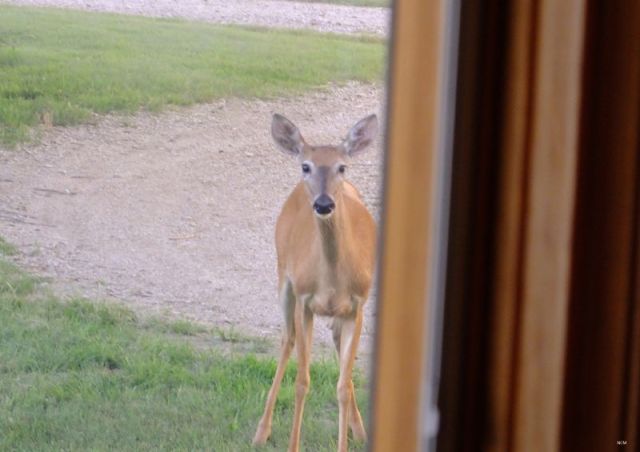


Reality Ranching May 2014

Reality Ranching May 201
The drab of winter has left our corner of the world and the prairie is now carpeted in the lush green of growing bluestem grass. We continue to miss the heavy rains that are needed to flush out the creek and fill up our depleted ponds. Others not far from us have overflowing ponds due to heavy rains. These spotty, hit and miss rains have been the case in Wabaunsee County for the past three years. We keep telling ourselves that the next serious rain event surely will pass over the southwest end of Wabaunsee county. One of these days our expectations will be met!

Pond we had to fence out to keep cattle from getting stuck in the mud

Pond we had to fence out to keep cattle from getting stuck in the mud


I haven’t written a reality ranching for several months, so I am reaching back to last December for the first story.
The Contrarian
Today we are working the calves that are at Milton’s farm. The first order of the day is enticing the herd into the working pen by stringing alfalfa hay out in front of them, in hopes that most will follow Paul willingly into the confines of the pens. There are always a few wise cows that must be chased up the small incline to join their greedy herd mates.
Once the herd is captured, we sort the calves off their mothers into a smaller pen. The noisy protest opposing our action begins almost immediately, once the separation of cows and calves are completed. It is mostly the cows that loudly voice their disapproval even though they can see and smell their calves through the steel panels. I always find the ensuing and continuous uproar from the cows ridiculous, plus it hurts my ears!
My job is to sort off a few calves into an even smaller pen, take one calf from this group, chase it up the alley and push the critter into the calf cradle. Once the calf enters the cradle, Randall and Paul tip the contraption onto its side which makes it easier to work the calf. The guys then vaccinate, brand, and if the calf is a bull, they castrate him.
calf cradle

calf cradle


I always try to sort the youngest and smallest calves off first so they can quickly rejoin mama. This also keeps the smallest calves from being jostled and pushed around by the larger calves. In this bunch of calves the youngest one is a heifer calf, uniquely marked with an almost heart-shaped, white spot in the middle of her black forehead. Each time I go after more calves to put them into the smaller pen, she hides in the midst of the group, and escapes my good intentions of reuniting her with mom.
Finally, I am down to the last few calves, and this time the spunky heifer has no choice but to enter the smaller pen. Despite my best efforts to guide her into the alley ahead of the larger calves, the little bugger manages to work herself to the back of the bunch every time.
When I am down to the last calf to be worked it is, of course, the calf marked with the heart. Using the calf paddle, I try to maneuver the baby calf to the entrance of the alley way. This device usually works wonderfully when you place the plastic paddle in front of one eye or the other. The calves can't see in that direction, so they turn in the direction you want them to go. This little girl isn’t falling for the nifty trick and just busts through the optical illusion that the paddle is. On the third try I throw the paddle down and just grab this bundle of adrenalin. I feel the tautness of her muscles that are virtually humming with determination to escape. The hard-headed calf wiggles free of my grasp and butts me in the knee to escape once again, I am laughing so hard I can hardly make another attempt at corralling the wild thing.
sorting paddle

sorting paddle


Besides Randall and Paul watching this private rodeo, there are two men working on replacing a hydrant near the pen. One of the men who own this farm is here too, helping the contractors in their work. The trio stops what they are doing to watch this nearly 60-year-old woman take on a month old calf. As I struggle to gain control of my 100 pound adversary, Paul’s voice rings out with fake impatience saying “Come on Nancy”. This only makes me laugh harder, but this time I manage to hang on to the bucking, angry heifer. Once the calf has been conquered, the crew of three shakes their heads, chuckle, and get back to working on their own project.
The calf probably spends a minute and a half in the cradle before the men are finished working her, making all the energy she expended trying to avoid her fate, seem rather silly. As for me, I will have bruises on my shins from a couple of well-aimed kicks for a few days, courtesy of my opponent.
Now that we are finished processing calves, we sort off the cows with the youngest calves in order to haul them to another farm, and this time it is my turn to laugh. As Randall and Paul are loading the baby calves in the back of the trailer, the heart-marked calf refuses to cooperate. When Randall grabs hold of her, the calf fights until Randall, like I did, loses his grip on the heifer. On the second try he muscles the kicking, bucking calf into the trailer with the other calves. One can’t help but have some begrudging admiration for the stubborn rascal.
While accompanying their Dad to chore one morning, Dalton and Jake name our contrarian calf, Sweetheart. The name Sweetheart alludes to the mark on her head, but little did the boys know that this name is also a sarcastic moniker of her less than sweet nature.
Sweetheart in early spring

Sweetheart in early spring


This winter, Randall has another run in with Sweetheart. When his count on calves is one short, his search for a missing calf leads him to the frozen creek. There he locates Sweetheart sprawled in the middle of a frozen pool on the creek. Randall has to walk out on the slippery surface and grab the helpless calf's leg to drag her off the ice. Naturally, Sweetheart fights Randall’s attempt to help her, making the rescue much harder than it needed to be. Little ingrate! And if you exclaim, why didn’t Randall pick the calf up instead of pulling her off the ice! Envision trying to pick up a by now 150 pound, struggling calf on slippery ice, and I’ll let your imagination figure out how that scenario would end.
Fast forward to this spring, when we are processing the same calves to booster the vaccines they were given last fall. The calves have easily tripled in size since we worked them last, and Paul has to push the calves into the working chute. As the number of the calves to work dwindles, Randall and I look back to see Sweetheart doing laps around the holding area, where Paul funnels the calves into the alley way. Randall and I see Paul standing behind the gate where the entire group of calves was penned at the start of the day. Normally Paul stays in the small pen with the calf he has sorted off. We both start laughing and ask Paul what the problem is. He sincerely replies “I think she would take me (charge) "! This makes us laugh louder and I say, “Ya think?”.
Paul relaxing with a normal calf in the work pen

Paul relaxing with a normal calf in the work pen


Due to Sweethearts demeanor it is guaranteed that she will not become part of the cow herd. We don”t put up with trouble makers or mean animals. The aggravation they cause, and the fact that a nasty temper often leads to a cow that has no qualms about trying to do harm to their human handlers, isn’t worth putting up with. It is too bad Sweetheart was born with a bad disposition, as she is such a uniquely marked heifer in addition to being a physically well-made bovine.

The Prankster
In the winter, Paul and I feed cattle together on the north end of the ranch, while Randall (the young guy) feeds alone on the south end of the ranch. Paul drives the pickup, I open gates and we both cut and pull twine off the big bales we feed. Once the twine is removed from the bale, Paul drives the truck and operates the hydra bed which unrolls the big bale of hay. I walk alongside the bale so I can holler at Paul to stop unrolling the bale, when enough hay has been laid out for whatever group of cows we are feeding.
This morning we are feeding in the field below our house. The cows are waiting nearby, but we drive halfway across the brome field to put some distance between us and the herd. This gives us a chance to remove the twine from the hay before the cows mob the truck in order to snatch bites of hay from the unrolled bale.
Once Paul begins unrolling hay, I am soon surrounded by cattle as we walk along the lengthening strip of hay. I enjoy walking in the midst of the cowherd. The frozen ground amplifies the sound of the cattle’s hooves as they stride towards the offered hay. Their frozen breath leaves wispy vapor trails in the air. It is rather peaceful, plodding along with the herd.
Suddenly my reverie is interrupted by a sharp, loud, “maaw” practically yelled in my ear. A cow then runs past me, and kicks in my direction as she passes by. My adrenalin kicked in when the cow bawled behind me, and I instinctively drew back when I saw the bottom of a hoof about head high, though she was safely out of range to actually make contact. Dang! I recover quickly and yell at the cow as she runs on down the hay line. I keep my eye on her, and when I reach the smart-alecky cow, I read the white freeze brand numbers on her hip, which are 013. I tell her she is a rat and move on.

013 the prankster

013 the prankster


A few days later, I again hear “boo” in cow talk directly behind me, followed by the cow running past me, then an exclamation point in the guise of a kick in my direction. Blast it, 013 got me again. Well, so much for enjoying the peaceful reverie with the cow herd.
This cow played her practical joke on me several times through the winter and I never heard her coming. Dang it cow, you blasted cow, doggone you, are a few of the phrases that I utter after being startled by the sneaky cow. I have no idea what possesses 013 to pull this trick on me but I admit that in the end it makes me laugh.
The Great Escape
It is late April and we are counting the days until we can turn the cattle onto the greening flint hills pastures. We are tired of feeding hay every day to the cows and the cows are eyeing the fresh, green grass that has only a thin wire fence separating them from the lush oasis.
looking down the valley from our house

looking down the valley from our house


Paul and I have finished feeding on this Sunday by mid-morning. It is a lovely spring day with the promise of much-needed rain developing late this afternoon. I have settled into the easy chair in our sun room with a good book intending to relax until it is time to get lunch. I gaze down the valley taking in the beautiful view I never tire of looking at. I look out at our meandering creek, growing brome grass, and the velvety green hills. The cattle are spread out over Milton’s alfalfa field, placidly grazing. What the…, Paul, the cows are out on the alfalfa field!!
It is amazing how quick one can get out of a chair, change into your chore clothes and be out the door when duty calls. We get into the Ranger and take off to round-up the wayward cows. Growing alfalfa and cows don’t mix as the alfalfa can cause them to bloat up with frothy gas and literally kill them. We have had the misfortune of two cows dying from alfalfa bloat in the past.
When we arrive at the alfalfa field we begin to gather the scattered cows into a group and herd them towards the gate. Surprisingly, the bovines give us little resistance and we move them into the adjacent brome field in a matter of minutes. Evidently the cows filled up on brome before they discovered the open gate that leads to the alfalfa field. Paul must take down the electric fence, which was supposed to keep the cows in the dry lot, so we can get them back to where they belong.
Once the fence is down, we push the escapees over the wire which is now lying on the ground. All goes well until the last two cows balk, and refuse to step over the wire that they know will “bite” them. Even though the wire is lying flat on the ground the cows are so brainwashed they turn back and run past Paul and I. We manage to bring the duo back for a second try to one cow decides she is more frightened of the yelling, arm-flapping humans than the wire. The other cow stampedes past us again, and we know that trying to corral her via this route is a lost cause. We watch as the ornery cow runs back into the brome field, and then turn our attention to figuring out how all these cows escaped. The electric fence was still standing and in working order when we arrived so the cows had to have breached the steep creek bank. Sure enough when studying the bank we see where the dirt has been trampled by the hooves of 40 head of cattle. I can’t believe they went up that vertical bank! I suppose one determined cow climbed up the dirt wall with the rest of the herd watching, and they figured if she can do it so can we.
Paul and I go home and gather up the material to build an electric fence at the bottom of the creek bank. If this new hot wire won’t keep them in, we will have to keep the cows locked off the creek and haul water to them. Come on cows, just a few more days and we will set you free! Later, Nancy
P.S. the fence worked for the duration of the cow’s confinement which was another ten days. The lone renegade decided she missed her herd mates within minutes after she escaped. The cow went back down the steep bank exactly where the cows had climbed up to escape. As I watched the cow slide down the creek bank, she reminded me of a wildebeest during migration, plunging down the river banks of the Zambezi!