We set our luggage by the door when we go up for breakfast as we will not be returning to this lovely hotel after our temple visit. After breakfast, Paul and I return to the room, do a walk through, then gather our backpacks and return to the hotel headquarters. When everyone in our group is present and has accounted for their luggage, we climb into the bus and are off to the temples. We have only driven a few yards, when the bus stops and Hussein gets off the coach. In a couple of minutes, he reappears and sheepishly laughs, telling us that he forgot to pay the man that collected and loaded our luggage onto the bus.
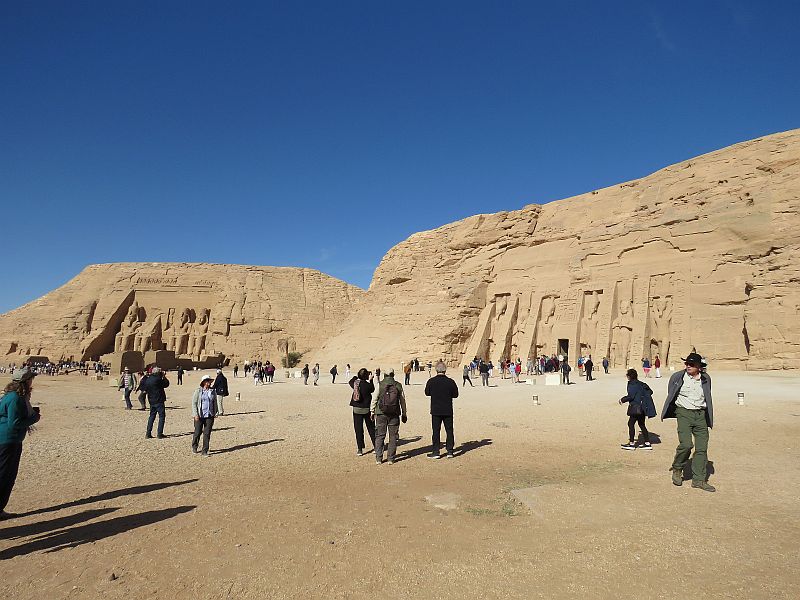
We join many tourists at the two temples this morning and I assume everyone is looking at these fantastic works of art with as much awe as all of us are. Hussein talks about the temples, telling us that they were carved out of a sandstone cliff. The four seated statues of Ramses II in front of his temple are sixty plus feet high. That is incredible and to me, suggests someone with a very big ego. Nefertari’s temple, dedicated to the Goddess Hathor, has four figures of Ramses II and two figures of Nefertari gracing the front of her temple. These statues are around half the height of the Ramses II statues at his temple. Hussein does point out that it was unusual for a King to build a temple for his Queen and that it shows what true affection and respect he had for Nefertari. The fact that her figures are the same height as Ramses II figures is very unusual as normally a Pharaoh’s wife never stood taller than the knees of the pharaoh.

The astounding aspect of these two temples is that they were doomed to be submerged by the water of Lake Nasser. An appeal went out to save the two unique temples and UNESCO answered the challenge. I believe fifty some countries worked together to move the temples away from the rising water. How they accomplished this is astounding. The workers removed the top of the cliff off and then cut the temples into blocks that weighed several tons each. The volunteers moved all these blocks two hundred feet from the original temple site removing the temples out of harm’s way. The UNESCO people reassembled the blocks by cementing the blocks back together but what a wonderful job these people did. Yes, you can see the seams but it was so well done that you might not notice this if you did not know the back story. I think this was all accomplished in three years although that is hard to believe, so maybe I have that time frame wrong. We did watch a film on the Aida about this stunning feat of saving the temples, so we were able to see how some of the work was accomplished.

We wander through the temples which are crowded with tourists. A painting on the wall that Hussein points out to us is Ramses II slaying an enemy in the war against the Nubians with Nefertari standing behind her husband in a gesture of support. Hussein tells us that this is another example of Ramses II holding his wife in high regards. At the end of the main hall of the Ramses II temple there are four seated deities, (one of them is a deified Ramses II), that the temple was dedicated to, (the main god being Ra). Two days of the year the sun’s rays penetrate these innermost statues, lighting the seated figures up. Can you imagine how precise the ancient builders had to be to make this happen? There is a spotlight shining on these deities to give an example of what it looks like on the two days that the sun reaches the end of this long corridor to illuminate the Gods. This manmade lighting of the stone figures does not make for good photos though. These temples are an UNESCO World Heritage site and rightly so.
A slide show of the interior of Ramses II temple. The corridor leading to the deities that are sunlit twice a year. Painted scenes found in the small side rooms. Many of the scenes depict Ramses II slaying his enemies. Victory over one’s enemies proved how great you were.
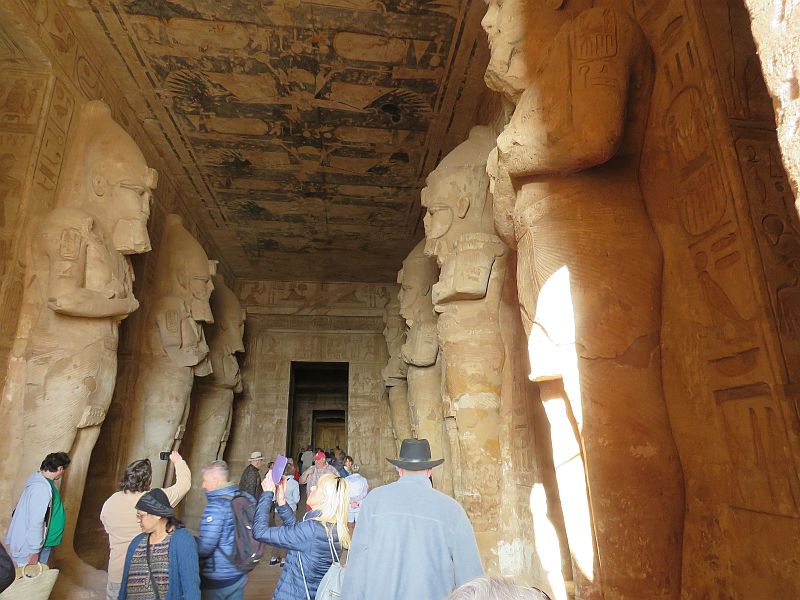
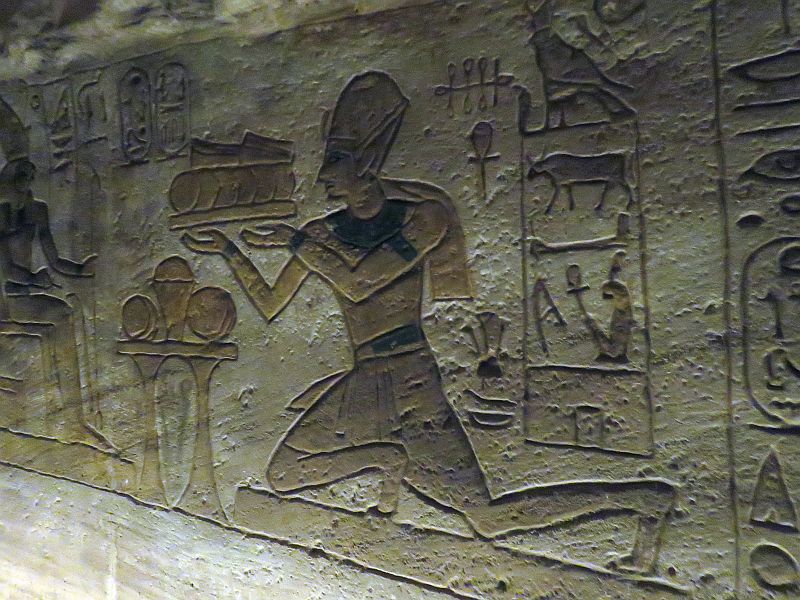

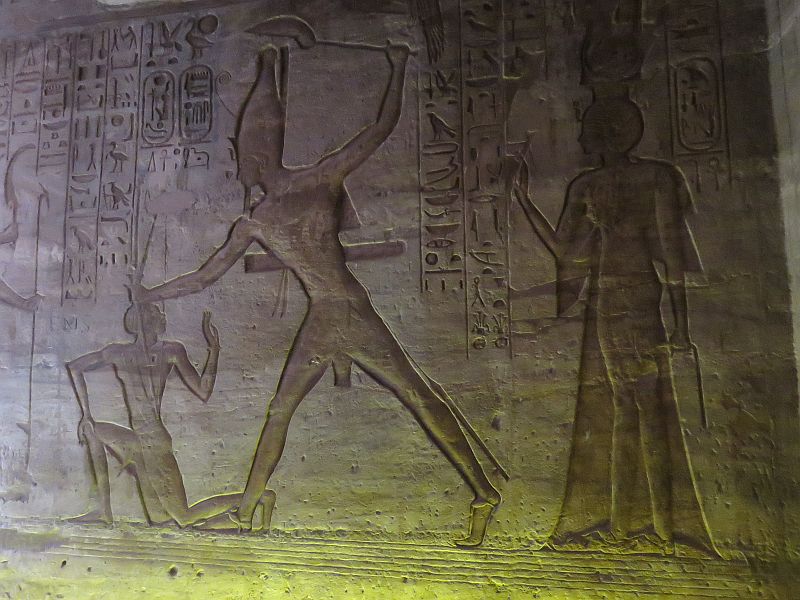


I suppose we spend a couple of hours at the temples before we return to the bus. We spend the next four hours driving back to Aswan with no new sites to be seen. Hussein has told us that most tourists do this trip to Abu Simbel in one day. I am so glad that OAT breaks the journey up into two days. Besides, those folks that just make this a day trip do not get to experience the wonderful sound and light show which I will never forget. Although we have seen many incredible temples, I think this is my favorite, partly because of the heroic effort that saved it from being submerged by Lake Nasser.

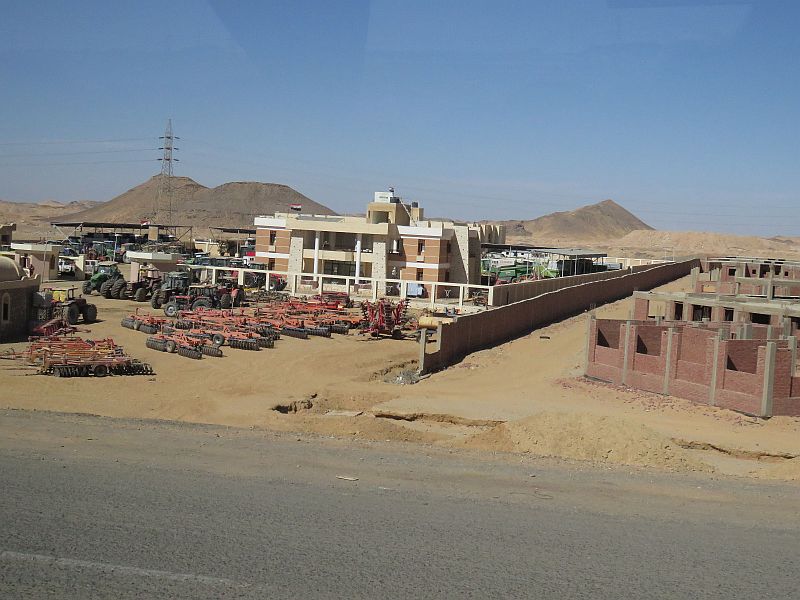
On the Aida and on this journey to Abu Simbel, Hussein has talked about the problem that Egypt is having with Ethiopia concerning the Nile. Ethiopia is building a dam on the Nile, just like Egypt did, and the Egyptian government understands this. The problem is that Ethiopia wants to fill the reservoir in three years which would deplete the flow of water from the Nile into Egypt. Egypt is trying to negotiate with them to prolong the filling of the reservoir over a span of thirteen years which so far, the Ethiopians are refusing to do. The Nile is the life blood of Egypt, and they could not survive without it. It is the only major river in the country and since Egypt, at least where we were, only averages one inch of rain a year this would ruin them! Ethiopia has several major rivers, so it is not like they do not have other options. You could tell that this was a very worrying subject for Hussein, and I am sure for all Egyptians. It does not take much imagination to see what could happen between the two countries if they can’t work this problem out.
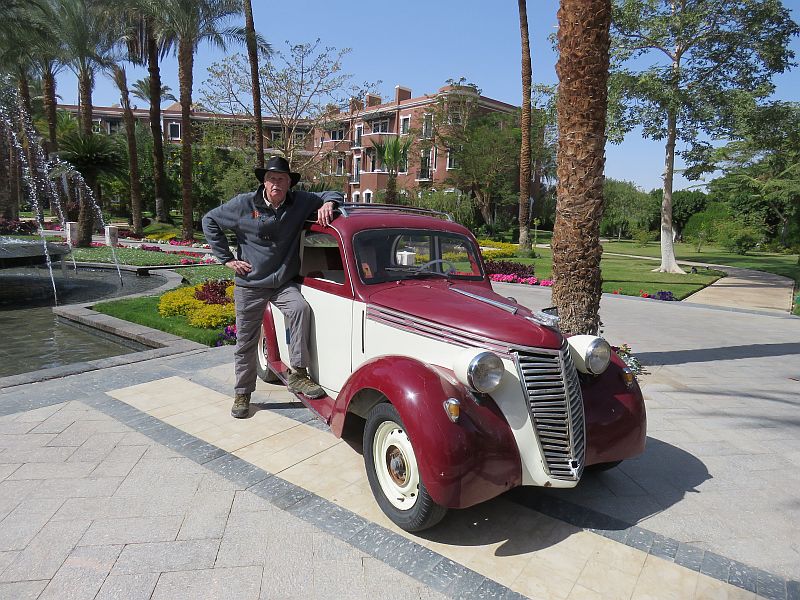
We reach Aswan, at two p.m. and eat lunch before going to our hotel. Once we have finished lunch our driver delivers us to the hotel where we will be staying for two nights. When we disembark at the entrance of the Sofitel Old Cataract Hotel, everyone exclaims at the beauty of the grounds and the building. It was built at the end of the 19th century and was fashioned after a Victorian palace. This luxurious hotel quickly became a favorite of wealthy European travelers in the early 1900’s. The rich and famous guests included Winston Churchill, Howard Carter, (the man who found King Tut’s tomb), and Agatha Christie.
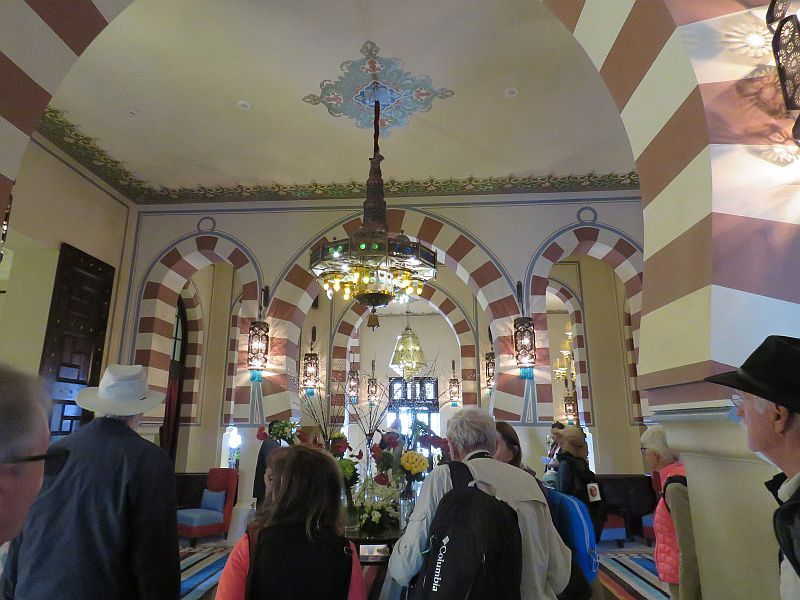
This historic hotel is where Agatha Christie wrote her book “Death on the Nile” in the 1930’s. Hussein had informed us before we arrived at the hotel that we could take a tour of the Agatha Christie suite this afternoon. When we were standing in the lavish lobby of the hotel checking in, a staff member informed Hussein that we would not be able to tour Christie’s suite after all. Well rats, many of us had been looking forward to seeing the famous author’s abode. Shortly after the bad news a man walks up and talks with Hussein who gives us one of his famous smiles and tells us the tour is on after all. We are to meet in the lobby at 3:30 if we want to go on the Christie tour.
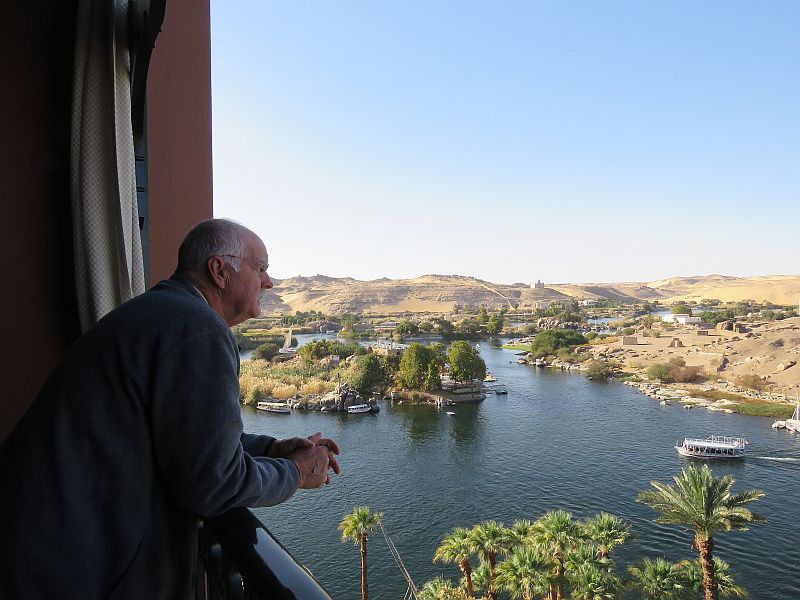
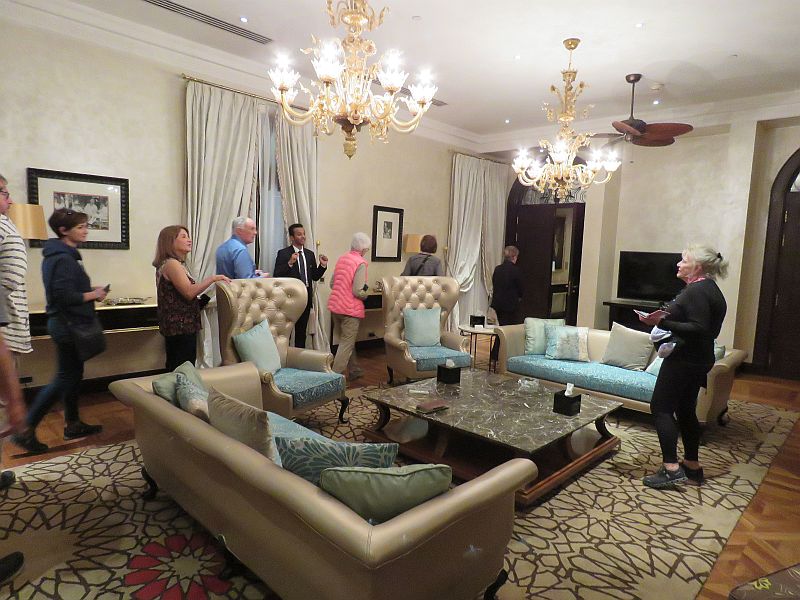
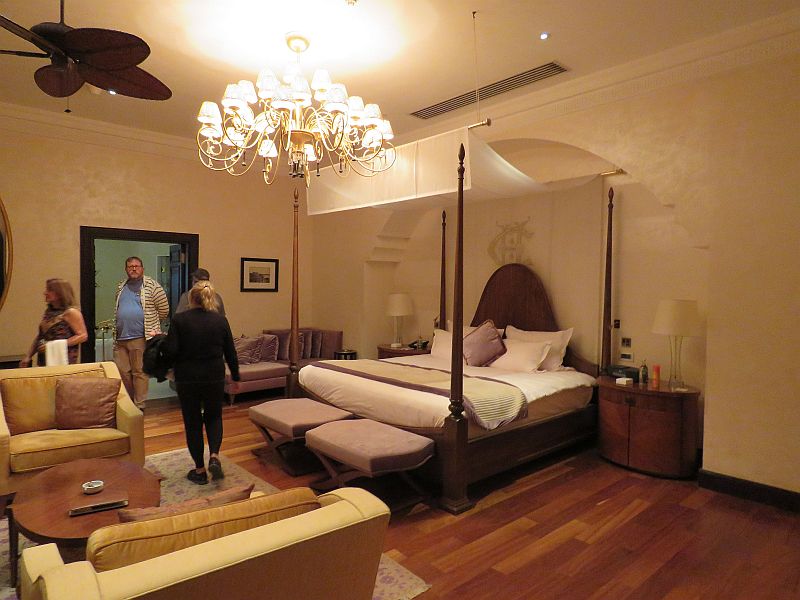
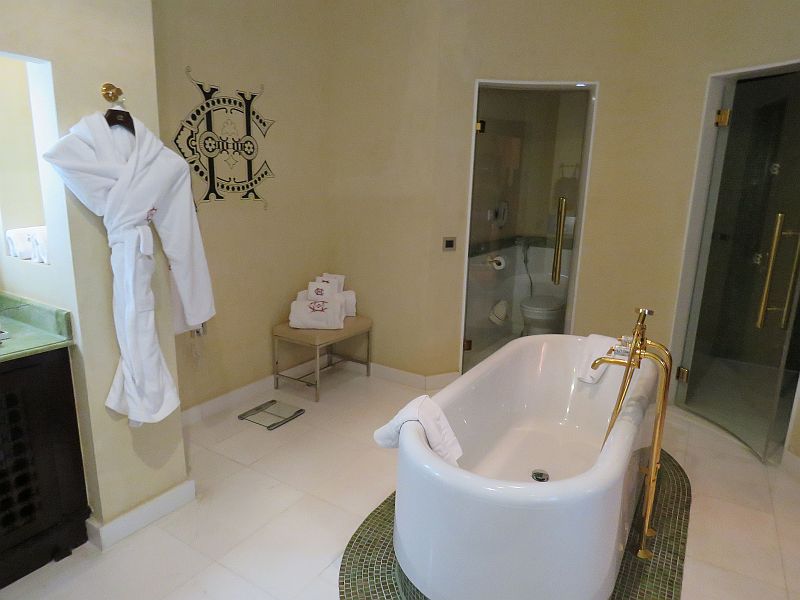
All of us are staying in the new wing of the hotel, known as the Nile wing, which is only a short walk from the old historic hotel. We are on various floors and the elevators are small only accommodating four people, but we eventually get to our room. When we exit the elevator, we are not impressed with the light green paint that covers the walls, in fact it is downright ugly. Our room is a different story however and we soon forget about the corridor color. The most fantastic aspect of our room is the balcony which overlooks the Nile and Elephantine Island which is across the Nile from us. It is absolutely gorgeous.
Slide show. Our bedroom and views from our balcony. The building on the hill is the main part of this historic hotel.



I do not have time to linger in the room as I must get back to the old part of the hotel or what is now called the Palace wing, in order to join the group for our Agatha Christie suite tour. When I arrive, (Paul opted out of this tour), there are a lot of guests taking the tour in addition to members of our group. It is going to be a bit crowded. Our tour guide is a young man who speaks fluent English and has an engaging personality.
First our guide takes us down a corridor that leads to the dining room where we will have our breakfasts. The young man points out many photos hanging on the wall of famous people that have stayed in the Old Cataract. He also shows us items that were salvaged from the hotel when it underwent restoration. Among the things on display in the corridor is the desk that Agatha Christie worked at while writing her famous novel.
Our young guide leads us back down the hall and up two flights of stairs to Agatha Christies’ suite. As we file into the room, our guide tells us that the famous novelist lived here for a year. The suite is decorated in furnishings depicting the time period. We are allowed to wander through the rooms which consist of a large sitting room, the bedroom, bathroom, and another side room I did not look into. Once everyone has finished looking around, the guide tells us to get ready for the best part, the view from the balcony. He opens the balcony doors, and everyone starts walking out onto the balcony. That is a lot of people going out there at once. Evidently another man on the tour thinks so too and calls out that maybe the amount of people on the balcony should be limited to a certain number. No one listens. Jennifer and I decide to forgo touring the balcony due to the crowd of people on it, besides I cannot imagine it is much better than our balcony view.
Slide show of Agatha Christie’s suite. It was pretty amazing to know you were standing in the room where the famous author wrote “Death on the Nile”.

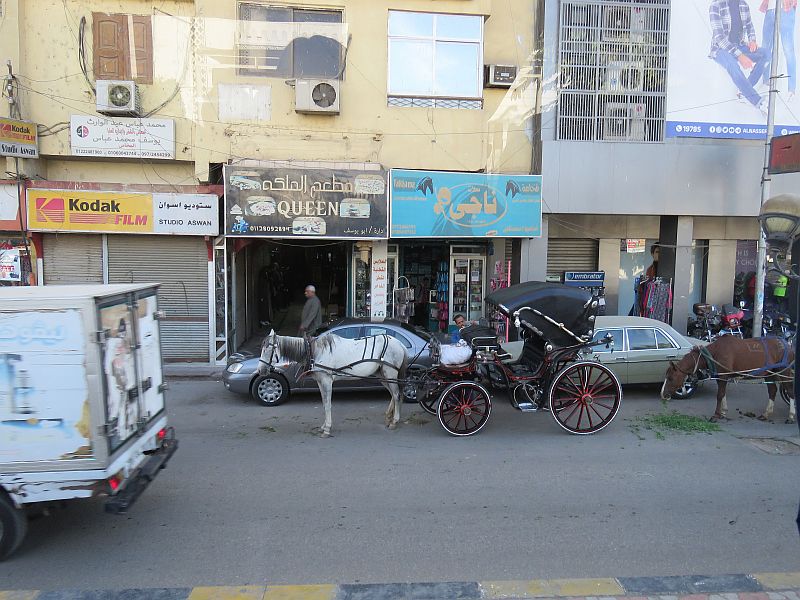
Shortly after the Christie tour, our group meets in the lobby of the Nile wing and walk to the bus. Hussein is taking us to the spice market to experience this part of Egyptian life and to let those that want to, do some shopping. The bus drops us off at the spice market entrance and we follow Hussein to a shop that specializes in spices. The owner offers us a sample of some kind of sugared nut, they are good, and then begins to show us all the things he has for sale. Before we leave nearly everyone has purchased spices but Paul and I. Hey, I am lucky if I remember to add salt and pepper to a dish. Jennifer buys a sack of dried hibiscus flowers to take home so she can brew her own hibiscus tea, as she really likes the hibiscus tea that is served here.


Upon leaving the spice store, one couple wants to purchase soccer jerseys for their grandkids. While they are negotiating with one shop owner, I observe the people around us and notice that there are a lot of young people walking up and down the wide aisle of the market. I see one group of teenage boys acknowledge a group of teen girls who titter and giggle at the boy’s attention. I am betting this scene is something you would see in our shopping malls at home. The couple did not find what they were looking for at this shop, or maybe Hussein thought the price was too high. Anyway, we follow our guide down the main corridor before turning into a narrow alley like passage. He tells the young man at the shop what the couple is looking for which sends the fellow scrambling to find the jerseys. He brings a few sample shirts out and the shoppers find one jersey that will work for them but the other shirts are to large. Upon searching further, a smaller jersey is found but this one is not acceptable because the name on it is that of a Russian player. In the end the shop owner does find a jersey that is the right size and even better the price is less than the initial shop!
It is time to return to the coach and on the way back through the market, a couple of young boys attach themselves to Paul, point to their bare feet. Paul assumes this means they are asking for money so they can buy themselves some shoes. Paul ignores them and eventually the persistent kids leave Paul’s side and attach themselves to the “tall guy” and go through the same ritual. They are still pestering our friend when we reach the area where our bus will come to pick us up. Hussein now notices the boys and barks out one word at them in Egyptian that sends the kids running away. They do not go far before turning around to watch us as we board our bus. I found it interesting that they would choose men to try and get money from and not the women in the group.
We stop at a small restaurant for supper and the only thing I wrote in my journal about the food is that only the appetizer and dessert were good. There are a couple of young men eating at a table near us and one of them is feeding tidbits to a feral cat. The hungry cat nips the fellows finger one time which only made him laugh and he continued to feed the white and yellow cat. I like that guy.
Temples of Philae, Farewell supper, morning flight to Cairo, museum, and final group supper before heading home.

 realityranching