We are up shortly after five and do a bit more packing. We go up to the dining room for an early breakfast and drop our tip for the ship crew in the box. This is one place that OAT does not take care of the tip. Upon returning to the room, we walk through the cabin and bathroom to double check that we did not overlook any of our things. We set our two large suitcases out in the hallway and lug our carry-on baggage to the observation deck. We are loading onto our coach by 7:30 and leaving this wonderful ship and the relaxing time we spent on her behind. Hussein tells us that the crew has four hours to get everything prepared for the next OAT group to board the Aida. This OAT group will be doing our adventure in reverse, sailing down the Nile from Aswan to Esna.
On our drive to Aswan High Dam, (finished in 1970), Hussein talks about the displacement of thousands of Nubian people, (Hussein is Nubian), due to the Dam’s construction and the forming of Lake Nasser, which is named after the man who was president of Egypt at that time. Naturally this was an extremely traumatic event for the Nubian people and anyone else who lived on the land that was inundated by the lake.
Our guide says the positive elements of the construction of the dam is that the annual Nile flood can now be controlled by humans. One other plus of the dam is that it generates a tremendous amount of hydroelectric power. Hussein also explains that the dam’s turbines are why there are no crocodiles in the Nile below the dam which is where we were sailing, (is that good or bad news?). The crocodiles cannot pass through the turbines as according to Hussein they would be chopped to bits. Hussein gives us the negative aspect of the dam’s construction, which is that controlling the annual flood has decreased the fertility of the riverside agricultural lands. This is because the rich silt ends up in the canals and reservoirs instead of being deposited on the farmland. The farmers have had to turn to artificial fertilizer which is no substitute for the rich nutrients found in the silt.
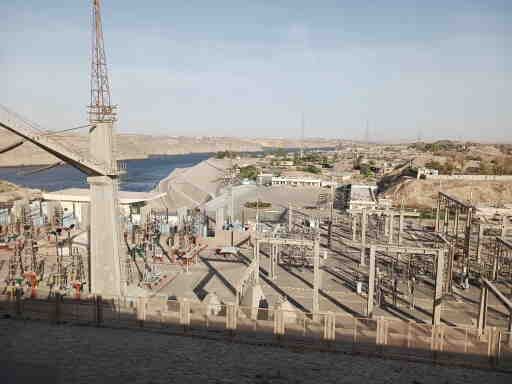
When we arrive at Aswan High Dam, we see military presence here. I think this is where a soldier walks around the bus inspecting it before we are allowed to drive onto the dam and sees me looking at him through the window. The soldier gives me a big smile and a wink before he continues his inspection. There are two soldiers sitting on a wall along the dam road and if I remember correctly there was a tank at the dam’s entry point with a man looking out the top opening of the tank turret armed with a rifle. This is not the first time we have encountered the military; we have seen towers manned by soldiers with rifles, at the edge of towns. Most of us already know not to take photos of anything military but Hussein reminds us of this rule.
We leave the bus and Hussein points out the restrooms and observation areas where you can look over the lake, see the Nile, and the original Aswan dam that was built by the British in 1902. Paul and I take a quick look at the views and then go buy some potato chips from the vendor that is located nearby. We both have been craving a salty snack! All of us are back on the bus after a short time as truthfully, there isn’t a lot to see here but also because it is chilly and windy this morning.
Hussein tells us that we have a four hour drive to Abu Simbel but we will stop at the midway point for a bathroom break. Once we are on the road, Hussein plugs in his phone and somehow this allows us to use our electronic devices. I don’t understand how that works but I know it is astounding that I can email a friend, play words with friends, and read on my tablet while traveling down the Egyptian highway in the middle of the Sahara Desert!
There is not much to see along our route except sand but I still look out the window now and then. I do a double take when I see irrigation systems sitting in the desert. I point the rigs out to Paul, and he is as puzzled as I am. Paul asks Hussein why there are pivot irrigation machines out here. Hussein laughs and says because they are going to grow crops like wheat and corn. Our guide tells us we will see the growing crops in the Sahara farther down the road. What? But sure enough, we later come upon lush fields of wheat or barley, and corn fields that are dried down and ready to harvest. All of this is being done by the army/government. The ability to grow crops has been made possible because of canals bringing water into the desert thus the need for the irrigation systems in order to water the crops. It still does not answer the question we have on how you get any crop to take root in sand. Hussein admits he does not know but surmises that there must be a more compact soil just beneath the sand. Wonders never cease!

At the rest stop, our group leaves the bus to use the restrooms. The water closets as they are called here, are surprisingly clean. Hussein gives us time to stretch our legs before we load up and continue our journey.
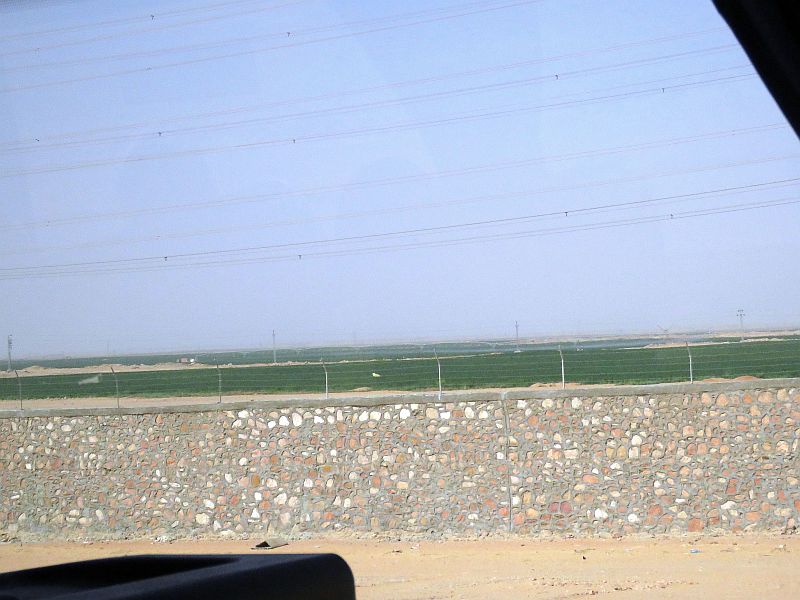
We drive by an area where a stone wall has been constructed with a barb wire fence built on top of it. The combination stone wall and barb wire fence, I would estimate is eight or ten feet high. Hussein explains that this is another army project which the government refers to as a ranch. There is a lot of irrigated areas which are vivid green with growing crops, quite a contrast to the desert outside the wall. We see no sign of any animals, but they could easily be out there as we are only seeing a small part of the government “ranch.” Hussein says the government will not answer the question that the people have asked on why they need such a barrier around the property. The wire that tops the fence is bent outward, which would keep anyone on the outside from crawling over the fence. Weird.

As we draw close to Abu Simbel, Hussein gets on the microphone and says “Guys, you have stayed in two five-star hotels so far and although this hotel is nice you cannot expect it to be like those in Cairo and Luxor.” He reiterates this warning to us as we drive up to the hotel, telling us not to be too disappointed and try not to compare this place to our prior hotels. There is a stack of bricks piled up not far from the hotel drop off point which makes one wonder if there is still some construction going on. I tell Jennifer that I do not care at all if this hotel is not as fancy as our prior hotels but I do hope it is clean.
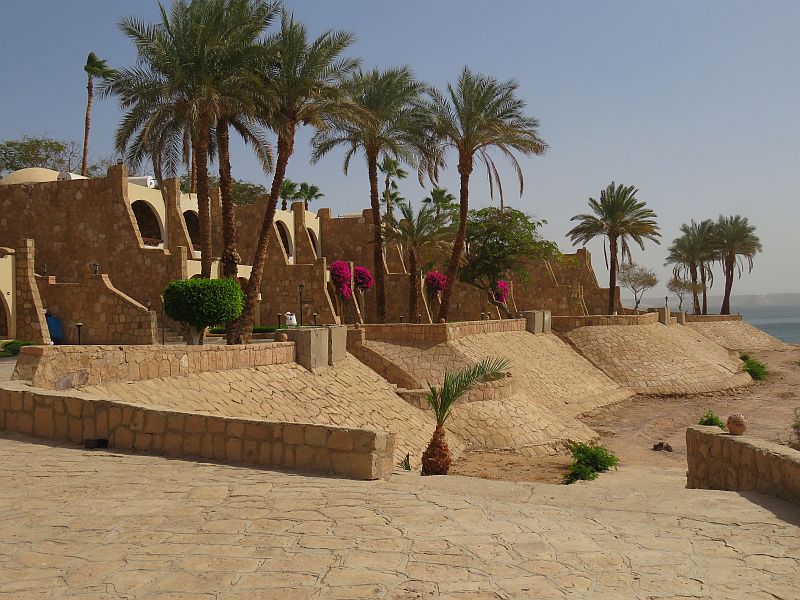
When we follow Hussein through the door of the Seti Abu Simbel hotel, it does not take long before we realize we have been duped! Somebody in our group exclaims, “you were kidding us.” Hussein is laughing as he got us to swallow his warning about the hotel, hook, line, and sinker! The rascal. Well played Hussein. This place is incredible. The hotel’s architecture is unique in that there are arches built off the main building which give you a cool view of the swimming pools, and rooms. It is stunning.

We eat lunch in the spacious restaurant before we go to our rooms. Our large room is gorgeous, and has a cool mural painted on the wall above our bed. There is a balcony that looks out on Lake Nasser affording us a beautiful view. Once we have halfway organized our belongings, Paul and I walk the grounds of the hotel. We admire the lake views, the colorful bushes that are blooming in front of the rooms, the swimming pools, and well-kept grounds. It is too bad that we are only here for one night.
Slide show of various aspects of our hotel. We loved this hotel.



At 4:30, Paul and I make our way back to the main part of the hotel. We are gathering in a small room to listen to a Nubian man whose family was one of the thousands that were forced off their land for the Aswan project. He is a well-spoken man who talks about the trauma to his family, he was very young, being uprooted from their land and moved to the desert. He remembers that they had to leave some of their cattle behind because there was not enough room on the boat. The man talks about the place the government moved them to which literally was in the desert with no grazing for the cattle. The houses were tiny and it was impossible to live the way they had before.
Many of his family, (including this man) among others left and took jobs in other places like Cairo or even other countries. Those that stayed did make the uninhabitable area habitable through hard work and by getting water to their new home via canals. I do not remember if the government dug the canals or how that happened. They turned the desert into a viable place to live which is something to be admired.

I believe that our entertainer was working in another country, when the president, (Assisi I think), put out a plea for the displaced Nubians to come back. The president promised them they could settle near the same area that they had been removed from all those years ago. Our speaker came home and ended up working with the people that manage the Ramses II Temple which is located by Abu Simbel. At the end of his talk the man plays Nubian instruments and sings some Nubian songs for us. He has a nice voice, and it was a pleasure listening to him sing. I probably have some of the facts wrong and I know I have forgotten other things the man related to us but you can get an idea of what these people went through.
After the Nubian’s talk, we follow Hussein to the bus and take a short ride to the temple that draws people to Abu Simbel. Tonight, we are going to experience the sound and light show that takes place at Ramses II temple. Hussein tells us that in his opinion this is the best sound and light show to experience in Egypt. We have to walk maybe a quarter of a mile to reach the bleachers and I am glad that I have my fleece on under my jacket. It is quite chilly this evening. It is dark by the time we get to the temple and Hussein points out a spectacular extra which is Venus, Jupiter, and Mars, in a descending line in the night sky. It turns out that Hussein has an avid interest in astronomy. Our guide continues to amaze and surprise us.
We have front row seats for the show and after we are settled on the benches, Hussein passes out recorders that will narrate the show for us in English. The sound and light show is spectacular with thundering music and animated scenes depicting the life of Ramses II and Queen Nefertari flashing across the temples, (there is a temple for Nefertari also). On our walk back to the bus, Hussein stops at one place to point out different constellations in the sky. This was a great experience and a wonderful evening.


Visiting the temples in daylight, driving to Aswan, visiting the spice market.
 realityranching