It looks like I am in a routine on the Aida, as this morning I arise at 6 a.m. and am sipping tea on the observation deck by seven. It is cooler this morning but not enough to keep us from eating on the deck. It is so peaceful out here and plenty of interesting things to look at. I love this!
Slide show of a few things we saw as we cruised this morning.


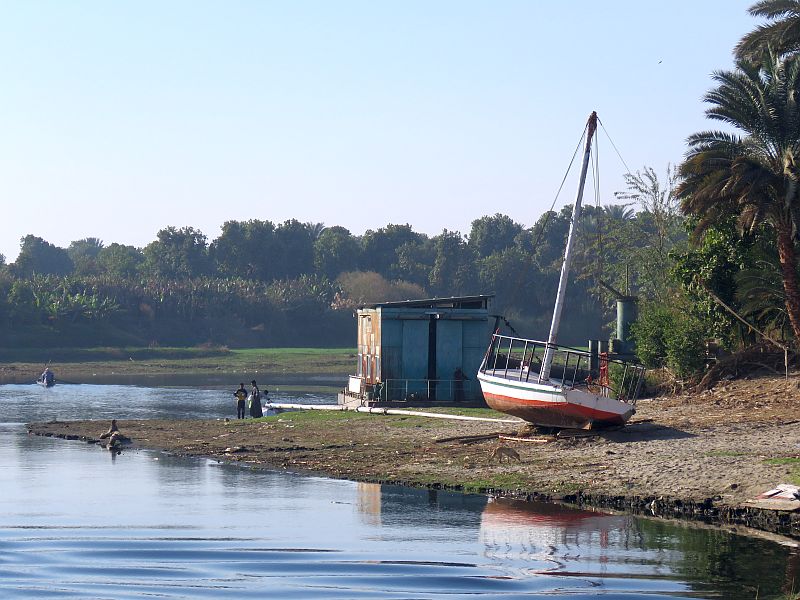
I am going to relate a story here that may or may not have taken place this morning, but I have a photo that I believe is of the man that was part of this tale. Jennifer and I are walking laps again when the tugboat and our ship crew begin maneuvering our ship towards the shore. Once the Aida is close to the riverbank, the crew slides the narrow gangplank over to the shore. A man walks across the makeshift bridge onto land and the crew pulls the gangplank back onto the boat. Who is that guy and why was he on the ship?
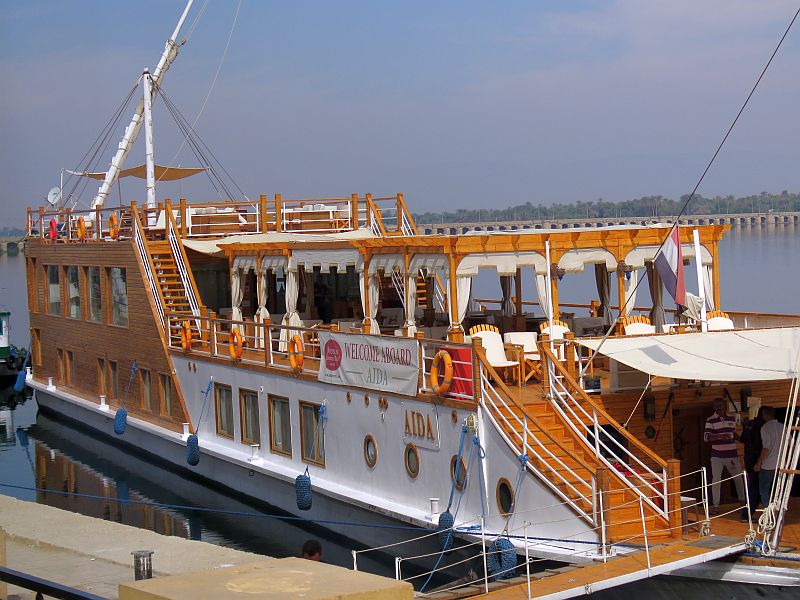
Jennifer and I look up at Paul who is standing on the sundeck above us. We ask him if he knows what is going on. He laughs and says he watched the whole episode unfold below him. Paul said there were two men in a rowboat that came alongside the Aida and grabbed onto our river yacht letting the ship pull them up the river. Paul said they must have grown tired of using their hands to hang onto the boat as one man took off his turban and tied it to something on the Aida and fastened the other end of the turban to the rowboat. Now they have themselves a makeshift tow rope although that must be some very strong material to withstand the pull of a rowboat and two passengers. Paul estimated that our ship towed them for about a half-mile when one of the men hoisted himself onto the narrow ledge that sits just under the windows of the ship cabins. According to Paul, the fellow carefully shuffled along the ledge until he reaches the bow of the Aida. Paul said that in the meantime, the man in the rowboat untied the end of the turban fastened to their boat and rowed away from the Aida. The man that climbed onto our ship was not on board for long as the crew quickly finds a place to deposit the stowaway on shore. It was not until this part of the story took place that those of us on the observation deck were aware that anything out of the ordinary was taking place. The finale of the story was when one of the crewmen threw the abandoned turban into the Nile. Oh yes, Paul is lamenting that he took no photos of this unusual activity. He said he was so captivated by what was unfolding before his eyes that it never crossed his mind to take pictures!

Hussein joins us on the observation deck and tells us that the man was calling friends on his cell phone when he safely made it to the bow, to see if anyone could come and pick him up. According to Hussein the man’s destination was too far for him to walk. He must not have found anyone willing to rescue him while aboard the Aida, as he was on his phone as soon as he sat foot on land. What Hussein did not explain or I missed that part of the story was why the man climbed onto our ship. You would have to surmise that the stowaway had hoped he would be allowed to stay on the Aida until he reached his destination because if he only wanted to get ashore the rowboat could have easily taken him there. You can see why Hussein and the crew refused to let the fellow stay on board because if you do it for one person how do you stop other river hitchhikers from boarding in the future with expectations to be delivered to their destination.
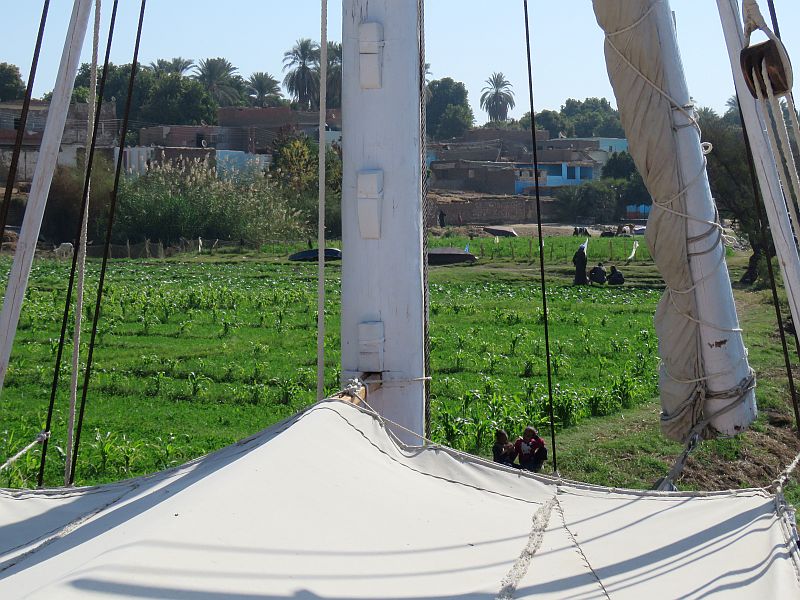
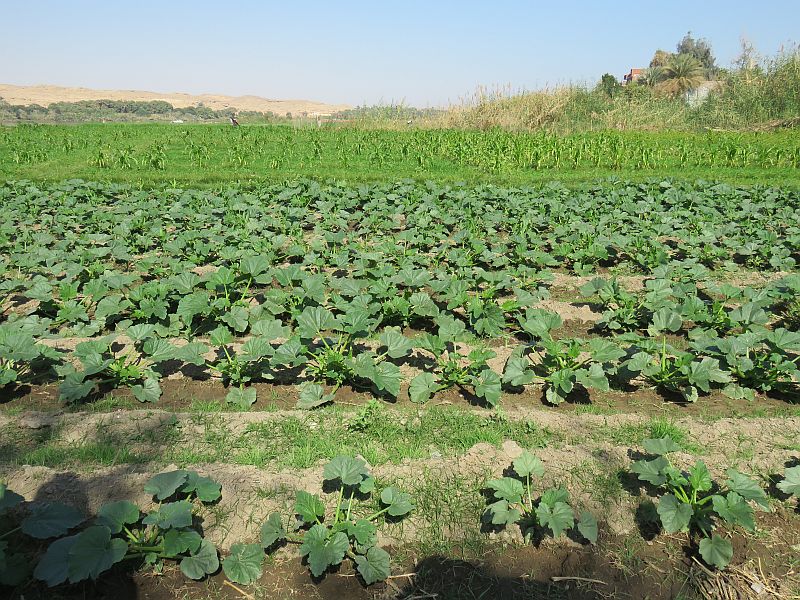
We have a wonderful view of the farming village as we approach the docking area. The green, symmetrical plots where a few head of cattle stand along the edges of the fields is beautiful. There are field workers carrying bundles of freshly harvested grass out of the fields with the village in the background. The man who will be educating us about farming and life in the village is waiting for us on the river’s edge as we dock.
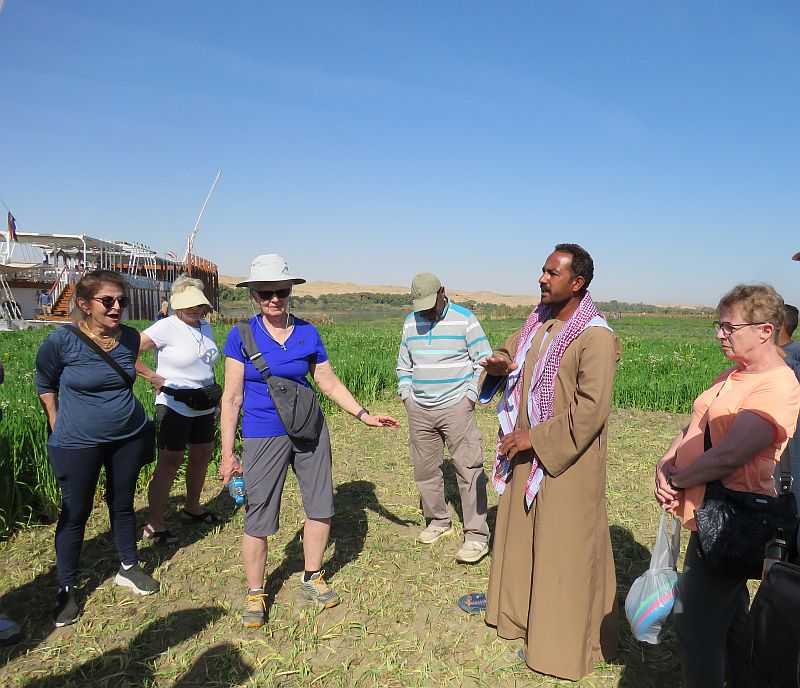
Hussein introduces us to our guide, whose name is Sayed, and informs us that he is the head of the farming village. Our first lesson is only a few yards away from the boat in a small field of barley. As our group walks to the barley field, we pass by a plot that appears to be alfalfa, but if it is, it puts the alfalfa we raise at home to shame. The leaves on these lush plants are huge compared to our alfalfa.
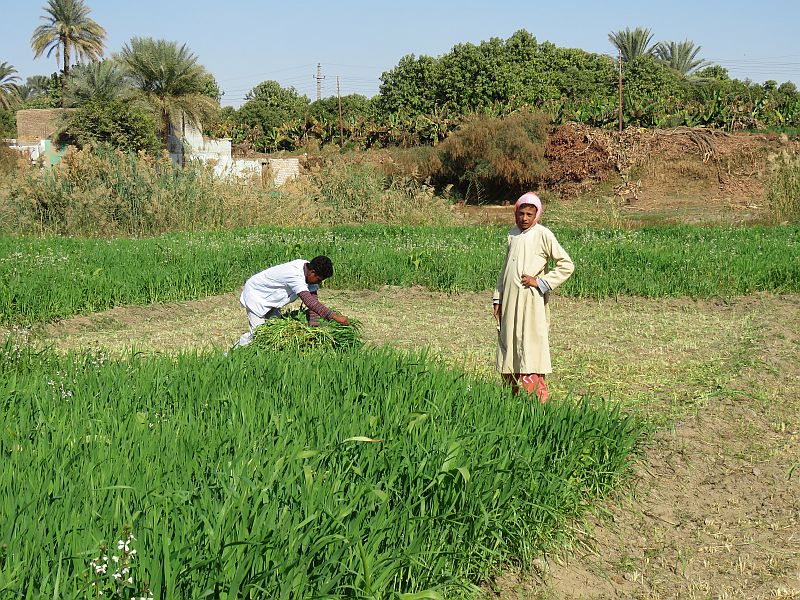
Sayed talks about the barley, which they cut before it heads out, which is used for livestock feed. He asks if anyone would like to try to harvest the lush grass using a hand-scythe. After a young boy demonstrates the technique of cutting the barley, many in our group try our hand at harvesting the forage. Hussein warns all of us to be very careful and keep our fingers out of the blades path. Good advice as the scythe blade is very sharp.
We work in pairs under the watchful eye of our youthful teacher while Sayed is busy answering questions from members of our group. Oh yes, Sayed speaks fluent English. When it is my turn to cut the barley, I get on my knees and swing the scythe in an arc as close to the ground as possible, just like the young fellow demonstrated. I bunch the cut grass together and pile it off to one side. I cut one more swath than stand up and pass the blade to the next volunteer. The young fellow flashes a big grin at me and gives me a thumbs up. It occurs to me this could be a likened to the Tom Sawyer story when he gets his friends to whitewash the fence!
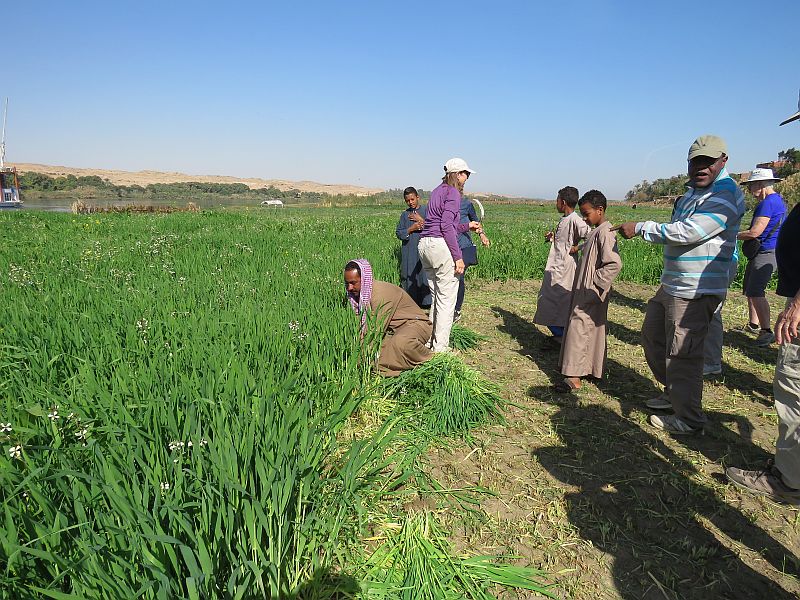
When everyone has had a turn at harvesting the barley grass, Sayed proceeds to demonstrate the art of scything barley. He gets on his knees and makes long, sweeping cuts that lays down a large area of the grass. I cannot imagine working like this for long but a seasoned worker like Sayed, could cut a lot of grass in a short amount of time.
Before we walk to the village, Hussein tells us to give the pens, crayons, papers, etc. we brought for the children to Sayed who will distribute them later. Since several children have begun to shadow us, Sayed decides to line them up and let members of our group just pass their gifts directly to them. Paul and I did not bring enough ink pens and paper pads to give to each of the kids that are in the line up, so we do not participate in the handout. Jennifer and a couple of other members of our group are in the same spot as we are. Those of us who didn’t have enough gifts for all the assembled children had understood that the items would be collected and given to the school.

There are a couple of kids who hide what they have been given and then they go to the back of the line where they receive even more loot. Rascals. The saddest thing is when someone from the village carries a young boy up to the group whose father has recently died. The gifts have already been distributed by then, but I hand this little guy a pen and a pad of paper. I believe everyone else finds something to gift to the grieving child.
Not long after we have entered the village, we are ushered into a small room where two women are preparing to bake bread. Sayed talks about the bread and then turns it over to the two women who demonstrate by dusting the bread with flour and then slapping it hard against the thin plate of steel that is attached to a long handle. One of the women slides the bread “shovel” into the oven and deposits the bread onto the oven rack. Sayed asks for volunteers to give this a try, and three or four people participate in this way of baking bread. As we are leaving the bakery, Sayed’s son runs up and proudly shows his dad a picture he has drawn with the items that were passed out to them. Everyone admires the boy’s work; it really is quite good. It is determined that the colored pencils used for this artwork was provided by the couple from Connecticut, (I think), and the boy agrees to let them keep the picture.


We follow Sayed and Hussein through the village and into a banana grove. We learn a lot about bananas from this young farmer, not that I knew anything about them to begin with. Sayed and his brother bring a large sprout that was taken from a mother tree for our group to plant. Three men, including Paul, dig a hole using a root hoe and then three women, including me, plant the banana tree to be.


It is very warm by now and as Sayed is answering our questions, one member of our group passes out. Paul said he saw the woman drop her water bottle, reach over to pick it up, and then just fall to the ground. Hussein is at the woman’s side immediately as are Sayed and his brother. Our friend comes to quickly and the men gently lift her to a sitting position. The woman has bloodied her nose and seems a bit dazed but is coherent. Hussein assures us that she will be fine and says that she is dehydrated. Once everyone is assured that she is fine, Hussein sends us with Sayed who leads us back to the village and to his house. Sayed’s brother stays with Hussein to attend to our friend.
Slide show of scenes in the village, the photo with the round white objects are loaves of bread sat outside to make the bread rise.

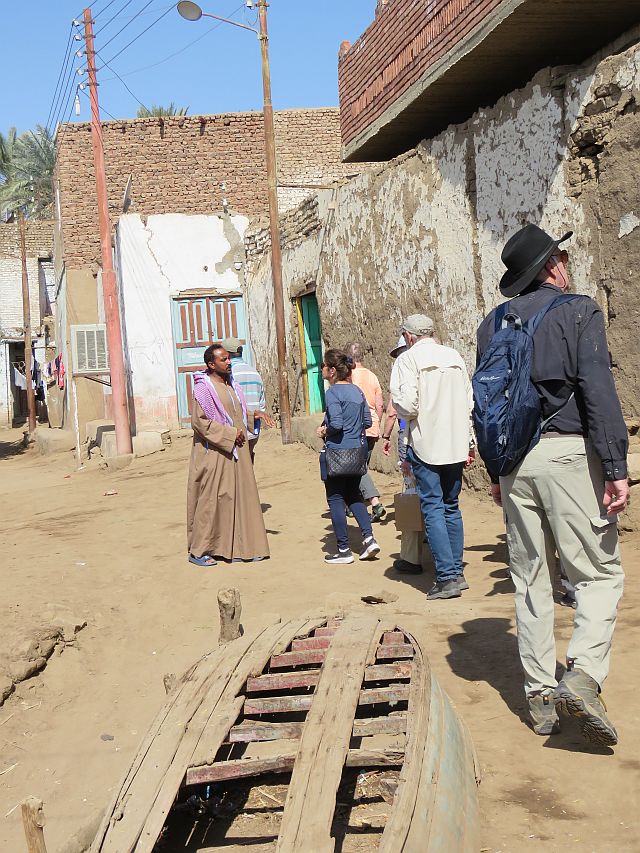

As we gather in front of Sayed’s house, we are all amazed when we see the woman walking up to the house, with the aid of Hussein and Sayed’s brother. Hussein takes us into Sayed’s house and has us take seats in a narrow room, then they bring the woman in to join us. Hussein brings a bottle of water that he has added salt and sugar to and directs the woman to sip on the home-made electrolyte solution. This is one tough, amazing woman who could have gone back to the boat but was determined to stay and experience the rest of our time in the village.
Once we have been served drinks, tea or sprite, Sayed picks up a laminated map, of the United States. He asks that each of us point out the state we are from and tell everyone what we do for a living. Sayed demonstrates his request by pointing to Colorado and stating that he lives in Colorado for six months where he farms. He then points to Texas and says that he lives in Texas for six months and is a fisherman. This of course, makes us all laugh. The man’s English is amazing, and he has shown us throughout this tour that he has a great sense of humor. Once everyone has identified their home and occupation, Sayed introduces his wife and sister. We are encouraged to ask questions which many do, some for Sayed, others for his wife and sister who is soon to be married.

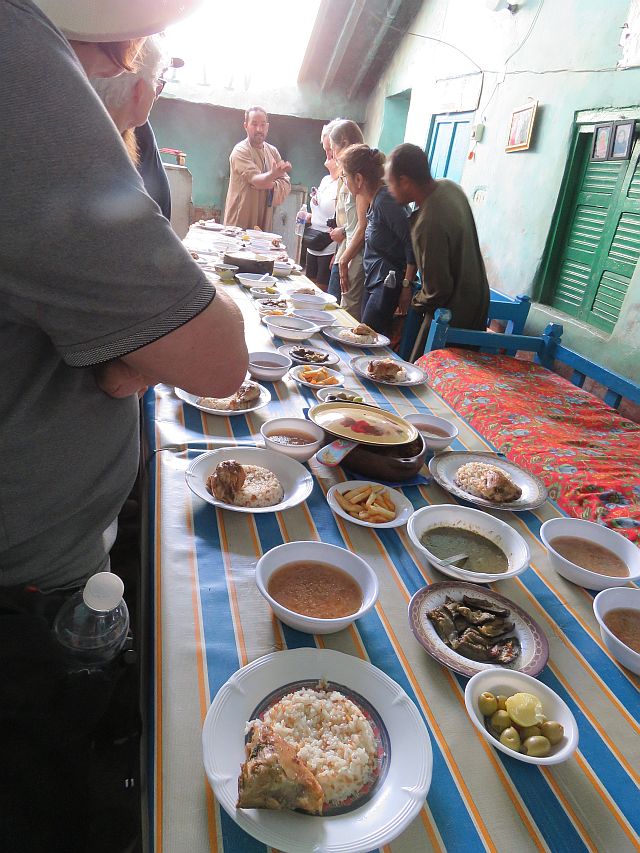
After the meet and greet we are ushered into another room where the women have laid out a feast for us. There is chicken, bread, rice, and other side dishes. Someone asks Hussein if the family eats like this every day, and he replies in the negative. Hussein tells us that a meal like this would be eaten once a week and that the people only have meat with their meals two or three times a week if I recall correctly.
After we have finished eating, we are taken back to the discussion room where Sayed again takes our questions. I ask him how they control pests in the alfalfa. He says they have cattle egrets that keep the bugs under control. I shake my head in disbelief and tell him that we have insects that can quickly damage the alfalfa if you do not catch a bug infestation quickly. He assures me that the egrets take care of the bugs in their crops, and this is not a problem. Amazing. Later, when thinking about this, it dawns on me that the birds have a very small corridor in this country to find food. The farmed area of Egypt only occurs along the Nile which does not extend far from the water. Therefore, the birds are highly concentrated, unlike in our country, and have a limited area to find food. This is purely a hypothesis on my part.

It is time to return to the Aida and we thank Sayed and his family for the meal and the interesting tour. After we leave someone asks Hussein if Sayed is highly educated. Hussein shakes his head and says that he is not, Sayed reads all the time and has gained his knowledge on his own. Imagine that. Paul and I agree that so far this has been the highlight of our visits in Egypt and we both were impressed and amazed by Sayed intelligence, ability and wit.
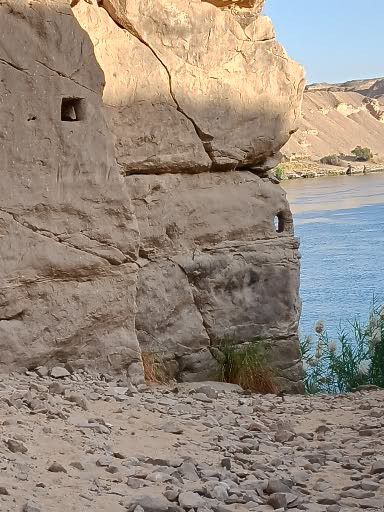
Our next stop is at an ancient stone quarry. We stroll along a trail and Hussein stops here and there to talk about the quarry. One stop is at a small tomb that our guide says that only a person of some importance would have warranted, but it is nothing compared to a King’s tombs. He points out where workers chiseled out big blocks of building stone. Hussein shows us the path that was used to drag the rock to the Nile. The workers bored out holes in the rock cliffs that line the trail. Ropes were placed through the holes which helped the laborers control the multi- ton blocks as they pulled them down the slope to the waiting barge.


We return to the Aida but the crew does not pull up the anchor as this is where we will be spending the night. Hussein informs us that there will be a film shown in the lounge at five o’clock. The film is about a man, British I believe, that walked the full length of the Nile. When the film is over it is time for dinner. Paul, Jennifer, and I sit at the table with the two women from Minnesota. They are delightful people and one of the women is a card. She enjoys telling jokes and keeps us laughing throughout the meal. I am as amused with her body language and how she cannot keep from laughing before she gets to the punch line, as I am with her jokes! Writing this is making me grin just thinking about her! A good way to end a very good day.
Tomorrow, we visit a crate maker and the temple of the crocodile God, Sobek. Nancy

 realityranching