VALLEY OF THE KINGS, HOME-HOSTED DINNER, part 5
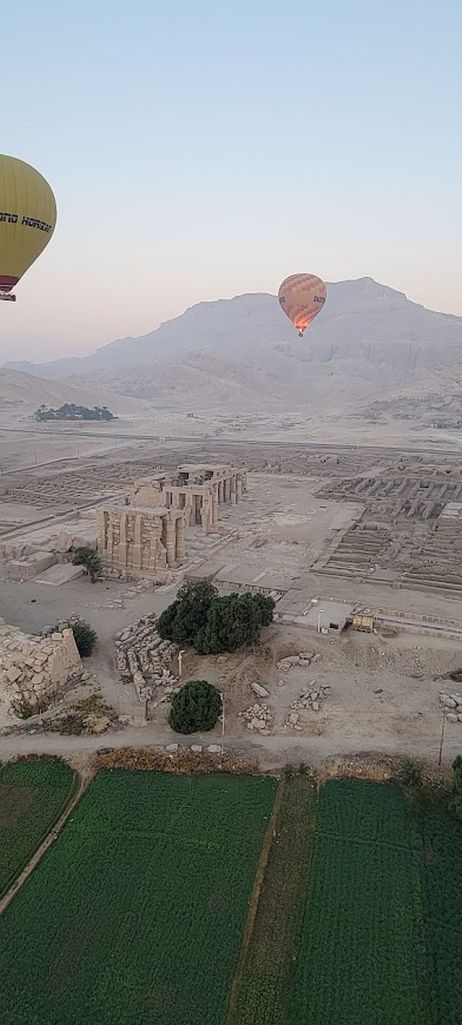
Paul and I ate breakfast this morning with another couple from our group who were kind enough to invite us to sit with them as all the tables were occupied. The buffet has a large variety of food, but it is not as expansive as Marriotts. Jennifer walks into the breakfast room about the time we have finished eating. Jennifer and some other members of our group left early this morning to go on the optional hot air balloon ride. They had to take a boat across the Nile, continue by car for quite a distance and then hope that the wind was cooperating when they arrived at the balloon launch. Fortunately, the wind was fine and Jennifer and the others that went raved about the experience of their hot air balloon ride. Paul and I opted not to go because we had taken a hot air balloon ride while on one of our earliest, maybe our first trip to Africa, and we were happy with that memory.

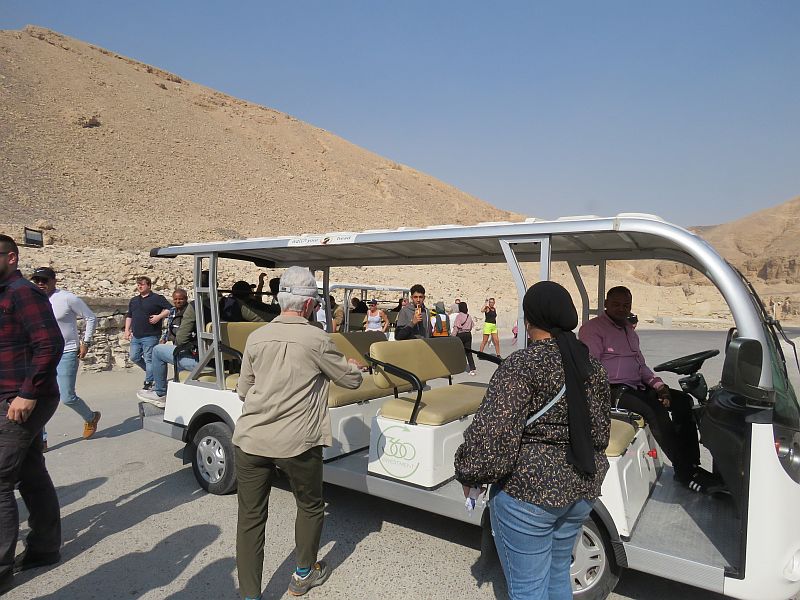
We are off to explore the Valley of the Kings this morning. We board a motorboat that takes us across the Nile to where a bus awaits us. Our first stop is at the Mortuary Temple for Queen Hatshepsut. All visitors must walk through the vendor tent in order to get to the ticket office. Oh my gosh, the people are very persistent and aggressive. Hussein stops at one stall and shows us the things he would recommend buying here if one is interested and then tells us what we should pay for these items. Hussein reminds us that you must bargain, it is expected. We finally reach the ticket office, after listening to the phrase “only one dollar” being shouted at us as we walk the length of the souvenir filled tent. Hussein hands us our tickets and points out the location of the restroom, which several of us take advantage of before we proceed. Have I mentioned that you must pay five Egyptian pounds to use a public restroom? This is equivalent to around 15 cents. When our group is all accounted for, we climb into carts and the driver takes us the short distance to Queen Hatshepsut’s Mortuary Temple.

We follow Hussein to the steps of the temple where he gives us the history of Queen Hatshepsut, which is complicated. The Queen was married to Thutmose II, who was her half-brother. Between Hussein’s lessons, books I read, and watching shows on the History Channel, ancient Egyptians marrying half siblings or cousins was common. The Pharoah’s believed that marrying within the family would ensure that their family would maintain control in Egypt for generations. When Thutmose II died, the throne passed to an infant son from a “lesser” wife because he and Hatshepsut had produced only a daughter, not a son.
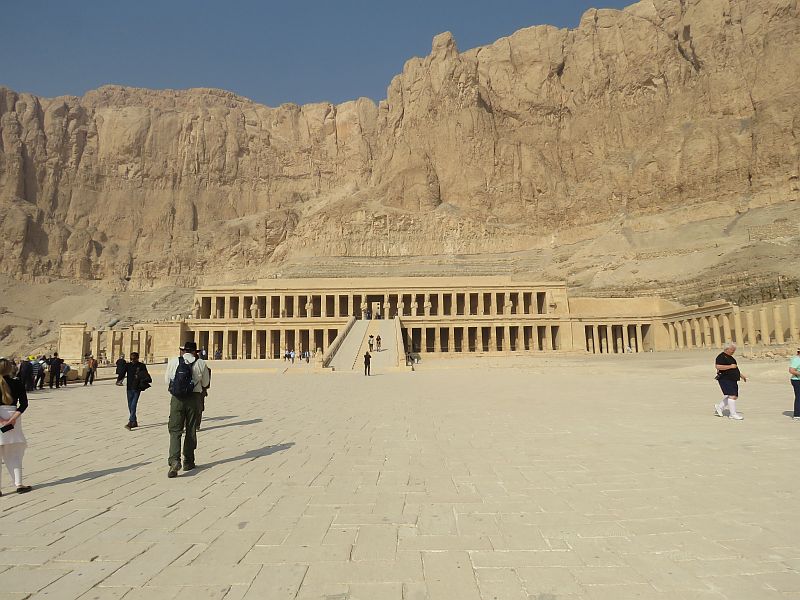
Queen Hatshepsut, who was Thutmose II’s principal wife, became Regent upon his death and acted, (ruled), for the baby Thutmose III. When he was still a child Hatshepsut was installed as the first female King of Egypt although how she achieved this is not clear. King Hatshepsut was considered a successful ruler because during her twenty-year reign, Egypt was at peace. Hatshepsut also opened trade with many of the countries that her predecessors had been at war with.
When Hatshepsut’s nephew took his rightful place on the throne after the female King’s death, he ordered all evidence of her to be erased. Hatshepsut’s’ monuments were defaced, her statues were torn down, and her name was removed from the official Kings list. Some Egyptologists theorize this was revenge taken by Thutmose III for being denied the throne when he came of age, another theory is that he did this to make sure the Thutmose line would not be interrupted by a female again. It sounds more like revenge in my opinion.

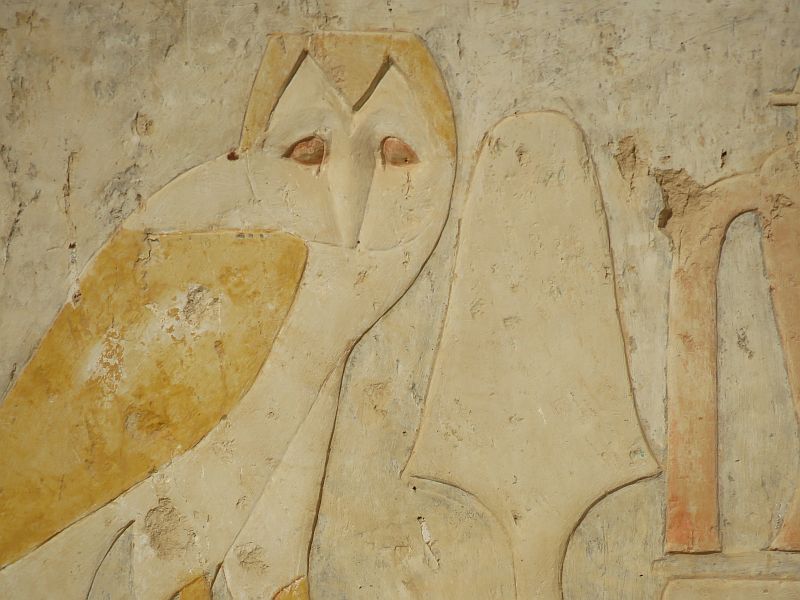
Hussein also told us what paintings or monuments we should look for once we were inside the temple. He particularly wanted us to find the stone pillar on the outside of the temple that depicted the face of Hathor, the goddess of love and motherhood. This goddess is depicted with a human face that has the ears of a cow. When she transformed into her animal form it was that of a cow. Hussein also told us this impressive mortuary temple was only used for seventy days which was how long the mummification process took.

Hussein is not allowed to lead us through the temple. I understood him to say that this was because they were trying to limit the number of people inside the temple. That does not really make sense so maybe I misunderstood. Jennifer’s theory was that a guide would stop to explain things to his group which would block the flow of people. Now that does make sense.
We gather outside by the steps of the temple, where Hussein is waiting and take the carts back to the parking area. Unfortunately, we must run the gauntlet of vendors to get back to our bus. You have to admit that this is a good marketing tool for these shop keepers but boy is it annoying.
We load up on the bus and in a short time we have arrived at the Valley of the Kings. There are carts to drive us to the tombs here also. One of the carts carrying members of our group comes to a halt and the woman from Pennsylvania hops out. It seems that her ticket blew out of her hand. A cart driver behind them saw the ticket and picked it up. The driver that picked up the wayward ticket insists on a tip and the woman hands him some Egyptian pounds. Really, shouldn’t that just be a kind thing to do for someone?

When we reach the tombs, we form a half-circle around Hussein, who talks about the history of Valley of the Kings. Hussein also gives us useful information at the entrance of each individual tomb we are visiting and describes specific scenes or figures to look for among the paintings on the tomb walls. The tomb of Ramses IV is included with the ticket that allows you entrance to the Valley of the Kings. King Tutankhamen’s tomb is included with our OAT package. Hussein has personally purchased the ticket for Ramses VI tomb for us as he insists, we must experience, what in his opinion, is the most spectacular tomb in the Valley. How kind and generous is that?
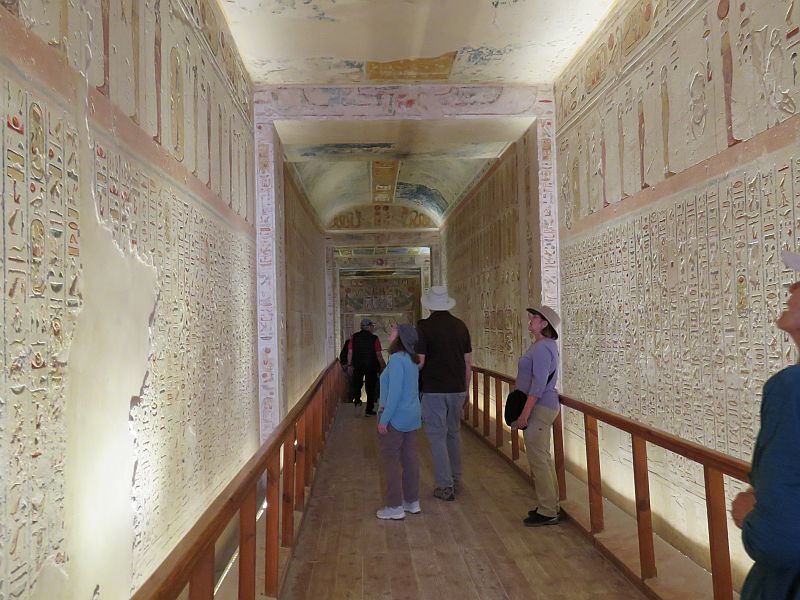
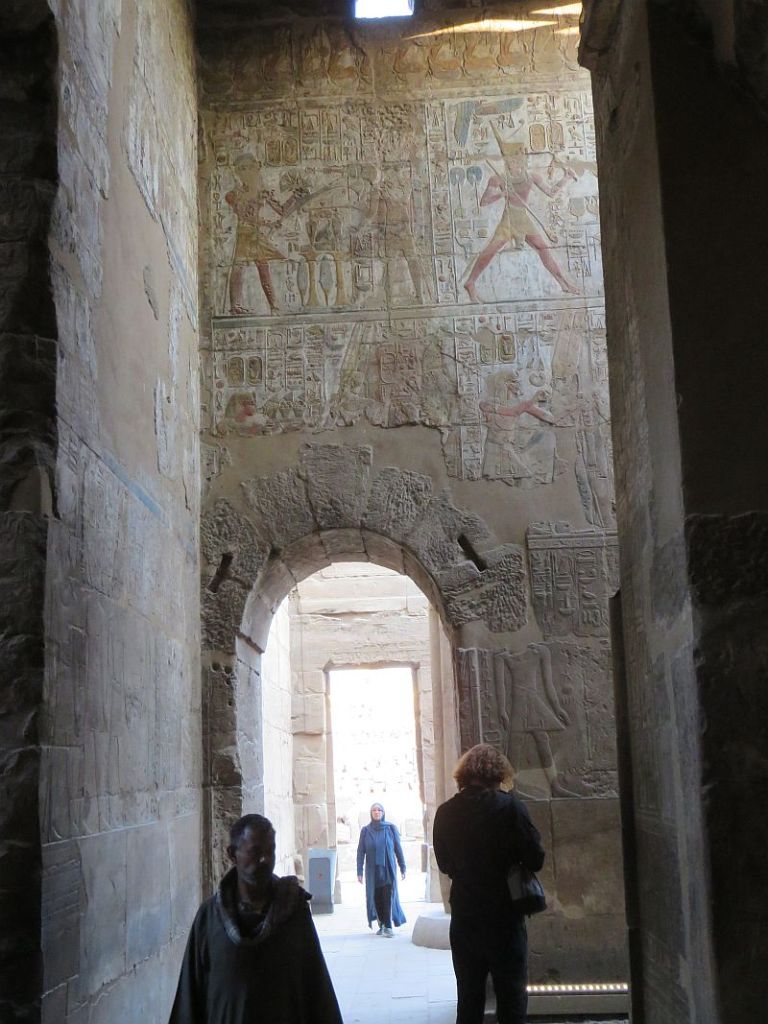
The number of people allowed into the tombs is limited, and rightly so as the area in the tunnel and tomb is not that spacious. We descend a staircase that takes us to Ramses IVs’ tomb. As we walk through the hallway we gaze at the painted scenes and hieroglyphs that cover the walls on both sides. We occasionally stop and admire a particular scene or figure. It is hard to fathom the work and time it took to carve this tomb out of the rock and to paint or carve all the scenes and figures that plaster every inch of the rock walls. What we are looking at is awesome. It is hard to imagine that Ramses VI’s tomb could surpass what we are experiencing in this tomb!

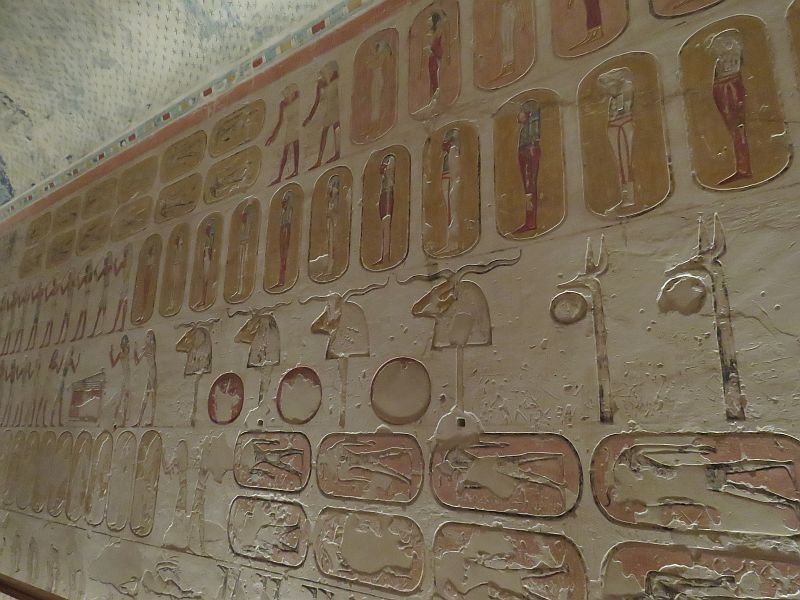
Jennifer and I leave the tomb and we have climbed halfway up the stairs when the lights go out. What the heck? The sunlight filters down weakly from the entrance/exit but we take our time and carefully climb to the top of the stairs. There were several people still in the tomb when we left, and I can only imagine how dark it is down there. Paul had left before Jennifer and me so he missed out on this fun experience. We had not been told or perhaps did not hear that tourists are allowed only so much time to be in the tomb which makes sense. The warning that your time is up is the extinguishing of the lights which seems a bit dangerous. I have a feeling a lot of cellphones were lighting the way for the people behind us.
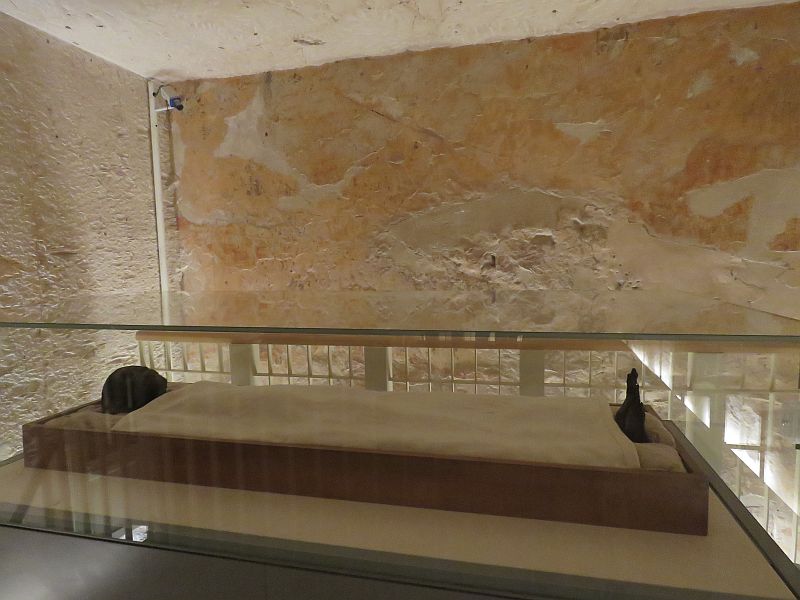
Hussein leads us on to the tomb of Tutankhamen, where he tells us the tomb robbers never found it because rubble had covered any signs of the tomb due to an earthquake (I think). Hussain also explains how Howard Carter finally figured out where Tut’s tomb was which is fascinating but too long of a story to write here. King Tuts’ tomb is small in comparison to the first tomb we were in, but the scenes painted on the walls of his tomb are amazingly vivid. King Tutankhamen’s mummy is on display, but I could have done without seeing Tuts’ mummy as it is not a pleasant sight.

Ramses VI tomb is our last stop, and we enjoy more history given to us by our excellent guide. As we begin walking down the long tunnel to Ramses VI tomb the depictions on the walls and ceiling are overwhelming. The deeper we get the more vivid the colors are. It is on this walk that I see a member of our group point out a very odd figure and says something about aliens which causes his wife to snort with derision. I speak up and admit that I do not discount the alien or otherworldly theory many people have, which makes her throw up her hands in exasperation. My open-minded friend and I continue talking about the possibility of alien influence or help building these structures throughout our trip, much to the hilarity of the rest of our group including Hussein. Yeah, we both watch Ancient Aliens on the History Channel, but my doubts started long before I began to watch that show. After Paul and my visit to Peru and Machu Pichu, I wondered about the ability of these ancient people being able to build such structures with only stone hammers and copper tools. Just saying.


We stop for lunch on the way back to the hotel. I had ordered potatoes au gratin and was disappointed to find that they had been baked to the point of being dried out. Oh well, that was the only disappointment today.
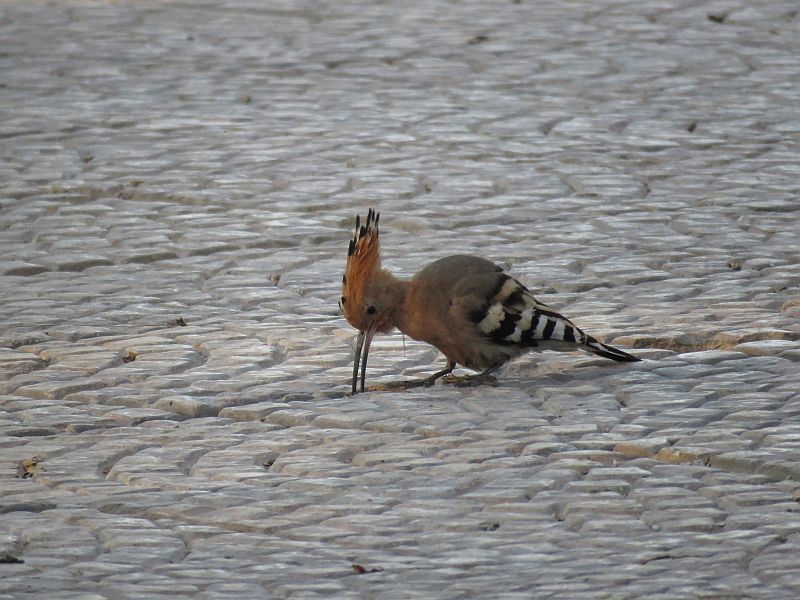
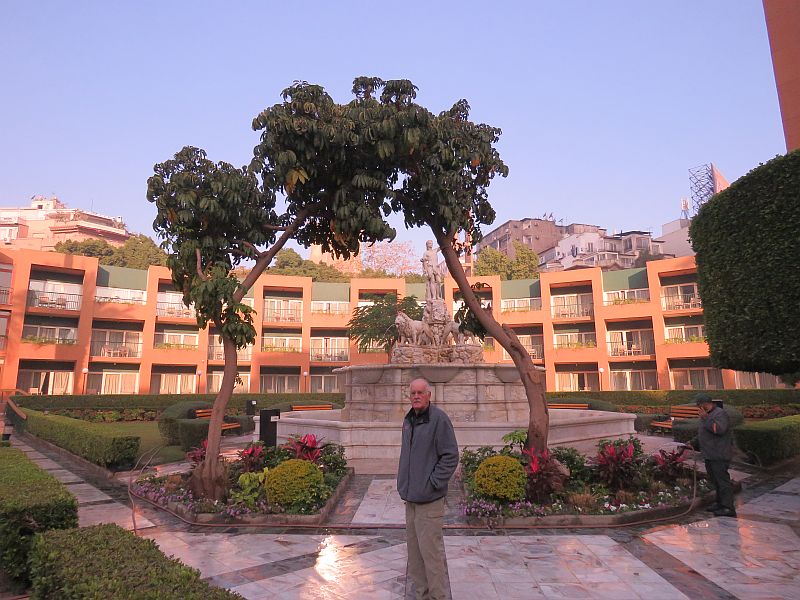
When we return to the Winter Palace hotel, Paul and I take a much-needed nap. When we wake up, we decide to go down and check out the hotel courtyard. The manicured garden is absolutely beautiful. We find Jennifer lounging by the large swimming pool, so we sit down for a bit and just relax. I was delighted to see a Hoopoe while we were exploring the grounds. He was so busy probing the ground for worms he paid no attention to us. The low light of our courtyard tour was seeing several flamingos that are enclosed in a small wire pen.


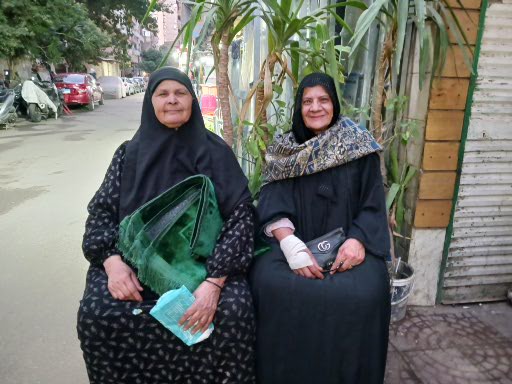
Tonight, we are going to our Home-hosted dinner. Hussein divides us into two groups. One group will be hosted by a farmer and his family who live in Luxor and the other group will be hosted by a retired chef and his family. The two women from Minnesota, and the solo traveler from Maryland are in our group. Hussein assigns our group to the retired chef which I admit, the three of us were a little disappointed as we had hoped to go to the farmer’s house.
The bus stops and lets us off at a side street where we follow Hussein down the dark, narrow street to our host’s house. A man is waiting for us, and he raises his hand while calling out a greeting to Hussein and our group. We follow our host into his house where Hussein introduces everyone. Hussein then leaves after telling our group that he will return later this evening to accompany us back to the coach.
It is a bit awkward at first. We all hand our small gifts to the host; we Kansans have given them a magnet featuring photos of things Kansas is known for like sunflowers and wheat. We also wrote a message of thanks inside the card which has a beautiful photo of the Flint Hills on the front. Jennifer, Paul, and I forgot to bring any gifts for the two little girls which are our hosts granddaughters. The women from Minnesota have brought a large sack of balloons and tell the girls that it is from all of us. How generous of them.
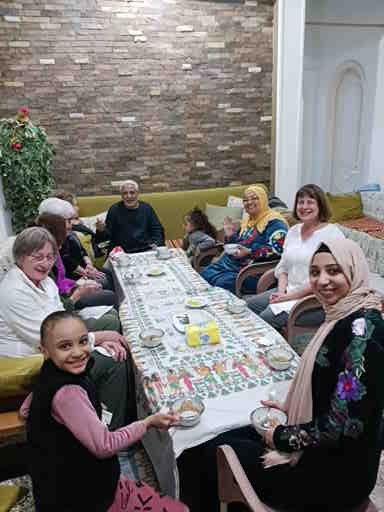
The retired chef tells us his son, the father of the young girls and the husband of the young woman that is helping prepare dinner, will join us later. Our host takes us on a tour of the house which consists of a large dining/sitting room, a good-sized kitchen, large bathroom and two bedrooms. When we have finished the house tour we sit down at the table and the two women begin bringing food to the table. The main dish is a favorite dish of Egyptians, and I would liken it to a stew. As we all prepare to begin eating the Hostess says “bon a petit” with a big smile on her face. We soon figure out that although all the other members speak fair English, our hostess does not speak English at all. She says “bon a petit” several times throughout our meal which is endearing.
The couple’s son walks in as we are being served dessert. He greets us and apologizes for not being here earlier, but he has been working. This man speaks excellent English and soon all of us are asking him questions on various topics. He talks about how the high inflation is hurting the Egyptian people. We learn that family is very important in Egypt, and he answers any questions we have on other topics.
At some point Jennifer pulls out her phone and calls the little girls over to see photos of her eight grandchildren. Boy does this break the ice. The hostess and daughter-in-law crowd around Jennifer so they can look at her photos too, and they ooh and ahh over her grandkids’ pictures. This prompts the older couple and younger couple to retrieve their wedding albums and we all look at the photos and comment about how beautiful everything was. Our host laughs and says his wife was crazy about Omar Shariff and claims she only married him because of his resemblance to Omar. We all laugh at this story and when looking at his wedding photo from decades ago we see that there is some resemblance to Omar. They tell us that an Egyptian wedding takes place over three days and the guests can be in the hundreds. Weddings also cost a lot of money and with the high inflation they are experiencing today, some people are reducing the wedding celebration from three to two days.
The girls want grandpa to blow up a couple of balloons for them which he gladly does, I think these girls have grandpa wrapped around their finger. The two girls begin to bat the balloons back and forth and then Jennifer gets up to join in the fun. Boy do the girls, especially the youngest, get a kick out of this. After the balloon games come to an end our host announces that the girls would like to sing for us. We listen to the “ABC” song and “Twinkle Twinkle Little Star.” The oldest girl, probably ten years old, has an incredible voice. I lean over to her mother and tell her what a wonderful voice her oldest daughter has which makes her beam with pride.
Shortly after the girl’s finish singing, a smiling Hussein walks into the house and greets everyone. We all shake hands and thank our hosts profusely for welcoming us into their home and for their wonderful hospitality. We follow Hussein back to the dark street and walk back to the bus. We tell Hussein what a great time we had and of course he is delighted to hear this. This was a really great day.
Leaving Luxor to board our private dahabeya, (sailboat), for a six-day cruise on the Nile. This is the part of our journey that I have been really looking forward to. Nancy

















 realityranching