ANOTHER DAY IN NDUTU, BLOG 13, APRIL 10TH 2020

A nice start to the day
We have another gorgeous sunrise to enjoy after eating our hot breakfast of bacon, sausage, crepes, and eggs this morning. George picks us up at the usual time of 6:30 and he informs us that today we return to the wildebeest herd but we will go to the other side of the marsh. We drove along the edge of the marsh yesterday while inspecting the wildebeest, however there was no place to cross the spongy ground in that area. One of the reasons George wants to go to the other side is that he heard through the grapevine, well guidevine, that a cheetah was seen in that part of Ndutu yesterday. Might as well try for number nineteen.
Before we reach the wetland, we stop to watch a pair of hyenas engaging in play. I would guess this is a mother and a nearly full-grown pup that are chasing and nipping at each other. The two run out of steam fairly quickly and shuffle away from us into the grass.

Hyena having fun
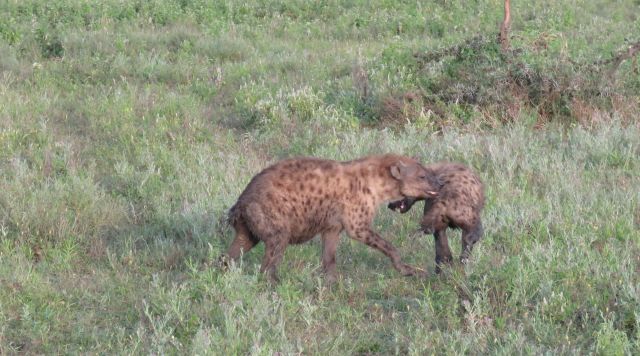
Hyena nipping and chasing one another
Once we reach the marsh George drives along the edge of the boggy ground until he finds the solid-bottom crossing near a small waterhole. It is only a few bumpy yards to the other side of the marsh. Of course, the wildebeest and other wildlife can cross the swamp any place they want as they don’t have to worry about getting mired down in the mud.
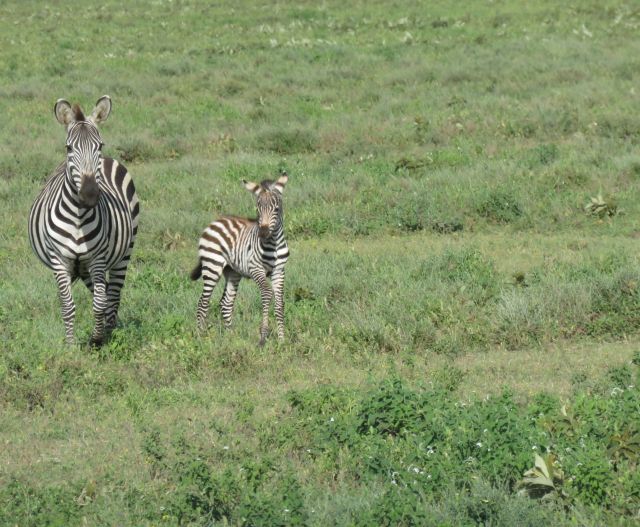
Another sweet baby zebra
We investigate the wildebeest on this side of the bog for cows giving birth driving slowly through the herd’s midst. At one point George has parked the truck and I notice a male wildebeest charge a calf that is lying down making it jump to its feet. The male begins chasing the poor calf and a couple other wildebeest join in, (one might be the calf’s mother). The big bull dashes after the baby who runs quite a distance trying to escape this knucklehead. I have no idea what instigated the bull to torment the calf, probably it is just boredom and orneriness. I noticed this same behavior yesterday of males chasing after little calves. It ticked me off then and it ticks me off today but my feelings don’t change a thing. The wildebeest finally stops his pursuit of the hapless calf and walks away.
On our search for a calving wildebeest, we do find a few calves that are very new but are already up and stumbling around. George drives towards one pair where the calf is dripping wet and just attempting to get up, man we couldn’t have missed its birth by more than a few minutes. I caution our guide to not drive too close to the pair in case our intrusion would interfere with the mother bonding with her calf. George begins to drive away as I am still observing the pair. The mother can’t seem to make up her mind about the calf and a couple of times turns as if to walk away. I speak out loud and tell the cow several times “don’t leave, don’t leave”. George thinks I am talking to him and brings the truck to a halt. The poor man looks completely confused because I had just instructed him, we should leave the wildebeest pair alone. I explain to him that I was talking to the mother wildebeest and not him, which makes him laugh.

New mother I was begging not to leave her calf
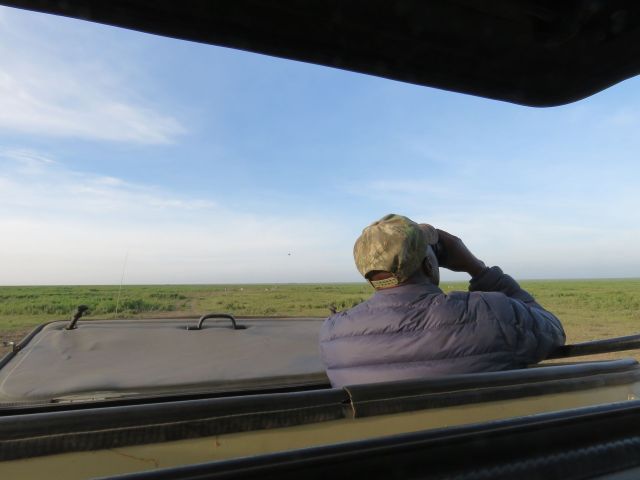
George using his binoculars to look for the cheetah
George covers a lot of ground in search of the cheetah and while on this mission we always find other interesting things to survey. One of the things of beauty we see isn’t an animal at all but an exquisite acacia tree. For some reason I fall in love with this tree and the proof of my enthusiasm for the acacia tree is evident when I see all the photos I took of the beautiful tree. At one point on our tour there is a Bateleur eagle sitting on the ground who seems to have no objection to us stopping to snap a photo of him. We observe a zebra stallion pursuing a mare. It is obvious that thoughts of mating are on the stallion’s mind but the zebra mare wants nothing to do with him. At one point when the stallion tries to mount the tiring female, she kicks out with both back legs and lands a sharp blow to the side of the stallions’ head. That seems to cool off the overzealous stallion at least for the moment.

The acacia I dubbed as perfect despite the big rift in its trunk

Bateleur eagle posing for us
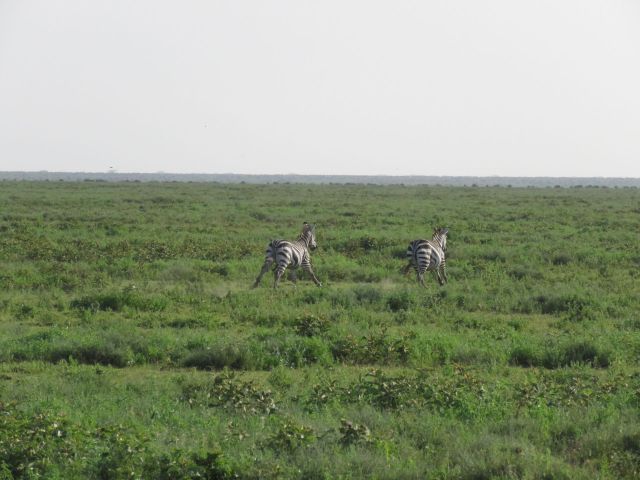
Zebra stallion chasing the unwilling mare
It was breezy shortly after we reached the plains this morning but now the wind is really blowing, and occasionally the truck shudders when the wind catches us broadside. The dust the safari vehicles kick up when we are on a road gets blown into our vehicle if we are close to them. George tries to avoid the dust clouds by moving off the road into the bush when vehicles approach which helps some but the invasive dirt still manages to find us. At times we see dust devils swirling over the plains. Paul remembers that he has a bandana in our pack and now when we meet another vehicle, I hold the cloth over my nose and mouth which helps keep the gritty dirt out of my lungs. The wind reminds us of the Kansas gales that are too common, but we would have preferred not to have experienced this blustery wind in Ndutu.

This baby zebra had deformed back legs. It could hardly walk let alone run. How it has survived this far is a miracle.
We still haven’t found that elusive cheetah but a few elands put on a wonderful show for us as they playfully run and leap into the air. Now that is beautiful. Another display that brings our truck to a stop is a dung beetle who is rolling an enormous ball of dung over the rough ground. George points out the female who is following the hard-working male. George tells us that the female will climb onto the dung ball occasionally. I can’t remember if this is to show the male that she accepts him as a mate, or if the female dung beetle is just giving the male encouragement. Nevertheless, it is quite a spectacle to see this bug rolling a sphere ten times as big as he is. The purpose of the dung ball is a medium for the female to lay her eggs in. When the larvae hatch, they consume the dung for their first meal. This nearly perfect orb the beetle constructed really is amazing despite the substance that it is made of!
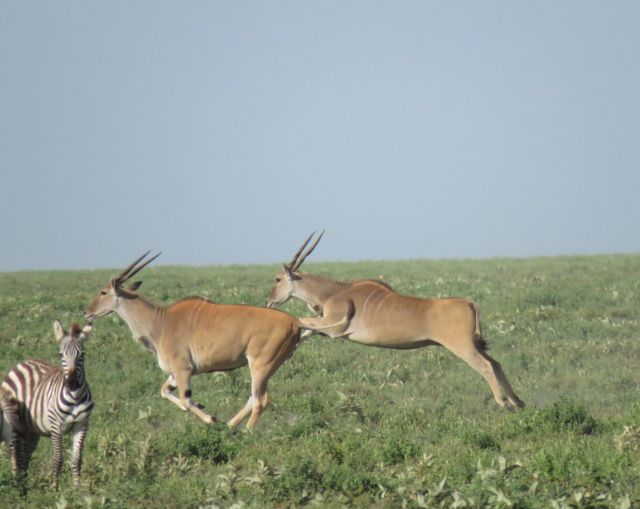
Elands having fun

Yipee. See the dust devil on the horizon?
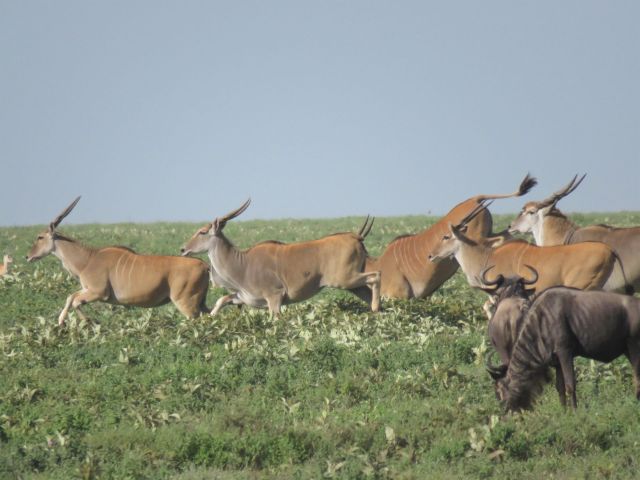
A couple more eland join the fun

How did that small beetle construct this huge dung ball? A part of the female can be seen following her mate
George gives up on finding the cheetah and turns back towards Njozi camp. We have to drive near my “perfect” tree on our way to the crossing. There is a mass of wildebeest and a few zebras spread out around the acacia tree which makes for an iconic African scene.

Iconic African scene
As we near our turn off to the camp there is a few trucks under the tree where Babs the lioness was perched yesterday. We join the sightseers and are happy to see the tawny beauty in a much more comfortable position today. She is lying flat upon a thick, sturdy limb and is sound asleep. We stay with Babs for awhile and other than shifting her position a time or two, she never really wakes up.
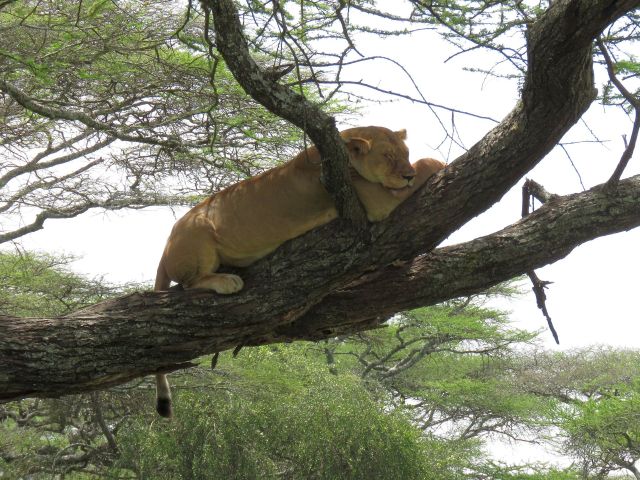
Babs looks so much more comfortable today

Using her leg as a pillow
Another guest has arrived in Njozi camp and Alex joins us for lunch. One of the first things Alex says to us is “you must be the people who saw the honey badgers”. It is nice to be semi famous even if it is only for a few days! The young man is a writer and is here penning an article on the Big Cat Research project, at least this is what we understood. It seems he travels internationally writing pieces on wildlife and I think he particularly writes about big cats. I do know this; Alex often uses words which I have no idea what they mean so I have to sort their meaning out using the context of his sentence. Whoa.
Paul and I take a short nap after lunch, the wind and the dirt took a toll on us so we can’t imagine how tired George must be. After naptime we sit in front of our tent and relax while reading, journaling and enjoying the solitude. Oddly enough there are hardly any birds to watch today. Paul and I do walk around the camp although it is hot so we don’t walk for too long.

The view in front of our tent makes us feel like we are sitting in the middle of the bush.
George arrives at four and he wants to go back to the part of Ndutu where we saw the tongue-injured cheetah yesterday. It is a long trek to the place where we encountered the spotted cat and some parts of the park we drive through are fairly empty of wildlife. One good thing is that the wind has died down. When we arrive at our destination there is not another vehicle around. There are thousands of wildebeest speckling the plains but our cheetah search proves to be futile. I hope this means she has moved to a location that isn’t infested with hyena. We take time to sit and watch the placid herd of wildebeest. There are cattle egrets hitching rides on the wildebeest backs or shadowing them as the animals are walking, snatching up insects that are startled into flying to avoid the wildebeest’s hooves.

An African hare sitting in the open.

Ostrich next to wildebeest. This shows how huge these birds are.
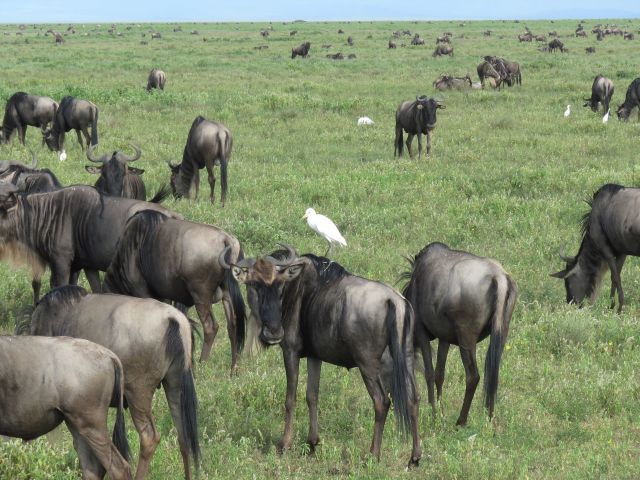
Cattle egret hitching a ride on a unconcerned wildebeest
When we are driving back to camp this evening it happens to coincide with the cattle egret’s flight to Lake Ndutu where they roost in trees for the night. George and I marvel at how low to the ground the stark white birds fly. We also question why it is that the egrets prefer to fly around bushes and tree trunks rather than fly higher and go over the top of the obstacles.

A line of cattle egrets
When we arrive to the driveway of the camp, George passes it by and drives up to the staff’s quarters. Paul and I raise our eyebrows but don’t say anything to our guide. When George realizes what he has done he utters his distinctive “whaat” and then starts laughing. Putting the truck in reverse George backs down the long, narrow drive until he reaches Njozi’s entrance. Salama and Lema are waiting at the end of the drive to greet us and both are shaking their heads and laughing. In order for George to save face we encourage him to tell the young women that we saw a bird and that is why drove into the wrong entrance. When we climb out of the truck the two women hand us our towels and then begin kidding George speaking in Swahili. George responds to the women but the only word we understand is the word ndege, which is bird in Swahili. We assume George decided to try using our excuse of bird watching but the two women don’t buy our cover story as they shake their heads and laugh. Poor George will probably not live this down anytime soon.
Paul and I appreciate our hot showers even more tonight after that dirty, windy morning game drive. At the bonfire we enjoy our Kilimanjaro beer that Joseph has ready for us. Joseph is featured in the camp book in our tent among other stories about Tanzanians that Wild Source has teamed up with. I won’t get the details perfect but the gist is that the owners of Wild Source noticed Joseph while they were in Arusha (I think). Joseph was selling souvenirs to tourists from a nifty little cart that made him stand apart from the other vendors. The Wild Source people began visiting with Joseph and were impressed with the entrepreneurs winning personality and motivation. Joseph had dropped out of secondary school due to lack of funds. I believe it was after a few more visits with Joseph that Wild Source offered to financially support Joseph so he could finish school. A job awaited him after his graduation at the Wild Source camp if he wanted it but that was his decision to make. Obviously, the young man took them up on their offer, thus the distinctive liquor cart at Njozi camp. Paul and I learn from Joseph that he hopes to get a college education, possibly in biology. We wish this enterprising young man all the best in his future endeavors.
The employment of, and aide to locals is a trademark of Wild Source. In the camp book there were other stories of giving people a helping hand. I remember that one of the reports was about helping a young woman start up a business. Kudos to the owners of this business for assisting people to achieve their dreams.
We visit with David and Useph as we relax next to the bonfire. David shows us photos of an old male lion they found today that died from his wounds after being in a fight with a pair of lions. Seeing the dead lion was a somber lesson that defending territory can cost you your life. One of the interesting tidbits David told us is you can age a lion somewhat by the color of their nose. When a lion is born their nose is completely pink. As lions age black spots begin to show up on their noses. Around age nine the nose becomes completely black.
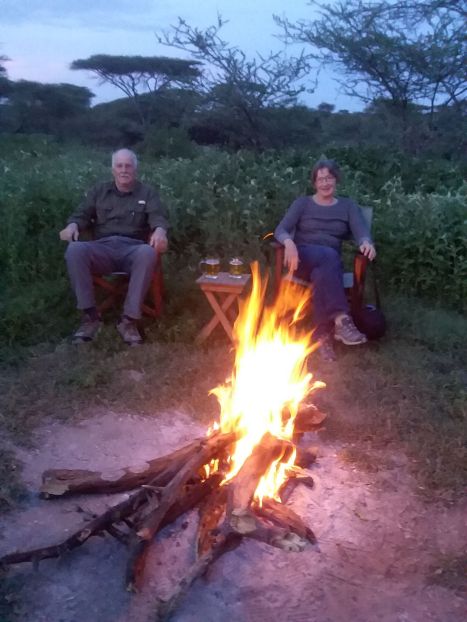
Paul and I enjoying our beer and the bonfire
During dinner we hear about Alex’s day of adventure which included seeing Babs in the tree. The chef outdid himself tonight with coconut chicken which was delicious, braised beef, potatoes, and snow peas and avocado green salad. I am grateful it is a buffet so you can try to limit your portion size! Paul enjoys an after-dinner drink of Amarula which is a favorite ritual for him when we are in Africa. We say goodnight to Alex and the staff and retire to our tent for the night. Nancy
 realityranching