ALEAVING NYUMBANI FOR NDUTU AND NJOZI CAMP, BLOG 11, APRIL 2ND 2020
Before Paul and I go up for our seven-a.m. breakfast, we pack up most of our belongings. We are leaving later than usual this morning because George must fill up with fuel near the Seronera airport and the fuel station isn’t open until eight o’clock.
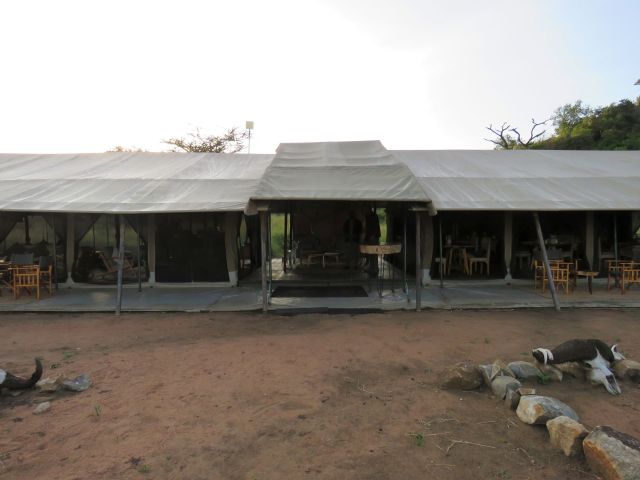
The dining and community tent at Nyumbani
After breakfast the staff gathers our luggage and all of them accompany us to the vehicle. We give Goodlove the envelope with the tip money for the staff telling them how much we enjoyed staying here and how much fun we have had with them. Once we are settled in the truck, we see Amani making a heart with his hands and Bazile is pretending to cry. Hilarious. These guys are such characters.

Paul and I with the staff of Nyumbani camp
On the drive to the gas station about all we see is a beautiful young giraffe who strolls across the road in front of us. The gas station consists of an austere concrete building with one fuel pump. George goes to pay the attendant, who then comes to fuel up the truck. There are beautiful kopjes next to the gas station and an unidentified bird is perched on the peak of one rock singing its heart out. Paul and I have to laugh when we see the station attendant rocking the truck back and forth in order to be able to get a little more diesel in the fuel tank!

Lone giraffe we saw on our way to get fuel

Fueling up
We have a long drive to Ndutu which will take us through half the length of the Serengeti, (Seronera is located in the middle of the Serengeti). One of our first encounters after leaving the gas station is a good-sized herd of Cape buffalo crossing the road in front of us. You bet they have the right away! There is a cow with a brand-new calf which is struggling to keep up, though mama does turn to check on the little guy now and then. Thank goodness the herd leaders stop to graze not long after they have crossed the road as I don’t know how long the wobbly calf could have kept going.

Mother cape buffalo checking on her brand new calf.

Wobbly Cape buffalo calf made it across the road.
We don’t find much more in the way of wildlife for quite some time. Well, George does stop at a kopje to laughingly point out several hyraxes that are squished together soaking up the sun. As we continue driving through the lovely grassland, we come upon a vehicle parked alongside the road. The people are focused on a solitary tree quite a distance from the road. George immediately declares that there is a leopard in the tree. Wow, we had no expectations at all of seeing a leopard in this country. George tells us to look for the tail of the leopard that is hanging down from a limb. Paul and I find the leopard but I don’t see a tail, I see hind legs hanging down on either side of the limb the stunning cat is lying on. George says there is another road not far away that will get us closer to the mottled cat so off we go. We have just turned onto the road when we see two vehicles approaching from the other direction. The leopard panics, climbs down the tree, and “poof” it immediately disappears. We have experienced this magical act when watching leopards before but I still don’t know how such a large feline can seemingly vanish into thin air. Alright, we are absolutely delighted at seeing a leopard in the Serengeti.
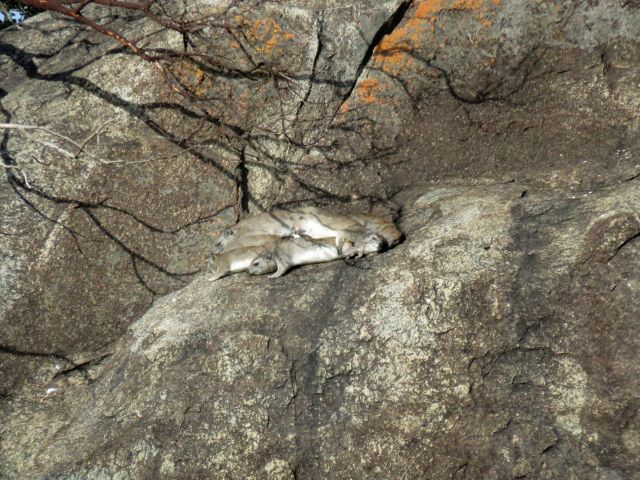
Hyrax piled up together, basking in the sunlight

Leopard in the tree. I had to use my full zoom to get this documentary photo

Startled leopard on the move, Oops, wasn’t fast enough to get his head in the shot

This is the last we see of the big cat
As we continue on our way, we find an overheated hyena cooling off in the middle of a small pond. Immersing itself in water doesn’t make the hyena any more attractive! As we are driving alongside a herd of zebras George finds one zebra with a bloody slash on one of its hindquarters. It looks like this fellow barely escaped death, probably from an attacking lion. The wound looks nasty but the zebra itself is grazing and otherwise seems healthy.

Hyena cooling off in the water
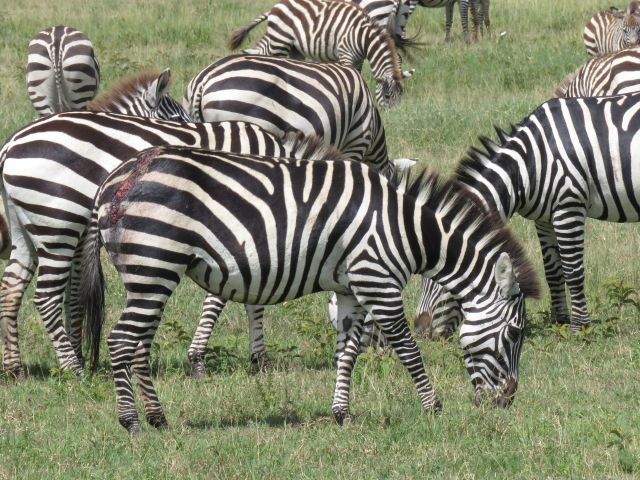
That is a nasty wound. Probably a result of a lions claws?
Our journey takes us back through the Gol Kopjes and we see the mother and cub cheetah again but for some reason I only have a photo of the mother, I guess the cub was hiding in the grass. There are some safari trucks ahead of us parked by a Kopje so we decide to see what they have found. Two vehicles are leaving when we arrive and a third guide is attempting to turn his truck around in a tight space. As the driver pulls forward, he startles a male lion that jumps up and limps into the towering grass. This is the same untidy male we saw with the two lionesses yesterday so maybe his injury is the reason he hasn’t been grooming himself. One of the lionesses is on top of an immense rock and the other one is barely visible as she is holed up in some dense bushes.

Startled male lion
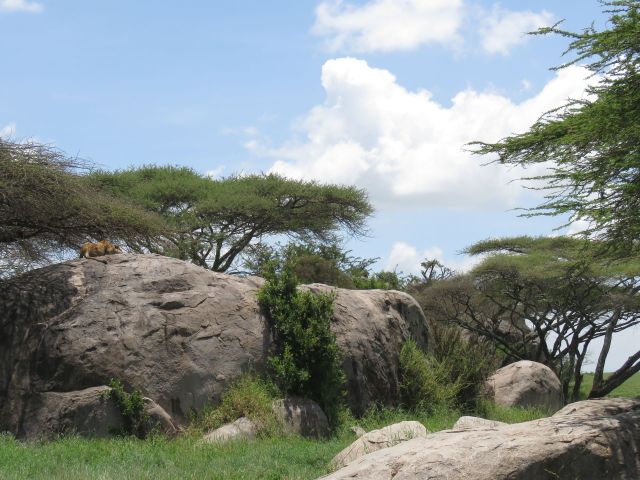
Lioness laying on Kopje rock
George has to sign in at a place called Naabi Hill so we can continue on to Ndutu. When we arrive, George suggests that Paul and I hike the path to the top of Naabi Hill as signing in will take some time. Paul and I think that is a great idea and we climb the steep but short path to the peak of Naabi Hill. I am gasping for breath when we reach the top but the birds eye view of the endless plains spread out below us was worth the exertion. Upon our return to the truck George asks if we want to eat our lunch here and we agree. There is a picnic area but it is so full of other safarists eating lunch that all the tables are taken so we have to settle for a wooden bench which is fine. As we are leaving, George gives our leftover apples to some construction workers who seem very appreciative. George is such a kind and thoughtful man.

Faded sign at the top of Naabi Hill

This lizard was next to the sign

View from the top of Naabi Hill
Once we leave Naabi Hill we come across a large number of zebras who have congregated into small groups. Each cluster of zebras is pushing tightly against each other in an effort to protect a small part of themselves from the voracious flies. There are white storks everywhere and George tells us that they are migratory birds. At one point on our drive we have to come to a stop as a line of wildebeest are dashing across the road, many of the cows have long-legged babies running beside them.

Zebras in small clusters trying to protect themselves from the biting flies.

One of the hundreds of white storks we saw in Ndutu. This isn’t a very good photo but I think it is the only close up I have of a white stork
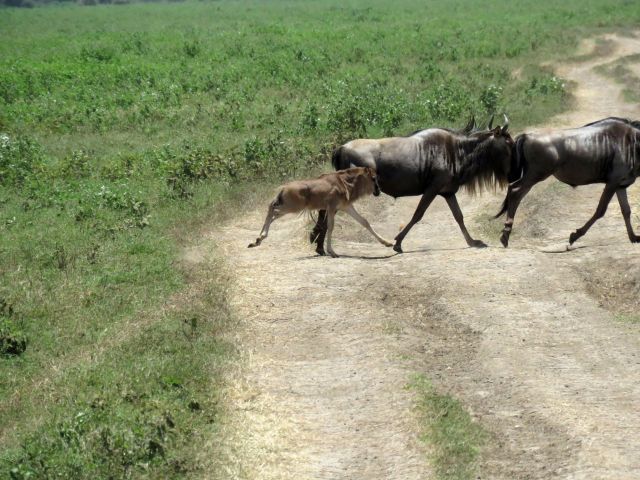
Wildebeest and calf dashing across the road
When we arrive at Ndutu lake there are greater and lesser flamingo wading along the edge of the placid lake. We spend a little time looking for a pride of lions that frequent this place but we don’t find them. We drive into Southern Njozi camp at three o’clock and the staff is waiting with hot towels and welcome drinks. The camp manager, Vana, takes us to our tent, which happens to be the closest tent to the dining tent. Vana then gives us the tent tour while explaining camp rules and giving us other information. It is a very nice tent and Paul and I get settled in, then rest before our late afternoon game drive.

The bedroom

Back room of our tent
It is really dusty here so it is hard to believe that they were having terrible rains and flooding here a few weeks ago! Unlike the Serengeti, you are allowed to drive off road in Ndutu which is nice as you can get off of the dusty roads. We were driving cross country when Paul and I thought we saw a hyena chasing a few wildebeest quite a way ahead of us. George corrects us and says that it is a baby wildebeest. The little calf is having trouble keeping up with the adults and then we lose sight of them.
As we draw nearer to where the wildebeest were stampeding, we catch sight of a golden figure scampering our way. Oh no, it is the baby wildebeest and he is bleating in terror. The lost calf catches sight of our truck and begins running towards us. George drives onto the road but now the baby wildebeest falls in behind us and trails us as though we were its lost mother. There are a few wildebeest several hundred yards away, and even though we know it isn’t the ones that this calf belongs to, Paul and I ask George to drive towards the wildebeest in hopes the baby calf will keep following us. Our idea is that the calf might stay with these wildebeest and with luck its mother will come looking for it. Sadly, the bewildered calf stops following us after we have driven another hundred yards and it stands and stares at us as we drive away. I am used to how cruel nature can be since I have spent my whole life on a ranch. But I must say the sight of that lost, confused, baby brings tears to my eyes. At home if we have a calf that the cow didn’t want or a twin that didn’t keep up with mom, we can gather that baby up and raise it on a bottle. Here all we can do is leave it behind and hope that the mother will return.
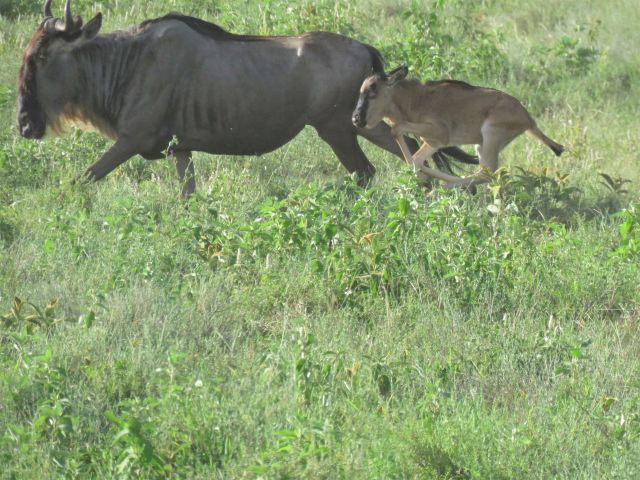
This calf is staying right with his mother unlike the lost calf.
When I know my voice won’t break, I ask George what the chances are that the misplaced baby’s mother will return for her calf. I don’t get the answer I was hoping for as George admits the chances aren’t good, adding that wildebeest aren’t very good mothers.
We drive on until we reach a spectacle that Paul and I can’t quite comprehend. There are thousands upon thousands of wildebeest in this part of Ndutu including lots and lots of young calves. George tells us to look through our binoculars in order to see that this vast herd of wildebeest seems to be endless in all directions! Wildebeest are very noisy so we are inundated with their odd, almost bullfrog like call. George drives slowly through the wildebeest around us and they react like our cattle do on the ranch. The creatures move out of the way of the vehicle, walk a few steps and most begin to graze again but a few will turn and stare at us.
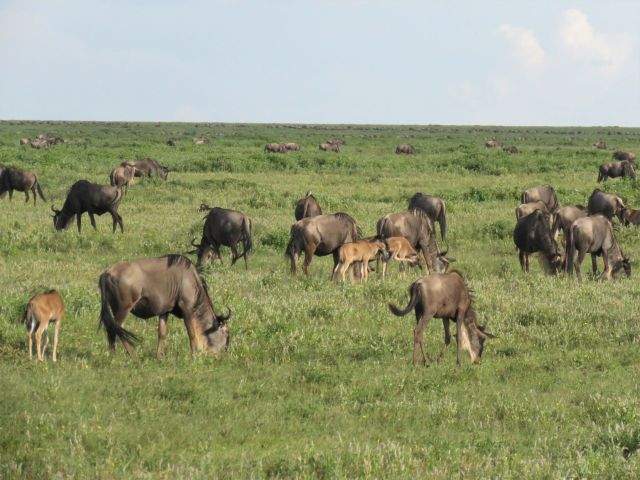
My camera is good for zooming, not good for landscape scenes so this photo does not clearly show the wildebeest in the background. Every dark bump all the way to the horizon is a wildebeest
It is getting late, so we must leave this jaw-dropping wonder behind and return to Njozi. I would have loved to have ended the day with the image of the unfathomable wildebeest migration in my head. That isn’t the case as when we reach the spot where we left the abandoned baby it is still standing there looking confused and very alone. There is another vehicle stopped by the little calf and the looks on those people’s faces mirror mine. Like I have said before, real nature is nothing like a Disney movie.
When we return to camp, Paul and I order our water for our bucket showers and boy does it fill good to wash the grit and the dust off. We go to the bonfire and order a beer from the young man that is manning the liquor cart, (that is another story for another blog). Since we are the only guests tonight the bartender isn’t going to be very busy!

Joseph and his liquor cart. One of the Maasai who escorted us to and from our tent decided to get in the photo too.
We meet David and Useph, who are Wild Sources big cat researchers. David says he met us in 2018 when we were at the Northern Njozi camp. Paul and I can’t truthfully say we remember David but we do have a vague recollection of being introduced to a big cat researcher while there.
While we are sitting at the bonfire, we hear someone whistling, suddenly the Maasai that are sitting near the fire jump up and start running towards the parking area. Someone starts honking a horn and then Paul catches a glimpse of an elephant running down the road with the vehicle in hot pursuit, furiously honking its horn. The people chasing on foot are whistling and whooping. It seems this elephant discovered the kitchen tent awhile ago and took a liking to the various fruits and vegetables inside. We understood that the elephant demolished the tent on that escapade too. The elephant returns now and then but so far, they have thwarted the pachyderm from carrying out another successful theft.
David eats dinner with us and we have a fascinating conversation with him about he and Useph’s work for Wild Source. If I had another life, these two young men are doing what I would love to do. The two men work with other groups who are following big cats in nearby regions such as Ngorongoro crater and they are building up a data base on lions, leopards and cheetahs. They compile movement of the various cats. They work at identifying the individual animals among a myriad of other interesting work. It has been a long day and it will be an early morning so Paul and I say a reluctant goodnight to David and retire to our tent. Nancy
 realityranching