Chiloe Island, Blog 4
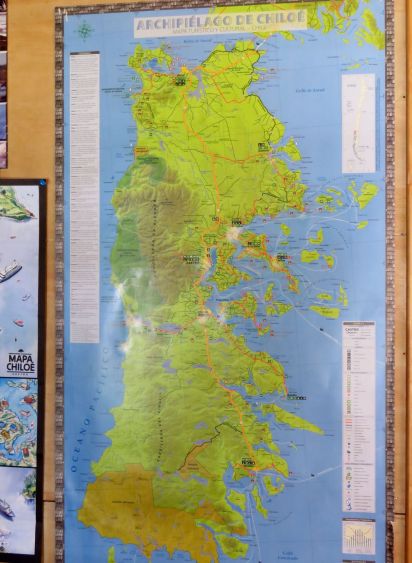
Map of Chiloe Island in our Palifito lobby
I forgot to write about our experience with some dogs when we came back from the supermarket. It was so nice out that Paul and I decided to explore the area that lay in the opposite direction of the town square. Paul has to return to the room for something so I tell Paul I will meet him outside our Palifito since I needed a photo of the front of our hostel.
As I walk down the hallway towards the exit I stop dead in my tracks because there is a young dog, a Pitbull mix, standing in the open doorway looking into the hostel. The panting dog sees me looking at him and his mouth snaps shut as he stares back at me. I quickly look away, then glance back at the brindle dog who gives a half wag with his tail. O.k. the brief tail wag gives me courage to approach the desk where I tell the man sitting behind it my problem, (that problem being that I am scared of dogs). He graciously gets up and shoos the dog away informing me when he returns that the dog is friendly.
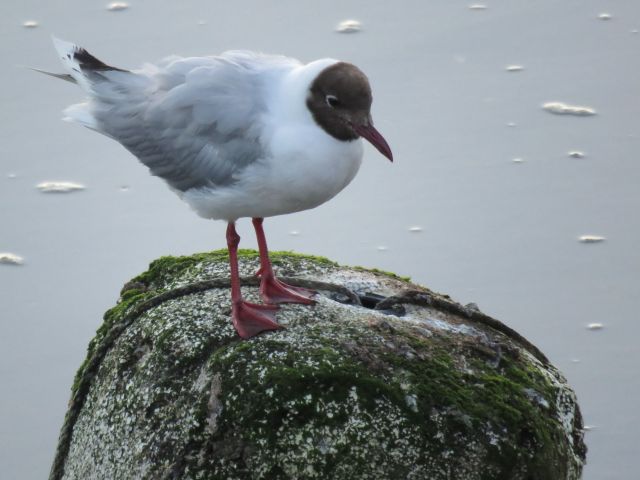
A photo of a calm Brown-hooded gull to take my mind off the dogs
I walk outside and am relieved when I don’t see the canine. I take the photo of the entrance and Paul shows up so we begin our walk. Oh great, the door-blocking pooch has spotted us from across the street and decides to accompany us on our walk. The dog must be an intruder in this area because two German Shepherds, that thankfully are fenced in, are barking frenziedly while running back and forth along the wire fence as we stroll by.
We continue down the sidewalk only to see two free-roaming dogs across the street who start growling at our unwanted companion. The darn Pitbull thinks the safest place for him is staying directly behind us. The fierce duo, their hackles raised, are smart enough to cross the street and try to sneak up behind us which we only notice when we glance back. Paul immediately pulls me off the sidewalk and into the street. Our unwanted companion seeing that his “protectors” have abandoned him, beats a hasty retreat through an open gate into somebody’s yard. Paul and I cut our walk short and return to the Palifito since there seems to be more dogs up ahead. That is one thing that is consistent in Chile as in other South and Central American countries we have been in. There are dogs running loose everywhere.

This photo with the dogs is actually taken in the last town we stayed in but the scene was the same whatever town we were in. Dogs on the loose
What a noisy night it was in and around our Palifito, of course it is Saturday. Some of the guests in the hostel are having a party in the common area with talking and laughing loudly as the music they are playing has to be at full volume. To add to the din, it sounds like every dog in Castro joins in on barking binges every few minutes. The canine serenade always starts when some little yapping dog next to our Palifito seems to be the instigator that sets the rest of the canines off. Thank heavens I have a pair of ear plugs which muffles the annoying noise and I actually get a decent night’s sleep. Paul has no ear plugs so I don’t think he was able to sleep very well.
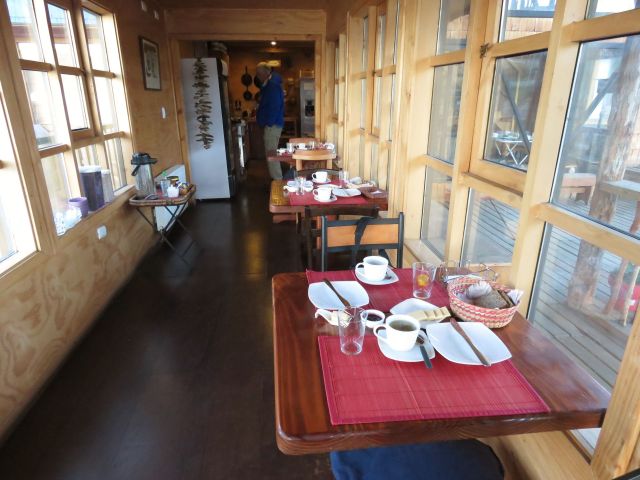
Breakfast area
After eating breakfast, we carry our luggage down to the lobby along with three small plastic bags full of dirty laundry (we both are down to one clean change of clothes). Since we will be back here tomorrow night letting them do our laundry works out great for us. It is nearly impossible to wash out clothes and get them dry when you are only spending one night in any place.

UNESCO church on the edge of Castro
The sky is heavy with clouds as we drive away from the Palifito at 8:30. Our first stop is another UNESCO wooden church in Castro. This lovely church, with the cemetery flanking it on two sides, is locked so all we can do is admire the architecture from the outside. One interesting or maybe sad thing is that an ultramodern school is being built next to this historical church. What a contrast.
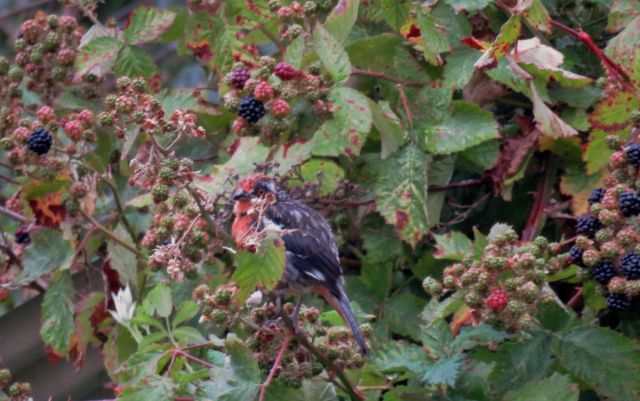
Rufous-tailed Plantcutter
We make frequent stops on our drive south to look at birds. One of the most colorful of the birds we see is the Rufous-tailed Plantcutter. The bright fellow just happened to be dining on blackberries where we stopped to look at another wooden church in a small village. We also see several Green-backed Firecrown Hummingbirds feeding on some flowering bushes at one stop. What a long name for such a small bird!
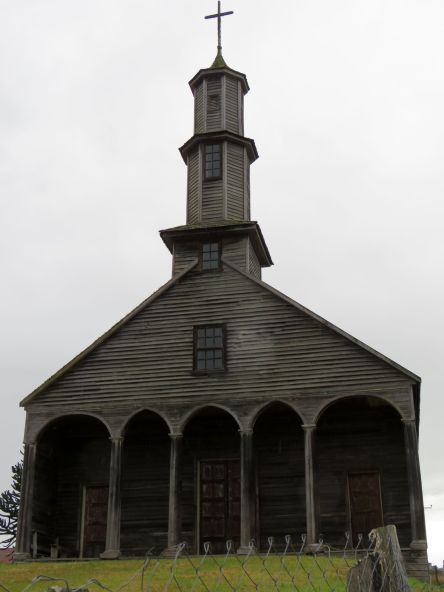
Another lovely wooden church
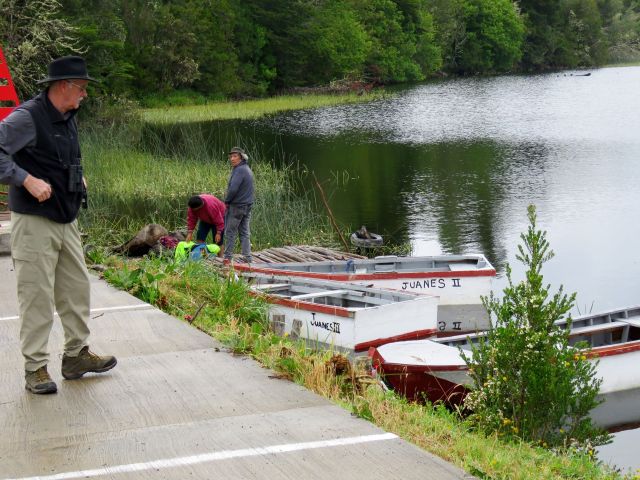
We stop here to look at various water birds. This is where we heard the Chucao that I refer to later in this blog
We turn off on a gravel road that leads to Lake Tepuhulico where we will be spending the night at a private lodge. Rafa makes a call once we are on the alternative road to Patrisio, the owner of the lodge, so he will be waiting for us at the boat dock. Yep, we must load ourselves and our luggage in a boat and cross the lake to get to the lodge. There used to be a bridge across the river that feeds into the lake but it was washed out by a flood a couple of years ago. Patrisio must replace the bridge himself and it is a very expensive project.
We have been driving through light rain off and on and it is spitting a bit when we reach the lake. We see the boat speeding towards us as we unload our luggage, (we leave one in the car that we won’t need), then Rafa drives the vehicle into a farmer’s yard which keeps the car out of sight from the road. Rafa pays the farmer a little money to be able to park the car there. We load the packs and ourselves, say hello to the smiling gentleman and motor out onto the lake. The lake is choppy and occasionally a spray of water comes into the boat. Paul and I are facing forward and so we catch the first spray of water in the face. Enough of that, we both twist to the right and let our rain coats do their job.

You can see the top of the unique lodge as we cross the choppy lake.
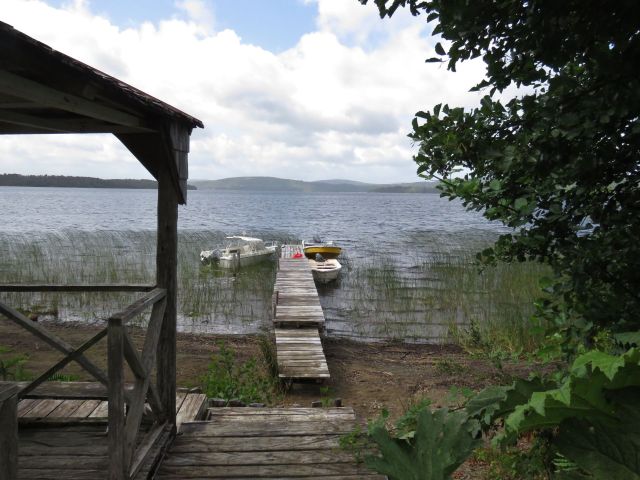
The dock and Lake Tepuhulico
Twenty minutes later we reach the pier and tie up to the dock. We put our luggage in the white van that is parked here and walk to the very unique lodge. This place is lush with trees, bushes and flowers but Paul and I can’t get over the size of the rhubarb here. Many of the gigantic plants have blooms which are also incredible and a bit weird. Rafa tells us that the natives use this rhubarb exactly as we use our scrawny rhubarb at home, it is no different just gigantic.
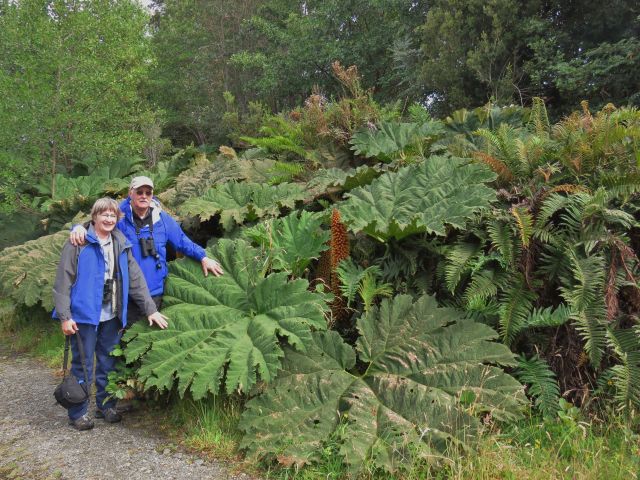
That is some big rhubarb

The bloom of the rhubarb
We place our luggage in our very nice room then Paul and I explore the grounds surrounding the round lodge. The flowers are past their prime but still lovely and the hummingbirds particularly like the red-hot pokers (at least that is what I call them). We return to the lodge after twenty minutes where we are served a very tasty gourmet lunch.
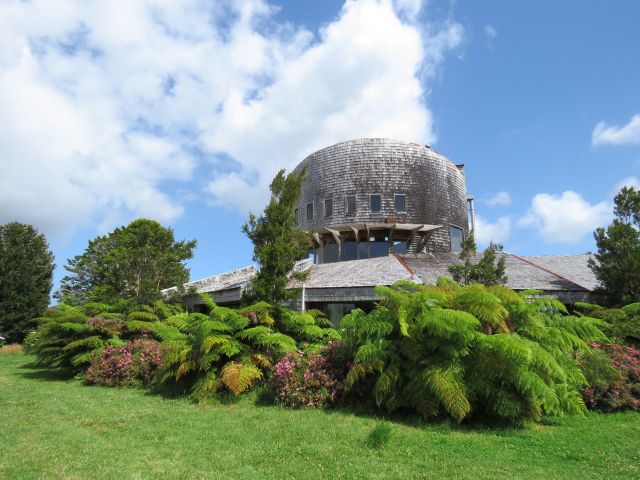
Tepuhulico Lodge. Beautiful
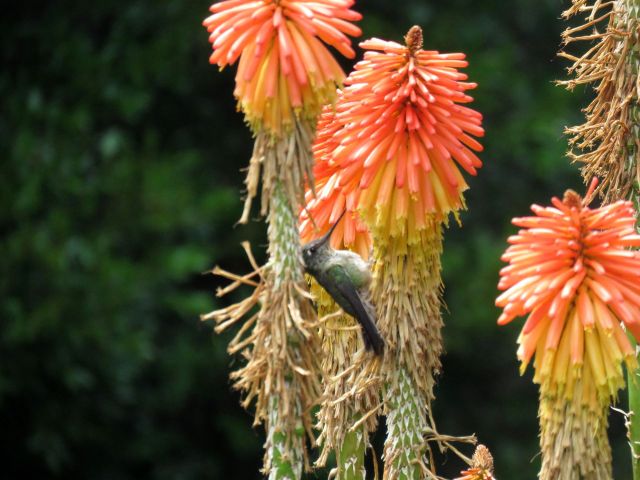
Hummingbird feeding on Red-hot pokers
After lunch Rafa throws his tripod and birding scope over his shoulder and we are off to see what we can find. We are literally just steps away from the lodge when we hear the loud call of the Chucao Tapaculo. We heard this small bird with the big voice this morning when we stopped to bird at a lake and Paul was determined to find it. Rafa told Paul that the Chucao, a ground bird, never comes out into the open but to satisfy Paul he tried to call the secretive bird out to no avail. Today the bird call works as the beautiful fowl can be seen scurrying along the ground toward us although it never leaves the cover of the trees. The bright-eyed bird seems to have no fear of us as it comes to a stop and checks us out as we do the same to him.

Chucao Tapaculo. What a gorgeous bird
Rafa leads us to a trail and soon we find ourselves in a very primitive forest. Rafa said this land is unchanged from the time that Darwin was here. In fact, the owner bought these 40,000 acres nearly 40 years ago and his intent was to keep it as untouched as possible. It appears the man and his family have done a great job. There are trees we pass by that are 800 years old!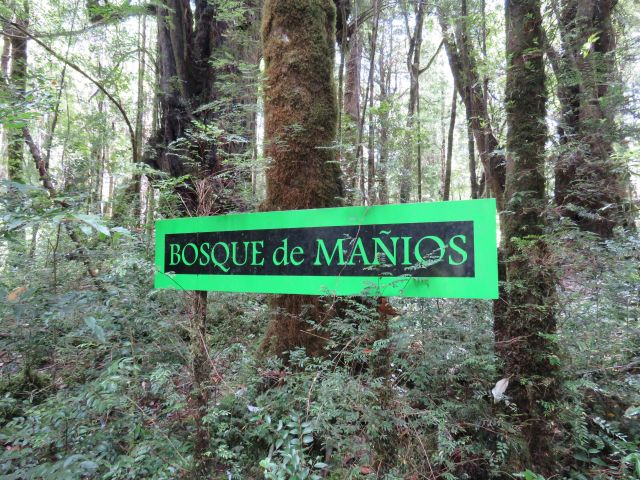
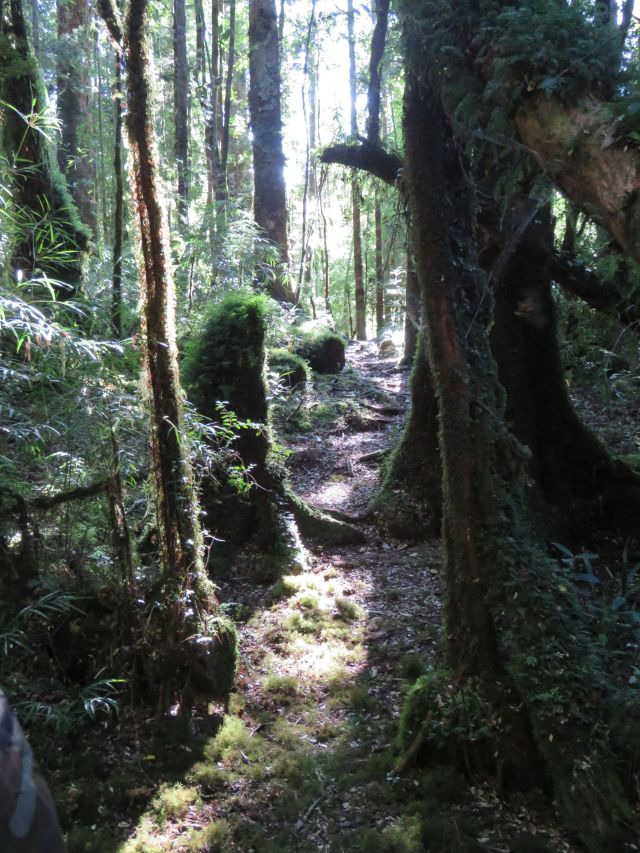
Trail we hiked through the primitive forest
Rafa hears a Black-throated Huet Huet, another forest dwelling bird that doesn’t stray into the open. Rafa plays the song of the Huet Huet and before long the big-eyed bird appears before us. The long-legged avian begins scratching in the litter like a chicken. We watch the bird for quite some time as it scurries around stopping to scratch vigorously through the debris on the forest floor. I ask Rafa if the bird is so relaxed with us that it is scratching for food but Paul says he thinks that the comical bird is being territorial. Guess who is right? Well it wasn’t me. We continue down the trail but it seems the Huet Huet isn’t done with us, the funny bird follows us for several minutes, hopping up on branches, scratching through the litter, and keeping an eye on us.
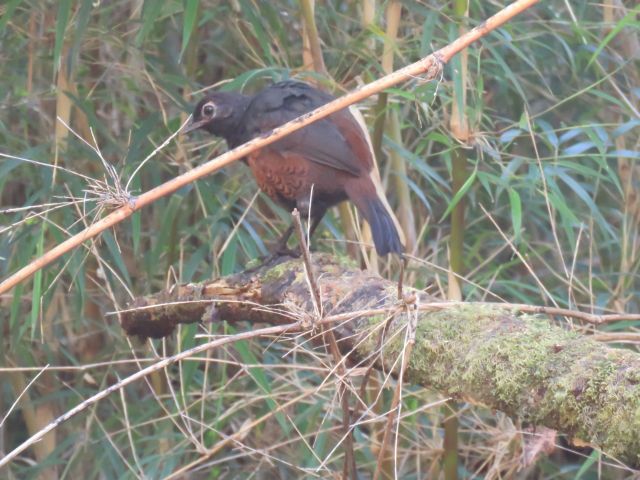
Black-throated Huet Huet the huet is pronounced like whit which sounds like the birds call

The Huet Huet in scratching mode. It was hilarious to see.
Rafa talks about the plants and trees that we encounter on our hike, and we marvel at the multitude of mosses, lichens, etc. that occupy a single rotten log or stump. Rafa even has a tiny microscope which allows us to see a bloom on one of the lichens that is barely discernible with the naked eye. Cool. There is proof that pudu, (a small endemic, rare deer), lives here as we find the deer’s scat on the trail. Rafa leads us to a small waterfall where the water is cascading with enough power to send spray into the now sunny day.
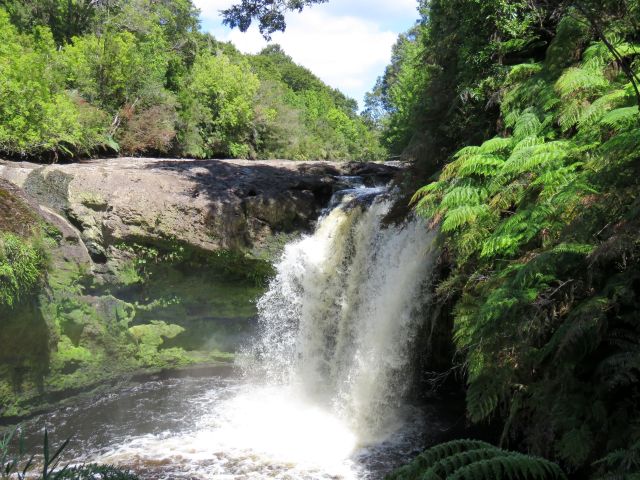
Nice waterfall
The only downside to our trek is that whenever we walk out of the shady forest into open areas and sunshine the stinking horseflies instantly find us and began to harass us by circling and buzzing around us, as they look for an opening to dine on us. Rafa says these irritating flies are females who need blood to finish the fertilizing of their eggs, (I wonder if I am remembering this quite right?). Anyway, the famished horseflies usually appear earlier in the summer but due to weather conditions the pests have only now shown up. Lucky us! The good news for later visitors is that the swarm of horseflies only last about two weeks.
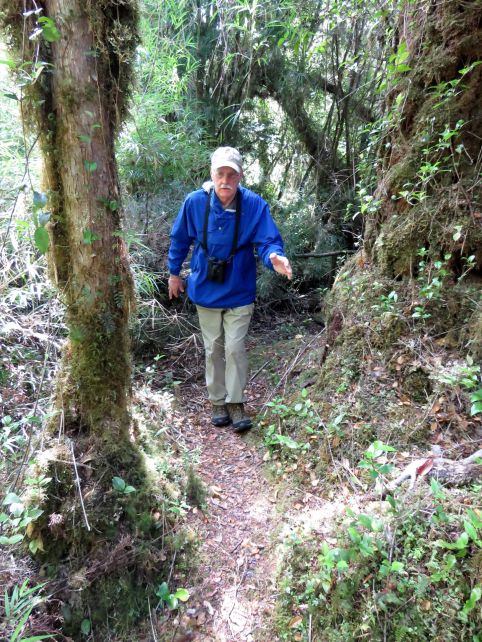
Paul being silly
On our way back Rafa comments that we have seen the majority of the hardest birds there are to find in the forest with one exception which is the Magellanic Woodpecker. I swear we haven’t walked more than a couple of minutes after our guides statement on seeing tough to find birds, when we hear the loud drumming of a woodpecker. There is no question that a large woodpecker is producing that loud noise and Rafa confirms that it is the Magellanic woodpecker. We follow the drumming noise, which the helpful bird continues to produce at intervals for us. We know we are close so begin to scan the canopy of the trees high above us. Guess who spots the handsome red-headed bird first? Not me or Rafa but Paul. The woodpecker is so high up that I can only kink my neck and gaze up through my binoculars for a few seconds at a time but I still get a good look at the magnificent woodpecker. There is something hitting me on the head occasionally and when I look closely at the debris, I realize it is the pith of the tree that the woodpecker is removing to get at whatever insect is hiding in the tree. Rafa tells us to press an ear next to the trunk and listen when the busy woodpecker is drilling on the tree. Whoa, the drumming sound can be heard inside the tree trunk plus when the woodpecker strikes the tree a small shudder can be felt on the trunk too. Think of the power generated by the woodpecker to have that effect on this huge tree.
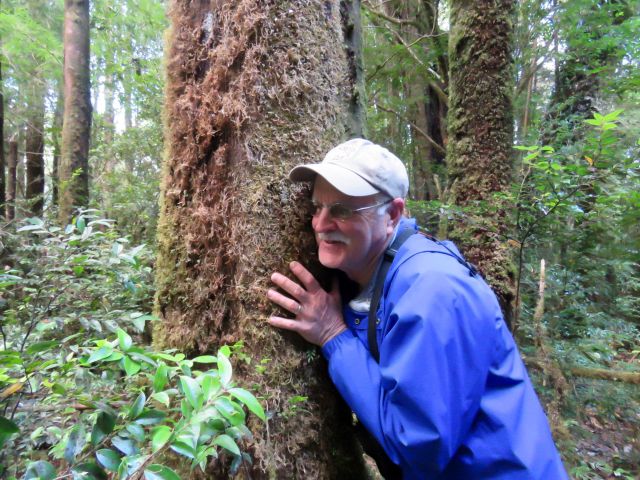
Listening to the drumming of the Magellanic Woodpecker through the tree trunk
Rafa is listening again and says, there is another Magellanic woodpecker drumming over that way as he points in the direction of the sound. Paul and I hear it too and we all begin looking for the second bird. Aha, there it is but we are a little surprised to find another male woodpecker pounding away on a tree. These woodpeckers like most birds are territorial. Rafa soon solves the mystery when he finds the female Magellanic not far from the second male, this must be a family! The female woodpecker only has a small spot of red around her beak with the rest of her head being black which makes her harder to find but eventually Paul and I do see her. Unbelievable, we go from not expecting to see this fantastic woodpecker to seeing three of them.
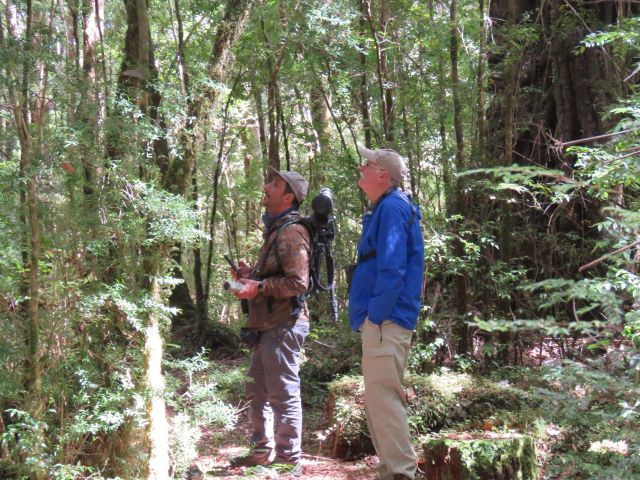
Paul and Rafa trying to pinpoint the other Magellanic woodpeckers we hear after the first one was spotted
We also caught a glimpse and I mean a glimpse of the Magellanic Tapaculo which is very small, black, and scurries around on the forest floor like a mouse. Another bird that played hide and seek with us was the Thorn-tailed Rayadito which is probably about the size of our smallest wrens but by gosh we finally got a look at the tiny bird.
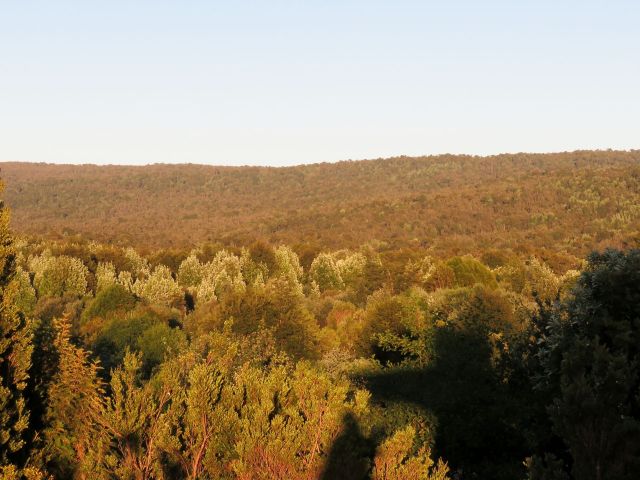
The untouched forest seen from the lodge balcony that Patrisio and his family have conserved
We return to the lodge after our very enjoyable two-and-a-half-hour hike and just relax before dinner. We enjoy another tasty meal prepared by the young chef Pedro and then retire to the balcony and wait in hopes that some pudu will appear to graze on the lawn. We sit patiently for over an hour and as darkness begins to fall the air is getting chilly. There is an owl hooting in the distance and Rafa identifies it as a Rufous-legged Owl. When it appears that no pudu are coming, Rafa suggests that we go see if we can find the owl. As we are walking towards the door, I see something move on the edge of the lawn. Even though it is fairly dark I can see the shape of a small animal that looks sort of deer like. Rafa shines a red light on the creature which catches the animal’s eyes and he says “that is a kodkod”, (a rare cat which is the smallest cat in the Americas). Paul reacts by saying “I’ll be damned” but barely finishes this declaration before Rafa corrects his id of the animal saying that no, it is a pudu.
To see a kodkod would have been unbelievable as Rafa tells us that he has seen the endemic cat maybe ten times in his twenty years of guiding. Rafa’s initial thinking that this was the Kodkod was because the grazing deer’s eyes were so close to the ground. The Pudu is the world’s smallest deer, ranging from a foot to a foot and a half tall! We look at the pudu as best we can through our binoculars and our assessment is that it is a buck due to the small antlers. Our other observations are that this fellow is really fat and also that he is at the high-end of the height range for Pudu.
We wait a bit longer, watching the little buck munch happily on the lawn but no more Pudu come to join him. Rafa decides we should go look for the owl who seems to be quite close. I think the owl is having great fun with us as we will follow the sound of his hooting and Rafa will play his lights over the trees only to hear the owl hooting behind us. We play the game walking this way and that until we finally cry uncle and head for our rooms and bed. What an incredible day we had. Nancy
 realityranching
Sadly there are a lot of emaciated, free roaming dogs here too. Though I’ve only been threatened by one of these mongrels, I take comfort having my trusty walking stick with me on my strolls. Nancy, I didn’t know you had fear of dogs.
Dang, you keep”scoring “ with sightings of rare bird species and then the little deer. I’ll have to google what pudu looks like.
The picture of Paul with his ear next to the tree listening to the woodpecker reverberations reminds me of the picture of Lois smelling the bark of the ponderosa pine.
Good blog. Unfortunately viewing your pictures on my iPhone doesn’t do them credit.
JEM
Most of the dogs in Chile belong to people and are healthy, they just let them run free.
Once I resize my photos they are not as sharp anyway. Nancy