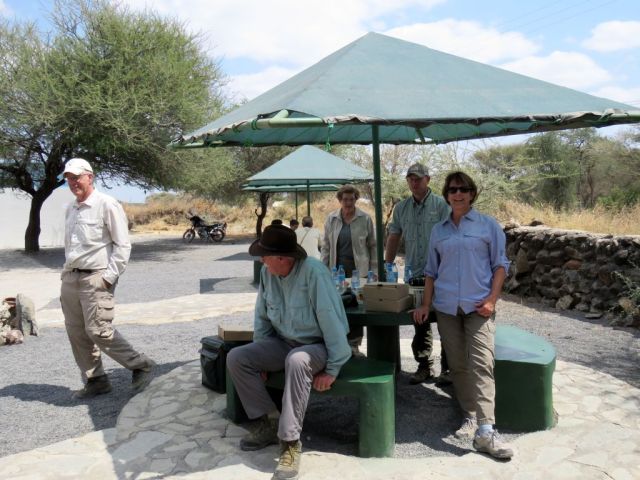
Northern Serengeti, Part 8

Northern Serengeti, part 8

Boy was it noisy last night, mostly from the wildebeest that ventured very close to the tents. The wildebeests were grunting, (they almost sound like bullfrogs with varying pitches), every time I woke up. I swear one critter was standing right by our tent as every time it grunted the sound reverberated through the tent. The wildebeests’ conversations didn’t keep me awake but I did enjoy listening to them for the brief moments I was awake.
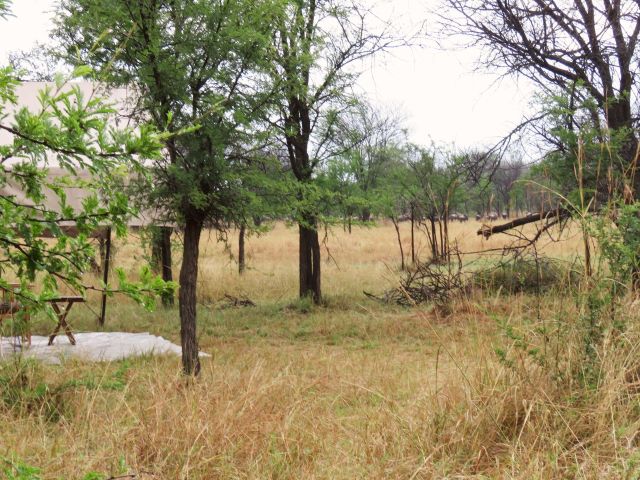
You can see wildebeest in the background if you look close. I took this photo from the front of our tent
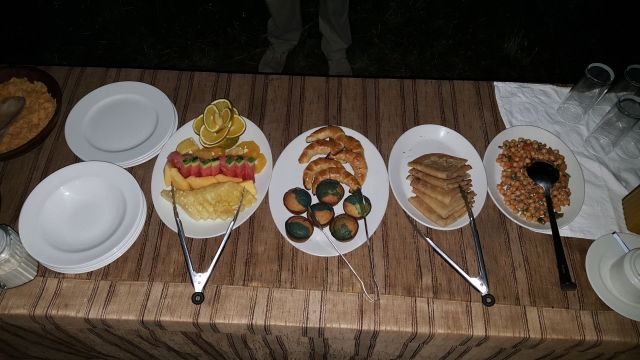
This was part of our breakfast fare at Njozi camp. You could also order eggs, bacon or sausage. Jesse’s photo

We were up early for breakfast and left camp shortly after six. George drives to the river and there are wildebeest everywhere. There are ten or eleven crossings along the Mara river where the herds of wildebeest cross. As we near one of the crossing places, (4 maybe?), wildebeest are amassing near the river bank. We surely wouldn’t be so lucky to see a crossing right off the bat. Some people sit for hours and never do see this phenomenon. George parks the Toyota a fair distance away from the river and we watch the wildebeest approach the bank, peer down at the water, then move away. The skittish animals do this several times before turning around and walking away. George has warned us that this is often the case when hoping to see a crossing, you can never predict when or if the wildebeest will actually traverse the crocodile infested river.
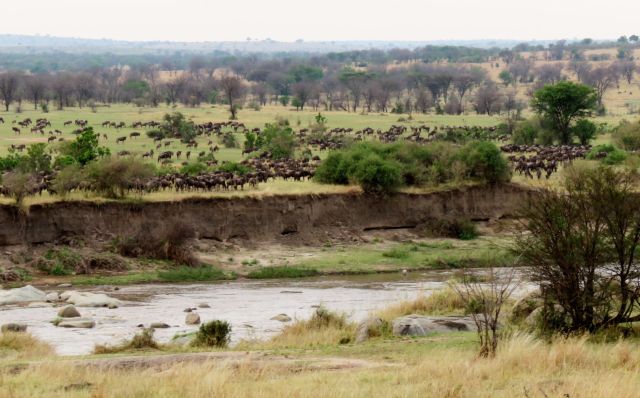
Wildebeest thinking about crossing the Mara

Because of the rain, yes George calls the weather weird again, our guide decides to cross the Mara into what is known as the Lamai Wedge. The Lamai Wedge is land that belongs to Tanzania north of the Mara River that borders Kenya. The wildebeests are crossing from where we are situated now over to the Lamai Wedge and you want to see the wildebeest coming towards you. So, we drive across the “bridge” which in our county would be called a low water crossing. This cement structure only has about two feet to spare on each side of your vehicle, yikes. The water is a few inches from going over the top of the bridge and George tells us at times you can become stranded on either side if there is a down pour of rain. To add to the atmosphere there is a dead wildebeest that obviously didn’t make it across the river floating next to the bridge and vultures are feeding on it. Yeesh.

I think this is the bridge that crosses over to the Lamai Wedge. You can see a couple of wildebeest carcasses against the right side of the bridge. Jesse’s photo

George drives to crossing 3 where a large number of wildebeests, (or gnus), are accumulating. Many of the long-headed animals are packed together standing next to the steep bank. Hundreds more are scattered throughout the area behind those next to the river. On the horizon, a line of wildebeests is on the move so while we are waiting to see what the nearby herd is going to do, Paul begins to count the marching wildebeest. When the far-off parade comes to an end, Paul has roughly counted eight hundred gnus. We estimate there must be at least one thousand wildebeest waiting at crossing three.
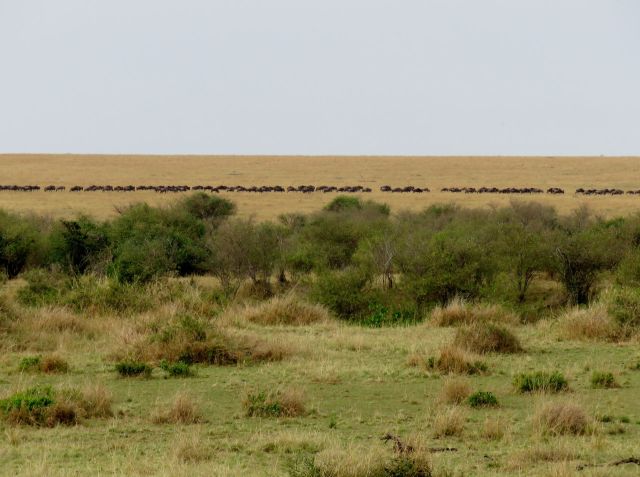
These are the line of wildebeest that Paul was counting

George finds us a good place to park, well away from the river, and we settle down to see what the gnus will do. There are lots of vehicles all around us and plenty more trucks on the other side where the herd is standing as they contemplate whether they will or won’t brave the Mara river.
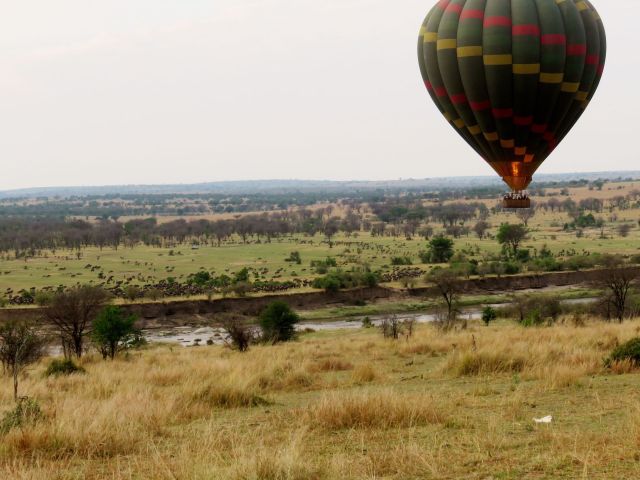
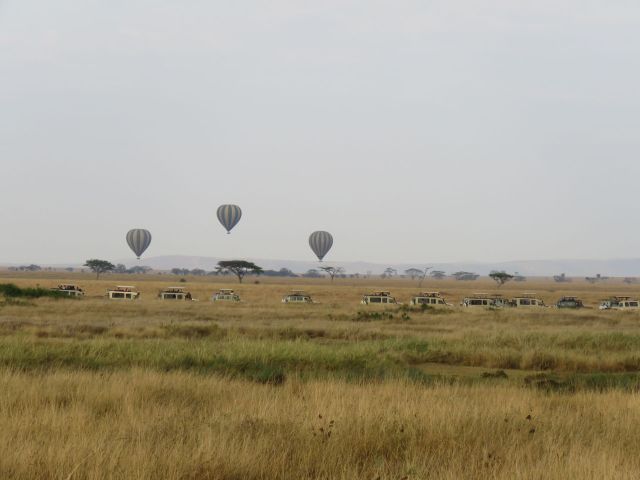
Hot air balloon getting a different perspective of the Serengeti

Elephant feeding near the river

There is other wild life around too, some behind our vehicle and more across the river. We see elephant, zebra, gazelles, and giraffe. At sometime during the waiting game we all need a bathroom break, so George must drive us away from the clutter of our fellow tourists. Our guide finds a fairly innocuous place to “check the tires” and we women clamber out and walk around behind the truck. There are some impalas, wildebeest, and zebra not far away who pay us little mind. While we three gals are using the open air restroom, Jesse tells us we have a hyena for company. We laugh at Jesse’s attempt to scare us but he insists that there is a hyena. Looking behind us sure enough there is a hyena skulking behind some bushes peering at us. As we stand up the peeping tom turns and runs away. Well, that is a new experience for we three ladies that will probably never happen to us again😊.
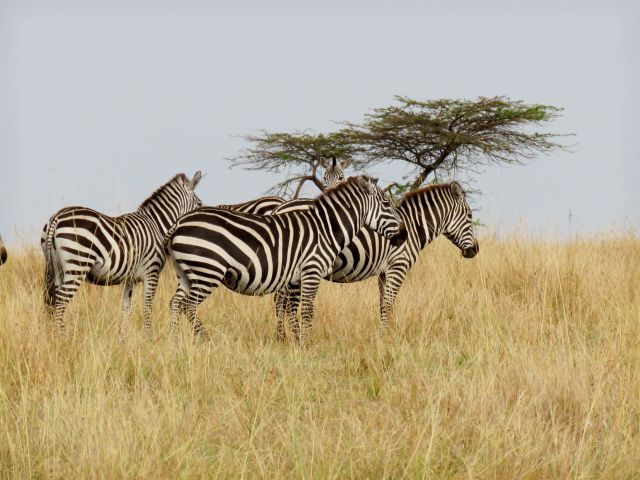
Zebra relaxing where we took our bathroom break

Jesse and George visiting at some point during our four-hour wait.

The wildebeest repeat the antics of the first group we watched, the gnus approach the river, then turn around and walk away. Twice it appears some of the gnus are ready to step into the river but they end up jumping sideways as something real or imaginary spooks them. We have been sitting here for nearly four hours and some of the Kansas crew are getting a bit antsy. George insists that we should be patient yet and it isn’t long after his advice that a wildebeest jumps in the water and the chaos begins.
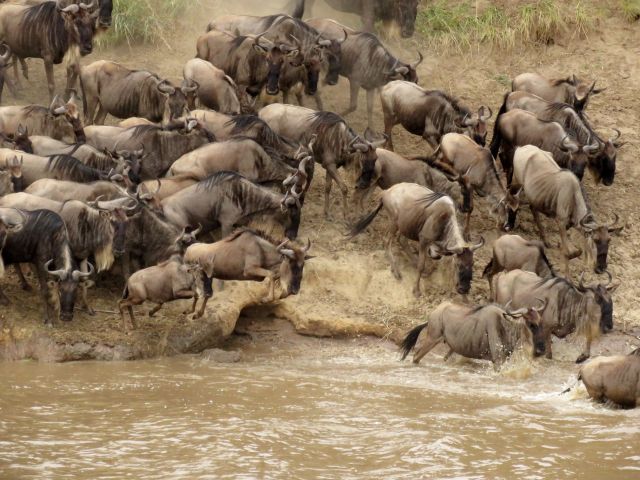
Wildebeest starting across the Mara River

George has told us that as soon as one of the gnus touches the water the rest of the bunch will blindly follow. He also said that all the guides will speed down to the river once the crossing begins to procure a good position to watch the frantic beasts swim the river. George wasn’t kidding about the guides as suddenly it seems we are in a cross-country race with no rules applied. I am into it at first, saying “go George go” until I see that this is turning into a melee. The safari vehicles are jostling as close as they can get to each other without running into anybody. Not only that but we are parking just a few feet away from the river bank. This is nuts.
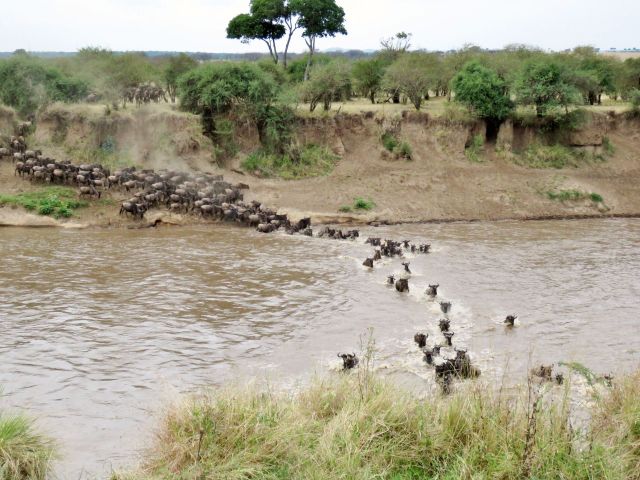
Pouring down the river bank

Well, George does get us a good location as we are directly across from where the nervous wildebeest are launching themselves into the Mara and swimming for all their worth. The poor creatures know that there is danger lurking in these waters in the form of big crocs but we see no evidence of the toothy reptiles. The wildebeests are dangerous to themselves as many launch themselves into the air, preferring to jump into the river instead of just stepping into the water. Crocodiles often wait right at the river’s edge so maybe they leap from the bank in hopes of clearing the jaws of a waiting croc. Unfortunately, the gnus that vault into the air often come down onto the backs of those in front of them taking the chance of breaking a leg or injuring the animal they land on.

You can see how they might jump on top of each other as they launch themselves off the bank

As the front-runners make it to the opposite bank they begin to struggle up steep inclines where all of we tourists are parked. There is half a dozen of the wide-eyed gnus that are clambering over the edge right by our truck. The terrified animals actually turn back towards the river and I fear that we have scared them into jumping back into the Mara to return to where they came from. I hear myself saying “This is not right” several times and then I tell George to pull up so the poor animals can find a way through the fence of vehicles. George does so only to have some knot head immediately pull his vehicle forward to take our spot, again impeding the panicked animals. Fortunately, a few of the wildebeest duck their heads down and weave through the maze of trucks and the rest of the herd follows them. Everyone in our vehicle is upset, we all work or have worked with cattle and know what extra stress this is putting on the wildebeest.
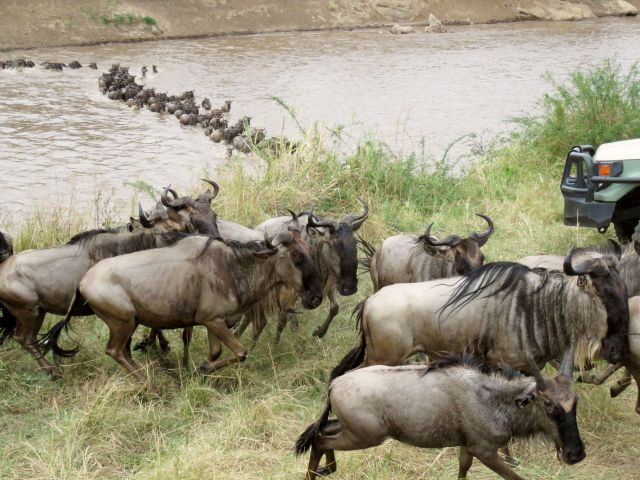
The Wildebeest coming out of the Mara river and running the gauntlet of tourist vehicles

As we are voicing our disapproval of the fiasco on this side of the Mara something even more incredibly stupid is taking place on the other side of the river. The tourists have clambered out of their vehicles and walked to the edge of the river bank to take pictures and in doing so they cut off the rest of the wildebeest that are trying to get down to the river. These morons have placed themselves between the river and a bunch of wild animals that are trying to follow the two or three hundred gnus that are in the river or have crossed the river. These ignorant fools are lucky that the wildebeest put on the brakes and turned around instead of continuing to the Mara and trampling them.
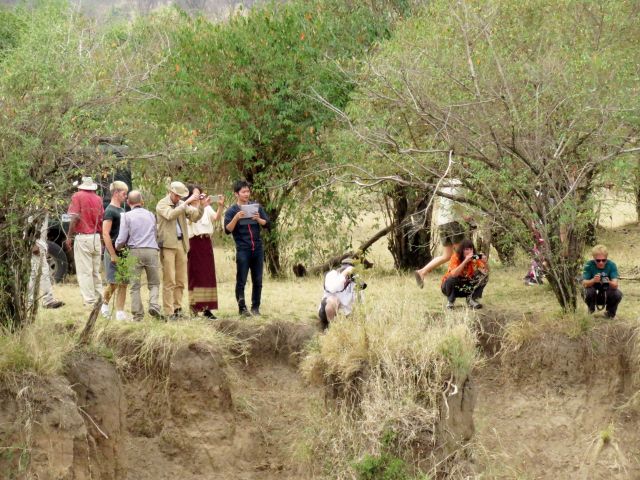
Are you kidding me!

We are not done yet with this drama. Several of the guides on our side of the river begin yelling over at the guides who let their customers disembark from the trucks. I’m sure they are letting them know that they have messed up big time. George tells us that if any Rangers had been here the guides would have had to pay a big fine for letting their clients out of the vehicles. The guides obviously knew no rangers were close by. With ten crossings to patrol there is no way the rangers can man every one of them.  We tell George we are ready to move on. Yes, we were glad to see the crossing but none of us wants to be part of that disgusting circus again. There is so much adrenaline shooting through me I am trembling. Part of it is the excitement of the crossing and part of it is my anger at the way we tourists behaved.
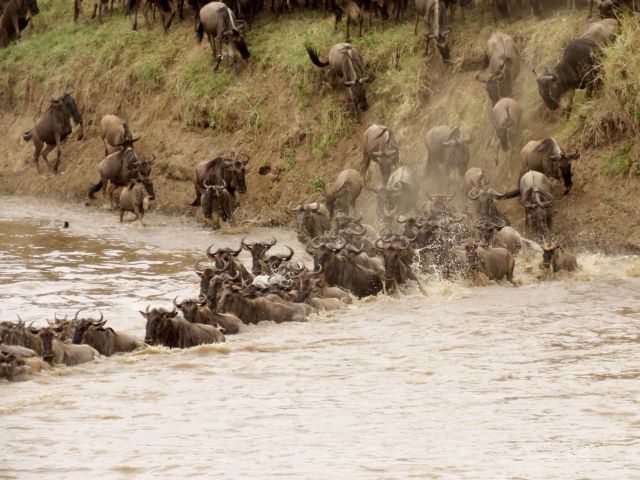
The second crossing

There is more current at this crossing

A half-grown calf jumps off the bank and is undercut by an adult. Can you see it?

George has driven maybe a quarter of a mile when he slows down and says he believes more wildebeest are thinking about crossing here. I don’t know if this is another crossing or still part of crossing three. There are only a couple other vehicles here and we decide to see what happens albeit we don’t go right down to the river bank. I’ll be darned, the gnus begin plunging into the Mara and there is no human folly messing anything up at the present. The wildebeest are unimpaired coming up the river bank and once they are back on dry ground they walk calmly down the road. The guides who are parked on the other side keep their occupants inside the vehicles this time and they also park back from the edge of the river so the gnus are moving freely towards the Mara. That is until one moron drives his truck directly through the line of gnus heading for the river so he can park on the edge of the bank. Again, the herd turns and runs back inland. At least this time seven or eight hundred of the migrators made it across the Mara.

A mass of wildebeest

Jumping as if their lives depended on it

All was going great until the Duma vehicle cut the gnus off. Why??

Feeling fortunate to have seen a second crossing that was more acceptable than the first one we move on. We drive along the Mara away from the wildebeest crossings to see if we can find any crocodiles. There are plenty to be found from small ones to humongous ones. There are plenty of hippopotamus in the river, including one big mama and a few month old baby. Vultures seem to be everywhere taking advantage of the numerous wildebeest that perished while trying to cross the Mara River.

A large crocodile showing off his sharp teeth.
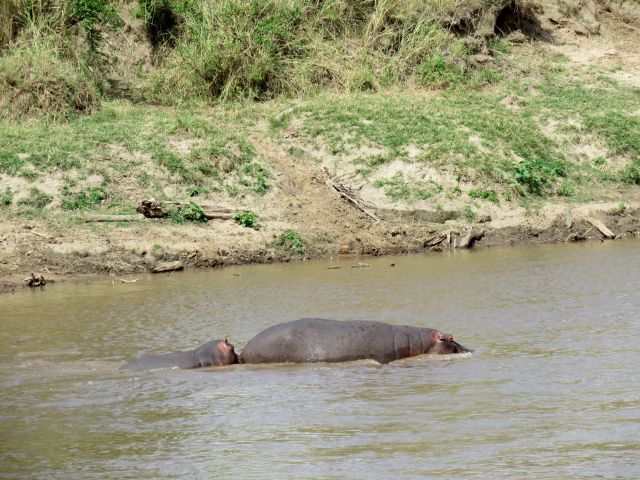
Mama hippo and baby

Vultures feeding on carcass of an unlucky gnu.

George takes us to more Kopjes where once again we search for lions or leopards. One thing we see plenty of on our drive are vultures and why not. We see or smell carcasses occasionally so there is plenty for nature’s undertakers to eat. We also see lots of colorful agama lizards, well the males are colorful dressed in their blue and red skin. There are also the ever-watchful Klipspringers perched on the top of rocks, still as statues, staring out into the landscape as they watch for danger. You can always count on finding hyrax when checking out kopjes.

Interesting rock in Kopje country
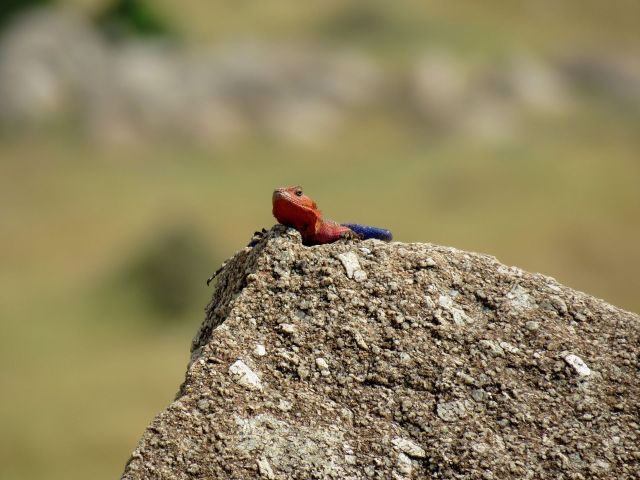
It is a little hard to hide when you sport these bright colors. Agama lizard
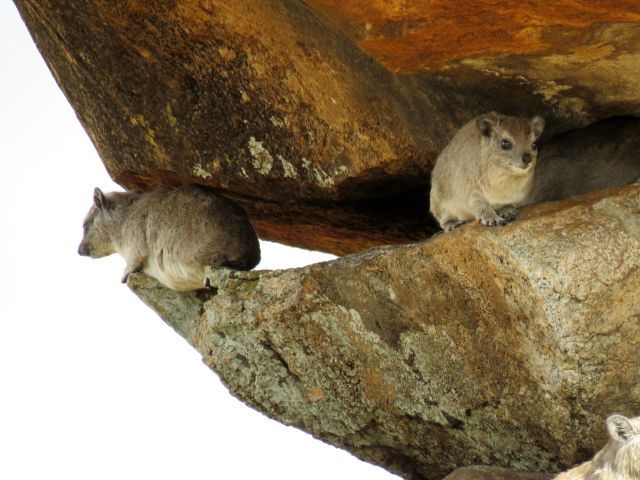
Two of the numerous hyrax we saw.
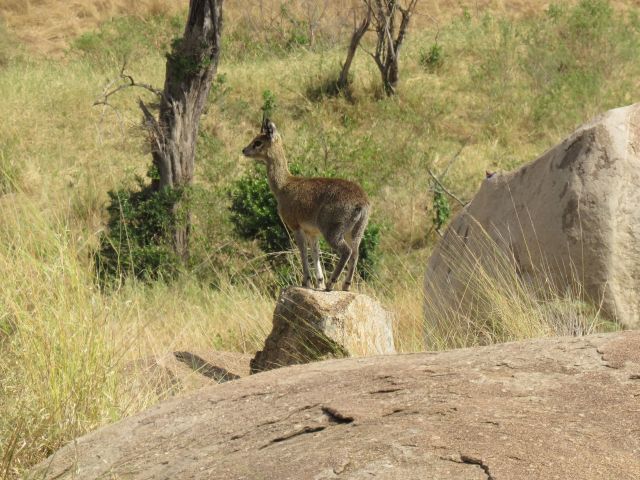
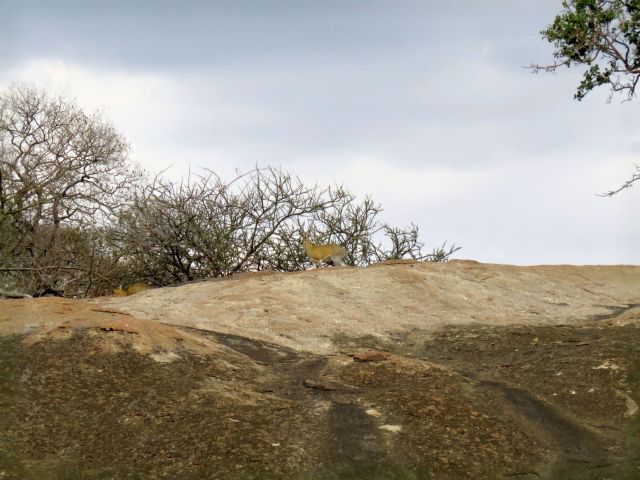
Klipspringer keeping watch

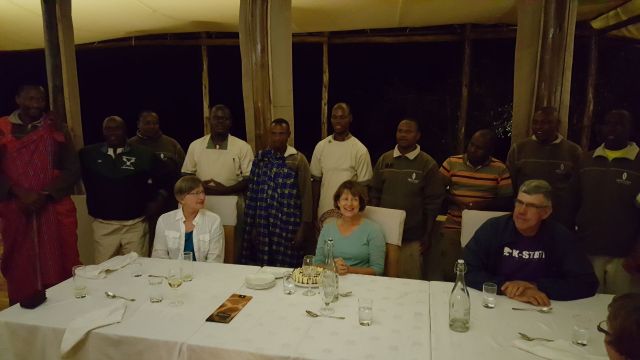
Time to go back to Njozi after another interesting but frustrating day. Before dinner is served there is a heavy rain so no nibbles by the campfire tonight. It is a special evening again as the youngest member of our group is a year older today. Although the participants are less than they were for Jennifer’s birthday celebration the staff’s enthusiasm is just as great. The very young chef leads the others in a conga line around our table. The chef whirls and twirls with Jesse’s birthday cake in his hand. He pretends to give it to the other guys sitting at the table, only to snatch the cake away at the last second. It is hilarious. Finally, the animated chef presents the cake to Jesse and the chant to “cut the cake” rings through the air. It is a great way to end the day. Happy Birthday Jesse!
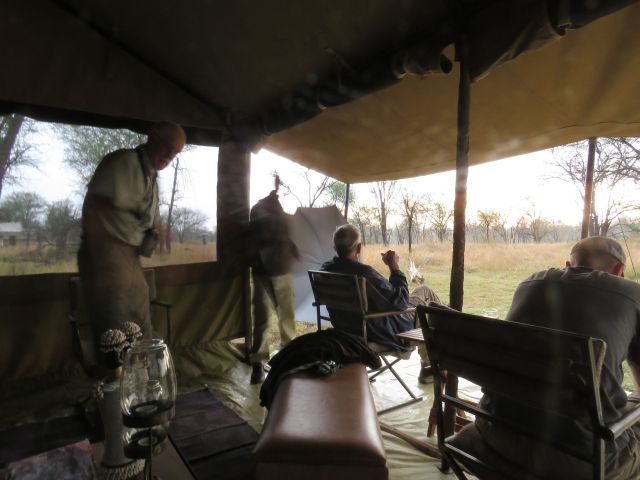
Waiting out the rain in what I called the lounge tent
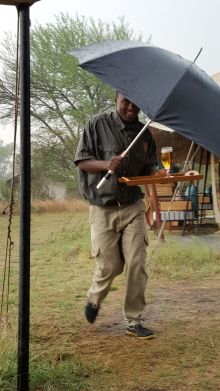
Heavy rain doesn’t keep Amos from delivering Jesse a beer, nor does it keep that wonderful smile off his face. Jesse’s photo
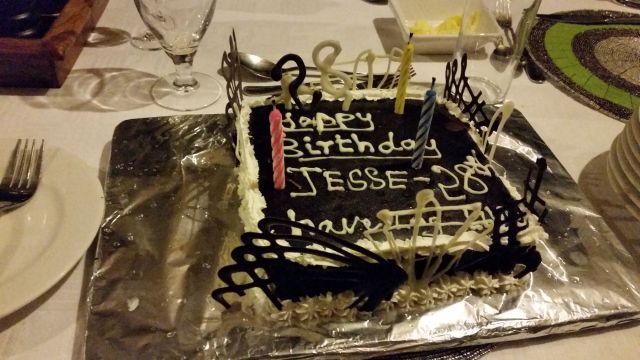
Jesse’s birthday cake. Pretty fancy. Jesse’s photo

Coming soon, more adventures in Northern Serengeti


Driving to Northern Serengeti and Njozi Camp, Part 7

Driving to Northern Serengeti and Njozi Camp, Part 7

Last night instead of lions and hyenas we were serenaded with rolling thunder and the pounding of rain on our canvas tent. Um, this is supposed to be the dry season. George had called the afternoon showers that occurred when we were at Kusini “weird”, so I wonder what he will say about this deluge.

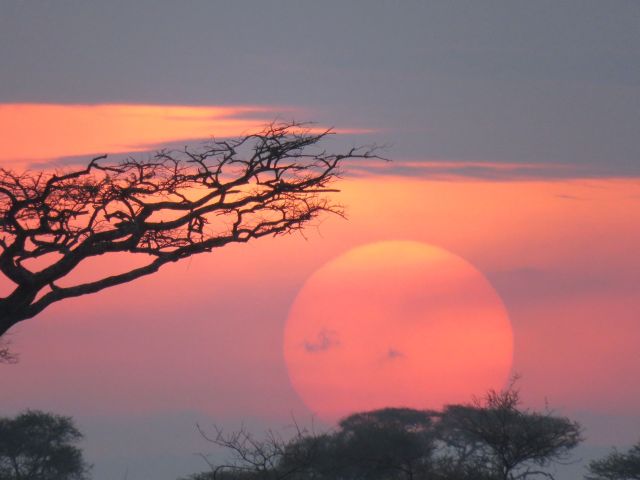
What a sunrise we are treated to.

We are up before daylight and Paul turns our flashlight on, sticks it out the tent opening and waves the beam of light into the darkness. Before long a staff worker is trotting our way, he calls out “Jambo” and escorts us up the soggy path to the main tent. The rest of the crew has arrived and soon we are clambering into the Toyota that we have spent so many hours riding in the past several days. We do take time to admire and snap photos of the incredible sunrise that has greeted us this morning.

As we drive over muddy roads in the predawn we see a grazing hippo with a tiny baby at her side, but it is to dark for a decent photo. We see more hippos out grazing that are startled by our presence. They gape at us and break into a stiff-legged run heading for the safety of nearby water.

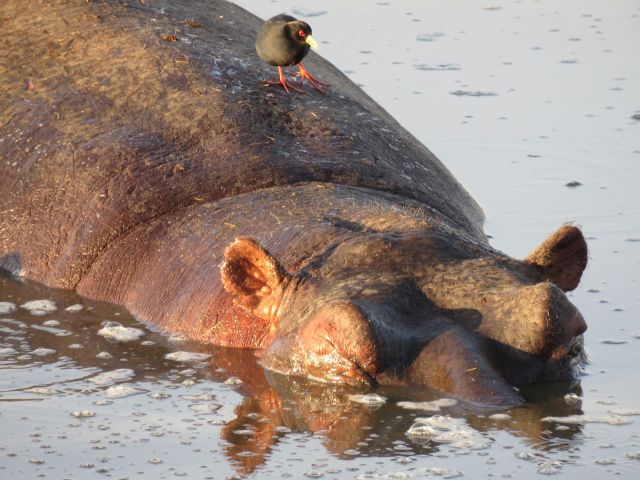
No photos of the early morning hippos but here is a hippo with a black crake walking on its back

It seems that the heavy rain has dispersed the wildlife because we really don’t see many critters. Carl spies a bird in the road which appears to be dying to me, so I turn my head. I only look back when Paul studies the tiny bird closer and proclaims that there are two birds and they are fighting. George takes a look, identifying them as cisticolas and says when they fight the small birds lock legs and whack away at each other using their wings and beaks. There are lots of feathers scattered all around the birds proving that this is a vicious fight. I suppose the birds spat is over territory and/or a female. One of the cisticolas breaks free and flies away with the victor literally on his tail to make sure the loser leaves the area.

Some of the safari vehicles lined up looking for the leopard. I took this photo before we knew there was a leopard in that field of grass.

We turn back for Ang’ata camp as we are scheduled to eat breakfast at eight o’clock. Up ahead of us we see lines of vehicles on parallel sides of a field of high grass and bushes. One of the guides we pass by points to the field and tells George there is a leopard in there somewhere. Jesse soon finds the head of the leopard poking out of the tall cover. Jesse tells the rest of us where to look, (the cat is to our left, near the bank, close to the dark green bushes, etc.). Okay I’m making all that up to demonstrate how darned hard it is to tell people where the subject you are looking at through your binoculars can be found. All of us end up finding the regal feline except Connie, darn it. It is hard to keep track of the leopard as he ducks in and out of sight. Luckily, the leopard briefly walks out into the open and we get a really good look at it. The beautiful cat is so far away that I don’t attempt a photo instead I just enjoy looking at him through my binoculars. When we arrived, there were around twenty vehicles parked along the roads bordering the field. There are more trucks streaming in and since the leopard has disappeared again we say “good enough” and head on to camp.  A great way to end the early morning game drive!

The leopard is in about in the middle of the photo. Very hard to see. Jesse’s photo

After eating breakfast all of us finish last-minute packing and let the staff carry our luggage to the main tent. Paul presents the card containing the tip money for the staff to the manager who thanks us. Since George hasn’t returned most of us walk up and down the paths leading to the tents to get some much-needed exercise. George pulls into the camp entrance just before ten, it seems there was still some problem getting everything to work on the new computer system, plus he had to drive to the ranger station to fill up with gas and also to buy water for us. We pull away from Ang’ata at ten o’clock and begin the final leg of our safari.

Waiting on George

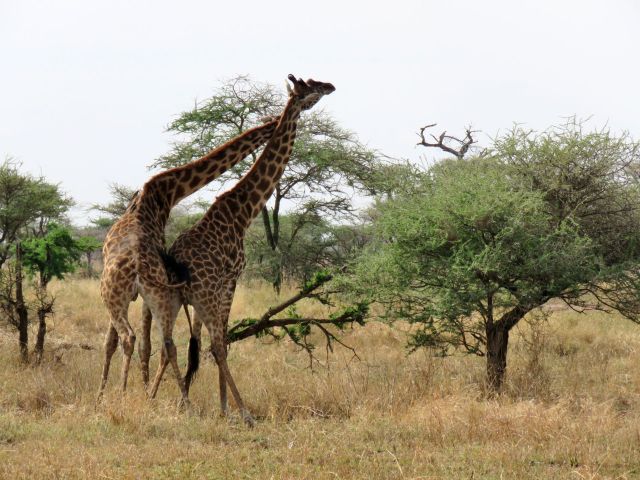
George informs us that there were two bull giraffes fighting just outside of camp when he came back so he is hoping the duo are still there. The towering giants are still present and are using their heads like sledge hammers to whack each other. The giraffe on our left seems to be landing more and harder hits on the slightly smaller fellow. We watch for several minutes and when we leave the combatants are still sparring.

Sparring Giraffes

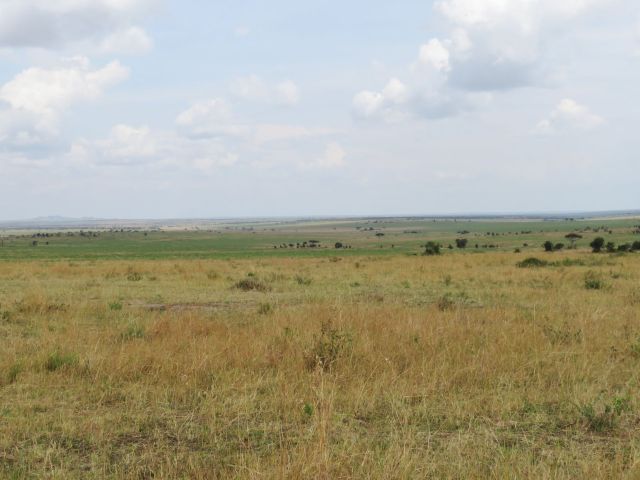
Somewhere on our drive to the north.

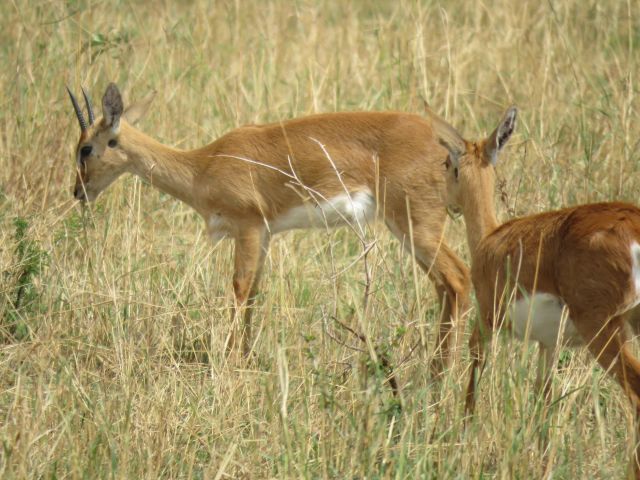
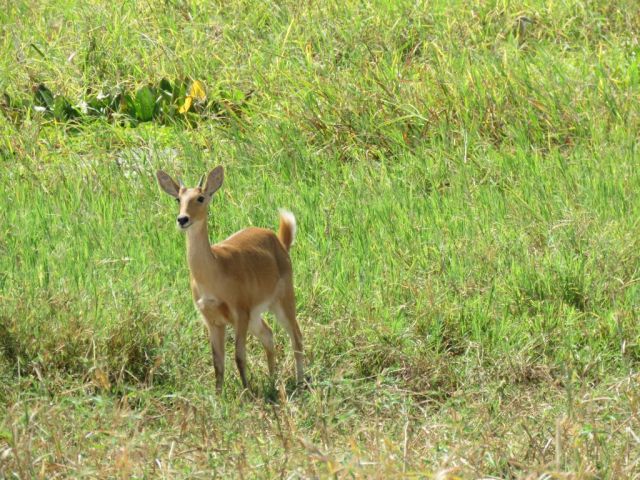
I think these were the only Oribis we saw.

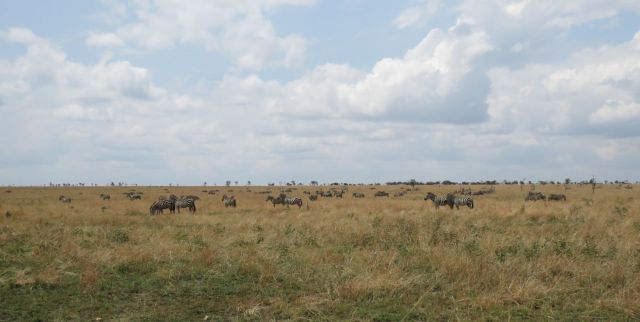
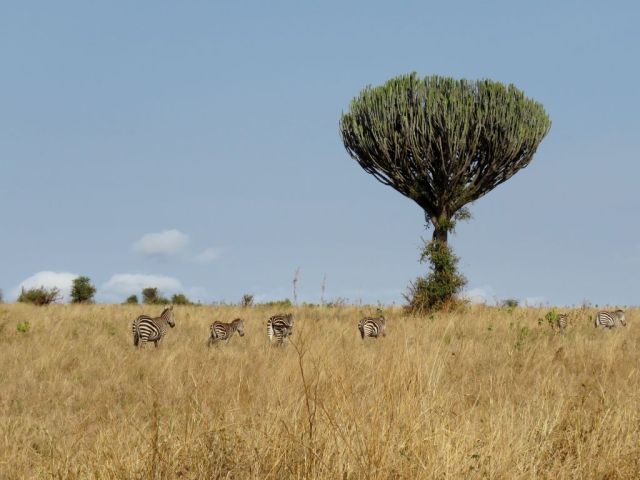
The farther north we drive the landscape becomes greener. We also begin to see lots of grazers. Topi, hartebeest, impalas, Thompson gazelles, cape buffalo and giraffe. The eye opener however is the herds of zebra that go on for several miles. We all agree that we had to have seen thousands of the striped beauties.

A try at showing how many zebra dot the landscape

This photo shows how a predator could get mixed up trying to sort out an individual zebra.

The zebra with its rear end showing has brown shadow stripes. I think we have only seen this a couple of other times.

George finds a spot overlooking a lush valley and decides this is a good place to have lunch. We place the lunch boxes on the “bonnet” of the truck and enjoy looking over the sweeping vista while we eat. There is wildlife scattered over the verdant valley but they are barely visible to the naked eye. When scanning with binoculars we find gazelles, wildebeest, zebra, and some warthogs.

Having lunch on the way to Northern Serengeti. Carl’s photo

Our view at lunch

Carl checking things out

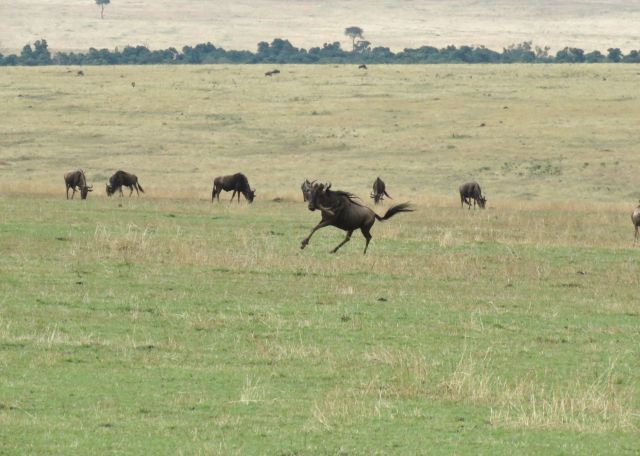
Continuing our northern drive, the herds of zebra are replaced by thousands of wildebeest. I wish I could do justice with a photo to the seemingly endless numbers of the odd-looking critters but it is just impossible. We stop to observe one wildebeest acting completely silly as he gallops and bucks and entices a couple of his herd mates to playfully fight.

Wildebeest everywhere

The playful wildebeest

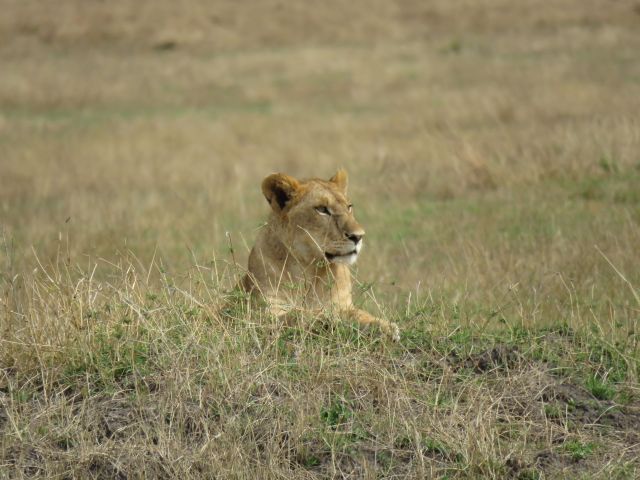
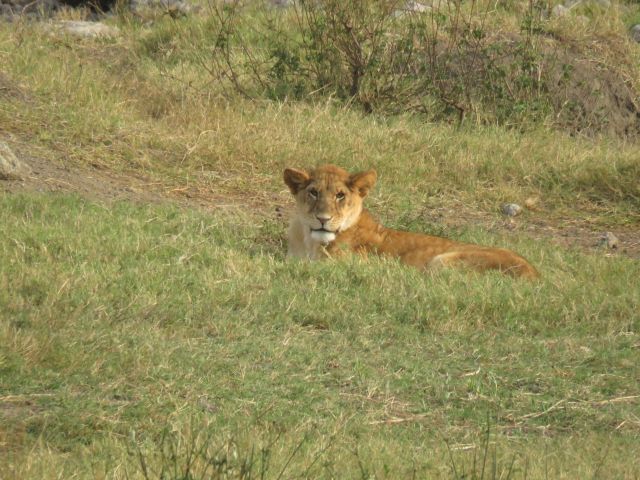
As we continue driving next to the legion of wildebeest we notice a vehicle parked a few hundred yards away observing a couple of lionesses. We drive closer to the splendid pair; one lion is lying in the open while the other girl is partially obscured by a mound of dirt. Eventually, both cats stand up and walk very close to the truck, heading in the direction of the enormous herd of wildebeest that are grazing a few hundred yards away. The wildebeests are browsing in a field of short green grass that has been burned. There is a plot of tall dead grass across the road from the wildebeest which will give good cover for the lions.

Looking toward the herd of wildebeest

Crossing behind our vehicle towards better cover

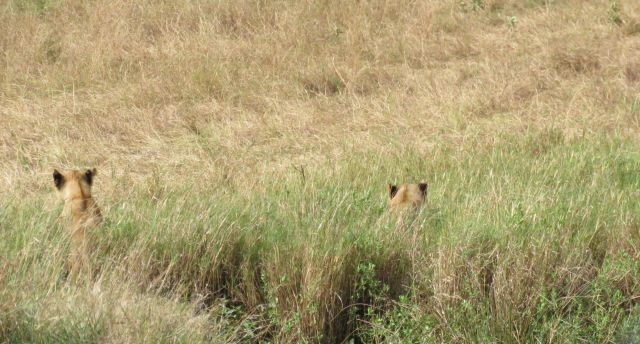
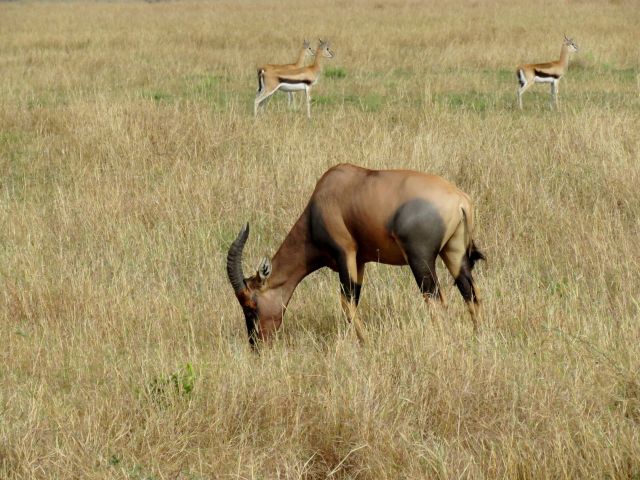
George reads the body language of the lions once they reach the lofty grass and tells us he believes the two cats will try to creep up on the wildebeest. George decides to move back to the road next to the wildebeest so we can watch the hunters approach.  Sure enough, the pair begin stalking the herd of wildebeest using the thick grass to help conceal their approach. Although the lions manage to get within a couple hundred yards of the wildebeest their hard work is foiled by the sharp eyes of several Thomsons gazelles. The little gazelles stand at attention, staring out to where the lions are lying in the grass. Soon a topi takes the small sentinels seriously and begins snorting and peering around trying to find the danger. After the Topi alarm call the wildebeest begin to calmly move away from the edge of the road. This leaves a lot of area where there is no cover so the lions would be in full view of their prey. The two girls don’t stand a chance in this scenario and they know it. The pair stop stalking, sit down and just begin looking around knowing full well their cover has been blown by the alert Tommie’s.

Beginning to stalk the wildebeest

The Thomson gazelles on alert. The topi hasn’t become alarmed yet.

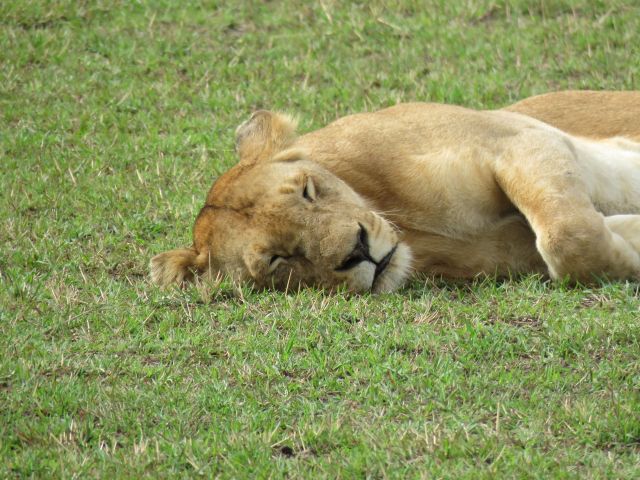
We noticed a half-dozen vehicles lined up just down the road when we began watching the two lionesses. There are still a couple of trucks parked there so George drives over to see what the people are watching. Aha! A male and female lion who are obviously only interested in each other. We have hardly come to a stop when the two lions begin mating. Boy did we time that perfectly as lions’ mate over several days and often you must sit for long periods of time to witness the pair mating if you get to see it at all. There is no sense staying around now since both lions have collapsed to the ground and fallen asleep.

Mating lions.

A big yawn

The female sound asleep

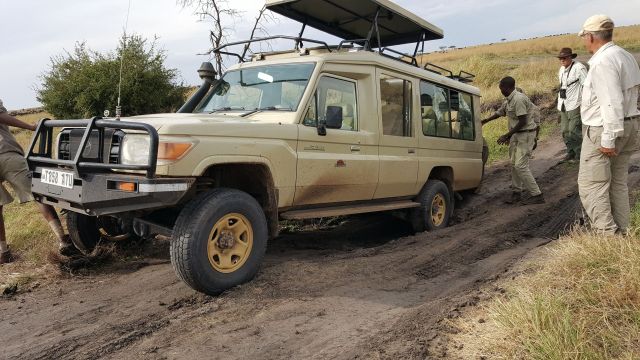
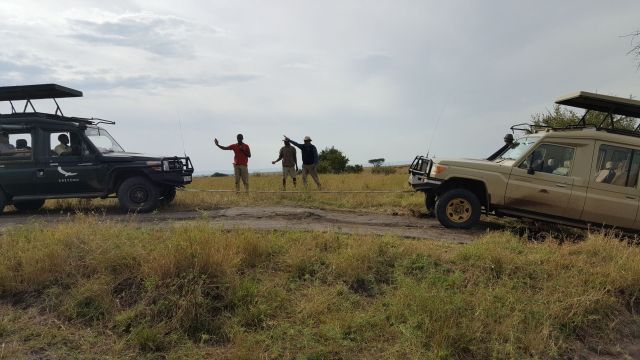
We aren’t far from the lion pair when George drives the Toyota through a dip in the road with deep tire ruts. I’m not sure what happened but we slip over so the left tire is in the track where the right tire should be and the right tire is completely off the dirt road. When George tries to maneuver forward the tires just spin and threaten to slip further into the grass, if we slip sideways much more we will end up in a ditch. Our rear bumper is bottomed out so George can’t back up in order to take a run at getting the truck out of this dilemma. All of us crawl out of the marooned truck and look the situation over. George, who I am sure is a bit embarrassed, checks to see if he can get a jack under the back bumper but though possible it will sure take digging away a lot of mud to make that happen. Fortunately, a couple of vehicles drive up and George and the other guides consult about the situation we are in. One vehicle drives within a few feet of our truck’s front bumper and hooks up a strap to both vehicles’ front ends. George and the other driver get back into their trucks and in no time at all our Toyota has been pulled free. The six of us just stayed out of the way, looking over our shoulders from time to time as the lioness’ we were watching earlier weren’t far from here and we sure can’t run as fast as a wildebeest .

Oops. Jesse’s photo

Help has arrived. Jesse’s photo

We reach Njozi camp which is nestled right in the bush. Stepping out of the truck I instinctively know that I am going to like this camp. There are wildebeest scattered around in the timber and the crew meets us with friendly smiles. After the ritual of washing our faces with the hot towels and sipping our welcome drinks we listen to Andrew give us the camp instructions. Don’t go to or from your tent after dark without an escort who you beckon to come get you by using your flashlight. The times our meals will be ready are given to us and after you order your hot water for bucket showers it will take ten or fifteen minutes to be delivered. Got it. Laundry and drinks are included here. Yes! our clothes need to be washed again.

The staff, carrying our luggage, leads us to our tents and we await the hot water that arrives shortly. Paul showers first only to discover that our shower head only has four holes where water is coming out. If you think trying to get wet, lathered up and worst of all getting the shampoo and soap rinsed off is hard with that little dribble from the shower head you are right! It was kind of funny though. Paul takes a toothpick after we both have finished and pokes it into several of the shower head holes. Paul’s ingenuity works as now instead of four jets of water there are about ten which proves to be adequate for the rest of our stay.

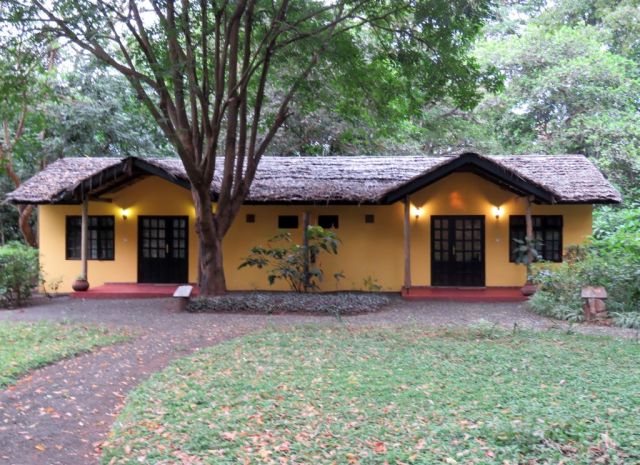
The tents are small but have everything we need

Paul and I walk up to the campfire and join our friends. We both order a beer from Amos who has the most endearing smile. Later they bring nibbles which include samosas. We had samosas in one of our lunches earlier in the safari which we loved them and these are just as delicious. Chopped and seasoned vegetables or meat, wrapped in a pastry sheet and deep-fried. Yummy. Amos comes later to take us to the dining tent for supper. We are joined by the only other guest in camp, Dave, who is an avid photographer and from Colorado. Dave is a soft-spoken man and extremely interesting. I believe he has been coming to Africa for twelve years and often takes multiple trips in a year.

Our soup tonight is carrot soup with ginger spice, this is the first African soup I don’t care for so I leave most of it in the bowl. To our delight at Njozi camp they serve the meal family style. The staff bring out the food in big bowls and we just take what we want. This is wonderful, as at the other camps I probably left half of the food on my plate. We visit after our meal for a bit but most of us retire to our tent by nine or so because we have an early morning wake up call. Another great day in Tanzania!

I am only blogging about one day here instead of the usual two days I have been doing. There will be lots of photos included in the next blog so decided not to make this one so long.

Next blog, Northern Serengeti and wildebeest river crossing. Later, Nancy


Ang’ata Serengeti Camp and Central Serengeti, Part 6

Ang’ata Serengeti Camp and the Central Serengeti, part 6
The Wabaunsee crew of six are up early and eating breakfast at sunrise. Our bags have been brought from our tents by some of the staff and are loaded into the truck. We say our goodbyes to this friendly group of people who genuinely seemed to enjoy having us at Sanctuary Kusini camp. The workers were always smiling, friendly and had a great sense of humor. The chef even shared his recipe for squash soup with us!

George wants to drive up to the plains to look for Cheetah before we head off for Central Serengeti. Everyone searches the wide-open grassland for the fastest land animal, (they can reach 75 miles an hour), but none of the spotted cats are found. This looks like prime country for cheetah, it just isn’t this morning. I believe it is Jennifer who does notice a bat-eared fox near the road with that perpetual grumpy look on its face.

Bat-eared fox, a poor photo as it is very early.

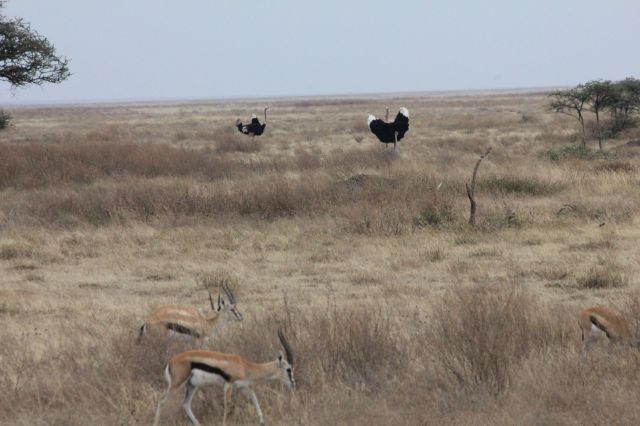
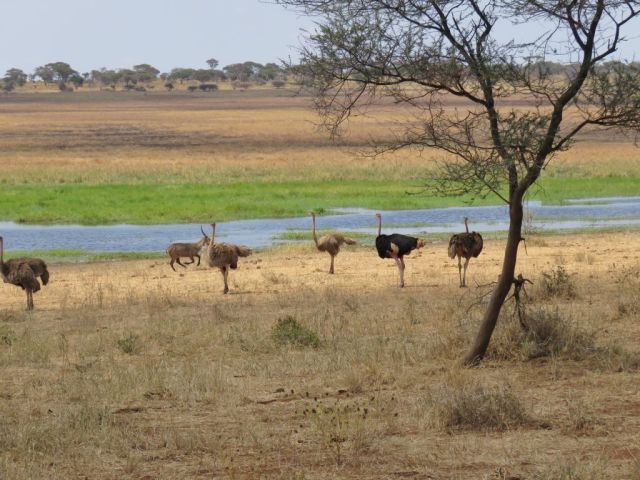
We may not have found cheetah, but we see something else that Paul and I have never witnessed. George points out a male ostrich in the distance, fanning his wings and dipping his head. George says that this is a courtship dance and the display is quite flamboyant. Hey, there is a female intently watching the flirting male and after a few minutes she lies down on the ground, signaling to the male that she is accepting his overtures. The flushed pink rooster struts over to the willing hen and the two begin to mate. Honestly, it is like watching a choreographed dance. The male fans his wings and moves his head back and forth as the hen also sways her head from side to side. Once the mating is over the two ostriches walk away, soon to build a nest and raise a brood of chicks I assume. How cool was that!

Male Ostrich approaching the hen with his wings outstretched. Jesse’s’ photo

The mating ostriches

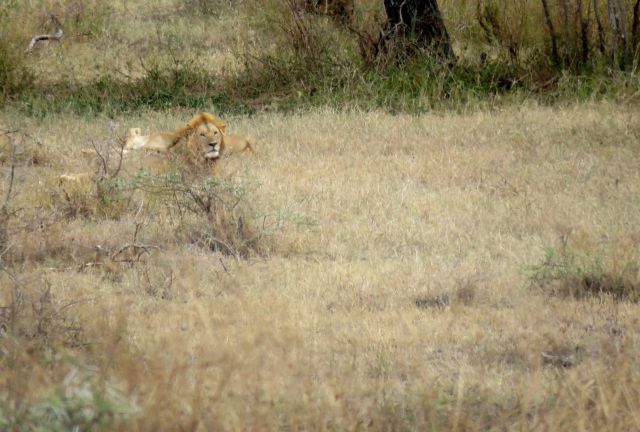
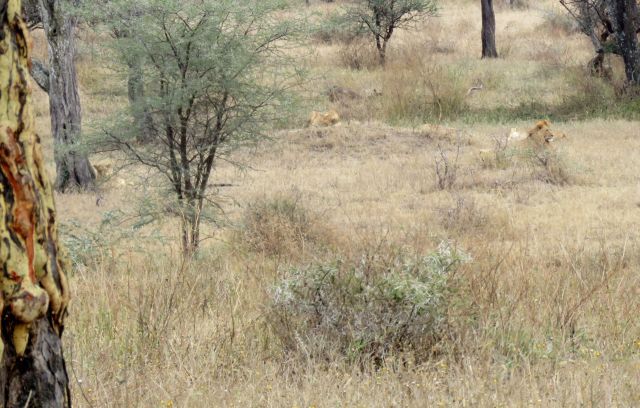
George says he is going to drive by the area where we watched the lions and cubs yesterday in anticipation that the pride won’t have moved very far. Before long, Jesse calls out that he has seen lions and tells George to stop and back up. Lying off the road in the distance is a beautiful male lion along with four, maybe five lionesses. There are no cubs in sight, but George assures us that this is the same pride since we are not far from where the lions were lounging yesterday. We watch the gorgeous cats for a while, but the females seem out for the count and even though the male is awake, he doesn’t seem to have any ambition either. Great spot Jesse! Jesse can’t help but tease George for not seeing the big cats.

Lion pride that Jesse spotted. They are a long distance from the road

A wider shot which includes a lioness laying by the grey tree trunk on the left. You might need a magnifying glass!

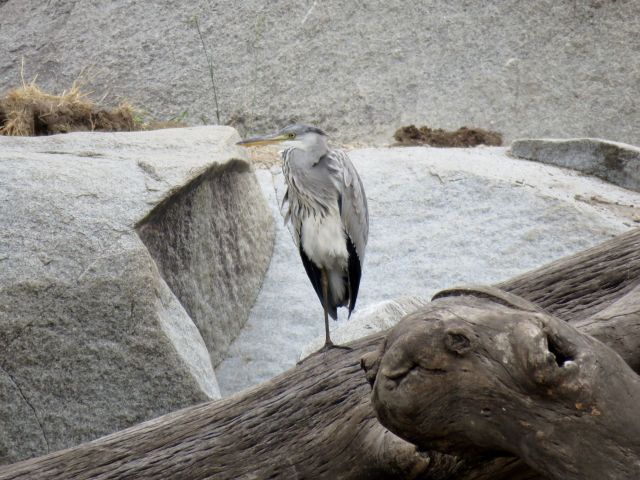
Just liked this shot with so many shades of grey including the heron and all the different shapes.

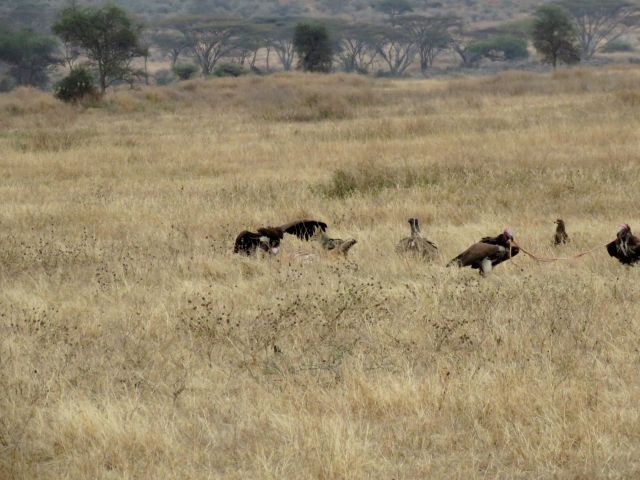
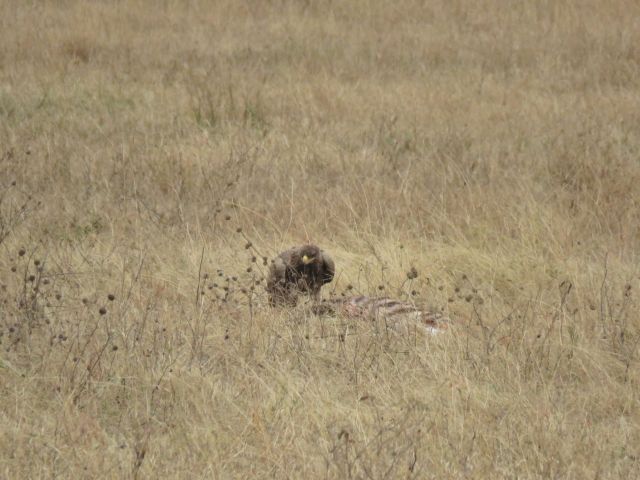
Traveling on, George brings the truck to a halt so we can watch two Tawny eagles that are eating on a carcass. At first, I think I am looking at ribs through the tall grass but once I use my binoculars I can see that the “ribs” are the black stripes on a zebra hide. Soon vultures begin to arrive, swooping in from every direction and the tawny eagles are pushed away from the feast. As we observe the big birds, one vulture hops into a clump of brush and grass. The vulture emerges with a string of intestine and is tugging on it as the ugly bird tries to pull the guts free. We watch in amazement as a black-backed jackal emerges from the cover of the brush hanging tight to the other end of the intestines. No wonder the vulture was having such a time getting its prize free of the weeds.

The Tawny Eagle that started this whole episode

The jackal chasing vultures while two vultures now are playing tug of war with the intestines

The vulture wins the tug of war which seems to make the feisty jackal furious. The jackal runs to the zebra remains and chases several vultures away from their breakfast. The jackal then takes a bite from the carcass, gulps it down and charges a vulture that sidles up and tries to grab a beak full of zebra. The battle between fowl and canine lasts for several minutes. At one point the small jackal is literally air born, he must have sunk his sharp teeth into the vulture’s leg because he obtained lift off for a few seconds. I wish I had caught that on camera! Suddenly the brave fellow stops eating, turns around and trots away. The jackal’s belly is so swollen with the meat he has consumed it is a wonder he can even move. As soon as the jackal leaves, the zebra carcass is swarmed by vultures until there is just a heap of moving feathers. Pretty gross.

The feisty jackal chasing away a Lappet-faced vulture. That is a big bird.

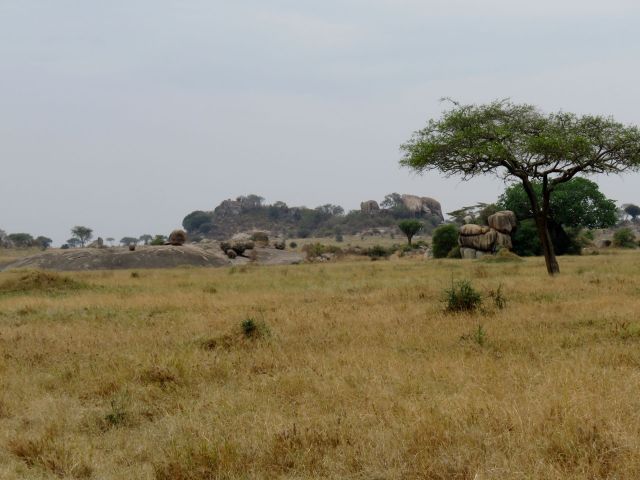
We are in Kopje country again and these formations are called the Moru Kopjes. Many of the kopjes have “balancing rocks” on them. It looks like the slightest touch would send the boulders tumbling off their precarious perches. There are Rhinoceros in this gorgeous place, but we aren’t lucky enough to find any of the endangered beasts.

Moru Kopje area

George does spy a group of lionesses sleeping in the yellow grass, their hides blending perfectly with the dry forage. Who would believe lions would be lying around snoozing. The backdrop for these seven lions is a magnificent kopje so the scene is quite breathtaking. One of the seven lions does sit up at one point. Another member of the pride is lying on her back, feet in the air and never even twitches while we are there as far as I know.

Part of the 7 lionesses, two were lying farther away from these

Beautiful backdrop for the pride of lions

We redirect our attention to a Black-headed heron who is stalking across the road in front of the Toyota. It appears the stately bird is walking towards the lions, but it veers off to the right and comes to a standstill. The long-legged bird begins to shimmy its neck while somehow keeping its head still. The heron does this several times and on one occasion the shimmy extends through the birds’ body, giving new meaning to “shake your tail feathers”!  I for one can’t take my eyes off this strange behavior. Suddenly the bird plunges its bill into the soil at its feet. When the heron raises its head there is a tail and hind feet of a black lizard sticking out of its beak. The lizard disappears down the herons’ long throat in short order. Whoa, I wonder if that morsel wiggled all the way down. Someone, (Carl I think), wonders if the herons’ shivering movements might somehow hypnotize the birds’ prey. I don’t know but the shimmying bird sure hypnotized me.

The stalking Black-headed heron

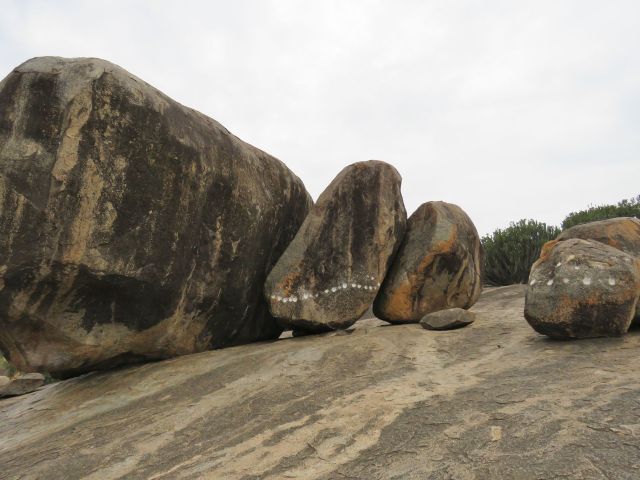
I understood that the white spots were where people have hit the rocks with smaller rocks to produce the musical notes. The spots seem awfully uniform tho.

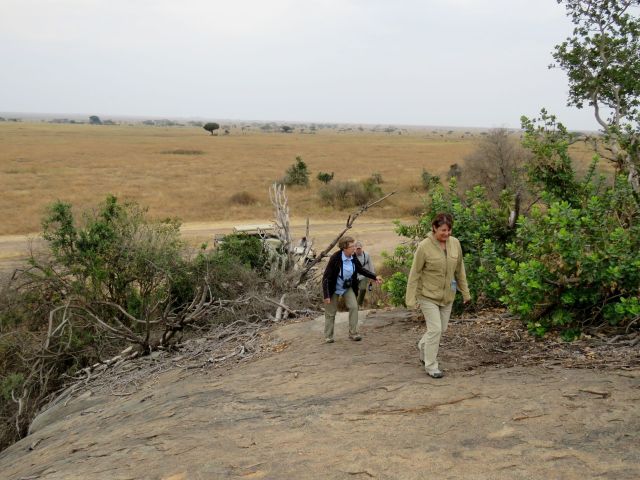
George takes us to N’gong rock for lunch. A beautiful kopje where people congregate at times to bang rocks against some of the large boulders to make music. This explains the white spots on the said rocks. Jennifer gives it a try and the various musical sounds that are produced is amazing. We enjoy our lunch as we look out over the endless plains. A male ostrich and several hens can be seen in the distance. As we are finishing our lunch, a herd of elephants are climbing up on a kopje a half mile from where we are eating. George says they are drinking water from the depressions in the rock that were filled up when it rained last night. Yes, we have run into some wet roads today which is nice compared to all the dust we have endured the past few days.

Jennifer,Connie, and Carl climbing N’gong rock

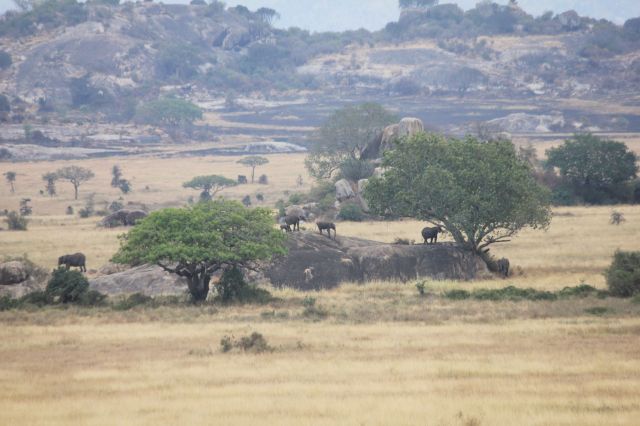
We hurriedly pack up the lunch debris and drive closer to the drinking elephants. Some of the pachyderms have already come down from the kopje when we arrive but there are two elephants atop the large boulder who are still drinking. It is quite a sight to look at elephants standing on top of this big rock. George says that the elephants can have some problems walking off the slick granite. We watch these two elephants come down from the steep rock and they handle it just fine.

Elephants on the kopje. I think Jesse took this photo while we were still on N’gong rock. Jesse’s photo obviously

Drinking water which was caught in depressions of the kopje

Coming off the kopje

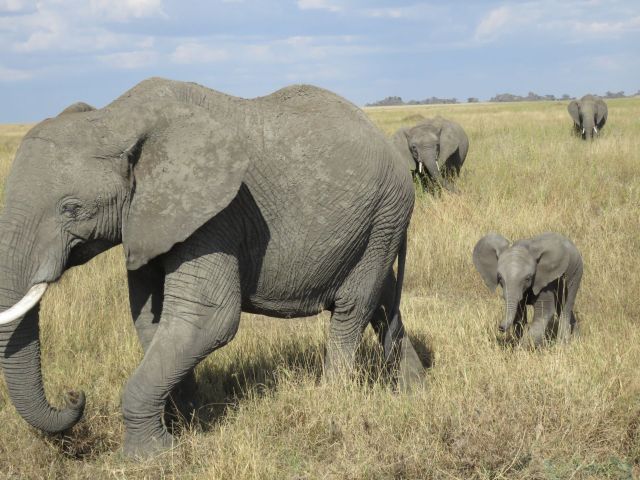
The matriarch of the group looks ancient and George estimates that she is around forty years old. In contrast there is a baby elephant, but I forgot how old our guide said this cute thing was, a few months I believe. As the elephants walk away from the kopje they pass very close to our truck. Even though they have a little one in their midst they show no sign of stress due to we curious humans. We can hear the low rumbles some make as they walk by our vehicle.  What a terrific experience.

The old matriarch

The youngest member of the herd

Leaving the elephants, we come across a very placid bull giraffe. The grand fellow chews his cud and stares at us before gliding behind our vehicle hopefully on his way to find some friends. George drives around a small lake where flamingos are feeding around the edges. We also encounter a Defassa waterbuck, more handsome in my opinion than the common waterbuck that were in Tarangire and Kusini. I love the Defassa’s heart shaped nose.  What a wonderful morning we have had.

Close up of the friendly giraffe

Defassa waterbuck . Look at that heart-shaped nose

As we draw closer to Ang’ata Serengeti camp we begin to meet lots of safari vehicles. On the next road over from the one we are traveling on there are thirty or forty vehicles lined up along the road. George asks if we want to join the melee to see what the tourists are watching and I say that I am not interested. No one else wants to go either so we continue down the road. We have been so spoiled having most of our sightings to ourselves that it will be hard to adjust to the hordes of vehicles and people who occupy them.
Pretty flower along the edge of the road

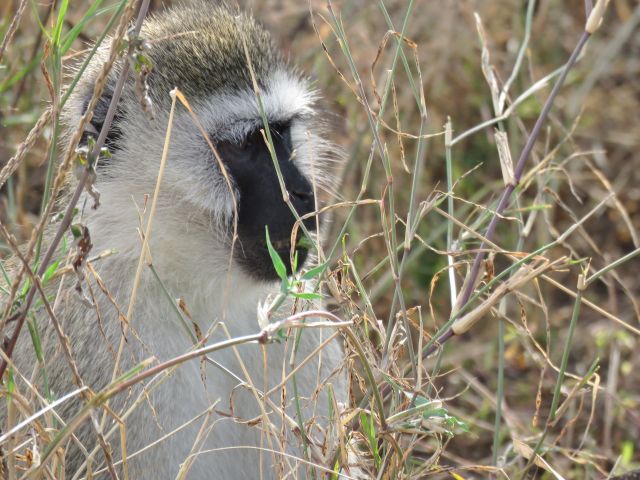
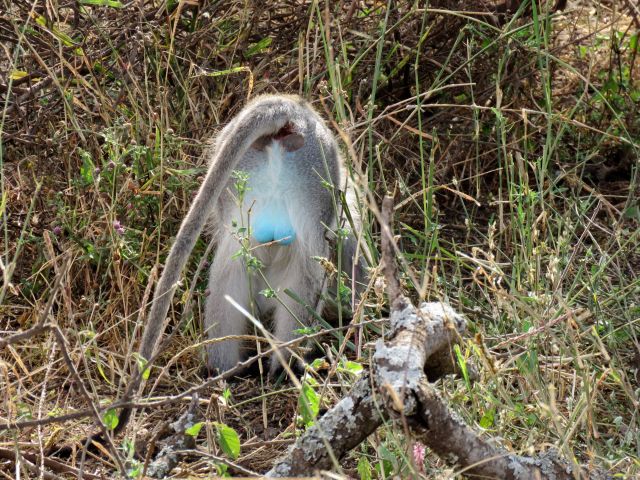
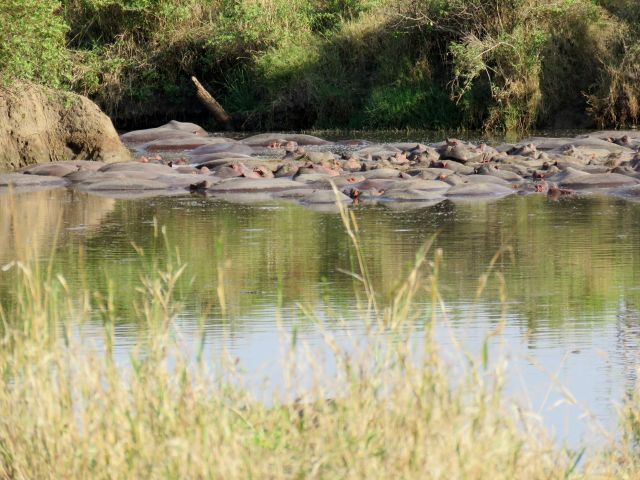
Our next encounter is with a vervet monkey sitting near the edge of the road. He suddenly walks off a few steps, bends over and gives us an unobstructed view of his very blue testicles. What the heck? George then drives us along a waterway lined with palm trees. Yes, palm trees and yes, they are an invasive species to Africa and doing quite well. The stench of the water is overwhelming but when we see the raft of hippos that have deposited themselves in the receding stream we know why. I would guess there are at least fifty of the bulbous beasts half-submerged in the fetid water. Jesse thinks you could run across the hippos backs to reach the other side and never touch water. The hippos are so smashed together that it might be possible, but I don’t think anyone is willing to give it a try.

A serious looking vervet monkey

Serious until he does this!

The raft of hippos, there are more that I didn’t get in the photo

We reach Ang’ata camp where the routine of hot towels and cool drinks is offered and gratefully accepted by this happy but tired group of Kansans. We are escorted to our tents which are unsurprisingly duplicates of the first Ang’ata camp we stayed at. What a great day we have had.

Our home for the next two nights

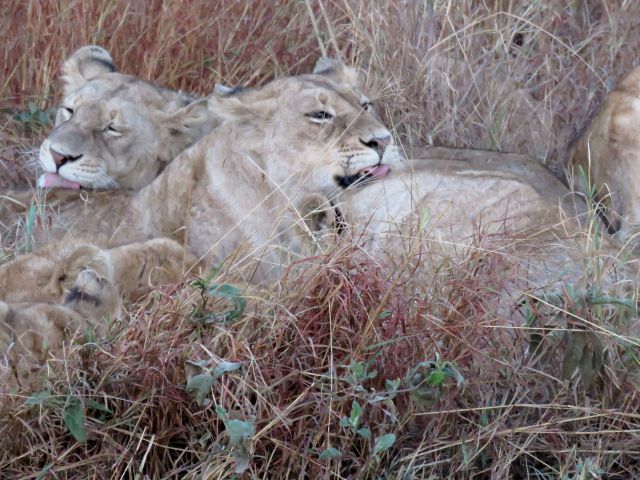
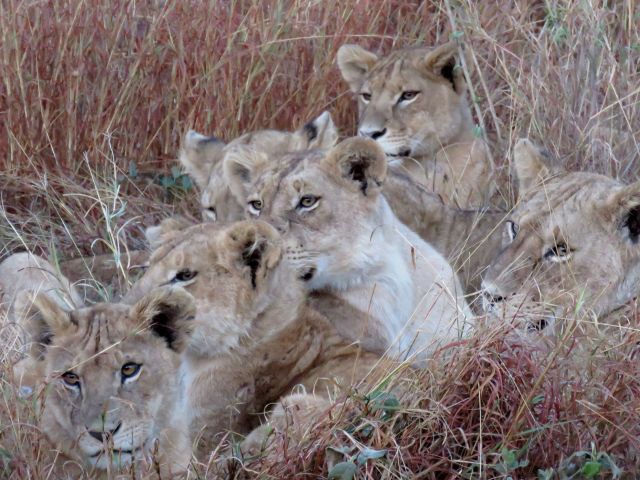
There were lions roaring and hyenas whooping during the night. I love lying in bed and listening to those wild sounds. We had an early breakfast and were out of camp by 6:15. George had driven only a short way when he stops by a pride of lions bedded down next to the road. Two males, several lionesses, several cubs, most are half-grown except for one small cub. We count a total of twelve lions. The light is very dim, so my camera is protesting that it can’t take a photo in these conditions. Soon the sun is creeping above the horizon, so my camera is happy, and I am happy. I think there was only one other vehicle at this incredible scene and they didn’t stay long.

A dim-light photo of the lion pride. The two males were off to one side. I am thinking that maybe there were 14 lions counting the two males. It is hard to see for sure but I believe there are 12 lions smushed together in this photo.

What a beautiful cat

Some mutual grooming

The young male is restless and when a flock of guinea land across the road he gets to his feet stares at them then wanders close to the noisy birds. The flock of guineas know he is there and know that they can escape the hungry cat easily so they don’t panic. The old grizzled male has disappeared into the long grass, possibly because we have made him nervous. The lionesses and cubs stay huddled together for warmth and are unconcerned with our close proximity.

The young male watching the guineas

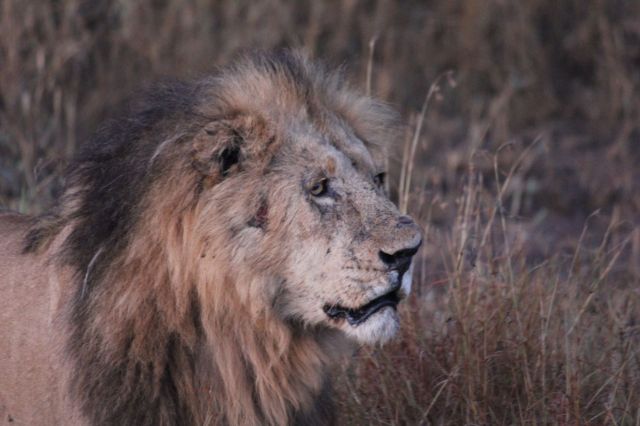
The old male before he disappeared into the grass. It looks like he has been in a recent battle. Jesse’s photo

Pride members watching the young male who is watching the guineas

Suddenly we see the young male lion dashing after a dark critter in the grass just beyond where the rest of the pride is lying. How did he get over there, a few minute ago he was on the other side of the road? None of us could make out what he was after, perhaps a wart hog. Almost as one the pride sits up staring at the area where we had caught a glimpse of the running lion. The little cub begins walking in the general direction of where the hunter had been, and it is followed by a few other lions. The lions soon come to a stand still and seem to be listening. After a bit they turn around and come back to the few lions who had settled back down. I guess they know that the hunt was not successful as we too had come to that conclusion since we heard no struggle or squealing of a captured animal.

Some of the pride walking in the direction of the failed hunt.

A half-grown cub trying to grab the small cubs tail.

I’m not sure what this look was all about

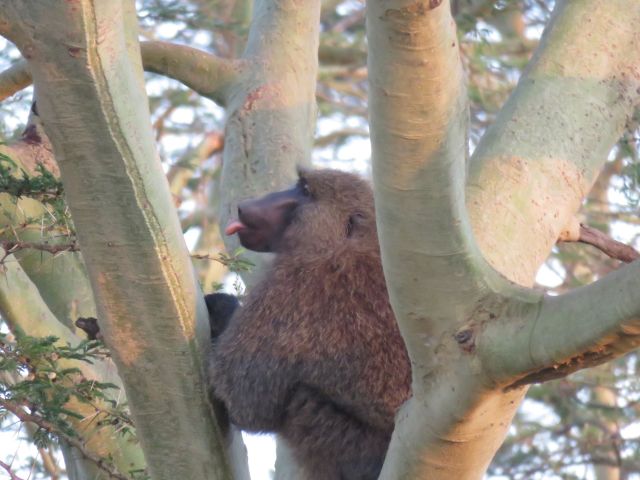
Perhaps what the lion was chasing was a baboon because a troop of baboons are roosting in a yellow fever tree situated a short distance from the pride. The primates are waking up, with many just sitting in the branches soaking up the sun. The younger members are beginning to play climbing up and down the limbs and trunk of the massive tree. I’m not a huge fan of baboons but watching them interact this morning is fascinating.

Baboon in yellow fever tree

Two young baboon wrestling, the sun came over the horizon. What a difference that makes for photos.

George is taking us to Nimiri Plains today which will allow us to escape the circus closer to camp. On our way we see a couple of vehicles parked along a road across a field of grass. They are watching lions which are walking down the dirt track. The beautiful cats are far away but we see three lionesses and at least two small cubs.

Two of the five lions we saw across the grassy field.

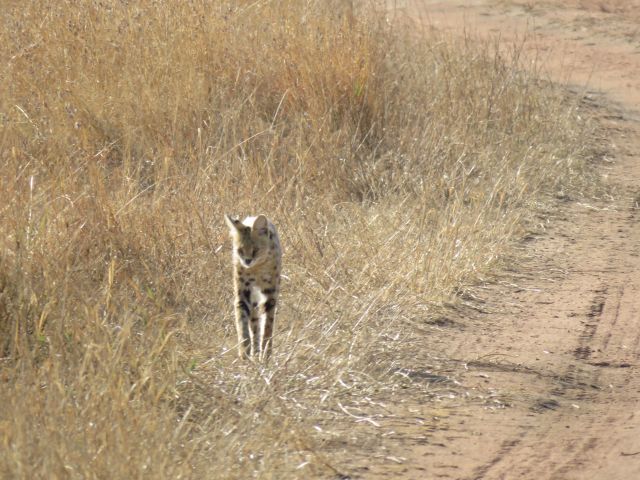
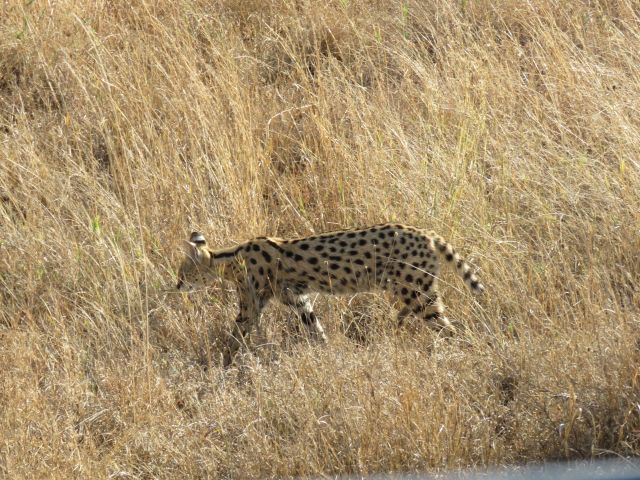
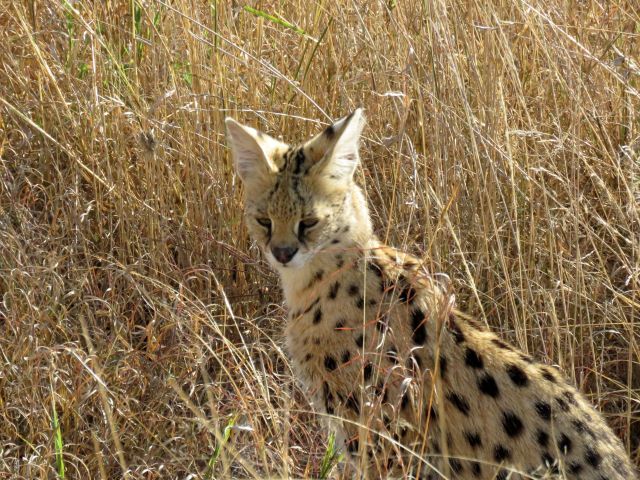
The vehicles are thinning out and as George navigates the truck down a quiet road he slams on the brakes and says there is a Serval cat walking on the road. It is mid-morning so having this small cat out in the open seems a bit unusual. Even more surprising the stunning feline continues walking straight at us and upon reaching our truck, it walks into the grass. Unbelievably, the serval sits down in the waving grass right next to our vehicle. We take photos and just enjoy the privilege of observing the little cat as it pays us no mind. At one point the serval acts as though it has heard prey in the turf and looks as though it is getting ready to pounce. It must have been a false alarm as the serval sits down and eventually lies down in a bed of grass.

Serval cat coming our way

Walking next to our truck

Sitting down by the truck and posing for us

At the same time, we were watching the serval George spots a hyena that has emerged from the grass onto the road a few hundred yards ahead of us. A Thompson gazelle is barely visible in the lanky grass to the hyenas left but the skulking animal either smells or sees the small antelope. The hyena runs into the field as the gazelle beats a hasty retreat. The hyena rears up on its hind legs occasionally in order to see over the lofty grass trying to locate the gazelle. It doesn’t take long for the hyena to say to heck with it and ambles away.

Topi with hot air balloon in the background

As we continue on our way to Nimiri Plains we enjoy watching a parade of elephants walking through the dry plains while above the regal tuskers is a vivid blue sky dotted with puffy clouds. Except for the elephants it reminds me of the prairies of Kansas.

If you take out the elephants and the Acacia this could be Kansas in the winter time

Oh why not! A handsome male lion is lying a short distance from the road. At times the big male is looking very regal for us and at other times is literally nodding off. It is hilarious to watch the massive head move downward as the big lion begins to fall asleep, only to jerk his head back up bringing himself back to wakefulness. Who can’t relate to that feeling of trying desperately to stay awake.

Lion that kept nodding off

I’m awake, I’m awake!

After a long drive we arrive at the east side of the Serengeti which is known as Nimiri plains. This country is wide open, a few kopjes here and there but very few trees. George picks out a small kopje and once our guide scouts around the rock to make sure nobody is home, this is where we have lunch. All of us are ready to stretch our legs and relax. There is no one else around, no fences, no electric lines, no hint of humans at all except for the tracks left by tourist vehicles. What an incredible feeling of freedom out here.
A view that goes on forever

Time for lunch

George pouring Jennifer a cup of hot tea.

The guys looking over Nimiri plains

After lunch George drives around a few of the kopjes but all we see are several jackals. One of the jackals is being fiercely pursued by another and the chaser even knocks the fleeing canine down at one time. George says it must have strayed into the other fellow’s territory. This wide-open grass land appears to be empty of wildlife but we see giraffe, topi, hartebeest and other animals scattered about.

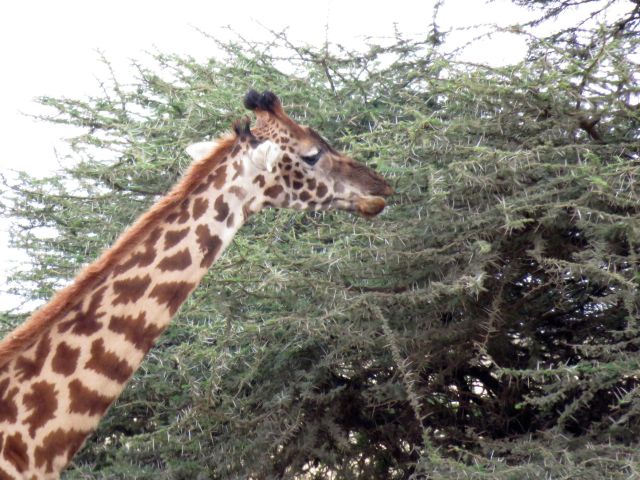
Giraffe eating on one of the few trees around. Ouch

Two topi and a hartebeest

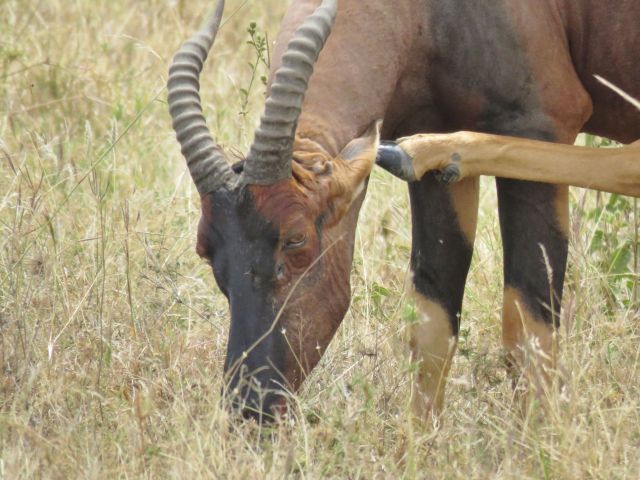
A topi with an itch

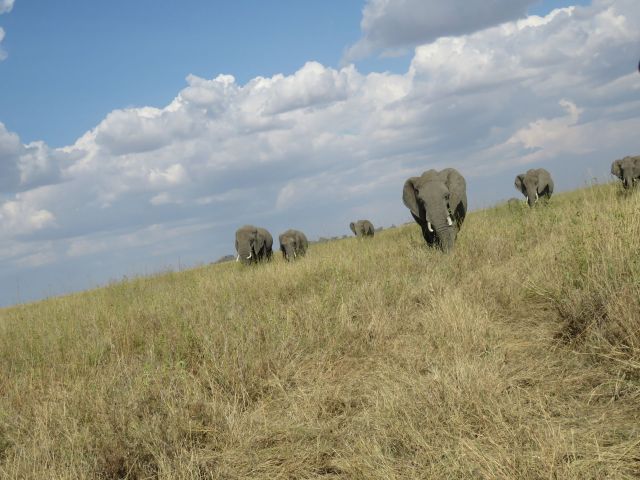
As we draw closer to our camp there is a large herd of elephant strolling towards our truck. The pachyderms are completely relaxed, very unlike many of the elephant we encountered on our last safari in Kenya. Frankly, many of those elephants were irate and down right scary. George has stopped the truck and there are a few other vehicles that are also parked. Soon we are surrounded by calm elephants. Some are in the road, some have crossed and are on our left while others are still on our right side. George is a bit nervous because there is one very small baby but none of the elephants become protective. It seems George literally had a run in with a mother elephant in the past that left his truck a bit bent up. Luckily, the elephant didn’t stick around to finish the demolition job. I can see why George would be a little shy when elephants come so close.

Elephants coming right at us.

They have arrived at our truck

The tiny baby

Oh for crying out loud, this is just nuts. There are two lionesses lounging in the grass a fair distance from us. We also saw the paw of a lion sticking up above a pile of dirt closer to camp. Carl says we can’t count this as an actual siting because all we saw was a paw, (we think he is kidding) but the rest of us vote him down. I have written in my journal that we saw 25 lions today!

Two more lions for the day!

One disturbing thing we came across as we near camp is a vehicle off-road looking at a cheetah. We can only see the cheetahs head and we couldn’t understand why George wouldn’t take us over to get a closer look at the cat. George points out that there is no road that leads there and this is as close as we can get.  Soon another vehicle plows through the tall grass and joins the other rule breakers. This obstructs our view of the cheetah’s head so we leave. George tells us we will find another cheetah but he refuses to break the rule of going off-road. All of us praise him for having the integrity to stay on the road. We meet several vehicles speeding down the road towards the cheetah siting and I would bet money that all of them will drive into the bush to get their clients close to the cheetah. Hopefully a ranger will catch them and they will have to pay a stiff fine.

A beautiful scene

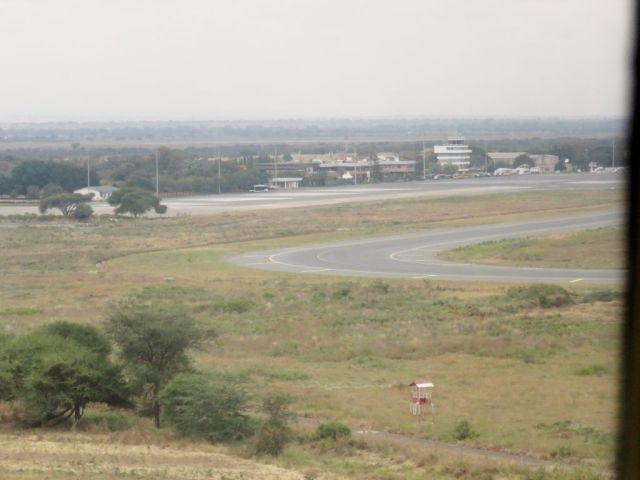
As we are nearing Ang’ata camp, George lays out our plans for tomorrow morning. We will go on a game drive before breakfast, then at 8 a.m. he will take us back to camp so we can eat while he goes to the airstrip to get our permit that allows us to enter the northern Serengeti. Since we are driving right by the airstrip now we encourage George to just stop and obtain the permit today. He seems delighted that we are willing to wait while he gets the permit and that he won’t have to return in the morning.

George and Paul looking very serious about something.

All of us take the opportunity to use the nice restrooms and then we wait. We wait some more at which time we three women decide to do laps around the dirt parking lot even though it is darned hot. The guys have a conversation with a guide who is waiting on his clients. We wait and wait and then George finally shows up without the permit. It seems that the airport has a new computer system that is giving them fits plus it is Sunday so the main headquarters is understaffed which is where the permit number must be faxed from. TAB, That is Africa Baby. George delivers us to camp and we are back to plan A for tomorrow morning.

Although we are all tired, we enjoy a tasty dinner and marvel at our incredible day before retiring to our tents .

The charging station at Ang’ata camp is in the main tent. Yikes. Jesse’s photo

Next stop, Njozi Camp and the Northern Serengeti. Later, Nancy


Sanctuary Kusini Camp, part 5

Sanctuary Kusini Camp, part 5

Before I begin writing the next chapter of our adventure, I wanted to relate a couple of things Jesse the young person had to deal with on this trip. Jennifer told me as we were trudging back up the Empakai crater trail, that this pace was likely driving Jesse crazy. Jesse is an avid hiker and Jennifer said he probably could have made three trips up and down the crater trail in the time it took us to make one trip. Sorry Jesse.

Jesse had plenty of time to take photos of the people plodding ahead of him as we went down into the crater

Jesse, well everyone actually, also must put up with at least three of us that are getting a bit hard of hearing, Paul, Carl and me. This hearing problem was evident at the start of our trip as we sat in the KC airport. Paul asked Carl if he could see his mammal book, Carl promptly dug out his candy bars and offered one to Paul. In DC at the hotel we four Millers went down to a gas station/shop adjacent to the hotel as Carl needed to buy a toothbrush, (he couldn’t find the one he packed). We decided to make a few laps around the hotel grounds to get some exercise once the toothbrush had been purchased. On our third lap, Carl facetiously said “all I wanted to do was buy a toothbrush”. Paul replied, “all I had to eat was pizza”. What?? Well, all you can do is laugh.

Leaving Sopa and heading to Sanctuary Kusini Camp

This morning after we are packed, I walk out our door and announce to staff workers that are waiting outside the rooms that we are ready to check out. A man and woman come on the run to gather our bags. Obviously with this enthusiasm, they expect to be tipped even though we have been told to place our gratuities for the entire staff in the tip box which sits on the check in/out counter. Once the porters have lugged our stuff to the lobby, I hand each of them a buck. I then put the suggested amount for our stay in the tip box. A worker observes my gesture and says, “bless you ma’am”. I smile and nod my head in acknowledgement to his appreciation.

Part of the Sopa Lodge lobby, Jesse’s photo

We meet the rest of the Wabaunsee safarists for breakfast and Connie promptly tells Jennifer, Happy birthday. I had completely forgot it was Jennifer’s birthday today. Thank goodness for Connie. Jennifer says Jesse remembered her birthday too.

George, smiling as usual, is waiting for us in the lobby and instructs some staffers to load our luggage. The fog is thick this morning and George must drive slowly over the narrow, curvy road. We meet a lot of vehicles including some big trucks that can hardly be seen in the pea soup fog. Some of our group sees elephant right next to the road who only become visible once we are right next to them. Scary. As we drop down off the high ridge we break through the fog and into a much drier landscape than we saw on the other side of Ngorongoro.

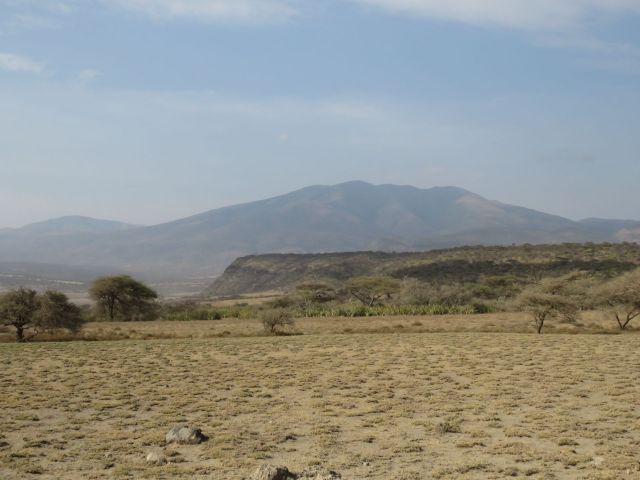
The dry landscape

And we think our life can be tough!

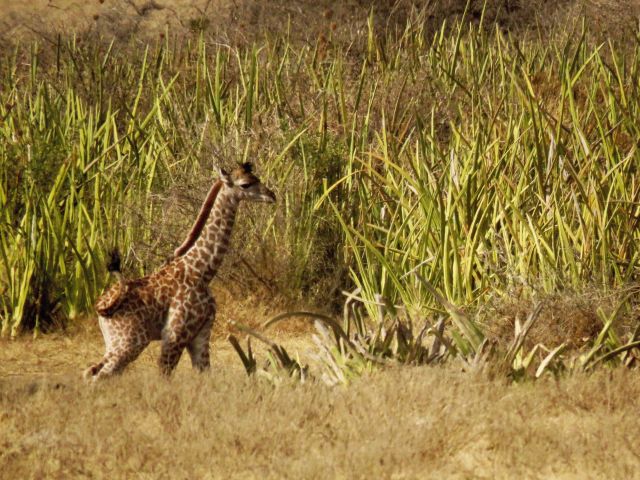
You would think due to the extremely dry landscape that there would be no wildlife here, but we haven’t traveled far when we spy giraffe browsing on some dusty trees. There is a baby giraffe with the group and the cute little guy looks like a toy.

Mama and baby giraffe

Can’t get much cuter

We drive by a large lake and then curve around and drive by a second lake. Well, not really, I just get confused by the change in direction and think we have come to a second lake. Yep, I take a lot of grief for that mistake.  George finds a water bird he doesn’t recognize and looks it up in his worn bird book. It is a Whimbrel which is a rare visitor to the interior of Tanzania. Cool.

The first and second lake.

Although we aren’t seeing the huge herds of grazers, there are still plenty of animals scattered through the landscape. There are lots of Thompson gazelles and several Grant’s gazelles which I consider the prettiest member of the gazelle family. There is also ostrich, wart hogs and elephant. As usual, we spot hyena skulking around here and there.

Grant’s gazelle

Hyena seem to be everywhere

Soon we enter Kopje country, Kopje’s are random outcropping of rock formed over millions of years. Paul and I love this landscape and by the reaction of our traveling companions they too, think these bizarre rock formations are fascinating. George tours around several of the Kopjes, searching for animals, particularly predators that often live in the jumble of rocks. We don’t find anything but hyrax, Jesse calls them rock rats, but that doesn’t mean leopard or lions aren’t hiding among the rocks and trees.

Jennifer, Connie and I begin imagining shapes in the rocks, the same principle of seeing shapes in clouds. We see all kinds of critters like dogs, lizards, birds, but the best one is when Jennifer says, “those look like hippo butts”. They do and hopefully your imagination is rich enough to see that hippo posterior in the photo below 😊.

Can you see the posterior of a hippo?

We eat lunch by a swamp, a green spot in the middle of dingy yellow grass. There is a shy reedbuck on the edge of the swamp. Carl finds an odd formation in a tree not far from us which George identifies as a beehive. It is an amazing structure as it is constructed around a tree limb, but the hive appears to be hanging from the limb.

Just before we get to the Kusini camp two Klipspringers are spotted on a long oval rock and a flock of guineas are running around the base of the boulder. A bit farther a troop of baboons can be seen walking through the trees several yards from the road. The baboons just keep streaming by us and there surely must have been thirty or forty of the big primates. We giggle when we see babies riding on the back of their mothers like a kid on a horse.

Klipspringers just outside of Kusini camp

Two of the numerous baboon that were spread out through this brushy area

The one species we didn’t want to find flew into our vehicle. A stinking tsetse fly. As someone tries to shoo the fly back out the window a few more fly in. In a frenzy of trying to get the flies back outside or trying to smash them into oblivion it becomes quite chaotic in the truck for a few moments. Fortunately, the pop-up top was put down a mile or as back as it began to shower lightly so that pathway for the voracious flies isn’t available. The fly eradication seems to have been successful and I don’t think anyone was bitten by the darn things.

Jesse’s photo

Moses the camp manager. Jennifer’s photo

George pulls the Toyota into the Kusini camp drive and there is a young man waiting to greet us. Moses introduces himself, then hustles us in to the open-air building away from the tsetse flies that are still buzzing around the outside of the truck. I don’t know why the pesky insects don’t come into the beautiful rooms with us. Hot towels are handed to us followed by a refreshing cool drink.  We are given the instructions for the camp by Moses and then a staff member picks up our luggage and takes us to our tent.

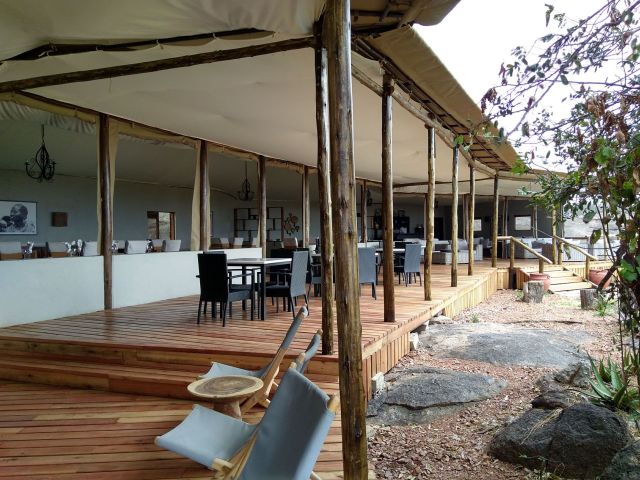
The main building at Kusini.  Carl and Connie’s photo

Paul and I are in the farthest tent from the headquarters but not too far from our friends. We are the only guests here which makes it very nice for us. We learn later that because of our age they have put us in the tents that are closest to the reception area. Jeez, I’m starting to get a complex about this age thing.

Paul and my tent at Kusini

Kusini camp is an all-inclusive camp unlike Ang’ata so the laundry baskets in all our tents are immediately filled with dusty, dirty clothes. I think most of us put on our last clean change of clothing this morning! Drinks are included, and we enjoy that perk too.

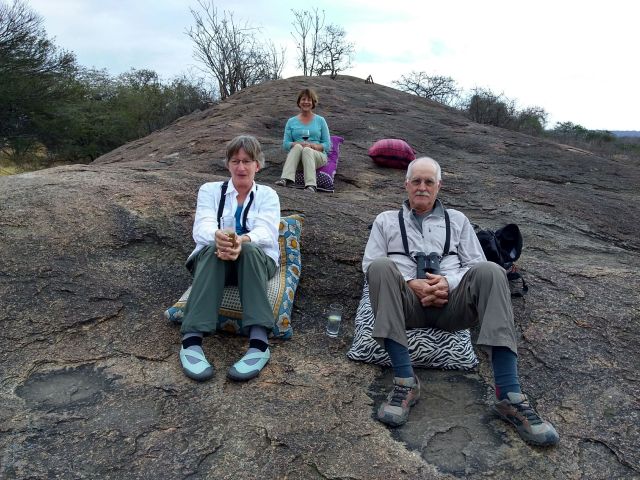
After showering all of us return to the main area and climb the kopje that is adjacent to the building. The staff has placed colorful pillows on the kopje so we all claim one and settle down to watch the sunset. Simon brings us drinks followed shortly by some delicious “nibbles”. Boy are we roughing it. The sunset isn’t exactly spectacular, but we enjoy the atmosphere of this place immensely.

Jennifer, Paul and I sitting on the kopje, enjoying a drink and waiting for the sunset.  Carl and Connie’s photo

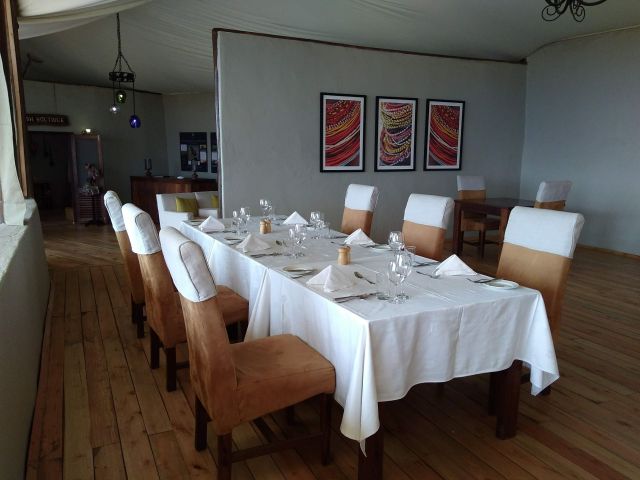
We return to the three-sided structure for dinner and are given a menu to choose our entre from. Paul and I opt for the chicken curry while the rest of the crew order beef filet. Paul and I are always leery of African beef as it tends to be tough, although two years ago in Kenya we had terrific beef at Sosian Ranch. Jennifer let me try a bite of her filet and it was surprisingly juicy and tender. The chicken curry is tasty too.

Our table. Connie and Carl’s photo

Once we have finished eating, the staff disappears, and we hear some singing outside. Soon a parade of staffers is filing into the dining area singing and dancing. The person leading the procession is carrying a cake for Jennifer’s’ birthday. Paul had set this up through Wild Source before we left. The singers, 17 of them, dance and circle our table several times before setting the cake in front of the birthday girl. Jennifer blows out the candles which promptly light again so she blows them out again. Finally, a staff member pinches the candles out with his fingers. The revelers begin chanting, almost demanding the phrase “cut the cakie, cut the cakie” or something like that. It is darned funny and I’m guessing a birthday celebration that Jennifer, or any of us, won’t soon forget. It was a fun evening.

Celebrating Jennifer’s birthday. Jesse’s photo

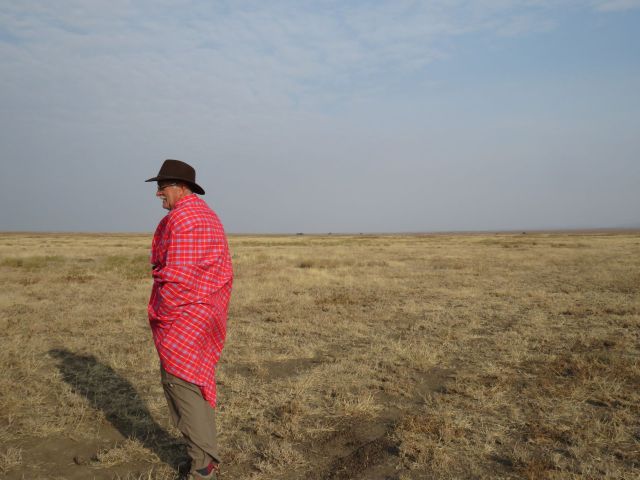
Up early but this morning we took our breakfast with us. We don’t see the expanse of animals as we did in Tarangire or Ngorongoro but there is enough wildlife to keep us occupied. George pulls the truck to a stop in the middle of nowhere and we eat breakfast. We have seen no other vehicles, there are no fences or utility lines in this vast grassland. It is amazing if you think about it. It is a bit cool this morning and Paul puts the blanket from his seat around his shoulders. Jesse dubs him the Wabaunsee county Maasai. As we eat there are Thompson gazelle and impalas scattered around us, a lone hyena can be seen poking its head up out of a brushy area. On the horizon a herd of cape buffalo appear, and we observe them as they trudge along heading for who knows where. A leopard has walked on this road recently leaving his tracks in the dust.

The Wb. county Maasai

Sand grouse. They made the oddest sounds when they were flying. It sounded mechanical rather than like a bird calling.

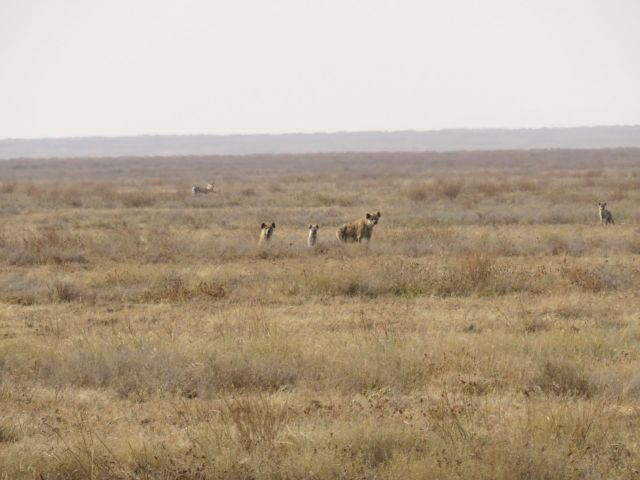
After we have finished eating, George packs up everything including us. Not far from our breakfast spot we come upon a den of hyena. Many of the dog like creatures’ scatter at the sight of us, including two pups. The mother and two other pups stay by the den and George can drive very close to the trio. It is hard to refer to hyena’s appearance in a positive light, but I must admit these pups are cute. Not only that but their mother is an extraordinary color which I would describe as golden. George says this females color is very unusual in his experience. I will acknowledge that this big mama also has a dignified air about her. One of the pups has little fear of us, even nursing mom at one time as we look on. The second pup, pops in and out of the den as he tries to be as brave as his sibling.

The hyenas that skedaddled upon our approach

The two hyena pups at the dens opening

The golden hyena, mother of the pups

The brave pup nursing


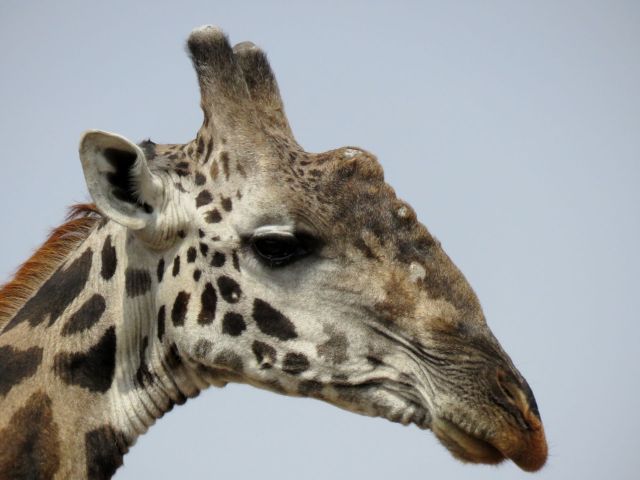
On our way back to headquarters George finds a steenbok browsing in the dried grass. We watch the tiny antelope and George tells us that trophy hunters prize this species because of their spikey horns. Good grief, I don’t understand the mindset of shooting a living creature that you aren’t going to eat just so you can hang its head on your wall. Fortunately, this fellow should be safe from humans if he stays in the boundaries of the park. We also see several giraffes, one who looks like it has boils on its face. There is a male ostrich, very pink due to the mating season, who crosses the road in front of us.

Steenbok

Close encounter with thorns?

The very pink male. If you look at his foot you can see that it resembles high heels

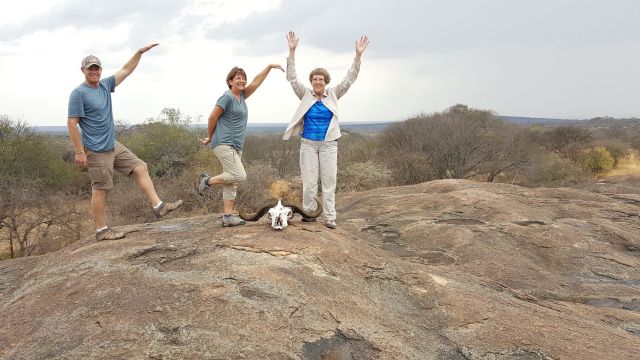
Upon returning to headquarters, Connie and I traipse up and down the kopje for exercise. One of the KSU grads comes up with the idea that they should spell KSU out on top of the kopje. I take photos of Jesse, Jennifer, and Connie as they use their arms and legs to form the letters of their Alma Mater. After a delicious lunch of chicken kabobs all of us relax in the lobby and I believe we all take a nap.

Jesse, Jennifer, and Connie spelling out KSU of the kopje at Kusini

Settling down to relax. Jennifer’s photo

George drives up in the truck at four and the three men and I take off for an afternoon game drive. Connie and Jennifer decide to stay in camp and relax. I had waffled about whether to go or not, but just knew if I did not go the guys would see something remarkable. We drive out of camp via the back way and see the staff quarters, equipment sheds, and where they capture water for the camp. On the fringe of the camp a few cape buffalo stare at us as we drive by. George wanted to drive by a big kopje on the edge of the camp where workers have reported seeing lions sitting atop the rocks. When there is no sign of any felines, George repeats the line we have heard quite often “nobody is home” and we drive on. There were also reports of wild dog here a few days ago so we keep an eye out for them when we drive through the area where the painted dogs had been seen but nobody is home.

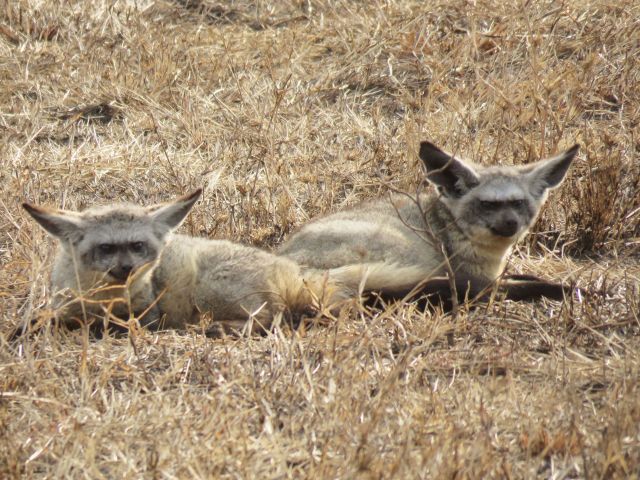
Two disgruntled looking bat-eared fox

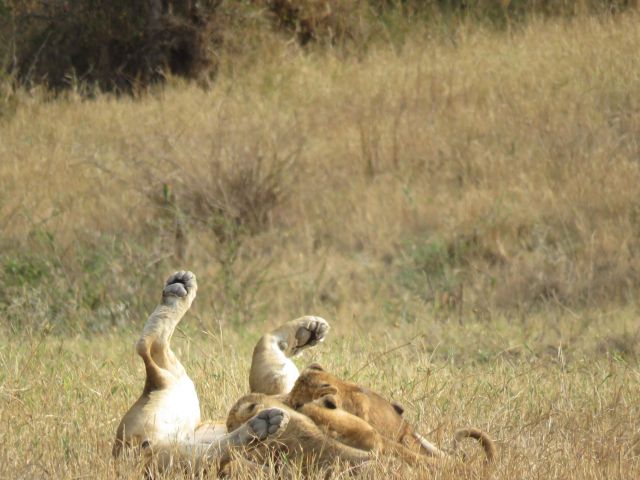
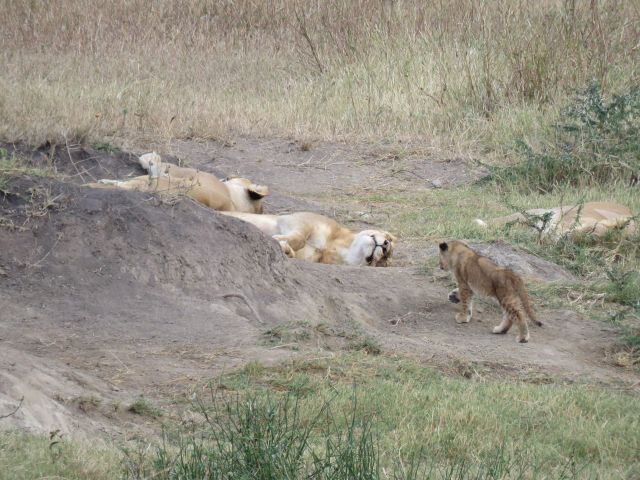
I don’t know who saw them, Jesse or George, but a pair of bat-eared fox are lazing near the road. They seem completely uninterested in the humans who stop to stare and take photos of them. Well seeing these foxes was well worth coming on the drive. We move on and a ways down the road Jesse, George, and I call out in unison, “lion”! Not just a lion but a lioness rolled on her back with small cubs hungrily nursing her. Oh wow!

The lioness with cubs nursing when we first spotted her.

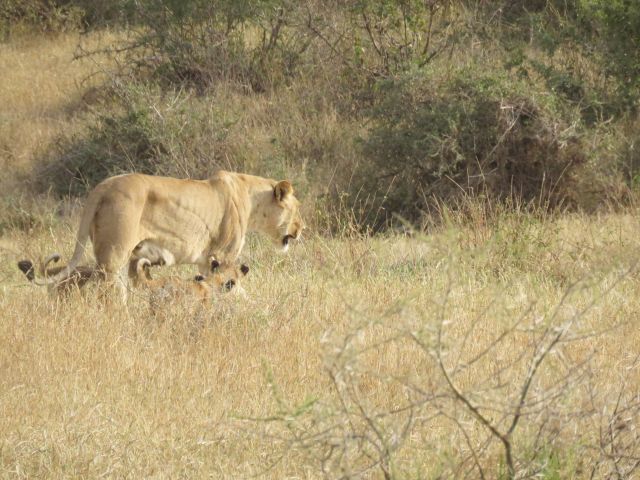
The lion family strolling off to join the rest of the pride

Now that we have disturbed the lioness, she gets to her feet shaking loose the four cubs and begins leisurely walking away, her cubs following closely. We can’t get off the road, but the lions are near enough to the dirt track that we are able to follow the lion family to their destination. Mama leads her brood to a nearby stream, plops down and the ravenous cubs promptly begin nursing.  Another lioness is laying in this small gully, along with a lone cub. Looking closer we see a paw showing over the top of a small berm of dirt.

Another lioness

The fifth cub laying off by himself

We watch this peaceful scene laid out below us and just revel in the moment. After scrutinizing the fifth cub it is obvious this is a “runt” and the poor thing isn’t getting his share of the food. That explains why he is laying alone instead of joining his siblings for dinner. When the four healthy cubs have sated their hunger they jauntily walk to where their litter mate is and engage in play with him. The runt joins in the rough house to my surprise but soon the others move away from the weakling and he doesn’t follow. The four robust cubs clumsily chase, bite, chew on sticks, and in general have a good time. The skinny cub in the meantime has tottered over to mom and is nursing, though I’m sure there is little milk left for him. This casts a cloud over the scene for me but Mother Nature is ruthless and as George says “it is survival of the fitness”.

The cubs rough housing

Gnawing on a stick

The skinny cub walking towards the two lioness that were hidden behind the berm of dirt until George moved the vehicle. Mom is to the right.

George drives up the road, so we can get a better look at the hidden lioness and to our surprise there is another beautiful cat behind the one whose paw we saw. The lion’s coats literally glow in the sun and looking at the shape they are in it is obvious that the pride has been having good luck in hunting prey. A dik dik wanders by on the other side of the stream but the lions pay no attention. Sadly, the sun is starting to sink in the west and we must leave the beautiful felines. Do you know how sick at heart I would have been if I had missed this incredible siting?

Connie and Jennifer enjoyed a private tour of the camp with Moses while we were gone and had no regrets that they stayed behind. The two women were relaxing on the Kopje when we returned around 6:30. We take a quick shower and do a little packing before returning to the main building for dinner. I skip the main course at dinner because I have been eating too much. We had another wonderful cream soup, squash I believe, and with a roll which was all I needed.  Since we are leaving tomorrow for Central Serengeti, we don’t linger after supper but go back to our tent to pack up.

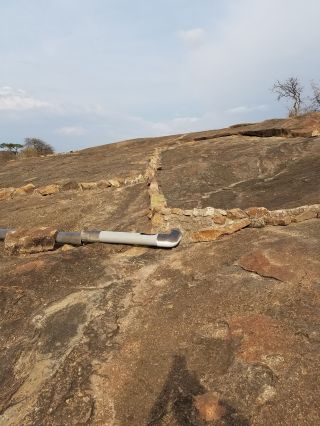
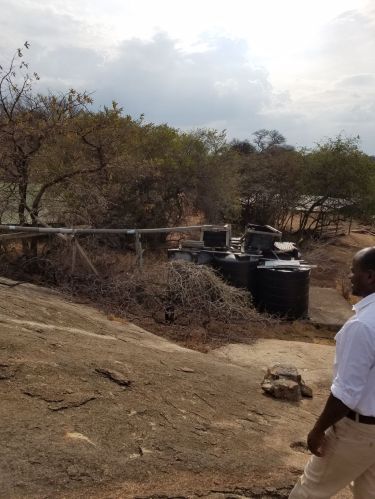
Collecting water that runs down the kopje. This is behind the camp. Jennifer’s photo

The water runs through pipes into these plastic barrels. Jennifer’s photo

Next stop, Ang’ata Serengeti camp in central Serengeti. Later, Nancy


Ngorongoro Crater Part 4


Ngorongoro Crater, part 4

We leave Tarangire and are behind George’s planned schedule due to the credit card snafu. Before long we turn on to a black top road and George has the Toyota zipping right along. I snap several photos of the fascinating local sights as we make our way towards the crater.

The land devoid of grass once we are outside the park

Notice the chef’s hat on the woman at this roadside cafe

George pulls into a gas station along the way to fill the trucks two fuel tanks. A young woman pumps the fuel while George goes into the station. The woman is singing and dancing while she fills the truck with gas. Once the nozzle has clicked off the woman goes to the back of the truck and begins rocking the Toyota. Then the station attendant walks to the front of the truck, grabs the grill and rocks the truck again. The woman glances at the pump, laughs and dances. The pretty lady does this several times. What the heck? Someone in our crew figures out that every time she rocks the vehicle the gas pump comes back on and runs a little bit more fuel into the trucks tank. Crazy. When George returns we ask about this trick the woman pulled. He laughs, shakes his head and says they are not supposed to do that but obviously he isn’t surprised that it took place. You learn something new every day.

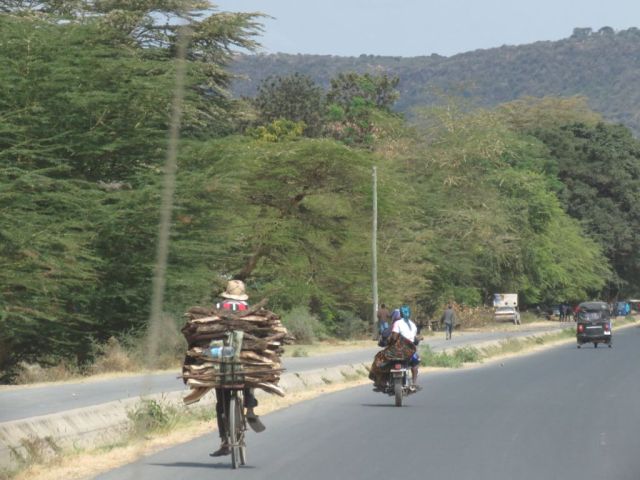
Transporting wood via a bicycle!

Selling bananas and whatever that pink stuff is along the road.

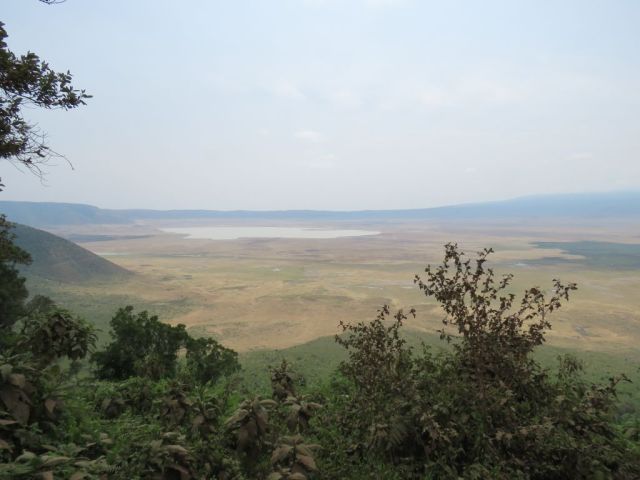
We are climbing steadily as George navigates the winding road that takes us to the edge of Ngorongoro Crater. Stopping at a view-point we join other tourists to get our first look into the famous crater. Some of us have wandered back towards the truck when Jesse comes to tell us that George has spotted a black rhino from the viewing platform. We follow Jesse back to the deck where he patiently describes to us where the rhino is. Sure enough, though even through binoculars the rhino appears very small, there is no doubt that it is a rhino. The rhino is laying on bare ground and as I watch, the rare animal moves his head enough that I can see the outline of its horn. Wow, a nice way to start our visit to the crater. Thanks George!

Looking into the Ngorongoro crater from the view-point.

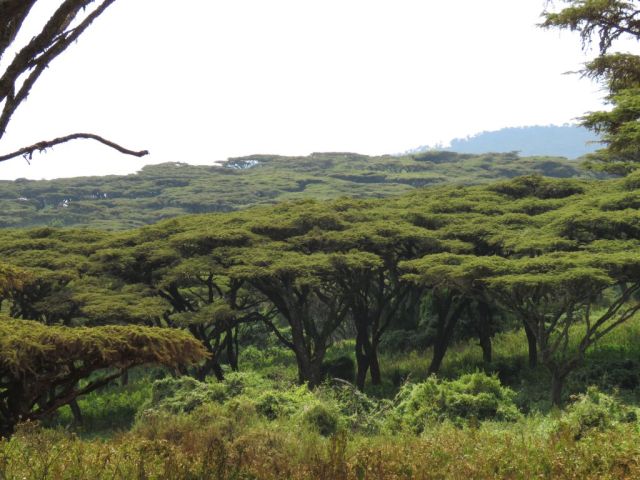
The umbrella acacias

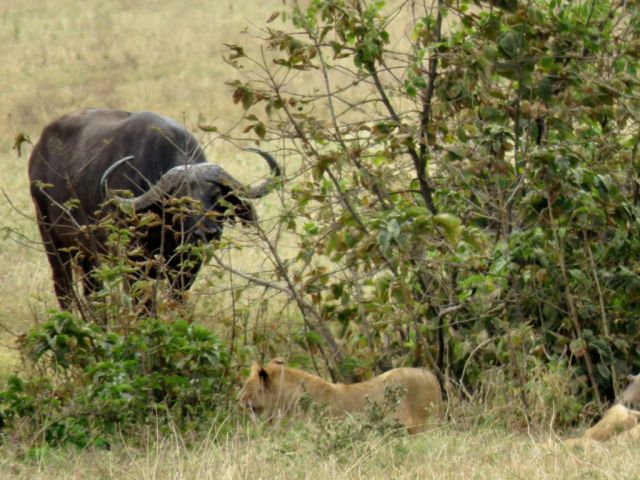
Leaving the viewpoint, we travel along an extremely rough, curvy road to the entrance on the west side of the crater. Here we eat the boxed lunches that the Ang’ata camp sent with us while George goes to check us in and to arrange for a ranger to accompany us on our walk tomorrow. We are going to walk down into the Empakai crater tomorrow. When we have finished our lunch, we bounce down the road to the bottom of the Ngorongoro crater. We admire the exquisite umbrella acacias along the way. It isn’t long before we begin seeing herds of zebra, cape buffalo, and wildebeest. There are a few Hartebeest scattered here and there. We join another group of tourists in watching some recumbent lions. The lions are also being checked out by a cape buffalo. One lioness rises to her feet briefly then plops back down on the ground so we move on. Many of the wildebeest prefer laying in the road and seem to grumble at us when they are forced to get up and allow our Toyota to pass. I actually see one wildebeest immediately come back to the road and lay back down. George tells us the animals are so tame down here because they are never threatened by humans.

Wildebeest laying in the road

Cape Buffalo staring at one of the lionesses

As in Tarangire, we see hippo laying out of the water. It is afternoon and even though it is mostly cloudy this seems unusual to me. Connie and Carl commented that of all the hippos they encountered on their last safari they hardly saw any out of the water and those that did see on land were making their way back to the water. Hmm.

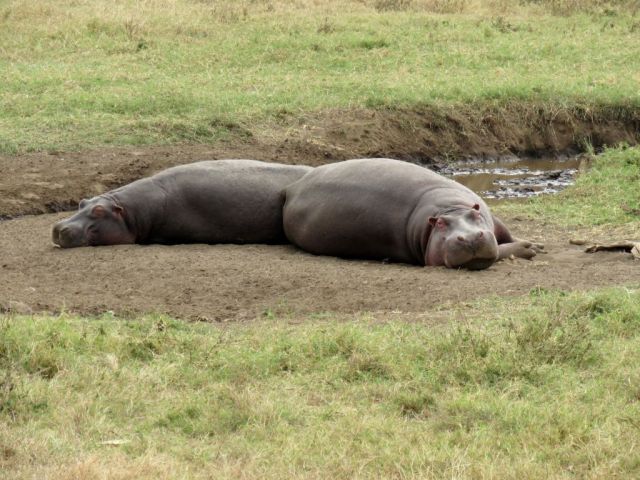
Are these hippos smiling?

Zebra in the crater

We find another large pride of lions as we go deeper into the park. I’m not sure who saw them but they are far from the road. The lions are piled together in a heap and they are keeping a wary eye on a few cape buffalo. We watch them for a while than move on to find a couple of scraggly hyenas taking a nap. There are two Grey crowned cranes standing near the road, such dignified birds. Perky little Thompson Gazelles can be seen everywhere.

The pride of lions, they were a long ways from us.

Raggedy looking Hyena

Now you know why they are called lesser and greater flamingos

As we near the lake, pink flamingos dot the shore, they are mostly the lesser flamingos but there are a few greater flamingos too. George stops the car so we can watch a yellow billed stork as it feeds. The large stork keeps its oversized yellow bill open and immersed in the water. The bird then uses its feet to herd frogs or fish into the trap that is its beak. In awe, I watch the show the stork is putting on but seeing the delight on George’s face gives me just as much joy. Here is a man who is taking tourists on safari day after day and yet he still shows an almost childlike pleasure in observing something he has probably seen hundreds of times.  George is obviously passionate about nature which makes him such a wonderful guide.

Catching lunch

The huge crowds of tourists in Ngorongoro crater that Paul and I have warned our safari mates about turns out to be false. Fourteen years ago, whenever you stopped to look at something there would be dozens of other vehicles parked along the road with everyone jockeying for a better position. It was not a fond memory for us. Today there were no other vehicles when we watched the pride of lions and only a couple of vehicles when we saw the trio of lioness. A nice surprise and we can’t really figure out why this would be. Perhaps it is because we didn’t come into the crater until early afternoon and the big crowds were here early this morning and have already departed.

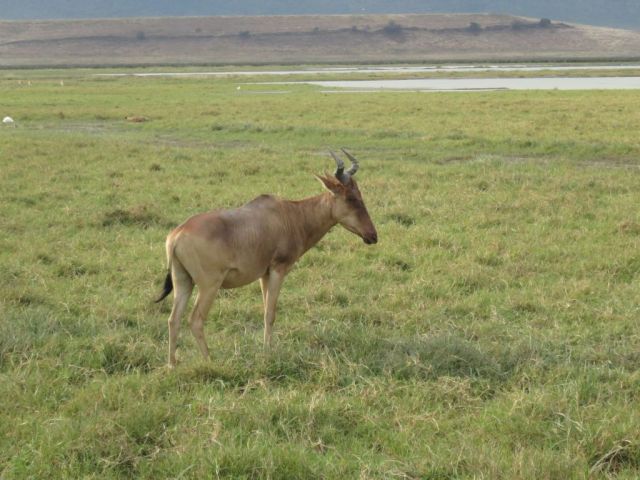
Hartebeest

Everyone must be out of the crater before dark so it is time for us to go. One of the last things we witness is a golden jackal chasing a scrub hare. The hare makes a move worthy of a football running back and totally fakes the coyote-look-alike out. The last thing we see is the hare barreling in our direction as the jackal keeps running straight. We laugh out loud as the jackal skids to a stop and with a puzzled look on its face tries to figure out how his dinner just vanished into thin air.

A golden Jackal but not the one that got out foxed by the hare

Maasai women and donkeys laden with wood on the crater rim road

We are staying at Sopa Lodge which is built within yards of the craters’ edge. The Lodge is impressive and big. Once we have checked in we follow the porters to our rooms. The rooms are quite spacious although a bit worn. We have a glassed-in patio that looks over a grassy area and there is a small opening in the trees where we can catch a glimpse of the crater. Very nice.

The front of Sopa Lodge and the pool that animals use as a watering hole. Connie and Carl’s photo

All of us meet in the lobby before seven as we intend to be at the front of the line for the buffet dinner. When the doors are opened we are shown to a table and instructed that this will be our table for all of our other meals. A very efficient way to run the restaurant. The sumptuous array of food is amazing. Soups, salads, various meats, many kinds of bread and of course desserts are offered to Sopas’ patrons. It is hard to contain oneself from heaping your plate with food, as the urge to try everything is hard to suppress. Yes, I think we all ate too much but boy was it delicious. The wait staff later sang and danced to everyone’s delight. Wow, do they have beautiful voices.

The South Millers and the Gehrts rooms-24 &25, at Sopa Lodge. Connie and Carl were one tier below

Jesse and Jennifers’ room, ours was the same. Jesse’s photo

When going to and from your rooms after dark you must be escorted as animals from the crater often migrate onto Sopa’s grounds. Jennifer, Paul and me are told by our jolly escort that they have had leopard, elephant, cape buffalo and other animals drink out of the swimming pool at night. Since our chaperone is only armed with a flashlight I ask him if he will just throw the flashlight at an animal if it is threatening us. This makes him laugh loudly and then he proclaims that he will make gun noises which will make the animal run away. It is our turn to laugh out loud now.

This cloud flowing over the crater rim was the sight that greeted us this morning. Gorgeous

I had a good night’s sleep despite a really weird dream and I am ready for another adventurous day. After we have eaten breakfast we find George waiting for us in the lobby and we leave the lodge by 7:30. We pick up our ranger escort, a very young man, whose name is Zachari. Instead of a gun our protector is carrying a spear!

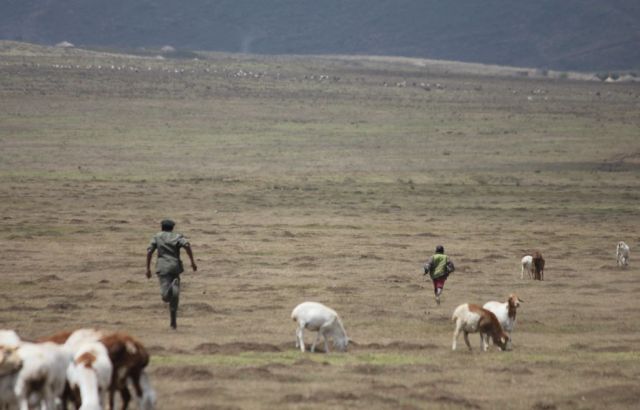
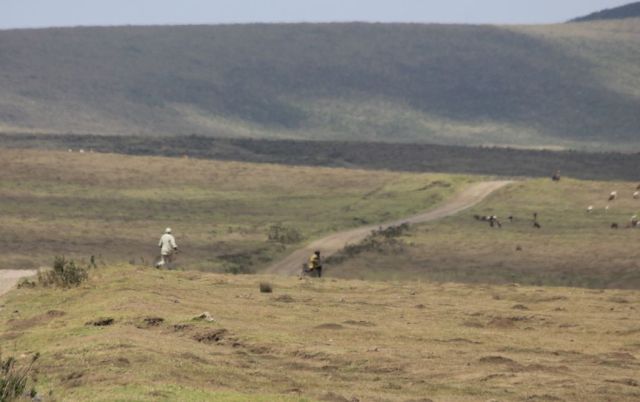
Maasai taking cattle out for the day

Maasai children by cattle corral

As we rock and sway through the vast landscape, Paul and I remember this area called the Embulbul depression with much fondness. Fourteen years ago, we were able to get out and walk among the Maasai who were scattered over these wide-open plains with their herds of cattle, sheep, and goats. In my memory I can still hear the Maasai singing to their cattle and the melodious sound of cow bells ringing as we strolled through the grassland. Today the Maasai are just beginning to move the cattle from the wooden corrals out into the plains where they will graze all day under the protection of herders. The grass is plentiful here and the colorful cattle are much fleshier than the cattle we saw around Tarangire. There is a scattering of wild life such as zebra, ostrich, golden jackals, a few solo wildebeest and Kori bustards. George informs us that the zebra will often join the cattle herds to graze knowing that they will be safe.

Zebra on the horizon of the Embulbul depression

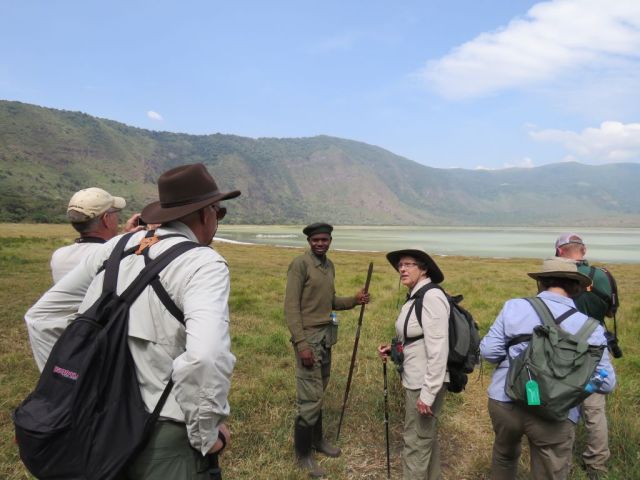
We arrived at the trail head before ten and make use of the cement long drop that is not far from the road but still hidden from sight. As we prepare to begin our descent into the crater, we hear George tell Zachari to go “pole pole”, (polee, polee), which means to go very slow. Zachari looks over at George and replies “I will see you tomorrow”. This makes us bust out laughing. I don’t think it will take us quite that long. I suppose that five of us do look pretty ancient to this young buck.

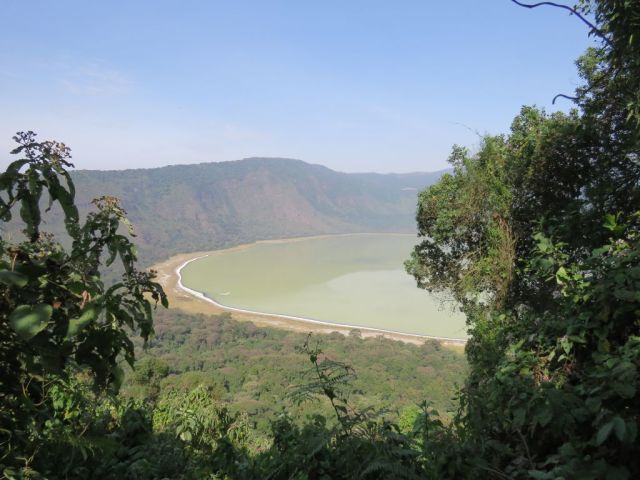
Looking down on Emapakai Crater

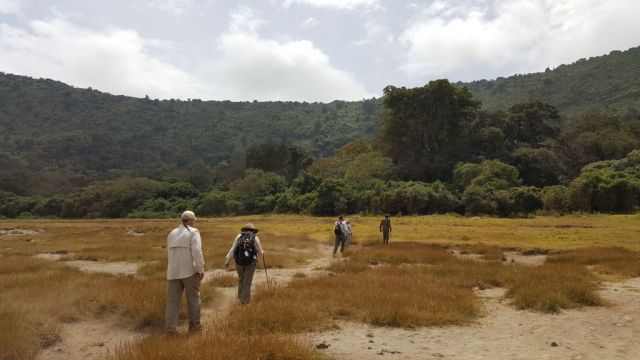
Boy, Zachari took this pole pole order from George to heart. We are mincing along so slow that even I with my short stride feel like I am barely moving at times. There are spots along the trail, which is very steep in places, where the soil is loose and slick. I think all of us, except probably Jesse, slip and slide in places. We try to keep a fair distance between us and the person in front of us but at times we end up nearly treading on the persons heels in front of us. I have this vision of a domino affect where one person falls, taking down the person in front of them who repeats the action with the person in front of them. Fortunately, this scenario does not come to pass and we make it safely to the bottom of the crater. I am so glad that I have my hiking poles which helped steady me several times.

Paul resting once we reach the bottom of the crater

Zachari, his spear and the crew

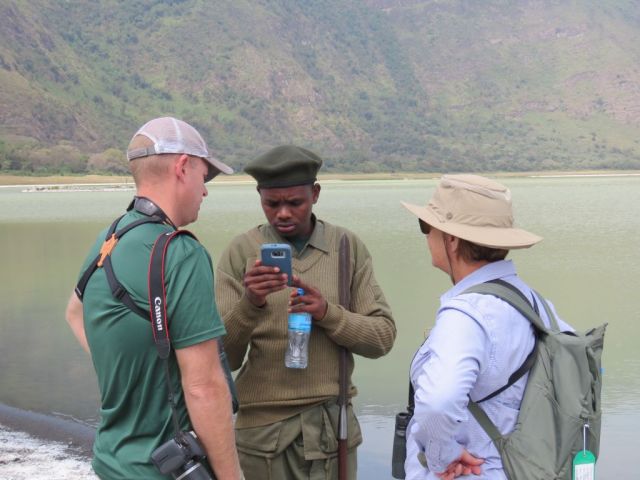
It is stunning down here, with the deep green of the thick forest covering the sides of the crater complimenting the green tinged water of the large lake at the base of the crater. There are flamingos feeding in the alkaline water but no other wildlife shows itself. We have the crater to ourselves for most of the time we spend down here and we just enjoy the peaceful, wild place. Jesse and Zachari are in deep conversation as Jesse shows the ranger photos from Kansas on his phone. Since they both have a similar line of work the game warden and ranger have a lot to discuss. It is pretty darn cool to watch the young men converse and laugh as though they are steadfast friends. At some point during their visit, Jesse has taken possession of Zachari’s spear, a weapon I’m sure he has never handled before. The rest of us keep our distance and let the two handsome fellows enjoy their new-found camaraderie. This is a memory both men will remember for a long time I bet.

Studying photos on Jesse’s phone

Jesse and Zachari look like old friends

We share this special place briefly with a fit young couple before we turn to climb back to the top. Jennifer again falls in behind Zachari as he goes pole pole up the trail. Jennifer and I have a quick consultation and then Jennifer asks our protector if he can walk a bit faster. He looks surprised but does pick up the pace a bit. The altitude of Empakai is about 8,000 feet and the North Millers have a little trouble with the altitude as we ascend the trail. We go back to our pole pole pace stopping several times to rest and catch our breath. A group from Australia passes us on their way down the trail, the two couples are probably about the same age as us. A Maasai has a firm grip on one of the women’s arm and our eyebrows raise when we see that she is wearing moccasins. This looks like a disaster waiting to happen as I can’t imagine that her shoes have much tread. I hope they make it without any problems.

Leaving the crater floor. Jesse’s’ photo

Getting ready for lunch

George smiles broadly when he sees us emerge from the craters rim. George had hoped to trek to the bottom with us but since no one was around that could watch the truck he had to stay behind. We felt badly about that. George begins preparing a place for lunch as he puts down one of the Maasai blankets on the ground. We have box lunches from Sopa Lodge. Unlike the small camps we were able to order from a list of five entre which was really nice. Even so the lunch boxes have way too much food in them. There are three Maasai women plus I assume their husband who have set up a temporary duka offering beadwork in various kinds of jewelry. We ask George if it is okay to give them our extra food and he said it is. The man, taking nothing, gestures towards the women who gladly take the food. Jesse ends up buying some beaded bracelets from the trio to take home to his daughter. Sweet.

Time to head back to the Lodge. We are all feeling quite contented with the days adventure. Little do we know that the adventure isn’t over. We are enjoying the large flocks of sheep and goats spread over the open range as we drive through the Embulbul depression. BAM! I look behind me and ask Paul if that was a rock that hit the vehicle. No, it wasn’t, it seems the Massai boys that had run to the edge of the road begging us to stop took exception to the fact that we didn’t. We had all waved at them as we passed by and one little stinker threw his staff at us. He had good aim as it hit hard against Paul’s window. Thankfully the window was closed and thankfully the window didn’t break.

I have hardly had time to digest what has happened when the Toyota screeches to a halt. George and Zachari jump out leaving the doors wide open and begin running back to where the boys were standing. They aren’t standing there anymore, they are running as if their lives depend on it. Zachari, who is wearing rubber mud boots manages to corral one of the kids who immediately points at his fleeing cohorts, obviously putting the blame on them. He is telling the truth as he is still carrying his wooden staff. The ranger turns him loose and takes off after the four or five others who have a pretty good lead on the pursuers. George in the meantime is running down the road trying to head off a couple of the trouble makers at the pass. Two more of the boys have already crossed the road and are disappearing from sight.

Zachari closing in. Remember he is running in rubber boots. Jesse’s photo

George losing the race.  Remember this chase is at least 1/4 mile away. Jesse’s photo

Eventually, George and Zachari have to admit they are beaten as the boys that were still within reach find an extra spurt of speed and leave the two men doubled over trying to catch their breath. Paul and I estimate that the guys pursued the troublemakers for a good quarter of a mile before crying uncle. As the men return to the Toyota they are laughing. Upon reaching us they declare that this will be a lesson the boys will not soon forget. I got so caught up in watching the drama unfolding that I never snapped a single photo until after the fact. Then I took a few photos of the flock of goats that had been abandoned by all but two of the shepherd boys. Jesse has the presence of mind to get a couple of photos of the chase.

The scene where the incident took place. All quiet again

Down the road there is a truck which has a bunch of men in the front seat and more riding on a bench in the bed. George stops so Zachari can tell the elders what has taken place. Most of them nod solemnly but someone in our crew notices an old man in the back smiling and giving a thumbs up. Does that mean he is proud of what the little punk did or is he glad that the two men scared the heck out of them for doing it? George also informs us that if the boy had done damage to the vehicle, the family would have to pay for that damage. That is unless it is a very poor family and then they won’t take anything from them. Obviously, this kind of thing has happened before.

We continue through the depression and two different times some kids run up to beg but they happen to be on the side where our ranger is sitting and as soon as they see his hat, they turn tail and run. Whoa. We arrive back at Sopa Lodge without any more adventures!

Since it is mid afternoon we have some leisurely time to ourselves. After getting as much as possible packed in prep for our departure tomorrow, I sit and relax in our little patio. I am just gazing out over the grass and weeds when a movement catches my eye. Well now we know why they escort us to our rooms because there is a cape buffalo grazing in a tall patch of weeds. I knock on the Gehrt’s door, they are right next door and tell them of our visitor outside. When I return to our room, Paul is sitting in the patio and says there is a reedbuck out there too. It is a doe and when Paul first saw her a tiny baby was visible too.

The Maasai that danced for our entertainment. Jesse’s photo

Maasai men took turns seeing how high they could jump. Jesses’ photo

The Wabaunsee crew meets in front of the Lodge and we go to watch the Maasai dance program that is being performed on the lawn. There are both young men and young girls who sing and dance. The men also jump high into the air which is amazing in itself. When the dancers have finished we move into the lobby where we are given an encore as the troupe files into the lobby behind us. We enjoy the second performance just as much as the first one. We are some of the first into the restaurant again and a whole different array of food is laid out for the guests to enjoy. One of the best things I ate was a corn and pineapple salad. An odd combination but boy was it tasty.

The Wabaunsee county safari group at dusk at Sopa Lodge. Carl, Connie, Jesse, Jennifer, Nancy, Paul

We are escorted back to our room by the same jolly fellow as last night. This time his flashlight beam lights up a Cape buffalo calmly grazing at the edge of the lawn, not twenty yards from where we are walking. The old buffalo pays us no attention at all.

Next stop, Sanctuary Kusini camp. Later, Nancy


A Walk In Tarangire National Park

A Walk in Tarangire National Park, Part 3

After our late lunch we had a couple of hours to kill before our scheduled walk with a Ranger in the park. I took a short but much-needed nap which helped revive me. Four hours of sleep just isn’t enough!

Our group met at the main tent before 4p.m. eager to begin our bush walk. We stand around for half an hour but the camp manager is nowhere in sight. Suddenly George drives up and talks to some of the staff. George has nothing to do with arranging this walk but he says he will go to the ranger station and find out what is going on. George returns within minutes and asks if we have our signed forms. Signed forms, what signed forms? We tell him we have signed nothing but we all remember that the camp manager talked about us needing to sign release forms.

George, Allen the ranger, the guy from camp and Connie. This is Jesse G’s photo

George loads us up and drives us to the Ranger station. There is another man who goes along who must be affiliated with the camp. When we get to the Ranger station, George and the other fellow talk to the ranger on duty. The camp guy stays at the station while the ranger gets in the truck with us. George drives us to the airstrip which is just a few minutes away from the Rangers headquarters. George and the Ranger go to the small building and retrieve the liability forms which we dutifully fill out. Some of us question if we should even go on the walk, (and I am one of them), since we are starting an hour late and the sun will set in an hour and a half. George informs us that we will walk with the ranger, Allen, from here because the grass is too tall around the camp. Umm, the grass is pretty darn tall here.

Signing our release forms in order to be able to walk in the Park

Once we turn over our “it’s not our fault if you are attacked, injured, or killed” forms, Alan instructs us to walk in single file behind him, (like wart hogs do), and stay close. No one steps forward to be behind the man with the gun so I gladly fall in behind our stoic escort. Our lineup is Allen, me, Jennifer, Connie, Carl, Paul and Jesse. The little ranger strides out across the bush and soon we are traipsing through even taller grass. There are a family of wart hogs 200 yards in front of us that beat a hasty retreat when they see humans on foot.  Allen leads us down into a gully where the broad-leafed grass is waist-high so I hold my arms above my head to keep my hands from being scratched by the tough blades. As we emerge from the gully I see manure that is obviously from a Cape buffalo, it looks like cow poop. I nudge the pile with my toe and to my chagrin I find that the poo is still soft. I only see one pile of manure which indicates this is a lone cape, whom are considered the most dangerous to encounter because they don’t have the security of a herd. I’m not liking this at all.

The treking lineup minus Jesse who took the photo

Looking down on two of the elephants. Jesse G’s photo

We arrive at a road and I feel a surge of hope that now we will just walk down the road. No such luck as Allen crosses the road and returns to the bush. I reach out and touch our guardian, pointing to an elephant to our left which is only a couple of hundred yards away. My confidence falters when I realize that our protector hasn’t seen the behemoth. Allen stops to assess the situation, then moves forward, pointing out more elephants below us, feeding in a little swale. We are downwind of the elephant group and Allen confidently walks on by the dozen or so elephants. As we maneuver around the elephants they become more visible to us and we find that two of the big girls have very small babies. Elephants are very protective of their vulnerable babies and will form a circle around the youngsters to keep them safe. Amazingly the elephants have no reaction to we humans even though we have to be in their line of sight because we can see them clearly. I truly think they have no idea our group is near them.

Two adults and barely visible is one of the tiny babies of the group

We stumble on through more hip-high grass and I look back to see that Jennifer is also raising her arms above her head but she rests her hands on her head. It occurs to me that if anyone sees us it would appear as if we are under arrest. In fact at the end of our trek, Paul and Jesse laughingly tell us that we appeared to be in Allen’s custody as our arms reached for the sky. The only thing out-of-place is that the guy with the gun is walking ahead of us instead of behind us. Having passed by the elephants safely we continue to weave around in an uneven path through the bush. I see Allen peek at the phone in his pocket now and then and I am guessing he is checking the time. He must have orders to keep us out for a certain amount of time on our bush walk.

I do look like I have surrendered. Jesse G’s photo

The sun is getting lower in the sky and I ask Allen how much farther we have to walk before we meet up with George. He confidently answers ten or fifteen minutes. Twenty minutes later I am really getting concerned as we have reached that part of the day where it is getting dusky. I again ask our impassive escort how much longer before we arrive at our end point. Without blinking an eye Allen replies ten or fifteen minutes. Shortly after this exchange we find ourselves just below a road where several vehicles are parked. I ask Allen if we can walk down the road now. “No”. I ask Allen if he can call George to come to this place and pick us up. “No”. Why not? “Because I don’t have his number”. I have to remind myself of the phrase “That’s Africa Baby” and soldier on.

Stoic Allen checking on us

As we parade below the line of vehicles someone calls out in Swahili and has a conversation with Allen. The ranger nonchalantly informs us that the tourists are watching a lion over by the tree across the river. We all scan “the” tree but we don’t see a lion, we instead spot a big male leopard resting in the crotch of the tree. Wow, that is amazing but I’m darned glad that there is a large gully between us and that big cat. When we tell Allen that it is a leopard not a lion, he informs us that there is a lion by the “other” tree. All of us use our binoculars to scan the area around the “other” tree and the dead grass around its base. Near an old dead stump, Jesse and I see a lion’s tail flip into the air and then disappear back into the thick cover. I don’t think anyone else in our group saw the twitching tail but Jesse and I saw it several times. Hey, Jesse and I have a cat trick. Cheetah, leopard and lion in the same day! Just as we prepare to resume our walk, the leopard climbs out of the tree and saunters in the direction of the lion. This could be quite interesting as lions and leopards despise each other. We can’t stay to find out what might happen as the sun is sinking lower by the minute.

We now have George and the truck within our sight; he is parked by a bridge that traverses the river. We still have some ground to cover, 10 or 15 minutes yet, but at least we will make it to the safety of the Toyota before dark. I don’t mind admitting that from the time I saw the fresh Cape buffalo patty, I was not comfortable with this walk. I think our youngest member of the group, Jesse, loved it. I know others in our group were disappointed that there was no information relayed to us by Allen about the animals or plants we encountered during this foray. We just meandered through the bush behind him. I really don’t think Allen wanted to take us on this hike as his expression never changed the whole time we were with him. Paul and I have been on bush walks before which I absolutely loved but we were never in this kind of terrain. It was scary.

When we were all loaded in the van, I noticed that Jennifer had grass stains on her pants and I asked her what happened. Jennifer told us that at the beginning of the walk she had stepped on some flattened grass and ended up thigh deep in a hole with one of her legs. Only Connie and Carl saw it happen but stalwart Jennifer never said a word to the rest of us. Jennifer had broken her little toe a few days before we left for Tanzania and her toe was still very sore, this fall made it worse. So, the woman had to walk through rough terrain with a gimpy toe and sore leg for an hour! Jennifer actually apologized for slowing us down after she related the story of her fall. Are you kidding me? We all felt terrible about her having to walk while in pain but as usual Jennifer shrugged it off, saying what choice did I have. Hats off to our tough, matter-of-fact friend, she is something else.

Upon arriving at camp, we have dinner and the only part I remember was the sumptuous pumpkin soup. Shortly after eating we left for the only night drive we will have on this safari. The camp provided the vehicle and driver plus Ally who did the spot lighting. Our friend Allen was riding shotgun with his rifle, I assume he was along to make sure no rules were broken by us, like driving off-road. Ally was a very nice, personable fellow and you could tell he loved this wild place.

One of our first encounters was a huge herd of zebra walking across the road into an open field, where Ally said they would spend the night. We also saw a white-tailed mongoose, impalas, and two bat-eared fox early in the drive. The quiet night was suddenly filled with the roaring of lions. Ally had our driver turn the lights and engine off and told us we should experience that awesome sound in complete darkness. The powerful roars reverberating through the night seem to penetrate to your bones. A very humbling experience.

We continue down the road as Ally sweeps his light back and forth. I am sure it is Jesse that sees the first male lion. Get used to me saying, Jesse saw it first. The big guy is laying by a clump of grass that is the same color as he is so the lion is very hard to see. When the magnificent cat raises his head we all are able to spot him but as soon as he lowers that massive head he is almost invisible. We move on when Connie thinks she sees something next to a large clump of dried grass. Yes, there is something there but we debate whether it is a living creature or a log. After some time, I believe it is Jesse who manages to figure out that indeed it is a prone male lion. Once Jesse describes how the lion is lying down, with his head to our left, it becomes apparent that indeed this is a second male lion. Well done Connie!

We leave the lazy lion behind and drive by a small herd of elephants that have a tiny baby in their midst. Ally keeps the spotlight off to the side because he says that elephants have been known to charge when you spotlight them directly. Yikes. As we drive away they look like grey ghosts in the black night. We also see ostrich bedded down so all that is visible are there skinny necks topped with their small heads sticking up out of the grass. It is quite a silly sight and it makes us laugh.

Male Lion walking toward our truck

We are headed back to camp when out of the gloom a male lion appears, walking down the road towards us. All of us go a little crazy at the sight of the approaching lion. The lion blinks a little at the bright headlights but he has no fear of the vehicle. Mr. Magnificent walks within inches of our front bumper, veers sharply and walks alongside the vehicle. Once he is past the truck he promptly goes back to walking in the road. The handsome male stops a few yards behind us so our driver backs up to get us closer in order to see what the cat is up to. The lion has stopped to sniff at something by the side of the road. The big male wrinkles his nose and opens his mouth in a gesture that is known as the Flehmen reaction, then as mysteriously as he had appeared he disappears into the darkness of the night. This was so cool.

The Flehmen face.

We were told that we should tip Allen for taking us on the trek and accompanying us on our night drive. I shake his hand and leave the crisp five-dollar bill in his hand at the same time. Hey, the guy can smile!

We had a very long day but boy was it a wow day! I’m afraid we have been very spoiled in the first two days of this safari and now will expect every day to be this exceptional.

LEAVING TARANGIRE

We were serenaded by lions in the night again and this time they sounded very close. I have no idea how far or in what direction from the camp the two male lions we saw last night were, but I assume the roars were from the duo we encountered on our night drive.

Hamerkop with more material in its beak to build the nest

We have our luggage and ourselves loaded into the Toyota by seven. We have given our card containing the tip money to the staff and said our goodbyes and we drive away from Ang’ata camp at a quarter after seven. We see the usual fare of grazers, (doesn’t that sound jaded already?), that we have encountered the past couple of days. George comes to a stop when he finds a pair of Hamerkops busy building their huge nests. The prehistoric looking birds carry small sticks, clumps of dried grass, and an occasional beak full of dirt to create this oversized nest. George says they build two entrances, one that they will use and a false entrance that will hopefully fool predators, like snakes, to use the fake opening. How in the world do birds figure this stuff out? And while I’m on the how part, I’m always in awe of the incredible nests most birds build. No one teaches them how to do this task, how can they just know? I find it mind-boggling.

The prehistoric looking hamerkop

When we reach the Park gate, George tells us that we might as well get out and walk around as checking out and paying for our stay in the park can take some time. This turns out to be the understatement of our trip. We all pay a visit to the nice rest rooms, wander around the outdoor exhibits of maps and animal skulls, look into the gift shop and return to the truck. George comes over and informs us that he is having trouble with the credit card being accepted so he has to contact the company and it will be a bit longer.

The only photo of a Von der Decken’s hornbill that I took even tho we saw lots of them.

Connie, Jennifer, and I climb the stairs that lead us up to a deck built in a baobab tree. The views are spectacular up here. As I am descending the steps I see two Von der Decken’s Hornbills reaching into a small crevice in one of the baobabs limbs. They will probe the crevice and then fly to the railing. At one point as the hornbills are perching, I see a lovebird poke its head out of the hole. Later I ask George if the hornbills were trying to catch and eat the beautiful little bird. His answer was absolutely they were.

These beauties are lovebirds.

We gather at the truck again to find out not only has the company card been rejected but George’s card has also been rejected. It is Park policy not to take cash or this wouldn’t be a problem. We can’t leave until our bill is paid and although it pains George to ask, he wonders if one of us will use our card. Paul and I agree to using ours somewhat reluctantly but what choice is there. Our card goes through without any problem and we are set free! George wants to pay us back with cash on the spot but Paul tells him to keep the cash until we are ready to leave Africa. Neither of us want to be responsible for carrying all that money around.

We now leave Tarangire and our next stop will be the Ngorongoro Crater. Nancy


Tarangire National Park, Part 2

Tarangire National Park, Part 2

Baby impalas

Our drive into the park has barely begun when we catch sight of a small herd of impalas, some vervet monkeys, and one huge bull elephant. As George drives slowly along we comment on how one side of the road is devoid of grass and the other side has abundant grass, albeit very dry grass. When we quiz George on this oddity he informs us that the grubbed side is not part of the Park and the Maasai have grazed their cattle here. Wow, none of us can figure out how the grassland can recover after being this overused.

Zebra at the beginning of our game drive

We see a few zebra and Connie and Carl comment that they have now seen more zebra than they did on their safari last spring which was in Botswana and Zambia, and Zimbabwe. The North Millers, (C&C live north of I70, we live south of I70), also saw one lone wildebeest on that safari which they dubbed Willie. That record is soon to be broken too.

I am sure I see a giraffe in the distance as we are driving through the park but it looks odd so I’m not positive. I ask George to back up and am subject to some “sure you saw it” ribbing when I can’t locate anything. Finally, I find the long-necked creature but no wonder the giraffe was hard to find. The Maasai giraffe is standing with its front legs splayed, head down, browsing on a low bush or grass an uncommon stance for a giraffe that is eating. George says “good spot” which is always satisfying when your guide gives you a verbal pat on the back.

A small portion of the wildebeest that were surrounding this water hole

Another view of the water hole

A bit further on we come upon a myriad of wildebeest and zebra which are scattered around a waterhole. There are also a few olive baboons foraging in the brownish grass.  Many of the wildebeest are just lounging about, some are grazing and a couple are drinking from the small pond. I think our traveling companions are a bit astonished with the number of critters in such a small area. Paul and I have seen this before and we are still in awe of all the life that this small body of water is sustaining. George finds a monitor lizard near the water’s edge half hidden under a bush.

One of many baboons we saw.

A lot of photos are taken, particularly by Jesse and me, in fact Paul doesn’t even take his small camera out and Jennifer has only brought her phone to take photos with. Why not, phone cameras take really good photos and they are much more convenient than the big cameras. George continues down the dusty road and we see many small waterholes that are nearly dry or completely dry. Now we know why the animals were so congregated around the two ponds we passed earlier.

An African Jacana that is foraging on a small pond that is choked with water plants

Giraffe, zebra and a wildebeest

Soon we see several graceful giraffes, browsing in trees or bushes. A few of them are on the move and I love watching the elegant animals as they seemingly glide over the land. We drive along a dry river bed and there is a lone elephant sipping water from a hole he has dug. The colorful bluffs behind him make for an image that I won’t soon forget. The elephant will leave the small hole of water open where other animals/birds will benefit from the tusker’s excavation. I am so happy to be back in Africa!

This landscape can even make an elephant look small

Elephants dining on leaves and a couple of impalas

The calm Cape buffalo herd

As we drive deeper into the park we come across lots of elephants, such regal creatures. An enormous herd of Cape buffalo are standing near the roads edge, the sunrays making the buffalo’s backs glow. As we watch the sedate herd, they peer back at us with no snorty animosity like many cape buffalo we have encountered on other safaris. Jesse opens the door on the far side from the buffalo herd, and says he is going to “check the tires”. There is a collective gasp from the rest of us and mom informs her son he must always ask permission before getting out of the vehicle. In the “youngster’s” defense he is a game warden so knows how to read an animal’s body language. The Capes were so uninterested in us and calm that I am sure Jesse thought if he was on the side away from the beasts it would be okay. Yikes. George finds another area he deems safe for the bathroom break, where Jesse has a group of banded mongooses cross the road as he “checks the rear tires”. No danger from those cute little guys.

No animosity towards us from this old grandma

Banded Mongooses or Mongeese if you prefer. Both are correct.

As we are touring through more open country, George stops the vehicle and looks through his binoculars. We all raise our binoculars scanning the area that he is looking at. Soon he puts lowers his binoculars and declares “a bush faked me out” which sent us all into peals of laughter. We are all going to get “faked out” numerous times before this safari is over but it is better to take a look rather than ignore an “an animal like thing” simply for your peace of mind.

We encountered a lot of shy giraffe on this safari but these two were willing to have their photo taken

Male ostrich and baboons at a pool that is close to drying up

A bold wart hog

As our journey continues we spy several ostriches, these half-feathered birds are so huge and quite odd-looking, not that they give a hoot what we humans think of their appearance. We see numerous wart hogs and the unusual thing about these wild hogs is that they don’t run as soon as we stop the vehicle. Usually wart hogs turn and run in single file, with their skinny tails lifted straight up. Of course, there are so many different kinds of birds around it is simply astonishing. The interesting and numerous birds is another reason I love Africa. I would be remiss if I didn’t mention the grand baobab trees that dot this park. These massive trees top my list of favorite African trees with the acacia tree a close second.

Zebra and a giant baobab tree

George drives really fast the last few miles to camp and we have a preview of what is to come in the following days. We hang on for dear life as we bounce and jounce down the rutted, washboard, road. As we pull into Ang’ata camp there is a welcoming committee waiting for us with hot wash cloths to wipe our dusty faces and a cold drink of juice to refresh us. After a briefing of camp policy and the details of our walk tomorrow, plus a night drive, we are shown to our tents. The tents are very basic fare but the one feature that puzzles us is the slatted wooden floor. You best not drop anything small on the floor or it will likely disappear down one of the cracks. Paul is using the toilet when he lets me know he is having a staring contest with a mouse. When he emerges from the lavatory he cautions me to carefully look around the room and check the floors when I get up at night. His reasoning is that if a mouse can get in the tent so can a snake. I will take that advice to heart.

Our tent at Ang’ata Tarangire camp

All of us order our hot water for our showers. With the bucket shower set up you must get wet, turn the water off, lather up and then rinse off. You get one bucket of hot water each so you don’t want to run out. Feeling refreshed after our showers, we get our stuff somewhat organized in what will be our home for the next two nights and then walk up to the dining tent.

Supper is at 7:30, too late for me, but I might as well get used to it. There is cream soup, not leek, and as usual it is delicious. Africa has the best soup I have ever tasted and if I was smart I would stop eating after the soup and the roll. I don’t though and we all enjoy the beef, potatoes, and the carrots/beans we are served. How they turn out such terrific food from these small camps I will never know.

Oh dear, Paul and I were assigned tent one which is just a stone throw from the dining area. Some of the other guests are having a good time, laughing and talking until after 11 p.m. Unfortunately, we are privy to every bit of the party. Paul manages to fall asleep but not me. I write in my journal and sigh with relief when the guards lead the revelers to their tents. Someone says lala salama to one of the guests who then calls the phrase out as he walks down the path by our tent. I hear him saying good night in Swahili until his voice finally dwindles away in the distance. We discover another problem with our tent when the wind comes up during the night. The canvas flaps and the tent shudders when it is hit with gusts of wind. Paul and I also hear something digging near our tent and what sounds like little creatures scurrying over the canvas roof. The good news is that I also hear lions roaring, hyenas whooping and some unidentified animal running down the path, twittering nonstop as if it is chastising itself for being behind schedule.  I finally give up and take half an Ambien, managing to get four hours of sleep with the drugs help.

I’ll be honest, I don’t know if this is a sunrise or sunset at Ang’ata but regardless it is spectacular

Up this morning at 5:20 and our arrival at the dining tent coincides with a spectacular sunrise. We were supposed to eat at 6 a.m. but we didn’t get our breakfast until 6:30. George had hoped to be on our game drive by then if not sooner. There was a lone elephant eating leaves from a tree as we left camp. We stopped to take a photo of the enormous fellow stripping and munching on the leaves but he promptly stops eating, and turns to give us a view of his better side. On the North Millers last safari this was referred to as the African salute. It was amazing how often this happened on our safari. As soon as we had driven off, we looked back to see the elephant happily munching on the tree again. I guess the animals are sick of having their photos taken.

An elephant giving us the African salute

We drive through herds of zebra, impalas, and wildebeest. There are numerous ostriches, and Paul and I comment how we have hardly seen any ostrich on our last two or three safaris. It is good to see so many of the half-naked birds as they prance around on feet that resemble high heels. How can you take them seriously?

I think this is the mother cheetah. It was pretty hard to tell them apart.

One of the young cheetah is waiting to ambush his sibling. Can you find it?

The Siblings as Mom has already went up the bank and is lying in the grass

As we are approaching a river, George calls out that he sees cheetah. Are you kidding me. Jesse immediately finds the sleek cats and the rest of us soon have them in our sight. The North Millers had ordered cheetah on this safari since they were didn’t see any of the speedy cats on their last safari. Well, they are being given the gift of three of the beautiful felines, a mother and two nearly grown cubs. The sinuous cats seem to have no problem with us watching them as they continue along the river bed, coming in our direction. The two cubs occasionally chase each other before flopping down to rest after the expended energy. Mom even joins in the play briefly. Eventually, they climb up the bank on the opposite side and disappear into the tall, yellow, grass. We catch a glimpse of a head now and then as they continue walking which soon puts them on our left side instead of the right side. Soon the trio are fully visible and saunter to a grassless area above the river bank and plop down. How cool is this to have three gorgeous spotted cats allowing us to enjoy them with no qualms about our presence. Granted there is a fair distance between our car and the cats but still.  We have had the pleasure of watching the cheetah family for a good half hour and we have had them all to ourselves. Unreal. Just as we are pulling away two vehicles are making their way towards us. Enjoy the cheetah folks.

Where did mom go?

The cheetahs once they had come back into full view. Beautiful

What is that look?

One last shot of the cheetahs.

George was taking us to the Silale swamp when we were side tracked by the cheetah. His plan was to get there early in order to find the predators that hang around this oasis due to the many grazers that come here to drink. Well, we don’t get to the swamp until mid-morning and the heat has ramped up so more than likely the lions and leopards are settled down for the day. Hey, seeing the cheetah was well worth the delay.

A tiny bit of the endless line of Cape buffalo walking along the swamp edge

As George motors along the road parallel to the swamp we can see lines of Cape buffalo coming towards us. George says they are looking for a good water hole to drink from. This herd is not placid like the first buffalo we encountered and in fact are downright unwelcoming to us. Many shake their ponderous heads at us and snort their displeasure at our presence. George says this is because the buffalo herd has so many small calves among them. At one point a group breaks off the endless line of the main herd and runs across the road in front of us. Great, now we are basically surrounded by cantankerous bovines. I can’t remember what George does, (rev his engine?) to keep the buffalo at bay but when he gets past the bunch that split off, he drives off-road for a bit putting more distance between our vehicle and the parade of Capes that are walking near the road. Thank you, George, Cape buffalo scare the bejesus out of me. We estimated that there were around one thousand buffalo making the trek to water. Seriously.

Are you talking to me?

We continue down the dirt lane where we encounter some other safari vehicles. George stops to talk to many of them and all of us enjoy listening to Swahili being spoken at lightning speed, with a drawn out ahhh or ehhh to punctuate the conversation. Sort of like our “hmm” or “really” in our own conversations I suppose. Unlike a lot of guides we have had, George informs us that there is a leopard in a tree up ahead. Are you kidding me, cheetah and now possibly a leopard.

A candelabra tree with the always photogenic zebra

Advancing down the road we see several vehicles tightly grouped under a large tree. There is no doubt where the leopard is. George expertly maneuvers our Toyota into the scrum of safari trucks, getting us into a good position to see the small leopard that is sleeping on a large limb. How the feline can sleep with all the excited chatter that is permeating the air I don’t know but sleep she does. George has informed us that it is a young female. After taking numerous photos from this angle of the leopardess, George moves into a different position so we can see  both the young cat and the hapless impala that the huntress has stashed in the fork of the tree. We spend ten minutes or so with the stunning cat and move on to make room for other onlookers.

The sleeping leopard.

She opened her eyes briefly

The leopardess and the half eaten impala. I’m always in awe with a leopards ability to pull their kill into a tree.

We head back in the direction we came from enjoying the abundance of wildlife along the way. There are hippos laying on the shore sound asleep and I can’t figure out why they aren’t in the water since they are prone to sunburn. Weird. There is a delicate reed buck grazing in the swamp and a variety of water birds. Herons, ibis, openbills, ducks and geese everywhere you look. We stop at a picturesque area for tea and to stretch our legs. I forgo the offered beverage but enjoy all the life that is around us. When we drove up a common waterbuck and her small baby ran into the trees but stopped long enough for us to get some photos. How cute is that!

Pretty Reedbuck

What a sweet baby waterbuck

George drives around the edge of the swamp so we are driving on the opposite side of where we had been. He has reports from fellow guides that there were lions over here but we have no luck finding them. If they are lying down in the tall grass only the flick of a tail or a raised head would ever give them away.

View of the oasis surrounded by dead grass

We do stop and watch a lilac-breasted roller decimate a large grass hopper he has caught. The roller wallops the insect against the limb of the dead shrub he is perched on trying to remove the wings. When the colorful bird has accomplished the wing removal the next task is to position the hopper so it can be swallowed whole. What a lot of energy it takes just to eat your lunch. The whole process was highly entertaining.

Lilac-breasted Roller and lunch

Flipping the grasshopper in the air to reposition it

George puts the pedal to the metal as we head back to camp. It seems we are late for lunch. What a half day this was and those of us who have been to Africa tell the newbies they have no idea how fortunate they have been this morning. Later, Nancy

A zebra with an old scar. How did it survive?


One of the larger groups of Ostrich we saw. Often it was two or three together.

Tarangire had a restroom and as you can see it was taken advantage of.


Destination Tanzania, Part one

Destination Tanzania, part one

It all started with a request from Connie and Carl after their return from an African adventure, that they would like to see the plains of Africa. The North Millers wondered if we would be interested in traveling to Africa with them. That question was like waving a piece of cheese in front of a hungry mouse! We were more than willing to visit the African continent with good friends, (no relation despite the same last name).

Paul grabbed the reins and volunteered to do the research and lay out a plan for an adventure in Tanzania. Paul spent hours researching companies, guides, what parks to visit and came up with a safari that would retrace a lot of the places that we had been on our first safari to Tanzania nearly 14 years ago. During the initial planning we added two more friends to the group, Jennifer and Jesse Gehrt, mother and son.

A year later on August 17th the four Millers and Jesse are on the way to the Kansas City airport. We are leaving behind one of the worst droughts in Wabaunsee county since the early 80’s, (but that is another story). One of the last things I said to our partner Randall is that I hoped he would have to put water gaps in while we were gone. Yes, only five of us are leaving this morning for the airport. Jennifer had meetings in Omaha this week and will be arriving in Washington D.C. on a later flight.

Our flight out of KC was uneventful except the precheck ticket we were so delighted with getting turned out to be useless for Paul and Carl. Paul’s artificial knee made the metal detector buzz and he got to enjoy a close encounter with a TSA agent.  Carl also tripped the alarm and underwent the same scrutiny by a TSA worker as Paul did.

We spent the night in D.C. and were up early to eat breakfast and then we were delivered to the airport four hours before our flight. Jennifer arrived in D.C. late last night so we didn’t see her until this morning.  We are flying Ethiopian Airlines to Africa due to the fact that it was 900 dollars cheaper than the flight that went to Amsterdam on KLM. Also, because the Ethiopian flight arrives in Tanzania by early afternoon while the KLM flight arrived at ten p.m.

On the Ethiopian website it cautioned passengers flying out of Dulles to arrive four hours before departure. It doesn’t take us long to figure out why this was requested of passengers. We get in line behind people who have huge piles of large suitcases stacked haphazardly on carts to be checked through. We watch two men who have their bulky suitcases numbered, one through ten. In addition, they have two big screen TVs, 65-inch screens, that is part of the loot they are taking back to Ethiopia. Yow, I wonder what that cost them as you are allowed two check through bags that can’t weigh over fifty pounds. It takes forever for those two men to get all their luggage checked in and there are many more Ethiopians behind us that have a similar amount of baggage. I wonder if the airline ever has to turn people’s luggage away due to excess weight for the plane. (Later when we board Paul happens to hear the captain say they will have to use a longer runway to take off due to the weight of the plane. Jeez.)

We reach the check-in counter where we check one duffel bag. Normally, we don’t check a bag but we wanted our walking sticks and they can’t be carried on. The North Millers have no check through luggage but the Gehrts check one bag each. We look behind us and realize that coming as early as we did was very wise because the line has lengthened considerably. It takes so long for the people who have the mountains of luggage to check, that even though we were not that far back in line, it took close to an hour to get through. Once we are in our assigned seats it becomes quite entertaining to watch people trying to fit bags in the overhead that are in no way going to fit!

Mt. Kilimanjaro-truthfully this was on our bush plane flight at the end of the safari

Thirteen hours later with little sleep we land in Addis Ababa where we have to change planes for our final leg of the journey. We walk into the dreariest terminal I have ever been in. We have a three-hour layover and there are no kiosks here to buy any water or snacks. There is a dirty looking water dispenser where the water is supposedly filtered but I and nobody else in our group are going to take the chance of drinking it.  Our plane arrives 15 minutes before takeoff but they load the jet quickly and we arrive in Kilimanjaro early. We did see the snow-capped top of Kilimanjaro as we winged our way to the airport which was pretty cool.

There was a woman near us on the plane which implored us to get to the declaration desk, fill out our forms quickly and try to be some of the first in line for a visa. She warned us that if we didn’t do this we could easily stand in line for our visa over two hours. I am proud to say our group managed to do exactly as she suggested and we were within the first twenty or so to get our visas. Looking back at the throng of people in the queue for entry visas it was obvious these weary travelers’ were in for a long wait.

Approaching Kilimanjaro, again this was at the end of our safari

We found our checked through luggage waiting for us and after sending it through an x-ray machine on the way out(why?), we walked through the door to find our Wild Source driver, Marium, waiting for us. We loaded our luggage and ourselves in the vehicle and sat back to enjoy the sights on our hour drive to the Rivertrees Country Inn. We had many questions for Marium on the way about the various things we were seeing. Jesses’ camera, and he has a really nice camera, was clicking steadily as we drove the African roads documenting the culture of Tanzania along the way. My camera is packed away in luggage or I would have joined Jesse in snapping away with my camera. Ah it is good to be back in Tanzania.

The Rivertrees Country Inn grounds are gorgeous and the rooms are very nice. There is a small river behind our room whose gurgling water adds to the soothing atmosphere of this lodge. After we showered, it’s been a long time since our last shower, we meet our travel mates to explore the grounds and get some much-needed exercise. Oh yes, Paul and I took cold showers since no one showed us where to turn the water heater on Oh well, it still felt good to have a shower. Connie and Carl also showered with cold water but the lucky Gehrts water heater was on.

This duplex was assigned to the North and South Millers

We walk the paths of Rivertrees enjoying the various trees and flowers that grow profusely on the grounds. Some of us enjoy a beer and Jesse skypes with his family in Kansas. Isn’t that just amazing? Later we meet for supper where Paul and I enjoy a bowl of leek soup plus French fries, an odd combination but it hit the spot. Paul and I sleep well except the soup lives up to its name so to speak 🙂 and we have to visit the restroom two or three times during the night. We recall that this soup had the same effect on us one other time while we visited Africa, so no more leek soup for us.

Paul checking out Rivertrees gardens

We all meet for breakfast and then Paul and I stroll around the grounds a bit. A worker sees our binoculars and flaps his arms and uses his hands to show the size of the bird. He motions for us to follow him and leads us to a small tree behind the restaurant where an immature African wood owl, (I think), is perched behind some branches. We thank the mute worker for taking time to show us the owl. He nods his head in acknowledgment and then goes back to work.

An African Wood Owl, at least that is what Paul and I decided it was using the bird book

Our guide, George Mbwambo, arrives by nine and we introduce ourselves. Paul requested George as our driver/guide after seeing that so many people on safari talk had nothing but wonderful things to say about him. After paying for our drinks and checking out, we load up in the 7 passenger seat Toyota truck and are ready to begin our Tanzanian adventure with George.

Our superb guide George. A special man.

Paul checking out our ride

When we reach Arusha, George takes us to a supermarket so we can buy beer. Paul and Jesse peruse the beer offerings while we three women walk around this impressive modern store. We are in awe of how neat everything is and the variety of offerings, including lots of American brand items. There are women with brooms and dustpans that are ready to sweep up any bit of dirt they see. When we wander back to the cashier area we see that the guys had to pay for the beer with a credit card as they won’t take American dollars. This is very unusual as we were told most everyone in Tanzania will gladly take U.S. money. George was very surprised at this news. Oh yes, the beer cost just a bit more than a dollar per bottle!

Onward through the chaotic traffic of Arusha and then we break free of the city into the country. There are Masai seemingly everywhere with cattle, goats and sheep. We have no idea how the animals are surviving in this dry, dusty landscape because the grass is nonexistent for the most part, literally grazed down to the dirt. There are young men dressed all in black with bright white designs painted on their faces. George tells us that this is the year for the circumcision ritual called emorata that happens every seven years.

We saw many of these young men in this area

Paul requested that we attend a cattle market and luckily for us there is one taking place today even though it is Sunday. The main market is right by the road where Masai are selling produce, grain, jewelry, shoes and about any other thing you can think of. We walk through the market taking in the color and atmosphere of the gathering. Unfortunately, George tells us to only sneak photos with a phone as the people don’t like to be photographed. Jesse manages to be very discreet and snaps photos as we move through the open-air market. It is very hard to leave my camera in the bag as we walk through this colorful gathering.

Photos taken by Jesse on the sly with his phone. Good job Jesse

Turning tire tread into sandals. Notice the brand new pieces of tire?

Leaving the main area behind we walk a quarter of a mile to where the livestock is being sold. Unlike livestock markets in the U.S. where we have an auction, the Masai bargain privately with potential buyers. George approaches one young cattle owner who seems receptive to visitors and asks the Masai questions for us. George tells us that the best cattle will bring 250 dollars. Paul has brought a few of our cattle photos along and he shows them to the friendly Masai. Pretty soon a few more Masai are gathered around looking at our cattle. Paul tells George to ask them if they think our cattle are too fat and we find out the Masai do think our black cows are overweight! They are mesmerized by the photos we have of our cattle in snow. I’m not sure some of them ever figured what the heck that white stuff was. The cattlemen drift away, going back to the business at hand which is trying to find buyers for their cattle.

Now you can see why they think our cattle are too fat.

Cattle market. This ground is a good example of what we saw in Masai land. What do these animals eat?

They sell goats and sheep here too. Again all market photos were taken by Jesse

We walk back to the Toyota, making our way through several people trying to sell us souvenirs, and continue towards Tarangire National Park. Once inside the gates of the park, George hands out our lunch boxes that Rivertrees staff made for us and we eat at a small picnic ground near the park entrance. There is a White crowned shrike, a Von der Decken’s Hornbill, and many superb starlings, (boy are they aptly named), hanging around hoping for a dropped crumb of food. After we have finished eating we are ready to enter the park and officially start our safari. Later, Nancy